

What do you think?
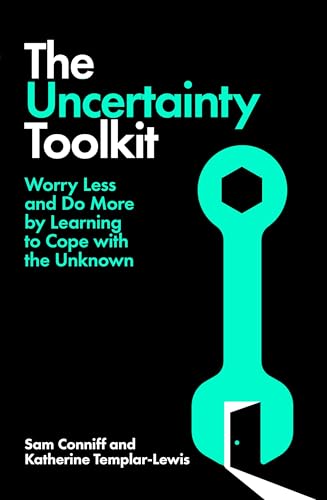
The Uncertainty Toolkit: How To Feel Calmer, Happier and More Confident In an Uncertain World
If it feels like the wheels have come off your world and you're daunted or exhausted at the thought of what to do next, if the struggle against constant change is leaving you weary, or you've simply come to realize that the world we live in is fundamentally uncertain, and it's about time you learnt how to embrace that, you need The Uncertainty Toolkit.
This groundbreaking book shows not only how to cope with uncertainty, but how to harness its power and transform it into opportunities for growth and creativity. Based on cutting-edge research from UCL's Brain Science department, and written by a cognitive scientist and an award-winning journalist, it unveils a roadmap for better mental health and a measurably increased tolerance for the unknown. The authors have led the world's most extensive study - also a Netflix-backed online course-cum-documentary - into how to increase Uncertainty Tolerance, and this book includes tests to measure your own, and track its improvement as you read.
Chapters include practical exercises, compelling narratives from unlikely 'uncertainty experts' including prisoners, former addicts, refugees and hostages, and insights into pioneering scientific techniques.
The book unveils a roadmap for better mental health, enhanced decision-making, increased tolerance for the unknown, and a profound understanding of how the mind and body interact. It is an invaluable guide for anyone seeking to do more and worry less in our complex and ever-changing world.
This groundbreaking book shows not only how to cope with uncertainty, but how to harness its power and transform it into opportunities for growth and creativity. Based on cutting-edge research from UCL's Brain Science department, and written by a cognitive scientist and an award-winning journalist, it unveils a roadmap for better mental health and a measurably increased tolerance for the unknown. The authors have led the world's most extensive study - also a Netflix-backed online course-cum-documentary - into how to increase Uncertainty Tolerance, and this book includes tests to measure your own, and track its improvement as you read.
Chapters include practical exercises, compelling narratives from unlikely 'uncertainty experts' including prisoners, former addicts, refugees and hostages, and insights into pioneering scientific techniques.
The book unveils a roadmap for better mental health, enhanced decision-making, increased tolerance for the unknown, and a profound understanding of how the mind and body interact. It is an invaluable guide for anyone seeking to do more and worry less in our complex and ever-changing world.
- GenresNonfiction
317 pages, Kindle Edition
Published December 16, 2025
About the author
Sam Conniff
11 books115 followersSam Conniff Allende is a multi-award winning serial social entrepreneur, and co-founder and former CEO of Livity, Don’t Panic and Live Magazine. Since starting his entrepreneurial career aged 19, Conniff Allende has mentored thousands of talented young entrepreneurs and hustlers around the world.
Sam is an acclaimed public speaker, an advocate of ‘business as unusual’ or corporate responsibility and accountability, and a purpose-driven strategy consultant to brands such as Red Bull, Unilever and PlayStation.
Sam has refined the concepts explored in Be More Pirate by delivering workshops to senior executives in the HQ’s of Google and Facebook, and to hundreds of socially conscious young entrepreneurs and innovators from the townships of South Africa, Baltimore, Athens and in London, his hometown.
Sam is an acclaimed public speaker, an advocate of ‘business as unusual’ or corporate responsibility and accountability, and a purpose-driven strategy consultant to brands such as Red Bull, Unilever and PlayStation.
Sam has refined the concepts explored in Be More Pirate by delivering workshops to senior executives in the HQ’s of Google and Facebook, and to hundreds of socially conscious young entrepreneurs and innovators from the townships of South Africa, Baltimore, Athens and in London, his hometown.
Ratings & Reviews
Friends & Following
Create a free account to discover what your friends think of this book!
Community Reviews
Displaying 1 - 10 of 10 reviews

May 13, 2026
Overall, a good book for dealing with anxiety, but I felt it was repetitive with certain phrases. While some of the techniques have a slightly new twist, or newer evidence to show how they work, this is basically cognitive therapy that I am already practicing. But it's always good to hear the science behind it and get a refresher.
While very aspirational, using people who come from extraordinary circumstances (which was done on purpose per the authors), leaves the average person who is struggling with seemingly insignificant anxiety in comparison and wasn't entirely helpful. I do understand the reasoning - people who overcame drug abuse, prison, torture - if they can do it so can you! However, it just left me feeling lacking at times. I'm just trying to get through the day without a meltdown, not change the world. But people find inspiration and help from different methods (for example, I hate fitness trainers who yell - but that works for some people) so if this helps you with your anxiety, then that's all that matters.
While very aspirational, using people who come from extraordinary circumstances (which was done on purpose per the authors), leaves the average person who is struggling with seemingly insignificant anxiety in comparison and wasn't entirely helpful. I do understand the reasoning - people who overcame drug abuse, prison, torture - if they can do it so can you! However, it just left me feeling lacking at times. I'm just trying to get through the day without a meltdown, not change the world. But people find inspiration and help from different methods (for example, I hate fitness trainers who yell - but that works for some people) so if this helps you with your anxiety, then that's all that matters.

February 14, 2026
In The Uncertainty Toolkit, Sam Conniff and Katherine Templar Lewis explore what it means to live well in a world that feels increasingly unpredictable. The book combines behavioural science with the lived experiences of people who have faced extreme instability to build a framework for coping with the unknown.
I picked this up because there is a lot of uncertainty in my own life at the moment, and I was looking for some practical advice to support my mental health. I really appreciated the mix of research and real-life case studies. While some of the examples are definitely exceptional and not something most people would ever encounter, I liked the idea of learning concrete techniques from people who have had no choice but to navigate instability. I found the practical exercises really helpful. Simple exercises (such as spending one focused minute in gratitude for something tiny) are presented as deliberate attempts to rewire habitual threat responses in the brain. The tone is accessible, and the structure makes it easy to pause and reflect.
Although readers already familiar with CBT-style techniques may not find the tools groundbreaking, I found value in having the science, the stories and the exercises gathered in one place. The book doesn’t promise to eliminate anxiety but it does offer a structured way of increasing one's tolerance for it.
A recommended read for fans of Oliver Burkeman's books, Atomic Habits, and practical self-help books for mental health.
Thank you to NetGalley and Bonnier Hive for providing a digital and a paperback copy of this book in exchange for an honest review.
I picked this up because there is a lot of uncertainty in my own life at the moment, and I was looking for some practical advice to support my mental health. I really appreciated the mix of research and real-life case studies. While some of the examples are definitely exceptional and not something most people would ever encounter, I liked the idea of learning concrete techniques from people who have had no choice but to navigate instability. I found the practical exercises really helpful. Simple exercises (such as spending one focused minute in gratitude for something tiny) are presented as deliberate attempts to rewire habitual threat responses in the brain. The tone is accessible, and the structure makes it easy to pause and reflect.
Although readers already familiar with CBT-style techniques may not find the tools groundbreaking, I found value in having the science, the stories and the exercises gathered in one place. The book doesn’t promise to eliminate anxiety but it does offer a structured way of increasing one's tolerance for it.
A recommended read for fans of Oliver Burkeman's books, Atomic Habits, and practical self-help books for mental health.
Thank you to NetGalley and Bonnier Hive for providing a digital and a paperback copy of this book in exchange for an honest review.

Review of advance copy received from Netgalley
The Uncertainty Toolkit: How to Feel Calmer, Happier and More Confident in an Uncertain World is a thoughtful, practical guide that earns a solid 4 stars from me. Conniff and Templar Lewis combine cognitive science, large‑scale research on “uncertainty tolerance,” and powerful real‑life stories—from ex‑gangland bosses to refugees and recovering addicts—to show how people actually live with extreme uncertainty and still find ways to thrive. What worked especially well for me was the balance between theory and application. The book explains in clear, accessible language how uncertainty affects the brain and body, then offers concrete tools: reflective exercises, mindset shifts, and a structured test to measure and improve your own tolerance for the unknown. The personal narratives keep it from feeling clinical, and many of the examples are memorable enough to stick in your head when your own anxiety starts spiking. At times, there is a fair amount of repetition around the central ideas, but the overall structure makes it easy to dip in and out or revisit particular sections when you need them.As a whole, The Uncertainty Toolkit delivers exactly what it promises: not a magic cure for worry, but a grounded, evidence‑based framework for feeling a little calmer, more confident, and more resilient in a world that isn’t getting any more predictable. It’s a useful resource for anyone who tends to spiral with “what ifs,” and one I can see myself returning to when big changes and decisions loom. I received an ARC in exchange for an honest review

January 1, 2026
I’m probably not the best person to review this, I’ve been trained in all the therapies and work with people with complex psychological issues. I’ve had and still live with significant uncertainty in my own life and so I thought is this going to teach me anything new? Nothing is ground breaking or rocket science and yet a lot of work has gone into bringing so many very helpful techniques and research together to help you develop skills to deal with uncertainty.
The subject is illustrated using real life examples and it’s an easy read.
I made notes of the techniques and have been practicing the.
There are references at the end and a questionnaire followed up with how to analyse it at the end.
I knocked a star off because I really think adding a spreadsheet of all the skills would be so helpful as it’s a lot to hold in your head, I probably should have made more notes so will go through it again. I also found some of the people’s examples felt quite low level and I recognise that my experiences are probably not typical and also by doing this the book is, hopefully, not triggering, for people to read. I may add another Star once I’ve gone through it again. I’d definitely recommend it for anyone struggling with coping with uncertainty in their lives, so that probably everyone then. I think a positive approach to the new year new you concept . Thank you to NetGalley for providing this book for my consideration, this is all my own rambling, honest and personal opinion.
The subject is illustrated using real life examples and it’s an easy read.
I made notes of the techniques and have been practicing the.
There are references at the end and a questionnaire followed up with how to analyse it at the end.
I knocked a star off because I really think adding a spreadsheet of all the skills would be so helpful as it’s a lot to hold in your head, I probably should have made more notes so will go through it again. I also found some of the people’s examples felt quite low level and I recognise that my experiences are probably not typical and also by doing this the book is, hopefully, not triggering, for people to read. I may add another Star once I’ve gone through it again. I’d definitely recommend it for anyone struggling with coping with uncertainty in their lives, so that probably everyone then. I think a positive approach to the new year new you concept . Thank you to NetGalley for providing this book for my consideration, this is all my own rambling, honest and personal opinion.

January 1, 2026
In an age where unpredictability has become the norm, The Uncertainty Toolkit offers a practical, intelligent approach to navigating the unknown. Conniff and Templar Lewis combine rigorous research with vivid storytelling, presenting a series of exercises and reflections that encourage readers to engage with uncertainty rather than shy away from it. The book balances scientific insight with real-life accounts, from individuals who have faced extreme challenges to everyday scenarios we can all relate to. Each chapter is structured with clarity, making complex psychological concepts accessible without sacrificing nuance. The authors’ complementary voices—Conniff’s energetic narrative and Lewis’s scientific grounding—ensure the text remains engaging throughout. Whether you are daunted by unpredictability or intrigued by the mechanics of human decision-making, this guide provides both practical tools and thoughtful perspectives. It is an enlightening, hands-on manual for anyone seeking confidence amid change.
Many thanks to Pan Macmillan and NetGalley for providing this advanced copy
Many thanks to Pan Macmillan and NetGalley for providing this advanced copy
July 27, 2026
Recognise your emotions in your body. Realise that thoughts are influenced by your body but can be changed. When you feel uncertain think about good things that might happen or a time in the past you were happy. Have you tried mediation?
There you go, saved you the cost of a book.
I was looking more for actionable techniques for living in an uncertain world you can't control. This book mixes CBT and mindfulness with long anecdotes, all written in a very tech bro style. Like, "Each of our three experts has fine tuned this tool to leverage uncertainty as a technology for possibility".
If you can cope with that style of book and if you've not had a lot of exposure to CBT before this book might help you but there's not really a lot in it for anyone who's more than passively engaged.
There you go, saved you the cost of a book.
I was looking more for actionable techniques for living in an uncertain world you can't control. This book mixes CBT and mindfulness with long anecdotes, all written in a very tech bro style. Like, "Each of our three experts has fine tuned this tool to leverage uncertainty as a technology for possibility".
If you can cope with that style of book and if you've not had a lot of exposure to CBT before this book might help you but there's not really a lot in it for anyone who's more than passively engaged.

November 19, 2025
This is a great book with some of the best examples and case studies I have come across. Very inspiring. There are practical items and reflections in each chapter and the text itself is very interesting. I made note of a few of the exercises that I will try with others. Overall I really enjoyed it. Thanks to NetGalley and Pan MacMillan for the ARC.

January 25, 2026
I’m going through a lot right now, and my biggest fear is actually driving. Out of all the self help books I’ve bought in the past, this really goes into details and there are people inside this awesome book who can help!!!! Give you actual tips!!!! On high intense situations.

May 10, 2026
Had potential to be inspiring with the different case studies but struggled to really retain any of the theories or concepts!

February 7, 2026
This is a rare and fantastic book on mental health, definitely among the better ones out there.
I can confidently say that I benefited a lot from this book, it has given me a lot of newfound confidence and happiness.
It did take me quite a bit of time to finish this book, and it does require effort, so don't expect this to be a 'walk in the park'. But if you are willing to put in the time and effort into not just reading, but applying the techniques presented in this book, the result will be extremely rewarding.
For this reason I hope the 'community rating' doesn't scare anyone off, as it genuinely helped a person struggling with rather serious anxiety.
I can confidently say that I benefited a lot from this book, it has given me a lot of newfound confidence and happiness.
It did take me quite a bit of time to finish this book, and it does require effort, so don't expect this to be a 'walk in the park'. But if you are willing to put in the time and effort into not just reading, but applying the techniques presented in this book, the result will be extremely rewarding.
For this reason I hope the 'community rating' doesn't scare anyone off, as it genuinely helped a person struggling with rather serious anxiety.
Displaying 1 - 10 of 10 reviews