Gaspar Noé's Irreversible is uncompromising and visceral, an essential piece of modern cinema. Punctuated by dazzling avant-garde techniques, the film depicts, in reverse-chronological order, a woman's rape and her boyfriend and friend's subsequent hunt for vengeance through the underworld of Paris. Confrontational yet influential, Irreversible has polarized audiences since its release in 2002, making it until now almost impossible to study dispassionately.
This first book-length study of Irreversible situates Noé's work in the ecosystem of contemporary French media, exploring how Irreversible and a larger-scale cinéma du corps actually inspired France's film resurgence in the early twenty-first century. From there, Palmer shows Irreversible to be one of the most subversive star vehicles in recent world cinema, in the form of its iconic lead performers, Vincent Cassel, Monica Bellucci, and Albert Dupontel. Investigating the spectrum of reactions created by Noé's film -- through its pugnacious stylistic design, its on-screen deconstruction of Paris, its international critical reception, its unexpectedly utopian counterpoints to violence and despair -- the book generates a new rational dialogue about Irreversible that challenges any instinct simply to reject or condemn it.
Tim Palmer is Professor of Film Studies at the UNC Wilmington in the USA. Born in Nottingham, England, he divides his time between the US, France, and the UK.
After getting a BA and MA for Research from Warwick University, Palmer travelled to Madison, Wisconsin, USA, as a Wisconsin Alumni Research Foundation fellow to get his PhD at the University of Wisconsin-Madison. Since joining the UNCW in 2003, his research has been supported by the National Endowment for the Humanities and the American Council of Learned Societies.
As well as writing and publishing books on French cinema, Palmer's work appears regularly in journals like French Screen Studies, The French Review, Cinema Journal (JCMS), Modern & Contemporary France, The Moving Image, and many others. He also regularly contributes to film history collections that are published globally.
Meaning that the movie begins with the chronologically latest events of the story, then skips back to what happened just before that, then skips back again, and so on, back through the day. 13 sections.
This is not unique – there’s Philip Dick’s Counter-Clock World (1967), Pinter’s play Betrayal (1978), Martin Amis’ novel Time’s Arrow (1991), Julia Alvarez’s novel How the Garcia Girls Lost their Accents (1991) and Alexander Masters’ Stuart: A Life Backwards (1995). This is a rape-revenge story, which because of the backwards chronology becomes a revenge-rape story. I Spit on Your Grave or The Last House on the Left refracted through French 21st century extreme cinema. It's the antidote to those meretricious movies. A different experience. I would argue : unmissable. But my tastes may not be yours.
FRENCH EXTREME CINEMA
Well, you can’t really deny it. Frontiers, Martyrs, Switchblade Romance, Baiser-Moi, Inside, Trouble Every Day, In my Skin, Calvaire. Some I like, some I hate. Irreversible is up there at the top, probably number 2 to Martyrs’ No 1. This stuff is soooooo violent. You never saw people suffer on screen till you see French extreme cinema.
BIZARRE CAMERAWORK INDUCING NAUSEA
Remember Leatherface at the end of Texas Chain Saw Massacre swinging his big ole chainsaw round and up and down? That’s how Gaspar Noe uses his camera for the first 20 minutes or so of this movie. So, that plus the violence plus the ugly painful soundtrack will be a bit too much for your mother-in-law, probably. This movie got plenty of walkouts.
AFTER THE HORROR, UNBEARABLE POIGNANCY
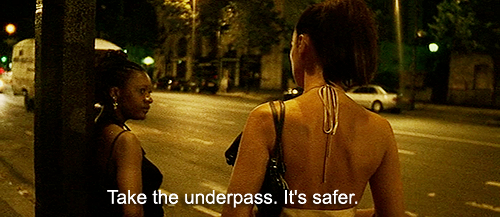
This is because we journey backwards through the day. We begin with the arrests, back to the revenge, back to the rape, back to the stupid argument in the bar which causes Monica Bellucci’s character to walk out alone and take some bad advice :
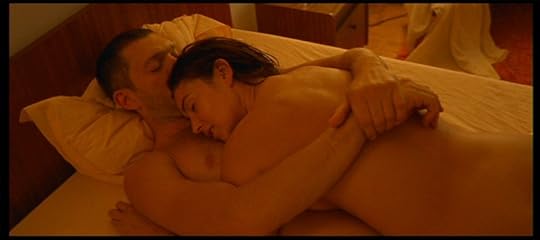
back to the intimate banter between the Monica, her boyfriend and her ex-boyfriend as they went out to the bar (“the only time she had an orgasm with me is when she fell out of bed and banged her head”), backwards before that to voluptuous scenes between Monica and boyfriend Vincent Cassel, a near perfect raunchy couple on a carefree morning. The movie therefore ends in perfect romantic-sexual harmony. Given what we have seen before, that is, know what is about to happen, the effect is devastating.
AMELIE
Amelie and Irreversible were released almost at the same time and of course the whimsical-cutesy fantasy Amelie became the world’s favourite French film up till then. It’s the total opposite of Irreversible. In Amelie romance thrives – a spooky, OCD version anyway – and Paris has never looked so lovely and manic dream pixie girls never so chic. Amelie clearly drives Tim Palmer quite insane and he takes the time to assemble some great anti-Amelie quotes :
Totally disconnected from all contemporary reality….cleansed of ethnic diversity and social problems with a broad CGI brush of smug totalising rightwing bluster… transposing euroDisney to Montmartre…. Opposed to everything Irreversible pursues
I can see all that, but, you know, Amelie and Irreversible are both great films. Suck it up Tim Palmer.
IT MUST BE AN OCCUPATIONAL HAZARD
Film critics and professors seem to develop weird obsessive linguistic tics which they can’t help or just don’t notice. In Annette Kuhn’s terrible book on the brilliant Ratcatcher, she can’t write more than two paragraphs without talking about space or using the word spatial. Here, it’s diegetic. Honest, it comes up every fourth sentence, bong, like a clock striking every ten minutes. Diegetic this, diegetic that.
Something unknown to Tim Palmer : the power of the synonym.
After that, we have a horrendously overused phrase : the French film ecosystem. This comes up about a thousand times.
And of course, it just wouldn’t be a film book written by a professor without some of those brainbending inscrutabilities, such as :
One rallying group goal – onscreen, issuing from that screen to coalesce around the spectator – is to subsume any regulated dispensation of diegetic information to a lyrical, contingent disbursement of cinematic data.
As a film fan, I must say that doing a film course at a university sounds like PURE HELL.
HOWEVER
Prof Palmer’s prose is unpleasant and sclerotic, true, but his monograph is stuffed full of interesting angles, and I actually do recommend it to any fan of this movie or French extreme cinema in general.
Palmer does an excellent job of placing this film within a particular context, explaining pre-production, production, post-production, exhibition, and critical evaluation of the film with a thoroughness that attempts to see its reputation ameliorated by the film’s relationship to the art cinema (his supposition that Irreversible works against the art cinema’s use of sexual assault scenes as metaphors or simple plot events is so compelling yet so perfunctory to his overall analysis), the French cinematic ecosystem, and the cinéma du corps, the latter point being compared to a large-scale group conversation between filmmakers like Noé, Breillat, de Van, and Denis. This film is certainly a powerful watershed moment in French cinema and in Noé’s career. Now, time to apply Palmer’s auteurist readings of Noé’s work to Climax, all for the lovely Richard Neupert, who’s even briefly cited in this book. A must-read for anyone who’s got Irreversible or any of Noé’s films still stuck in their craw, regardless of initial reactions.