

What do you think?
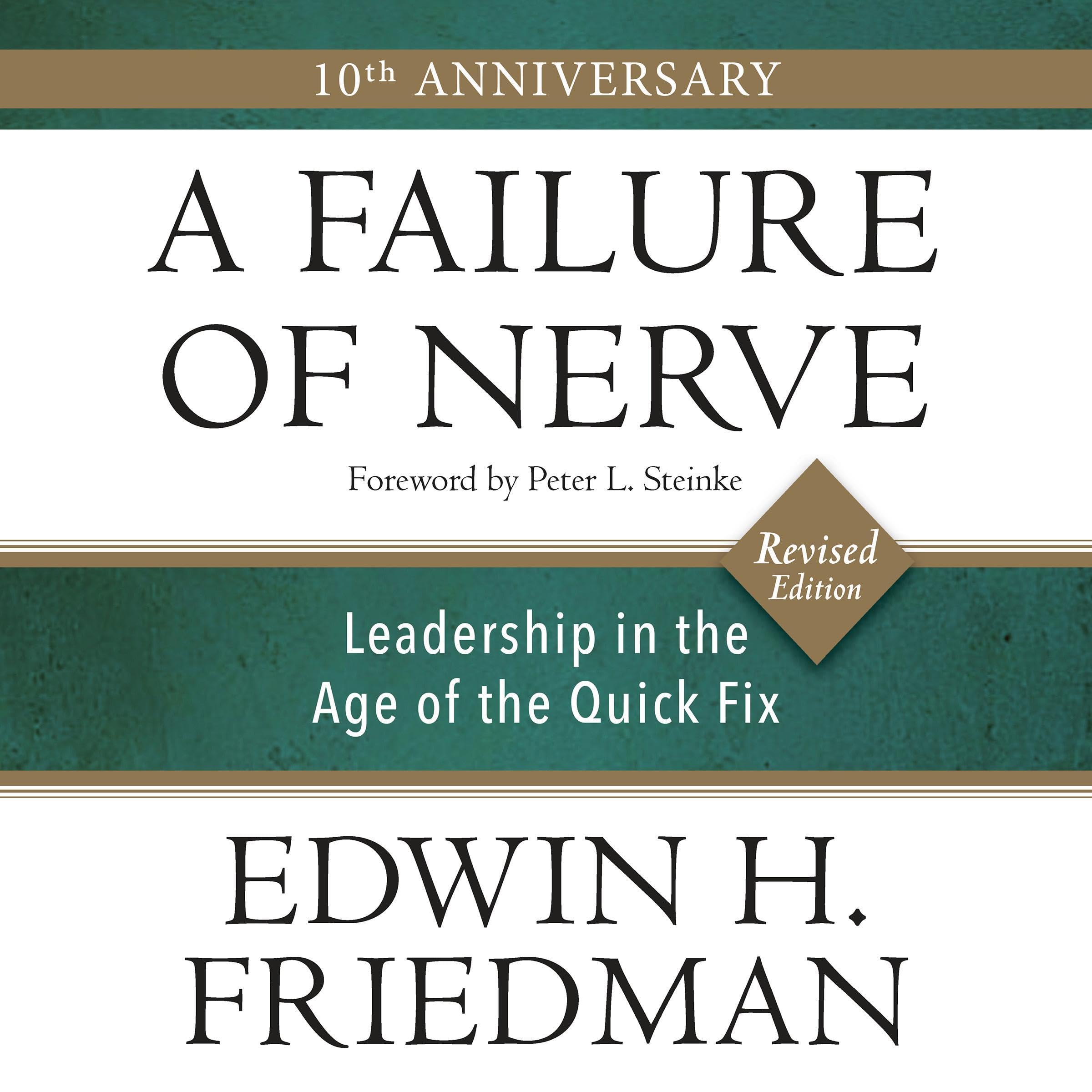
A Failure of Nerve (Revised Edition): Leadership in the Age of the Quick Fix
An invitation and guide for leaders “to cast a courageous and imaginative vision, to lead resiliently, and to be present and steady in times of deep anxiety.”
Ed Friedman’s genius was to see the individual in the family in the larger group, bringing the wisdom of his experience as a therapist and rabbi to the field of organizational leadership.
A timeless bestseller, A Failure of Nerve still astonishes in this new edition with its relevance and continues to transform the lives of leaders everywhere―business, church, family, schools―as it has for more than 20
Offers prescient guide to leadership in the age of “quick fix.”Provides ways to recognize and address organizational dysfunction.Emphasizes “strength over pathology” in these anxious times. “The age that is upon us requires differentiated leadership that is willing to rise above the anxiety of the masses. We need leaders who will have the ‘capacity to understand and deal effectively’ with the hive mind that is us. This is, in Friedman’s words, ‘the key to the kingdom.’ I am grateful for this accessible new edition.”
―C. Andrew Doyle, Bishop, Episcopal Diocese of Texas
This audiobook is expertly read by Charles Constant, with audio engineering by Mike Thal. It was produced and published by Echo Point Books & Media, an independent bookseller in Brattleboro, Vermont.
Ed Friedman’s genius was to see the individual in the family in the larger group, bringing the wisdom of his experience as a therapist and rabbi to the field of organizational leadership.
A timeless bestseller, A Failure of Nerve still astonishes in this new edition with its relevance and continues to transform the lives of leaders everywhere―business, church, family, schools―as it has for more than 20
Offers prescient guide to leadership in the age of “quick fix.”Provides ways to recognize and address organizational dysfunction.Emphasizes “strength over pathology” in these anxious times. “The age that is upon us requires differentiated leadership that is willing to rise above the anxiety of the masses. We need leaders who will have the ‘capacity to understand and deal effectively’ with the hive mind that is us. This is, in Friedman’s words, ‘the key to the kingdom.’ I am grateful for this accessible new edition.”
―C. Andrew Doyle, Bishop, Episcopal Diocese of Texas
This audiobook is expertly read by Charles Constant, with audio engineering by Mike Thal. It was produced and published by Echo Point Books & Media, an independent bookseller in Brattleboro, Vermont.
- GenresSelf HelpLeadership
Audible Audio
Published January 20, 2025
Ratings & Reviews
Friends & Following
Create a free account to discover what your friends think of this book!
Community Reviews
Displaying 1 - 16 of 16 reviews
July 30, 2025
This book was an interesting read, but difficult to rate. The author has some amazingly insightful observations about an “anxious society” and its effects. He helpfully points out that the current trend of blaming leaders for unpleasant feelings which arise in followers as a result of their leaders’ decisions, is in fact, just a mask for immaturity, childishness, and an inability for people to take responsibility for their own emotional responses. He rightly shows that leaders who have a failure of nerve and cave-in to every negative reaction from their followers, in essence, abdicate their responsibility to lead.
What I didn’t find helpful was the preponderance of somewhat random and loosely related anecdotes, the heavy emphasis on the farce that is evolutionary theory, the lack of clear solutions.
What I didn’t find helpful was the preponderance of somewhat random and loosely related anecdotes, the heavy emphasis on the farce that is evolutionary theory, the lack of clear solutions.

August 7, 2025
The book suffers somewhat for being unfinished at the time of Friedman's death and for being entirely and unnecessarily reliant in its middle upon evolutionary assumptions to prove points that didn't need further proof, given that so much of what Friedman describes with regard to the dynamics of anxious leadership is manifestly evident from observation and experience. I almost wonder if he felt the need to lend "scientific" credence to principles that could be better categorized as "human nature horse sense" than pure sociology.
Moreover, I couldn't help but notice the lack of engagement with matters of mercy and sacrifice, which I hold to be fundamental to the exercise of good leadership even though (because?) they are fundamentally theological categories. Perhaps I ask too much of Friedman here, as he has not set out to write theologically, yet the caveat must be made for those reading Friedman in the context of Christian family and church leadership. This is not to imply that mercy and sacrifice are incongruous with Friedman's thesis - I don't believe they are - but they simply are unengaged in the present work and must be engaged in the context of Christian community. It seems to need saying that healthy "differentiation" can be an act of mercy and that enduring "sabotage" for the sake of the community's health is an act of sacrifice; it also needs saying that an over-reliance upon a concept like "differentiation" might quickly be used as an escape hatch from the inevitably and intentionally snug confines of life together in Christ.
All this being said, Friedman's basic diagnosis of anxious leadership and its effects seems spot on, along with many of his suggested remedies, and I would venture to guess that at least the first third of the book should qualify as a must-read for those called to heft the mantle of responsibility for a family, church, or community.
Moreover, I couldn't help but notice the lack of engagement with matters of mercy and sacrifice, which I hold to be fundamental to the exercise of good leadership even though (because?) they are fundamentally theological categories. Perhaps I ask too much of Friedman here, as he has not set out to write theologically, yet the caveat must be made for those reading Friedman in the context of Christian family and church leadership. This is not to imply that mercy and sacrifice are incongruous with Friedman's thesis - I don't believe they are - but they simply are unengaged in the present work and must be engaged in the context of Christian community. It seems to need saying that healthy "differentiation" can be an act of mercy and that enduring "sabotage" for the sake of the community's health is an act of sacrifice; it also needs saying that an over-reliance upon a concept like "differentiation" might quickly be used as an escape hatch from the inevitably and intentionally snug confines of life together in Christ.
All this being said, Friedman's basic diagnosis of anxious leadership and its effects seems spot on, along with many of his suggested remedies, and I would venture to guess that at least the first third of the book should qualify as a must-read for those called to heft the mantle of responsibility for a family, church, or community.

July 3, 2026
When I first listened to this book in April/May of 2025, I was struck by how relevant Friedman's anecdotes and diagnoses were to the current state of society, and how insightful he was on hot topics like empathy, trauma, victimhood, and so on. Then I realized he died in 1996. Interesting.
Friedman talks about the regressive effect of a focus on safety above all; about the characteristics of chronically anxious families (which he extends to include businesses, organizations, churches/synagogues, and governments as well), including reactivity, herd mentality, and blame displacement; and about the similarities between the dynamics of these families and the dynamics of biological organization, from cells on up. He comes to the latter from an evolutionary perspective, which I found interesting considering that he was a rabbi. Nonetheless, what he describes about immunity, differentiation, and the nature of healthy vs. malignant processes is valid even apart from the idea of these things developing over millions of years.
Friedman's discussion of self in chapter 5 (which is also where he discusses the immune system, what it actually does, and the definition of integrity) is pivotal. It would be tough to communicate its main points outside of the context of the whole book, so I won't try here. I'll just say that it, and the chapter on emotional triangles, has helped to clarify a lot in my experience, background, and--dare I say--worldview that was previously fuzzy and bewildering.
Change takes time, which is why I have read this book in full or in part multiple times over the past year and a half. As Friedman himself notes, joking that he may have only provided a good book-burning candidate in this work, it may be fairly polarizing. However, I definitely recommend giving it an honest and fair reading.
(Joe Rigney's books The Sin of Empathy and Leadership and Emotional Sabotage draw from Friedman's work, and may be a good starting place especially for Christians before reading A Failure of Nerve.)
Friedman talks about the regressive effect of a focus on safety above all; about the characteristics of chronically anxious families (which he extends to include businesses, organizations, churches/synagogues, and governments as well), including reactivity, herd mentality, and blame displacement; and about the similarities between the dynamics of these families and the dynamics of biological organization, from cells on up. He comes to the latter from an evolutionary perspective, which I found interesting considering that he was a rabbi. Nonetheless, what he describes about immunity, differentiation, and the nature of healthy vs. malignant processes is valid even apart from the idea of these things developing over millions of years.
Friedman's discussion of self in chapter 5 (which is also where he discusses the immune system, what it actually does, and the definition of integrity) is pivotal. It would be tough to communicate its main points outside of the context of the whole book, so I won't try here. I'll just say that it, and the chapter on emotional triangles, has helped to clarify a lot in my experience, background, and--dare I say--worldview that was previously fuzzy and bewildering.
Change takes time, which is why I have read this book in full or in part multiple times over the past year and a half. As Friedman himself notes, joking that he may have only provided a good book-burning candidate in this work, it may be fairly polarizing. However, I definitely recommend giving it an honest and fair reading.
(Joe Rigney's books The Sin of Empathy and Leadership and Emotional Sabotage draw from Friedman's work, and may be a good starting place especially for Christians before reading A Failure of Nerve.)
February 5, 2026
Feels truly original and so intricate that this could be used like a textbook. The practicality for work, home, and organizations makes it especially interesting.

Read
March 9, 2026All be it a tough read, some great concepts. Well worth the trudge of American History you sometimes have to endure.
February 11, 2026
I read this after reading both of Joe Rigney's books: "Leadership & Emotional Sabotage" & "The Sin of Empathy", which are essentially books that extrapolate Friedman's ideas on emotional manipulation. Both of those books were so helpful that I wanted to read this book to get the bigger picture. I listened to the audiobook but bought a hard copy 1/3 of the way through as 1) there was far too much I wanted to underline and 2) I could tell I was missing a lot of the structure of the book (graphs, outlines, headings, etc.). I plan to read the hard copy immediately.
This book is, as another reviewer noted, very hard to rate. I am giving it 4 stars despite wishing I could give it 5. The *ideas* are worthy of 5 stars, and I will be frequently recommending this book. I came away from the book with a renewed appreciation for the people in my life that are well-defined (as Friedman defines in the book) and willing to exercise necessary, truly quality leadership and responsibility despite being mischaracterized as either unemotional or not compassionate (or something else along those negative lines). I found myself easily seeing connections to EVERYTHING in life as I worked through this book, which is another sign of a good book, in my opinion.
Ultimately, the 5-star review I want to give is cut short because of a few things. 1) this was unfortunately published posthumously before Friedman was even finished with it, so I hate that he didn't get to edit his own book. It could have been much shorter, organized better, relieved of extraneous anecdotes, etc., and I can't help but wonder if Friedman would have made this a 5-star book had he had the chance to refine it more himself. 2) the evolution metaphors were pretty insufferable to me (and surprising considering he was a "rabbi") and did absolutely nothing to enhance his ideas. If anything, I think it took away from his points. I'm not sure if he felt like having something "scientific" in the book would validate his points or if he thought talking about billions of years of prokaryotic evolution was an accessible metaphor to help explain his points, but either way I cannot for the life of me figure out why he put all that in there (largely chapter 5) and wish he had not.
I recommend this book to pretty much everyone: people who are like me and very subject to emotional manipulation, people who are in "helper"/"fixer" roles like doctors and pastors, people who are in leadership roles and overwhelmed trying in vain to please everyone, people who have lots of relational issues (family, friends, business, etc.) and just can't seem to figure out why, people who are perpetually anxious but trying to make progress, young adults about to be launched from mom & dad into a society that largely incentivizes squashing their vision/hope/enthusiasm for the future... read it! But read a hard copy, have someone to discuss with, and appreciate the ideas knowing there are some annoyances to overlook.
This book is, as another reviewer noted, very hard to rate. I am giving it 4 stars despite wishing I could give it 5. The *ideas* are worthy of 5 stars, and I will be frequently recommending this book. I came away from the book with a renewed appreciation for the people in my life that are well-defined (as Friedman defines in the book) and willing to exercise necessary, truly quality leadership and responsibility despite being mischaracterized as either unemotional or not compassionate (or something else along those negative lines). I found myself easily seeing connections to EVERYTHING in life as I worked through this book, which is another sign of a good book, in my opinion.
Ultimately, the 5-star review I want to give is cut short because of a few things. 1) this was unfortunately published posthumously before Friedman was even finished with it, so I hate that he didn't get to edit his own book. It could have been much shorter, organized better, relieved of extraneous anecdotes, etc., and I can't help but wonder if Friedman would have made this a 5-star book had he had the chance to refine it more himself. 2) the evolution metaphors were pretty insufferable to me (and surprising considering he was a "rabbi") and did absolutely nothing to enhance his ideas. If anything, I think it took away from his points. I'm not sure if he felt like having something "scientific" in the book would validate his points or if he thought talking about billions of years of prokaryotic evolution was an accessible metaphor to help explain his points, but either way I cannot for the life of me figure out why he put all that in there (largely chapter 5) and wish he had not.
I recommend this book to pretty much everyone: people who are like me and very subject to emotional manipulation, people who are in "helper"/"fixer" roles like doctors and pastors, people who are in leadership roles and overwhelmed trying in vain to please everyone, people who have lots of relational issues (family, friends, business, etc.) and just can't seem to figure out why, people who are perpetually anxious but trying to make progress, young adults about to be launched from mom & dad into a society that largely incentivizes squashing their vision/hope/enthusiasm for the future... read it! But read a hard copy, have someone to discuss with, and appreciate the ideas knowing there are some annoyances to overlook.

June 27, 2026
A failure of nerve is filled with wisdom and what seems to me to be a right diagnosis of the climate of much leadership in America. As a leader of an organization, I recognize some key things I deal with when I seek to lead change. Success is not guaranteed, so leadership takes nerve. The only critique I have of the book is that it was written with what seems to me to be unnecessary complexity. For instance, that main concept of being a well-differentiated leader and a secondary concept of emotional triangles were written in abstract ways that still make it hard to define after reading the book. Perhaps that is just me, though. I think I would need to read it a couple times to completely grasp the concepts. As it is, I understood them enough to find it helpful. A well-differentiated leader is emotionally grounded in their identity, so while they are connected to the climate they are leading, they are also separate from it. I have experienced the emotional triangle concept in the form of people wanting me to deal with a personal conflict that they need to deal directly with. This notion is also from the Bible in Matthew 18 and how to handle personal conflict. So i understood the concepts enough, and the book overall was discerning of the current climate of leadership. However, the critique stands–the book was written in a way that was not engaging and easily readable. And yet, I would still recommend it for any leader who struggles with confidence our courage to lead, especially if they face opposition. My favorite quote was tied to my favorite concept of the book (that leaders must restore the sense of adventure); “The safest place for ships is in the harbor, but that’s not why ships are built.”

March 2, 2026
Not sure how to feel about this book. Some helpful principles and analysis from Steinke's experience as a therapist. He does not have any footnotes or references so it is basically just his take. He can often state things strongly which can be good and bad. He also uses metaphors and reasoning from nature that sometimes might apply but also at times seem far fetched. For example, drawing principles for human connection or differentiation from dividing cells. I did find some things helpful, particularly being reminded that present emotional problems are often the result of unresolved emotional problems in the past. Also, there is the potential of a leader being effective or not effective by how he deals with chronically anxious people.

September 11, 2025
A Failure of Nerve had some good insights, but honestly it was WAY too long. Friedman writes with absolute certainty on all kinds of issues and often doesn’t actually offer any substantial proof for many of the things he speaks so confidently about. Instead of building a case, he often just throws out personal anecdotes to back up claims that at times felt pretty hard to believe.
There are nuggets of wisdom here, but I came to this book because of Joe Rigney’s Leadership and Emotional Sabotage, and honestly, I think Rigney sharpened and improved upon Friedman’s ideas.
There are nuggets of wisdom here, but I came to this book because of Joe Rigney’s Leadership and Emotional Sabotage, and honestly, I think Rigney sharpened and improved upon Friedman’s ideas.

October 29, 2025
The thing that stuck me most about this book is that it seems to be crritiquing "woke" culture before it hit the mainstream. At times I found Friedman's style a little overly intellectual and harsh, but I thought some of the core principles about building resilience and not giving in to anxiety were helpful.
January 26, 2026
Good theory behind this book (namely, everyone needs to grow up and act like an adult, and that's what leadership is), but - suffered from random anecdotes, clearly being unfinished and interrupted by the author's death, and repeating itself and making outlandish claims without any cited evidence.
May 9, 2025
Some great principles within, but it is a bit hard to follow and disconnected at times
October 4, 2025
Provides some really good insights and pretty grounded in Family Systems research.

November 28, 2025
Offers direction for addressing one of the major challenges of the clergy calling by underscoring how important it is for leaders to find the gumption to stand up for what they believe.

February 4, 2026
Very insightful and worth reading if you want to grow in your leadership of yourself and others.

September 12, 2026
It’s not the best written book, but in fairness he never actually finished it.
Leadership is a lost art that needs to be reacquired in our time.
Leadership is a lost art that needs to be reacquired in our time.
Displaying 1 - 16 of 16 reviews