From the author of the acclaimed New York Times bestseller Lawrence in Arabia, a stunningly revelatory narrative history of one of the most momentous events in modern times, the jaw-dropping stupidity of the American government, and the dawn of the age of religious nationalism.
“A must-read that is both urgent and unforgettable.”—Steve Coll, author of The Achilles Trap, Directorate S, winner of the National Book Critics Circle Award, and Ghost Wars, winner of the Pulitzer Prize
"A masterful and gripping account of the Iranian revolution. Anderson gives us a page-turning history lesson that is more relevant than ever."—Rajiv Chandrasekaran, author Imperial Life in the Emerald City, a finalist for the National Book Award
"Anderson’s brilliant new account of the events leading to the shah’s fall is both masterful and mesmerizing.”—Joby Warrick, author of Black The Rise of ISIS, winner of the Pulitzer Prize
"Instantly absorbing, King of Kings is an exhilarating plunge into the psychology of unchecked power, which secludes, blinds, and ultimately betrays its holders.”—Evan Osnos, author of Age of Ambition, winner of the National Book Award
On New Year’s Eve, 1977, on a state visit to Iran, President Jimmy Carter toasted Shah Mohammad Reza Pahlavi, King of Kings, Light of the Aryans, Shadow of God on Earth, praising Iran as “an island of stability “ due to “your leadership and the respect and admiration and love which your people give to you.” Iran had the world’s fifth largest army and was awash in billions of dollars in oil revenues. Construction cranes dotted the skyline of its booming capital, Tehran. The regime’s feared secret police force SAVAK had crushed communist opposition, and the Shah had bought off the conservative Muslim clergy inside the country. He seemed invulnerable, and invaluable to the United States as an ally in the Cold War. Fourteen months later the Shah fled Iran into exile, forced from the throne by a volcanic religious revolution led by a fiery cleric named Ayatollah Khomeini. The ensuing hostage crisis forever damaged America’s standing in the world. How could the United States, which had one of the largest CIA stations in the world and thousands of military personnel in Iran, have been so blind?
The spellbinding story Scott Anderson weaves is one of a dictator blind to the disdain of his subjects and a superpower blundering into disaster. Scott Anderson tells this astonishing tale with the narrative brio, mordant wit, and keen analysis that made his bestselling Lawrence of Arabia one of the key texts in understanding the modern Middle East. The Iranian Revolution, Anderson convincingly argues, was as world-shattering an event as the French and Russian revolutions. In the Middle East, in India, in Southeast Asia, in Europe, and now in the United States, the hatred of economically-marginalized, religiously-fervent masses for a wealthy secular elite has led to violence and upheaval–and Iran was the template. King of Kings is a bravura work of history, and a warning.
Scott Anderson is a veteran war correspondent who has reported from Lebanon, Israel, Egypt, Northern Ireland, Chechnya, Sudan, Bosnia, El Salvador, and many other strife-torn countries. He is a contributing writer for The New York Times Magazine, and his work has also appeared in Vanity Fair, Esquire, Harper's and Outside.
I'm going to regret this review, but here goes: I am furious at this book and can’t go on reading it. It’s a DNF after reading approximately 200 pages. This book may be interesting for a non-Iranian, but for me who was born and raised in Iran and knows the events and their 'when and why and who and where', this book was not ‘it’!
First off, when writing about a historical event, do some research about the country, her history, culture, customs and psychology of the people of the country you're writing about.
For example, you should know that in Iran we have had arbitrary rule for ages. Meaning, from the start, in Persia there had been kings and those kings had been revered and obeyed like gods. The Shah wasn’t even comparable to your Carter. You are comparing a president with a king? Really? He was the king with certain duties and very specific understanding of how to behave as a king, inheriting what he had been taught. Meaning, when someone was in his presence, that someone should be standing until invited to be seated. The same goes for every royal country. There are etiquettes to be observed. I’m sure you couldn’t just barge in the Oval Office and high-five Trump and sit your ass down without leave? So, the criticisms directed at Shah about his behavior is uncalled for. By the way, just so you know, Shah was an extremely introvert person, hence his not mingling. Jesus Christ!
Secondly, that’s Shahbanu Farah to you, not just Farah, like you’re talking about a pet puppy. And, you are still at it, criticizing her for caring for her country?? She does charity work and your tone implies that she’s doing it for show? Shah crowns her as Queen, not because of his arrogance, but because he wants her to be an example for the downtrodden women of Iran, to show them that 'yes, they can too! Iran had never seen a woman become a queen until then. The wives of the kings used to be confined in the harems. But I digress...
Thirdly, don’t rely on some minister’s diary entries. You are basing your opinion of Shah and what went on behind closed doors using a third person’s perspective who for all we know wrote a bunch of lies in his diary to suit his narrative. And at the same time you are bashing the Queen’s own memoir, telling us without shame that she lied or exaggerated?
Right at the beginning you ask us ‘why didn’t the US support Shah and prevent his downfall. Well if you don’t know why, then you have no business writing a 700 page book. But I will tell you why your country and your revered Carter didn’t back Shah. It was because Shah didn’t want to give free oil and concessions to other countries anymore. Shah was striving to become independent. That's why. He had to go, so another puppet regime would do whatever your country demanded. And Shah went, because if he stayed, there would have been bloodshed and he didn’t want that. You portray Shah as some kind of a ninny who didn’t know shit. Shah knew shit, the only thing he did wrong was trusting the wrong people. He was a dreamer, a patriot and an idealist and those traits cost him his country.
An excerpt to show what kind of a history book this is. Notice the “In all likelihood… probably…just as probable…” ?
"In all likelihood, that morning’s meeting of the two men followed the same general pattern as the hundreds that had preceded it. The shah had probably been reading from one of the stacks of papers on his desk with his oversized, black-rimmed bifocals when Alam entered. It’s just as probable that he neither spoke nor looked up as his minister approached, but instead absently raised his right hand from the desk to let it hover in the air. Drawing up at the shah’s side, Alam would have executed a deep bow, then taken the proffered hand and, while kissing it, whispered a prayer for the continued health and safety of the man known as the King of Kings, Light of the Aryans, Shadow of God on Earth. This incantation complete, Alam would have then rounded the desk, careful not to show his back to the monarch while doing so, to stand on its opposite side. Because their meeting that April morning was scheduled to be brief, perhaps a mere twenty minutes, the court minister probably remained standing for the duration."
I am sorry for my rant and grammatical errors if they are any.
I was excited for King of Kings: The Iranian Revolution by Scott Anderson. Unfortunately, Iran became rather topical recently, but I was most enticed by the fact that I knew very little about the entire story.
Turns out, apparently the shah, his government, and the Carter administration had the same problem.
First things first, I have to praise Scott Anderson's work making this narrative understandable. The Iranian Revolution did not follow the same ramp up and culmination like many of the other revolutions of history. As an American, I have Lexington and Concord as the flashpoint where the shot heard round the world served as the final explosion of the tension which had built to a climax. Scholars may argue some of the finer points, but it started there.
Iran? It was more like a boiling pot of water. There were a few overflows here and there, but then a cooling period. Then a few more overflows. Then the whole thing overflowed while many government officials stood there and said, "I didn't realize the pot was boiling."
Anderson masterfully makes this all understandable. There are dozens of people vital to the story or sometimes only vital to one part of the story. The author finds a way to make each character stick in your head and present them as full individuals who often have tragic tunnel vision. Anderson has to play with the timelines a bit which is necessary but can feel almost overwhelming. Luckily, being overwhelmed helps you imagine what it was like to actually be there.
I also appreciate that Anderson is willing to call people out when necessary. He never paints any particular person as fully good or evil. These are people who are complex. However, when they make (or fail to make) a boneheaded decision, I like when the author confirms that what you just read is a head-scratcher. To put it another way, he's not interested in villainizing his characters, but a dumb move is a dumb move, and it needs to be acknowledged.
I highly recommend this one especially if you are unfamiliar with the subject.
(This book was provided as an advance reader copy by Doubleday Books.)
I was drawn to read Scott Anderson's King of Kings after reading Ben Macintyre's The Siege. The 444-day American hostage crisis in Tehran was mentioned in the book as the simultaneous hostage situation and rescue efforts at the Iranian embassy in London were described by Macintyre. What in the world is going in with Iran at this point of modern history? And for me, I wondered about Iran's overall history.
Anderson does a phenomenal job in taking all of the intricate details with the players, the politics, and the actions and shapes them into an understandable and linear timeline.
America aligned itself with Iran as the country was deemed the most stable in the Middle East at the time. America traded armaments for oil. Iran had a large established army, the fifth largest in the world. Within Iran, murmurings were coming to surface of a desire to overthrow the Shah and establish a government that would end up being theocratic in nature. The United States was so obsessed with preventing the spread of Communism that the Carter administration and other government agencies and higher-ups failed to see until it was too late the dangers of a takeover by Ayatollah Ruhollah Khomeini and the men he placed in charge after the Shahanshah and his family departed the country.
Anderson does extensive research and offers a deep-dive into how all of this happened. He was in Washington at the Ellipse reporting on the protests when Shah Pahlavi came to Washington, D.C. in November of 1977. He interviews those who are still with us, including the late Shah Pahlavi's wife, Farah.
As an Iranian girl, I grew up hearing one account of life under the Shah’s regime at home, while being taught a completely different one in school. Between that and the endless conspiracy theories that circulated, I’ve always wondered how the truth of that era actually unfolded. King of the Kings is a tactful, balanced, and deeply engaging account of the events, the mistakes, and the key players that shaped the revolution and led to its ultimate outcome. It also examines its aftermath, the ignorance and miscalculations that plagued the U.S. government, and how those errors helped shape key international conflicts that still echo today. The writing is exquisite, well-researched, captivating, and masterfully told. I truly could not put it down. A must-read for anyone seeking to understand not only this pivotal chapter in Iran’s history, but its lasting impact on the world.
Step by step analysis of how Iranian Revolution came to be: king who lost touch with his people. One bad U.S. policy after another; Nixon and Kissinger using Iran as Cold War pawn, helping it build 5th biggest army in world for its oil, Carter admin. continuing same mistakes and bungling hostage crises, led to Carter's election defeat, takeover by a fundamentalist cleric. The consequences of which we're still dealing with to this day.
Once you accept that Scott Anderson has chosen to cast the Iranian revolution largely as a story of American foreign policy failure, his account is completely absorbing, even thrilling at times. What surprised just about everyone at the time (even the revolutionaries) was how quickly things fell apart in Iran once the first cracks started showing. Between the speed of the revolution, the slowness of the Shah’s decision-making and the stubbornness behind American denial (e.g., not listening to the Farsi speaking diplomats who sensed how bad things were), one leaves the book with a very clear picture of the Shah’s fall.
Despite my initial statement, Anderson does manage to cover the revolution from the perspective of the Americans, the palace (even managing to extensively interview the Shah’s widow), and the revolutionaries; it’s just that his priorities (and perhaps his access) are in that order. The detail is incredible until the Shah falls, but I wanted a bit more insight into how the hardcore Islamists managed to seize the revolution from the moderates.
Overall, this is an outstanding account that makes us feel as though we are there. Thanks to Doubleday and Netgalley for providing a pre-publication egalley in exchange for an honest review.
I found myself struggling to explain not simply why this book was so good but also why I found the story of the overthrow of the Shah (or the Shahenshah as he is usually referred to in this book which while it is/was his correct title was not one I remember being used by Western media when he was still 'Shahenshah') and the Iranian revolution both relevant but also difficult to explain. So I am will begin with some personal recollections which you will find under the heading 'Preface' but if you would prefer only my 'Review' I suggest scrolling down until it appears under that heading.
PREFACE:
I was born in 1958 and can very clearly remember reading the account in the National Geographic of the Shah's coronation in 1967 though it was the tiny figure of the barely seven year old crown prince Reza Pahlavi which captured my attention. It was over forty years later that I thought again about the little crown prince of Iran - specifically in 2011 at the funeral of an obscure former MEP, Otto von Habsburg, who can be seen in newsreels from 1916 as the little crown prince at the coronation of his father as the last King of Hungary. I couldn't help thinking that when Reza Pahlavi eventually dies his funeral is unlikely secure as many minutes of TV coverage as Otto von Habsburg's received hours (six hours in Austria and other former Habsburg lands).
I make the point not because I wish to praise or bury either Habsburg or Pahlavi or dynasties or their heirs, I am no monarchist, but oddly enough the contrast between the coronations Otto and Reza played a part in, down to the outfits each boy wore, tells so much (see: https://film.iwmcollections.org.uk/re... for the Habsburg coronation [this an excerpt from a 1 hour 10 minute documentary made at the time by Michael Curtiz who went on to make Casablanca amongst other films] and https://vimeo.com/751365745 for the Shahenshah's coronation). The 1916 coronation of the last King of Hungary is many things but it is 100% real. The Shahenshah's 1967 extravaganza is utterly unreal - an elaborate theatrical farce in which the little crown prince looks terrified that he is going to be beaten if he makes a mistake and the shahenshah and shahbanou look like beauty pageant winners decked out in over the top cubic zirconia tiaras. Let me make it clear everything to do with the Pahlavi's look ersatz, pseudo, bogus, noveaux, of being unsure of themselves.
This air of absurdist disconnect from reality was there in the Pahlavi court with its ocean of officials, including ministers, appearing in the sort of court dress last seen under the Ottoman's at the Dolmabahçe Palace and reached its pinnacle at the mad 1971 party thrown for 2,500 years of the Persian Empire (see: the wonderful film 'Decadence and Downfall In Iran: The Greatest Party In History' at: https://www.youtube.com/watch?v=dWxwt...). It was obvious to me watching the coronation at ten and the 2,500 'anniversary' party at 13 that the Shah was lacking in confidence and conviction - who crowns themselves after thirty years on the throne? Who celebrates 2,500 years of an empire when your dynasty is barely fifty years old? - a man who is weak and desperate for reassurance. In an earlier biography of the shah I was astounded by how often and long this 'absolute' monarch spent chatting with the American and British ambassadors and asking them to say he was doing the right thing. The Shahenshah was, to quote that wise and prescient Irisman Oscar Wilde, the ultimate 'Sphinx without a secret'.
REVIEW
I've said enough about the Shah and his role, or really lack of a role, in causing what happened in Iran in 1979. If you have read de Tocqueville there is nothing surprising in the demise of the Shah's 'empire', what the book helps make clear is that the shah was always '...as sounding brass, or a tinkling cymbal (1 Corinthians 13:1, KJV)' because he was always Ozymandias (see my footnote *1 below) a man with unlimited hubris, dictatorial powers, delusions of grandeur and a massive military budget to spend. Unfortunately he was 'enabled' by a man who throughout the last third of the 20th centuries was responsible for more evil deeds than any other, Henry Kissinger, in his determination to be the Jewish Metternich.
It is amazing what harm a weak man, like the shah, backed by an unscrupulous monster, like Kissinger, can do.
What is even more fascinating is how the various departments of the United States co-operated with the Shah of Iran to ensure that neither of them knew what was going on in Iran. Although the limitations revealed are often said to relate to the pre internet social media world I am inclined to believe that the old adage 'Junk in Junk out' still holds true as well as the problem of getting the right information to the right people at the right time has not changed one iota by social media.
Like all books which look forensically at how any bureaucracy fails to communicate with itself 'King of Kings' will provide no succour to those looking for the dark hand of conspiracy in history. It is good to be reminded how history is more often decided by jealousy and career worries as those dedicated to doing the right thing. 'King of Kings' is essential reading by anyone who doesn't realise how a seasoned bureaucrat can destroy a rival by placing a key document in a 'slow' channel and thus ensure it will only be read long after its usefulness has past.
I should make clear that this is a history of the Iranian revolution from the American point of view - of 'how did we miss' or 'how did we get things' so wrong? This is not a history of the Iranian revolution told from an Iranian perspective and as long as that is borne in mind it is useful. But when the history of Iran during the Pahlavi years with full access to the archives it may be surprising how little real control the Shahenshah had over events. This book will help explain why America made such a mess of its involvement in Iran but will not tell you why Iran ended up where it is today.
*1 "My name is Ozymandias, King of Kings; 'Look on my Works, ye Mighty, and despair!', Nothing beside remains. Round the decay, Of that colossal Wreck, boundless and bare, The lone and level sands stretch far away." from the poem 'Ozymandias' by Percy Bysshe Shelley.
The Shah of Iran certainly knew how to make an entrance. In 1971, he threw a lavish celebration at Persepolis to mark 2500 years of the Persian Empire, a spectacle so extravagant that the international press swung between awe and disbelief. Heads of state were flown into the desert, gourmet meals came from Maxim’s of Paris, and luxury tents rose beside ancient ruins. The Shah cast himself as the heir to Cyrus the Great, calling himself the King of Kings. To some it was a display of national pride. To others it looked like a ruler hopelessly out of touch with his people.
Yet Iran was no ordinary country. Persia had once been one of the great civilizations of the world, producing emperors, poets, scholars, and vast empires long before much of Europe emerged from the Dark Ages. But by the late nineteenth and early twentieth centuries, the country had weakened badly under the Qajar dynasty through corruption, economic decline, tribal divisions, and constant foreign interference. As I had also discovered while reading Lawrence in Arabia, oil sat at the center of much of the West’s interest in the Middle East, and Iran was no exception. Britain had retained a large influence in Iran mainly because of its oil. Reza Shah, the father of Mohammad Reza Pahlavi, tried to modernize the country through secular reforms, infrastructure, and a stronger central government, but was eventually pushed out by the British during the Second World War. His son was initially seen as little more than a figurehead, but somehow managed through luck, political instinct, and sheer persistence to remain in power for nearly four decades.
The Shah’s reign transformed Iran in many ways. Women gained greater freedom, literacy improved, industries expanded, and oil wealth poured into ambitious projects. Tehran increasingly resembled a modern Western capital. But much of this modernization was viewed as an imposition by religious conservatives and didn’t do much for the poor. After the 1953 coup backed by the CIA and the British, the Shah tightened his grip on power while Western oil companies benefited from the new arrangement. The CIA also helped create SAVAK, the feared secret police that crushed dissent ruthlessly. Religious conservatives felt alienated, many ordinary Iranians saw the elite growing richer, and resentment slowly built up.
Ironically, the Shah himself often came across as deeply indecisive, even though he ultimately outlasted six American presidents. Eventually, Iran became very important to the United States during the Nixon years, when Washington wanted a strong regional ally to safeguard oil supplies and contain Soviet influence. The Shah embraced that role enthusiastically, buying huge quantities of American weapons and so tying Iran ever more closely to Washington. Unfortunately, in trying to satisfy both the West and his own increasingly restless population, he ultimately satisfied neither. The revolution that swept him away in 1979 was caused by a combination of revolts against authoritarianism, social inequality, foreign interference, and conservative religious backlash. Reading this today feels strangely unsettling — Iran still sits at the center of global tensions, whether through sanctions, proxy wars, American bombing campaigns, or recurring fears over the Strait of Hormuz and the world’s oil supply.
Scott Anderson turns the fall of the Shah and the Iranian Revolution into something far more gripping than a run of the mill history lesson. He depicts how decades of American and British miscalculations, foreign interference, oil politics, and blind faith in one ruler slowly pushed Iran to implode. From the Shah’s gilded palaces to the fury on the streets, Anderson traces the events that led to the Shah’s downfall, the hostage crisis, and the rise of a theocracy whose impact still reverberates across the Middle East nearly fifty years later.
Ultimately Scott Anderson argues a compelling thesis: the success of the Iranian Revolution of 1979 was aided and abetted, if not the direct result of, hubristic and surprisingly low-information administrative cultures in both the Shah’s government and the U.S. state department. Anderson‘s laser-focus on the staff of the U.S. embassy in Tehran in the 70s, members of the Carter administration, the Shah himself, and a handful of leading figures in the revolutionary vanguard (from moderates like Ebrahim Yazdi who wanted an Islamist democracy to inveterate theocrat Ruhollah Khomeini) results in a propulsive, often cringe inducing, history.
Anderson argues his particular thesis very convincingly. However, if you are looking for a comprehensive overview of the Iranian Revolution or if you’re particularly interested in how Iranian people experienced and drove these upheavals then you will have to read elsewhere. In my opinion, this definitely shouldn’t be the only book anyone reads about Iran or its Revolution.
With all that said, I do have one more critique that is simultaneously a bit pedantic and absolutely fundamental. When discussing the contemporary significance of this book, Anderson claims that the Iranian Revolution “poses a chief complicating factor in Western efforts… to temper Israel’s devastating military offensive in Gaza” (page xvii). The term you are looking for is GENOCIDE, Mr. Anderson. To be fair, I read an ARC of this text so I hold out hope that a correction was made before publication or will be in future editions.
The Shah, whose people for millennia revered him and his role as "Light of the Aryans" and "Shadow of God on Earth", begins his day with courtiers kissing his hand and following age-old ceremonial rituals. His closest confidant, Asadollah Alam, serves as diplomat and family therapist, shuttling between quarreling royals.
Meanwhile, George Braswell, a Baptist missionary, teaches comparative religion in Tehran and somehow wanders into secret prayer sessions where cassette tapes of Ayatollah Khomeini blare revolutionary sermons in tinny audio.
By the 1970s, oil money floods the country faster than it can be spent. The Persepolis coronation celebration becomes the pinnacle of extravagance. Worldly guests dine on quail eggs stuffed with caviar beneath a glittering tent city pitched in the desert. The Shah imports 250 Mercedes sedans to ferry dignitaries across the wasteland. Foreign observers sip champagne while ignoring the early tremors of revolt.
Urban wealth sits beside rural deprivation, and state-approved mosques begin to sound suspiciously like political rallies in clerical robes. By the time strikes and demonstrations take hold, Washington is still issuing memos calling Iran "an island of stability".
The Shah appears to the poor to be dithering in gilded palaces, issuing contradictory orders. All the while, his treacherous secret police frantically "disappear" the evidence of their corruption, bribery, and other misdeeds through mass document shredding. The Americans, when not busy misreading the streets, are preoccupied with oil prices and Middle Eastern war and peace theater starring Anwar Sadat and Menachem Begin.
The palace walls close in. Ministers resign, and foreign allies tire of pretending the emperor's wardrobe contains clothing. All the while, Khomeini sits in exile, protected by oblivious international governments, with the patience of a cat at a mouse hole, his cassette tapes multiplying like underground bootlegs. Inside Iran, ministers jostle for survival while the Immortals, the Shah's supposedly loyal guard, look less immortal by the hour. And then it all blows up.
By the time oil prices in the US begin to skyrocket, the Carter administration is mired in contradiction. Cyrus Vance tells reporters that America will "support any Iranian government restoring order while the reform process continues", a remark the Shah interprets as proof of Washington's wavering. Ambassador William Sullivan writes that thousands of young men rage through Tehran as soldiers stand by or flee.
Inside the White House, conflicting telegrams and mixed assurances convince the monarch that his allies have abandoned him. According to this book, historians later found that, amid the smoke and the shouting, neither the Shah nor the Americans had any true comprehension of the Iranian street.
On the night of August 19, 1978, Khomeini's terrorist arsonists, opposing Western influence, individual thinking, art, and free expression, locked the doors of the Rex Cinema in Abadan and set it ablaze while a full house watched The Deer. The fire spread so fast that fire trucks arrived to find the walls glowing red and the exits sealed. Four hundred and seventy-seven people were burned alive. Within hours, the government blamed Islamic radicals, while clerical leaders calmly declared it a secret police plot.
The confusion turned the charred theater into a national shrine. Across Iran, mourners filled the streets carrying black banners and portraits of the dead, chanting that the Shah had murdered his own people. The regime's statements contradicted one another, and the public stopped believing any of them. Anderson writes that the smell of smoke from Abadan drifted across the country and never truly lifted.
As the protests swelled into millions, the Shah grew gaunt and indecisive, whispering to his ministers that he felt abandoned by God. His speeches wavered between apology and denial, his authority dissolving faster than his health. Khomeini, still in exile near Paris, held daily press conferences from a modest house where journalists lined the street and revolutionary tapes were copied by the thousands.
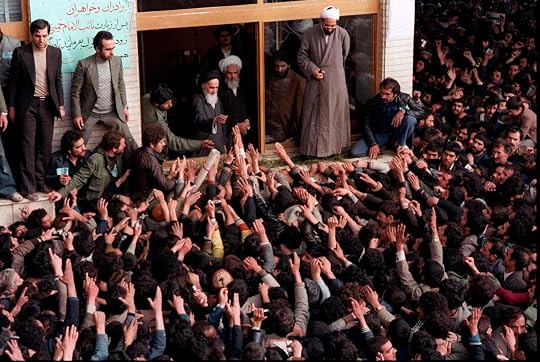
When the army's loyalty began to crack, generals met in secret to discuss neutrality, and the prime minister confessed that "the government no longer governs". The Shah boarded his plane on a winter morning, waving weakly to an empty tarmac. Two weeks later, Khomeini stepped off another plane in Tehran to a crowd so vast that his car could not move through it, and the soldiers who had once fired on demonstrators now stood quietly with their rifles lowered.
The assault on the American embassy on November 4, 1979, created an ordeal that lasted 444 days. Carter's instinct was to pursue calm negotiation, signaling that the safety of the hostages outweighed retribution. Khomeini, seeing this restraint, declared, "The Americans can't do a damned thing." As months dragged on, American audiences tuned nightly to Nightline to hear the day count, while Carter's approval ratings plunged from the high 50s into political oblivion.
Operation Eagle Claw, the daring rescue attempt, ended in a desert fireball that killed eight servicemen and left the administration looking both tragic and inept. In Tehran, Ayatollah Sadegh Khalkhali paraded the charred remains of the Americans before cameras. When the ordeal ended, it coincided precisely with Ronald Reagan's inauguration. The hostages were lifted from Tehran as Carter watched from the sidelines. Many cursed him to his face.
The aftermath resembles a hangover with no cure: proxy wars, religious militancy exported worldwide, and decades of geopolitical bungling by every party involved. The same fools who confused class disparity with jihadist morality are still marching in Western streets, waving the Ayatollah's slogans against the very values they hold dear and the freedoms that protect them.
This is a very New York Times kind of book. It shamelessly projects smug Manhattan self-righteous values onto a millenia old noble and gallant civilization. Opinions are presented as facts. Omissions are carefully chosen. The Carter doctrine is given a far too lenient treatment. The insane Jihadi barbarism is excused, accepted and forgiven as inevitable and logical. Wealth, money and oil are the presented as the source of all evil.
Scott Anderson has written the kind of history that reads like a royal soap opera in which everyone is overdressed, overarmed, and underqualified. Hubris, delusion, betrayal, and catastrophic miscalculation converge until the order collapses.
Nevertheless, it is a crucially important period in world history for the unititiated to ponder. A cautionary tale to Western leaders who once gave refuge to Khomeini and are repeating the same mistakes with his ideological monstrous descendants.
A highly sympathetic but not uncritical portrayal (he thinks Andrew Cooper overdoes it) anchored on interviews with former Pahlavi players in exile, including a SAVAT officer and not least the Shahbanou herself.
Anderson offers an admirably thorough and stirring history of Iran under the rule of Mohammad Reza Pahlavi up to the time of Pahlavi's death in 1980. While Pahlavi is the centerpiece of the book the author goes into sufficient detail about other prominent Iranians and Americans to provide a good sense of the era.
Pahlavi makes an interesting subject due to his complexities and contradictions. Thoughtful and intelligent yet indecisive and prone to decision paralysis. A staunch ally of the US but a leader in the OPEC decision to raise oil prices and jam up the US economy. A seemingly progressive human rights advocate who was accused of massive abuse. I wish there had been some background about Pahlavi's religiosity or lack of it. I don't know whether he was strictly secular, a devout worshiper or something in between. I don't think him being one thing or the other would have changed the outcome but in a story about a revolution led by a religious leader I would have liked to have known where the shah fit in. (Although it's clear to me Khomeini was content to steamroll anyone in his path regardless of anything at all.)
Overall a very good book that I'd recommend to most. One essential element to enjoy the book is a very strong interest in the subject matter. The writing is very good but some of the chapters are occasionally dense. Two things I didn't particularly like were the author's gratuitously harsh comments about the people in the book. They added nothing and made the author seem like a spiteful bully. If the comments were funny I'd have a different opinion but his characterizations just felt mean-spirited and like an attempt to put his thumb on the scale to sway reader opinions. The other annoyance was his extreme use of dashes to create parenthetical asides; maybe half of the book.
⭐️⭐️⭐️⭐️⭐️ 5 Stars — A Riveting Look at a Troubled Chapter in History
King of Kings by Scott Anderson is a terrific read — gripping, enlightening, and paced so well that it never feels overwhelming. I’ve been enjoying reading about major global events that took place when I was a kid, and America’s complicated relationship with Iran and the Shah is one I’ve long wanted to understand better. I can still recall snippets of the Iran hostage crisis from my youth, but Anderson connects those hazy memories to a clear, compelling narrative that helped me finally see the bigger picture.
Just like when I read Midnight in Chernobyl, I found myself fascinated by the way history can be both distant and personal at the same time. That same feeling of “I vaguely remember this happening… but I never knew the whole story” kept coming back as I turned the pages. There’s something powerful about learning the truth behind the headlines you grew up with.
Anderson does a deep dive into the foreign policy errors of the era — but without ever burying the reader in irrelevant details. Every piece of information feels purposeful and tied to the broader consequences that still echo in our world today. It’s smart, balanced storytelling that keeps you fully engaged.
I won’t go into specifics — that’s not my style on Goodreads, and I’m not one for spoilers. But I will say this: if you’re interested in modern Middle Eastern history, U.S. diplomacy, or simply a well-crafted historical narrative, this book is absolutely worth your time. I gained new knowledge and made meaningful connections to memories from my childhood.
This book is essentially half narrative history of the Iranian Revolution and half a history of how the US was blindsided by this pivotal turning point in Middle Eastern history, with a key ally being replaced with a militantly anti-American theocracy that lasts to the present day. The US made a number of crucial mistakes: first not recognizing the massive discontent with the shah's regime among the Iranian people, then putting faith in the shah's ability to crush the uprising, then finally (and perhaps most crucially) misreading the intentions of the main opposition figure, Ayatollah Khomeini. I came away from this book with a grudging respect for Khomeini as a political tactician: he played his cards extremely well at all turns, knowing exactly what he wanted (Islamist theocracy) and getting it. He held firm on his main demand for the shah's abdication when others in the opposition were willing to cut a deal and preserve the monarchy, while also duping the Americans into believing an Islamist Iran would be better for US interests than a communist Iran (never a serious prospect, but Khomeini learned from Iranian American sources that a Soviet-aligned Iran was Washington's main concern). He even duped his moderate, Western-educated advisers into believing that he would be a spiritual mentor to the revolution and gently guide it to democracy from the outside. Of course, the quick march of events in 1979, culminating in the seizure of the US embassy in Tehran that November (swiftly endorsed by the ayatollah) and ratification of an Islamist constitution in December, confirmed what Khomeini really wanted.
Where was the US in all of this? Supporting the status quo (Iran was the single largest purchaser of American weapons in the final years of the shah's reign) and being blind to events in a country that was a key ally in the region (President Carter infamously toasted the Shah at a New Year Eve's dinner in 1977 that he was beloved by his people, in other words on the very eve of the revolution). Despite having a large embassy staffed with hundreds of employees and one of the largest CIA stations in the world, there was a massive amount of ignorance about Iran: few of the Americans stationed there travelled outside the capital, often living a bubble-like existence behind fortified compounds and shopping at specialty stores with American-stocked goods; even fewer spoke Farsi. Few probably understood the history of US-Iranian relations (particularly US support for the 1953 coup that overthrew Prime Minister Mohammed Mossadegh). The end result of this ignorance was President Carter making the fateful decision in October 1979 to admit the shah into the US for medical treatment, gravely underestimating the impact this would have on the Iranian population. Student militants just weeks later stormed the US embassy and took its personnel hostage, sparking a 444 day crisis that destroyed Carter's presidency and set the stage for the mutual antagonism that persists between these two nations. Hopefully a new chapter in US-Iranian relations can be written soon.
I don’t think the author has a solid understanding of the Iranian people. He sees and writes about what is on the surface and promoted by the Islamic regime. Obviously the author had a limited exposure to the average people or did not have the trust of them to express their real thoughts and feelings about the Islam and Islamic regime in Iran.
Thais book is straight trash. It belongs in the fucking Gossip section of history books. Full of supposed palace intrigue with zero historical analysis, casually dismissing Amnesty International prisoner numbers. Fuck this book.
This book is not a history book. It reads like a tale, and relies on the diary of the minister of the Shah's imperial court, some interviews, and on anecdotal "he said she said "accounts.
This is a biography of Iran’s last ruling shah, Mohammad Reza Pahlavi, his reign from the 1950s to the end of the 1970s, as well as a broader historical outlook in both Iran and the USA. As I joke, this is a story of a Ukrainian and a Pole (more about them below) who tried to prevent the worst-case scenario, but no one listened to them at the time. I read it as a part of the monthly reading for April 2026 at Non Fiction Book Club group.
The book starts in the 1960s and gives perspectives on Iran and the Shah from George Braswell, an American evangelical missionary, who observed Iran’s religious and social fabric during the late 1960s but closer to the USA diplomatic corps or even the CIA, who chiefly dealt with high-ranking officials and the capital city. As a contrast, Braswell was introduced to underground opposition, including the sermons of Ayatollah Ruhollah Khomeini, smuggled into Iran via cassette tapes. Then there is an important role of the minister of the imperial court and close confidant of the shah, Asadollah Alam, whose death from cancer in the 1970s left the shah without the guidance of this wise man. Last but not least is Shah’s third wife (there is not a lot of info on the first two), Queen Farah, who was a visible symbol of modernization and cultural patronage, a champion of women’s rights, and the national heritage.
The first important event readers witness is the 1971 Persepolis celebration, a lavish party commemorating Persian imperial history, which became a focal point of internal opposition and external criticism. It was wrong on so many levels, from feasting while a lot of rural Iran was still impoverished, spending money on creating a (temporary!) oasis in a desert to importing everything, from food and chiefs to decorations: Queen Farah attempted to oppose this and even added to the event’s schedule the academic congress on Persian studies and the cultural exhibitions put on in foreign cities but this was put far into the background. And the shah’s ultimate goal, to show him as an equal to the world’s leaders by getting as his guests the American president, Richard Nixon, and Britain’s Queen Elizabeth II has also failed.
Shah’s Iran wasn’t a glorious modern society of veilless women and European norms, as a lot of modern pundits try to argue, contrasting it with the Islamic Republic of today. While it definitely attempted (at least in the largest cities and among the middle classes) to push for modernization, it still had its secret police, SAVAK, hundreds if not thousands of political prisoners, strict censorship, and suppressions of protests, including in 1953 and 1963. In 1953, a CIA-backed coup d’état against (possibly turning authoritarian) Prime Minister Mohammad Mossadegh, who championed the nationalization of the oil industry, which led to a severe economic blockade by Britain. Concerted efforts by the CIA and the British helped to overthrow Mossadegh and restore the power of the Shah, who became known as the “American Shah,” which will be important later. In 1963, after the Shah initiated a series of modernization reforms called the White Revolution, including land reform and women's suffrage, these reforms antagonized the conservative Shia clergy, who saw them as a threat to traditional Islamic values and their own power, including one Ayatollah Ruhollah Khomeini. The Shah ordered Khomeini’s arrest, which triggered widespread riots and protests across the country, resulting in at least a hundred protesters being killed according to official sources. Khomeini escapes to Iraq.
There is a bit on the creation of OPEC (where I guess the author overemphasized the role of Iran) and the consequent boom. GDP was growing at an astonishing 22%, boosting incomes and inequality. This hit rural areas (highly traditional and religious) especially hard. Youth rushed to cities in a kind of gold rush. Iran actively spent on its military, buying from the USA, its army was the 5th strongest. So, when the oil price fell in the late 70s, they had a lot of unsatisfied youth to start a revolution.
Now, let’s move to the two men whose advice wasn’t followed. The first is Michael Metrinko (of Ukrainian descent, there is his interview, where he tells his family’s history). He was a U.S. Foreign Service officer who was chiefly stationed in provincial cities, including Tabriz. He was fluent in Farsi and Turkish, so he was uniquely attuned to the sentiments and realities of ordinary Iranians, especially in regions away from the capital, unlike most of the diplomatic staff there, who sat in Tehran and spoke chiefly with English-speaking officials. Metrinko observed early signs of unrest and dissatisfaction in Iran’s provinces, and reported them as early as February 1978, highlighting the organization and coordination among rioters, which contrasted with earlier assumptions of spontaneous violence. His warnings were ignored or watered down by senior embassy officials. An ultimate example of a bureaucracy behemoth unable to shift swiftly was when Metrinko was asked to report his views on a meeting with senior State Department officials at the policymaking level. It was scheduled to take place in a State Department conference room the following afternoon. Arriving at the conference room a few minutes early, Metrinko was going over his notes for his presentation when a departmental security officer explained that the meeting had been given a security classification higher than Metrinko had clearance to attend. Metrinko politely inquired if the officer understood that the reason for the meeting was to discuss his reporting. “Yeah,” came the reply. “Doesn’t matter.”
Another, much more famous man was Zbigniew Brzezinski, the National Security Advisor under President Jimmy Carter. He was very hawkish (even if the main threat for Iran he saw in growing Soviet influence). Therefore, he believed in the necessity of strong, decisive action, including support for a military coup.
Finally, a few words about Khomeini. It turns out that a lot of people in the West, before the 1979 revolution, viewed him as another Gandhi, a humble and not authority-hungry guy, a far better choice than the corrupt and oppressive Shah for Iran. They were disillusioned, but it was too late.
I think the portrait of the Shah in the book lacks important details. The author muses a lot about Mohammad Reza Pahlavi's indecisiveness, but says he worked hard as a ruler. Yet, while he says that the shah could spend 12 hours daily on matters of the state, he doesn’t dwell on any results of such adherence to the duty. For example, was he a driving force behind the White Revolution or just a supporter of the drive by others?
Overall, the book supplies a wealth of information, highly recommended.
4.5 stars. There are few things that both impress and please me more than nonfiction that takes extremely complicated events and breaks them down with nuance, clarity, and is even a pleasure to read (or in this case, listen to). Of course, I have no real idea if this is a fair treatment of the US and the fall of the Shah in Iran, but the way that Anderson pulls in sometimes competing perspectives and leaves questions unanswered makes me trust his narration. I learned a ton about a significant hole in my understanding of recent history, and am reminded once again that the history is always more complicated and interesting than we may think.
An impressive book, on an important subject. I knew that I was woefully underinformed about the particulars of the Iranian revolution, and this book seriously filled in the gaps. Anderson’s writing is both clear and compelling, which is exactly what this needed. By the time I finished, I was surprised just how deep and broad the analysis had been. I had absorbed so much about the details of life in Iran under the Shah, as well as the American presence there, without the reading ever feeling dry or overly dense.
The book is kind of a hybrid between political history and morality tale. The events detailed are complex and contextualized, arising from specific actions, missteps, and confluences of fate. But underlying it all is a kind of drumbeat, calling to mind again and again the hubris at work. You can’t help but marvel at the blinding arrogance of both the Iranian governing elite and the American intelligence apparatus. Their critical disconnect from the facts on the ground, coupled with an exaggerated sense of their own capacity, could only lead to disastrous results. In Anderson’s hands, this trail of inevitability makes a coherent, compelling narrative, where misreads and bad decisions in both Tehran and Washington steadily drive toward that inevitable result.
Anderson does a good job representing individuals in their complexity. I had, for example, always accepted the portrayal of the Shah as a tyrannical monster, killing and torturing at every whim. He comes across here as a man for whom that reputation is a hardened shell, but who is himself feckless and blundering. Not to deny the harm that he did, and that was done in his name, but I certainly feel like I understand the entanglement of faults that led to that harm. It also helps explain his otherwise baffling inability to quell what should have been a relatively small, localized uprising rather than the full revolution it quickly became.
The Ayatollah, similarly, appears less as a rousing revolutionary leader who brings up an entire nation to overthrow a powerful dictator, and more as a brilliant tactician who deftly seizes the fleeting opportunities that present themselves to him, surprising even his own co-insurgents with his effectiveness.
This is the second book I’ve read from Anderson that deals with the American intelligence state (the first being The Quiet Americans), and I would definitely read more. His understanding of that world is grounded and full, so that he’s able to show a lot without saying more than he needs to. That sense of hubris certainly comes through in both books, and what you see more than anything is what a weakness that mindset is for intelligence work. Assuming that you understand a situation when you don’t, believing you can control it when you can’t, and trusting your reading of the signals when you shouldn’t—this is no way to project power, even when you are ostensibly the most powerful nation the world has ever seen.
The author did an excellent job of reporting and analyzing the entirely sad, but probably not preventable history of Iran in the 20th century, and the amateurish, arrogant, unforgivable way the United States meddled in this country's affairs, which made things even worse. The book reads like a thriller, another tribute to the excellent writing style of Mr. Anderson. As foolish and prideful and harsh as the Shah could be, Khomeini was far worse. As far as I am concerned, he was a butcher, a war criminal and a heartless, evil man, not fit to be considered a religious leader.
Absolutely fascinating and informative. I wish I could say that I was surprised by the US's failures and blunders, but I'm not. It is disappointing though. I truly wonder how much different things might have been had intelligence been heeded. Had they had people fluent in Farsi in place to even hear what was going on. The fact that this was not the case was incredibly shocking to me. How can you deal in intelligence when you cannot speak the language and must be given translated (ALTERED) versions of official statements, or sermons, or rumors, or rally speeches, or whatever. It's mind boggling to me how badly the US handled this. But probably shouldn't be.
I am not in a position knowledgeable enough about Iran's culture or people to comment on that aspect of it. I grew up knowing only post-revolution Iran, and barely that. I think that both leaders of Iran were wrong for using their positions of power to violently silence dissent - regardless of the fact that that their ideological reasoning was opposed (the Shah wanting more modernization and liberalization, and the Ayatollah wanting a return to Islamic religious purity and piety). But what the Iranian PEOPLE feel or felt, or how they justified, rationalized, or acted given the situation, I cannot comment on or judge.
As Iran is extremely relevant again now (thanks to Dodo and Bibi deciding to bomb them) I think that this was a timely selection by my NF group as BOTM, and it's definitely piqued my interest to read more about the country. Good thing there's another Iranian BOTM coming up next month!
If I had one criticism, it's that this book is very densely detailed, and it can be somewhat overwhelming. I understand the impulse to include all of the context possible, but it can be a double-edged sword.
A timely recounting of the events leading up to and during the Iranian Revolution of 1979. Anderson creates a tense atmosphere even though the reader knows how the events will unfold. An informative and engaging read. The concluding epilogue also highlights the long-term impacts of the Revolution (spoiler: not much good has come from it).
This is my third Scott Anderson book and I have enjoyed all three. "Lawrence in Arabia" remains my favorite but all three are worth checking out if you enjoy history. Strong four stars.
George Costanza would have loved working for the US embassy in Iran in the 1970s, which should tell you all you need to know about the quality of our diplomatic efforts
If I’m being honest, this book just wasn’t what I was looking for when I picked it up. I probably should have gleaned this from the title and descriptions of the book, but oh well.
Rather than an in depth history of the Iranian revolution, focused primarily on Iranian actors, this book was really much more of a historical narrative centered on the Shah, the United States government and how they managed to stumble into a very easily avoidable disaster. I have no doubt that this book would be interesting to many people, but as someone who is generally much more interested in the social and political histories of these kinds of events, this certainly felt much more like a state-department/IR bro kind of read.
I also got the impression that Scott Anderson… doesn’t really know very much at all about Iran in general or Shia Islam in particular. Of course, I’m no expert either, but having done some reading and taken some college courses on these topics, there were many “facts” I encountered throughout this book that I knew to not be true, or to lack important context and nuance. Don’t get me wrong, it was clear that Anderson knew a great deal about the internal workings and conversations taking place within the State Department, CIA, and National Security Council during the crisis, and that he was able to gain a lot of insight into the Shah’s mindset through his interview with the former Empress of Iran, Farah Pahlavi, which was very interesting, and that makes sense. These were clearly the kinds of stories that he was interested in telling. His interests in this topic and mine were just different, which affected my enjoyment of the book through no real fault of the author.
However, I will also say that I found Anderson‘s narrative of Iran being ~generally~ better off before the revolution to be quite tiring. Of course, the Islamic Republic is a repressive and theocratic regime, and that is not good, but it feels like throughout this narrative, he constantly tries to whitewash and defend the Shahist regime. He’s certainly critical of the Shah himself on a personal level, depicting him as a generally cowardly and indecisive leader at a time that required strength, but he’s very quick to laud the “attempts” of himself and his advisors at liberalization or the supposed “reigning in” of its repressive state apparatuses. I just found this beat of the narrative to be disingenuous, maybe a little tone deaf, and almost propagandistic in way that I wasn’t comfortable with.
A more minor gripe that I had with this book: it often felt as though Anderson would just repeat himself a lot. At points it was as if in nearly every instance in which he brought up a topic, regardless of how frequently he had discussed it previously, he felt the need to give us the same summaries over and over again, as though he didn’t trust the reader to remember critical information. This got annoying, but overall I would say the prose was well written outside of this recurring issue.
Overall, this wasn’t a bad book, per se, just not for me.
Not a page turner, but worth it. I knew pretty much zero about Iran, and this book helped me understand the recent history. I didn't realize the US was allies with Iran prior to the 1979 revolution, nor that the Shah (King of Kings) was relatively progressive and open to Western involvement in Iran. He was aloof from his own people, which resulted in the Ayatollah Kohmeini's unexpected rise and swing back to ultra conservative Islamic principles. The book is well researched and uses a lot of primary sources from ambassadors and diplomats on the ground in Iran during the 70's.
One interesting note was how Ayatollah's rise sort of mirrored the rise of Trump in 2016. There are a lot of differences, but the main takeaway was how unhappy people were outside of the cities/centers of 'power' and how there was a quiet, slow pendulum swing toward conservatism by unhappy people in the kingdom who felt the Shah wasn't hearing them. Most of them didn't really know who Ayatollah Komeini was (he was in exile in France), they just knew they didn't want the current Shah. A ton of rural, unhappy men rallied behind the Ayatollah and a swift revolution happened, shocking pretty much everyone inside the centers of power and outside of Iran. But those on the ground in Iran saw it coming for awhile because they'd been unhappy with the powers that be for so long. In the end, they ended up with a new leader they didn't really know until he had power.