Many thanks to NetGalley for providing an advance copy.
This review contains spoilers.
The Traitor's Circle's greatest strength is that it is absolutely gripping, in a way that had me flipping forward to the next chapter so many times when I should have been getting up to do chores or going to bed on time! I devoured this book in about three or four sittings, getting so hooked on the story that I read for several hours straight. The blurb promises tension, and the book delivers.
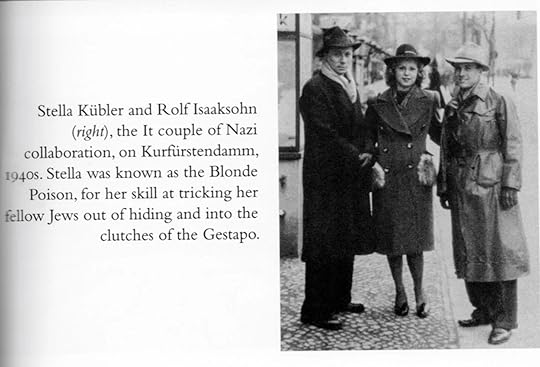
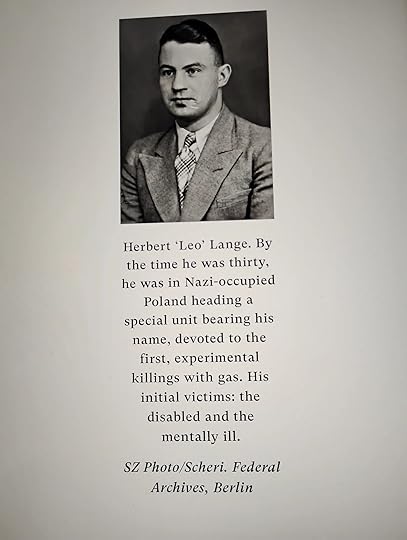
A real strength of this book is that it conveys so powerfully the kind of everyday stress and scrutiny that came with the Nazi regime, and how oppressive it was to live under. Readers get a clear picture of how horrendous it was - Freedland, to his credit, does not shy away from the gory details, especially when discussing Leo Lange, who essentially invented concentration camp gas chambers - and I think that emphasises just how brave the group of people the book follows really were. We follow them through true ups and downs, into the horrors of being imprisoned in a concentration camp and tortured, and it drives home the message of just how horrific Nazi Germany was.
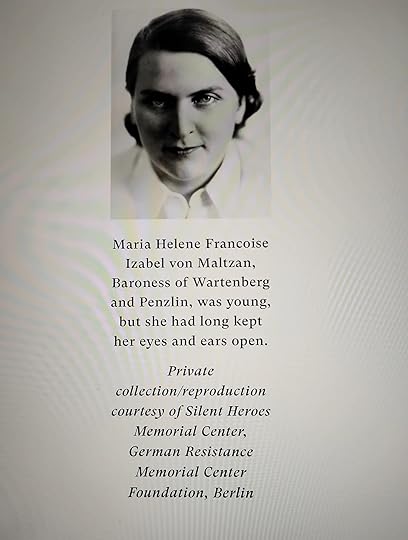
Freedland does a great job of introducing us to the main cast of 'characters,' the people in the so-called 'Traitor's Circle.' Their stories were central to the book, and Freedland manages to condense a vast amount of research and detail into a narrative that is easy to follow and gripping to watch unfold. My only problem with this was that sometimes, the intense focus on the members of the tea party worked to the book’s detriment. There were several times when a brother, son, maid, etc., of one of the leading ‘characters’ seemed to spring out of nowhere, or were referred to as if they had already been introduced; I would have appreciated a little more introduction of these people.
Also, while I'm not entirely sure this is not my own faulty memory talking, I felt like we could’ve done with more explanation or detail of how the participants knew each other before they were all invited to the tea party. We got that for some members, but some invites seemed a little random. And because of this, it felt a little odd that the blurb and title were selling this as ‘the Traitor’s Circle’ as if they were an organised group of rebels, like the various groups who plotted to assassinate Hitler, several of whom (Black Orchestra, July 20th plot) are detailed in this book as well. As for the tea party group, it often seems more like they were rebels doing separate anti-government things who all happened to know each other and all happened to get invited to the tea party with the spy. They were treated as if they were an organised group later on by their interrogators, true, but it still felt like a disconnect between the marketing and what actually happened in the book.
As for the writing itself, I often felt The Traitor's Circle could have used more mentions of exactly where Freedland was getting his information from, for example, ‘she wrote in her diary’ or ‘we know from a letter’. The style he’s written it in increases the thriller-like nature of the text, but I would’ve really appreciated seeing a bit more of the bones, so to speak, so I would know when the author had direct evidence for someone saying or thinking something, and when he was inferring what they must have been feeling. I feel like this is so important in historical writing because it assures people you’re not just pulling this stuff from nowhere to make the story more exciting; it gives the text much more credibility.
Linked to this, I felt that the author missed a trick when I reached the acknowledgements section and saw how many relatives he had spoken to who got no mention in the text. Again, seeing more of the bones of the research would've helped hugely with making this feel more like a credible historical work than a thriller. It would’ve been great to hear that this comment came from an interview with a nephew or granddaughter, for example, and I don't think asides like that would've slowed down the pace of the book or made it feel less thrilling. The author did a tremendous amount of work and research in writing this book, and unless you flip through the notes or read the acknowledgements (which many readers don’t!), you’re not getting a good sense of exactly how much work went into this.
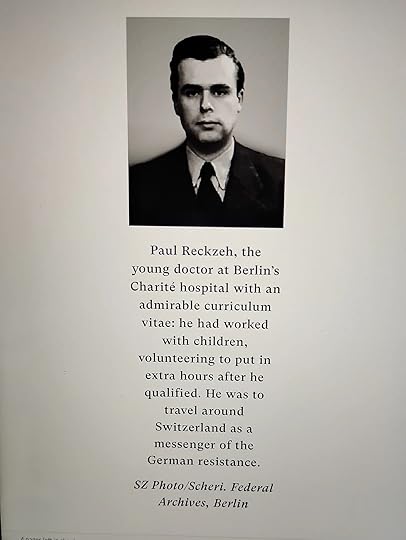
I also feel that there’s some information in the notes that would have been much more satisfying if it had been included in the main text. The account of what Bianca Segantini felt after Reckzeh was outed as a spy stands out most obviously in my mind; I was wondering about that throughout most of the book, and I am glad we got that answer, but it should have been in the main text!
And while we're talking about it, a note on the notes system in this book: I’m not convinced by the idea of having notes attached to phrases in the main text (i.e., “joining the Kriminalpolizei: Montague, Chełmno, p. 16.”) rather than the usual style of having a superscript number correspond with a note in the back of the book. In the former system, you still have to flip from the main text to the notes section to see exactly which part of the main text is relevant, and random phrases are, in my opinion, much harder to pick out than superscript numbers. A case of ‘don’t fix what isn’t broken'!
Throughout the book, I got a little tired of the ‘stinger’ lines at the end of every chapter. Some worked well, setting up anticipation for the next chapter that kept me reading, but when it was at the end of every chapter, it at times became forced and repetitive.
With all that said, I am still giving The Traitor's Circle four stars, as it is a very well-written book with a lot of research behind it. None of my gripes above really detracted from my reading experience all that much; I often got so caught up in the flow of the story that I didn't really notice them. What's more, I think The Traitor's Circle addresses a truly important subject matter that, with the worrying rise of fascist tendencies worldwide, we need to be discussing. Topical, intense, and thrilling, I would highly recommend The Traitor's Circle.