The Artifacts is a brand new, original picture book created especially for iPad/iPod Touch and iPhone.
Designed for children aged 4 and up, this is an interactive picture book about a boy called Asaf who loves to collect.
It is inspired in equal parts by: childhood collections of bizarre and unlikely things, memories of moving house, the minimalist movement, and the joy of creating imaginative worlds of one’s own.
Lynley Stace has written short stories for anthologies and zines which tend to go out of print or become abandoned.
So in 2011 Lynley wrote and illustrated her first children's book app, since apps don't go out of print, having never been in print in the first place. The Artifacts is a universal app.
In 2013 Midnight Feast was published for iPad only.
In 2015 Hilda Bewildered was published. But then Apple took it off the App Store for their own private reasons so actually apps do go out of 'print'.
In the same year, she produced a slightly disturbing re-visioning of Little Red Riding Hood with a friend, and an illustrated iBook version of Diary of a Goth Girl, which went out of print in England six years earlier.
Creative output still going strong, privately..
Not underweight as in the profile pic. Hipster avatar creator only had one option.
The Artifacts is an interactive, linear (Unsworth, 2006) text designed specifically for iPad. Its co-contributors (Stace & Hare, 2012) have integrated narrative and digital elements into an immersive story with universal appeal. Although being confined to one platform might seem a disadvantage, no platform has guaranteed long-term viability; just as book covers date, digital platforms ebb and flow.
Stace’s story is simple. Asaf is obsessed with collecting discarded, sometimes unhygienic objects. His parents use moving house as a chance to clear out all his junk. Asaf resorts to collecting in his imagination, and builds an impressive, intangible, invisible bank of ideas, culminating in writing and sharing. It’s a powerful theme enriched by interactive components, music, and sound effects. The inclusion of metaphor and humour is especially successful.
The Artifacts depends on gesturing and digital manipulation (Bouchardon & Heckman, 2013) for full experience. Coder, Daniel Hare, has developed several excellent features, including voice-over and sound effects, both optional. Admittedly, the main voice is sometimes monotonous, but the sound effects add authenticity and humour. There’s a page (p. 2) with rubbish bins tipping over, and if the screen is tapped in just the right spot, a little shadow dog jumps high and there is a distinct ‘yip’. Young children would be keen to keep it jumping and yipping.
While the need to tap and rub the screen of The Artifacts ensures reader engagement (Houston, 2011), there isn’t always a signal indicating it’s time to move on. On page 5, the text notes (Asaf’s parents) ’did not appreciate his penchant for caterpillars’. Each touch produces a leaf, exactly where the touch happens, and the three caterpillars wriggle over to munch it. Repeated tapping results in more leaves and more munching. It doesn’t seem to matter how long the screen is tapped, the leaves appear. I was disappointed the creatures didn’t transform into butterflies. I really did feed them a lot!
On the other hand, not knowing when to move on can result in a happy surprise. I thought I had discovered everything about one page, but while showing it to another teacher, I accidentally unlocked another element. This led to a shared moment of fun and wonder, and it prompted me to review pages to see if there were other things I’d missed (and there were).
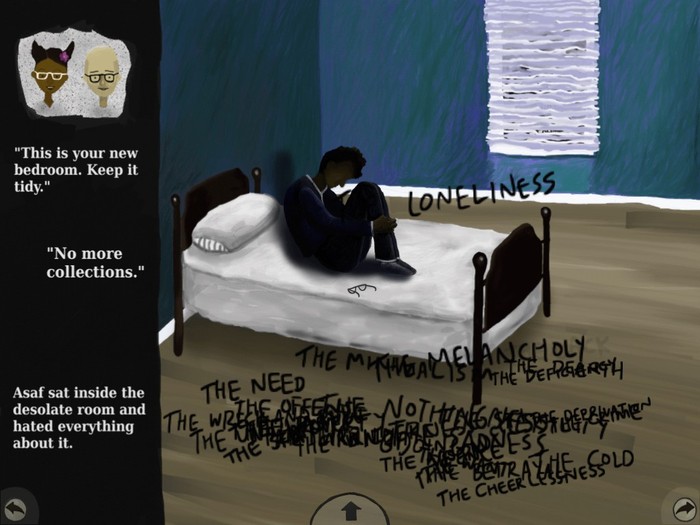
Although there is very little text, the language is powerful, and builds vocabulary. To accentuate Asaf’s despondency, one illustration depicts him curled up in shadow, and as the screen is tapped, words appear and grow. The gloom, the desolation, isolation, loneliness, the emptiness (p. 9) and so on, a visual representation of his sadness.
There is one particularly effective alliterative sentence on a different page: He stepped on shadows to snag them… then strung them across his ceiling… (p. 17). Even though there isn't enough text to sustain sophisticated readers, there is plenty to challenge those who are reluctant or just starting their independent reading journey.
The Artifacts also has something to offer educators who want to develop empathy in students. On one page (p. 6) there is a simple reverse screen, where Asaf moves from being the large human looking in on the trapped bug in a closed bottle, to actually being in the bottle being watched over by a big green bug. The idea to walk in the shoes of another person is a strong reason to encourage young people to read, and digital literature may be able to do this well.
On a Meta level, The Artifacts can be seen as a metaphor for the move from print to screen reading. Asaf’s initial collections are all physical objects. There is much talk now about the print book as an artefact (Ingram, 2013), and although the journey isn’t quick or easy, Asaf eventually adapts to his intangible imaginary collection (his virtual world), paralleling our process of moving from one form of reading to another. A sense of nostalgia permeates, our sense of grief is strong, yet inevitably we move on, adapt and find another way to read, and ultimately share.
This review has been completed for the subject INF533, Literature in Digital Environments, as part of a Masters of Education degree. Image used with permission of authors.
Reference List
Bouchardon, S., & Heckman, D. (2012). Digital Manipulation and Digital Literature. Electronic Book Review. Retrieved from Electronic Book Review website: http://www.electronicbookreview.com/t....
Houston, C. (2011). Digital Books for Digital Natives. Children & Libraries: The Journal of the Association for Library Service to Children, 9(3), 39-42.
Stace, L., & Hare, D. (2011). The Artifacts. Slap Happy Larry. Retrieved from iTunes App Store.
Unsworth, L. (2005). Learning through web contexts of book-based literary narratives (Ch. 3). In E-literature for Children: Enhancing Digital Literacy Learning. Hoboken: Taylor and Francis. Retrieved from http://CSUAU.eblib.com/patron/FullRec....