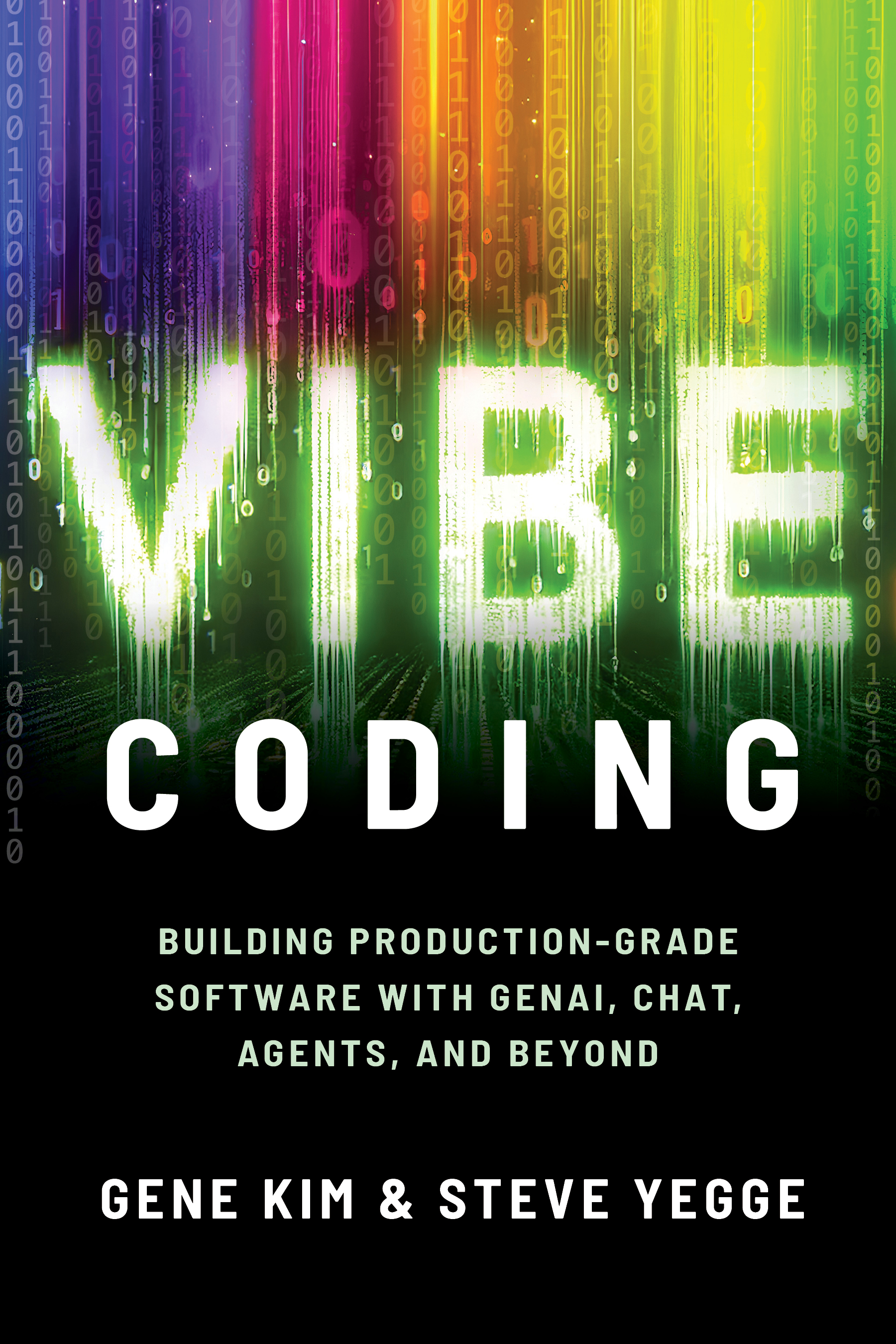
I read this book to try and get useful insights on how to use AI beyond vibecoding. I did not find that in this book. Now excuse me while I go off on the biggest rant for a book I may ever write.
I am in software, and I wanted to like this book so much. I forced myself to get through the whole book to give it a fair shot (I even read the “just checking if you’re reading carefully tricks” that were slotted in -- no, Clojure is not the future of programming languages, Steve), because I greatly respect the two authors and their previous writing. I had read Gene’s Phoenix Project, and it introduced me to the DevOps movement. Steve’s blog posts are a big reason I took the compilers class during university.
Unfortunately, this ended up being the first book that I have read that I unequivocally think deserves the lowest rating possible. It’s possible they were pressured to release this earlier because it’s such a hot topic, but I’m actually offended they saw fit to release this in its current state.
Firstly, this book is marketed towards developers, and it’s got “building production grade software” in the title, but I feel like they couldn’t make up their mind throughout the book about their target audience (developers, technical leadership, hobbyists?), pingpong-ing from talking about Gradle, unit testing and Clojure in one chapter (clearly developer-focused) and explaining what an API is in another (very basic). If they got this straight, I feel like they would have been able to have a much more cohesive narrative. As it stands, I feel like leadership was more of the target audience, just because most developers wouldn’t find anything really of value here. This was like those workshops you hear about that are really just fluff and talk about things at very high levels, making you feel good about yourself but not really giving you anything actionable to take away.
Secondly, the first ~1/3 of the book is basically dedicated to scaring you into feeling left behind. It could really be summarized in a few pages - lots of people are using AI, agentic coding is becoming the norm, it’s changing workflows forever, and if you tried it in 2023/204 and think it’s crap, you need to try it again. Well worth stating, but not over and over.
Thirdly, I don’t agree with a lot of the central premise of the book. There is so much focus on tying success to lines of code (LOC) generated, which is famously a horrid way of measuring output (and stinks of something only leadership focuses on). I don’t care that you wrote 10,000 lines of Clojure code in 4 days across how many files. Is that robust? Do you know how it works? And there is barely any talk about how to ensure code quality beyond them really just saying “use version control. Tests are mandatory now.” There is barely any concrete acknowledgement about how jamming in 10,000 new lines of code means you now have 10,000 LOC to support, with a fraction of time spent working with and understanding that new system.
Their experience is so different to mine - there is a lot of talk about the dopamine rush of when AI implements things so quickly. When I use AI, I like that it can automate writing code, and it is a great pair programming and thinking partner, but if I were to use it to the extent they are recommending, I get anxious about not fully understanding how the code I’ve written works. Maybe that’s a sign of me not letting go of the wheel enough, but I don’t like how they don’t seem to acknowledge that one of the core responsibilities of being a developer is having a proper mental model to know how to build and modify a system correctly, not just to deliver features.
But the main reason why I hate this book (truly, truly hate it) is nothing to do with the content. It’s 100% the writing.
This was the first book I “skimmed” in the truest sense of the word (practically skipping some chapters, flying through some of them within minutes towards the end). And it wasn’t for a lack of trying. This book is so bad I feel guilty for counting it towards my read challenge.
I eventually gave up and started skimming because it’s actual literal AI slop. Without them even telling me, I began to suspect 1/5th of the way through the book that it was written with AI. Only for them to admit a few chapters later that they used it directly to help with the writing process. You would think that them acknowledging it would mean they were well aware of its limitations and used it responsibly. But it’s the opposite. There is just so much repetition everywhere, and it absolutely ruins the book (not to mention, makes me feel like I got conned into spending more money because the actual content is so minimal).
Just as with AI code, if I start to doubt the integrity and quality of a block of code, I start to doubt the whole PR. Here, I’m questioning the quality of the entire book (and whoever agreed to publish this).
Why is there so much intro and prefacing before diving into each topic? Why does every chapter need a conclusion section? Why is there signposting everywhere? In Chapter 2: there is an intro and conclusion to something that can be read within 5-10 minutes.
There are countless repeated stories across chapters. The writing tools developed by Gene, the “should have been a summer intern project”, the “ai deleted the last copy of something for wyvern and it only existed in this one terminal.” They especially kept referencing the same 2 examples (Gene’s writing bench and the Wyvern project), as if I haven’t heard the horror stories like 15 times already, ad nauseum. It’s one thing if we look at different aspects of that story/project, but it’s pretty much just the same story, repeated again but written slightly differently (because it’s AI WRITTEN).
There are needless analogies and explanations cluttering the book “it was like asking your dog to put back the shoes it ruined” - I don’t need that analogy when you say AI deleted your tests, and you then asked it to bring it back. What is the point of that?
When I use AI-assisted coding, I find that if you’re not careful, it is very easy to get wrapped up in following the logic it puts out, especially if things are working, and at some point, you forget the big picture and don't take a step back and see the spaghetti code you are writing. I feel like the same thing happened here.
They talk so much about using AI to improve this draft. At one point they even talk about a parallel draft ranking system for this book. The one thing I just wish they would have done is read the dang book cover to cover and actually proofread/copy-edit it properly.
If I could, I would consider giving this a 1.5, just because there are some tidbits of useful insight here. The bit about how LLM context works is a good breakdown. And the bit about implementing features via a tracer bullet style, one vertical slice at a time, is good. But the writing is so bad that I could never, ever recommend this book to anyone.
I thought AI code slop was bad. They’ve now introduced me to dystopian world of AI literature slop, and it hurts my soul 100x worse. I truly hope this is not the future of writing, because I hate it.