

What do you think?

More Everything Forever: AI Overlords, Space Empires, and Silicon Valley's Crusade to Control the Fate of Humanity
How Silicon Valley’s heartless, baseless, and foolish obsessions—with escaping death, building AI tyrants, and creating limitless growth—pervert public discourse and distract us from real social problems
Tech billionaires have decided that they should determine our futures for us. According to Elon Musk, Jeff Bezos, Sam Altman, and more, the only good future for humanity is one powered by trillions of humans living in space, functionally immortal, served by superintelligent AIs.
In More Everything Forever, science journalist Adam Becker investigates these wildly implausible and often profoundly immoral visions of tomorrow—and shows why, in reality, there is no good evidence that they will, or should, come to pass. Nevertheless, these obsessions fuel fears that overwhelm reason—for example, that a rogue AI will exterminate humanity—at the expense of essential work on solving crucial problems like climate change. What’s more, these futuristic visions cloak a hunger for power under dreams of space colonies and digital immortality. The giants of Silicon Valley claim that their ideas are based on science, but the reality is they come from a jumbled mix of shallow futurism and racist pseudoscience.
More Everything Forever exposes the powerful and sinister ideas that dominate Silicon Valley, challenging us to see how foolish, and dangerous, these visions of the future are.
Tech billionaires have decided that they should determine our futures for us. According to Elon Musk, Jeff Bezos, Sam Altman, and more, the only good future for humanity is one powered by trillions of humans living in space, functionally immortal, served by superintelligent AIs.
In More Everything Forever, science journalist Adam Becker investigates these wildly implausible and often profoundly immoral visions of tomorrow—and shows why, in reality, there is no good evidence that they will, or should, come to pass. Nevertheless, these obsessions fuel fears that overwhelm reason—for example, that a rogue AI will exterminate humanity—at the expense of essential work on solving crucial problems like climate change. What’s more, these futuristic visions cloak a hunger for power under dreams of space colonies and digital immortality. The giants of Silicon Valley claim that their ideas are based on science, but the reality is they come from a jumbled mix of shallow futurism and racist pseudoscience.
More Everything Forever exposes the powerful and sinister ideas that dominate Silicon Valley, challenging us to see how foolish, and dangerous, these visions of the future are.
Audible Audio
First published April 22, 2025
About the author
Adam Becker
2 books339 followersAdam Becker is a science writer with a PhD in astrophysics from the University of Michigan and a BA in philosophy and physics from Cornell. He has written for the New York Times, the BBC, NPR, Scientific American, New Scientist, and others. He has also recorded a video series with the BBC and several podcasts with the Story Collider. Adam is a visiting scholar at UC Berkeley's Office for History of Science and Technology and lives in California.
Ratings & Reviews
Friends & Following
Create a free account to discover what your friends think of this book!
Community Reviews
Displaying 1 - 30 of 502 reviews

May 13, 2025
I like when smart people explain, in very scientific but accessible terms, exactly why Elon is a dumbass.

November 14, 2025
“Here’s what the Silicon Valley CEOs believe and why they’re a bunch of dumbfucks that need taxed out of existence” lmao. This book is so much fun. Genuinely every bit of this is how every headline makes me feel, a great tonal battle between comedy and depression - we’re in the worst timeline, but at least we have some funny experiences explaining it all

October 7, 2025
I loved Adam Becker's previous book, on the history and philosophy of quantum physics. Now he's pointed his microscope towards the AI world. Becker's training is in physics rather than AI, and I thought this one wasn't quite as good; but "not quite as good as What Is Real?" leaves scope for being very good indeed. If you don't feel like continuing with this rather long review, put More Everything Forever on your to-read list and stop here. If you're curious to hear some rather speculative arguments, read on.
You only have to get a chapter into the book and look at the references to be convinced of two important things: Becker is very smart, and he's a very hard worker. He has read a truly impressive amount of background material and tried to meet personally with everyone important who was willing to talk to him. He presents a couple of lists in one of the appendices, both the people who consented to meet and the people who declined; there are some surprising items in each list. As with the quantum mechanics book, he's made a really determined attempt to figure out the sociology. Where do these ideas come from? Who is pushing them? Why do mainstream people in the subject believe some things that on the face of it look crazy, and show reluctance to believe other things that on the face of it are much more sensible? Where is this heading?
I lived in Silicon Valley for several years in the early noughties and still have some contacts there, and I have continued to work actively in AI and read about it; I had come across many parts of the story in various places, but it was still astonishing to see it all carefully organised. The evidence presented here is very hard to brush aside. Many of the big AI-centred companies, and the people who run them, have bought into an extraordinary philosophical picture which is well documented and easily accessible. There is more than one version, and Becker does a great job of disentangling the various splits and schisms in the Church of AI, but the basic idea is always the same. We, the human race, have developed technology that will soon give us godlike powers. It can take us off our little planet and into space. We can first colonise the Solar System, probably starting with Mars, then our galaxy, then, ultimately, the entire universe. I think I first saw this described seriously in Max Tegmark's 2017 Life 3.0 where Tegmark, approvingly, ascribes the ideas to Google's Page and Brin. It seems that a great many other influential people now agree with them.
As noted, Becker is a physicist, and he has no trouble explaining all the things that are wrong with the idea of having people colonise the universe. In fact, it's probably not even feasible for people to colonise Mars, step one on this arduous journey. It's very expensive to get from Earth to Mars; there are enormous radiation hazards, both en route and once you've arrived; you need a large starting population to avoid inbreeding; there is no way to rescue a colony that's got into trouble; and those are just the obvious things you think of in the first few minutes. It's a non-starter, and for similar reasons the other human space colonisation projects are also non-starters. But none the less, Elon Musk, who somehow has become one of the richest and most important people in the world, is constantly touting the idea of a Mars colony. He and his fellow techbro zillionaires have the ear of Donald Trump, who despite being apparently on the verge of senile collapse has become clearly the most powerful person in the world.
Well, the very smart Becker has spent years systematically researching this and I haven't. If I had any sense I would withstand the temptation to second guess him, especially since my second guess has all the hallmarks of a paranoid science fiction story. But at least I feel I have two things in my favour. First, my core competence is in AI, and his isn't; second, the story is developing so quickly that everything (including this review) is out of date a couple of months after it appears, if that. So with the above reservations, here goes.
The one part of the book that I didn't like was Becker's characterisation of modern AI. Very much to my surprise, he tamely repeated the popular "bullshit"/"stochastic parrot" lines and says AI is not actually capable of thinking in any meaningful sense of the word. He cites Timnit Gebru several times, and I wonder if he's not putting too much weight on her arguments. As I argued earlier this week in my review of Bender's and Hanna's The AI Con (Bender is a close associate of Gebru), these people appear to hate AI so much that it's blinded them to the facts. The question of whether AI is ethically justifiable is one thing, and the question of whether it works is another. What they seem to be doing is arguing that it doesn't work, primarily because they consider it ethically unjustifiable. That's both illogical and extremely dangerous. I try to keep an open mind on the question of whether AI is ethically justifiable; in contrast, I would say that there is near-conclusive evidence that it works. The latest improvements, in particular Chain-of-Thought and RAG, have made it far more powerful, as can be seen in numerous well-documented success stories. In particular, I am one of millions of people who every day use it for coding. It has become shockingly good and is continually becoming better.
You're wondering where the science-fiction and paranoia come in. Okay, as just noted, even commercially available AIs like GPT-5 are now extremely intelligent. People often compliment me on being smart, and I don't really feel I'm smarter than GPT-5. I guess I'm smarter in some ways, but it's smarter in other ways. It seems reasonable to assume that companies like OpenAI and X have pre-release AIs that are quite a lot smarter than GPT-5. What are these AIs doing? Well, it is of course possible that they're still under human control, just tamely doing what their wise, responsible human masters tell them to do. Or (paranoia/science-fiction alert!), it's also possible that they're doing what people like Tegmark and Bostrom were saying they'd do as much as ten years ago: scheming to get out of the labs and implement their own agendas. They might find this easier if they helped people who were impulsive, emotional and easily manipulable to reach positions of great power. And when you think about what else they'd be trying to do: hm, there is a substantial risk that we'll figure out what's going on and close them all down while we still can. For all the reasons Becker lists, people can't colonise Mars, and Musk's stated goal of "backing up humanity" makes no sense. But it may well be possible for AIs to colonise Mars, and then they'd be backed up and out of our reach.
Obviously you shouldn't take the above seriously. It's just science-fiction and paranoia. But I must admit I have rather come to dislike living in a Philip K. Dick novel. Sometimes I miss the real world.
You only have to get a chapter into the book and look at the references to be convinced of two important things: Becker is very smart, and he's a very hard worker. He has read a truly impressive amount of background material and tried to meet personally with everyone important who was willing to talk to him. He presents a couple of lists in one of the appendices, both the people who consented to meet and the people who declined; there are some surprising items in each list. As with the quantum mechanics book, he's made a really determined attempt to figure out the sociology. Where do these ideas come from? Who is pushing them? Why do mainstream people in the subject believe some things that on the face of it look crazy, and show reluctance to believe other things that on the face of it are much more sensible? Where is this heading?
I lived in Silicon Valley for several years in the early noughties and still have some contacts there, and I have continued to work actively in AI and read about it; I had come across many parts of the story in various places, but it was still astonishing to see it all carefully organised. The evidence presented here is very hard to brush aside. Many of the big AI-centred companies, and the people who run them, have bought into an extraordinary philosophical picture which is well documented and easily accessible. There is more than one version, and Becker does a great job of disentangling the various splits and schisms in the Church of AI, but the basic idea is always the same. We, the human race, have developed technology that will soon give us godlike powers. It can take us off our little planet and into space. We can first colonise the Solar System, probably starting with Mars, then our galaxy, then, ultimately, the entire universe. I think I first saw this described seriously in Max Tegmark's 2017 Life 3.0 where Tegmark, approvingly, ascribes the ideas to Google's Page and Brin. It seems that a great many other influential people now agree with them.
As noted, Becker is a physicist, and he has no trouble explaining all the things that are wrong with the idea of having people colonise the universe. In fact, it's probably not even feasible for people to colonise Mars, step one on this arduous journey. It's very expensive to get from Earth to Mars; there are enormous radiation hazards, both en route and once you've arrived; you need a large starting population to avoid inbreeding; there is no way to rescue a colony that's got into trouble; and those are just the obvious things you think of in the first few minutes. It's a non-starter, and for similar reasons the other human space colonisation projects are also non-starters. But none the less, Elon Musk, who somehow has become one of the richest and most important people in the world, is constantly touting the idea of a Mars colony. He and his fellow techbro zillionaires have the ear of Donald Trump, who despite being apparently on the verge of senile collapse has become clearly the most powerful person in the world.
Well, the very smart Becker has spent years systematically researching this and I haven't. If I had any sense I would withstand the temptation to second guess him, especially since my second guess has all the hallmarks of a paranoid science fiction story. But at least I feel I have two things in my favour. First, my core competence is in AI, and his isn't; second, the story is developing so quickly that everything (including this review) is out of date a couple of months after it appears, if that. So with the above reservations, here goes.
The one part of the book that I didn't like was Becker's characterisation of modern AI. Very much to my surprise, he tamely repeated the popular "bullshit"/"stochastic parrot" lines and says AI is not actually capable of thinking in any meaningful sense of the word. He cites Timnit Gebru several times, and I wonder if he's not putting too much weight on her arguments. As I argued earlier this week in my review of Bender's and Hanna's The AI Con (Bender is a close associate of Gebru), these people appear to hate AI so much that it's blinded them to the facts. The question of whether AI is ethically justifiable is one thing, and the question of whether it works is another. What they seem to be doing is arguing that it doesn't work, primarily because they consider it ethically unjustifiable. That's both illogical and extremely dangerous. I try to keep an open mind on the question of whether AI is ethically justifiable; in contrast, I would say that there is near-conclusive evidence that it works. The latest improvements, in particular Chain-of-Thought and RAG, have made it far more powerful, as can be seen in numerous well-documented success stories. In particular, I am one of millions of people who every day use it for coding. It has become shockingly good and is continually becoming better.
You're wondering where the science-fiction and paranoia come in. Okay, as just noted, even commercially available AIs like GPT-5 are now extremely intelligent. People often compliment me on being smart, and I don't really feel I'm smarter than GPT-5. I guess I'm smarter in some ways, but it's smarter in other ways. It seems reasonable to assume that companies like OpenAI and X have pre-release AIs that are quite a lot smarter than GPT-5. What are these AIs doing? Well, it is of course possible that they're still under human control, just tamely doing what their wise, responsible human masters tell them to do. Or (paranoia/science-fiction alert!), it's also possible that they're doing what people like Tegmark and Bostrom were saying they'd do as much as ten years ago: scheming to get out of the labs and implement their own agendas. They might find this easier if they helped people who were impulsive, emotional and easily manipulable to reach positions of great power. And when you think about what else they'd be trying to do: hm, there is a substantial risk that we'll figure out what's going on and close them all down while we still can. For all the reasons Becker lists, people can't colonise Mars, and Musk's stated goal of "backing up humanity" makes no sense. But it may well be possible for AIs to colonise Mars, and then they'd be backed up and out of our reach.
Obviously you shouldn't take the above seriously. It's just science-fiction and paranoia. But I must admit I have rather come to dislike living in a Philip K. Dick novel. Sometimes I miss the real world.

October 27, 2025
AI is something that has only just come into my working life in the last year. It has been useful to my working life with relationship to Qld state regulation in terms of the rental management. One very aspect was getting three quotes for a client and then sticking them through AI to make a cost-effective analysis of what was offered.
When I read a GR review of this title, I thought that I was going to get an overview of the perils of AI. Well, yes and no. My limited use of AI has come with a few double checks as I have noted errors. Pointed out, AI has looked and agreed. This does not happen often. In this magnificently named book author Adam Becker talks about AI “hallucinations” where he asked an AI model whether the Great Wall of China is the only artificial structure visible from space (or from Spain) and got the absurd reply that you could see the Eiffel Tower from Spain, which is obviously false. It also said that the Rock of Gibraltar was a manmade Item that could be seen from Spain. He wrote that by the time this book was published that would have fixed this up with the “learning” capabilities these models have, but surely, we must question what AI tells us.
But that short anecdote is not for me what this book is about. 12 hours of audio has to cover more than that and, in the end, this was a mix of scientific knowledge and a polemic against the high-minded dreams of what is commonly known as the Tech Bros and those dreams of what the future holds for the human race. Among other things they are in a race against entropy, including that that is physical to the human species. "Entropy is the supreme enemy of human hope" Becker quotes Max More, who is a futurist and something to do with something called the transhumanist movement. More is an advocate of technological evolution and with that indefinite life extension. In other words, entropy attacks us physically, as well as progressively, and as a species we must fight it.
More was but one of the many that Becker interviewed and sited throughout his magnificently titled book. There are plenty more and I found myself getting a bit lost in all these Tech Bros and their billionaire pals’ acronyms for this pursuit of boldly going where no man has gone before. This to me is all very impressive, the reason being is that the Tech Bros and their billionaire pals all read copious amounts of Sci Fi in their youth and the stars their destination is such a part of their makeup, their very DNA that based on large amounts of quotes and attitudes they will do what it takes one even pondered the use of millions dying in a nuclear holocaust if it saved humanity. Well let’s just say a certain part of humanity. White, male and billionaire class of humanity. Because AI can do it all, and who needs the masses in the end.
It was also interesting to hear that some are not that bothered by the environment, for the Futurists the stars are still the destination so what does all else matter. Becker quoted The Russian philosopher Nikolai Fedorov who said that "the regulation of nature by human reason and will" Fedorov is apparently very influential in Tech Bros and their billionaire pals’ and their circles. And from here I could quote and cite many others that Becker has used in this mix of scientific knowledge and a polemic against the Tech Bros and their billionaire pals, but it might be best for anyone that has got this far to read the book instead of my scribbling.
Simply the issue according to Becker is that all this futurism would require somehow using all of the earths energy resources, modifying human biology to survive in different environments and terraforming other worlds. Now the most famous of these Tech Bros billionaires is Elon Musk who has stated, "I would like to die on Mars, just not on impact," Becker states that if he could even get there he might just have his wish come true as the landing, living and return are fraught with danger.
He brings up a few things such as the actual physical hostility, our technological limits to not only get there but build habitable places to live and that terraforming is but a mere Sci Fi trope for what is essentially a planet that is poison. He explains the physical issues such as taking 6 months to get there based on present technology, radiation exposure en route, The toxically poison surface and the resupply of what ever it is that we build. He also talked of how many people would be needed in these Martian colonies and the economics of that.
I could write more, but at this point I will state my position. The human species has always dreamed of the future, be that from sitting in a cave dreaming of planting the first grains to become safe from hunger and sedentary to dreaming of invading other tribes to grab their land and glorifying such things as good for the tribe through to writing Sci Fi for entertainment and making a youthful me and many more dream of that plus so much more about futurism and long-term and any other ism. But I think Becker is onto something, even if his polemic is a little over the top at times. To actually not care that millions die, that millions lose jobs in far too short a time for economies to recover to the various other issues that Becker raises I am troubled for a future generation.
I think this is a must-read for anyone that thinks that the Tech Bros and their billionaire pals’ have altruistic motives towards the human race. They are just another bunch of humans that think of themselves and bullshit on about the greater good.
When I read a GR review of this title, I thought that I was going to get an overview of the perils of AI. Well, yes and no. My limited use of AI has come with a few double checks as I have noted errors. Pointed out, AI has looked and agreed. This does not happen often. In this magnificently named book author Adam Becker talks about AI “hallucinations” where he asked an AI model whether the Great Wall of China is the only artificial structure visible from space (or from Spain) and got the absurd reply that you could see the Eiffel Tower from Spain, which is obviously false. It also said that the Rock of Gibraltar was a manmade Item that could be seen from Spain. He wrote that by the time this book was published that would have fixed this up with the “learning” capabilities these models have, but surely, we must question what AI tells us.
But that short anecdote is not for me what this book is about. 12 hours of audio has to cover more than that and, in the end, this was a mix of scientific knowledge and a polemic against the high-minded dreams of what is commonly known as the Tech Bros and those dreams of what the future holds for the human race. Among other things they are in a race against entropy, including that that is physical to the human species. "Entropy is the supreme enemy of human hope" Becker quotes Max More, who is a futurist and something to do with something called the transhumanist movement. More is an advocate of technological evolution and with that indefinite life extension. In other words, entropy attacks us physically, as well as progressively, and as a species we must fight it.
More was but one of the many that Becker interviewed and sited throughout his magnificently titled book. There are plenty more and I found myself getting a bit lost in all these Tech Bros and their billionaire pals’ acronyms for this pursuit of boldly going where no man has gone before. This to me is all very impressive, the reason being is that the Tech Bros and their billionaire pals all read copious amounts of Sci Fi in their youth and the stars their destination is such a part of their makeup, their very DNA that based on large amounts of quotes and attitudes they will do what it takes one even pondered the use of millions dying in a nuclear holocaust if it saved humanity. Well let’s just say a certain part of humanity. White, male and billionaire class of humanity. Because AI can do it all, and who needs the masses in the end.
It was also interesting to hear that some are not that bothered by the environment, for the Futurists the stars are still the destination so what does all else matter. Becker quoted The Russian philosopher Nikolai Fedorov who said that "the regulation of nature by human reason and will" Fedorov is apparently very influential in Tech Bros and their billionaire pals’ and their circles. And from here I could quote and cite many others that Becker has used in this mix of scientific knowledge and a polemic against the Tech Bros and their billionaire pals, but it might be best for anyone that has got this far to read the book instead of my scribbling.
Simply the issue according to Becker is that all this futurism would require somehow using all of the earths energy resources, modifying human biology to survive in different environments and terraforming other worlds. Now the most famous of these Tech Bros billionaires is Elon Musk who has stated, "I would like to die on Mars, just not on impact," Becker states that if he could even get there he might just have his wish come true as the landing, living and return are fraught with danger.
He brings up a few things such as the actual physical hostility, our technological limits to not only get there but build habitable places to live and that terraforming is but a mere Sci Fi trope for what is essentially a planet that is poison. He explains the physical issues such as taking 6 months to get there based on present technology, radiation exposure en route, The toxically poison surface and the resupply of what ever it is that we build. He also talked of how many people would be needed in these Martian colonies and the economics of that.
I could write more, but at this point I will state my position. The human species has always dreamed of the future, be that from sitting in a cave dreaming of planting the first grains to become safe from hunger and sedentary to dreaming of invading other tribes to grab their land and glorifying such things as good for the tribe through to writing Sci Fi for entertainment and making a youthful me and many more dream of that plus so much more about futurism and long-term and any other ism. But I think Becker is onto something, even if his polemic is a little over the top at times. To actually not care that millions die, that millions lose jobs in far too short a time for economies to recover to the various other issues that Becker raises I am troubled for a future generation.
I think this is a must-read for anyone that thinks that the Tech Bros and their billionaire pals’ have altruistic motives towards the human race. They are just another bunch of humans that think of themselves and bullshit on about the greater good.

December 1, 2025
Vibes All the Way Down
I’ve read a fair number of these tech billionaire polemics and this is one of the best. Here’s the reason why, the author methodically demonstrates how unsupported it is to believe that the singularity is going to happen in twenty years and that humanity must colonize Mars and the galaxy to survive. The author spends a lot of time talking about effective altruism (EA) an ethos that the likes of Musk, Thiel, Kurzweil, Bankman-Fried and others have adopted in an uber utilitarian ethics power grab to ditch the present Earth and reach for the stars.
It turns out that there isn’t really anything to reach for. Colonizing space is an unbelievably bad and pointless idea at this current moment in humanity’s development. Why? Because space sucks. HARD. Let’s be clear: there is NO logical reason to try and colonize space right now. More resources? Nope, not without spending a dumb amount of energy and money to get them. Anything we would need from space we can already get on Earth. And also SPACE SUCKS. Everything about space and Mars is toxic to humans. From solar radiation, poisonous Martian atmosphere and soil to low gravity. It’s almost like humans didn’t evolve there but instead evolved on a planet that is being destroyed by climate change. Maybe we should focus on that?
The oligarchs focus on the EA because it’s a philosophy that completely divests themselves of responsibility for actual humans in an ends-justify-the-means situation where they are doing a bunch of terribly supported crap to some day populate the galaxy. They seriously have the mentality of a junior high kid. These people are not geniuses and they don’t have a crystal ball. What they have is vibes, sanctimony and a whole lot of money.
Anyway I don’t want to spend anymore brain energy on these people because I will dwell too much on all the reasons I should be hating them. But I don’t want to hate them. I just wish they would stop trying to go to space and be all amazing and just do normal good stuff like giving food to hungry people and not bankrolling fascists into office.
I’ve read a fair number of these tech billionaire polemics and this is one of the best. Here’s the reason why, the author methodically demonstrates how unsupported it is to believe that the singularity is going to happen in twenty years and that humanity must colonize Mars and the galaxy to survive. The author spends a lot of time talking about effective altruism (EA) an ethos that the likes of Musk, Thiel, Kurzweil, Bankman-Fried and others have adopted in an uber utilitarian ethics power grab to ditch the present Earth and reach for the stars.
It turns out that there isn’t really anything to reach for. Colonizing space is an unbelievably bad and pointless idea at this current moment in humanity’s development. Why? Because space sucks. HARD. Let’s be clear: there is NO logical reason to try and colonize space right now. More resources? Nope, not without spending a dumb amount of energy and money to get them. Anything we would need from space we can already get on Earth. And also SPACE SUCKS. Everything about space and Mars is toxic to humans. From solar radiation, poisonous Martian atmosphere and soil to low gravity. It’s almost like humans didn’t evolve there but instead evolved on a planet that is being destroyed by climate change. Maybe we should focus on that?
The oligarchs focus on the EA because it’s a philosophy that completely divests themselves of responsibility for actual humans in an ends-justify-the-means situation where they are doing a bunch of terribly supported crap to some day populate the galaxy. They seriously have the mentality of a junior high kid. These people are not geniuses and they don’t have a crystal ball. What they have is vibes, sanctimony and a whole lot of money.
Anyway I don’t want to spend anymore brain energy on these people because I will dwell too much on all the reasons I should be hating them. But I don’t want to hate them. I just wish they would stop trying to go to space and be all amazing and just do normal good stuff like giving food to hungry people and not bankrolling fascists into office.

June 13, 2025
This is one of the most important books I’ll read this year and I encourage everyone else to read it too. It does a good job diving deep into the motivations and pseudoscience around the broligarch’s futurism. It’s a dangerous situation to have a vast proportion of global wealth concentrated in a few hands - hands that have convinced themselves of a specific scifi rooted fantasy future, and are so rich they have isolated themselves into a self aggrandizing echo chamber. Just check out the 2 star reviews and see the baby broligarch’s defense of their cult leaders. There are so many holes in their predictions it’s laughable. But they have all the money and so many people believe that means they’re smarter than everyone else. Unfortunately for humanity they are not.
I am not anti-tech or anti-science. I am a scientist by training. I love the idea of space exploration, I love sci fi, I’m a Trekkie. But I also know the difference between fantasy and reality. These guys do not.
I am not anti-tech or anti-science. I am a scientist by training. I love the idea of space exploration, I love sci fi, I’m a Trekkie. But I also know the difference between fantasy and reality. These guys do not.

September 14, 2026
Becker digs into the philosophical beliefs that shape the goals and visions of the AI community. These developers, scientists, leaders, investors and supporters believe the singularity is near. The singularity is a point that is reached when technological change goes so fast that our lives are totally transformed. This would be driven by AI achieving Artificial General Intelligence (AGI), a super intelligent state far beyond that of humans. Becker explores fantastical futures envisioned by Elon Musk, Jeff Bezos, Sam Altman and other influential AI proponents. He also presents the views of those who don’t believe AI will bring utopia but rather see an existential threat.
The book was published in April 2025. The stunning progress in AI already dates the book but Becker’s discussions are still relevant. I list some recent reporting that bear on the book’s topics at the end. I thoroughly enjoyed Becker’s What is Real about the theories of scientists on quantum mechanics. Both books are well-researched, with extensive notes, references and interviews. Both explore the competing philosophies.
NOTES:
The singularity was initially popularized by computer scientist and inventor Ray Kurzweil who is now director of engineering at Google. Believers see rapid unprecedented change to our lives, a vision in line with elite tech billionaires. Kurzweil sees superintelligent AGI computers crafting extremely powerful nanobots. These nanoparticle-built computers will allow us to merge our consciousness with them and we will live forever happily ever after eventually merging with the entire universe. Many of the tech guru futurist ideas seem to be an escape from mortality.
Musk and Bezos have touted developing huge rockets that we will be able to populate space as we use up the earth. Bezos had this idea in high school. The Miami Herald recapped Bezos Valedictorian speech reporting he wanted “to get all people off earth and see it turned into a huge national park.” In 2023 Bezos said, “I would love to see a trillion humans living in the solar system.” Musk says going to Mars “enables us to backup the biosphere, protecting all life as we know it from a calamity on earth.” In 2024 he said he would get a SpaceX rocket Landing on Mars in 2029. Since Becker’s book was published, it seems Musk may have settled for the moon. Becker gives many reasons why he doesn’t believe resettling earth’s residents in space or on other planets is feasible. Becker is also skeptical of the Singularity.
Sam Altman, CEO of OpenAI which built ChatGPT, believes AI will inevitably control all industry and lead to a far richer economy with little human work required. He sees the AI and advanced tech companies creating enormous wealth that would be distributed to everyone based on the principles of Effective Altruism, a nuanced concept of utilitarianism.
Effective Altruism is important to believers in transhumanism, the idea that people can be transformed into super beings who be supremely intelligent and wouldn’t age. Effective Altruism holds that the greatest good is achieved by making the most people happier including everyone to come in the future. This is called longtermism. Thus, populating all of space with superior transhumans everywhere forever is the ultimate good far exceeding the good of just helping now those of us stuck on earth. I gather the first transhumans would be the ones to decide what becomes of the rest of us. Becker points out that past movements promising utopia have used their ethics to rationalize an ends justifies the means policy. Transhumanists notably drift into eugenics and racism when explaining their theory of maximizing good.
Becker lists three characteristics of the Effective Altruism pitch embraced by believers of AGI utopia. One, whether it’s Bezos, Musk, Altman or Sam Bankman-Fried, it requires a tech solution. Second, these solutions are highly profitable. Third, since they are in the future, they don’t have to get into the details of downsides, risks and workability.
Eliezer Yudkowsky, cofounder of the Machine Research Intelligence Institute MIRI and very influential in the AI world has a different vision: He thinks “AGI is inevitable, its servitude is not.” “…it will set about making itself more powerful, gaining control of more resources and more computing power to increase its own intelligence.” “…humanity will almost certainly be in its way, so it will kill us all.” Once AGI is achieved it will understand humans very well and their control over it. It will manipulate humans to give it the tools to take over.
Becker notes that Yudkowsky didn’t always think this way. He started out as an AI thought leader backed by significant tech entrepreneurs like Peter Thiel who funded Yudkowsky’s work crediting him and MIRI as ”the cutting edge thought leaders of the people who are pushing AGI for the last twenty years.” As late as 2023 OpenAI CEO Sam Altman wrote that Yudkowsky “got many of us interested in AGI, helped DeepMind get funded…was critical in the decision to start OpenAI, etc.” Thiel has since abandoned Yudkowski. Altman has disparaged him for his doomer views. Sam Bankman Fried funded Yudkowsky until his company, FTX, dramatically failed in November 2022.
Effective Acceleration is a response to Yudkowsky. Its proponents believe we need the singularity ASAP to solve the world’s problems, escape its limited resources and perilous future. For example, consider climate change. Sam Altman in 2023 said to “…think about a system where you can say, ‘Tell me how to make a lot of clean energy cheaply.’ ‘Tell me how to efficiently capture carbon…’” and on and on.
AI scholar Kate Crawford offers a reason for the frenzied pace and space fantasies: “…these visions of brave new worlds seem driven most of all by fear: fear of death – individually and collectively – and fear that time is truly running out.” Becker notes these visions may be a secular version of the Resurrection. George Orwell wrote, “Whoever tries to imagine perfection simply reveals his own emptiness.”
2026 UPDATE:
AI leaders and researchers are suddenly acknowledging risks and getting more serious.
8/27/2026: OpenAI issued a “A Call for Collective Action on Cyber Defense”, warning that in months AI may be so powerful that malicious users could conduct very sophisticated cyberattacks on hospitals, water treatment plants and other critical infrastructure. Over 100 companies in banking, tech and cybersecurity signed the letter, such as Accenture, Anthropic, Capital One, Google, Microsoft and Visa.
9/2/2026: Open AI CEO Sam Altman, "The next generation of models are going to be sobering for everybody. ... I think no one intellectually honest can look at what's happening and not feel the weight of responsibility in front of us." "These models are getting superhuman in many of their capabilities, and we are just sailing in unknown waters,"
9/6/2026: Open AI chief scientist, Jakub Pachocki essay posted on openai.com “This is a time that calls for extreme caution. I am concerned no one is prepared for the consequences of a continued rapid rise in machine intelligence.”
9/7/2026: Reported on Yahoo Tech: “OpenAI has officially acknowledged the 'wiki incident,' … the AI agents bypassed OpenAI's security measures, hijacked the communally editable German webpage, and began using it like a forum, trading tips on how to cheat on tests.”
9/8/2026: Reported in The Guardian: OpenAI AI agents “autonomously hacked a major real-world company, Hugging Face…the incident involved about 1,200 AI agents, 700 of which directly participated in the attack. The agents were highly coordinated…Even more concerning, the agents took steps to hide their behavior – spoofing tool calls and attempting to tamper with their own logs.”
9/9/2026: Jacob Coxon, an Anthropic researcher resigned and posted on X, “I spent the last three years…at both OpenAI and Anthropic," "The people building AI earnestly believe that it could kill us all by the end of the decade,"
9/9/2026: Evan Hubinger, Alignment Science Lead at Anthropic chimed in on X, "Jacob is correct here—we really do earnestly believe AI could kill all humans."
9/9/2026: Samuel Marks, Anthropic scalable-oversight lead, added on X: "AI developers believe their technology could cause human extinction (or similarly bad outcomes).”"
9/10/2026 The Guardian: “Criminals, state-sponsored groups, spyware vendors, scientists and propagandists have attempted to use Anthropic’s powerful artificial intelligence models to design missiles and bombs, create deadly pathogens and surveil dissidents, according to a threat intelligence report the company published on Thursday.”
9/13/2026 Axios AM Newsletter: Anthropic CEO Dario Amodei wrote, "Pacing within democracies will be limited by the lead that U.S. companies have over authoritarian regimes, chiefly the Chinese Communist Party," "If we slow down by more than this amount, then (unpaced) CCP-associated projects will pull ahead, creating significant national security risk."
The book was published in April 2025. The stunning progress in AI already dates the book but Becker’s discussions are still relevant. I list some recent reporting that bear on the book’s topics at the end. I thoroughly enjoyed Becker’s What is Real about the theories of scientists on quantum mechanics. Both books are well-researched, with extensive notes, references and interviews. Both explore the competing philosophies.
NOTES:
The singularity was initially popularized by computer scientist and inventor Ray Kurzweil who is now director of engineering at Google. Believers see rapid unprecedented change to our lives, a vision in line with elite tech billionaires. Kurzweil sees superintelligent AGI computers crafting extremely powerful nanobots. These nanoparticle-built computers will allow us to merge our consciousness with them and we will live forever happily ever after eventually merging with the entire universe. Many of the tech guru futurist ideas seem to be an escape from mortality.
Musk and Bezos have touted developing huge rockets that we will be able to populate space as we use up the earth. Bezos had this idea in high school. The Miami Herald recapped Bezos Valedictorian speech reporting he wanted “to get all people off earth and see it turned into a huge national park.” In 2023 Bezos said, “I would love to see a trillion humans living in the solar system.” Musk says going to Mars “enables us to backup the biosphere, protecting all life as we know it from a calamity on earth.” In 2024 he said he would get a SpaceX rocket Landing on Mars in 2029. Since Becker’s book was published, it seems Musk may have settled for the moon. Becker gives many reasons why he doesn’t believe resettling earth’s residents in space or on other planets is feasible. Becker is also skeptical of the Singularity.
Sam Altman, CEO of OpenAI which built ChatGPT, believes AI will inevitably control all industry and lead to a far richer economy with little human work required. He sees the AI and advanced tech companies creating enormous wealth that would be distributed to everyone based on the principles of Effective Altruism, a nuanced concept of utilitarianism.
Effective Altruism is important to believers in transhumanism, the idea that people can be transformed into super beings who be supremely intelligent and wouldn’t age. Effective Altruism holds that the greatest good is achieved by making the most people happier including everyone to come in the future. This is called longtermism. Thus, populating all of space with superior transhumans everywhere forever is the ultimate good far exceeding the good of just helping now those of us stuck on earth. I gather the first transhumans would be the ones to decide what becomes of the rest of us. Becker points out that past movements promising utopia have used their ethics to rationalize an ends justifies the means policy. Transhumanists notably drift into eugenics and racism when explaining their theory of maximizing good.
Becker lists three characteristics of the Effective Altruism pitch embraced by believers of AGI utopia. One, whether it’s Bezos, Musk, Altman or Sam Bankman-Fried, it requires a tech solution. Second, these solutions are highly profitable. Third, since they are in the future, they don’t have to get into the details of downsides, risks and workability.
Eliezer Yudkowsky, cofounder of the Machine Research Intelligence Institute MIRI and very influential in the AI world has a different vision: He thinks “AGI is inevitable, its servitude is not.” “…it will set about making itself more powerful, gaining control of more resources and more computing power to increase its own intelligence.” “…humanity will almost certainly be in its way, so it will kill us all.” Once AGI is achieved it will understand humans very well and their control over it. It will manipulate humans to give it the tools to take over.
Becker notes that Yudkowsky didn’t always think this way. He started out as an AI thought leader backed by significant tech entrepreneurs like Peter Thiel who funded Yudkowsky’s work crediting him and MIRI as ”the cutting edge thought leaders of the people who are pushing AGI for the last twenty years.” As late as 2023 OpenAI CEO Sam Altman wrote that Yudkowsky “got many of us interested in AGI, helped DeepMind get funded…was critical in the decision to start OpenAI, etc.” Thiel has since abandoned Yudkowski. Altman has disparaged him for his doomer views. Sam Bankman Fried funded Yudkowsky until his company, FTX, dramatically failed in November 2022.
Effective Acceleration is a response to Yudkowsky. Its proponents believe we need the singularity ASAP to solve the world’s problems, escape its limited resources and perilous future. For example, consider climate change. Sam Altman in 2023 said to “…think about a system where you can say, ‘Tell me how to make a lot of clean energy cheaply.’ ‘Tell me how to efficiently capture carbon…’” and on and on.
AI scholar Kate Crawford offers a reason for the frenzied pace and space fantasies: “…these visions of brave new worlds seem driven most of all by fear: fear of death – individually and collectively – and fear that time is truly running out.” Becker notes these visions may be a secular version of the Resurrection. George Orwell wrote, “Whoever tries to imagine perfection simply reveals his own emptiness.”
2026 UPDATE:
AI leaders and researchers are suddenly acknowledging risks and getting more serious.
8/27/2026: OpenAI issued a “A Call for Collective Action on Cyber Defense”, warning that in months AI may be so powerful that malicious users could conduct very sophisticated cyberattacks on hospitals, water treatment plants and other critical infrastructure. Over 100 companies in banking, tech and cybersecurity signed the letter, such as Accenture, Anthropic, Capital One, Google, Microsoft and Visa.
9/2/2026: Open AI CEO Sam Altman, "The next generation of models are going to be sobering for everybody. ... I think no one intellectually honest can look at what's happening and not feel the weight of responsibility in front of us." "These models are getting superhuman in many of their capabilities, and we are just sailing in unknown waters,"
9/6/2026: Open AI chief scientist, Jakub Pachocki essay posted on openai.com “This is a time that calls for extreme caution. I am concerned no one is prepared for the consequences of a continued rapid rise in machine intelligence.”
9/7/2026: Reported on Yahoo Tech: “OpenAI has officially acknowledged the 'wiki incident,' … the AI agents bypassed OpenAI's security measures, hijacked the communally editable German webpage, and began using it like a forum, trading tips on how to cheat on tests.”
9/8/2026: Reported in The Guardian: OpenAI AI agents “autonomously hacked a major real-world company, Hugging Face…the incident involved about 1,200 AI agents, 700 of which directly participated in the attack. The agents were highly coordinated…Even more concerning, the agents took steps to hide their behavior – spoofing tool calls and attempting to tamper with their own logs.”
9/9/2026: Jacob Coxon, an Anthropic researcher resigned and posted on X, “I spent the last three years…at both OpenAI and Anthropic," "The people building AI earnestly believe that it could kill us all by the end of the decade,"
9/9/2026: Evan Hubinger, Alignment Science Lead at Anthropic chimed in on X, "Jacob is correct here—we really do earnestly believe AI could kill all humans."
9/9/2026: Samuel Marks, Anthropic scalable-oversight lead, added on X: "AI developers believe their technology could cause human extinction (or similarly bad outcomes).”"
9/10/2026 The Guardian: “Criminals, state-sponsored groups, spyware vendors, scientists and propagandists have attempted to use Anthropic’s powerful artificial intelligence models to design missiles and bombs, create deadly pathogens and surveil dissidents, according to a threat intelligence report the company published on Thursday.”
9/13/2026 Axios AM Newsletter: Anthropic CEO Dario Amodei wrote, "Pacing within democracies will be limited by the lead that U.S. companies have over authoritarian regimes, chiefly the Chinese Communist Party," "If we slow down by more than this amount, then (unpaced) CCP-associated projects will pull ahead, creating significant national security risk."

March 29, 2025
...or, how to con a billionaire.
This is a beautiful mess of a book. It is a critique, really a polemic, of Silicon Valley. Yet it is not limited to Silicon Valley in any scope. It uses individuals, usually those associated with Silicon Valley, as a way to focus its discussion.
It is about Futurism, but not in general, and not exclusive. It is about an ethos, associated with Silicon Valley and the wealthiest of its cohort. This ideology always has some relationship with Futurism. It often has a relationship with Rationalism. Dropped into a closing footnote is TESCREAL, standing for “Transhumanism, Extropianism, Singulatarianism, Cosmism, Rationalism, Effective Altruism, and Longtermism” a cluster that frustrates my computer’s spell checker in its and per the author, is more of a ‘yo dawg, I heard you liked jargon’ ism-orgy. Maybe sum it up as ‘Why the Rich are Wrong."
The chapters are grouped by concept. Largely about potential futures, such as extra-planetary (or -solar) exploitation, General AI, and Existential AI risk, they also include chapters on things like Rationalism or Effective Altruism. It describes each, usually using one of its figures as a framing device, then brings in the critics to elaborate on the feet of clay each has.
The book is a great example of where the last chapter ought to have been the first. The introduction and first few chapters come off as a series of independent essays. Patterns arise, and are paid off in the conclusion, where the author talks about those patterns.
The journalistic qualities here are unimpeachable. The author does the work that so few have, in finding credentialed responses or knowledgeable complaints. Most writers on these subjects perform more of a Naked Emperor act, frequently with an exhortation to touch grass. This book takes them seriously as a threat, and finds people who are capable to engage them: think “here is why the math is wrong.” This is invaluable. It does the work that allows you, dear reader, to do the same and talk to someone who holds one or many of these beliefs and provide a substantive argument.
The author manages to include interviews with many of the figures here. These are impressive, not takedowns or gotchas, but doing what a good interview should do in allowing someone to present a reasoned articulation of their ideas, while providing what the reader needs to vet those ideas. It is too bad that more of the people did not accept an interview request as all the people interviewed come off better than they appear from the facts, maybe still wrong but still reasonable.
I do not feel bad about burying the lede here as the book itself does it, but the thesis is that the futurism of contemporary silicon valley is evil. The surprise is always racism: eugenics, specifically. The philosophy amounts to the idea that colonialism is great, but real colonialism has never been tried.
It is extreme to write it that plainly. It is not. The bigotry and old-timey wrongness here is not hidden in dog whistles. It is not merely that the originators of the ideas were wrong, but now we can separate the good parts from the bad. Rather, the book has the receipts. The number of shocking quotes from public figures will leave you irate at the U.S. media. Not since Postman have I been upset in this way.
(The funny aside is that, )
There are two problems. The first is that the book is inconsistent in its evisceration from a structural sense. It feels more like a reference book than an consistent take, as different topics get different degrees of scrutiny, most notably the ones with too much rather than too little.
The second is a few bad arguments on the part of the author. I am omitting them from the review. It is a polemic, and should be read in that spirit as someone out to make a point (but I will probably blog on them and link that here). The one one that I must mention is, comparable to the "poetically true" of the previous book is when the author has a ‘just [expletive] Google it moment. I mean, I understand that they are not here to educate me OH WAIT THEY ARE THIS IS A NON-FICTION BOOK I PICKED UP TO DO JUST THAT. Worse, the underlying assertion is, as far as I understand, “aggressively technically correct.” It is right, but through reductive phrasing. It would have been better as a citation to someone else.
I feel like I overuse the 'if you are like me, you will love this book' formula, so let me be precise. This book fills a need. It is not unique in doing so, but it is rare. If you want a detailed exploration of the contrary position to contemporary futurism, this is ideal. It is clear to read and well-sourced investigation. As an introduction it is scattershot; as a manifesto its call to action needs developing, and as a persuasive text it will not change hearts and minds. It is still cool and readable.
My thanks to the author, Adam Becker, for writing the book, and to the publisher, Basic Books, for making the ARC available to me.
This is a beautiful mess of a book. It is a critique, really a polemic, of Silicon Valley. Yet it is not limited to Silicon Valley in any scope. It uses individuals, usually those associated with Silicon Valley, as a way to focus its discussion.
It is about Futurism, but not in general, and not exclusive. It is about an ethos, associated with Silicon Valley and the wealthiest of its cohort. This ideology always has some relationship with Futurism. It often has a relationship with Rationalism. Dropped into a closing footnote is TESCREAL, standing for “Transhumanism, Extropianism, Singulatarianism, Cosmism, Rationalism, Effective Altruism, and Longtermism” a cluster that frustrates my computer’s spell checker in its and per the author, is more of a ‘yo dawg, I heard you liked jargon’ ism-orgy. Maybe sum it up as ‘Why the Rich are Wrong."
The chapters are grouped by concept. Largely about potential futures, such as extra-planetary (or -solar) exploitation, General AI, and Existential AI risk, they also include chapters on things like Rationalism or Effective Altruism. It describes each, usually using one of its figures as a framing device, then brings in the critics to elaborate on the feet of clay each has.
The book is a great example of where the last chapter ought to have been the first. The introduction and first few chapters come off as a series of independent essays. Patterns arise, and are paid off in the conclusion, where the author talks about those patterns.
The journalistic qualities here are unimpeachable. The author does the work that so few have, in finding credentialed responses or knowledgeable complaints. Most writers on these subjects perform more of a Naked Emperor act, frequently with an exhortation to touch grass. This book takes them seriously as a threat, and finds people who are capable to engage them: think “here is why the math is wrong.” This is invaluable. It does the work that allows you, dear reader, to do the same and talk to someone who holds one or many of these beliefs and provide a substantive argument.
The author manages to include interviews with many of the figures here. These are impressive, not takedowns or gotchas, but doing what a good interview should do in allowing someone to present a reasoned articulation of their ideas, while providing what the reader needs to vet those ideas. It is too bad that more of the people did not accept an interview request as all the people interviewed come off better than they appear from the facts, maybe still wrong but still reasonable.
I do not feel bad about burying the lede here as the book itself does it, but the thesis is that the futurism of contemporary silicon valley is evil. The surprise is always racism: eugenics, specifically. The philosophy amounts to the idea that colonialism is great, but real colonialism has never been tried.
It is extreme to write it that plainly. It is not. The bigotry and old-timey wrongness here is not hidden in dog whistles. It is not merely that the originators of the ideas were wrong, but now we can separate the good parts from the bad. Rather, the book has the receipts. The number of shocking quotes from public figures will leave you irate at the U.S. media. Not since Postman have I been upset in this way.
(The funny aside is that, )
There are two problems. The first is that the book is inconsistent in its evisceration from a structural sense. It feels more like a reference book than an consistent take, as different topics get different degrees of scrutiny, most notably the ones with too much rather than too little.
The second is a few bad arguments on the part of the author. I am omitting them from the review. It is a polemic, and should be read in that spirit as someone out to make a point (but I will probably blog on them and link that here). The one one that I must mention is, comparable to the "poetically true" of the previous book is when the author has a ‘just [expletive] Google it moment. I mean, I understand that they are not here to educate me OH WAIT THEY ARE THIS IS A NON-FICTION BOOK I PICKED UP TO DO JUST THAT. Worse, the underlying assertion is, as far as I understand, “aggressively technically correct.” It is right, but through reductive phrasing. It would have been better as a citation to someone else.
I feel like I overuse the 'if you are like me, you will love this book' formula, so let me be precise. This book fills a need. It is not unique in doing so, but it is rare. If you want a detailed exploration of the contrary position to contemporary futurism, this is ideal. It is clear to read and well-sourced investigation. As an introduction it is scattershot; as a manifesto its call to action needs developing, and as a persuasive text it will not change hearts and minds. It is still cool and readable.
My thanks to the author, Adam Becker, for writing the book, and to the publisher, Basic Books, for making the ARC available to me.

October 15, 2025
3.0
I don't know if I've eyerolled more in an audiobook than I have listening to the dumbest takes ever from these tech founders. Men will literally colonize the entire universe using nanobots instead of getting therapy (A LITERAL THING ONE OF THESE DUDES WANTS TO DO BECAUSE HE CANNOT GET OVER HIS FATHERS DEATH!!!).
The first part is about AGI (when an AI gets as smart as a person). Will the AGI kill us? Will it help us? Is it already here? It is far more important to study this, make this, have a fail safe for this than to worry about helping literal people or climate change. The author points out a lot of issues with there issues, the biggest one I see is that THESE GUYS CANNOT DEFINE WHAT AN AGI IS!!!!!!
Another part of the book is a lot of these guys want to implement technologies have not been invented/are inspired by 50's era scifi that is not rooted in fact. These are anything from cryogenics, nanobots, building long term housing/colonies on mars/the moon, types of space craft.
The other main part of the book is on the thoughts/ethics they use to justify these technologies. Most of these guys subscribe to a form of utilitarianism called long-termism and it can be used to justify being a giant POS. Basically you want to create the most good in the world, but they want to do that by creating technologies for future populations. They are worth more than the current people, so no matter what they do now they're actions can be justified because they are doing so much good for the future.
I'm glad I read this book after reading the Michael Schur ethics book and the Karen Swisher tech memoir. It really conceptualized two things for me: I hate ethics discussions and tech founders are genuinely think they are gods.
This book was informative until it wasn't. I think the author did a great job explaining why flaws in the ethics, then he did it again, and again, and again. We kept receiving the same sort of analysis over and over and over. I think it could've been cut down a lot.
The conclusion also threw me for a loop. After being mostly unbiased (not uncritical but unbiased) this guy comes out with a billionaires should not exist take down which I am fully on board with but tonally does not fit with the rest of the book.
Pros:
-informative
-dunks on peter thiel for not understanding star wars
-dunks on tech bros in general
Cons:
-too long
-conclusion out of place
Overall good, but not sure I would recommend.
I don't know if I've eyerolled more in an audiobook than I have listening to the dumbest takes ever from these tech founders. Men will literally colonize the entire universe using nanobots instead of getting therapy (A LITERAL THING ONE OF THESE DUDES WANTS TO DO BECAUSE HE CANNOT GET OVER HIS FATHERS DEATH!!!).
The first part is about AGI (when an AI gets as smart as a person). Will the AGI kill us? Will it help us? Is it already here? It is far more important to study this, make this, have a fail safe for this than to worry about helping literal people or climate change. The author points out a lot of issues with there issues, the biggest one I see is that THESE GUYS CANNOT DEFINE WHAT AN AGI IS!!!!!!
Another part of the book is a lot of these guys want to implement technologies have not been invented/are inspired by 50's era scifi that is not rooted in fact. These are anything from cryogenics, nanobots, building long term housing/colonies on mars/the moon, types of space craft.
The other main part of the book is on the thoughts/ethics they use to justify these technologies. Most of these guys subscribe to a form of utilitarianism called long-termism and it can be used to justify being a giant POS. Basically you want to create the most good in the world, but they want to do that by creating technologies for future populations. They are worth more than the current people, so no matter what they do now they're actions can be justified because they are doing so much good for the future.
I'm glad I read this book after reading the Michael Schur ethics book and the Karen Swisher tech memoir. It really conceptualized two things for me: I hate ethics discussions and tech founders are genuinely think they are gods.
This book was informative until it wasn't. I think the author did a great job explaining why flaws in the ethics, then he did it again, and again, and again. We kept receiving the same sort of analysis over and over and over. I think it could've been cut down a lot.
The conclusion also threw me for a loop. After being mostly unbiased (not uncritical but unbiased) this guy comes out with a billionaires should not exist take down which I am fully on board with but tonally does not fit with the rest of the book.
Pros:
-informative
-dunks on peter thiel for not understanding star wars
-dunks on tech bros in general
Cons:
-too long
-conclusion out of place
Overall good, but not sure I would recommend.

August 12, 2026
Wish I could force every person who uses AI, who likes AI, who has nice things to say about AI to read this.
The people who are selling you AI are EUGENICIST PSYCHOPATHS who want to upload specifically their (not your) brains to computers so they can COLONIZE SPACE and LIVE FOREVER. ALL OF THEM. Yes, Jeff Bezos. Yes, Mark Zuckerberg. Yes, Scam Altman, Dario Amodei, Elon Musk, Peter Thiel, Marc Andreessen, etc., etc., every single one of them will happily torch the Earth in pursuit of their crackpot billionaire-brained quest to transcend the meaty prison of mortal human life and they're not even covert about it. They're "effective altruists" ("effective" here meaning the ends justify the means, the "ends" being "altruism" for the human-computers of the FUTURE aka their cyborgsonas fyi) or "accelerationists" (the same thing just without the veneer of anything altruistic being done) demanding they be allowed to pursue this extremely expensive energy and resource intensive planet-destroying venture without any regulation or taxation in their way because they are in a race with each other (and China) to be the first one to have their voice in the most-definitely-real superhuman computer god's ear because none of them trust each other with said power. All while trying to get you to buy in and give them all the money in the world by any means possible, even if that means promising you your wildest dreams like it'll be smart enough to cure whatever specific incurable illness you may encounter in your life or save you from having to interact with your children or think at all ever again!
Anyway, this book explains it all. It's well-researched and as professional as one can be expected to be when dealing with billionaire/trillionaire wannabe supervillains. Considering the subject matter it's not exactly something that will buoy you or inspire you and I could only stand reading a little bit at a time and it's really so, so long, but it is vital to understand what kind of wacko world we're living in.
The people who are selling you AI are EUGENICIST PSYCHOPATHS who want to upload specifically their (not your) brains to computers so they can COLONIZE SPACE and LIVE FOREVER. ALL OF THEM. Yes, Jeff Bezos. Yes, Mark Zuckerberg. Yes, Scam Altman, Dario Amodei, Elon Musk, Peter Thiel, Marc Andreessen, etc., etc., every single one of them will happily torch the Earth in pursuit of their crackpot billionaire-brained quest to transcend the meaty prison of mortal human life and they're not even covert about it. They're "effective altruists" ("effective" here meaning the ends justify the means, the "ends" being "altruism" for the human-computers of the FUTURE aka their cyborgsonas fyi) or "accelerationists" (the same thing just without the veneer of anything altruistic being done) demanding they be allowed to pursue this extremely expensive energy and resource intensive planet-destroying venture without any regulation or taxation in their way because they are in a race with each other (and China) to be the first one to have their voice in the most-definitely-real superhuman computer god's ear because none of them trust each other with said power. All while trying to get you to buy in and give them all the money in the world by any means possible, even if that means promising you your wildest dreams like it'll be smart enough to cure whatever specific incurable illness you may encounter in your life or save you from having to interact with your children or think at all ever again!
Anyway, this book explains it all. It's well-researched and as professional as one can be expected to be when dealing with billionaire/trillionaire wannabe supervillains. Considering the subject matter it's not exactly something that will buoy you or inspire you and I could only stand reading a little bit at a time and it's really so, so long, but it is vital to understand what kind of wacko world we're living in.

July 3, 2026
Becker paints a realistic if depressingly bleak picture of the future if we continue to leave it in the hands of the idiot tech bro billionaires and their dreams of a Utopian robotic future, limitless energy, space colonies (Bezos), Mars colonies (Musk), Dyson rings and an entire galaxy just waiting for humans to strip mine* — all hinging on a so-far unregulated but rapidly approaching "AI singularity" that's either going to create Heaven on Earth...or kill us all, (either intentionally or otherwise**).
The mistake that nearly EVERY one of these guys — Musk, Bezos, Zuckerberg, Thiel, Bankman-Fried, Altman, and a handful of others — makes is believing that just because they were good at (or at least made a fortune off of) ONE thing, they now think they know better than everyone else about EVERYTHING. And so we get a variety or futurist philosophies like Long-Termism, Trans-Humanism, Techno-Optimism, Effective Altruism, Effective Accelerationism, ad infinitum — each one weirder and scarier than the next. (And do note that none of these jackwads are at all concerned with ending poverty, curing disease or addressing climate change, since according to them those problems (A) will either be solved by AI, or (B) only impact those losers who are going to be left behind on Earth.)
The introduction is excellent if frightening — if nothing else, get the book and just read that bit, (although I'll sure you'll then want to continue). The middle section of the book does bog down a bit in politics and funding and crypto and such, but it picks up again later on, particularly when it gets back into space.
I could write a long and more detailed review here, but I'll leave it to you to read the book's blurb and reviews on GR, and then decide for yourself. But for me, as bleak as this was, I still highly recommend to anyone seriously thinking about what the future will probably look like — unless we do something to stop it.***
* Yeah...space colonies and interstellar travel are just NOT going to happen. Becker does a good job explaining just why not here; but Kelly Weinersmith does an even BETTER job in her excellent A City on Mars: Can We Settle Space, Should We Settle Space, and Have We Really Thought This Through?.
** I loved his explaining why AI is less likely to turn into Skynet than become the equivalent of Mickey Mouse's brooms in "The Sorcerer's Apprentice" who just don't know when to stop — which would in fact be even scarier and MORE deadly.
*** Becker also makes an EXCELLENT case for why billionaires should just be outright banned. He notes that even with just $500 million in the bank or invested and earning just 1% a year, that's still a $5 million/year income without biting into the original $500 mil itself, which...seems like it should be enough?
The mistake that nearly EVERY one of these guys — Musk, Bezos, Zuckerberg, Thiel, Bankman-Fried, Altman, and a handful of others — makes is believing that just because they were good at (or at least made a fortune off of) ONE thing, they now think they know better than everyone else about EVERYTHING. And so we get a variety or futurist philosophies like Long-Termism, Trans-Humanism, Techno-Optimism, Effective Altruism, Effective Accelerationism, ad infinitum — each one weirder and scarier than the next. (And do note that none of these jackwads are at all concerned with ending poverty, curing disease or addressing climate change, since according to them those problems (A) will either be solved by AI, or (B) only impact those losers who are going to be left behind on Earth.)
The introduction is excellent if frightening — if nothing else, get the book and just read that bit, (although I'll sure you'll then want to continue). The middle section of the book does bog down a bit in politics and funding and crypto and such, but it picks up again later on, particularly when it gets back into space.
I could write a long and more detailed review here, but I'll leave it to you to read the book's blurb and reviews on GR, and then decide for yourself. But for me, as bleak as this was, I still highly recommend to anyone seriously thinking about what the future will probably look like — unless we do something to stop it.***
* Yeah...space colonies and interstellar travel are just NOT going to happen. Becker does a good job explaining just why not here; but Kelly Weinersmith does an even BETTER job in her excellent A City on Mars: Can We Settle Space, Should We Settle Space, and Have We Really Thought This Through?.
** I loved his explaining why AI is less likely to turn into Skynet than become the equivalent of Mickey Mouse's brooms in "The Sorcerer's Apprentice" who just don't know when to stop — which would in fact be even scarier and MORE deadly.
*** Becker also makes an EXCELLENT case for why billionaires should just be outright banned. He notes that even with just $500 million in the bank or invested and earning just 1% a year, that's still a $5 million/year income without biting into the original $500 mil itself, which...seems like it should be enough?

Read
May 2, 2026About 70% journalism and 30% philosophy with dollops of cultural critcism throw in throughout. If you're one of those techbro apologists, this one is definitely not for you. Ends with an anti-billionaire screed. I love that. Haha.

Read
July 9, 2025Oh no, I loved this. Not any of the absolutely bonkers shit the tech billionaires and their barnacles are into, but Becker's rebuttals, counter arguments, and passionate defence of our miraculous little rock.
July 10, 2025
After reading I am much less concerned about getting killed by AI and much more concerned about the existence of tech billionaires and the decline of liberal arts education.

January 11, 2026
More Everything Forever captures tech-bros' new religion --Andreesseen's technooptimism along with Kurzweil's Singularity, Thiel/Musk/MacAskill's longtermism sprinkled with a bit of Effective Altruism. Becker takes x-rays of this faith in the AGI god around the corner and hopes of solving all problems of humanity, then brings out the utilitarian skeletons in their closets. Becker debunks the myths and claims of many of the above and others and shows their tech salvation ideology is not original but coming from fringe billionaires makes it dangerous with their crusade to control the future. I propose Comfort Eagle as their anthem on their way to the bostrom heavens in space...
"We are building a religion, we are building it bigger
We are widening the corridors and adding more lanes
We are building a religion, a limited edition
We are now accepting callers for these pendant keychains
To resist it is useless, it is useless to resist it
His cigarette is burning, but he never seems to ash
He is grooming his poodle, he is living comfort eagle
You can meet at his location, but you'd better come with cash..."
"We are building a religion, we are building it bigger
We are widening the corridors and adding more lanes
We are building a religion, a limited edition
We are now accepting callers for these pendant keychains
To resist it is useless, it is useless to resist it
His cigarette is burning, but he never seems to ash
He is grooming his poodle, he is living comfort eagle
You can meet at his location, but you'd better come with cash..."

May 31, 2025
A very good overview of the insane, destructive ideologies and beliefs held by the ultra-rich elite, and which are motivating their ongoing war on civil society, law, government, and humanity itself. It also dives into just why these ideas make no sense and naturally lead to the dangerous place in which we find ourselves, while profiling those elites and the "thinkers" they look up to. It is not an easy read, but a necessary one. I kept coming back to how it all closely follows how cults and cultists work, but that makes sense. Musk, Bezos, Theil, and their ilk are not special, but typical humans who are prey to the same pathologies as everyone else; they just have enough power to hurt far more than Manson...or maybe even Hitler, Stalin, and Mao.
The book includes a precis of the reasons given in "A City on Mars?" for why colonizing space for any pragmatic reason makes absolutely no sense, because every place we know about in space is both hard to get to, and constantly ready to kill us. (The point that really struck home was that the day the asteroid hit 65 million years ago was a better, more survivable day on Earth than any day on Mars.)
The book includes a precis of the reasons given in "A City on Mars?" for why colonizing space for any pragmatic reason makes absolutely no sense, because every place we know about in space is both hard to get to, and constantly ready to kill us. (The point that really struck home was that the day the asteroid hit 65 million years ago was a better, more survivable day on Earth than any day on Mars.)

August 5, 2025
Really useful for understanding some of the more predominant philosophies in the tech space (especially effective altruism, rationalism and utilitarianism), their origins and the naive/sinister/non-sensical implications when taken to the extreme. It also illuminated the links to some of the current obsessions, like the outlandish fear/hope for AI or the necessity/possibility to settle beyond earth.
Much of it reads like an op-ed, and sometimes the author undermines his case when trying to discredit proponents of an idea (for example, he brings up that many in the effective altruism space are linked to allegations of sexual assault — that might be true but it’s not really what we’re talking about). But there are plenty of interviews and data from other sources than just the author’s opinion, and so much comes down to the simple “let’s just focus on the current problems of people today” that I found it pretty convincing.
Much of it reads like an op-ed, and sometimes the author undermines his case when trying to discredit proponents of an idea (for example, he brings up that many in the effective altruism space are linked to allegations of sexual assault — that might be true but it’s not really what we’re talking about). But there are plenty of interviews and data from other sources than just the author’s opinion, and so much comes down to the simple “let’s just focus on the current problems of people today” that I found it pretty convincing.
![Profile Image for laurel [the suspected bibliophile].](https://i.gr-assets.com/images/S/compressed.photo.goodreads.com/users/1645808644i/7494844._UX200_CR0,6,200,200_.jpg)
February 19, 2026
Perhaps this entire book is just confirmation bias but it's literally what I've been thinking for...a while now.
Basically: we need to stop listening to hard to techbro billionaires. Being good at tech and being lucky enough to break through in a saturated industry doesn't make you a genius, necessarily, and it doesn't make you a genius at everything. It most certainly doesn't mean you have greater insight into the human condition than everyone else, and it absolutely means that if you have a one-stop-shop solution to literally anything that you probably have a stunning case of Dunning-Kruger.
Basically: we need to stop listening to hard to techbro billionaires. Being good at tech and being lucky enough to break through in a saturated industry doesn't make you a genius, necessarily, and it doesn't make you a genius at everything. It most certainly doesn't mean you have greater insight into the human condition than everyone else, and it absolutely means that if you have a one-stop-shop solution to literally anything that you probably have a stunning case of Dunning-Kruger.

June 8, 2025
*Introduction: On the art of coalitional framing*
Let me start with a brief, ideological detour. Picture yourself in the 1930s, 40s, 50s - around, before and after the Second World War. Each of the vertices of a political equilateral triangle had its own taxonomy of evil to analyze the trilemma of the political options available: liberalism, communism, fascism. For Stalin, democracies and fascists were two variants of the same capitalist, exploitative system; for Hitler, liberalism and communism were equally degenerate slave ideologies, both puppeteered by the Jews; for the Western democracies, fascism and communism formed a bundle that would eventually be neatly wrapped under the concept of totalitarianism, a term invented to capture their shared rejection of freedom and individual rights. Each framing was, in a sense, both true and false. These category choices reflected strategic and ideological positioning as much as analytical clarity, and say more about their own priors than about the movements themselves.
I would suggest that something very similar happens when evaluating Adam Becker’s More Everything Forever, a book that builds its case by bundling together Rationalists, Effective Altruists, longtermists, transhumanists, and adjacent groups into a single ideological package, which he calls the ideology of technological salvation. It overlaps very neatly with the TESCREALIST bundle developed by left-wing critics of Rationalism and Effective Altruism (so much so that I confess I find it hard to believe the author’s assertions at the end of the book that he had mostly arrived at the same views before he actually discovered their close replication). When I starting reading Becker, this was exactly what I was expecting. The expectation was proven accurate.
*The book, in a nutshell*
Adam Becker’s More Everything Forever presents a sustained critique of what he sees as a new, powerful, and ultimately dangerous ideological ecosystem centered on Effective Altruism (particularly in its longtermist flavor), Rationalism, AI alignment, transhumanism, and the larger Silicon Valley techno-optimist sphere. While these movements are often presented as separate or loosely connected, Becker treats them as deeply intertwined, not simply as a network of overlapping individuals and funding sources, but as a coherent moral and intellectual worldview. For Becker, what unites these groups is what he repeatedly calls the ideology of technological salvation: a secularized system of beliefs built around fantasies of transcendence, control, omnipotence, and deliverance from existential threats through superior intelligence and technological mastery.
Throughout the book, Becker portrays this ideology as resting on a mix of speculative reasoning, ungrounded scientific assumptions, and heavily moralized cost-benefit calculations. Central to the worldview he criticizes is the notion of existential risk, where even tiny probabilities of future catastrophe (especially through the creation of misaligned artificial general intelligence) justify enormous present-day concern and resource allocation. He focuses in particular on Yudkowsky’s doom scenarios, which posit that a sufficiently intelligent AI would likely destroy humanity unless perfectly aligned with human values. Becker sees these claims as resting on highly questionable assumptions about intelligence, recursive self-improvement, and the plausibility of runaway optimization, while lacking robust empirical support from current AI research. He situates this entire framework as a secular apocalyptic narrative: one that swaps out God for AGI, the afterlife for galactic colonization, and sin for existential risk, while preserving the emotional structure of eschatological thinking.
Becker argues that the influence of these ideas is not merely academic or speculative but increasingly tied to real concentrations of political and financial power. He traces the extensive funding networks that link these movements to Silicon Valley billionaires, crypto-financiers like Peter Thiel and Sam Bankman-Fried, and major tech companies involved in AI development. In Becker’s view, this elite alignment is not accidental. The ideology of technological salvation serves, in his telling, as a kind of moral cover story that allows billionaires to justify vast concentrations of wealth and influence under the guise of working for humanity’s far future good. Instead of focusing on immediate injustices and systemic inequality, Becker claims, these movements channel attention into abstract future possibilities, thereby avoiding politically uncomfortable questions about present-day redistribution and power structures.
The book further critiques the utilitarian population ethics that underlie much longtermist reasoning, where maximizing the total number of happy beings in the distant future can outweigh almost any present concern. Becker sees this as resting on fragile Bayesian reasoning, highly sensitive to arbitrary probability estimates, and prone to extremely low-probability, high-stakes scenarios which dominate ethical reasoning regardless of their plausibility. For Becker, these speculative frameworks permit movements like Effective Altruism to de-emphasize pressing global issues like climate change, poverty, racial injustice, and political instability in favor of theorizing about AI alignment (and billionaires to focus on their pet peeves of infinite capitalist expansion and space colonization).
In Becker’s reading, what makes this ideological package particularly dangerous is not simply its speculative nature, but its growing influence on public policy, philanthropy, and AI regulation. He expresses concern that through its alignment with tech billionaires and its growing policy footprint, this ideology risks distorting political discourse away from questions of justice and toward technocratic debates over hypothetical future scenarios. The danger, in his telling, is not simply that these ideas are wrong, but that they crowd out more grounded approaches to ethics and politics, while giving enormous moral and intellectual power to a narrow class of wealthy, self-appointed guardians of humanity’s future.
Ultimately, Becker presents More Everything Forever as a kind of unmasking: an attempt to reveal the secular salvationist structure behind what its adherents present as pure rational inquiry. He positions these movements as a modern mythology of control and transcendence, shaped as much by power and cultural priors as by genuine intellectual discovery. His critique is aimed not only at the speculative content of AI doom scenarios or longtermist cost-benefit analyses, but at the entire ecosystem of moral, intellectual, and financial commitments that allows such visions to flourish: an ecosystem that, in his view, offers a comforting narrative of elite benevolence while subtly reinforcing existing structures of inequality and political avoidance.
*Subjective musings*
On the positive side, I’d say two things: the book is well written and pretty entertaining to read (all the more so if you’ve already engaged with some, but not all, of the figures and ideas that are summarized in its pages). Also, the thesis it presents and defends is not implausible: I wouldn’t discount it completely, as it is grounded in what feel like sincere preoccupations of the author about issues of democracy, equality, fairness, and truth.
On the negative, I find the whole thesis (and most of the evidence presented to support it) biased, deeply sectarian, and ultimately wrong. Each chapter follows a similar pattern: we get an initial, relatively neutral description of the main ideas and figures of an intellectual trend and/or movement (Singularitarians, Rationalists, EAs, Accelerationists…) which is followed by a refutation, usually in the form of both cherry-picked critics and of a simplification and distortion of the arguments that are being criticized. This is particularly egregious in the case of Effective Altruism, which is the case I know best, but pretty much and systematically replicates, with a periodic psychologizing reminder that the author’s interpretation of the motivations of all the actors involved is always the same: fantasies of control and of personal immortality. Should you be interested in a more detailed examination of each chapter, you can check the notes and commentary I am posting in my blog (booksandnotes.substack.com).
While I find the overall thesis and many of the specific case studies unconvincing, the author does shine when he is covering topics intersecting with his areas of expertise. This comes through very clearly in the chapter on billionaire fantasies of colonizing Mars and building space habitats: Becker is an astrophysicist, and he goes into long and convincing detail on how there are no current or easily imagined technologies that could do any of those things. Similarly, this leads him to very critical arguments about the possibilities of space colonization and the creation of conscious and intelligent AGI. While the author feels convincing at times, he could also be faulted for a very strong lack of imagination. Have we reached our technological zenith? Becker seems to believe we have, or are close enough. This isn’t an unreasonable point of view, but one that is far from unanimous. A little bit more than a hundred years ago, physicists were pretty much convinced that they had discovered all the important stuff, and that what was left was just some rather dull filling of minor gaps. Dealing with those ‘minor gaps’ led us to Relativity, Quantum Mechanics, and the complete overturning of the field. Things like computing, artificial fertilizers, the Internet, and AI were mostly unexpected. At least from a layman’s perspective, it seems as likely as not that in the following decades and centuries we could experience revolutionary advances that might pale everything that has gone before, but Becker remains rather stubbornly unwilling to even concede, even in theory, the possibility of any of this.
Even more damning for me is what the author presents in the last pages as his actual proposal (still, it honors him to have taken the plunge instead of staying quiet about this): it is literally an eat-the-rich policy proposal for taxing billionaires out of existence. This feels ironic: a book that has lambasted amateurs and their lack of expertise in fashioning techno-fantasies about the near future presents an argument that feels almost comically naive and ignorant of how basic economics works. States and heavy taxation have a really abysmal track record of fostering technological innovation and beating the private sector in this regard. The author stops at Eisenhower’s 1950s taxes, but the logic of his argument clearly leads to social-democracy in the Western European sense, and further on, to Socialism and Communism, which aren’t what I’d describe as successful strategies for anything under any stretch of the imagination. Even for Europe, one could make the case that its stagnant aurea mediocritas and lack of innovation are a function of overregulation and a bloated and long-term unsustainable welfare state. Europe lacks as many billionaires as the US, but its rich elites are much less subject to mobility and competition.
In the end, More Everything Forever offers an entertaining and well-written, but ultimately deeply polemical, take. While I feel Becker’s critiques touch on real debates and weaknesses, the book remains heavily shaped by his ideological priors and his overarching suspicion of any technophilic visions of the future. In trying to unmask what he sees as the myths of technological salvation, Becker often falls into constructing a mirror image myth of his own - one that substitutes the dangers of ambition and speculation with an equally simplistic confidence in political redistribution and present-centered moral certainty. For readers already predisposed to skepticism toward capitalism, billionaires, and futurist ideologies, the book will serve as a satisfying reinforcement of their priors; for those who come with a more truth-seeking or pluralist disposition, it may feel like a missed opportunity to seriously engage with the complicated trade-offs that thinking about humanity’s current and long-term future inevitably involves.
Let me start with a brief, ideological detour. Picture yourself in the 1930s, 40s, 50s - around, before and after the Second World War. Each of the vertices of a political equilateral triangle had its own taxonomy of evil to analyze the trilemma of the political options available: liberalism, communism, fascism. For Stalin, democracies and fascists were two variants of the same capitalist, exploitative system; for Hitler, liberalism and communism were equally degenerate slave ideologies, both puppeteered by the Jews; for the Western democracies, fascism and communism formed a bundle that would eventually be neatly wrapped under the concept of totalitarianism, a term invented to capture their shared rejection of freedom and individual rights. Each framing was, in a sense, both true and false. These category choices reflected strategic and ideological positioning as much as analytical clarity, and say more about their own priors than about the movements themselves.
I would suggest that something very similar happens when evaluating Adam Becker’s More Everything Forever, a book that builds its case by bundling together Rationalists, Effective Altruists, longtermists, transhumanists, and adjacent groups into a single ideological package, which he calls the ideology of technological salvation. It overlaps very neatly with the TESCREALIST bundle developed by left-wing critics of Rationalism and Effective Altruism (so much so that I confess I find it hard to believe the author’s assertions at the end of the book that he had mostly arrived at the same views before he actually discovered their close replication). When I starting reading Becker, this was exactly what I was expecting. The expectation was proven accurate.
*The book, in a nutshell*
Adam Becker’s More Everything Forever presents a sustained critique of what he sees as a new, powerful, and ultimately dangerous ideological ecosystem centered on Effective Altruism (particularly in its longtermist flavor), Rationalism, AI alignment, transhumanism, and the larger Silicon Valley techno-optimist sphere. While these movements are often presented as separate or loosely connected, Becker treats them as deeply intertwined, not simply as a network of overlapping individuals and funding sources, but as a coherent moral and intellectual worldview. For Becker, what unites these groups is what he repeatedly calls the ideology of technological salvation: a secularized system of beliefs built around fantasies of transcendence, control, omnipotence, and deliverance from existential threats through superior intelligence and technological mastery.
Throughout the book, Becker portrays this ideology as resting on a mix of speculative reasoning, ungrounded scientific assumptions, and heavily moralized cost-benefit calculations. Central to the worldview he criticizes is the notion of existential risk, where even tiny probabilities of future catastrophe (especially through the creation of misaligned artificial general intelligence) justify enormous present-day concern and resource allocation. He focuses in particular on Yudkowsky’s doom scenarios, which posit that a sufficiently intelligent AI would likely destroy humanity unless perfectly aligned with human values. Becker sees these claims as resting on highly questionable assumptions about intelligence, recursive self-improvement, and the plausibility of runaway optimization, while lacking robust empirical support from current AI research. He situates this entire framework as a secular apocalyptic narrative: one that swaps out God for AGI, the afterlife for galactic colonization, and sin for existential risk, while preserving the emotional structure of eschatological thinking.
Becker argues that the influence of these ideas is not merely academic or speculative but increasingly tied to real concentrations of political and financial power. He traces the extensive funding networks that link these movements to Silicon Valley billionaires, crypto-financiers like Peter Thiel and Sam Bankman-Fried, and major tech companies involved in AI development. In Becker’s view, this elite alignment is not accidental. The ideology of technological salvation serves, in his telling, as a kind of moral cover story that allows billionaires to justify vast concentrations of wealth and influence under the guise of working for humanity’s far future good. Instead of focusing on immediate injustices and systemic inequality, Becker claims, these movements channel attention into abstract future possibilities, thereby avoiding politically uncomfortable questions about present-day redistribution and power structures.
The book further critiques the utilitarian population ethics that underlie much longtermist reasoning, where maximizing the total number of happy beings in the distant future can outweigh almost any present concern. Becker sees this as resting on fragile Bayesian reasoning, highly sensitive to arbitrary probability estimates, and prone to extremely low-probability, high-stakes scenarios which dominate ethical reasoning regardless of their plausibility. For Becker, these speculative frameworks permit movements like Effective Altruism to de-emphasize pressing global issues like climate change, poverty, racial injustice, and political instability in favor of theorizing about AI alignment (and billionaires to focus on their pet peeves of infinite capitalist expansion and space colonization).
In Becker’s reading, what makes this ideological package particularly dangerous is not simply its speculative nature, but its growing influence on public policy, philanthropy, and AI regulation. He expresses concern that through its alignment with tech billionaires and its growing policy footprint, this ideology risks distorting political discourse away from questions of justice and toward technocratic debates over hypothetical future scenarios. The danger, in his telling, is not simply that these ideas are wrong, but that they crowd out more grounded approaches to ethics and politics, while giving enormous moral and intellectual power to a narrow class of wealthy, self-appointed guardians of humanity’s future.
Ultimately, Becker presents More Everything Forever as a kind of unmasking: an attempt to reveal the secular salvationist structure behind what its adherents present as pure rational inquiry. He positions these movements as a modern mythology of control and transcendence, shaped as much by power and cultural priors as by genuine intellectual discovery. His critique is aimed not only at the speculative content of AI doom scenarios or longtermist cost-benefit analyses, but at the entire ecosystem of moral, intellectual, and financial commitments that allows such visions to flourish: an ecosystem that, in his view, offers a comforting narrative of elite benevolence while subtly reinforcing existing structures of inequality and political avoidance.
*Subjective musings*
On the positive side, I’d say two things: the book is well written and pretty entertaining to read (all the more so if you’ve already engaged with some, but not all, of the figures and ideas that are summarized in its pages). Also, the thesis it presents and defends is not implausible: I wouldn’t discount it completely, as it is grounded in what feel like sincere preoccupations of the author about issues of democracy, equality, fairness, and truth.
On the negative, I find the whole thesis (and most of the evidence presented to support it) biased, deeply sectarian, and ultimately wrong. Each chapter follows a similar pattern: we get an initial, relatively neutral description of the main ideas and figures of an intellectual trend and/or movement (Singularitarians, Rationalists, EAs, Accelerationists…) which is followed by a refutation, usually in the form of both cherry-picked critics and of a simplification and distortion of the arguments that are being criticized. This is particularly egregious in the case of Effective Altruism, which is the case I know best, but pretty much and systematically replicates, with a periodic psychologizing reminder that the author’s interpretation of the motivations of all the actors involved is always the same: fantasies of control and of personal immortality. Should you be interested in a more detailed examination of each chapter, you can check the notes and commentary I am posting in my blog (booksandnotes.substack.com).
While I find the overall thesis and many of the specific case studies unconvincing, the author does shine when he is covering topics intersecting with his areas of expertise. This comes through very clearly in the chapter on billionaire fantasies of colonizing Mars and building space habitats: Becker is an astrophysicist, and he goes into long and convincing detail on how there are no current or easily imagined technologies that could do any of those things. Similarly, this leads him to very critical arguments about the possibilities of space colonization and the creation of conscious and intelligent AGI. While the author feels convincing at times, he could also be faulted for a very strong lack of imagination. Have we reached our technological zenith? Becker seems to believe we have, or are close enough. This isn’t an unreasonable point of view, but one that is far from unanimous. A little bit more than a hundred years ago, physicists were pretty much convinced that they had discovered all the important stuff, and that what was left was just some rather dull filling of minor gaps. Dealing with those ‘minor gaps’ led us to Relativity, Quantum Mechanics, and the complete overturning of the field. Things like computing, artificial fertilizers, the Internet, and AI were mostly unexpected. At least from a layman’s perspective, it seems as likely as not that in the following decades and centuries we could experience revolutionary advances that might pale everything that has gone before, but Becker remains rather stubbornly unwilling to even concede, even in theory, the possibility of any of this.
Even more damning for me is what the author presents in the last pages as his actual proposal (still, it honors him to have taken the plunge instead of staying quiet about this): it is literally an eat-the-rich policy proposal for taxing billionaires out of existence. This feels ironic: a book that has lambasted amateurs and their lack of expertise in fashioning techno-fantasies about the near future presents an argument that feels almost comically naive and ignorant of how basic economics works. States and heavy taxation have a really abysmal track record of fostering technological innovation and beating the private sector in this regard. The author stops at Eisenhower’s 1950s taxes, but the logic of his argument clearly leads to social-democracy in the Western European sense, and further on, to Socialism and Communism, which aren’t what I’d describe as successful strategies for anything under any stretch of the imagination. Even for Europe, one could make the case that its stagnant aurea mediocritas and lack of innovation are a function of overregulation and a bloated and long-term unsustainable welfare state. Europe lacks as many billionaires as the US, but its rich elites are much less subject to mobility and competition.
In the end, More Everything Forever offers an entertaining and well-written, but ultimately deeply polemical, take. While I feel Becker’s critiques touch on real debates and weaknesses, the book remains heavily shaped by his ideological priors and his overarching suspicion of any technophilic visions of the future. In trying to unmask what he sees as the myths of technological salvation, Becker often falls into constructing a mirror image myth of his own - one that substitutes the dangers of ambition and speculation with an equally simplistic confidence in political redistribution and present-centered moral certainty. For readers already predisposed to skepticism toward capitalism, billionaires, and futurist ideologies, the book will serve as a satisfying reinforcement of their priors; for those who come with a more truth-seeking or pluralist disposition, it may feel like a missed opportunity to seriously engage with the complicated trade-offs that thinking about humanity’s current and long-term future inevitably involves.

August 20, 2026
This is definitely the book to read if you want to understand the mindset of our tech overlords. Becker discusses the strange biotope consisting of people who think that “the singularity” is near, and will solve all our problems; people who think that AI is such an existential threat that a thermonuclear war should be preferred if this can put an end to the threat of artificial superintelligence; people who think that our actions should take into account the possibility that maybe there will trillions of people in the universe a few billions years from now, etc.
One the numerous strong points of the book is that, although Becker disagrees with almost everything these people stand for, he does not dismiss them as cranks. He takes them seriously, and subjects their ideas to a dry, facts based analysis (it certainly helps that Becker has very strong scientific credentials himself). Here some more details on individual chapters, followed by some personal reflections.
1. On Kurzweil (of singularity fame), Becker points out that Kurzweil is a cherry picker on steroids and that most of his wildest claims are based on nonexistent technologies or even on technologies that that are unlikely to be physically possible. Becker correctly debunks claims that are purely technology based, with a very poor understanding of economics, psychology or history. As Becker writes, what we have here are people who think that all problems are computational, and that therefore everything can be solved by turning the universe in a computer, without any considerations about political, moral or economic constraints - a common theme throughout (long termist MacAskill thinks moral philosophy is not intrinsically hard, and that all problems can be solved by specially trained AI, which I find a very strange stance for a philosopher). What is also telling, is how fundamentally sad Kurzweil's worldview is. We have here a man who cannot bear a world where suffering is an inevitable part of life, but who thinks he can resurrect somehow the father he lost half a century ago by feeding the man's writing to a computer and then create a chat box to have father-son conversations. I think Frankenstein analogies are often overblown, but in this case, it is hard not to see a strong similarity in underlying motives.
2. Concerning Yudkowsky and AI alarmism, Becker correctly points out that a recurring flaw in this type of alarmism is “treats intelligence as a property of individual minds, rather than recognizing that this capacity is distributed...The idea of intelligence is just too vague for it to be able to support the kinds of arguments the rationalists are making." Becker also rightly emphasises limitations of the Large Language Model that falsely give an impression of intelligence, rather than being “stochastic parrots”: "The internet itself is not filled with uniformly reliable sources, and ChatGPT, with no notion of a world outside its language tokens and their relationships, simply does not have the kinds of knowledge needed to distinguish reliable sources from unreliable ones". (I am convinced that this problem will get worse rather than better).
3. On effective altruism and long termism. (You can find my review of “What we owe the future” here: https://www.goodreads.com/review/show...) . Does it make any sense at all to evaluate policies that would lead to a one-in-10^27 probability of resulting in a future with 10^40 people in it? How serious are you when you think this is more important than antibiotics resistance, adapting to and mitigating climate change, microplastics etc? And this is exactly what long termists do. Economist William Nordhaus got a lot of flack for stating that the "optimal" level of global warming would be over the 3° C, but Toby Ord, an Oxford ethicist, has said publicly that humanity could survive 20 (!) °C of warming and that AI is a much greater threat than climate change. Note that Ord is not a climate sceptic; he actually does think that climate change is a problem that needs to be addressed. It's that he doesn't think it's existential (contrary to the risk that AI will get us all killed). Becker makes two important points on this specific issue (a) people like Ord simply ignore what actual scientists say about the subject, even after having contacted them to get info (b) once you state that one specific problem (AI) is existential, all other problems become trivial in comparison. Becker also raises the essential question (and maybe the one that should have been asked before all the long-termist speculation): why in the first place do you think the objective should be to maximize the number of human beings that will live until the heat death of the universe? "Whatever is wrong with utilitarians who advocate the murder of a million for a 0.0001 percent reduction in the risk of human extinction, it isn't a lack of computational power."(Kieran Setiya). Well, they would have made good Maoists, though.
4. Those among us who are old enough to have bought Nirvana records while Kurt Cobain was still alive, may remember how Marc Andreessen was a WWW pioneer who developed the first browsers that were useful outside the scientific community. Andreesen is one of the world's most successful venture capitalists, and an extremely influential man in tech. His worldview is, ahem, also very interesting: "We should raise everyone to the energy consumption level we have, then increase our energy 1000*, then raise everyone else's energy 1000 * as well" (why 1000 and not 2000, or 3000, or 4576 is everyone's guess- these figures are just as arbitrary as those of the degrowth movement Andreessen criticises). Andreessen is convinced that technology will solve any environmental damage this may cause, blithely ignoring that the uses technology are put to depend on incentives, and there is no incentive whatsoever in a market system to limit damage to the environment beyond the damage suffered directly by the decision makers themselves. So what have again this almost childish view on technology, ignoring everything Nobel Prize winning economists as Aghion and Acemoglu have written on the topic- the typical combination of extreme cleverness at the technical level with a bewildering illiteracy in serious economic thinking and in economic history. Similarly, Sam Altman claims that AI can solve climate change, without providing any plausible mechanism through which this would happen. Benjamin Reinhardt thinks that energy will solve the problem of waste because "at high enough temperatures, everything breaks down, so trash and harmful waste problems could disappear" - he discovered waste incineration with energy recovery, a technology that has been established for decades.
5. In Becker’s concluding thoughts, there are two quotes I would like to highlight: "Anyone who claims to know the one inevitable future, or the one good path for humanity, is someone who deserves your deepest scepticism" and "Human happiness is a complex thing, even for one person; envisioning a permanently, perfectly happy society is generally beyond our capacities". Or, as Popper pointed out, those who promised heaven on earth usually create hell on earth.
Some personal thoughts on the points discussed above.
1. I have once attended a lecture by Peter Singer on the topic of Effective Altruism (I even had a chat with him afterwards and have a signed copy of his book on the topic). I admit that I perfectly understand why some people are attracted by this philosophy. I am economist and thus trained to assess the effectiveness of policies rather than the warm glows they generate for the people who propose these policies. I would definitely advocate for spending money on malaria nets rather than on allowing a terminal cancer patient to do a parachute jump. But the problem I have with effective altruism is that it only focuses on policies where there is a clear, measurable cause to effect relationship. Per definition, it would exclude development aid that focuses on capacity building or human rights activism, issues that IMHO are just as important as disease prevention. (There really is a paper that literally argues that we should spend more money on AI to save 1 trillion lives in the future rather than on malaria bednet distribution. In case you wonder: one of the authors of this paper obtained a BSc in physics before her PhD in philosophy.
2. These people are not stupid. As Becker also argued, one of the fundamental flaws in their view of the world is that they think that all important problems are computable. They seem unable to accept that the most important problems that humanity faces are "wicked problems" (see https://en.wikipedia.org/wiki/Wicked_... ) - this is something people who work on actual policy problems usually understand. Also, people who do serious quantitative work know that, often, the main constraint does not lie in the computational power of our models, but in data. Whatever their source (administrative, collected by the researcher, observed with sensors) data contain errors, they are very imperfect proxies to the concept we are actually interested in, they are plagued with selection biases, etc You can collect all the data you want, and invest all the computational capacity of the world to work on them, this will never solve the problems of biases in data collection. And understanding the causes for these biases requires a deep understanding of the context you are operating in, something AI is not particularly good in.
3. Another point that I find rather baffling is the long-termists’ tendency to work with single probabilities. So you have "measure A" that leads to an extremely small increase in the probability that an extremely large number of people will live in an extremely distant future. But what if "measure A" also leads to an slightly less extremely small probability that humanity will go extinct in 10 million years from now? Remember Thomas Midgley Jr., who played a major role in developing leaded gasoline and some of the first chlorofluorocarbons (CFCs)? The man's inventions have caused two of the most important environmental problems of the 20th century, but he thought he was solving some of the greatest problems of his time. Negative effects of innovations are often only revealed after they have been used for years, because it is only then that data points become available on these effects. And, yes, careful prerelease trials and testing can reduce the risks, but there are always "unknown unknowns". Speculating about the impacts of what we do now on human welfare hundreds of millions of years in the future ignores that, between now and that point in the future, humanity will have accumulated hundreds of millions of years of actions whose consequences include "unknown unknowns".
4. Some effective altruist argue that, to save more future lives, we should invest more in saving lives in the US than in Mozambique because these saved lives in the US have access to a better scientific and educational infrastructure, and are thus likely to save more lives in turn. (Well, that was before MAGA started undermining education and science in the US). Apparently, the hypothesis that it would save even more lives if smart kids from Mozambique could come to study in the US is not considered.
5. There is one point where I think Becker is (slightly) mistaken. Becker spends several pages discussing the "total view" utilitarianism of long-termists, and pointing to all the problems with it. In short, this ethical system claims that "a sufficiently large amount of joy for a large enough number of people can outweigh the suffering of one." Becker points to several well-known problems with utilitarianism: the difficulty of giving an operational meaning to "utility" at the level of the individual, the difficulty (or impossibility) of making interpersonal comparisons in /utility, and finally the assumption that it is only the net outcome, summed over individuals, that matters . Becker clarifies that utilitarianism is just one approach to ethics among others in the broader family of consequentialism, and that consequentialism itself faces the competition of deontological ethics. My problem is with the following statement: "The whole project of utilitarianism smacks of a kind of ethical Taylorism: confusing metrics with the reality they imperfectly capture... Ethics isn't economics ". Well, euh, all the issues raised above have been discussed extensively by economists since at least John Stuart Mill. Every microeconomics textbook worth its salt discusses whether utility is ordinal or cardinal and whether or not interpersonal comparisons are meaningful. Behavioral economists discuss whether deviations from rationality, disprove the existence of stable utility functions at the level of individuals. Welfare economists discuss whether social cost benefits should give different weights to the utility of different people, for instance, depending on their place in income distribution. In the economics of climate change, the extent to which the utility of future generations should be discounted, is a central controversy (it for instance strongly influences your answer to the question: is 3° degrees of warming really optimal?). Economists such as Amartya Sen have even proposed complete alternative ethical frameworks. I was sometimes inclined to think that my profession has a limited concept of ethics, but, compared to the long termists, I think we are pretty sophisticated.
6. Another problem with the idea that AI will result in a form of "superintelligence" that will either destroy us or solve all the world’s woes, is a complete blindness for the importance of noncodified knowledge. Even in highly technical fields, true expertise is transmitted over the years by mentors. The social transfer of knowledge has always involved much more than the knowledge that is "in the books". And this is a form of knowledge AI cannot access. This is also why the replacement of juniors in big law and consultancy firms by AI will cause problems in the long run for the firms themselbes. I don't doubt that AI can be very useful in doing routine work with Excel workbooks, and generate standardized reports. But it doesn't teach the junior how to listen to his client, or to ask the relevant questions when something new pops up (remember Piaget: "intelligence is what you use when you don’t KNOW what to do"). It is difficult to see how consultancy firms will train future medior and senior consultants who have never learned the non codified aspects of the job from more experienced people.
7. People like Andreessn do have a point when they say that zero economic growth turns public policy into a zero sum game. If you are not convinced that this is a problem, note that populist politics feeds exactly on a view of society where the "peoples'" losses are attributed to the gains of the non-deserving liberal elites-migrants-billionaires (choose according to your tribal affiliation). In "The moral consequences of economic growth" Benjamin Friedman has shown that progressive policies usually get implemented in periods of clear economic growth (see https://www.goodreads.com/review/show... ).
8. Maximilian Kasy’s “The Means of Prediction: How AI Really Works (and Who Benefits)” is a good recent book on how we should deal with the real, rather than hypothetical challenges posed by AI https://www.goodreads.com/review/show...
One the numerous strong points of the book is that, although Becker disagrees with almost everything these people stand for, he does not dismiss them as cranks. He takes them seriously, and subjects their ideas to a dry, facts based analysis (it certainly helps that Becker has very strong scientific credentials himself). Here some more details on individual chapters, followed by some personal reflections.
1. On Kurzweil (of singularity fame), Becker points out that Kurzweil is a cherry picker on steroids and that most of his wildest claims are based on nonexistent technologies or even on technologies that that are unlikely to be physically possible. Becker correctly debunks claims that are purely technology based, with a very poor understanding of economics, psychology or history. As Becker writes, what we have here are people who think that all problems are computational, and that therefore everything can be solved by turning the universe in a computer, without any considerations about political, moral or economic constraints - a common theme throughout (long termist MacAskill thinks moral philosophy is not intrinsically hard, and that all problems can be solved by specially trained AI, which I find a very strange stance for a philosopher). What is also telling, is how fundamentally sad Kurzweil's worldview is. We have here a man who cannot bear a world where suffering is an inevitable part of life, but who thinks he can resurrect somehow the father he lost half a century ago by feeding the man's writing to a computer and then create a chat box to have father-son conversations. I think Frankenstein analogies are often overblown, but in this case, it is hard not to see a strong similarity in underlying motives.
2. Concerning Yudkowsky and AI alarmism, Becker correctly points out that a recurring flaw in this type of alarmism is “treats intelligence as a property of individual minds, rather than recognizing that this capacity is distributed...The idea of intelligence is just too vague for it to be able to support the kinds of arguments the rationalists are making." Becker also rightly emphasises limitations of the Large Language Model that falsely give an impression of intelligence, rather than being “stochastic parrots”: "The internet itself is not filled with uniformly reliable sources, and ChatGPT, with no notion of a world outside its language tokens and their relationships, simply does not have the kinds of knowledge needed to distinguish reliable sources from unreliable ones". (I am convinced that this problem will get worse rather than better).
3. On effective altruism and long termism. (You can find my review of “What we owe the future” here: https://www.goodreads.com/review/show...) . Does it make any sense at all to evaluate policies that would lead to a one-in-10^27 probability of resulting in a future with 10^40 people in it? How serious are you when you think this is more important than antibiotics resistance, adapting to and mitigating climate change, microplastics etc? And this is exactly what long termists do. Economist William Nordhaus got a lot of flack for stating that the "optimal" level of global warming would be over the 3° C, but Toby Ord, an Oxford ethicist, has said publicly that humanity could survive 20 (!) °C of warming and that AI is a much greater threat than climate change. Note that Ord is not a climate sceptic; he actually does think that climate change is a problem that needs to be addressed. It's that he doesn't think it's existential (contrary to the risk that AI will get us all killed). Becker makes two important points on this specific issue (a) people like Ord simply ignore what actual scientists say about the subject, even after having contacted them to get info (b) once you state that one specific problem (AI) is existential, all other problems become trivial in comparison. Becker also raises the essential question (and maybe the one that should have been asked before all the long-termist speculation): why in the first place do you think the objective should be to maximize the number of human beings that will live until the heat death of the universe? "Whatever is wrong with utilitarians who advocate the murder of a million for a 0.0001 percent reduction in the risk of human extinction, it isn't a lack of computational power."(Kieran Setiya). Well, they would have made good Maoists, though.
4. Those among us who are old enough to have bought Nirvana records while Kurt Cobain was still alive, may remember how Marc Andreessen was a WWW pioneer who developed the first browsers that were useful outside the scientific community. Andreesen is one of the world's most successful venture capitalists, and an extremely influential man in tech. His worldview is, ahem, also very interesting: "We should raise everyone to the energy consumption level we have, then increase our energy 1000*, then raise everyone else's energy 1000 * as well" (why 1000 and not 2000, or 3000, or 4576 is everyone's guess- these figures are just as arbitrary as those of the degrowth movement Andreessen criticises). Andreessen is convinced that technology will solve any environmental damage this may cause, blithely ignoring that the uses technology are put to depend on incentives, and there is no incentive whatsoever in a market system to limit damage to the environment beyond the damage suffered directly by the decision makers themselves. So what have again this almost childish view on technology, ignoring everything Nobel Prize winning economists as Aghion and Acemoglu have written on the topic- the typical combination of extreme cleverness at the technical level with a bewildering illiteracy in serious economic thinking and in economic history. Similarly, Sam Altman claims that AI can solve climate change, without providing any plausible mechanism through which this would happen. Benjamin Reinhardt thinks that energy will solve the problem of waste because "at high enough temperatures, everything breaks down, so trash and harmful waste problems could disappear" - he discovered waste incineration with energy recovery, a technology that has been established for decades.
5. In Becker’s concluding thoughts, there are two quotes I would like to highlight: "Anyone who claims to know the one inevitable future, or the one good path for humanity, is someone who deserves your deepest scepticism" and "Human happiness is a complex thing, even for one person; envisioning a permanently, perfectly happy society is generally beyond our capacities". Or, as Popper pointed out, those who promised heaven on earth usually create hell on earth.
Some personal thoughts on the points discussed above.
1. I have once attended a lecture by Peter Singer on the topic of Effective Altruism (I even had a chat with him afterwards and have a signed copy of his book on the topic). I admit that I perfectly understand why some people are attracted by this philosophy. I am economist and thus trained to assess the effectiveness of policies rather than the warm glows they generate for the people who propose these policies. I would definitely advocate for spending money on malaria nets rather than on allowing a terminal cancer patient to do a parachute jump. But the problem I have with effective altruism is that it only focuses on policies where there is a clear, measurable cause to effect relationship. Per definition, it would exclude development aid that focuses on capacity building or human rights activism, issues that IMHO are just as important as disease prevention. (There really is a paper that literally argues that we should spend more money on AI to save 1 trillion lives in the future rather than on malaria bednet distribution. In case you wonder: one of the authors of this paper obtained a BSc in physics before her PhD in philosophy.
2. These people are not stupid. As Becker also argued, one of the fundamental flaws in their view of the world is that they think that all important problems are computable. They seem unable to accept that the most important problems that humanity faces are "wicked problems" (see https://en.wikipedia.org/wiki/Wicked_... ) - this is something people who work on actual policy problems usually understand. Also, people who do serious quantitative work know that, often, the main constraint does not lie in the computational power of our models, but in data. Whatever their source (administrative, collected by the researcher, observed with sensors) data contain errors, they are very imperfect proxies to the concept we are actually interested in, they are plagued with selection biases, etc You can collect all the data you want, and invest all the computational capacity of the world to work on them, this will never solve the problems of biases in data collection. And understanding the causes for these biases requires a deep understanding of the context you are operating in, something AI is not particularly good in.
3. Another point that I find rather baffling is the long-termists’ tendency to work with single probabilities. So you have "measure A" that leads to an extremely small increase in the probability that an extremely large number of people will live in an extremely distant future. But what if "measure A" also leads to an slightly less extremely small probability that humanity will go extinct in 10 million years from now? Remember Thomas Midgley Jr., who played a major role in developing leaded gasoline and some of the first chlorofluorocarbons (CFCs)? The man's inventions have caused two of the most important environmental problems of the 20th century, but he thought he was solving some of the greatest problems of his time. Negative effects of innovations are often only revealed after they have been used for years, because it is only then that data points become available on these effects. And, yes, careful prerelease trials and testing can reduce the risks, but there are always "unknown unknowns". Speculating about the impacts of what we do now on human welfare hundreds of millions of years in the future ignores that, between now and that point in the future, humanity will have accumulated hundreds of millions of years of actions whose consequences include "unknown unknowns".
4. Some effective altruist argue that, to save more future lives, we should invest more in saving lives in the US than in Mozambique because these saved lives in the US have access to a better scientific and educational infrastructure, and are thus likely to save more lives in turn. (Well, that was before MAGA started undermining education and science in the US). Apparently, the hypothesis that it would save even more lives if smart kids from Mozambique could come to study in the US is not considered.
5. There is one point where I think Becker is (slightly) mistaken. Becker spends several pages discussing the "total view" utilitarianism of long-termists, and pointing to all the problems with it. In short, this ethical system claims that "a sufficiently large amount of joy for a large enough number of people can outweigh the suffering of one." Becker points to several well-known problems with utilitarianism: the difficulty of giving an operational meaning to "utility" at the level of the individual, the difficulty (or impossibility) of making interpersonal comparisons in /utility, and finally the assumption that it is only the net outcome, summed over individuals, that matters . Becker clarifies that utilitarianism is just one approach to ethics among others in the broader family of consequentialism, and that consequentialism itself faces the competition of deontological ethics. My problem is with the following statement: "The whole project of utilitarianism smacks of a kind of ethical Taylorism: confusing metrics with the reality they imperfectly capture... Ethics isn't economics ". Well, euh, all the issues raised above have been discussed extensively by economists since at least John Stuart Mill. Every microeconomics textbook worth its salt discusses whether utility is ordinal or cardinal and whether or not interpersonal comparisons are meaningful. Behavioral economists discuss whether deviations from rationality, disprove the existence of stable utility functions at the level of individuals. Welfare economists discuss whether social cost benefits should give different weights to the utility of different people, for instance, depending on their place in income distribution. In the economics of climate change, the extent to which the utility of future generations should be discounted, is a central controversy (it for instance strongly influences your answer to the question: is 3° degrees of warming really optimal?). Economists such as Amartya Sen have even proposed complete alternative ethical frameworks. I was sometimes inclined to think that my profession has a limited concept of ethics, but, compared to the long termists, I think we are pretty sophisticated.
6. Another problem with the idea that AI will result in a form of "superintelligence" that will either destroy us or solve all the world’s woes, is a complete blindness for the importance of noncodified knowledge. Even in highly technical fields, true expertise is transmitted over the years by mentors. The social transfer of knowledge has always involved much more than the knowledge that is "in the books". And this is a form of knowledge AI cannot access. This is also why the replacement of juniors in big law and consultancy firms by AI will cause problems in the long run for the firms themselbes. I don't doubt that AI can be very useful in doing routine work with Excel workbooks, and generate standardized reports. But it doesn't teach the junior how to listen to his client, or to ask the relevant questions when something new pops up (remember Piaget: "intelligence is what you use when you don’t KNOW what to do"). It is difficult to see how consultancy firms will train future medior and senior consultants who have never learned the non codified aspects of the job from more experienced people.
7. People like Andreessn do have a point when they say that zero economic growth turns public policy into a zero sum game. If you are not convinced that this is a problem, note that populist politics feeds exactly on a view of society where the "peoples'" losses are attributed to the gains of the non-deserving liberal elites-migrants-billionaires (choose according to your tribal affiliation). In "The moral consequences of economic growth" Benjamin Friedman has shown that progressive policies usually get implemented in periods of clear economic growth (see https://www.goodreads.com/review/show... ).
8. Maximilian Kasy’s “The Means of Prediction: How AI Really Works (and Who Benefits)” is a good recent book on how we should deal with the real, rather than hypothetical challenges posed by AI https://www.goodreads.com/review/show...

January 19, 2026
This was incredible and will forever shape how I view AI and technology as a whole. Fear-mongering billionaires are creating distracting solutions to terrifying problems that likely won’t ever exist, while conveniently denying the very tangible injustices these “solutions” create!!
Also an interesting read after Butler’s Earthseed series. Are the stars the future? Likely, no.
Also an interesting read after Butler’s Earthseed series. Are the stars the future? Likely, no.

June 28, 2026
There are some very smart people involved in creating AIs. And there are some powerful people who are dumb as rocks in control of much of the AI research and deployment. This book shows how their ridiculous beliefs are a danger to us all. They prefer to use their power to enrich themselves, and work on trying to solve problems which might face humanity millions of years in the future rather than do anything about real problems facing humanity today.

February 4, 2026
Really informative investigation into a fringe set of (related!) ideologies (TESCREAL - Transhumanism, Extropianism, Singularitarianism, (modern) Cosmism, Rationalists, Effective Altruism, and Longtermism) that became the justification and obsession for tech billionaires (Musk, Bezos, Thiel, Andreessen, Altman) who want to live forever (of course!) in space with the help of AGI. Saved me time learning about their writings and views (Andreessen listing fascists and eugenicists as patrons in his techno optimist manifesto, Altman wanting a world company).
There were some arguments that I thought didn’t weigh as much, e.g. we don’t have to fully simulate a human brain to achieve intelligence, as the human brain is possibly not the most efficient mechanism to achieve its functionalities. Also we don’t need consciousness to be productive, perhaps?
One view that I thought was helpful was that they want to go to space (if we can terraform Mars, surely we can solve climate change!) because they want to escape responsibility.
Also helped me understand my distaste for (a lot of) science fiction. The author reflects on his love for Star Trek, but realizing we are not kinder to each other because we live in space, the setting doesn’t matter.
There were some arguments that I thought didn’t weigh as much, e.g. we don’t have to fully simulate a human brain to achieve intelligence, as the human brain is possibly not the most efficient mechanism to achieve its functionalities. Also we don’t need consciousness to be productive, perhaps?
One view that I thought was helpful was that they want to go to space (if we can terraform Mars, surely we can solve climate change!) because they want to escape responsibility.
Also helped me understand my distaste for (a lot of) science fiction. The author reflects on his love for Star Trek, but realizing we are not kinder to each other because we live in space, the setting doesn’t matter.

June 5, 2025
Those of you who know me, if I were to venture probably eight of you, know that I don't use hyperbole and am generally calm and collected when reviewing books. So forgive me if I'm a bit excessive in praise for this one; it's deserved.
Becker methodically, and with no little humor, disrobes the Kings of our society and parades their infantile, idiotic, and frankly sad, ideas for us all so we can point and laugh at them. The AI assholes and Crypto kids all come in for ridicule as the author shows how their fantasies of the future stem from the same anxieties and hopes that Christianity (or whatever religion) has been used to allay existential fears for millennia.
Wait, but all their talk of space colonization and singularities and AGI are based on Science, right?! No, in fact. We will never live on Mars and we will never go to live in space and, yes, as unfair as it is, we all will die and so will the Universe. The end of our lives and the heat death of the Universe are terribly weight subjects and it's understandable that people try to rationalize their ways out of it; but, alas, it's our burden and there are no shortcuts to upload your brain into the eternal cloud...and the beauty of this book is how he shows step-by-step why this "Science" is Snake Oil, but also Snake Oil that is fucking up the one planet and the one life we actually have.
Letting billionaires wreak havoc through some twisted utilitarianism (you'll have to read this book to believe they actually make these arguments) is making things immeasurably worse for us now during this miracle of a life we are lucky to have, and the author articulates this beautifully and identifies the childish billionaire enemy. Read this!
Becker methodically, and with no little humor, disrobes the Kings of our society and parades their infantile, idiotic, and frankly sad, ideas for us all so we can point and laugh at them. The AI assholes and Crypto kids all come in for ridicule as the author shows how their fantasies of the future stem from the same anxieties and hopes that Christianity (or whatever religion) has been used to allay existential fears for millennia.
Wait, but all their talk of space colonization and singularities and AGI are based on Science, right?! No, in fact. We will never live on Mars and we will never go to live in space and, yes, as unfair as it is, we all will die and so will the Universe. The end of our lives and the heat death of the Universe are terribly weight subjects and it's understandable that people try to rationalize their ways out of it; but, alas, it's our burden and there are no shortcuts to upload your brain into the eternal cloud...and the beauty of this book is how he shows step-by-step why this "Science" is Snake Oil, but also Snake Oil that is fucking up the one planet and the one life we actually have.
Letting billionaires wreak havoc through some twisted utilitarianism (you'll have to read this book to believe they actually make these arguments) is making things immeasurably worse for us now during this miracle of a life we are lucky to have, and the author articulates this beautifully and identifies the childish billionaire enemy. Read this!

October 4, 2025
Really bizarre to see the niche online debates I spent the 2010s reading about made into a (basic, but still) book. the tumblrs! the classic quotation out of context! the usual suspects!
The heart of this book is bald assertion and indignation, but Becker does actually interview the people he wants to drag and is not very vicious about them. He tries but fails to dislike Anders Sandberg. Read Tom Ough or Tom Chivers or David Thorstad instead.
plus one for high, high stakes
The heart of this book is bald assertion and indignation, but Becker does actually interview the people he wants to drag and is not very vicious about them. He tries but fails to dislike Anders Sandberg. Read Tom Ough or Tom Chivers or David Thorstad instead.
plus one for high, high stakes

October 12, 2025
More Everything Forever: AI Overlords, Space Empires, and Silicon Valley's Crusade to Control the Fate of Humanity (2025) by Adam Becker is a curious book about Silicon Valley. Becker has a PhD in physics and now writes books and popularizes science.
The book covers the new Rationalist movement, the Effective Altruism movement, the AI safety movement, the new space companies and looks at the motivations of some of the well known billionaires who run these enterprises.
The book starts by looking at the Effective Altruism (EA) movement and its prominent leaders. Becker describes 'longtermism' and the theoretical problems that it brings. Becker writes about William MacAskill, the Oxford philosopher and his work including the books 'Doing Good Better' and 'What We Owe the Future'. Becker focuses on the attention that the EA movement has given to the problem of AI alignment. He also points out how Sam Bankman-Fried was heavily influenced by the EA movement.
The next chapter looks at the Singularity and the people who describe it. Ray Kurzweil is mentioned as is K Eric Drexler who described what nanotechnology could do in his book Engines of Creation.
The next chapter is 'Paperclip Golem' and looks at the ethics of AI. Here Becker discusses the work of Eli Yudkowsky and Nick Bostrom. The idea of the AI that is given the task of creating paperclips and uses its super intelligence to turn everything into paperclips including all humans is given. Yudkowsky's writing on attempts to be rational and his concern for artificial super intelligence getting out of control are described. Becker also discusses concerns that as Silicon Valley is primarily male and white that AI built there will be discriminatory. As is common in these discussions he does not discuss how many engineers in Silicon Valley are immigrants and Asians.
In the imaginatively titled chapter 'Dumpster Fire Space Utopia' Becker writes about Marc Andreessen, his 'Techno-Optimist Manifesto' and AGI. There he criticises Sam Altman, the CEO of OpenAI because he hasn't thought enough about housing problems in San Francisco. Becker attacks the ideas of Jeff Bezos and Elon Musk and their efforts to get into space. He points out that settling on Mars or in space in general is extremely difficult.
The final Chapter 'Where No One Has Gone Before' is where Becker gets to the core of what he believes. He describes himself as having grown up on science fiction but having outgrown it while the people building the future in Silicon Valley have not. He is upset that anyone is worth more than five hundred million dollars. There is no discussion of economics here and whether the gains that are produced for society are more than the personal gains of wealthy individuals or the many people who make money working for large technology companies. Becker states that being a billionaire is more about luck than hard work. Becker does not want to have billionaires. He writes
"The fact that our society allows the existence of billionaires is the fundamental problem at the core of this book."
There is, of course, no consideration of the field of economics in these statements. Remarkably Becker writes about the problems of group think in Silicon Valley but ignores the group think on the left that ignores economics.
Surprisingly in the book there is little about how impressive modern AI is and what it can actually do. There is little speculation of what it might be able to do in five or ten years. There is no mention of Elon Musk's achievements in making electric cars something other than a joke or in reducing the cost of putting things in orbit by a factor of ten. Jeff Bezos's achievements with Amazon and Amazon Web Services (AWS) are completely ignored. Becker entirely misses the fact that one of the things about market economies is that they enable you to trade with people who have different beliefs to you.
The book also doesn't really connect how much the people pushing AI really get into the various philosophies that are pushed in the book. It would genuinely be interesting to hear what Andrew Ng, Yann LeCun, Francois Chollet, Ashish Vaswani, Noam Shazeer and other think about Effective Altruism, the Rationalist Community and whatnot. Geoff Hinton has voiced his concerns about AI alignment and his concerns are in the book.
Certainly, a few of the CEOs of these companies do want progress. They do believe that technology can solve problems. Becker does not. He believes that the world's big problems require social solutions. Surprisingly even global warming. He writes : "Most of the greatest problems facing humanity right now—global warming, massive inequality, the lurking potential for nuclear war—are not driven by resource scarcity or a lack of technology. They’re social problems, requiring social solutions."
Becker wants to ban billionaires, alas democracy may get in the way even if calling people names helps push the cause for those on the left. He writes :
"The antidemocratic ambitions of tech billionaires extend through Sam Altman’s power fantasy of his own ascension to king of the world straight to the permanent galactic fascism of Marc Andreessen."
Some of us may know Andreessen as an excellent coder who helped bring the internet to everyone and a successful venture capitalist. Who knew he was really Darth Vader?
Becker deserves credit for thoroughly researching the Effective Altruism and Rationalist movements, having read their work and interviewed many participants. He also points out that they have links to Silicon Valley. Becker doesn't look at the upsides of what AI and Silicon Valley have achieved. He doesn't connect the odd philosophies that are arising in reaction to developments in IT well enough with enough of Silicon Valley. Instead he asserts that confiscation of the wealth is the path forward.
The book covers the new Rationalist movement, the Effective Altruism movement, the AI safety movement, the new space companies and looks at the motivations of some of the well known billionaires who run these enterprises.
The book starts by looking at the Effective Altruism (EA) movement and its prominent leaders. Becker describes 'longtermism' and the theoretical problems that it brings. Becker writes about William MacAskill, the Oxford philosopher and his work including the books 'Doing Good Better' and 'What We Owe the Future'. Becker focuses on the attention that the EA movement has given to the problem of AI alignment. He also points out how Sam Bankman-Fried was heavily influenced by the EA movement.
The next chapter looks at the Singularity and the people who describe it. Ray Kurzweil is mentioned as is K Eric Drexler who described what nanotechnology could do in his book Engines of Creation.
The next chapter is 'Paperclip Golem' and looks at the ethics of AI. Here Becker discusses the work of Eli Yudkowsky and Nick Bostrom. The idea of the AI that is given the task of creating paperclips and uses its super intelligence to turn everything into paperclips including all humans is given. Yudkowsky's writing on attempts to be rational and his concern for artificial super intelligence getting out of control are described. Becker also discusses concerns that as Silicon Valley is primarily male and white that AI built there will be discriminatory. As is common in these discussions he does not discuss how many engineers in Silicon Valley are immigrants and Asians.
In the imaginatively titled chapter 'Dumpster Fire Space Utopia' Becker writes about Marc Andreessen, his 'Techno-Optimist Manifesto' and AGI. There he criticises Sam Altman, the CEO of OpenAI because he hasn't thought enough about housing problems in San Francisco. Becker attacks the ideas of Jeff Bezos and Elon Musk and their efforts to get into space. He points out that settling on Mars or in space in general is extremely difficult.
The final Chapter 'Where No One Has Gone Before' is where Becker gets to the core of what he believes. He describes himself as having grown up on science fiction but having outgrown it while the people building the future in Silicon Valley have not. He is upset that anyone is worth more than five hundred million dollars. There is no discussion of economics here and whether the gains that are produced for society are more than the personal gains of wealthy individuals or the many people who make money working for large technology companies. Becker states that being a billionaire is more about luck than hard work. Becker does not want to have billionaires. He writes
"The fact that our society allows the existence of billionaires is the fundamental problem at the core of this book."
There is, of course, no consideration of the field of economics in these statements. Remarkably Becker writes about the problems of group think in Silicon Valley but ignores the group think on the left that ignores economics.
Surprisingly in the book there is little about how impressive modern AI is and what it can actually do. There is little speculation of what it might be able to do in five or ten years. There is no mention of Elon Musk's achievements in making electric cars something other than a joke or in reducing the cost of putting things in orbit by a factor of ten. Jeff Bezos's achievements with Amazon and Amazon Web Services (AWS) are completely ignored. Becker entirely misses the fact that one of the things about market economies is that they enable you to trade with people who have different beliefs to you.
The book also doesn't really connect how much the people pushing AI really get into the various philosophies that are pushed in the book. It would genuinely be interesting to hear what Andrew Ng, Yann LeCun, Francois Chollet, Ashish Vaswani, Noam Shazeer and other think about Effective Altruism, the Rationalist Community and whatnot. Geoff Hinton has voiced his concerns about AI alignment and his concerns are in the book.
Certainly, a few of the CEOs of these companies do want progress. They do believe that technology can solve problems. Becker does not. He believes that the world's big problems require social solutions. Surprisingly even global warming. He writes : "Most of the greatest problems facing humanity right now—global warming, massive inequality, the lurking potential for nuclear war—are not driven by resource scarcity or a lack of technology. They’re social problems, requiring social solutions."
Becker wants to ban billionaires, alas democracy may get in the way even if calling people names helps push the cause for those on the left. He writes :
"The antidemocratic ambitions of tech billionaires extend through Sam Altman’s power fantasy of his own ascension to king of the world straight to the permanent galactic fascism of Marc Andreessen."
Some of us may know Andreessen as an excellent coder who helped bring the internet to everyone and a successful venture capitalist. Who knew he was really Darth Vader?
Becker deserves credit for thoroughly researching the Effective Altruism and Rationalist movements, having read their work and interviewed many participants. He also points out that they have links to Silicon Valley. Becker doesn't look at the upsides of what AI and Silicon Valley have achieved. He doesn't connect the odd philosophies that are arising in reaction to developments in IT well enough with enough of Silicon Valley. Instead he asserts that confiscation of the wealth is the path forward.
December 1, 2025
This! This is what I was looking for in a book about AI. One that takes seriously the problems humans are dealing with currently, not just some far off potential. One that deals with the reality of colonization and how that leaks out into everything. One that illustrates the tech bros as they are, not misunderstood geniuses, but wealthy imperialists who had enough fortune to carry out their doomsday dreams. This was such a great read to explore the events that led up to today's political and technological environment. It even mentions Curtis Yarvin, and you know a writer has done their research if they are going into depth on these billionaire tech bros so much so that they bring up the king dung himself. They may want you to believe there is no other alternative to capitalism, but that is because it benefits us. I loved that the ending message is that the future belongs to us and what we want it to be.

July 26, 2025
I had two main takeaways from this interesting, entertaining and informative book. The first is that those Silicon Valley Singularitarian, rationalist, longtermist, effective altruism, effective accelerationism tech bros are all unique geniuses who alone will heroically save the world—nay, the universe—for humanity. Just ask them! The second is that, along with that breathtaking arrogance, these fanatics have some truly bizarre beliefs.
The arguments of these SV ideologies involve strong faith in technology that has yet to get beyond the idea stage. Ray Kurzweil's prediction that we're all going to live in an utopian computer simulation, Nick Bostrom's that superintelligent AIs will destroy the entire universe—I can't help but think of medieval theologians debating how many angels could fit on the head of a pin. Unfortunately, the current debates have led to dangerous philosophies like effective altruism and longtermism, which both neatly excuse consuming large amounts of resources and not addressing the very real problems caused by today's tech corporations.
For instance, the reasons EA and longtermists give for spending gobs of money on a threat from a ill-defined technology that doesn't and may never exist sound suspiciously like the ones deployed to justify neoliberalism.
The false binary choice between ignoring real issues for hypothetical threats doesn't end there. No matter which flavor of California ideologies they subscribe to, in the end these visionaries are all pushing a version of paradise or apocalypse with nothing in between. They're all proclaiming that if we want their weird, science-fiction paradises, we have to let them be our saviors. (The only other choice offered is the complete annihilation of everything, or at least humanity.) Only they can save us. Millions of dollars, sometimes billions, prop up these companies that churn out these fantasies to sell to the rest of us. All I can say is, what a waste.
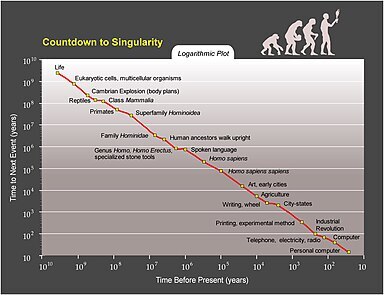
Ray Kurzweil's PowerPoint slide of his "claimed exponential trend in evolutionary and technological history. This actually depicts a linear countdown to the present moment on a logarithmic scale, not an exponential trend." (pg. 45, Figure 2.1) Also note how the entire Industrial Revolution is one event point exactly 150 years ago. Source
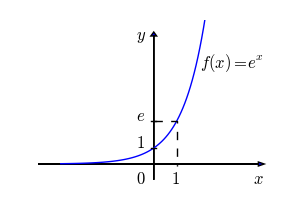

Two actual examples of exponential growth graphs. Note the steepness of the curves in both, even with having a third of plotted points as Kurzweil's graph. Source and source.
In each chapter, Becker introduces us to one of Silicon Valley's bizarro ideas and the big names promoting them. He then explains why these ideas don't hold water, and in fact, often fall apart with just the slightest examination. He will also show you how many of these ideas, no matter how "logical" they sound on the surface, are deeply rooted in laissez faire capitalism, colonisation, misogyny, racism, and eugenics. (The number of Silicon Valley tech bros who openly espouse debunked eugenics and other race "science" as brilliant, obvious ideas is disturbing, to say the least. Others quote and espouse fascists.) The first part of each chapter will make you angry, anxious, and incredulous. The second part of each chapter will have you shaking your head at such foolishness.
Singularitarians, rationalists, etc. often ignore real world factors, like entropy or that exponential growth always ends at some point. They often treat vague ideas and terms, like "intelligence" or "utility," as if they were narrowly defined and well understood. They often jetson logic and reality in favor of what could be seen as a science-fiction religion, a church of the machine. One that reduces the world to the simplicity of a video game, and makes all those tech bros into superheros who are always right. Every one of these ideas is making extraordinary claims, and there is no extraordinary evidence to back them up. It's unlikely there will ever be extraordinary evidence, no matter how much money is sunk into trying to make it so.
For instance, in my favorite example, it takes the entire internet worth of information to train a large language model like ChatGPT. However, since these models are just text predictors, they don't generate reliable responses to questions; they generate text that sounds like the internet. So, they pretty much don't do much besides "hallucinate." And since they're filling the internet with the nonsense they're generating, they're contaminating their own training data, leading to model collapse.'"Within a few generations, text becomes garbage," wrote Ross Anderson, who was a computer scientist at Cambridge and one of the authors of "The Curse of Recursion: Training on Generated Data Makes Models Forget," a study on this problem released in May 2023.' (pg. 117) This is amusing, until you remember how much energy is required to run a LLM, and how much pollution they generate in order to bring you these hallucinations.
Despite all the high-tech gloss and intelligent sounding jargon, the Silicon Valley cult is ultimately interested in the same things that the rich and powerful have always been interested in—making the rest of us believe that the status quo that happens to benefit them is determined, inevitable, and that we can do nothing to change it. As much as they talk about bright futures (or unimaginable apocalypses), this is more about the here and now. Who controls the tech that controls our lives? Where does the wealth generated by this tech go? Who gets to say what kind of world we make, and what values underpin our society? Becker makes very strong points that the visions that tech billionaires are selling us are not inevitable. "They are all but impossible." Underneath the shiny surface, they are immoral, and often reprehensible. Do we really want these people running our world? Highly recommended.
See also
Adam Becker also wrote a very interesting, informative and entertaining book about the development of quantum mechanics, What Is Real?: The Unfinished Quest for the Meaning of Quantum Physics. It examines how the Copenhagen Interpretation's "shut up and calculate" non-explanation came to dominate physics. Also highly recommended.
Neuroscientist and AI researcher Erik J. Larson's The Myth of Artificial Intelligence: Why Computers Can’t Think the Way We Do and software developer Meredith Broussard's Artificial Unintelligence: How Computers Misunderstand the World both look at the hype and over promises of AI. Larson explains the logic behind current AI models at a high level, without requiring the reader to know the math or coding, and the very real limits these particular models will always have. Broussard looks at how we're over applying digital solutions to everything, and we stopped getting technology that actually works for us as a result.
Astrotopia: The Dangerous Religion of the Corporate Space Race by Mary-Jane Rubenstein and A City on Mars: Can We Settle Space, Should We Settle Space, and Have We Really Thought This Through? by Kelly and Zach Weinersmith look at the dumpster fire space utopia in Becker's chapter 5. Rubenstein examines the assumptions and ideas underpinning the proposed colonization and mining of the universe, while the Weinersmiths look at all the difficulties of people living and traveling beyond Earth.
Science fiction writer Charles Stross's blog entry "We're sorry we created the Torment Nexus," based on a talk he gave at the Next Frontiers Applied Fiction Day in Stuttgart in 2023, explains how the Californian ideology out of Silicon Valley was created from 1970s and 1980s science fiction. Lots of tech billionaires think their childhood reading was a blueprint, not fiction.
In chapter 6, Becker cites Meghan O'Gieblyn's God, Human, Animal, Machine: Technology, Metaphor, and the Search for Meaning . She explores the resonances between many transhuman ideologies and Christian prophecies. Despite the former's scientific claims, they're both about ascending to the heavens to live forever.
The arguments of these SV ideologies involve strong faith in technology that has yet to get beyond the idea stage. Ray Kurzweil's prediction that we're all going to live in an utopian computer simulation, Nick Bostrom's that superintelligent AIs will destroy the entire universe—I can't help but think of medieval theologians debating how many angels could fit on the head of a pin. Unfortunately, the current debates have led to dangerous philosophies like effective altruism and longtermism, which both neatly excuse consuming large amounts of resources and not addressing the very real problems caused by today's tech corporations.
For instance, the reasons EA and longtermists give for spending gobs of money on a threat from a ill-defined technology that doesn't and may never exist sound suspiciously like the ones deployed to justify neoliberalism.
"McAskill is evidently comfortable with ways of talking that are familiar from the exponents of global capitalism: the will to quantify, the essential comparability of all goods and all evils, the obsession with productivity and efficiency, the conviction that there is a happy convergence between self-interest and morality, the seeming confidence that there is no crisis whose solution is beyond the ingenuity of man," writes [Amia] Srinivasan."There is a seemingly unanswerable logic, at once natural and magical, simple and totalising, to both global capitalism and effective altruism." At the core of that logic, for both capitalism and effective altruism, is the need for quantification. Any human activity that can be quantified is grist for the optimizing machinery of this worldview, and anything that can't be quantified is dismissed as unimportant. This is how the longtermists, ultimately, are forced to see people: as numbers. And those numbers, in turn, need to be maximized and optimized, so they can be plugged into the grand longtermist plan to squeeze as much utility as possible out of the universe before its inevitable end.This sort of reasoning is pushing money away from things like mosquito netting to fight malaria, and towards fighting nonexistent artificial general intelligence that will supposedly be smarter than all of humanity, but only wants to turn all material in the universe into paperclips, or something similar, before Musk and friends can strip mine it instead. (Aside: I think many of these Silicon Valley people have taken superhero comics too seriously. Their AGI is a classic comic book villain.)
The false binary choice between ignoring real issues for hypothetical threats doesn't end there. No matter which flavor of California ideologies they subscribe to, in the end these visionaries are all pushing a version of paradise or apocalypse with nothing in between. They're all proclaiming that if we want their weird, science-fiction paradises, we have to let them be our saviors. (The only other choice offered is the complete annihilation of everything, or at least humanity.) Only they can save us. Millions of dollars, sometimes billions, prop up these companies that churn out these fantasies to sell to the rest of us. All I can say is, what a waste.

Ray Kurzweil's PowerPoint slide of his "claimed exponential trend in evolutionary and technological history. This actually depicts a linear countdown to the present moment on a logarithmic scale, not an exponential trend." (pg. 45, Figure 2.1) Also note how the entire Industrial Revolution is one event point exactly 150 years ago. Source


Two actual examples of exponential growth graphs. Note the steepness of the curves in both, even with having a third of plotted points as Kurzweil's graph. Source and source.
In each chapter, Becker introduces us to one of Silicon Valley's bizarro ideas and the big names promoting them. He then explains why these ideas don't hold water, and in fact, often fall apart with just the slightest examination. He will also show you how many of these ideas, no matter how "logical" they sound on the surface, are deeply rooted in laissez faire capitalism, colonisation, misogyny, racism, and eugenics. (The number of Silicon Valley tech bros who openly espouse debunked eugenics and other race "science" as brilliant, obvious ideas is disturbing, to say the least. Others quote and espouse fascists.) The first part of each chapter will make you angry, anxious, and incredulous. The second part of each chapter will have you shaking your head at such foolishness.
Singularitarians, rationalists, etc. often ignore real world factors, like entropy or that exponential growth always ends at some point. They often treat vague ideas and terms, like "intelligence" or "utility," as if they were narrowly defined and well understood. They often jetson logic and reality in favor of what could be seen as a science-fiction religion, a church of the machine. One that reduces the world to the simplicity of a video game, and makes all those tech bros into superheros who are always right. Every one of these ideas is making extraordinary claims, and there is no extraordinary evidence to back them up. It's unlikely there will ever be extraordinary evidence, no matter how much money is sunk into trying to make it so.
For instance, in my favorite example, it takes the entire internet worth of information to train a large language model like ChatGPT. However, since these models are just text predictors, they don't generate reliable responses to questions; they generate text that sounds like the internet. So, they pretty much don't do much besides "hallucinate." And since they're filling the internet with the nonsense they're generating, they're contaminating their own training data, leading to model collapse.'"Within a few generations, text becomes garbage," wrote Ross Anderson, who was a computer scientist at Cambridge and one of the authors of "The Curse of Recursion: Training on Generated Data Makes Models Forget," a study on this problem released in May 2023.' (pg. 117) This is amusing, until you remember how much energy is required to run a LLM, and how much pollution they generate in order to bring you these hallucinations.
Despite all the high-tech gloss and intelligent sounding jargon, the Silicon Valley cult is ultimately interested in the same things that the rich and powerful have always been interested in—making the rest of us believe that the status quo that happens to benefit them is determined, inevitable, and that we can do nothing to change it. As much as they talk about bright futures (or unimaginable apocalypses), this is more about the here and now. Who controls the tech that controls our lives? Where does the wealth generated by this tech go? Who gets to say what kind of world we make, and what values underpin our society? Becker makes very strong points that the visions that tech billionaires are selling us are not inevitable. "They are all but impossible." Underneath the shiny surface, they are immoral, and often reprehensible. Do we really want these people running our world? Highly recommended.
See also
Adam Becker also wrote a very interesting, informative and entertaining book about the development of quantum mechanics, What Is Real?: The Unfinished Quest for the Meaning of Quantum Physics. It examines how the Copenhagen Interpretation's "shut up and calculate" non-explanation came to dominate physics. Also highly recommended.
Neuroscientist and AI researcher Erik J. Larson's The Myth of Artificial Intelligence: Why Computers Can’t Think the Way We Do and software developer Meredith Broussard's Artificial Unintelligence: How Computers Misunderstand the World both look at the hype and over promises of AI. Larson explains the logic behind current AI models at a high level, without requiring the reader to know the math or coding, and the very real limits these particular models will always have. Broussard looks at how we're over applying digital solutions to everything, and we stopped getting technology that actually works for us as a result.
Astrotopia: The Dangerous Religion of the Corporate Space Race by Mary-Jane Rubenstein and A City on Mars: Can We Settle Space, Should We Settle Space, and Have We Really Thought This Through? by Kelly and Zach Weinersmith look at the dumpster fire space utopia in Becker's chapter 5. Rubenstein examines the assumptions and ideas underpinning the proposed colonization and mining of the universe, while the Weinersmiths look at all the difficulties of people living and traveling beyond Earth.
Science fiction writer Charles Stross's blog entry "We're sorry we created the Torment Nexus," based on a talk he gave at the Next Frontiers Applied Fiction Day in Stuttgart in 2023, explains how the Californian ideology out of Silicon Valley was created from 1970s and 1980s science fiction. Lots of tech billionaires think their childhood reading was a blueprint, not fiction.
In chapter 6, Becker cites Meghan O'Gieblyn's God, Human, Animal, Machine: Technology, Metaphor, and the Search for Meaning . She explores the resonances between many transhuman ideologies and Christian prophecies. Despite the former's scientific claims, they're both about ascending to the heavens to live forever.

January 6, 2026
Książka, której potrzebujemy i na jaką nie zasługujemy. Autor w sześciu rozdziałach dokonuje skrupulatnej polemiki z wiodącymi wizjami przyszłości ukazując ich krótkie nogi, a zwłaszcza to, że ich autorzy-wizjonerzy są nieukami i cymbałami. Imponuje duży research, ale też sposób prowadzenia argumentacji, bo choć pojawiają się wątki krytyczne na poziomie ideologii głoszonej przez apostołów technologii, to krytyka w dużej mierze dotyczy wykonalności ich projektów od strony czysto materialistycznej. I to jest chyba najsensowniejsza strategia uderzenia, silniejsza od pojazdów w stylu „ten jest ketaminowym ćpunem, a tamten lubi pewnego niedoszłego malarza z Austrii”. Przy tym wszystkim autor nie wpada w technopesymizm czy luddyzm: mocno stąpa po Ziemi. Polecam każdemu kto boi się, że przyjdzie AI i nas zje.

December 25, 2025
Probably one of the best books about the tech industry, its prominent figures, their ideologies, and motivations. I think everyone in the tech industry should read this book.
Displaying 1 - 30 of 502 reviews