

What do you think?
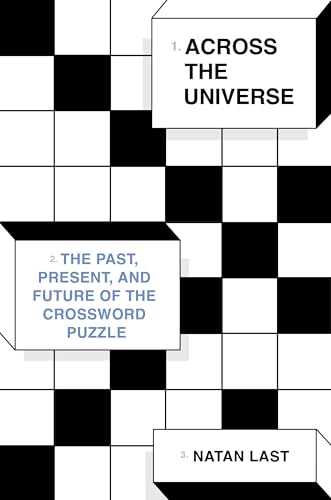
Across the Universe: The Past, Present, and Future of the Crossword Puzzle
An entertaining and eye-opening look at the history of the crossword, who constructs it, and why it matters as both a reflection of and influence on our culture
From WORDLE to SPELLING BEE, we live in a time of word game mania. Crosswords, in particular, gained renewed popularity during the Covid-19 lockdown, when games became another kind of refuge. Today, 36 million Americans solve crosswords once a week or more, and nearly 23 million solve them daily. Yet, as longtime New Yorker crossword contributor Natan Last will tell you, the seemingly apolitical puzzle has never been more controversial.
In recent years, popular puzzle makers like The New York Times—the original and still the gold standard for word games—have been challenged for the way they prioritize certain cultures and perspectives as either the norm ( white and male) or obscure (everyone else). At the same time, the crossword has never been more democratic. A larger, younger, more tech-savvy, and solidaristic group of people have fallen in love with puzzle solving, ushering in a more inclusive rise to the kinds of people constructing them, challenging the very idea of them and, in fact, what "normal" actually is.
With a critical eye toward its history, Natan Last explores the debates about the future of the crossword and investigates those who want the puzzle to transform into a tool of progressivism; ultimately, asking if the crossword can help us reshape the world. Across the Universe interrogates all the ways words—and the games we make using those words—change our culture while bringing us into the worlds of those pushing for the crosswords’ much-needed evolution.
From WORDLE to SPELLING BEE, we live in a time of word game mania. Crosswords, in particular, gained renewed popularity during the Covid-19 lockdown, when games became another kind of refuge. Today, 36 million Americans solve crosswords once a week or more, and nearly 23 million solve them daily. Yet, as longtime New Yorker crossword contributor Natan Last will tell you, the seemingly apolitical puzzle has never been more controversial.
In recent years, popular puzzle makers like The New York Times—the original and still the gold standard for word games—have been challenged for the way they prioritize certain cultures and perspectives as either the norm ( white and male) or obscure (everyone else). At the same time, the crossword has never been more democratic. A larger, younger, more tech-savvy, and solidaristic group of people have fallen in love with puzzle solving, ushering in a more inclusive rise to the kinds of people constructing them, challenging the very idea of them and, in fact, what "normal" actually is.
With a critical eye toward its history, Natan Last explores the debates about the future of the crossword and investigates those who want the puzzle to transform into a tool of progressivism; ultimately, asking if the crossword can help us reshape the world. Across the Universe interrogates all the ways words—and the games we make using those words—change our culture while bringing us into the worlds of those pushing for the crosswords’ much-needed evolution.
336 pages, Hardcover
First published November 25, 2025
Ratings & Reviews
Friends & Following
Create a free account to discover what your friends think of this book!
Community Reviews
Displaying 1 - 30 of 133 reviews
June 30, 2025
3.25
I always say I love reading novels written by poets because you can just *tell* through their beautiful and lyrical and flowery writing. And in a similar (but maybe slightly less positive) vein, you can tell that this is written by someone who also writes crossword puzzles? lol
At risk of making myself just sound stupid, I do think the writing style and timeline of this was hard to follow. Writing about clever wordplay by using tons and tons of clever wordplay yourself was... a lot. Every sentence felt like a clue I needed to dissect and I felt like the really interesting points and stories were lost amid the efforts to make them sound really cool.
I obviously love language but this just felt overwritten. Still a fun and interesting read if you love crossword puzzles, but it did take a bit of work to get through (work that I sometimes just preferred to spend on actual puzzles and not confusing sentence structures).
I always say I love reading novels written by poets because you can just *tell* through their beautiful and lyrical and flowery writing. And in a similar (but maybe slightly less positive) vein, you can tell that this is written by someone who also writes crossword puzzles? lol
At risk of making myself just sound stupid, I do think the writing style and timeline of this was hard to follow. Writing about clever wordplay by using tons and tons of clever wordplay yourself was... a lot. Every sentence felt like a clue I needed to dissect and I felt like the really interesting points and stories were lost amid the efforts to make them sound really cool.
I obviously love language but this just felt overwritten. Still a fun and interesting read if you love crossword puzzles, but it did take a bit of work to get through (work that I sometimes just preferred to spend on actual puzzles and not confusing sentence structures).
January 25, 2026
Always eager to read while educating myself in equal measure, I turned to this fascinating—and unexpectedly contentious—slice of cultural history by Natan Last. A longtime New Yorker crossword contributor and devoted puzzle enthusiast, Last traces the century-long evolution of the crossword, examining how it has transformed over the decades and what its future may hold as newspaper and digital word games continue to flood the market.
From Wordle to Spelling Bee, we are living in a full-blown word-game renaissance. Crosswords in particular experienced a dramatic resurgence during the COVID-19 lockdowns, when puzzles became both refuge and ritual. Today, tens of millions of people around the world solve crosswords weekly—many daily—yet, as Last convincingly argues, these seemingly apolitical grids have never been more controversial. Institutions like The New York Times, still the gold standard in the crossword world, have come under scrutiny for privileging certain cultural perspectives as “normal” while marginalising others.
What makes Across the Universe so compelling is its balance of critique and optimism. While Last interrogates the crossword’s historically narrow lens, he also highlights its rapid democratisation: younger, more diverse, and more tech-savvy solvers and constructors are reshaping what these puzzles look like, as well as what they can represent. With a thoughtful, critical eye, Last explores whether the crossword can evolve into a vehicle for cultural change, or even progressivism, without losing what makes it beloved. Insightful, accessible, and surprisingly provocative, this book reveals how words—and the games we build around them—both reflect and reshape the world in which we live.
Last effectively constructs his book to argue in subtle, yet powerful ways about the role of crosswords and their importance. Through a handful of well-charted chapters, the book comes to life, through numerous vignettes and social analyses. I quite enjoyed how Last builds things up from chapter to chapter, before culminating the historical assessment, as one might a hidden word in a Sunday puzzle. While I am no expert or even a crossword aficionado, I quite enjoyed the book and all it had to offer. Natan Last made this reading experience once for which I will long be grateful and provided clues that ensure my Across and Down life moments intersect with greater ease.
Kudos, Mr. Last, for a great look into the puzzling world of the crossword!
From Wordle to Spelling Bee, we are living in a full-blown word-game renaissance. Crosswords in particular experienced a dramatic resurgence during the COVID-19 lockdowns, when puzzles became both refuge and ritual. Today, tens of millions of people around the world solve crosswords weekly—many daily—yet, as Last convincingly argues, these seemingly apolitical grids have never been more controversial. Institutions like The New York Times, still the gold standard in the crossword world, have come under scrutiny for privileging certain cultural perspectives as “normal” while marginalising others.
What makes Across the Universe so compelling is its balance of critique and optimism. While Last interrogates the crossword’s historically narrow lens, he also highlights its rapid democratisation: younger, more diverse, and more tech-savvy solvers and constructors are reshaping what these puzzles look like, as well as what they can represent. With a thoughtful, critical eye, Last explores whether the crossword can evolve into a vehicle for cultural change, or even progressivism, without losing what makes it beloved. Insightful, accessible, and surprisingly provocative, this book reveals how words—and the games we build around them—both reflect and reshape the world in which we live.
Last effectively constructs his book to argue in subtle, yet powerful ways about the role of crosswords and their importance. Through a handful of well-charted chapters, the book comes to life, through numerous vignettes and social analyses. I quite enjoyed how Last builds things up from chapter to chapter, before culminating the historical assessment, as one might a hidden word in a Sunday puzzle. While I am no expert or even a crossword aficionado, I quite enjoyed the book and all it had to offer. Natan Last made this reading experience once for which I will long be grateful and provided clues that ensure my Across and Down life moments intersect with greater ease.
Kudos, Mr. Last, for a great look into the puzzling world of the crossword!
December 31, 2025
Thank you Pantheon for sending me a free copy!
ACROSS THE UNIVERSE by Natan Last provides the history of crossword puzzles as well as the direction it’s headed in the future. While the word game made its first appearance in newspapers over a century ago, it saw a resurgence when everyone was staying at home during the COVID lockdown. Revenue from crosswords and other games are vital in keeping news divisions afloat. Creators of crosswords often see editors making changes to their puzzles due to politics and failure to catch up with the times.
I’ll admit I was not a huge fan of the writing style as it was hard to follow at times. The author is definitely a wordsmith and while I found much of the info interesting, the way it was presented was not for me. My average intelligence was not enough to keep up with everything. I recommend the book to anyone who is smart enough to fill out a weekend NY Times crossword in pen.
ACROSS THE UNIVERSE by Natan Last provides the history of crossword puzzles as well as the direction it’s headed in the future. While the word game made its first appearance in newspapers over a century ago, it saw a resurgence when everyone was staying at home during the COVID lockdown. Revenue from crosswords and other games are vital in keeping news divisions afloat. Creators of crosswords often see editors making changes to their puzzles due to politics and failure to catch up with the times.
I’ll admit I was not a huge fan of the writing style as it was hard to follow at times. The author is definitely a wordsmith and while I found much of the info interesting, the way it was presented was not for me. My average intelligence was not enough to keep up with everything. I recommend the book to anyone who is smart enough to fill out a weekend NY Times crossword in pen.

August 21, 2025
This is a highly comprehensive and engaging review of crosswords throughout history. I did find it a bit dense at times, but it was playful and packed with facts. I did not know crossworditis was a thing (prior to WWII) where people were mocked for being addicted to them. Librarians even blacked out the puzzles in papers before shelving them. It was the librarian's duty to ensure that the public didn't stumble upon them. I also liked the chapter on tricky puzzles and double meanings. Those are the hardest ones for me.

December 3, 2025
I have somewhat complicated feelings about this book: it’s chock-full of interesting tidbits about crossword puzzles and the people who make them, and it has a very artistic sensibility, but its organization is frankly mystifying! Last’s prose is rich and lyrical but also prone to such stretchy, lateral associations that at times, I felt I was in a fever dream. One moment, the book is discussing Schrödinger crosswords, and the next, Nabokov’s dating life; after some concerted effort rereading, I think the unifying theme there was supposed to be that modernist literature, quantum superposition, and crossword puzzles have a lot in common, though I am still rather bemused.
My favorite parts of the book were more straightforward: the profiles of people like Erik Agard, Manesh Ghogre, Elizabeth Gorski, and David Kwong; the discussion of the politics of the puzzle and its potential as an activist vehicle; the analysis of neat/notable puzzles and exemplary bits of wordplay; and the history of the 1920s crossword craze. These parts were delightful and absolutely worth the price of admission. I even discovered my new anthem: “Cross-word Mamma, You Puzzle Me (But Papa’s Gonna Figure You Out)”! I’d just warn prospective readers to be prepared for a unique and sometimes impenetrable structure along the way.
My favorite parts of the book were more straightforward: the profiles of people like Erik Agard, Manesh Ghogre, Elizabeth Gorski, and David Kwong; the discussion of the politics of the puzzle and its potential as an activist vehicle; the analysis of neat/notable puzzles and exemplary bits of wordplay; and the history of the 1920s crossword craze. These parts were delightful and absolutely worth the price of admission. I even discovered my new anthem: “Cross-word Mamma, You Puzzle Me (But Papa’s Gonna Figure You Out)”! I’d just warn prospective readers to be prepared for a unique and sometimes impenetrable structure along the way.
December 6, 2025
There is a moment early in “Across the Universe” when a computer, left humming overnight on Eric Albert’s desk, quietly discovers an 8×8 word square that had been hiding in English all along. Albert comes home from work and finds the solution waiting for him in green phosphor, like a dog with a bone. Natan Last lingers there – on the glow of the monitor, on the improbable feeling of having coaxed something new out of the alphabet – and you realize that this is not going to be a quaint book about puzzles. It is a book about how we live inside language, and how language, in turn, lives inside systems of power, immigration, technology, desire.
“Across the Universe” bills itself as a history of the modern crossword, and it is that, but the noun never quite keeps up with the verbs. Last is forever constructing, excavating, reframing. The chapters spiral outward from the grid into computer science, colonial literature, neuroscience, avant-garde poetry, game shows, TikTok, and an adult-education classroom in Hell’s Kitchen. The through-line is a conviction that what happens in the little black-and-white box is not a sealed diversion but a microcosm: of who gets named, who gets erased, which accents get flattened, which jokes land, and who is left holding the pencil.
He begins, sensibly enough, with a programmer and a baby. Eric Albert, looking for work he can do from home as a stay-at-home father, decides that the only way to make a living from crosswords is to make the human out of the equation. Albert’s journey – from pencil-and-paper tinkerer to a pioneer of computer-assisted construction – gives Last a chance to reconstruct a pre-software era of graph paper, eraser shavings, and reverse-letter dictionaries that look like relics from a parallel publishing universe. By the time Albert’s code is pruning impossibly large search spaces down to viable word squares, the crossword has already drifted into something more interesting than a hobby. It has become an experiment in how much of language can be formalized without losing its charm.
Last belongs to a particular New York tribe: the youngish, politics-literate puzzler who can talk as easily about bigrams as about Gramsci. The book is full of those quick crossovers. A digression on the Latin Sator square turns into a meditation on determinism; a close reading of clue databases leads to a quietly devastating indictment of how often “INDIA” appears in grids only as a backdrop for British writers and colonial exploits. The effect is not quite the pile-up of references in “The Waste Land,” but you can hear the family resemblance. Crosswords, like certain modernist texts, have sometimes been derided as a “puzzle school” of literature. Last accepts the insult and writes from inside it.
The early chapters are historical and analytic in roughly equal proportion. Joseph Pulitzer’s “New York World” becomes a vertical diagram of early mass media: golden dome, editor’s floor, pressroom, color supplement. Arthur Wynne, scrambling to fill a Christmas issue of that supplement, invents the “Word-Cross” almost by accident. The detail that really sticks is the business logic. When Wynne invites readers to send in their own grids, barrels of puzzles arrive and the magazine quietly acquires a near-infinite supply of content for almost no money. Last, who has worked in publishing, is attuned to this. Crosswords, from the beginning, are tied to precarious labor and to the transformation of leisure into revenue.
As the narrative moves into the twentieth century, the book gets both more personal and more sharply political. Last writes warmly about his own apprenticeship under Will Shortz in Pleasantville – a house full of crossword clocks and crates of submissions – and about the charge of sitting at the Times’s proprietary editing terminals typing “Crosswords – Yes!” into acceptance emails. He remembers the thrill of a clue he suggested for LEIA (“Film character known for her buns”) making it into print. He also remembers, years later, watching a minor controversy flare over the entry JEWFRO, and realizing that his earlier instinct to treat puzzles as “just a game” had been too easy.
From there, the grid becomes a soapbox. A substantial section of the book is devoted to gender and representation: who gets to appear in the crossword as an answer, and who gets to decide. Last is very good on the quiet violence of editorial judgment – the minus sign in a spreadsheet that labels MARIE KONDO “too niche” or BLACK GIRLS ROCK “too risky,” the way generic EROTICA appears dozens of times while GAY EROTICA is deemed off-limits. When a woman constructor submits a puzzle filled entirely with women’s names and one clue is quietly rewritten to reference a male actor instead, the edit is small enough to pass unnoticed in the solving experience, but, in Last’s telling, emblematic of a pattern. The crossword is a canon engine; it lags behind the culture not by accident but by habit.
One of the strongest chapters, “Except for the Marabar Caves,” takes its title from the opening line of “A Passage to India” and works outward to Edward Said and “Orientalism.” We are asked to count, over the Shortz era, how often “INDIA” is clued via British adventurers, colonial administrators, or anodyne outsourcing references, and how rarely via Indian languages, writers, or living politics. The numbers are not flattering. The crossword, for millions of solvers, is a first encounter with certain names and places; if those entries are consistently framed through a narrow Western lens, the grid quietly reproduces a distorted atlas.
Last’s interest in gatekeeping extends to technology. A chapter on AI and crossword-solving programs could have been dutiful; instead, it becomes a tour of the limits of current machine reading. Dr.Fill, the program built by the computer scientist Matt Ginsberg, can assign probabilities to clue–answer pairs faster than any human solver, but it “doesn’t know that letters have shapes.” It can, in other words, treat the string CLINTON as an answer to a question about the 42nd president, but it cannot spontaneously appreciate the acrobatics of Jeremiah Farrell’s Election Day puzzle where the central entry can equally be BOB DOLE; it has no native sense of what it means for a capital M to rotate into a W.
Last detours, unexpectedly, into Stanislas Dehaene and the neuroscience of letter recognition: the visual word form area, neuronal recycling, the way alphabets mirror the statistics of junctions and edges in natural scenes. It is an ambitious set piece, and you can feel the book straining a little to hold it all. Readers who come for gossip about constructors may find the cortical diagrams a bit much; readers who thrill to cognitive science will wish for even more. The chapter signals one of the book’s few weaknesses: a tendency to carry each associative leap as far as possible, even when that means the narrative wanders.
“Across the Universe” is most satisfying when it returns from theory to concrete puzzles and people. The chapters on “Schrödinger” crosswords – grids that can be solved correctly in more than one way – are small masterpieces of formal criticism. Farrell’s “BOB DOLE”/“CLINTON” stunt puzzle is the familiar example, but Last also attends to later constructions about gender fluidity and indeterminacy. These grids, he argues, nudge the crossword closer to an art form that can register multiple truths at once. A standard puzzle valorizes uniqueness; a quantum puzzle allows ambivalence, invites you to live in the space before the box collapses.
The book’s second half broadens further, into performance and time. There is a delightfully detailed account of Zach Sherwin’s live show in which comics solve a themeless crossword on stage while the host anagrams their names and breaks into rap. There is a student musical, “Word Nerd,” in which a crossword game show becomes a vehicle for debates about authenticity and selling out. There is a magic trick by David Kwong, performed at the Magic Castle, that culminates in a crossword grid constructed in real time from audience suggestions that also hides the identity of a previously chosen playing card. Here, the crossword is literally theatre: a prop, a script, and a reveal.
Time, too, is both subject and medium. Last writes about David Hockney’s photo collage “The Crossword Puzzle, Minneapolis,” in which many slightly offset photographs of a couple solving shuttle our gaze, in sequence, from the solver’s hairline down to the tip of her pen. It is a way of rendering the act of solving as a series of micro-moments layered on top of one another. Last is persuasive that this is how we actually move through a grid – not left to right like a line of prose, but in darting saccades, eyes and mind jumping around in search of a foothold. Crosswords become a time art alongside film and music, experienced as much as read.
Running parallel to all of this scholarship is a quieter narrative about teaching. In the conclusion, Last returns to his “Get a Clue!” class for older adults, first in a John Jay College classroom, then on Zoom during the pandemic. Together, he and his students construct a puzzle about PARALLEL PARKING, hiding car brands in stacked entries so that the vehicles are literally aligned in the grid. The image that lingers is not of clever theme entries but of an older woman offering up the key phrase and Last, for all his theoretical apparatus, treating it as the gift it is. The class becomes a kind of counterweight to the book’s institutional and technological powerhouses. The crossword is here a social practice, not an object of critique: a reason for people to keep meeting, keep learning, keep punning, even as the world outside the boxes gets scarier.
The prose is spry, generous, occasionally in love with its own cleverness. Last has inherited, and to some extent earned, the crossword-blog habit of treating short words as characters; ERA, EEL, and OLE are called back with a mix of affection and exasperation. He can be very funny about the clichés of puzzle-speak – the “helpers” and “cheaters” (those extra black squares constructors add to make a grid fillable), the internal acronyms in an editor’s spreadsheet for unexciting themes. At the same time, he is capable of clean, almost reportorial description when the story demands it. There are passages, especially on immigration and on the racial politics of clueing, where the jokes fall away and the tone hardens appropriately.
The cost of this range is that the book sometimes feels more like a collection of linked essays than a single argument unfolding. Chapters that began life, one suspects, as standalone pieces retain their own internal arcs, their own pet frameworks. The motif of “melting pot vs salad bowl,” for instance, sits a bit awkwardly next to the quantum-modernist frame; a long discussion of “cute” as an aesthetic category, borrowed from contemporary theory, will enchant some readers and make others long for the next story about a cranky editor. For the most part, though, the jumps feel earned. Crosswords, after all, are themselves mosaics: bits of language from law, pop music, chemistry, Yiddish, anime, all interlocking in a single grid. It seems fair that a book about them should be similarly motley.
How much a reader enjoys “Across the Universe” will depend on where they come from. Word-game devotees will recognize themselves on almost every page and will thrill to the deep dives into the American Crossword Puzzle Tournament, into the etiquette of bylines and constructor credits, into the minor scandals that have ruffled the squares. General readers without an existing puzzle habit may find a few sections a touch inside-baseball, but the book offers more than enough doors in: a history of media economics, a primer on early AI, a case study in how seemingly apolitical objects transmit cultural values. Even someone who never intends to fill in a grid might finish the book and inspect the words around them differently.
If the book has a central moral argument, it is that crosswords are not just for fun and not just for outrage; they are part of the way a culture imagines itself. To treat them as trivial is to miss an opportunity to see how bias and imagination knit together at the level of names, abbreviations, little three-letter answers that accumulate into a worldview. The corrective, in Last’s vision, is not to make every puzzle didactic or earnest, but to widen the circle of who gets to play, who gets to be clued, who gets to appear at all. It is a serious argument made with considerable joy.
Asked to reduce all of that to a number, I would say that “Across the Universe” earns something like an 89 out of 100: a lively, intellectually ambitious, occasionally baggy but genuinely illuminating tour through the crossword’s past and possible futures, written by someone who loves the grid enough to want it to do better.
“Across the Universe” bills itself as a history of the modern crossword, and it is that, but the noun never quite keeps up with the verbs. Last is forever constructing, excavating, reframing. The chapters spiral outward from the grid into computer science, colonial literature, neuroscience, avant-garde poetry, game shows, TikTok, and an adult-education classroom in Hell’s Kitchen. The through-line is a conviction that what happens in the little black-and-white box is not a sealed diversion but a microcosm: of who gets named, who gets erased, which accents get flattened, which jokes land, and who is left holding the pencil.
He begins, sensibly enough, with a programmer and a baby. Eric Albert, looking for work he can do from home as a stay-at-home father, decides that the only way to make a living from crosswords is to make the human out of the equation. Albert’s journey – from pencil-and-paper tinkerer to a pioneer of computer-assisted construction – gives Last a chance to reconstruct a pre-software era of graph paper, eraser shavings, and reverse-letter dictionaries that look like relics from a parallel publishing universe. By the time Albert’s code is pruning impossibly large search spaces down to viable word squares, the crossword has already drifted into something more interesting than a hobby. It has become an experiment in how much of language can be formalized without losing its charm.
Last belongs to a particular New York tribe: the youngish, politics-literate puzzler who can talk as easily about bigrams as about Gramsci. The book is full of those quick crossovers. A digression on the Latin Sator square turns into a meditation on determinism; a close reading of clue databases leads to a quietly devastating indictment of how often “INDIA” appears in grids only as a backdrop for British writers and colonial exploits. The effect is not quite the pile-up of references in “The Waste Land,” but you can hear the family resemblance. Crosswords, like certain modernist texts, have sometimes been derided as a “puzzle school” of literature. Last accepts the insult and writes from inside it.
The early chapters are historical and analytic in roughly equal proportion. Joseph Pulitzer’s “New York World” becomes a vertical diagram of early mass media: golden dome, editor’s floor, pressroom, color supplement. Arthur Wynne, scrambling to fill a Christmas issue of that supplement, invents the “Word-Cross” almost by accident. The detail that really sticks is the business logic. When Wynne invites readers to send in their own grids, barrels of puzzles arrive and the magazine quietly acquires a near-infinite supply of content for almost no money. Last, who has worked in publishing, is attuned to this. Crosswords, from the beginning, are tied to precarious labor and to the transformation of leisure into revenue.
As the narrative moves into the twentieth century, the book gets both more personal and more sharply political. Last writes warmly about his own apprenticeship under Will Shortz in Pleasantville – a house full of crossword clocks and crates of submissions – and about the charge of sitting at the Times’s proprietary editing terminals typing “Crosswords – Yes!” into acceptance emails. He remembers the thrill of a clue he suggested for LEIA (“Film character known for her buns”) making it into print. He also remembers, years later, watching a minor controversy flare over the entry JEWFRO, and realizing that his earlier instinct to treat puzzles as “just a game” had been too easy.
From there, the grid becomes a soapbox. A substantial section of the book is devoted to gender and representation: who gets to appear in the crossword as an answer, and who gets to decide. Last is very good on the quiet violence of editorial judgment – the minus sign in a spreadsheet that labels MARIE KONDO “too niche” or BLACK GIRLS ROCK “too risky,” the way generic EROTICA appears dozens of times while GAY EROTICA is deemed off-limits. When a woman constructor submits a puzzle filled entirely with women’s names and one clue is quietly rewritten to reference a male actor instead, the edit is small enough to pass unnoticed in the solving experience, but, in Last’s telling, emblematic of a pattern. The crossword is a canon engine; it lags behind the culture not by accident but by habit.
One of the strongest chapters, “Except for the Marabar Caves,” takes its title from the opening line of “A Passage to India” and works outward to Edward Said and “Orientalism.” We are asked to count, over the Shortz era, how often “INDIA” is clued via British adventurers, colonial administrators, or anodyne outsourcing references, and how rarely via Indian languages, writers, or living politics. The numbers are not flattering. The crossword, for millions of solvers, is a first encounter with certain names and places; if those entries are consistently framed through a narrow Western lens, the grid quietly reproduces a distorted atlas.
Last’s interest in gatekeeping extends to technology. A chapter on AI and crossword-solving programs could have been dutiful; instead, it becomes a tour of the limits of current machine reading. Dr.Fill, the program built by the computer scientist Matt Ginsberg, can assign probabilities to clue–answer pairs faster than any human solver, but it “doesn’t know that letters have shapes.” It can, in other words, treat the string CLINTON as an answer to a question about the 42nd president, but it cannot spontaneously appreciate the acrobatics of Jeremiah Farrell’s Election Day puzzle where the central entry can equally be BOB DOLE; it has no native sense of what it means for a capital M to rotate into a W.
Last detours, unexpectedly, into Stanislas Dehaene and the neuroscience of letter recognition: the visual word form area, neuronal recycling, the way alphabets mirror the statistics of junctions and edges in natural scenes. It is an ambitious set piece, and you can feel the book straining a little to hold it all. Readers who come for gossip about constructors may find the cortical diagrams a bit much; readers who thrill to cognitive science will wish for even more. The chapter signals one of the book’s few weaknesses: a tendency to carry each associative leap as far as possible, even when that means the narrative wanders.
“Across the Universe” is most satisfying when it returns from theory to concrete puzzles and people. The chapters on “Schrödinger” crosswords – grids that can be solved correctly in more than one way – are small masterpieces of formal criticism. Farrell’s “BOB DOLE”/“CLINTON” stunt puzzle is the familiar example, but Last also attends to later constructions about gender fluidity and indeterminacy. These grids, he argues, nudge the crossword closer to an art form that can register multiple truths at once. A standard puzzle valorizes uniqueness; a quantum puzzle allows ambivalence, invites you to live in the space before the box collapses.
The book’s second half broadens further, into performance and time. There is a delightfully detailed account of Zach Sherwin’s live show in which comics solve a themeless crossword on stage while the host anagrams their names and breaks into rap. There is a student musical, “Word Nerd,” in which a crossword game show becomes a vehicle for debates about authenticity and selling out. There is a magic trick by David Kwong, performed at the Magic Castle, that culminates in a crossword grid constructed in real time from audience suggestions that also hides the identity of a previously chosen playing card. Here, the crossword is literally theatre: a prop, a script, and a reveal.
Time, too, is both subject and medium. Last writes about David Hockney’s photo collage “The Crossword Puzzle, Minneapolis,” in which many slightly offset photographs of a couple solving shuttle our gaze, in sequence, from the solver’s hairline down to the tip of her pen. It is a way of rendering the act of solving as a series of micro-moments layered on top of one another. Last is persuasive that this is how we actually move through a grid – not left to right like a line of prose, but in darting saccades, eyes and mind jumping around in search of a foothold. Crosswords become a time art alongside film and music, experienced as much as read.
Running parallel to all of this scholarship is a quieter narrative about teaching. In the conclusion, Last returns to his “Get a Clue!” class for older adults, first in a John Jay College classroom, then on Zoom during the pandemic. Together, he and his students construct a puzzle about PARALLEL PARKING, hiding car brands in stacked entries so that the vehicles are literally aligned in the grid. The image that lingers is not of clever theme entries but of an older woman offering up the key phrase and Last, for all his theoretical apparatus, treating it as the gift it is. The class becomes a kind of counterweight to the book’s institutional and technological powerhouses. The crossword is here a social practice, not an object of critique: a reason for people to keep meeting, keep learning, keep punning, even as the world outside the boxes gets scarier.
The prose is spry, generous, occasionally in love with its own cleverness. Last has inherited, and to some extent earned, the crossword-blog habit of treating short words as characters; ERA, EEL, and OLE are called back with a mix of affection and exasperation. He can be very funny about the clichés of puzzle-speak – the “helpers” and “cheaters” (those extra black squares constructors add to make a grid fillable), the internal acronyms in an editor’s spreadsheet for unexciting themes. At the same time, he is capable of clean, almost reportorial description when the story demands it. There are passages, especially on immigration and on the racial politics of clueing, where the jokes fall away and the tone hardens appropriately.
The cost of this range is that the book sometimes feels more like a collection of linked essays than a single argument unfolding. Chapters that began life, one suspects, as standalone pieces retain their own internal arcs, their own pet frameworks. The motif of “melting pot vs salad bowl,” for instance, sits a bit awkwardly next to the quantum-modernist frame; a long discussion of “cute” as an aesthetic category, borrowed from contemporary theory, will enchant some readers and make others long for the next story about a cranky editor. For the most part, though, the jumps feel earned. Crosswords, after all, are themselves mosaics: bits of language from law, pop music, chemistry, Yiddish, anime, all interlocking in a single grid. It seems fair that a book about them should be similarly motley.
How much a reader enjoys “Across the Universe” will depend on where they come from. Word-game devotees will recognize themselves on almost every page and will thrill to the deep dives into the American Crossword Puzzle Tournament, into the etiquette of bylines and constructor credits, into the minor scandals that have ruffled the squares. General readers without an existing puzzle habit may find a few sections a touch inside-baseball, but the book offers more than enough doors in: a history of media economics, a primer on early AI, a case study in how seemingly apolitical objects transmit cultural values. Even someone who never intends to fill in a grid might finish the book and inspect the words around them differently.
If the book has a central moral argument, it is that crosswords are not just for fun and not just for outrage; they are part of the way a culture imagines itself. To treat them as trivial is to miss an opportunity to see how bias and imagination knit together at the level of names, abbreviations, little three-letter answers that accumulate into a worldview. The corrective, in Last’s vision, is not to make every puzzle didactic or earnest, but to widen the circle of who gets to play, who gets to be clued, who gets to appear at all. It is a serious argument made with considerable joy.
Asked to reduce all of that to a number, I would say that “Across the Universe” earns something like an 89 out of 100: a lively, intellectually ambitious, occasionally baggy but genuinely illuminating tour through the crossword’s past and possible futures, written by someone who loves the grid enough to want it to do better.

May 14, 2026
hate to do this but 3.2
sigh. had rlly high hopes for this one and i did like it better than the other crossword books (although he references “thinking inside the box” so that loses him points). ultimately i think a crossword book is doomed because people who care enough about crosswords are too obnoxious to write a good book.
he had good analysis and too-woke but arguably correct opinions. but it was lost in the 300 pages of wordplay pomp and circumstance. could have been a really interesting essay or even collection of essays but felt distracted and lost as a book.
sigh. had rlly high hopes for this one and i did like it better than the other crossword books (although he references “thinking inside the box” so that loses him points). ultimately i think a crossword book is doomed because people who care enough about crosswords are too obnoxious to write a good book.
he had good analysis and too-woke but arguably correct opinions. but it was lost in the 300 pages of wordplay pomp and circumstance. could have been a really interesting essay or even collection of essays but felt distracted and lost as a book.
Did Not Finish
September 13, 2026DNF @70% - It feels crazy to DNF this when I'm most of the way through it, but this should have been at least 25% shorter. The wordiness was fun and on brand at the beginning, but it has become tiring and pretentious. The actual content of the book has been really interesting but I wish the author could just get to the point faster. Having each section broken down into 3 [long] chapters that were essentially all repeating the main point was exhausting to deal with as a reader. (It's wild that this book is less that 350 pages since each chapter felt like it was 200 pages long). Although there were some really interesting anecdotes, there was way too much name dropping for me. All in all this had potential but needed more of a slash and burn style edit.
July 30, 2026
a deeply considered and lyrically delivered portrait of the crossword's inner machinery and evolving role in language and culture. everyone should read!!!

December 7, 2025
I am definitely the target audience for a book on crossword puzzles!! My mother loved doing the crossword in ink, and I was introduced to the practice when I was 10 or 11. I remember my mother teaching me to look up every clue/answer I didn't know. Even if I had figured it out, she wanted me to learn the reference. This taught me to love research from a very young age (and I'm still reaping the rewards today).
As a long-time crossword nerd, I enjoyed Last's exploration of the puzzle's origins, conventions, growing pains, and both descriptive and prescriptive cultural roles. Last has a lot of great fodder here, but it's let down by subpar editing, in my opinion. There's too much cutesy wordplay within the book itself, and the tangents about ERB and magic tricks stretched the connective tissue to the breaking point. I strongly believe if I read a re-edited version of Across the Universe, it'd be a 5-star read.
I'm glad the book exists, but I'd include a litany of caveats before recommending it to someone other than a diehard puzzler.
As a long-time crossword nerd, I enjoyed Last's exploration of the puzzle's origins, conventions, growing pains, and both descriptive and prescriptive cultural roles. Last has a lot of great fodder here, but it's let down by subpar editing, in my opinion. There's too much cutesy wordplay within the book itself, and the tangents about ERB and magic tricks stretched the connective tissue to the breaking point. I strongly believe if I read a re-edited version of Across the Universe, it'd be a 5-star read.
I'm glad the book exists, but I'd include a litany of caveats before recommending it to someone other than a diehard puzzler.

October 28, 2025
Pantheon Books provided an early galley for review.
My love of word puzzles started as far back as elementary school. I come by it honestly as my father, for most of his life, enjoyed doing the daily crossword. So, this new book called out to me.
As a former computer scientist, I found the discussion around the use of software (and more recently AI) in crafting puzzles to be fascinating. I appreciate the efforts that the constructors go through as they craft their grids, so any modern tools that can help I am sure are appreciated. Of course, any book focusing on wordplay would be obligated to include those elements; Last does not disappoint in this area (the book is riddled with answers and clues).
This one will certainly appeal to all the word-nerds and cruciverbalists (yes, I learned a new word - thanks, Mr. Last) out there.
My love of word puzzles started as far back as elementary school. I come by it honestly as my father, for most of his life, enjoyed doing the daily crossword. So, this new book called out to me.
As a former computer scientist, I found the discussion around the use of software (and more recently AI) in crafting puzzles to be fascinating. I appreciate the efforts that the constructors go through as they craft their grids, so any modern tools that can help I am sure are appreciated. Of course, any book focusing on wordplay would be obligated to include those elements; Last does not disappoint in this area (the book is riddled with answers and clues).
This one will certainly appeal to all the word-nerds and cruciverbalists (yes, I learned a new word - thanks, Mr. Last) out there.

January 24, 2026
So fun and informative and stylish. My crossword game has improved measurably over the course of reading this
April 16, 2026
Delightful, the exact thing I want when I read nonfiction about a niche topic.

May 29, 2026
This is the kind of nonfiction I love. A fascinating history of the crossword puzzle and commentary on its role in representing (and shaping) culture. So fun to see names mentioned in this book that I recognize from solving their puzzles. I love learning new things!!! Nonfiction can be fun!!!

January 28, 2026
As a devoted crossworder this was a fun read that peels back the curtain on crosswords and crossword culture across many dimensions- the history and business of the American crossword, the politics, the art, etc etc. What I enjoyed the most was the clever wordplay of the writing, and the many personal stories of constructors interspersed in the different themes of the book.
Funny enough I had my first NYT crossword submission rejected while I was reading this book, but after finishing Across the Universe I am motivated to keep trying :)
Funny enough I had my first NYT crossword submission rejected while I was reading this book, but after finishing Across the Universe I am motivated to keep trying :)
Did Not Finish
April 21, 2026Maybe I just need to come back to this at a later time, but I am just having a hard time getting through this book. As another reviewer said, it really is evident that someone who makes crosswords wrote this book. The language at times just feels like a bit of an overkill, as it feels like the author is trying to show off that he went to Brown. I love crosswords a lot, and the history is very interesting; however, I think this is just too prestigious sounding at times. Who knows, maybe when I'm feeling a bit more pretentious I'll try picking this book up again lol
September 13, 2025
Thank you Pantheon and NetGalley for the gifted digital ARC.
In this part history, part memoir, Last takes us on a journey every puzzle lover and crossword enthusiast will enjoy. You will walk away knowing more than you ever thought you could about a humble (or is it?) puzzle, while also seeing its larger societal impacts. I think experiencing this while knowing literacy rates are dropping, AI is dominating attention spans, and conversations around anti-intellectualism are prevalent, very much added a level of urgency to the traditional roots of the puzzle. They were all interesting dynamics to be aware of as an undercurrent to my reading experience.
This was one of my most-anticipated nonfiction releases of the year and it did not disappoint! I’m a big crossword fan so I already had a vested interest in what was going to be shared, and I will admit, I think that might be a prerequisite to fully enjoying it (or at lease a willingness to experience a nerdy and wordy book). My preferred puzzle is the weekly crossword in the print edition of The New Yorker (I’m a subscriber and I am devout to a black ballpoint pen), which also means I’ve had the meta experience of working on Last’s own puzzles. Overall, I think he did a great job of capturing the spirit of the crossword and the fascinating, differing philosophies around it.
My only qualm is that I wished I had the audiobook to tandem read it, as some sections got a little slow to eyeball read (I’ve been reading this on-and-off for the past two months). But I do think tandem reading is the way to go regardless, because it’s nice seeing how clues are written out and the accompanying pictures of various puzzles.
📚Follow for more on Instagram: @oliviasbooktalk
In this part history, part memoir, Last takes us on a journey every puzzle lover and crossword enthusiast will enjoy. You will walk away knowing more than you ever thought you could about a humble (or is it?) puzzle, while also seeing its larger societal impacts. I think experiencing this while knowing literacy rates are dropping, AI is dominating attention spans, and conversations around anti-intellectualism are prevalent, very much added a level of urgency to the traditional roots of the puzzle. They were all interesting dynamics to be aware of as an undercurrent to my reading experience.
This was one of my most-anticipated nonfiction releases of the year and it did not disappoint! I’m a big crossword fan so I already had a vested interest in what was going to be shared, and I will admit, I think that might be a prerequisite to fully enjoying it (or at lease a willingness to experience a nerdy and wordy book). My preferred puzzle is the weekly crossword in the print edition of The New Yorker (I’m a subscriber and I am devout to a black ballpoint pen), which also means I’ve had the meta experience of working on Last’s own puzzles. Overall, I think he did a great job of capturing the spirit of the crossword and the fascinating, differing philosophies around it.
My only qualm is that I wished I had the audiobook to tandem read it, as some sections got a little slow to eyeball read (I’ve been reading this on-and-off for the past two months). But I do think tandem reading is the way to go regardless, because it’s nice seeing how clues are written out and the accompanying pictures of various puzzles.
📚Follow for more on Instagram: @oliviasbooktalk

December 8, 2025
3.5 stars. The content is very interesting as is the prose but the organization is odd resulting in redundancies

May 2, 2026
Really hard to rate this one. I’ve recently picked up crosswording and I did love all of the fun tidbits of information about crossword history, construction and culture in this. Also thanks to this book, I’ll be receiving my first copy of The Enigma, a monthly newsletter/puzzle guide sent out by the National Puzzlers League, any day now, I discovered a handful of fun Instagram accounts to follow, and hey maybe one day I’ll attend CrosswordCon if my husband doesn’t make fun of me too much.
All that being said, this was an absolute chore to read. Another reviewer said it’s obvious this was written by a crossword constructor and I completely agree. Practically every sentence felt like a clue I had to decipher. I was looking up words at least once a paragraph, had to reread many many sentences, and straight up just skipped through some parts. It was very disorganized and took me forever to get through. I think the writing style might’ve been geared more towards hardcore crossworders (I’m just not at that level yet) but the content seems like stuff hardcore crossworders would already know? Not sure what the target audience was but I guess it wasn’t people like me!
All that being said, this was an absolute chore to read. Another reviewer said it’s obvious this was written by a crossword constructor and I completely agree. Practically every sentence felt like a clue I had to decipher. I was looking up words at least once a paragraph, had to reread many many sentences, and straight up just skipped through some parts. It was very disorganized and took me forever to get through. I think the writing style might’ve been geared more towards hardcore crossworders (I’m just not at that level yet) but the content seems like stuff hardcore crossworders would already know? Not sure what the target audience was but I guess it wasn’t people like me!
February 2, 2026
I spent a good chunk of this book with the back of my mind churning up clever ideas of how to elucidate the author’s erudite pomposity. But I’ve now realized that 1) building a themed crossword actually takes quite a bit of skill, and 2) I was really enjoying the book, despite, or maybe due to, Natan Last’s intelligence and artistry.
I found pretty much all of this book fascinating. Every chapter took a dive into aspects of the crossworld that I had vaguely wondered about previously but never long enough to look into. There was a lot of jumping around (temporally, thematically, though not literally, I stayed seated while reading), and a bit of a fixation on one single publication and one single editor there, but it does open the door to a world of future puzzling possibilities.
I found pretty much all of this book fascinating. Every chapter took a dive into aspects of the crossworld that I had vaguely wondered about previously but never long enough to look into. There was a lot of jumping around (temporally, thematically, though not literally, I stayed seated while reading), and a bit of a fixation on one single publication and one single editor there, but it does open the door to a world of future puzzling possibilities.
December 13, 2025
Loved this re-telling of the crossword puzzle. While this book covers topics spanning from the introduction of the crossword puzzle in the New York World in 1913, through the first Times puzzle in 1942, and then to more modern developments brought by both technological and cultural change, it does not do so linearly. It tends to skip around, juxtaposing parallel storylines. I found this engaging, and but I think it is something worth knowing before you get into it. Overall, I thought the approach gave it a rather poetic and musing vibe, which I enjoyed, and I think it mirrors crosswords’ own tendency to eschew linear thinking and find unexpected links.
August 6, 2026
In which Natan waxes poetic about everything I thought I knew about crosswords and more. It goes deeper into parts of crossworld than I thought any book ever would, from the backstory behind Simon & Schuster's first crossword book to the backstories behind Dr.Fill and Crosscord. It might as well be called "Everything Is Crosswords" (Literature? Sure. Art? Sure. Theater? Sure why not). Very glad it exists and I hope wider audiences don't think it's too inside basebally.

June 4, 2026
3.5, because some of it was 5/5 and I couldn’t shut up about crosswords, but also I had to read the phrase “[he] pumped the English language with protein until it bulged with veiny illegibility” and also I kind of wanted it to be over about 50 pages before it was. And then I kind of forgot reading existed

December 29, 2025
My Rating: 2 Crossword Puzzles
Started out okay, but soon lost my interest.
Started out okay, but soon lost my interest.
April 7, 2026
2.5/5 turns out i do NOT love crosswords enough to find this book that interesting
Read
April 11, 2026Feeling a weeee bit emosh about the crossword puzzle

May 1, 2026
def read if you’re super into crosswords… i am, but thought it was a bit dry and only a few interesting tidbits were sprinkled throughout
July 13, 2026
I fear I do not have the right type of neurodivergence to enjoy this book 🙃
March 30, 2026
Wowowowow amazing
Didn’t expect this to be so graceful and poetic, what a wonderful read. Shouts out to Stephen Sondheim EPIC RAP BATTLES OF HISTORY Simpsons Mm… Food
Feels so crazy the amount of people mentioned in this book I have talked to….. I’m networking like crazy nowadays
Didn’t expect this to be so graceful and poetic, what a wonderful read. Shouts out to Stephen Sondheim EPIC RAP BATTLES OF HISTORY Simpsons Mm… Food
Feels so crazy the amount of people mentioned in this book I have talked to….. I’m networking like crazy nowadays
Displaying 1 - 30 of 133 reviews