

What do you think?
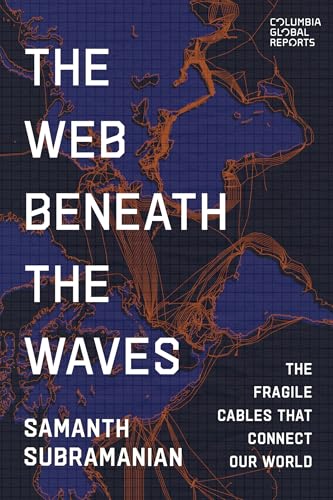
The Web Beneath the Waves: The Fragile Cables that Connect our World
What if the Internet goes dark?
We think of the Internet as wireless, weightless, ever-present—but its true foundation lies in the ocean’s depths, where nearly 900,000 miles of fiber-optic cables quietly pulse with all the world’s information.
In The Web Beneath the Waves, the acclaimed journalist Samanth Subramanian travels from remote Pacific islands to secretive cable-laying operations to reveal the astonishing world of undersea infrastructure. He reveals the fate of Tonga after a volcanic eruption severs its only undersea link to the Internet, meets the men and women engaged in the fiendishly complex work of laying submarine cables, and scrutinizes the acts of “grey zone warfare,” in which ghost ships cut the cables of other countries.
Subramanian charts the deep geopolitical tensions, corporate power grabs, environmental risks, and quiet heroics involved in maintaining the Internet’s unseen circulatory system. With his signature clarity and curiosity, he brings to life the cables that stitch continents together—and exposes just how vulnerable our connected lives really are. This is narrative nonfiction at its most urgent and a book that asks what happens when the world goes offline, and who controls the switch.
We think of the Internet as wireless, weightless, ever-present—but its true foundation lies in the ocean’s depths, where nearly 900,000 miles of fiber-optic cables quietly pulse with all the world’s information.
In The Web Beneath the Waves, the acclaimed journalist Samanth Subramanian travels from remote Pacific islands to secretive cable-laying operations to reveal the astonishing world of undersea infrastructure. He reveals the fate of Tonga after a volcanic eruption severs its only undersea link to the Internet, meets the men and women engaged in the fiendishly complex work of laying submarine cables, and scrutinizes the acts of “grey zone warfare,” in which ghost ships cut the cables of other countries.
Subramanian charts the deep geopolitical tensions, corporate power grabs, environmental risks, and quiet heroics involved in maintaining the Internet’s unseen circulatory system. With his signature clarity and curiosity, he brings to life the cables that stitch continents together—and exposes just how vulnerable our connected lives really are. This is narrative nonfiction at its most urgent and a book that asks what happens when the world goes offline, and who controls the switch.
121 pages, Kindle Edition
Published October 14, 2025
About the author
Samanth Subramanian
6 books185 followersSamanth Subramanian is the India correspondent for The National and the author of two books of reportage, "Following Fish: Travels Around the Indian Coast" and "This Divided Island: Stories from the Sri Lankan War." His writing has appeared in the New Yorker, the New York Times, Granta, the Guardian, the Wall Street Journal, Newsweek, Intelligent Life, Aeon, Mint, Travel + Leisure, and Caravan, among other publications. His longer reported articles occupy the confluence of politics, culture and history, examining the impact of these forces upon life and society; his shorter pieces include op-eds, cultural criticism, and book reviews.
He also co-hosts The Intersection, a fortnightly science and culture podcast from Audiomatic.
"This Divided Island" won the 2015 Crossword Prize for Non Fiction and was shortlisted for the Samuel Johnson Non Fiction Prize the same year. "Following Fish" won the Shakti Bhatt First Book Prize in 2010 and was shortlisted for the Andre Simon Award in 2013.
Samanth Subramanian grew up in Madras, and he lives and works in New Delhi.
Ratings & Reviews
Friends & Following
Create a free account to discover what your friends think of this book!
Community Reviews
Displaying 1 - 30 of 58 reviews

Read
October 22, 2025outstanding. my only gripe is it constantly refers to time periods based on North American seasons. what does 'late Spring' mean? I wish these American published books would stop doing that and be more exact. especially because we're not talking about the US! how is a US season the preferable marker of time when talking about Cote d'Ivoire?
February 1, 2026
Niche subject, for sure, but undersea cables have fascinated me since I was a little kid.

March 6, 2026
As a civil engineer myself, I like to think that I'm cognizant and aware of all the infrastructure that makes our modern lives possible. But this book pointed out a blindspot I'm not ashamed to admit I'd never considered: the thousands of miles of undersea cables that physically connect the world to the internet.
Like all of the best Columbia Global Reports, this book reads like a really long article from a journalist with a passion for a niche interest. The author's personal anecdotes add color to the overall discussion without getting in the way of the content, which is interesting enough on its own. The main case studies feature a small South Pacific island cut off from the world after an underwater avalanche severs their sole cable, a series of landfall operations on the west African coast, and an act of hybrid warfare in the South China Sea relating to a vulnerable Taiwanese territory.
Physically it seems the world is beginning to schism into multiple different internets as megacorporations (Meta vs. Google) and regional powers (USA vs. China) refuse to share cables with each other out of distrust. But geography dictates choke-points and other challenges which just means everyone is laying down their own cables over the same routes and coming ashore at the same nodes. Instead of acting as redundancies, it just seems an inefficient waste of limited time, space, and resources in the name of independence and security, which isn't even guaranteed as the discussion about how easy it is to tap into a cable explains.
There's a lot of interesting content in such a short read, and it also just feels like I walked away from this more informed, which I feel is a measure of a good nonfiction read.
Like all of the best Columbia Global Reports, this book reads like a really long article from a journalist with a passion for a niche interest. The author's personal anecdotes add color to the overall discussion without getting in the way of the content, which is interesting enough on its own. The main case studies feature a small South Pacific island cut off from the world after an underwater avalanche severs their sole cable, a series of landfall operations on the west African coast, and an act of hybrid warfare in the South China Sea relating to a vulnerable Taiwanese territory.
Physically it seems the world is beginning to schism into multiple different internets as megacorporations (Meta vs. Google) and regional powers (USA vs. China) refuse to share cables with each other out of distrust. But geography dictates choke-points and other challenges which just means everyone is laying down their own cables over the same routes and coming ashore at the same nodes. Instead of acting as redundancies, it just seems an inefficient waste of limited time, space, and resources in the name of independence and security, which isn't even guaranteed as the discussion about how easy it is to tap into a cable explains.
There's a lot of interesting content in such a short read, and it also just feels like I walked away from this more informed, which I feel is a measure of a good nonfiction read.

December 24, 2025
I am a fan of Samanth's writing, so I had no second thoughts on reading this book at all. This is such an obscure, nerdy but an interesting and important topic. What we take for granted, while we are immersed in our digital world, is the underlying infrastructure that makes this work.
I am technically savvy and curious person. I thought satellites (and Starlink like systems) are a huge component of making the Internet work but I was wrong. I was surprised to hear on this elaborate network of subsea cables that does the heavylifting of Internet. The history, politics and economics behind this network makes me more appreciative about this and wants me to dig deep into this rabbit hole.
A great companion piece for this book is a three-hour long podcast on datacenters https://pca.st/episode/ef8197cc-2518-.... It would make your appreciate what goes behind a ChatGPT prompt or a Netflix show or a simple Gmail search.
Highly recommend this short book.
I am technically savvy and curious person. I thought satellites (and Starlink like systems) are a huge component of making the Internet work but I was wrong. I was surprised to hear on this elaborate network of subsea cables that does the heavylifting of Internet. The history, politics and economics behind this network makes me more appreciative about this and wants me to dig deep into this rabbit hole.
A great companion piece for this book is a three-hour long podcast on datacenters https://pca.st/episode/ef8197cc-2518-.... It would make your appreciate what goes behind a ChatGPT prompt or a Netflix show or a simple Gmail search.
Highly recommend this short book.

September 5, 2026
Dave’s Summary
Every day we send emails across town and across the world without ever thinking about how they arrive at their destinations. We just know it happens; it’s reliable, and it’s quick. But what most people don’t consider is that many of those messages travel via fiber cables laid deep beneath the oceans. “The Web Beneath the Waves” shows us just how vulnerable they are to natural disasters and political tampering. A small tear could wreak havoc worldwide because we have become so dependent on electronic communications, from informal notes to the foundation of our banking system.
These cables lie in deep ocean canyons, often around jagged ridges. Many of them have been there for many years. The idea for these communication links dates to the 19th century, when telegraph cables connected Britain to mainland Europe. But as the world has become more interconnected, cables carry 95% of the world’s data traffic. That’s even more than satellites.
Fiber optic cables are a network of glass tubes, covered by a steel casing, a copper layer that carries an electrical current, and then a nylon covering soaked in tar. The electricity propels light at 125,000 miles per second. While that may sound thick and indestructible, it’s only about as thick as a garden hose.
Journalist Samanth Subramanian takes us to remote Pacific Islands to illustrate how the system works and what happens when it fails. In 2022, a volcanic eruption severed a cable, taking the island nation of Tonga offline and triggering a series of consequences. Residents couldn't access their bank accounts, conduct business, or send messages to family.
Besides natural occurrences, underwater cables have been tools of war. The day after Britain entered World War I, it severed German undersea telegraph lines.
Politics still plays a role. The US doesn't allow cables that start in China, even though it's a popular communications route. Cables must run through a third country, such as Hong Kong, which is not only inefficient but also riskier.
Another problem is how fast cables can be fixed. There are fewer than 70 ships in the world that can do the repairs, as they require specialized equipment. Only 5 new ships were launched between 2004 and 2020, and many of the others are old. Plus, repairing them is not as simple as fixing your garden hose. Even after a torn cable is repaired, it must be energized and tested before being considered reliable.
A small number of tech giants control much of this network, raising privacy and surveillance concerns. Governments can ‘eavesdrop’ on the cables. The US National Security Agency and the UK Government Communications Headquarters have used intercept probes since 2002. According to the book, a whistleblower called it ‘vacuum cleaner surveillance.”
As digital communications grow, our reliance on these cables will increase. Some have considered alternatives. Some think space-based communications will replace the cables, since Elon Musk wants to launch 30,000 satellites. But satellite community ideation is slow by comparison. They transfer data at about a dozen gigabits per second, while fiber cables top several terabits per second. The author suggests that, given these challenges, new solutions will be necessary to ensure secure, useful technology is available to everyone.
Every day we send emails across town and across the world without ever thinking about how they arrive at their destinations. We just know it happens; it’s reliable, and it’s quick. But what most people don’t consider is that many of those messages travel via fiber cables laid deep beneath the oceans. “The Web Beneath the Waves” shows us just how vulnerable they are to natural disasters and political tampering. A small tear could wreak havoc worldwide because we have become so dependent on electronic communications, from informal notes to the foundation of our banking system.
These cables lie in deep ocean canyons, often around jagged ridges. Many of them have been there for many years. The idea for these communication links dates to the 19th century, when telegraph cables connected Britain to mainland Europe. But as the world has become more interconnected, cables carry 95% of the world’s data traffic. That’s even more than satellites.
Fiber optic cables are a network of glass tubes, covered by a steel casing, a copper layer that carries an electrical current, and then a nylon covering soaked in tar. The electricity propels light at 125,000 miles per second. While that may sound thick and indestructible, it’s only about as thick as a garden hose.
Journalist Samanth Subramanian takes us to remote Pacific Islands to illustrate how the system works and what happens when it fails. In 2022, a volcanic eruption severed a cable, taking the island nation of Tonga offline and triggering a series of consequences. Residents couldn't access their bank accounts, conduct business, or send messages to family.
Besides natural occurrences, underwater cables have been tools of war. The day after Britain entered World War I, it severed German undersea telegraph lines.
Politics still plays a role. The US doesn't allow cables that start in China, even though it's a popular communications route. Cables must run through a third country, such as Hong Kong, which is not only inefficient but also riskier.
Another problem is how fast cables can be fixed. There are fewer than 70 ships in the world that can do the repairs, as they require specialized equipment. Only 5 new ships were launched between 2004 and 2020, and many of the others are old. Plus, repairing them is not as simple as fixing your garden hose. Even after a torn cable is repaired, it must be energized and tested before being considered reliable.
A small number of tech giants control much of this network, raising privacy and surveillance concerns. Governments can ‘eavesdrop’ on the cables. The US National Security Agency and the UK Government Communications Headquarters have used intercept probes since 2002. According to the book, a whistleblower called it ‘vacuum cleaner surveillance.”
As digital communications grow, our reliance on these cables will increase. Some have considered alternatives. Some think space-based communications will replace the cables, since Elon Musk wants to launch 30,000 satellites. But satellite community ideation is slow by comparison. They transfer data at about a dozen gigabits per second, while fiber cables top several terabits per second. The author suggests that, given these challenges, new solutions will be necessary to ensure secure, useful technology is available to everyone.
June 27, 2026
Picked this one up, since it was a read for our university alumni book club. Topic seems to be popular these days with bunch of anglo-saxons trying to artificially create another fear for heavily brainwashed Europeans and Americans - that Iran or Russia will cut their internet cable so they won’t be able to doom-scroll or post their opinion, no one is interested in.
It is certainly an interesting read, with few facts that might surprise if you are far from this niche field. After all, 95% of the internet traffic goes via fibre optic undersea cables and there is no alternative, even Starlink will not become one. While cables are indeed subject to damage, both deliberate and accidental, situation is by far not as critical as many are trying to portray.
What is more worrying so, is only a handful of Big Tech firms and governments having the ability to invest into the laying of new cables, leading to unintended consequences like bifurcation of the internet. On one side we see Meta and Amazon investing billions in laying their own cables. On the other side, China is doing same while United States has sanctioned CN companies from participating in any cable-related tenders. In fact, there must be no direct cable connection between China and the USA today, despite traffic being all time high between the two countries, instead data is routed via other locations.
The book has good stories from the Subramanian’s travels around the world, but somehow it ends very abruptly. It could have been far more reaching journalistic research, but seems interest (or money) ended at some point. But short length doesn’t make it worth, we've just left waiting for more and maybe follow author on the many podcasts he joins since topic became a hot potato in a world torn apart by geopolitical tensions.
It is certainly an interesting read, with few facts that might surprise if you are far from this niche field. After all, 95% of the internet traffic goes via fibre optic undersea cables and there is no alternative, even Starlink will not become one. While cables are indeed subject to damage, both deliberate and accidental, situation is by far not as critical as many are trying to portray.
What is more worrying so, is only a handful of Big Tech firms and governments having the ability to invest into the laying of new cables, leading to unintended consequences like bifurcation of the internet. On one side we see Meta and Amazon investing billions in laying their own cables. On the other side, China is doing same while United States has sanctioned CN companies from participating in any cable-related tenders. In fact, there must be no direct cable connection between China and the USA today, despite traffic being all time high between the two countries, instead data is routed via other locations.
The book has good stories from the Subramanian’s travels around the world, but somehow it ends very abruptly. It could have been far more reaching journalistic research, but seems interest (or money) ended at some point. But short length doesn’t make it worth, we've just left waiting for more and maybe follow author on the many podcasts he joins since topic became a hot potato in a world torn apart by geopolitical tensions.
September 17, 2026
Samanth Subramanian is a favourite and both his Divided Island and Following Fish were amazing non-fiction reads! So I go into this with great expectations.
It's a mixed bag. This one is a series of articles written across a large time period - 2011 to 2026. And to say the topics are diverse, is an understatement. From a profile of Lalit Modi at his prime (written in 2011, and hence can seem dated), to an essay about Subramanian's passion for quizzes, to one about a survey of Indian languages, to another about the racism and power-broking at the Breach Candy Club in Mumbai, to yet another about the corporate war between tissue paper and hand dryers, this is a hodge-podge, with little thematic structure. But it sure is an engaging, informative hodge-podge.
Some essays were not very interesting to me - the 'Where's the art' one about the Indonesian art collective, left me cold. As did the one on the golf estate in Surrey. Sometimes I was quite flummoxed about the intent of the essay - was the essay on Breach Candy a criticism of its racist origins or the take-over by the nouveau riche ?
But some were pure delight. He writes of watching a documentary created in 1987, fifty years after independence, where twenty year olds talk about their views on the future of the country. He tries to reach those same people 25 years later to see if their views have changed. In another, he writes about the expansion of Judaism in Nigeria (who knew?). In yet another, about how two rich, young Muslim brothers in Sri Lanka turned to terrorism. And in the eponymous essay (very long), Subramaniam explores the world of the undersea cables that drive the internet we cannot live without - the history of how they came to be, the near-total dependence on them, and the geopolitics that drive the growth of this invisible network today. It is a superb piece that combines anecdotes with information in a way that leaves you totally enthralled.
All in all, this book, while somewhat inconsistent, is what Mukul Kesavan describes well in his foreword - "First-rate writing leaves readers feeling cleverer than they were before in an unearned, second-hand way."
A recommend.
It's a mixed bag. This one is a series of articles written across a large time period - 2011 to 2026. And to say the topics are diverse, is an understatement. From a profile of Lalit Modi at his prime (written in 2011, and hence can seem dated), to an essay about Subramanian's passion for quizzes, to one about a survey of Indian languages, to another about the racism and power-broking at the Breach Candy Club in Mumbai, to yet another about the corporate war between tissue paper and hand dryers, this is a hodge-podge, with little thematic structure. But it sure is an engaging, informative hodge-podge.
Some essays were not very interesting to me - the 'Where's the art' one about the Indonesian art collective, left me cold. As did the one on the golf estate in Surrey. Sometimes I was quite flummoxed about the intent of the essay - was the essay on Breach Candy a criticism of its racist origins or the take-over by the nouveau riche ?
But some were pure delight. He writes of watching a documentary created in 1987, fifty years after independence, where twenty year olds talk about their views on the future of the country. He tries to reach those same people 25 years later to see if their views have changed. In another, he writes about the expansion of Judaism in Nigeria (who knew?). In yet another, about how two rich, young Muslim brothers in Sri Lanka turned to terrorism. And in the eponymous essay (very long), Subramaniam explores the world of the undersea cables that drive the internet we cannot live without - the history of how they came to be, the near-total dependence on them, and the geopolitics that drive the growth of this invisible network today. It is a superb piece that combines anecdotes with information in a way that leaves you totally enthralled.
All in all, this book, while somewhat inconsistent, is what Mukul Kesavan describes well in his foreword - "First-rate writing leaves readers feeling cleverer than they were before in an unearned, second-hand way."
A recommend.

January 5, 2026
The book is not any deep dive into Internet cables technologies, but rather a macro perspective of the “web” of cables being a key global infrastructure component of the Internet. The author reveals how these undersea cables are not merely technical artifacts but foundational components of the modern information economy, geopolitical power, and national security.
Data flows depend on geographically fixed chokepoints, fragile seabed assets, specialized ships, and a small number of corporations and states that design, finance, deploy, and maintain cables. This physicality creates vulnerabilities including accidental damage, natural disasters, espionage, sabotage, and strategic competition. At the same time, cables enable unprecedented economic integration, real-time communication, and the scalability of modern digital services.
The book also highlights the changing political economy of undersea cables. Whereas governments once dominated cable construction for imperial and strategic reasons, private firms, particularly hyperscale cloud providers, now play a central role. This shift raises questions about sovereignty, regulation, resilience, and the balance between efficiency and security.
Data flows depend on geographically fixed chokepoints, fragile seabed assets, specialized ships, and a small number of corporations and states that design, finance, deploy, and maintain cables. This physicality creates vulnerabilities including accidental damage, natural disasters, espionage, sabotage, and strategic competition. At the same time, cables enable unprecedented economic integration, real-time communication, and the scalability of modern digital services.
The book also highlights the changing political economy of undersea cables. Whereas governments once dominated cable construction for imperial and strategic reasons, private firms, particularly hyperscale cloud providers, now play a central role. This shift raises questions about sovereignty, regulation, resilience, and the balance between efficiency and security.

September 26, 2026
3.5 Stars
Have you ever wondered who sends you those random (annoying ) texts encouraging you to buy property/land in the outskirts of your city? Has the sudden dip in the vulture population caught your attention? Or have you wondered about the beauty of a batsman in full flow ?
If you are a relentlessly curious soul like me and random questions often take you down rabbit holes then Samanth Subramanian's collection of essays is for you. He is definitely one of the most prolific and delightful non-fiction writers out there. He writes with an infectious passion that will draw you into worlds, that might often be deemed banal. That said, based on your interest, some of these essays might seem a bit uneven and your mind might wander.
But overall, this is an elegant book which will leave you with more questions and probably make you go looking for answers that you didn't know you needed, and according to me, is a great problem to have.
Have you ever wondered who sends you those random (annoying ) texts encouraging you to buy property/land in the outskirts of your city? Has the sudden dip in the vulture population caught your attention? Or have you wondered about the beauty of a batsman in full flow ?
If you are a relentlessly curious soul like me and random questions often take you down rabbit holes then Samanth Subramanian's collection of essays is for you. He is definitely one of the most prolific and delightful non-fiction writers out there. He writes with an infectious passion that will draw you into worlds, that might often be deemed banal. That said, based on your interest, some of these essays might seem a bit uneven and your mind might wander.
But overall, this is an elegant book which will leave you with more questions and probably make you go looking for answers that you didn't know you needed, and according to me, is a great problem to have.
April 27, 2026
Sbort, intensely interesting book about the explosive growth in the number of fiber optic cables spanning the world's oceans, carrying petabits of information every second between nations. Some of the most interesting chapters in Subramanian's book involve the technology in laying these fiber optic cables, the process of repairing them when they break, and the consequences of small island nations losing their cable, plunging them into complete internet darkness.

March 20, 2026
The internet, AI, and much of digital technology occupy a lot of the world's consciousness nowadays, apart from the usual wars, terrorism, and geopolitical tussles. The internet evokes an image of being ethereal, existing in the sky as a weightless, wireless, and "cloudy" entity. This book by Samanth Subramanian shatters that image and brings it down to earth, in fact to the depths of the vast oceans. The physical infrastructure that makes our digital lives possible is an 870,000-mile network of fiber-optic cables pulsing on the ocean bed, conducting 95% of our internet traffic. They connect and reconnect the eyelets on our shorelines, lacing the earth together, stretching from Rhode Island to Bilbao in Spain or Penmarch in France. Subramanian takes us to the far corners of the world in transforming a technical subject into a “travel journey” that blends history, science, hi-tech, and geopolitics.
Subramanian offers a concise overview of the technology powering the cable infrastructure. When scientists and engineers invented the laser, it led to developing the highly purified glass, paving the way to creating fiber optic cables. Development in this technology proceeds at a dizzying pace. Along a fiber optic cable, it takes just 0.000006 seconds to send a Harry Potter book. For example, a Finnish company intended to invest a billion dollars in laying cables beneath the Arctic Ocean. Analysts projected these cables would reduce trade execution times for banks in Tokyo and London by twenty to sixty milliseconds. The first transatlantic optical fiber carried 565 million bits a second in 1988. In 2022, a Japanese experimental cable carried 1,000 trillion bits a second. Engineers achieve this through wavelength division multiplexing, an ingenious technique. It mixes differently colored lasers, with each color representing a separate stream of information, into a single beam of light. It then travels through the fiber and is unmixed at the other end back into its various colors, into its constituent data streams. In an instant, it multiplies the capacity of a fiber by 10 or 20 or however many colored lasers are passing through it.
Readers not expert in the subject would find the technical details captivating, evoking simultaneous awe and fear regarding our world. We marvel at science and technology’s brilliance, and fear our lives’ fragility exposed by immense seabed systems. A tiny group of private American tech firms like Google and Meta commission and own subsea cables. However, in the inky depths of the deep ocean, they’re protected by neither military nor legal muscle. For example, Taiwan is crucial in chip manufacturing for the modern world. But only fifteen submarine cables link Taiwan to the rest of the world. Submarine cables carry $10 trillion in financial transactions daily. The author believes the future of the internet will entail the weaponisation of its submarine cable systems because there is no Plan B for these cables. Despite using satellites, systems like Starlink offer much slower data transfer speeds (a dozen gigabytes per second at best) compared to physical cables (multiple terabytes per second).
Encryption protects most internet data that travels through undersea cables today. However, we must not think that this protects us completely. There is metadata, which internet ‘sniffers’ can access. Metadata reveals whether one is accessing Pornhub, or HoorayTheUighursShallBeFree.com, or something else. An eavesdropper can learn whom one emails, how many times he makes Amazon purchases, how long he spends watching Netflix daily, and where he travels. Michael Hayden, previously NSA director, even stated that the US kills individuals based on metadata. As long as undersea cables betray their data, countries will try to tap the cables of others and protect their own. It is already clear in the dynamic between the US and China.
The book’s key insight is that the modern world depends on the internet’s physical components, not its immaterial aspects. Almost 99 percent of global data zips through glass filaments just three inches wide. Since so much of political and national strength relies on the internet, we realize how much of global power hangs by a glass thread that is only inches wide. Subramanian illustrates this fragility right at the start of his book with his account of the 2022 Tonga volcanic eruption. The snapping of the nation’s single data cable by an earthquake on the seabed plunged Tonga into a state of isolation not seen in a century. Money became inaccessible as ATMs failed and trade halted. Doctors could not get access to the medical records. Subramanian also discusses the vulnerability of Taiwan through the frequent cable cuts around the island, which is often attributed to Chinese “gray zone warfare”. He highlights the global risk these events pose, emphasizing how crucial undersea cables are to every nation.
Saying ‘data is the new oil’ feels cliché. Subramanian shows how it indeed is true in geopolitics. Controlling information transmission infrastructure has been a source of power throughout history. Britain dominated the world in the nineteenth century through its telegraph network, which comprised undersea cables. The modern map of submarine fiber optic networks and an old map of the British Cable & Wireless routes have few differences. In the early twentieth century, the cable map could identify the centers of wealth and geopolitical power. Twenty-first century undersea communication cables exhibit similar characteristics. They embody the same essential structure of geopolitical power: the wealth and might of the US and Europe and the relative poverty of Africa.
Subramanian portrays tech companies in an imperial light, much like other recent works on digital technology. The author draws a parallel to the ‘bad boy’ of the 19th-century, the British East India Company. Karen Hao’s book, “The Empire of AI” compares OpenAI to an imperialist power like Britain in the nineteenth century. Subramanian views Google, Microsoft, Amazon, and Meta as successors to 19th-century entities such as the East India Company and the Hudson’s Bay Company. These companies mimic their 19th-century predecessors as private, profit-seeking entities on which the US relies to carry the flag of imperial power and project national power worldwide. Undersea cables are expensive and extensive. Only companies like Google and Meta, which have deep pockets, can fund massive, high-risk infrastructure projects—like the 1.4 million kilometers of undersea cables that exist today. Poorer nations have to depend on these companies for their essential internet capabilities. Just as colonial powers once negotiated exclusive concessions, poorer nations today find they must relinquish some of their sovereignty to Western tech giants for better internet connectivity. The same asymmetry that prevailed in colonial times continues today in transferring data. Sometimes, one feels the comparison with imperialism and 19th-century colonialism stretches a bit, but overall, I think more similarities than differences exist.
The book, though brief at 130 pages, touches upon a broad spectrum of topics without delving into any single one in depth. It serves as an educational read, opening our eyes to the extensive and unseen network of undersea cables that operate ceaselessly, underpinning every moment of life on our planet. Subramanian's work prompts reflection, allowing us to perceive this network either as a clandestine force enabling global control or as a foundational element that makes contemporary life possible. Personally, I found the book to be an engaging, entertaining, and informative experience, imparting significant insights into our world.
Subramanian offers a concise overview of the technology powering the cable infrastructure. When scientists and engineers invented the laser, it led to developing the highly purified glass, paving the way to creating fiber optic cables. Development in this technology proceeds at a dizzying pace. Along a fiber optic cable, it takes just 0.000006 seconds to send a Harry Potter book. For example, a Finnish company intended to invest a billion dollars in laying cables beneath the Arctic Ocean. Analysts projected these cables would reduce trade execution times for banks in Tokyo and London by twenty to sixty milliseconds. The first transatlantic optical fiber carried 565 million bits a second in 1988. In 2022, a Japanese experimental cable carried 1,000 trillion bits a second. Engineers achieve this through wavelength division multiplexing, an ingenious technique. It mixes differently colored lasers, with each color representing a separate stream of information, into a single beam of light. It then travels through the fiber and is unmixed at the other end back into its various colors, into its constituent data streams. In an instant, it multiplies the capacity of a fiber by 10 or 20 or however many colored lasers are passing through it.
Readers not expert in the subject would find the technical details captivating, evoking simultaneous awe and fear regarding our world. We marvel at science and technology’s brilliance, and fear our lives’ fragility exposed by immense seabed systems. A tiny group of private American tech firms like Google and Meta commission and own subsea cables. However, in the inky depths of the deep ocean, they’re protected by neither military nor legal muscle. For example, Taiwan is crucial in chip manufacturing for the modern world. But only fifteen submarine cables link Taiwan to the rest of the world. Submarine cables carry $10 trillion in financial transactions daily. The author believes the future of the internet will entail the weaponisation of its submarine cable systems because there is no Plan B for these cables. Despite using satellites, systems like Starlink offer much slower data transfer speeds (a dozen gigabytes per second at best) compared to physical cables (multiple terabytes per second).
Encryption protects most internet data that travels through undersea cables today. However, we must not think that this protects us completely. There is metadata, which internet ‘sniffers’ can access. Metadata reveals whether one is accessing Pornhub, or HoorayTheUighursShallBeFree.com, or something else. An eavesdropper can learn whom one emails, how many times he makes Amazon purchases, how long he spends watching Netflix daily, and where he travels. Michael Hayden, previously NSA director, even stated that the US kills individuals based on metadata. As long as undersea cables betray their data, countries will try to tap the cables of others and protect their own. It is already clear in the dynamic between the US and China.
The book’s key insight is that the modern world depends on the internet’s physical components, not its immaterial aspects. Almost 99 percent of global data zips through glass filaments just three inches wide. Since so much of political and national strength relies on the internet, we realize how much of global power hangs by a glass thread that is only inches wide. Subramanian illustrates this fragility right at the start of his book with his account of the 2022 Tonga volcanic eruption. The snapping of the nation’s single data cable by an earthquake on the seabed plunged Tonga into a state of isolation not seen in a century. Money became inaccessible as ATMs failed and trade halted. Doctors could not get access to the medical records. Subramanian also discusses the vulnerability of Taiwan through the frequent cable cuts around the island, which is often attributed to Chinese “gray zone warfare”. He highlights the global risk these events pose, emphasizing how crucial undersea cables are to every nation.
Saying ‘data is the new oil’ feels cliché. Subramanian shows how it indeed is true in geopolitics. Controlling information transmission infrastructure has been a source of power throughout history. Britain dominated the world in the nineteenth century through its telegraph network, which comprised undersea cables. The modern map of submarine fiber optic networks and an old map of the British Cable & Wireless routes have few differences. In the early twentieth century, the cable map could identify the centers of wealth and geopolitical power. Twenty-first century undersea communication cables exhibit similar characteristics. They embody the same essential structure of geopolitical power: the wealth and might of the US and Europe and the relative poverty of Africa.
Subramanian portrays tech companies in an imperial light, much like other recent works on digital technology. The author draws a parallel to the ‘bad boy’ of the 19th-century, the British East India Company. Karen Hao’s book, “The Empire of AI” compares OpenAI to an imperialist power like Britain in the nineteenth century. Subramanian views Google, Microsoft, Amazon, and Meta as successors to 19th-century entities such as the East India Company and the Hudson’s Bay Company. These companies mimic their 19th-century predecessors as private, profit-seeking entities on which the US relies to carry the flag of imperial power and project national power worldwide. Undersea cables are expensive and extensive. Only companies like Google and Meta, which have deep pockets, can fund massive, high-risk infrastructure projects—like the 1.4 million kilometers of undersea cables that exist today. Poorer nations have to depend on these companies for their essential internet capabilities. Just as colonial powers once negotiated exclusive concessions, poorer nations today find they must relinquish some of their sovereignty to Western tech giants for better internet connectivity. The same asymmetry that prevailed in colonial times continues today in transferring data. Sometimes, one feels the comparison with imperialism and 19th-century colonialism stretches a bit, but overall, I think more similarities than differences exist.
The book, though brief at 130 pages, touches upon a broad spectrum of topics without delving into any single one in depth. It serves as an educational read, opening our eyes to the extensive and unseen network of undersea cables that operate ceaselessly, underpinning every moment of life on our planet. Subramanian's work prompts reflection, allowing us to perceive this network either as a clandestine force enabling global control or as a foundational element that makes contemporary life possible. Personally, I found the book to be an engaging, entertaining, and informative experience, imparting significant insights into our world.
April 15, 2026
The Hidden Weight of Our Digital Lives
We speak of "the cloud" as if our emails, Netflix streams, and bank transfers float weightlessly in some ethereal elsewhere. Samanth Subramanian's The Web Beneath the Waves performs a necessary and unsettling service: he drags the cloud down to the ocean floor, where it belongs.
The book opens with the 2022 eruption of the Hunga Tonga-Hunga Ha‘apai volcano—a blast so powerful it was heard in Alaska. Within hours, Tonga's single submarine cable was severed, and the nation of 100,000 people simply vanished from the internet. Not just Facebook. Banking, medical referrals, government coordination, foreign remittances (44% of GDP), the ability to apply for emergency helicopter evacuations—all gone. Tonga had dismantled its satellite backup because the cable had worked so reliably. Subramanian's central insight lands like a punch: The more reliable a system becomes, the more we dismantle its backups. And then it fails.
The Ghosts of Old Cables
One of the book's most fascinating arguments appears in Chapter 2 ("The Cartography of Cables"). Subramanian visits Porthcurno, Cornwall—a village that was once the center of the British Empire's telegraph network. In 1870, a cable from Porthcurno to Bombay carried the first message: "How are you all?" The reply came in five minutes: "All well."
Here is the startling claim: Modern fiber optic cables largely follow the exact same routes as those 19th-century telegraph lines. If you overlay a map of today's submarine cables onto a map from 1901, the thickest thatch remains the North Atlantic. Cables still hug the west African coast. They still land in Mumbai and Chennai rather than elsewhere on India's long coastline.
Why? Partly geopolitics (the wealthy nations stayed wealthy), but also sheer physical constraint. Cable companies look for beaches with soft sand, gentle slopes, and calm water—then they must negotiate with local governments, secure environmental permits, and avoid submarine canyons like the Congo Canyon where avalanches snap cables. Once a route is proven safe and permitted, it becomes the default. As Subramanian writes, "along the historical optimum routes, it's now getting pretty crowded down on the seabed."
He offers a telling example: Mumbai now hosts dozens of data centers precisely because cables have landed there for over a century. When he asked an Indian cable executive why new cables don't land in Cochin (further south), the reply was: "If you land it in Cochin, you will in any case have to run the cables back up to the data centers in Mumbai. As a result, you don't really diversify." Infrastructure begets infrastructure. The past literally shapes the flow of data.
The Three Revolutions
Subramanian traces three seismic shifts. First, in the 1990s, private financiers (FLAG) broke the monopoly of state-owned telecoms, crashing bandwidth prices. Second, Big Tech—Meta, Google, Amazon, Microsoft—became the primary owners of new cables, funding 80% of recent capacity. Third, geopolitics: the US (via Team Telecom) and China (via permitting delays in the South China Sea) now treat cables as strategic assets, excluding each other's companies and building parallel, duplicative networks. The "splinternet" is no longer a theory; it is under construction.
Verdict
At just over 100 pages, The Web Beneath the Waves is a model of concise, urgent nonfiction. Subramanian's prose is elegant, his reporting is meticulous, and his argument is essential.
We speak of "the cloud" as if our emails, Netflix streams, and bank transfers float weightlessly in some ethereal elsewhere. Samanth Subramanian's The Web Beneath the Waves performs a necessary and unsettling service: he drags the cloud down to the ocean floor, where it belongs.
The book opens with the 2022 eruption of the Hunga Tonga-Hunga Ha‘apai volcano—a blast so powerful it was heard in Alaska. Within hours, Tonga's single submarine cable was severed, and the nation of 100,000 people simply vanished from the internet. Not just Facebook. Banking, medical referrals, government coordination, foreign remittances (44% of GDP), the ability to apply for emergency helicopter evacuations—all gone. Tonga had dismantled its satellite backup because the cable had worked so reliably. Subramanian's central insight lands like a punch: The more reliable a system becomes, the more we dismantle its backups. And then it fails.
The Ghosts of Old Cables
One of the book's most fascinating arguments appears in Chapter 2 ("The Cartography of Cables"). Subramanian visits Porthcurno, Cornwall—a village that was once the center of the British Empire's telegraph network. In 1870, a cable from Porthcurno to Bombay carried the first message: "How are you all?" The reply came in five minutes: "All well."
Here is the startling claim: Modern fiber optic cables largely follow the exact same routes as those 19th-century telegraph lines. If you overlay a map of today's submarine cables onto a map from 1901, the thickest thatch remains the North Atlantic. Cables still hug the west African coast. They still land in Mumbai and Chennai rather than elsewhere on India's long coastline.
Why? Partly geopolitics (the wealthy nations stayed wealthy), but also sheer physical constraint. Cable companies look for beaches with soft sand, gentle slopes, and calm water—then they must negotiate with local governments, secure environmental permits, and avoid submarine canyons like the Congo Canyon where avalanches snap cables. Once a route is proven safe and permitted, it becomes the default. As Subramanian writes, "along the historical optimum routes, it's now getting pretty crowded down on the seabed."
He offers a telling example: Mumbai now hosts dozens of data centers precisely because cables have landed there for over a century. When he asked an Indian cable executive why new cables don't land in Cochin (further south), the reply was: "If you land it in Cochin, you will in any case have to run the cables back up to the data centers in Mumbai. As a result, you don't really diversify." Infrastructure begets infrastructure. The past literally shapes the flow of data.
The Three Revolutions
Subramanian traces three seismic shifts. First, in the 1990s, private financiers (FLAG) broke the monopoly of state-owned telecoms, crashing bandwidth prices. Second, Big Tech—Meta, Google, Amazon, Microsoft—became the primary owners of new cables, funding 80% of recent capacity. Third, geopolitics: the US (via Team Telecom) and China (via permitting delays in the South China Sea) now treat cables as strategic assets, excluding each other's companies and building parallel, duplicative networks. The "splinternet" is no longer a theory; it is under construction.
Verdict
At just over 100 pages, The Web Beneath the Waves is a model of concise, urgent nonfiction. Subramanian's prose is elegant, his reporting is meticulous, and his argument is essential.
April 17, 2026
Heard about this book from a recent review in The Economist, and I agree that it is excellent. It is short (little over 100 pages) but I actually found that to be a refreshing change -- I knew going in I wouldn't have to wade through a long historical background or anything.
The author brings to life the sheer ridiculousness of today's internet and the subsea cables that make it possible. Namely, he exposes the contradiction that while the internet has become invaluable for virtually all aspects of daily life in the modern world, it is extraordinarily vulnerable. As we've now seen in the news, all you have to do to potentially bring a country to its knees for weeks or more is drag the anchor of a ship across the seabed where you know one of their subsea cables -- whose locations are public knowledge -- is routed.
The author explains the consequences of a damaged cable, the costs and processes of laying and replacing cables, and the geopolitical/tech power struggle that governs their use. He interviewed a variety of personalities related to telecom around the world, in places as widespread as Tonga, Ivory Coast, Malaysia, and Taiwan. The reporting is lucid and enlightening, and always efficient and fast-paced. Highly recommended.
I will add one mind-boggling fact I learned. As incredibly advanced as fiber-optic communication is, before setting out, cable-laying ships still wind their cable around a drum manually, by human beings walking around in circles day and night. This can take over a month to store thousands of miles of cable, as is often the case.
The author brings to life the sheer ridiculousness of today's internet and the subsea cables that make it possible. Namely, he exposes the contradiction that while the internet has become invaluable for virtually all aspects of daily life in the modern world, it is extraordinarily vulnerable. As we've now seen in the news, all you have to do to potentially bring a country to its knees for weeks or more is drag the anchor of a ship across the seabed where you know one of their subsea cables -- whose locations are public knowledge -- is routed.
The author explains the consequences of a damaged cable, the costs and processes of laying and replacing cables, and the geopolitical/tech power struggle that governs their use. He interviewed a variety of personalities related to telecom around the world, in places as widespread as Tonga, Ivory Coast, Malaysia, and Taiwan. The reporting is lucid and enlightening, and always efficient and fast-paced. Highly recommended.
I will add one mind-boggling fact I learned. As incredibly advanced as fiber-optic communication is, before setting out, cable-laying ships still wind their cable around a drum manually, by human beings walking around in circles day and night. This can take over a month to store thousands of miles of cable, as is often the case.

January 27, 2026
Fascinating Look at the Internet’s Hidden Backbone — Informative but Slower-Paced”
The Web Beneath the Waves is an eye-opening look at a critical piece of global infrastructure that most of us rarely think about: the vast network of undersea cables that quietly powers the modern internet. I was genuinely intrigued by the information and found myself fascinated by how much of our daily digital life depends on these fragile lines resting on the ocean floor.
The book does an excellent job unpacking the hidden complexity behind global connectivity. The geopolitical implications alone are compelling — from national security concerns and espionage risks to sabotage threats and the vulnerability of cables to natural disasters. It’s sobering to realize how exposed and strategically important this infrastructure really is.
That said, while the subject matter is inherently dramatic, the reading experience felt slower than I expected. I found myself wishing the narrative leaned more into the tension and urgency of these real-world stakes. With higher pacing and more storytelling momentum, the book could have delivered greater adrenaline and emotional impact to match the significance of the topic.
Overall, this is a highly informative and thought-provoking read that will permanently change how you think about the internet. Readers looking for deep insight into global connectivity and infrastructure will appreciate it most, even if those hoping for a faster-paced, thriller-style narrative may find parts of it a bit measured.
The Web Beneath the Waves is an eye-opening look at a critical piece of global infrastructure that most of us rarely think about: the vast network of undersea cables that quietly powers the modern internet. I was genuinely intrigued by the information and found myself fascinated by how much of our daily digital life depends on these fragile lines resting on the ocean floor.
The book does an excellent job unpacking the hidden complexity behind global connectivity. The geopolitical implications alone are compelling — from national security concerns and espionage risks to sabotage threats and the vulnerability of cables to natural disasters. It’s sobering to realize how exposed and strategically important this infrastructure really is.
That said, while the subject matter is inherently dramatic, the reading experience felt slower than I expected. I found myself wishing the narrative leaned more into the tension and urgency of these real-world stakes. With higher pacing and more storytelling momentum, the book could have delivered greater adrenaline and emotional impact to match the significance of the topic.
Overall, this is a highly informative and thought-provoking read that will permanently change how you think about the internet. Readers looking for deep insight into global connectivity and infrastructure will appreciate it most, even if those hoping for a faster-paced, thriller-style narrative may find parts of it a bit measured.
November 30, 2025
The trouble with an e-book is you have no sense for how large it is. After 'this divided island' and 'a dominant character', I went in expecting a tome. Halfway through the book, (just as I realised I was already halfway through the book!) it hit me that this wasn't a deep dive into the history, science and engineering acrobatics behind internet cables but an overview. And while I appreciate the deftness with which the author describes the physics of information transfer through lasers in a single paragraph, and the weaving narratives of globalization, geopolitics and technology, I came away wanting more, feeling a little let down by having been given a trailer of the undersea cabling infrastructure without having access to the full movie. Can we have the unabridged version next please?

March 30, 2026
There are 900,000+ miles of fiber optic cable under the oceans, carrying internet information to every corner of the globe. They have our government's national defense communications as well as our individual Schwab Accounts! They can be tapped, they can be disrupted, and they can be intentionally sabotaged. I am surprised that more of the later has not happened, although I understand that there has been some recent Russian sabatoge in the Baltic Sea.
This brief booklet explores the history of cabling, and examines a volcanic disruption of a cable serving a remote Pacific Island. It is a warning.
This brief booklet explores the history of cabling, and examines a volcanic disruption of a cable serving a remote Pacific Island. It is a warning.
November 14, 2025
Samanth beautifully puts across something that I've always felt - that the facade of our world as digital makes it so easy to forget the material nature of everything. This is a fantastic look behind the facade and at the true face of the world. The cables mark a towering achievement of humanity as a whole, though we are mostly unaware of it and take it for granted. The amount of work that goes into this and the number of people who are so dedicated to this just makes me smile in satisfaction. Great, short read!
January 9, 2026
I was excited for this book because I loved Mother Earth Mother Board by Neal Stephenson. The author explicitly starts by saying this may be something of an update to Stephenson's work. Well, it ain't. This does not at all land like MEMB. It is more concerned with the geopolitics and especially "equity" of internet access rather than the interesting technical aspects of actually laying, servicing, and operating the cables.
February 25, 2026
Interesting read about about data cables. I never realized how important (and fragile) they are, and how they can't be replaced by satellites. Makes me wonder how my life would be different if they were lost, like say in a conflict with China. Kudos to the author for a nice, succinct, get-to-the-point book. He didn't feel the need to add filler to make this a usual sized 300 page book. I appreciate it.

March 30, 2026
A concise, thorough, and fascinating primer on a subject that folks know little about, but should.
You get the feeling that when people refer to the "cloud," that they think it's an actual cloud. Puny earthlings and their misconceptions. People also think the world is wired by towers and satellites.
WRONG!
Cables, baby. It's cables. Everything here is RIGHT, and people should pay better attention.
You get the feeling that when people refer to the "cloud," that they think it's an actual cloud. Puny earthlings and their misconceptions. People also think the world is wired by towers and satellites.
WRONG!
Cables, baby. It's cables. Everything here is RIGHT, and people should pay better attention.
April 10, 2026
My friend Samanth's short, but packed book on the politics, physics, geography, economics, etc. of the (undersea) fiber optic cables that bind the world together. Using the severance of a cable connecting a remote Tongan island as an umping off point the book explores the history, policy and politics of these cables. This nouvella-length book is a worthy successor (exactly 30 years later) to Neal Stephenson's Mother Earth Mother Board.
May 28, 2026
An interesting primer on subsea cables
Fiber optic cables carry nearly everything on the internet - even Starlink is connected to the rest of the internet via fiber.
The Web Beneath the Waves explains how many of those cables pass under the seas between nations, and what it takes to keep them safe, what happens when that fails, and the consequences of that failure to everyday people. And a little bit about how there is a growing cold war involving them as well.
Fiber optic cables carry nearly everything on the internet - even Starlink is connected to the rest of the internet via fiber.
The Web Beneath the Waves explains how many of those cables pass under the seas between nations, and what it takes to keep them safe, what happens when that fails, and the consequences of that failure to everyday people. And a little bit about how there is a growing cold war involving them as well.

January 30, 2026
This brief, lyrical survey of the Internet's underwater Infrastructure & the people who maintain it offers a timely reminder of the entent to which the modern world depends on a fragile filigree of subsea cables- and of the many waysin which the supposedly disembodied online world is vulnnerable to physical, commercial, and geopolitical interference.
December 23, 2025
Submarine cables would be expected to make a very boring subject, but the author makes it thrilling. An essencial book to raise awareness to our dependence on the internet and its fragility, in particular how it is becoming controlled by a few private US corporations.

December 27, 2025
Fascinating book about that which I had never really thought about. It does however read more like an extended magazine article - and a couple of political comments slip in to reveal the journalist's bias. But all-in-all a good read.

January 4, 2026
A short, well-written and lively book about the importance the network of underseas cables plays in allowing us to surf the Internet and connect to the outside world. It's a story of good guys and bad guys, triumphs, disasters, global politics and big business. Read it. You'll be surprised.

January 13, 2026
Concise, well written, brilliant, in fact. How did I not know about the issues addressed in this book? They affect everyone on the planet, most especially those in the first world but not exclusively by any means. Next critical question - how do I get everyone I know to read this book ?

January 20, 2026
A useful look at an unexplored topic. It has a narrative, journalistic moments, and fascinating facts. Just extend it by another 100 pages and the result will be the ultimate non-fiction book of our time, where certain topics will not be merely touched upon.
January 24, 2026
4.5✨ If the narrator didn’t feel the need to put on an accent for certain interviews I would have given this a 4.75.
A nice mix of information awareness driver, nature documentary level narration and personal interviews.
A nice mix of information awareness driver, nature documentary level narration and personal interviews.

March 19, 2026
Engaging, easy to understand, extremely niche and interesting. I reserve 4 and 5 stars for really mind altering books, so this book wasn’t exactly that experience for me. But this is still an excellent read on a subject I knew nothing about and was intrigued in.
Displaying 1 - 30 of 58 reviews