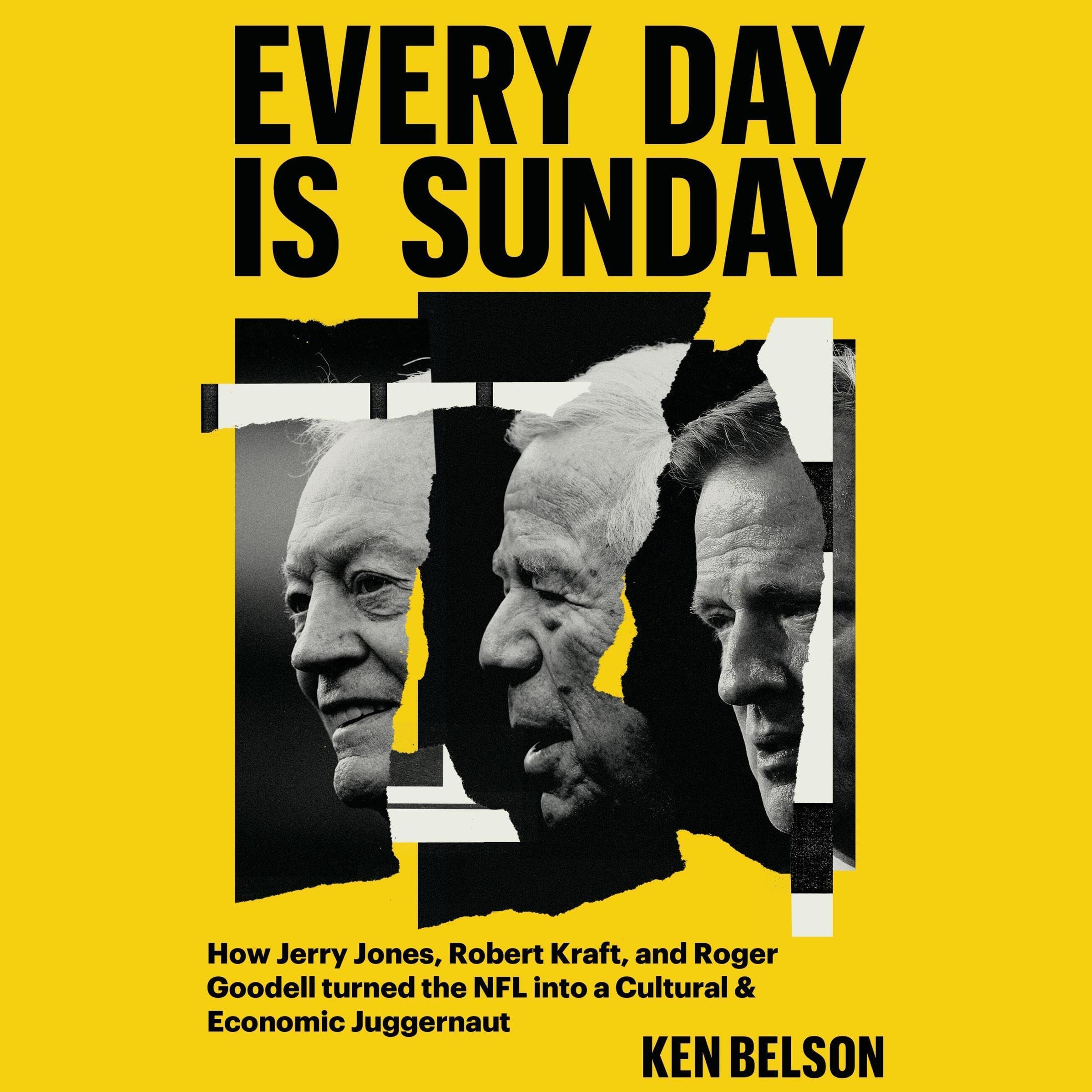
From veteran New York Times Business & NFL reporter, Ken Belson, a deeply-reported account of how the NFL’s Commissioner, Roger Goodell, and its two most powerful owners, Jerry Jones & Robert Kraft, turned the league into a cultural phenomenon.
On February 11, 2024, NFL Commissioner, Roger Goodell, & the league’s two most powerful owners, Jerry Jones & Robert Kraft, looked down at the spectacle before them. What they saw was the sport’s championship game, the Super Bowl—now a de facto national holiday—being played in a shiny new $2B stadium, home to the first franchise based in Las Vegas, after the league’s embrace of nationwide gambling. The moment was over 30 years in the making. As one of Goodell's colleagues “Roger doesn’t view the other leagues as competition. He wants to be mentioned with Disney and the Vatican, these massive institutions.”
In Every Day is Sunday, Ken Belson traces the evolution of the league from “one of the four US professional sports,” to the superpower it is today. Belson illustrates how the league’s rise coincided with the arrival of Jones & Kraft in the early 90’s. He provides an inside look on how these two men reshaped the league, taking readers into the secretive owner’s meeting, how they decided Goodell was the right man to place as Commissioner, and how the three built, wielded, and held on to their collective power.
Perfect for fans of The Dynasty and Big Game, Belson provides a unique peek behind the curtain of how America’s favorite sport achieved its status—and how these three men let nothing stand in their way.
The makings of the giant that the NFL is today are fascinating to me. Kraft comes across as the biggest winner of this book from my perspective as it portrays him as the smartest owner that steered the NFL in the right direction time and time again. The Jerry Jones portions were just OK, but that may be because I just watched the Jones-Netflix doc a couple months back. Goodell is the most compelling character as the wrangler of the 32 owners.
Again and again, it seems the way the NFL handles issues in a manner that seems...wrong? But somehow the league continues to comes out ahead when it came to concussions, Kap, rouge owners, etc.
The parts about Rupert, David Hill, and FOX's impact on the league in the 90s were compelling to myself for unique reasons, but I also believe my enjoyment of the book peaked too early.
I felt as if it lost me in the details on the NFL's legal battles when it came to head injuries. I understand that period was crucial to the NFL marching on in its growth, but it may have been just a bit too much detail for my liking.
Belson pulled me back in with his commentary on the negotiations between the NFLPA and NFL on the CBA. For one, I couldn't believe how much current ESPN talent are former top NFLPA members (Jeff Saturday, Ryan Clark, Dominique Foxworth). Jerry's folksy analogies made me laugh out loud.
Overall, reading about the build-up of the NFL to what it has become today, where it has reached a peak no other sport has gone before, and I don't know if another ever will, was a quality experience I would recommend to any NFL fan. I would also tell them not to feel bad skipping a page or two in the middle...
This reads like a pretty solid collection of articles on the major NFL stories of the last 40 years, but it doesn’t come together into anything bigger than an assortment of writing. The stated concept of the book is that Jerry Jones, Robert Kraft, and Roger Goodell have directed the NFL’s wild success since they came onto the scene in the 80s and 90s, but Jones and Kraft disappear for chapters at a time, and Goodell is a non-entity as a personality, so his presence doesn’t really pop.
There’s also a sloppiness to the ordering of the book, with entire chapters on a subject followed by a brief mention of the same subject in a later chapter written as though the previous chapter didn’t already address it. I put this more on editors, because I can see how a talented author could divide a book like this into sections, write them, and then get an editor to help piece them together. Someone dropped the ball here. Otherwise, quite enjoyable.
Ken Belson's Every Day is Sunday is a careful examination of the managerial class of the NFL. it traces the growth of the NFL from the early 90s to the present with a focus on its revenue streams. The protagonists are not quarterbacks and linebackers but executives, owners, and commissioners. Belson is an insider and his access allows him to portray central figures such as Roger Goodell, Jerry Jones, Robert Kraft, and Rupert Murdoch. Belson's portrait is balanced without condemning the NFL for its capitalist wiles. Perhaps he should, but that is not his task. Fans of sports and sports business will learn a great deal from this book even if their ire for the sport's owners is inflamed. Belson's prose is lucid, a testament to the countless words he has penned as a journalist.
If you've read any long-form stories about the past 20 years of the NFL, there isn't a thing in this book that will strike you as groundbreaking or even new. The league is run by a bunch of owners who join with their figurehead commissioner to make billions of dollars while paying mere lip service to the idea of caring about players or fans. As for the fans, all we care about is football every Sunday in the fall. There are times where you wonder what would happen if the bottom dropped out on all this... but it's doubtful it would take place any time soon.
This book is aggravating on two fronts: one, because seeing how the NFL operates behind the scenes only makes me want to stop watching games or participating in fantasy all the more; and two, because this book never attempts to really make a statement about the look it gives us, as it rambles around, repeats itself, and shares history that feels unimportant (like spending nearly a whole chapter on the creation of the nfl’s website).
I’m left with more questions than answers.
At least we got to hear Jerry talk about circumsizing mosquitos and owls having sec with chickens, though!
New York Times reporter Ken Belson looks into how the NFL has become a mega-business over the last 30 years, driven particularly by Patriots owner Robert Kraft, Cowboys owner Jerry Jones and Commissioner Roger Goodell. He looks at how they’ve maximised TV deals, minimised labour costs and seized on opportunities like legalised gambling. A fascinating read and a worthy update to titles like Michael Oriard's Brand NFL and David Harris's The League.
Well-written but the author clearly dislikes the NFL and is upset by its staggering popularity. Trots out all the same one-sided criticisms people who don’t watch or understand football consistently repeat.
The feature stories on Jerry Jones and Roger Goodell were the most interesting aspect.
I will never watch a NFL game the same way again! Even though I am only a casual NFL fan, this book was an absolutely riveting “behind the scenes” look at the business side of the NFL. Enter the world of NFL owners and executives, and prepare to know more about the NFL than your husband!
This was a good summary of how the NFL has grown and maintained its brand under the stewardship of commissioner Roger Goodell, including the fancy footwork down the sidelines necessary to dodge controversies such as CTE and anthem protests.
American football is my least favorite sport and this book didn't make me like the game anymore. NYT sports reporter Ken Belson researched deeply and told a compelling story, but the overly revenue- and growth-driven, cult of personalities overseeing a dangerous game left a bad taste in my mouth.
Veteran NYT reporter Belson tells the story of the rise of the NFL since the 1990s into a cultural and economic powerhouse. The roles of Jerry Jones, Robert Kraft, and especially Roger Goodell are explained in detail. NFL fans will enjoy this book.
This was an interesting look at how the NFL has transformed into the behemoth industry giant it is today. Primarily focused on Jerry Jones, Robert Kraft and Roger Goodell, it shows how the trio have leveraged TV deals, labor negotiations and gambling to turn the league into a cash cow. While there isn’t a ton of new-to-me info, I still found it a fascinating and quick read that I’d recommend to sports fans interested in the business side of the NFL.