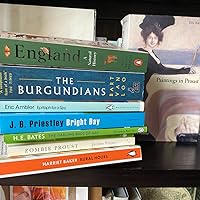
J.B. Priestley was especially fond of this novel of his: "I am not one for favourites," he wrote in the introduction to the Everyman edition, "and I have always been irritated by questions about my favourite this, that and the other. But if I have a favourite among my novels, it is Bright Day, which I wrote towards the end of the war."
The novel was written towards the end of World War II. JBP disclaimed any autobiographical roots in the work, but it is nontheless resonent with his early youth and coincided with JBP's recoil from the commercial film world. Bright Day was the only serious novel that he wrote in the first person.
Gregory Dawson, the novel's hero, is a middle-aged film script writer who goes off to Cornwall to complete a script. At his hotel he spots Lord and Lady Harndean, and realizes that they are the Malcolm and Eleanor Nixey he knew when he worked as a clerk in a Bruddersford wool firm. They represent the beginning of the break-up of the bright day which had preceded the year 1914, and thus the story starts to unfold...
Vincent Brome, one of JBP's biographers, wrote: "Bright Day is one of Priestley's two most important and successful novels. The other is Angel Pavement."
John Boynton Priestley was an English writer. He was the son of a schoolmaster, and after schooling he worked for a time in the local wool trade. Following the outbreak of the Great War in 1914, Priestley joined the British Army, and was sent to France - in 1915 taking part in the Battle of Loos. After being wounded in 1917 Priestley returned to England for six months; then, after going back to the Western Front he suffered the consequences of a German gas attack, and, treated at Rouen, he was declared unfit for active service and was transferred to the Entertainers Section of the British Army.
When Priestley left the army he studied at Cambridge University, where he completed a degree in Modern History and Political Science. Subsequently he found work as theatre reviewer with the Daily News, and also contributed to the Spectator, the Challenge and Nineteenth Century. His earliest books included The English Comic Characters (1925), The English Novel (1927), and English Humour (1928). His breakthrough came with the immensely popular novel The Good Companions, published in 1929, and Angel Pavement followed in 1930. He emerged, too, as a successful dramatist with such plays as Dangerous Corner (1932), Time and the Conways (1937), When We Are Married (1938) and An Inspector Calls (1947). The publication of English Journey in 1934 emphasised Priestley's concern for social problems and the welfare of ordinary people. During the Second World War Priestley became a popular and influential broadcaster with his famous Postscripts that followed the nine o'clock news BBC Radio on Sunday evenings. Starting on 5th June 1940, Priestley built up such a following that after a few months it was estimated that around 40 per cent of the adult population in Britain was listening to the programme. Some members of the Conservative Party, including Winston Churchill, expressed concern that Priestley might be expressing left-wing views on the programme, and, to his dismay, Priestley was dropped after his talk on 20th October 1940. After the war Priestley continued his writing, and his work invariably provoked thought, and his views were always expressed in his blunt Yorkshire style. His prolific output continued right up to his final years, and to the end he remained the great literary all-rounder. His favourite among his books was for many years the novel Bright Day, though he later said he had come to prefer The Image Men. It should not be overlooked that Priestley was an outstanding essayist, and many of his short pieces best capture his passions and his great talent and his mastery of the English language. He set a fine example for any would-be author.
J. B. Priestley’s Bright Day is a thoughtful portrait of 1913, recalled 30 years later by a man in middle age. Although now rediscovered and republished, the book, like many of Priestley’s, was forgotten for years, and I should not have known of it had I not found an ancient copy some 20 years ago in a secondhand bookshop in the Middle East, and bought it purely because I had little to read. It was a lucky accident, to the extent that I have read it again it two or three times since. This is one of the best novels I have ever read; it might actually be the best.
The book opens in an expensive but bleak cliff-top hotel in Cornwall. It is the spring of 1946 and a successful but jaded middle-aged screenwriter, Gregory Dawson, has been sent there by a producer to finish an urgent script. Dawson is English, but spent many years in Hollywood, then returned at the start of the Second World War. At the hotel, he works. There is not much else to do; the weather is mixed, the (rationed) food mean and dull, the other guests old, wealthy and sclerotic. However, one older couple catch his eye. Discreet enquiry tells him they are a wealthy and titled couple, Lord and Lady Harndean; the husband, a businessman, received a lordship for services rendered to the prewar Chamberlain government. Dawson is sure they have met, yet he cannot place them. Then a day or two later the band in the lounge play a Schubert trio that jogs his memory, and he remembers who they are.
Dawson is back in in 1912. His father, who is in the Indian Civil Service, and his mother both die suddenly of a fever in India just as he, an only child of 17 or so at school in England, is preparing to take his entrance examination for Cambridge. Too shocked to sit the exam, he finishes the school year and is then taken in by an aunt and uncle in Bruddersford (a thinly disguised Bradford); and instead of attending Oxford or Cambridge, as befits the son of an ICS officer, he finds himself working for – in effect, apprenticed to – a wool merchant in a Northern city.
This does not trouble him, for the sudden loss of his parents has rendered everything meaningless. In any case, he already knows that he wants to write. He reads widely, especially poetry; and in Bruddersford he discovers some of the magic of being young as well as its oppression: “At the time when verse becomes magical to us, there is also another sorcery, created by glimpses, brief and tantalizing, of people we do not know... Later in life we merely see interesting strangers ...the mystery, the magic, the sense and promise of unexplored bright worlds, no longer haunts us.” On the tram he often notices a group of people, probably a family, with lively intriguing young people, that fascinates him. And then he starts work; and finds that Alington, the local head of the wool merchant for which he is working is the father of that family. Bit by bit he comes to meet them all, including the three attractive daughters; and there is an air of the wonder of adolescent discovery. In the winter and spring of 1912-1913 the young Dawson accompanies this magical family to the pantomime, to classical concerts, and finally out to the high moors beyond the city limits, where long days are spent in bright sunshine.
It is after one such day on the high, bright Pennine moors that the Alington family, with Dawson, return to Bruddersford on a May evening in 1913, and decide to have some music. Three of them are playing the Schubert trio when a youngish couple enter unannounced: “And then there were two strangers standing in the doorway, among the splinters of the Schubert.” They are the Nixeys. Malcolm Nixey has been sent by the London office, ostensibly to learn the business, but actually to force Alington out. What they actually do is best not discussed here, as it might spoil the book. But when Dawson leaves for the Western Front just over a year later, the Alingtons’ lives have been changed irrevocably.
Dawson never returns to Bruddersford. But when on a cold spring day in 1946 he hears the Schubert and sees Lord and Lady Harndean at the same time, he knows that they were, before ennobling, the Nixeys. Over the next few days he tries to recall, for the first time in years, his life in the last two years before the first war, and in so doing, tries to make sense of the life he has led since. The book switches between 1946 and 1912-1914 and describes a process of remembrance that leads Dawson to change his life, absorbing hard but decent lessons from a past that he had thought he had understood.
Bright Day is at least partly autobiographical. Priestley, who was from Bradford, went to work for a wool merchant at 16, and left aged 20 to fight in the First World War – an experience that marked him, as it did the fictional Dawson. Priestley too never moved back to Bradford (though, unlike Dawson, he never cut his links with the city). Although more a novelist and playwright than a screenwriter, he did have contacts in Hollywood and visited the US a number of times in the 1930s, spending many months there. However, he spent the Second World War in Britain, and was very active in the media and in public life. He was more or less the same age as his Gregory Dawson and the book was published in the year it was set, 1946.
Priestley wrote several books about parts of his life, but never wrote a proper autobiography. The closest he got was Margin Released (1962), a series of three autobiographical sketches, each of 100 pages or so. The first concerns the time when, as a very young man, he did indeed work at a Bradford wool merchant’s in the years just before the First World War, and there is a clear sense of a time when the world was new. Bright Day itself drips with the remembrance of things past; seen from the bleakness of 1946, Christmas 1912 is “a vast Flemish still-life of turkeys, geese, hams, puddings, candied fruit, dark purple bottles, figs, dates, chocolates, holly... It was Cockaigne and ...there has been nothing like it since and perhaps there never will be anything like it again.” A concert in the city’s main hall, Dawson’s first and thrilling night out with the glamorous Alingtons, is lit by gaslight, so the hall is steeped in a golden October-like light. A bright spring day on the moorlands begins “in an almost empty little train, chuff-chuffing towards the Dales through the vacant and golden Sunday morning. (There don’t seem to be any trains like that any more... All transport now seems to be fuss, crowds, rain and anger.)”
This is the key to Bright Day: remembrance. It is not mere nostalgia; there is no weird yearning for a country that never existed. In 1914 Britain and Europe were heaving with social unrest. It was a tense world with rotten underpinnings, brought wonderfully to life by the late Barbara Tuchman, herself born in 1912, in The Proud Tower; and recently by Michael Portillo in the radio series 1913: The Year Before. There was no Cockaigne. Priestley was not so daft as to believe otherwise. He was on the Left, and was a fierce social critic, most notably in his 1934 travelogue English Journey. At about the same time, in a satirical novel about the Press, Wonder Hero, he hinted he had no great love of Empire either. His work was rarely divorced from reality. Bright Day is not a paean to some prelapsarian Edwardian heaven stolen from us by the Great War. Rather, it is a very personal journey back through that time of one’s life when everything glittered with the unexplained and undiscovered.
Priestley died in 1984. By that time he was not as widely read as he had been. At his brilliant best, he could be a wonderful writer, but he was not always; as a technician, he was inferior to many of his contemporaries, including Orwell, Evelyn Waugh, or Graham Greene. Priestley could be pompous and wordy. He could certainly write for the gallery and could, if he wished, serve up more ham than a wholesale butcher.
But Bright Day is one of the best novels in the English language. It is deeply personal, a far-off place of bellowing Yorkshiremen and enormous lamb chops and cricket and bright sunlit moorlands, tinged by the magic of youth and remembered by a tired man in a pinched bleak world. The world of 1913 is remembered in relief, at length, from a seat on a high fell as the bright day turns into late afternoon and then to dusk, the shadows climbing slowly towards us across the fields and the bracken and the dry-stone walls.
From BBC Radio 4 - Classical Serial: Disillusioned scriptwriter Gregory Dawson is staying at a hotel in Cornwall, finishing a script. A chance encounter in the bar sends him back to the lost world of his youth before the slaughter of the First World War when he was a 18-year old in Bruddersford, Yorkshire: Through rediscovering his past Dawson realises where his life took a wrong turn and where he must make amends if he is to start afresh. There is a glow of magic in poignant rediscovery.
My goodness, another slow read! Two weeks for a novel. I really am slipping!
But I did thoroughly enjoy this one. I've decided this year to try and read all the old Priestly I can find. I came across this one, as a lovely penguin paperback from 1946 in the local oxfam. It's front cover and back cover both fell off as I was reading it. But better to red it and have it fall apart than sitting on the shelf unread.
This was quite magical, in the way that Alan Moore was magical. The main character was going back and remembering or reliving his youth, and looking at how the war changed everything, how our decisions when we are young affect us in ways we don't quite understand. How and why things change. There were a few parts where dull middle class people had dull middle class fun, which were not the most interesting parts. But overall it was still excellent. Parts were just terribly beautiful and haunting and the interconnectedness was wonderful. Definitely one I'd recommend.
Another great read. A good story, set in Bruddersford again and flitting backwards and forwards in time. Priestley was obviously very taken with performing and show business as the first of his novels that I read was about a theatre group, The Good Companions. This one was about the film industry and also writing. The main character works in a wool merchants in his early years, writing articles for newspapers. He eventually has a very successful career as a film script writer and the decisions that he has to take about where his career takes him are much influenced by the experiences of his early life. The character comes across as a man of strong principals and great thought. If you have never read Priestley, then I can highly recommend him!
This was my second J.B. Priestley novel. The first being "The Magicians" (which I also loved)
"Bright Day" I read was, for a very long time, Priestley's favourite novel. I can now understand why. Priestley has a way of expressing the human condition as expertly as Greene, Maugham and Davies only on a slightly more romantic (as in art, not love) level.
I simply could not put this book down.
I will continue to read his books (hopefully all of them) as he has found a new and adoring admirer of his work.
One of the best books which I have ever read. The story depicted here is moving and also realistic. The book was written immediately after The Second World War and reflections of Pristley about the British war generation are breathtaking from the historical point of view.
A 50-year-old film writer returns to England from Hollywood and starts remembering the years when he was 18, an apprentice in a new small town, meeting new and fascinating people. It was 1912-14, and most of the young men he befriended at the time were later killed in the war, and the girls he liked then saw their lives change forever. He reflects upon how those events have shaped his life. Having read the letters of Dorothy Sayers, it felt like revisiting the period Priestley is describing, as she was the same age and describes similar charade parties, classical concerts, and enjoyment of a life that no longer exists.
Having misunderstood the author as V.S. Pritchett, I decided to have this 60th anniversary edition to read since I have never read him before. In fact, it’s first published in 1946, the year after the end of World War II so its narrative has revealed aftermath accounts of those key characters in Bruddersford and England more than six decades ago. Therefore, I think there would be a few reasons why we should try reading this reprinted novel recommended by Dame Judi Dench, Michael Billington, Alan Plater (outside covers) as well as Margaret Drabble, Beryl Bainbridge, Melvyn Bragg (inside covers).
First, as non-native speakers of English, in some pages we would have fun in guessing his conversational, colloquial English as spoken in those days. I’m not sure if it is dramatically different from everyday spoken English as used nowadays so this should not post any problem to its native speakers but, for those having known English as L2, it is a bit tough to demystify some unfamiliar sentences into grammatically-correct as well as precise, understandable spellings as read in ordinary, present-day novels. For instance:
“Ay, Ah’ve summat to say to you,” Ackworth continued, quietly now. “You an’ me’s never got on, an’ Ah dare say that’s been as much my fault as yours. But you could ‘ave stood by Mr. Alington an’ me an’ this end o’ the firm, an’ you ‘aven’t. You’ve been well in wi’ Nixey right from the start – ay’ an’ Ah’ll bet you’ve told ‘im plenty an’ all. …” (p. 214)
Or this one:
“if you’ve got summat in you that wants to be let out an ‘goes on natterin’ at you day an’ night, then you let go of everything else an’ get it out. For that’s your life, lad, an’ don’t let anybody tell you it isn’t. An’ if you don’t get it out, it’ll go bad in you. …” (p. 223)
Second, there is an interesting episode depicting a literary/comedy game called “charades” (pp. 187-194) in which the sides are picked by those attending as a familial amusement for friendship and intimacy, that is, to break the ice so that the visitors would feel free to become more acquainted with the host members. This kind of acting/playing game is informative to me because it is my first encounter and I wonder if it is still popular and played in rural, local communities in England.
Third, the handsome hardcover with its following contents, I think, may interest some of my friends out there: Foreword by Tom Priestley [i.e. his son] Foreword by Margaret Drabble J. B. Priestley Biography What Priestley means to me Bright Day Literary Tour What Priestley means to me (continued) A Last Word by Tony Benn Subscribers
Finally, its design and layout by Brahm Limited should deserve praise and honour for its generosity regarding the sufficiently-large fonts, especially for the elderly, in which nearly every page is readable and enjoyable. However, I’m not sure if it is due to its technicality having posted two kinds of ink shades, in other words, dark gray fonts in Chapter 1 through one third of Chapter 4 followed by light gray fonts till the end of Chapter 6. After that, the shades vary (my note: from Page 194 onwards, the ink shade is darker, it’s easier to read). Moreover, some few lines are too tight for words with less normal spaces, for example:
thanagrossofaquarterofamillionsterling.BeaBigSuccess,Darling.And (p. 257) Or this one: “Well,that’showitis.Peoplehavetokeeponsayingthesesensible (p. 285)
in which, we hope, these unimaginable lines should be improved in its future publication by the computer know-how. In brief, I think if I had read and been familiar with this novel, I would have enjoyed reading his “Literature and Western Man” some years ago.
Although I listened to a dramatisation of this book I still felt the mastery of Priestley's writing through the dialogues. If the novel is semi-autobiographical, as hinted, it would explain how all the characters surrounding Gregory are so alive and vivid. I felt that Gregory was a bit staid and underdeveloped as if the supporting characters were more important than the main. I felt his depiction of life before ww1 was spot on: the gaiety and carefreeness of life for the upper lasses followed by the uncertainty of war and then after the war had touched and ruined their lives the innocence of it was gone forever. Also, those 3 have-it-all, fun loving sisters' lives ended in such tragic ways. A cut short tragic death; a self-induced drug dependant death and the last sister seems bitter and quite sad. Gregory had been so in love with all 3 girls, their happiness and zest for life. Circumstances and life had touched all 3 and they'd ended so disillusioned and sad. It was the end of a dream.
This entire review has been hidden because of spoilers.
A young orphan is sent to live with a distant Aunt and Uncle in the Yorkshire countryside before WWI. Gregory is shy, reserved and lonely. He is given a job in a wool factory and begins to make friends and to publish some writings. The Alington family befriends him and invites him into their inner circle of family, food and music. The Great War changes all of their relationships and the world forever. As the adult protagonist remembers his time in Bruddersford, he makes some life affirming changes to his life and self. Tender, poignant with beautiful characterizations and setting.
This is a beautiful book. Just after the second world war a middle aged man, now a scriptwriter and producer looks back at his life before the first world war when as a young man he worked in the wool trade. There is feeling of impending doom throughout his reminiscences leading eventually to a tragedy and we see how this has affected his life up until the present and how he eventually finds some closure.
Having never read Priestley before, I just happened to pick this off my library shelf. I love An Inspector Calls, and Bright Day lives up to that. I can only imagine that Sillitoe read this before writing Saturday Night etc..though Bright Day is far more middle/upper class. But it tells the same truths about people. A wonderful book and author and I shall be reading many more by him.
A late gem from an author who is unfashionable these days. Almost as compelling as "Lost Empires" this book juggles time-frames with ease and looks into the dark heart of human beings
"Because this novel is written in the first person and its action swings from the West Riding I once knew to the contemporary film world, a special word of caution is probably necessary. This work is pure fiction, containing no autobiographical material, no portraits of actual persons living or dead, no reporting of scenes ever visible to my outward eye. I beg the reader to accept this not as a mere formality but as a solemn assurance."
So said Priestley to the reader back in 1946. But this book is in my view, an autobiographical novel. Many of the characters and incidents may here may be fictional but there is something about the setting Bruddersford (Bradford) and some details about Priestley's early life that are recounted here, in the guise of the narrator Greg Dawson.
Dawson is a script writer, circa 1946, who is staying at a hotel in Cornwall trying to finish a workable script for a movie producer. While staying there, he meets an older couple whom he recognizes. They (Malcolm and Eleanor Nixey) are a couple he met more than thirty years before, back when he was a 18 year old lad in Yorkshire working at a wool merchants company. The husband was someone sent to learn the wool merchants business, and over a period of time, (to the mind of at least one man there) take over the company and remove some employees who were already working there.
Dawson's mind, upon meeting the couple, leaves the present time and goes back to the years -1912 to 1914 - he spent in Bruddersford and concentrates on his meeting with the Alington family.
This family, to a lonely lad of 18 , have some magical quality about them to his eyes. He is thrilled to find that the head of the family is also the manager of the wool merchant company where he takes up new employment. But life at the company is to change for ever when Malcolm Nixey takes up employment there.
The narrator Dawson gives the reader a vivid portrayal of life in England in the immediate years before World War One. This was a simpler time, when people had fun going to concerts and pantomimes, and made their own entertainment at home. When every family had at least one member who could play the piano and other instruments. When Sundays were reserved for walks and picnics on the moors. A society where many didn't think of war or believe that any forthcoming war could really be possible. A way of life and feeling of security that would be shattered by what did arrive - the Great War.
Dawson reveres the Alington family, and places them on a high pedestal. Just being welcomed into their lives is like magic to him. But over the long period of time that follows, it becomes evident that the family are normal people, with their own failings and frailties, a family whose happiness would be shattered by war and other tragedies that beset many other families nation/worldwide.
When war arrives, Dawson signs up , and loses contact with Bruddersford, his work colleagues and the Alington family. Will he ever have contact with them again, or ever learn what happened to a few particular people he left behind?
As well as looking back, the present is also important, as middle-aged Dawson works in the film script business. He's going though a mid-life crisis of sorts and is tired of what he does, tired of the film industry and wants to quit even though his friends in the business want him to stay. What's to become of him?
Written in a cozy first person narrative, this book moved quickly for me. Some of the chapters were long, which would normally slow things down for me, but not with this book. I read the book avidly and quickly, it was hard to put down. A few small sections may have seemed a bit wordy, but not excessively so. The narrator may well have been a fictional character, but I feel a lot of Priestley was behind the narrative. The observations, comments, even the grumbling seemed compatible with Priestley's persona.
N.B: 5 stars for the novel, 1 star for the Kindle formatting
“Bright Day” is an exceptional novel, a sort of archaeology or even geology of the soul, as earlier layers of ourselves surface once more in response to sights, sound and smells from the past.
The narrator is Gregory Dawson, a cynical middle-aged film scriptwriter. He has enconsed himself in a Cornish hotel, away from distractions, to complete a script. But distraction comes from within, sparked by hearing a Schubert Trio and seeing a couple he knew over thirty years previously.
Greg is taken back to his youth in the Yorkshire city of Bruddersford (Bradford). As an 18-year-old orphan, he started a new life here, living with his uncle and aunt, and working in the wool trade. This was the time before the First World War, when people “made their own fun, instead of having it concocted for them by film and radio experts.” He recaptures his enchantment with the Alingham family, five siblings aged mid-teens to early twenties.
It’s a bittersweet tale, as there’s a sense of doom hanging over the recollections, as well as the youthful feeling of “mystery, the magic, the sense and promise of unexplored bright worlds ...”
I enjoyed the novel immensely. The author has a warm affection for Yotkshire, place and people. The description of a pre-WW1 Yorkshire Christmas, a kaleidoscope of mince-pies, holly, figs, dates, geese, hams, beer, whisky, port and brass bands is marvellous!
Unfortunately, the Kindle version (at least on my device) had problems. I don’t know if my device had somehow corrupted the files, but much of the extra content at front and back was almost unreadable. Here are just a few of the errors: “as tart led” for “startled” “onus” for “on us” “haste about” for “he set about” “amoral” for “a moral” etc. It all read like an AI transcription gone horribly wrong - please review and edit!
I think Mr Priestley protesteth too much with his claim on the title page that “this work is pure fiction.” The past that Gregory Dawson, the main character, painstakingly recovers - “Once you settle down deliberately to remember, it is surprising how much comes back, some of it in sharpest detail” - bears numerous similarities to Priestley’s own life story. But disclaiming the work as autobiographical clearly gives Priestley a free licence to edit and embroider his own past without fear of libel claims from “actual persons living and dead.”
Once the narrative framework of the novel has been established - the random encounter with a couple he last saw thirty years ago that sets him “diving and groping into the past” - the anecdotes, observations and whimsies flow in true Priestley style, touching, humorous and quirky:
- “The orchestra had two of the chanciest French horns I have ever listened to, so uncertain, so mournfully dubious and fearing, that the whole audience would breathe a loud sigh of relief when they reached the end of any solo passage.”
- “Eva brought the sugar and with it the colossal candied plum of her own looks.”
- “There was Mr Peckel, who was enormously stout, had a high whinnying voice, could perform astonishingly good conjuring tricks, and was terrified of his wife, who was tiny but very fierce.”
- “He couldn’t be said to be drunk - he never was drunk - but he was even further away than usual from being sober.”
The novel’s themes are those that recur across many of Priestley’s works, reflecting his wider interests and preoccupations. They include:
Good companionship:
- “I experienced that feeling of cosy enchantment, that sense of having snugly to hand, under the same protecting roof, almost all this earth’s most precious persons and things.”
- “Brass bands played and choirs sang in the streets; you went not to one friend’s house but to a dozen; acres of rich pound cake and mince pies were washed down by cataracts of old port, whisky and rum.”
- “Secure and snug with the Alingtons, to whose magic, still potent, a certain friendly cosiness had been added, I loved that pantomime, and was half inside its fairy tale.”
- “The rain drummed and spat, and we felt small and cosy in a huge darkness, warmed by a new intimacy, ready for secrets.”
- “A blur of sunlight and green leaves and shining water, of laughing girls and long-vanished friendly faces, of bread and jam and happy nonsense in a lost Arcadia.”
The North-South divide:
- “Mr Alington was not a Bruddersford man but came from the flimsy and treacherous South.”
- “If they could not be cosmopolitan then they would be as aggressively provincial as possible.”
- “His wife, a fluttery woman hung about with exotic ornaments, was not Yorkshire but came from the South somewhere.”
Politics:
- The “simple and noble” Edwardian-age socialism of Labour Councillor, Fred Knott (“I’m a fighter, that’s all - an’ what I fight for, an’ what I’ll go on fighting for till I drop, is more good life for the people, especially the poor muckers that don’t know where they are and can’t talk for themselves.”)
- The cynicism of Post-War politics (“Socialists who write Tory columns. Working-class leaders who forget their origins until they’ve had some drinks late at night.”)
The girl with “fine eyes”:
- Self possessed, attractive women, like Joan Alington and Eleanor Nixey, generally have a disconcerting affect on Priestley’s sturdy male heros. “Fine eyes” always signify class and quality in Priestley’s women, as opposed to the squints and low morals of the lower orders …
His metaphysical theories of time and space:
- “And if the universe is not simply an idiotic machine, grinding out nothingness, then in some queer but cosy dimension of it my Aunt Hilda is still trotting round to the Miss Singletons to secure the last brown loaf and the remaining six Eccles cakes.”
- “I think he [Jock Barniston] came from a long way off, to drink beer and coffee with us, to smoke a pipe and hear our troubles, to vanish in the slaughter-house of the First World War, and then perhaps to make some cool and amused report on us to some authority outside the solar system.”
- “The real Eleanor Nixey was somewhere behind all these appearances and fragmentary distortions, existing outside change and time.”
Apparently “Bright Day” was Priestley’s personal favourite. And it’s mine too (though perhaps joint-favourite with his “Angel Pavement”). I love that the chap in the story is about my age - and that we both spend a lot of time ruminating on our long lost youth. In the case of Gregory Dawson, however (and Priestley himself, I suspect), there’s something especially symbolic about the years he’s looking back on. It’s the period on the cusp of the First World War and the novel captures so sweetly, so elegiacally, the innocence of that other world that would be lost forever in the “slaughter-house” that changed everything and everyone.
And so memory turns out to be double-edged. At the last New Year’s party of those golden, Edwardian years, Bridget Alington comments that family life “usually seems pretty awful at the time. Yet when you look back, you feel it was wonderful.” Gregory replies that “That’s not just family life, that’s everything.” But this isn’t true. As the older Gregory starts to realise, too much memory isn’t good for you. And letting the past overwhelm the present becomes “like the ache of a badly-healed wound, that sense of loss and desolation and bereavement.”
The other problem with memory is that it’s faulty. Meeting up with Bridget Alington thirty years later, she shatters the golden memories he’s cherished of her and her sisters all this time with her very different perspective: “I don’t think you really understood any of us. We often used to laugh at you - I don’t mean we disliked you or anything like that - but I suppose because you were a lonely boy and rather sentimental and romantic, and enjoyed making things up - because you wanted to be a writer, I imagine, you never saw us as we really were.”
And so it starts to dawn on us that Gregory has perhaps been an unreliable narrator. Not only do his selective recollections of events differ from those of other people. It turns out he might actually have fictionalised the past. As the middle-aged Bridget tells the middle-aged Gregory: “I think you’re still just making things up. Probably, being a writer, you can’t help it”. Priestley’s disclaimer on the title page turns out to be true - this is fiction not autobiography, after all.
Just one thing I was uncomfortable with. Given that Gregory, the successful Hollywood scriptwriter, makes such a fuss about the importance of films having a convincing ending, it seems ironic that the end of this novel feels perhaps just a tad tacked on. I wasn’t expecting a “happy ending” and was ready for the novel to finish on a wistful note some fifty pages earlier than it did.
I felt I didn’t need the rather contrived coincidence of little Laura Blackshaw popping up, now a stout matron with her chorus of young hopefuls and her homely wisdom: “Life goes on - and if people die and things change, that’s all part of it - and the worst thing to do is to turn your face away and hold yourself rigid and not let life go flowing through you.”
Perhaps I prefer Priestley’s melancholy to his forced optimism. In any case, if I were making a film version of this novel, I’d go for a title like “Picnic at Pikeley Scar” rather than “Bright Day” which I’d have thought Priestley (or his character, Gregory) would have scoffed at as “so much screen hokum” …
Much of this book is an absolute masterpiece (right up there with The Go-Between, which it more than slightly resembles). But unfortunately the undercutting of that whole "enchanted" aura leaves the reader in a sort of "Monkey's Paw" situation: if the Alingtons really weren't so special--but were actually just a bunch of more or less clueless jerks--then the sublime feeling exemplified throughout much of the narrator's past gleanings really just amounted to a lot of smoke and mirrors. It's no wonder he was feeling rather out of sorts by the end of things. All of which led us to that last chapter, with a decidedly tacked-on and forced, deus ex machina feel to it. (Also, the conversations between Gregory and Liz came off as rather pat at times.)
Disillusioned scriptwriter Gregory Dawson is staying at a hotel in Cornwall, finishing a script. A chance encounter in the bar sends him back to the lost world of his youth before the slaughter of the First World War when he was a 18-year old in Bruddersford, Yorkshire: Through rediscovering his past Dawson realises where his life took a wrong turn and where he must make amends if he is to start afresh. There is a glow of magic in poignant rediscovery.
This is my favourite J.B Priestly novels it’s funny and is also thoughtful. It looks back on family life and to a time when things were more innocent. It weaves a wonderful interesting story into a well though out completion.
I went on a tear many years ago buying as many of JBP;'s books that I could find after seeing the play "An Inspector Calls" then reading the book and then realizing I had seen a few plays based on J B Priestley words. I did not realize when I bought it that it was a First Edition with no DJ.
I was looking forward to reading Bright Day as it seems it was one of his favourite books and also many of his readers say the same thing ..... I don't. In Good Companion, An Inspector Calls and Lost Empire ... I have said his paragraphs/pages are very long and wordy but usually wisely written. In Bright Day ... NOT. Way way too much filler and you tend to jump paragraphs and even pages to just move on.
At one very important point, a past reader had underlined a word ... and I reread the paragraph a few times but didn't get the reference until very close to the end and went back to it and reread the pages preceding that mark. The little mystery totally fell into place ...... but many would not have realized that the one word was so very significant.
For a very small sized and thin book it is hard to believe there are appr 350 pgs and in very readable type. I got through it in 3 days but I very easily could have put it down and not finished it. For me it sort of rambled.
My first J B Priestly novel, and I am sure not my last as there is much to like about this book. But I felt it could have been stronger. There was a lot of circuitous rehashing of thoughts - Greg, the narrator, would think something for several pages and then we would hear it all again as he discussed it with one or more people. I also felt some of the most potentially insightful parts of the story, despite all the rumination which makes up much of the book, was glossed over or never picked up at all. Very strange.
This novel, published in 1946, Is very much a book of its time. Its main theme is how two world wars upset the social norms and decimated lives, either cutting them short or completely derailing them. The narrator meets a couple he knew before WWI and brings back memories from that time, especially of a family, the Alingtons, who cast a magical circle for him. The conceit of the novel is he must return to the person he was to understand who he is now and pull together an authentic life. So much interesting thinking in this book.
Excellent! This is my first work of Priestly’s that I’ve read and I greatly enjoyed it.
From a deep nihilism for the present (downstream from both the slaughter of WW1 and the commodification of art Gregory himself has been an accessory to, albeit in a more inadvertent sense) our dear narrator, through a chance encounter and subsequent reflection back to his youth, finds himself again.
Ultimately, one must learn to live with the past; not to bury it and forget until it all comes crashing out again years down the line, but to instead wrestle with what comes from confronting it to instead inform a better tomorrow. Business types are also parasites, hell bent on profiteering at the expense of good, honest people.
“…and that’s the worst thing to do is to turn yourself rigid and not let life go flowing through you”
Мы, повелители Земли, теперь постоянно пытаемся убить время и, как правило, тупым предметом.
Не хотелось бы поскользнуться на эйджизме, но эта книга явно предназначалась для людей либо старшего возраста, либо для народа с жизненным опытом чуть больше красной тележки. Блуждать по ностальгическому лабиринту мужчины средних лет и пугать его тараканов в голове, анализируя «а что если бы..» — абсолютно точно не та вечеринка, на которую следовало приходить. Как проникнуться романом, когда не можешь понять кому таблетки нужнее? Мой внутренний ворчун прокачан до «нанесение палкой средних телесные за пропуск ежедневного эдвента в Клубе романтики», а жизненные успехи на стадии «Черная полоса» в UNO. Так вот, пытаясь разобраться с кашей в своей тыковке, не очень хочется сочувствовать плоду чужого воображения полувековой просрочки, который тебя жутко бесит. Если вы еще не поняли, Пристли попал ко мне в руки прям ой как не вовремя, а так как я далеко не филолог и не критик, поэтому, выезжаю на праве быть недовольной из-за настроения биачь.
Тик-так, Доусон, я тут как бы не молодею, не соизволишь скорее перейти уже к сути? Сюжета сегодня не будет, расходимся. "При блеске дня" преподнесет нам лишь вышколенный до скрипа текст выедает глаза излишней напыщенностью, пытаясь украсить до скрипа скучную историю (местами надуманную, излишне романтизированную и чересчур многословную). Наскрести побольше красивых цитат — пожалуй, да, но увлечься и полностью погрязнуть в истории, не годится. В надежде получить колоритных дедов, предающихся хардкорным воспоминаниям, от которых всякие зуммеры поседеют, получаем вялые брюзжания и только
This book is like two novels in one. A screenwriter is sequestered in a hotel to complete a screenplay. While there he runs into a couple old acquaintances, which gets him reminiscing about his past, particularly about a family he became attached to when he was 18. This part of the novel is great and is why I'm giving the book 4 stars. The "other novel" is about the man's stay in the hotel: his relations with the other guests and with the people he works with in the film industry. I found this part of the book rather tedious and I resented their constant interruptions of the character's looking back. So, only 3 stars for that part of the book, but the rest of it is so good that I'm giving it 4 stars overall.
This is a strong and moving novel of remembrance and tragedy. It involves the characteristic Priestley themes of social ambition, artistic appreciation and missed opportunities. I won't summarise (let alone spoil) the plot but I greatly enjoyed the way in which the narrator recalls his encounters in a pre-First World War amalgam of Bradford and Huddersfield with a fascinating if ultimately tragic family.
I didn't think the framing device, and the narrator's complex relationship with the glamorous female film star, works particularly well, but it does enable him to understand rather more the true circumstances in which his younger self encountered.
Priestley as Proust! For those who want a book tinged with nostalgia and memory (and a clearer plot), but do not want to read the tome that is Proust's work, 'Bright Day' would be an excellent choice. Instead of a Madeleine, it is music that takes our narrator back to reminisces of the summer of 1913. And just like in Proust, our narrator is besotted with a group of young women, who represent a golden moment in time. It's been ages since I've read Priestley- I loved 'The Good Companions'; I'll be sure not to let so much time pass before I read another of his works- excellent novelist.