

What do you think?

The Music On The Hill
A couple apparently run into some ancient forces when they move to the country.
Unknown Binding
About the author
Saki
1,918 books607 followersBritish writer Hector Hugh Munro under pen name Saki published his witty and sometimes bitter short stories in collections, such as
The Chronicles of Clovis
(1911).
His sometimes macabre satirized Edwardian society and culture. People consider him a master and often compare him to William Sydney Porter and Dorothy Rothschild Parker. His tales feature delicately drawn characters and finely judged narratives. "The Open Window," perhaps his most famous, closes with the line, "Romance at short notice was her specialty," which thus entered the lexicon. Newspapers first and then several volumes published him as the custom of the time.
His works include
* a full-length play, The Watched Pot , in collaboration with Charles Maude;
* two one-act plays;
* a historical study, The Rise of the Russian Empire , the only book under his own name;
* a short novel, The Unbearable Bassington ;
* the episodic The Westminster Alice , a parliamentary parody of Alice in Wonderland ;
* and When William Came: A Story of London under the Hohenzollerns , an early alternate history.
Oscar Wilde, Lewis Carroll, and Joseph Rudyard Kipling, influenced Munro, who in turn influenced A. A. Milne, and Pelham Grenville Wodehouse.
His sometimes macabre satirized Edwardian society and culture. People consider him a master and often compare him to William Sydney Porter and Dorothy Rothschild Parker. His tales feature delicately drawn characters and finely judged narratives. "The Open Window," perhaps his most famous, closes with the line, "Romance at short notice was her specialty," which thus entered the lexicon. Newspapers first and then several volumes published him as the custom of the time.
His works include
* a full-length play, The Watched Pot , in collaboration with Charles Maude;
* two one-act plays;
* a historical study, The Rise of the Russian Empire , the only book under his own name;
* a short novel, The Unbearable Bassington ;
* the episodic The Westminster Alice , a parliamentary parody of Alice in Wonderland ;
* and When William Came: A Story of London under the Hohenzollerns , an early alternate history.
Oscar Wilde, Lewis Carroll, and Joseph Rudyard Kipling, influenced Munro, who in turn influenced A. A. Milne, and Pelham Grenville Wodehouse.
Ratings & Reviews
Friends & Following
Create a free account to discover what your friends think of this book!
Community Reviews
Displaying 1 - 27 of 27 reviews

July 6, 2021
H.H Munro was the master of the short story. In this tightly written little yarn we are given a warning not to mock old gods and their worship. When a city woman desecrates an altar dedicated to Pan, the nature god shows his dark side. H.H.Munro could tell a great yarn in just a few pages. This is one of his shorter works but it its one of his most effective.

July 14, 2021
My first introduction to Saki, I fell in love. Small, tight, concise plot with enough suspense to get you captivated and carry you through to the end. Really enjoyed it, especially the "Pan" references.

April 18, 2025
An excellent short story of "Don't fuck with the countryside"!!
Well written, good build up and spectacular ending!
I read it online here:-
https://www.scribd.com/document/10979...
Well written, good build up and spectacular ending!
I read it online here:-
https://www.scribd.com/document/10979...
June 21, 2024
According to Goodreads this short story is about:
"A couple (who) apparently run into some ancient forces when they move to the country."
which is akin to describing Cinderella as the story of a girl who loses a shoe. It is not inaccurate but it rather misses the point. Indeed most reviewers on Goodreads seem to miss the point of this story because they insist on placing it in a category like 'horror'. What happens in 'The Music on the Hill' may be horrible but it is not a horror story. I am surprised no one has commented on the story's abundant misogyny but even more amazed that no one has identified this story as one of the great tales of schadenfreude in any language. Saki is the one enjoying the pleasure of schadenfreude at the expense of his 'heroine' Sylvia Shelton, a young woman of the type who fastens on a young man living a perfectly happy but dissolute life and deciding it is her job to 'save' and 'reform' him by marriage and settling him down to a life of irreproachable dullness in the country (please see my footnote *1 below).
That everything goes so horribly wrong for Sylvia Shelton, though she achieves everything she set out to, is just one of the story's exquisite pleasures. It is like all Saki's stories extremely brief, probably about 1,200 words, so to provide any kind of synopsis is de trop. The story's power is in the protagonists actions and motivations. Long before Strasberg's 'method acting' Saki was creating a wealth of realistic characters whose brilliant reality is firmly based on Saki's own memories and experience. The richness of Saki's acute and usually cruel observations gives his characters and stories a moral richness that makes comparisons with the likes of P.G. Wodehouse absurd if not insulting.
Finally 'The Music on the Hill' is a classic of the 'revival of Pan' as a metaphor in English literature in the Edwardian era. There are masses of fascinating articles and posts on the theme available in print and on the internet and it is probably by linkage with Arthur Machen's 1890 'The Great God Pan' that this story is so persistently shelved as 'horror'. The 'Pan as a force of nature' and replacement for the pieties of conventional religion in Saki is no doubt true but it is not the theme of this story or Saki's work. It is more a part of the rich loam that fertilised Saki's imagination and from which his stories grew.
*1 Sylvia Shelton is a recognisably literary trope of literature that, with changes and adaptations, is still with us as the girl/woman who persists in falling for unsuitable or commitment-phobic men.
"A couple (who) apparently run into some ancient forces when they move to the country."
which is akin to describing Cinderella as the story of a girl who loses a shoe. It is not inaccurate but it rather misses the point. Indeed most reviewers on Goodreads seem to miss the point of this story because they insist on placing it in a category like 'horror'. What happens in 'The Music on the Hill' may be horrible but it is not a horror story. I am surprised no one has commented on the story's abundant misogyny but even more amazed that no one has identified this story as one of the great tales of schadenfreude in any language. Saki is the one enjoying the pleasure of schadenfreude at the expense of his 'heroine' Sylvia Shelton, a young woman of the type who fastens on a young man living a perfectly happy but dissolute life and deciding it is her job to 'save' and 'reform' him by marriage and settling him down to a life of irreproachable dullness in the country (please see my footnote *1 below).
That everything goes so horribly wrong for Sylvia Shelton, though she achieves everything she set out to, is just one of the story's exquisite pleasures. It is like all Saki's stories extremely brief, probably about 1,200 words, so to provide any kind of synopsis is de trop. The story's power is in the protagonists actions and motivations. Long before Strasberg's 'method acting' Saki was creating a wealth of realistic characters whose brilliant reality is firmly based on Saki's own memories and experience. The richness of Saki's acute and usually cruel observations gives his characters and stories a moral richness that makes comparisons with the likes of P.G. Wodehouse absurd if not insulting.
Finally 'The Music on the Hill' is a classic of the 'revival of Pan' as a metaphor in English literature in the Edwardian era. There are masses of fascinating articles and posts on the theme available in print and on the internet and it is probably by linkage with Arthur Machen's 1890 'The Great God Pan' that this story is so persistently shelved as 'horror'. The 'Pan as a force of nature' and replacement for the pieties of conventional religion in Saki is no doubt true but it is not the theme of this story or Saki's work. It is more a part of the rich loam that fertilised Saki's imagination and from which his stories grew.
*1 Sylvia Shelton is a recognisably literary trope of literature that, with changes and adaptations, is still with us as the girl/woman who persists in falling for unsuitable or commitment-phobic men.

January 21, 2018
Although the descriptions of manor country were beautiful , but the story is devoid of the delicious twists I have come to expect from Saki . So , though the ending was creepy , the story was a la Newton's third law of motion , an equal and opposite reaction to my expectations !

November 8, 2025
She deserved that, lol.

May 16, 2021
This is my first read of a Saki book aka HH Munro. So his writing is new to me. Very prosaic and rich in words, I loved the description of the village countryside and had no idea of Pan. So that took a bit to get into. The overall lyrical style to the grisly ending is well done but creepy in the same vein. Fans of gore and horror would love this.

January 10, 2017
A great little tale where a non-believer suffers fatal death when mocking anothers beliefs. It wasn't really fair for the main character, since she did not get much of a chance to become a believer if she wanted to, and the punishment a bit harsh - has similar connections to films like 'The Eye of the Devil' and 'Harvest Home' which are pagan horror stories.
'Saki' is the pen name of writer Hector Munro.
'Saki' is the pen name of writer Hector Munro.

May 24, 2016
I was slightly nonplussed by the style but got into it as I was reading. The short story not unlike The Bull revolves around the struggle between nature and civilisation in which the cruel face of Pan is again revealed through a character's death.

June 11, 2024
Moral of the story:
Respect the Old Gods, and other religious practices. The consequences may be deadly.
Good short story that was very well written. The ambience was magnificent. Highly recommend this short read.
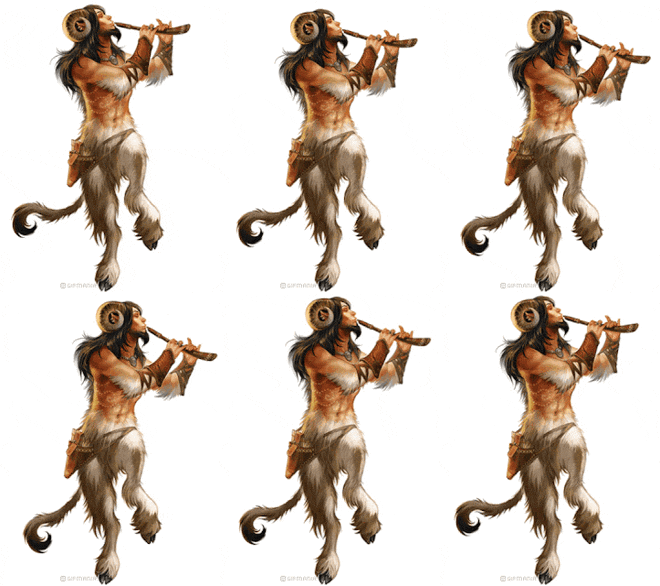
Respect the Old Gods, and other religious practices. The consequences may be deadly.
Good short story that was very well written. The ambience was magnificent. Highly recommend this short read.

May 24, 2021
2.5 stars. Don't mess with Pan. This story lacked the usual wit and humor of Munro's stories. Audible edition narrated by Nadia May.

March 23, 2023
Should you ever chance to come across a statue of Pan in the forest it would be wise to avoid it. By no means should you remove any offerings laid down next to it; say a bunch of grapes, for example. This would be unwise and very dangerous. The old gods are very jealous of what little adoration is offered them now that in the shadow of the cross has fallen heavy upon them: still, discretion is the better part of valor.

October 14, 2023
The Music on the Hill by Saki — Review
A story “The Music on the Hill” by Saki is about the god Pan, which was popular in the late 19th and early 20th centuries. Pan here is a very jealous and vengeful god who severely punishes disrespect for himself.
Here is the link to the text of the story:
https://americanliterature.com/author...
A story “The Music on the Hill” by Saki is about the god Pan, which was popular in the late 19th and early 20th centuries. Pan here is a very jealous and vengeful god who severely punishes disrespect for himself.
Here is the link to the text of the story:
https://americanliterature.com/author...

August 15, 2017
This was such a simple, short tale but sufficiently creepy. The plot was pretty well executed, the build up was great all through out the story with a very satisfying ending. Masterfully done.

June 19, 2018
Listened to via the Public Domain Theater podcast.

April 5, 2020
Short and horrifying!

December 31, 2021
I like the writing style.
January 18, 2022
Not sure what was the point of the story? That Pan (nature god) is real?

September 15, 2022
Don't mess with musicians who live in the bosky countryside.
See PodCastle 752.
See PodCastle 752.

June 6, 2023
Legends of the forest deities, and changing value systems have created gems of suspense stories. This is one of those. One of the strength points is, it doesn't drag.
November 18, 2023
I listened to this as part of the Classic Tales of Horror - 500+ Stories. It was very enjoyable 2023

July 13, 2024
fine at best.

January 27, 2025
"Her victory had not been so complete as she had supposed: it had carried her onto ground that she was already anxious to quit. "

June 28, 2025
Great story by great author.

March 12, 2026
I enjoyed this. A play on the old Gods and folklore, so in the same type of genre I write in. A very short piece, close to being what modern writers might call flash fiction.
March 22, 2026
Horror, no thank you... Kristi & Abby Tabby

August 29, 2023
i don't know how to feel about this but ok
Displaying 1 - 27 of 27 reviews