Jump to ratings and reviews
Rate this book

The Owl Who Liked Sitting on Caesar: Living with a Tawny Owl

Rate this book
A moving and informative memoir of life with a lovable tawny owl.

When author Martin Windrow met the tawny owlet that he christened Mumble, it was love at first sight. Raising her from a fledgling, through adolescence and into her prime years, Windrow recorded every detail of their time living together (secretly) in a south London tower block, and later in a Sussex village. This is the touching, intriguing and eccentric story of their 15-year relationship, complete with photographs and illustrations of the beautiful Mumble. Along the way, we are given fascinating insight into the ornithology of owls—from their evolution and biology to their breeding habits and hunting tactics. The Owl Who Liked Sitting on Caesar is a witty, quirky and utterly charming account of the companionship between one man and his owl.

320 pages, Paperback

First published February 27, 2014

120 people are currently reading
1548 people want to read

About the author

Martin Windrow

132 books26 followers
Martin C. Windrow is a British historian, editor and author of several hundred books, articles and monographs, particularly those on organizational or physical details of military history, and the history of the post-war French Foreign Legion. He has been published since the mid-Sixties.

Ratings & Reviews

What do you think?
Rate this book

Friends & Following

Create a free account to discover what your friends think of this book!

Community Reviews

5 stars
213 (20%)
4 stars
398 (37%)
3 stars
341 (32%)
2 stars
83 (7%)
1 star
16 (1%)
Displaying 1 - 30 of 211 reviews
Profile Image for Trish.
2,390 reviews3,748 followers
March 11, 2016
This was one of those books that enters your life through sheer coincidence. A colleague showed me a book about owls on amazon because of a very funny picture of three hatchlings and one of the recommendations was this book. I clicked it and was intrigued.

A man, a real-life man, who had an owl as a pet?
A British man at that who seemed to be typically humorous?

Needless to say that it didn't take long for the package to arrive. A sidenote: A couple of weeks previously, I bought this little tote bag (I have several to put my books in for when I transport them in my bag so they won't get damaged)

I consider it a sign that this book was about to enter my life. ;)

You know how there are different kinds of humour?
There are great jokes and sketches performed by often wonderful artists and then there is real-life humour stemming from normal situations that turned hilarious when something, unexpectedly, goes horribly wrong.
This book belongs in the latter category and if it had been any more funny, I might not have survived reading it!

Granted, when reading the introduction I was already sad, knowing that from today's perspective Mumble (the owl) was dead. I was furious however when it was hinted that an activist was responsible for her dying even sooner than she would have had to.
But then the first chapter started and although it wasn't about Mumble at all but about another owl named Wellington, I shook with laughter.

For a man who is a military historian, Martin Windrow is a first class entertainer and comedian! This is him fairly recently as opposed to his younger self in one of the photographs I posted in the status updates while reading the book:


The book details how Mr. Windrow got the idea of having an owl as a pet and how he acquired one. It also details how his first try went horribly wrong (in a realistic and enormously funny way) and then how he got to live with Mumble from when she was just a few weeks old for about 15 years.

Usually, I would think that wild animals belong in the wild but I'm not an idiot. There are many situations resulting in wild animals needing to live with humans in order to survive and given the living space provided to Mumble, I was OK with it all. Maybe that is what made me so angry about the aforementioned activist who caused Mumbles death through sheer ignorance/stupidity.

What is very clever and noteworthy about this book is that the author didn't just type his journal entries (yes, he had a diary from during those years) and generally recounts tales from back then. He also included a lot of scientific information about the evolution, anatomy, hunting, living and mating habits and all sorts of other useful information about owls (mostly tawny owls of course) - making this book not only funny as hell but also very informative and the included photographs


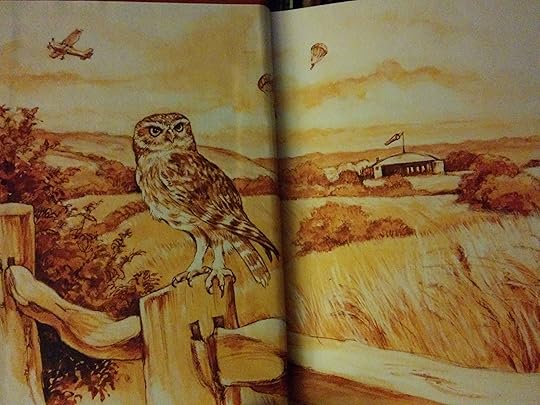
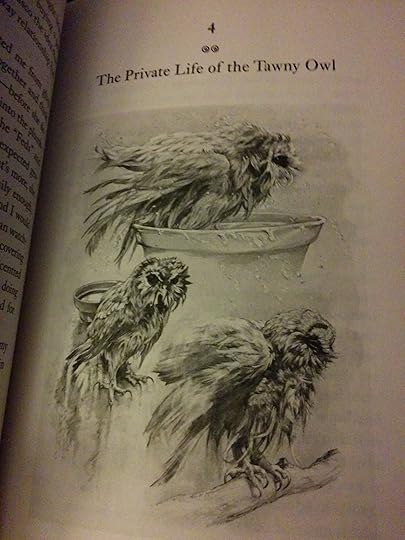
and illustrations on the inside of the cover

as well as at the beginning of each chapter


round everything off to a great reading experience.

I won't give away too much about Mumble's life but the following is an excerpt from chapter 3 that had me cracking up on the train so much that I had tears in my eyes, people talking about me and the conducter asking if I was OK. This was about young Mumble not being fully able to fly yet:
Her incompetence was most obvious when she forgot (as she often did) her previous experiences of "ice landings" on the long marble coffee table. She made her final approach far too fast and at far too shallow an angle, and when she touched down she simply skidded across it with her feet flailing vainly for traction, her wings beating wildly, and her tail fanning out awkwardly in all directions. Invariably she would disappear off the far side in an ungainly cartwheeling of feathers, like some broken ornithopterin a jerky early-1900s newsreel.
One day she added a refinement to this routine attempting a lengthways landing while a roll of paper towels was lying on the near end of the "flight deck". Apparently expecting this to be solidly fixed, she smacked straight into it, talons first. Naturally, under the impact of about a pound of fast-moving owl it began to roll along the table, unreeling as it went. Mumble found herself frantically flapping and back-peddaling on top of it, riding the ever-diminishing cylinder like a lumberjack on a rolling log until both of them fell off the end of the table. She seemed to find my helpless laughter irritating (one can take umbrage so much more convincingly when one has a lot of feathers).


The author also describes his move from South London to the countryside and all the adjustments that meant for him and Mumble. He takes the reader through a daily and a yearly routine of Mumble and he's even making a great case for animals having affections (like Mumble enjoying their cuddles and not just coming for food, her not letting anyone else handle her etc).
The end, of course, is hard to digest so I'm going to curl up into a ball in my bed and cry now (and I completely understand why he never wrote about his life with Mumble before and why, when he ultimately did it, it was so hard for him)!

A great read for any owl lover like me, but also for every other person who is interested in a bit of natural history (not just about owls, about humans too), pet stories and a great deal of fun and mischief.
Profile Image for Orsolya.
650 reviews284 followers
February 7, 2017
For those obsessed with owls (guilty!); there is no fonder thought than having a pet owl (even though this is impractical and often illegal). Thankfully, owl-lovers can live vicariously through people who have experienced this bliss for themselves. One such lucky individual is Martin Windrow, a prestigious author and editor of military history. Windrow shares his life with a pet owl in, “The Owl Who Liked Sitting on Caesar: Living with a Tawny Owl”.

“The Owl Who Liked Sitting on Caesar” is unlike most other memoirs as one will not find amateur writing amongst its pages. Windrow combines a memoir recap with science, zoology, paleontology, and even sociology; with a prose that sometimes reminds of a classic lit novel. Not only it is clear that Windrow is both intelligent and completed hours of research on owls but he presents it in exciting and captivating way.

The issue with this plethora of information is a slight lack of cohesiveness. Instead of seamlessly inserting academic information into the memoir stories; Windrow opts to alternate chapters between memoir and research breaking reader attention. Plus, Windrow sometimes goes into too much detail in order to attract general readers (such as owl descriptions which most readers will already know as owl lovers and explaining what a typewriter is…REALLY?!).

Further causing some choppiness is the insertion of diary entries from times Windrow spent with Mumble, his pet owl. This feels abrupt and changes the tone. On the other hand, these excerpts bring both Windrow and Mumble to life and reveal what their interactions were like, first-hand.

Elaborating on that note, Windrow truly allows the reader to get to know both him and Mumble. Personalities are explored through the memories and laugh-out-loud moments are depicted with a strong pace. Basically, Windrow’s text is a perfect mix of scholarly prose with an accessible and friendly attitude.

After the half-way point, “The Owl Who Liked Sitting on Caesar” becomes slightly more clinical with an absence of emotion and stray tangents. Windrow tends to simply review Mumble’s behaviors like an experiment and bores with comparisons to the military (obviously he couldn’t help himself). Those readers seeking a light-hearted animal/pet memoir will be disappointed.

The conclusion of, “The Owl Who Liked Sitting on Caesar” is highly emotional (without being too sappy) but including some science and philosophy in true Windrow fashion. This is solid, powerful, and memorable; wrapping the memoir up well.

Windrow provides the reader with a few written and web sources for further reading plus supplements the text with photos (although these are sadly only in black and white).

“The Owl Who Liked Sitting on Caesar” is an excellent memoir for owl lovers and definitely not flimsy. However, those seeking a casual, heartwarming animal story may find it a tad clinical and over-written. Not to mention, the text would have been stronger with more direct information on life with Mumble (readers are left with many unanswered questions). Regardless, “The Who Liked Sitting on Caesar” is quite a delight.
Profile Image for Ellie Spencer (catching up from hiatus).
280 reviews393 followers
September 19, 2020
I confess, I picked up this book years ago because I LOVE owls. I seriously do not regret any moment of this.

The book follows the true story of the author (Martin Windrow) and his pet tawny owl (Mumble).

It was full off warm-hearted moments that made my heart sing. You get to see such a beautiful side to Mumble’s nature. I loved the addition of the photos of Mumble, I couldn’t stop showing them to my family. This book taught me so much about owls that I didn’t no previously, I am suddenly gifted with random knowledge like an owls heart rate!

I smiled, laughed and felt tearful throughout this book. I was beautiful and felt like receiving a warm hug. I’m not usually one for non-fiction books, but I loved this!
Profile Image for Jane.
1,680 reviews238 followers
November 27, 2015
Delightful memoir in breezy, casual style. The author, a military historian, has fashioned a narrative about his adopting an owl as a pet. He fails to raise Wellington, a Little Owl, but is very successful in raising Mumble, a female Tawny Owl. She comes to him as a weeks'-old fledgling and they bond from the first. Her life with the author is described and she has a definite personality. Her favorite perches are the lintel of a door and a bust of Germanicus, NOT Julius. She's a really intelligent bird and a "quick study". Losing then recovering her leads the author to give us facts on Tawnies: life in the wild, sharp senses, life cycle.

Some humorous and poignant episodes are related, e.g. Mumble in the author's den and her reaction to his typewriter WHILE he's typing. This made me chuckle. She reacts to guests, an "owl-sitter", a visit to farm of author's brother in Kent, other owls and pigeons she sees through the glass of his apartment window. The anatomy of a generic Tawny switching to Mumble then how she spends her day. The drawing of an owl skeleton is given on page 167: it's quite different from the fluffy, rotund bird that we see!

Their move to Sussex in the country stimulates Mumble more because of her outdoor aviary. The author describes her typical year from notes in his journal. The summertime moulting is the big event each year, also mood and psychological changes. Finally Mumble dies, after fifteen years--lifetime in the wild is maybe five. The author to this day has wonderful memories of their life together.

Fascinating book between this fun memoir and the frequent nuggets of information on the Tawny Owl. Line drawings and photos added another dimension. Highly recommended.
Profile Image for Ladiibbug.
1,580 reviews85 followers
June 17, 2015
Non-Fiction

Martin Windrow adopts "Mumble", a tawny owl, when she's still developing in her shell. He actually selected that one owl egg from others.

I'm fascinated by birds, and have spent much time in my heavily forested area trying to spot an owl(s) I hear. No luck in 12+ years. This book explained the coloring of owls, that match their surroundings, but also their ability to sit silently in one place for long periods of time.

I wish I liked this book more. The author's repeated and tedious chronicles of the owl's life inside his apartment, "moods" etc. got old fast. He did get away from this repeated theme with an explanation of the bone structure of owls, which was very interesting.

I was bothered that this owl, about the size of a loaf of bread, was confined to this man's apartment for the most part of 15 years. Later, the man moved to the country and assembled a more natural outside "pen" for the owl.

Mumble didn't suffer any disability which would have made her unable to be released into the wild. I kept thinking, this poor owl, stuck inside an apartment for most of his/her life.

Why didn't he adopt an injured owl, who couldn't be released in the wild? Or maybe a parakeet?
Profile Image for John.
817 reviews31 followers
January 26, 2015
I normally avoid books about a man and his animal. They always end with the animal dying and me crying.
I was sucked into this one by the clever title. Clever, and misleading: There's only one mention in the book of the owl sitting on a bust of Caesar (Germanicus Caesar, if I recall correctly).
What I learned from this book is that there's a reason owls will never outdo dogs and cats as popular pets. Although the author clearly found his tawny owl endearing, all of the evidence of the book suggests that an owl makes a horrible pet.
I learned some interesting things along the way, such as the fact that an owl -- or at least a tawny owl -- can swivel its head 270 degrees. Don't try this at home, unless you are an owl.
But if I shed any tears, they were tears of boredom.
Profile Image for Penny.
342 reviews90 followers
November 20, 2014
This is the 2nd book I've read recently about the bond between a human and a wild bird (the 1st being the excellent H is for Hawk by Helen Macdonald).

I live in a very rural location surrounded by fields and copses of woodland, and I see owls quite frequently, usually sitting on fence posts. I always get a particular thrill though if I see them in flight - there's something about that owl face and those wings that makes me feel as if I have experienced something special. I also enjoy hearing them hooting at night.

However, I cannot imagine any circumstance that would mean me sharing my home with a tawny owl - and even more so if that home was a 7th floor flat on the edge of London.

This is exactly what Martin Windrow did and this book very amusingly tells us about this relationship with the tawny owl he calls Mumble.

The book often alternate between his experiences (often with diary entries) about living with Mumble and chapters giving us a wider picture about owls - for example their place in legend and mythology.

Windrow reminds us several times that he is 'no ornithologist' but living so closely with a tawny owl for so many years has given him a superb insight into the way they live, even noting different moods and responses at different times of the year.

I wonder what rules of the Highway Code he broke in driving through heavy London traffic with a tawny owl on his shoulder! I also laughed at the description of 3 male visitors sitting on his sofa drinking wine and each of them wearing a metal helmet (Windrow is a Military Historian) to avoid Mumble's razor sharp talons when she decided to dive bomb their thinning scalps!

Windrow is unsentimental and straightforward but his love for Mumble shines through on every page.
Profile Image for Vityska.
493 reviews86 followers
August 24, 2017
По-перше, тут дуже багато загальної інформації про сов - які вони бувають і які їхні різновиди живуть у Британії, як тамтешні закони їх захищають, чим сипуха відрізняється від, наприклад, сови сірої, звідки ці птахи походять (до речі, ви знали, що як біологічний вид сови набагато старші, ніж гомо сапіенси? :) ), чому у фольклорі різних народів сов вважають мудрими і водночас бояться - і багато іншого.
☑️ По-друге, тут багато практичної інформації, яку необхідно знати, якщо ви мрієте/збираєтеся завести вдома сову. Я от, наприклад, хотіла б, але той факт, що для нормального травлення сова мусить їсти м'ясо зі шматочками пір'я чи шерсті і що найкраще для цього корму підходять порізані на шматочки одно- чи дводенні курчата, мене трішки напрягає [Якщо ви саме їли, коли читали це - вибачте].Але крім цих несмачних подробиць ви також дізнаєтеся, в якому віці найкраще брати совеня додому, де його селити, як його виховувати і багато іншого корисного.
☑️ І, по-третє, це дуже красива і зворушлива історія дружби чоловіка із совою на ім'я Мабл. Я би сказала більше - це історія щирою любові. Бо лише коли дуже любиш свою сову, ти можеш не лише розчути всі відтінки настрою у звуках, які вона видає, а й описати їх так, що читач майже зможе сам їх почути :)
Короште, для совоманів - дуже хороша книга, мастрід, можна сказати:)
Profile Image for Steven.
574 reviews26 followers
September 5, 2017
From 1978 to 1993, the author shared his life with a female Tawny Owl named Mumble. This book is the story of his life with her, along with observations about Tawny Owls. He uses excerpts from a diary he kept on his observations about her health, behavior and their interactions.

Though he clearly adores Mumble, and writes quite eloquently about their special bond, I was never quite comfortable with the fact that he wanted to keep a wild animal as a pet. He had to go through some sort of paperwork to allow his to get a Tawny Owl chick, but the whole thing seemed strange. While I appreciate his respect, care and affection for this creature, I just felt like from the get-go this relationship was more about him having an owl. It wasn't as if she was an injured animal that could no longer live in the wild. She was born just so he could raise her.

The book goes into a lot of detail about her behavior changes through the year, along with her variations in appetite, affection and molting patterns. It all ends rather abruptly, and sadly.

Windrow is a very good writer, but I didn't feel like I would like him very much.
Profile Image for Book Princess (Anastasia).
423 reviews77 followers
February 28, 2018
Незвична розповідь чоловіка, чиїм домашнім улюбленцем стала сова! Оскільки сови - мої улюбленці, ця книга просто не могла пройти повз мене). Але є одне але: не знала, що це нон-фікшн. Поки не почала читати і зрозуміла це з другого розділу). І хоча декілька розділів читалося, як підручник із зоології чи філософії, а може культурології, але останні три розділи реабілітували твір в моїх очах. Не скажу, що про побудову скелета сови було читати нецікаво, проте мене більше цікавила історія автора та Мамбл (його сови), тому що вона справді чудова, неймовірно зворушлива і мила. Автор із неабиякою любов‘ю описує ставлення Мамбл до себе і навпаки, усі ті неймовірні речі, які вона виробляла (наприклад, шматувала шнурівки черевиків (була в неї якась непоясним любов до них) чи приземлялася на голову, чи шматувала газету на малесенькі шматочки, а потім скидала їх згори і дивилася, як вони летять). Все це було суперцікаво читати! Також загальну інфу про сов викладено автором у доволі простій формі, щоб могла зрозуміти й дитина (і чесно кажучи, якщо б ця книга потрапила мені до рук в дитинстві, я була б у цілковитому захваті і точно потай мріяла б собі про такого домашнього улюбленця).
Profile Image for Graychin.
874 reviews1,831 followers
February 6, 2018
Luckily for him (but moreso for us), Martin Windrow is a delightful writer. His book might otherwise have been a slog, but it reads very well and is full of wry observations, humor, and (even though it’s a book about an owl) humanity.

Two things that, apart from the memorable character of Mumble herself, stand out to me: First, I very much like the image of Mr Windrow’s three houseguests seated in the living room wearing antique military helmets to protect themselves from owl attack. Second, I am impressed by the observation offered by one of the author’s friends, that we human beings lead “vertical” lives, whereas most other animals (it seems) lead “horizontal” lives.

In Windrow’s re-presentation of the idea, the vertical soul is “capable of touching all levels of existence – from the satisfaction of animal appetites to the intellectual exploration of distant galaxies or the highest flights of artistic creativity.” The vertical soul may also perhaps (Windrow won’t commit himself) continue an upward trajectory beyond death. By contrast, creatures with horizontal souls are “in touch as we never can be with every manifestation of life at their own level, feeling and responding to all the tides of which we are unaware.” Furthermore, “it is to our sick cost that the great majority of humanity have lost that ‘horizontal’ awareness entirely.”

In summarizing his fifteen-year companionship with Mumble, Windrow suggests that we are somehow able to re-discover, to a degree, the vitality of the horizontal soul in the bonds we form with other creatures. There is something healthy and enriching in such relationships, and no one who has ever loved a fellow but non-human creature can doubt it.
Profile Image for Deborah D..
562 reviews12 followers
March 21, 2019
I just cannot continue reading about this guy's infatuation with keeping this little Tawny Owl in his apartment, there was no real interest in the welfare of this hand-raised owl.

After making it through 1/3 of the book I just had to stop. I have no doubt that the author loved his owl in some way, but he came across to me as self-centered and not interested in the well-being of the owl.
Profile Image for Buchdoktor.
2,363 reviews188 followers
November 15, 2015
Martin Windrow, der im Hauptberuf militärhistorische Bücher schrieb und verlegte, ermahnt seine Leser zuerst, unter keinen Umständen Wildtiere mit nach Hause zu nehmen. Er ist sich der Gefahr vollkommen bewusst, dass Leser seines Buches den Waldkauz Mumble so niedlich finden, dass sie Windrows Experiment nachahmen könnten. Die Idee des englischen Autors, im siebten Stock eines Londoner Appartementhauses einen Kauz zu halten, wirkt von dem Punkt an weniger exzentrisch, an dem man erfährt, dass Windrows Bruder erfahrener Falkner ist, der auf seinem großzügigen Farmgelände selbst einen Kauz hält. Wäre Martin Windrow gescheitert, hätte es in der Familie sicher noch einen Plan B für Mumble (engl . Murmler, Grummler) gegeben.

Da Greifvögel auch in England streng geschützt sind, kauft Windrow seinen Jungkauz aus einer privaten Zucht. Meist sind diese Tiere Nachkommen verletzt aufgefundener Elterntiere, die aufgrund ihrer Verletzung in Freiheit nicht überleben würden. Mumble wird vom Kind des Züchters von Hand aufgezogen und verhält sich von Anfang an völlig zahm.

Martin Windrows erste Versuche als Eulenvogelhalter haben durchaus komische Seiten. Er muss nicht nur eine möglichst unauffällige Voliere für seinen Balkon bauen, da er offiziell keine Tiere in der Wohnung halten darf, sondern auch die zuverlässige Versorgung mit Eintagsküken sicherstellen, da er in der Stadt kaum mal schnell eine Wühlmaus für sein ungewöhnliches Haustier fangen kann. Mensch und Kauz nähern sich einander an, was erheblich dadurch erleichtert wird, dass Windrow die Fachliteratur kennt und weiß, dass Käuze im Gegensatz zu anderen Eulenarten lebenslang monogam leben und ein ausgeprägtes Revierverhalten haben. Nachdem Mumble der Pubertät entwachsen ist, darf es also außer ihm und seinem Menschen im gemeinsamen Revier im 7. Stock keine anderen Bewohner geben. Ein Problem, das Eulenliebhaber aus Bernd Heinrichs Ein Forscher und seine Eule kennen.

Die Beziehung zwischen Mumble und seinem Besitzer wird sich später noch einmal komplett verändern, als Windrow nach Sussex aufs Land zieht und Mumble von sich aus in seinem neuen Revier, einer Voliere im Garten, kleine Nagetiere und Vögel zu jagen beginnt, die von draußen in das Gehege gelangen. Dabei schreckt er selbst vor ausgewachsenen Tauben nicht zurück. Die sorgfältige Beobachtung von Mumbles Interessen durch seinen Halter, das Vergnügen des Käuzchens an Schränken, Kartons, verborgenen Winkeln und der Cäsar-Büste aus dem Originaltitel zaubert so manches Lächeln ins Gesicht des Lesers. Die ungewöhnliche Partnerschaft endet tragisch, vermutlich durch einen Eingriff Außenstehender aus fehlgeleiteter Tierliebe.

Der Autor zeigt seinen kleinen Mitbewohner niemals als „niedlich“ oder vermenschlicht, sondern referiert, getrieben von wissenschaftlicher Neugier, in den Sachkapiteln des Buches Hintergrundwissen zu Eulenvögeln, die Bedrohung ihrer natürlichen Lebensräume, ihre Fähigkeiten und Eigenarten. Ausgiebig reflektiert er, was ein Greifvogel in Gefangenschaft vermissen und als was Mumble seinen Menschen wohl betrachten könnte.

Für einen Autor, der sich inhaltlich gewöhnlich mit der Französischen Fremdenlegion und den Uniformen vergangener Kriege befasst, finde ich Windrows Buch stilistisch und durch seine moralische Reflektion der Tierhaltung in Gefangenschaft äußerst gelungen. Es tendiert stärker zum Sachbuch als zu heiterer Unterhaltungsliteratur.
Profile Image for Sarah Potter.
Author 2 books35 followers
February 22, 2016
A sweet and, at times funny book. I love owls, but can't say I ever thought of keeping one as a pet.

At first, when reading this account of the author, Martin Windrow, living a South London tower block with a young tawny owl, I didn't totally approve of the arrangement, thinking to myself that an owl should be living in a tree and hunting for food in the woodlands and fields. But as I read on, I realised that the owl, called Mumble, and Martin had a real bonding, and were both quite happy with the arrangement. However, their subsequent move to a Sussex village seemed a better idea, although Mumble had adapted well enough to his urban existence.

The book was filled with lots of interesting owl info, such as their breeding habits and hunting tactics, plus their biology and evolution.

Since reading this book, whenever I hear the sound of a tawny owl at night in my local woodland I think of Mumble. And if it's raining, I think of Mumble enjoying having a bath and being dried by a hairdryer after.
Profile Image for Joe Rodeck.
894 reviews1 follower
January 5, 2016

I identified with Martin Windrow's inexplicable, eccentric determination to have an owl pet, even after his first failed trial with a Little Owl. Don't mistake this for child's lit; he doesn't try to make the owl too cutesy or lovable. As a writer, he succeeds in making me feel like a friend and equal. Demonstrable is the therapeutic value of a creature companion for the lonely or depressed.

The everything-you-ever-wanted-to-know ornithology might be boring for some, though most of it is interesting. Regardless, it's easy enough to read in cruise mode through these sections. The second half it does become a somewhat rambling diary. For the substance of the topic, this book runs about 30% too long.

I wish the author told us a little about himself. Family? Any significant other?

Style sample: "Her company enriched my life; it saved me from too much self-absorption, and increased my daily pleasure to a degree that I would never have imagined possible."
Profile Image for Leslie.
444 reviews19 followers
November 5, 2015
Although I pressed on and read to the end, I was a bit disappointed in the proportion of personal owl memoir to objective scientific narrative; although I found some of the latter fascinating--the ecological and environmental aspects of owl life in the wild--there was a fair amount of anatomy, biology, and eye-crossing detail that just didn't work for me.

Mumble, the owl of the title, is a great character, and Martin Windrow does not sugarcoat the difficulties of living with such a wild creature, however tame she was. I just wanted more of Mumble than we got...more of the character on the wonderfully sweet cover. And, of course, I cried at the end, particularly as Mumble apparently died due to a human's stupidity (not her owner's, thank goodness). It hurts.
Profile Image for Christoph.
37 reviews
September 17, 2016
3 *
Ich hatte mir erhofft, dass mir dieses Buch ähnlich gut gefallen würde wie Helen Macdonalds "H wie Habicht", wurde aber leider ein wenig enttäuscht. Schlecht ist "Die Eule, die gern aus dem Wasserhahn trank" zwar nicht, aber gerade die etwas merkwürdige Mixtur aus Tagebucheinträgen, nachträglichen Ergänzungen und Erinnerungen sowie allerlei Wissenswertem über Eulen (gerade diese Passagen lesen sich stellenweise leider so trocken wie Lexikonartikel zu dem Thema), hat die Freude an diesem ansonsten recht charmanten, unterhaltsamen und humorvollen Buch doch etwas getrübt.

Ausführliche Rezension hier: https://buchbube.wordpress.com/2016/0...
Profile Image for pancake.
21 reviews
May 5, 2014
Oh my word. Mixing personal observations and day to day experiences with his owl, and information about owls in general, this is a really interesting book. And unsentimental as it seems to be written, you build up a picture of their time together. Had me weeping in the end.

In a word, this book is lovely.
Profile Image for gardienne_du_feu.
1,450 reviews12 followers
May 9, 2025
Martin Windrow ist Militärhistoriker und nicht zuletzt dank seines Bruders, der auf dem Land lebt und sich sehr für Raubvögel interessiert, fasziniert von den Jägern der Lüfte. Insbesondere Eulen haben es ihm angetan, und eines Tages im Jahr 1978 zieht ein Waldkauzbaby bei ihm ein, Mumble genannt, weil sie so seltsame kleine murmelnde Geräusche macht.

Mumble stellt Martins Leben ordentlich auf den Kopf. Er lernt, seine Mietwohnung eulensicher bzw. eulentauglich zu machen und täglich frische Küken zu servieren. Und er gewöhnt sich daran, dass sie Einrichtungsgegenstände umwirft, ihm beim Rasieren auf der Schulter sitzt, mit Vorliebe auf die Caesar-Büste kackt und dass es irgendwann nicht mehr angeraten ist, Gäste in die Wohnung einzuladen, weil Eulenkrallen auf Köpfen unangenehme Spuren hinterlassen.

Nach wenigen Jahren folgt dann ein Umzug aufs Land, weil die Eulenhaltung dort für Mensch und Tier einfacher ist und Martin die Großstadt auch einfach leid ist. Dort ergibt sich ein ganz neues Zusammenspiel zwischen Mumble in ihrer Voliere und Landtieren in freier Wildbahn. Martin führt akribisch Tagebuch über Verhalten, Fressgewohnheiten, Mauser und andere Dinge und stellt im Laufe der Zeit gewisse Gesetzmäßigkeiten fest wie das regelmäßig zum Frühjahr hin wiederkehrende aufgedrehte Wesen der sonst eher ausgeglichenen Mumble.

Eulen haben mich schon von klein auf mit ihren geheimnisvollen großen Augen in ihren Bann gezogen, und spätestens seit Harry Potter gab es durchaus das eine oder andere Gedankenexperiment, wie es wohl wäre, eine Eule als Haustier zu haben. Ernsthaft in Betracht gezogen habe ich das im Gegensatz zu Martin Windrow natürlich nicht, und das Buch hat mich auch in meiner Auffassung bestärkt, dass Eulen zum Haustier nicht wirklich taugen.

Ein wenig seltsam mutet es schon an, dass es überhaupt legalerweise möglich war, ein Eulenei bewusst im Inkubator ausbrüten zu lassen, damit später die Prägung auf den Menschen statt auf die Eulenmutter funktioniert. (Ob das heutzutage in Großbritannien noch ginge, konnte ich noch nicht herausfinden.) Und auch die dauerhafte Käfighaltung fand ich etwas fragwürdig, selbst wenn Windrow sich durchaus Mühe gegeben hat, die Behausungen möglichst großzügig und artgerecht zu gestalten. Eine Eule ist doch in erster Linie ein Wildtier, das draußen jagen gehen sollte und nicht in einem, wenn auch großen, Käfig oder einer Voliere mit toten Küken gefüttert werden. Das lag mir beim Lesen doch ein wenig quer.

Interessant war das Ganze dennoch. Mumble und Martin waren 15 Jahre lang zusammen und in der Zeit haben sich natürlich gemeinsame Rituale entwickelt, Martin hat Mumbles Marotten und Gewohnheiten bestens kennengelernt und auch die Leserschaft lernt, nicht zuletzt dank seiner Tagebuchaufzeichnungen, viel über Waldkäuze im allgemeinen und Mumble im besonderen. Allerdings las sich das gerade bei den (kondensierten) Tagebuchauszügen manchmal ein wenig trocken und technisch, wenn genauestens beschrieben wurde, welche Feder bei der Mauser wann abgeworfen wird oder wo wann bei der Gefiederpflege welche Fläumchen vom Körper abstehen.

Zusätzlich gibt es Kapitel, die sich generell mit Eulen beschäftigen - mit verschiedenen Arten, mit der besonderen Anatomie, den unterschiedlichen Jagdmethoden und auch dem einen oder anderen Mythos, der die Vögel umwabert.

Ich muss zugeben, dass ich schon bessere Eulenbücher gelesen habe und mich etwas gestört hat, dass Mumble kein aus Nöten gerettetes Wildtier ist, sondern von vornherein als Hauseule angeschafft wurde. Aber es gab auch einige wirklich nette Szenen und viel Wissenswertes, und die gefiederte Protagonistin ist einfach allerliebst.
Profile Image for CarolB.
368 reviews1 follower
January 5, 2025
Here is another excellent bird-geek book. It's the true story of an Englishman who raises a tawny owl and documents her growth, her habits, her needs, her seasons and, very importantly, her effect on him over 15 years of cohabitation.

Owls, like other birds of prey, have very specific requirements to lead happy lives with humans. Step one is that a person has to have the bird very soon after it hatches so that the bird will bond. Windrow learned this the hard way with his first foray into owl-dom, when that bird never became any sort of companion. With his second attempt, Mumble grew to be affectionate and somewhat predictable. Windrow says precious little about any social life during his 15 years with her, so it comes to appear that Mumble was it. Hardly likely. Maybe an editorial decision, maybe a personal decision, but it did come off sort of odd. He does talk about his work in publishing. His other books, which are about military history, can't possibly have all the charm of his writing about his owl.

I really loved Windrow's detailed reporting of Mumble's behavior, of how she inspects his bookshelves, how she perches on him and nuzzles with him. He works to avoid anthropomorphism, but he does conclude that they do have a relationship, and that she trusts him. Whether she "cares" about him or not is an area he says he's not prepared to explore. I respect that, though it's clear early on that he cares deeply about her, as we do about our pets.

So this is another great read that most people I know wouldn't ever consider reading. Pity.


Profile Image for Kylie Stoneburner.
173 reviews1 follower
March 14, 2017
I can understand why it took Windrow 20 years before he could start writing Mumble's story. I had to sleep on it, and let my emotions settle, before I could even fathom writing a review.

The part about Mumble's departure rocked me so hard, it was as if I had lost one of my own closest friends. I was a snotty, sobbing, chest-clenched mess. This emotion stemmed from Windrow's seemingly sneaky writing. His diary entries, at first glance, are simple accounts of Mumble's varying behaviors throughout the years. Some were only a few lines, and some were repetitive information that confirmed Mumble's antics during specific seasons. Little do you realize that these little details draw you into their relationship and day to day life, so that you feel you personally know this silly owl; until you read of her departure and then you understand why it feels like your own best friend just died.

The few chapters of science in between Mumble's personal story were a bit dry. I did appreciate the explanation of a wild tawny owl's life history and behaviors, as this helped to understand why Mumble acted certain ways as he described in her yearly diary. However, the information on the evolution of owls was a contrastingly tedious read, and I feel like the story could have got along just fine without it.
Profile Image for Caly ☯ Crazy Book Lady.
488 reviews34 followers
October 6, 2017
I love books about animals and nature and I wanted to be able to give this book 4 or 5 stars but the endless chapters about feathers and molting behavior got to be a bit much. Lovely story about the affectionate relationship between owner and owl but a little bit too much zoological information since it was not a text book.
Profile Image for David.
51 reviews2 followers
October 1, 2022
Not a literary masterpiece but a very cute telling of a relationship between human and animal.
Profile Image for Briana.
11 reviews
June 20, 2021
This book was so fascinating! As an animal lover, I thoroughly enjoyed the beautiful interaction between such a wild creature and her human caretaker. All of Mumble’s antics were so wonderfully described and I both laughed and cried. I enjoyed learning so much about tawny owls as well. Truly lovely writing from cover to cover. I loved this story!
Profile Image for Mitch.
784 reviews18 followers
July 29, 2017
I wouldn't read anything else by Martin (since he's written about military history...) but I enjoyed this account of his time owning and caring for his pet owl, Mumbles.

Martin writes honestly and openly about his experiences and he ruminates on the moral implications as well. The book provides a chance for people who will never have an owl to learn more about them from a personal perspective- and that's good.

Less welcome is the amount of background material on tawny owls. Some of this is entirely welcome but in my opinion, Martin went into too much detail there. Perhaps a 200-250 page book on this topic would have been better for the average reader than the 300 pages it is.

Still, it's a good book and I would solidly recommend it.
Profile Image for Kate.
2,321 reviews1 follower
July 13, 2024
"WHEN MARTIN WINDROW adopted an owl the size of a corncob, it was love at first sight. A war historian, he had little experience with pets. But Mumble was adorable -- despite her knife-sharp talons -- and over the course of fifteen years, she became Windrow's closest, if at times unpredictable, companion.

"Their friendship was such that, when Mumble passed, nearly two decades went by before Windrow felt able to share their story. In The Owl Who Liked Sitting on Caesar, he recalls their finer moments with wry humor -- as well as the reactions of his incredulous neighbors -- and offers fascinating insights into the zoology and sociology of owls along the way. At once revelatory and affecting, The Owl Who Liked Sitting on Caesar is an unforgettable meditation on a singular relationship with an improbable pet."
~~back cover

I have mixed feelings about Windrow adopting Mumble -- she spent so much of her life in a cage -- a very large cage of course, but still ... Does it help that Mumble was hatched in captivity by a licensed breeder of birds of prey and reared by hand? I'm not sure. Evidently there is an abundance of tawny owls in the wild, so breeding in captivity isn't to help save a species from extinction. I know I'm anthropomorphizing, but I can't help but think that Mumble would have had a happier (if probably shorter) life had she been born and lived in the wild.

That sentiment kept me from enjoying the book as much as I might have done, along with the fact that I didn't particularly care for the author's writing style.
Profile Image for Amanda.
96 reviews14 followers
August 24, 2014
This is a beautiful book. I've had the somewhat random, good fortune to live with Mocha, a tangerine dove, since 1992. And, like Mr. Windrow's relationship with Mumble, Mocha and I have a shared domestic life filled with all sorts of surprisingly spectacular lovely moments that are hard to communicate to anyone who hasn't been as lucky to have an intimate friendship with a feathered friend. I dreaded reading the final section of this book, as I tear up just thinking about the day when Mocha is absent from my life. I'm thankful for Mr. Windrow's thoughtful and affectionate account which gave me cause to reflect on and appreciate even more the shared daily life I have with Mocha.
1 review
June 12, 2024
Since I’m a fan of owls, I eagerly looked forward to reading this book, but after the first 36 pages, I couldn’t continue.

It’s amazingly selfish to take an egg from an owl’s nest so the owlet can imprint upon the person who stole the egg, and the interloper can keep it as a pet. Depriving it of its natural life. . . here’s that word again . . . is just so selfish. One might argue that a captive owl may have a longer life, but that’s not how it worked out for Wellington, his first owl, as his potential fate was so cavalierly described in the book, tethered as he was to jesses when he escaped.
Profile Image for Brittany.
1,330 reviews143 followers
March 10, 2015
This is an enchanting true story.

I didn't realize that living with an owl was something people did. I've met falconers and people who own parrots, but never thought about owls. It's one of those things that, once you know it exists, immediately becomes something you fantasize about doing.

Martin lived with an owl, Mumble, for more than a decade. He's an intelligent, perceptive observer, and one who clearly adored his owl and significantly changed his lifestyle to give her the best life possible.

A well-written, engaging, and stimulating book that I highly recommend.
Profile Image for Eileen.
82 reviews3 followers
August 8, 2016
The book made me love owls more than I did before! On the one hand, there are chapters with anecdotes of Mumble and Martin which I enjoyed a lot. On the other hand, Martin tells us loads of interesting facts about owls, their historical evolution and much about their biology and their nature! This was a great mix. People who like owls will love this book! I loved Mumble from the very first time they met each other. Very lovely book!
Displaying 1 - 30 of 211 reviews

Can't find what you're looking for?

Get help and learn more about the design.