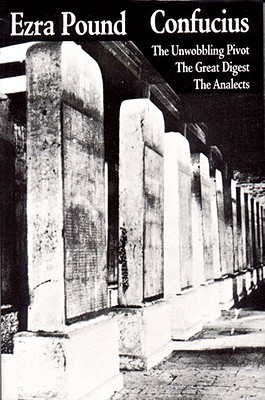
The study of Chinese culture was a dominant concern in Ezra Pound’s life and work. His great Canto XIII is about Kung (Confucius), Cantos LII-LXI deal with Chinese history, and in the later Cantos key motifs are often given in Chinese quotations with the characters set into the English text. His introduction to Oriental literature was chiefly through Ernest Fenollosa whose translations and notes were given him by the scholars widow in London about 1913. From these notebooks came, in time, the superb poems entitled Cathay and Pound’s edition of Fenollosa’s Chinese Written Character as a Medium for Poetry. But it was Confucius’ ethical and political teachings––that most influenced Pound. And now, for the first time, his versions, with commentary, of three basic texts that he translated have been assembled in one volume: The Great Digest (Ta Hsio), first published in 1928; The Unwobbling Pivot (Chung Yung), 1947; and The Analects (Lun-yü), 1950. For the first two, the Chinese characters from the ancient “Stone Classics” are printed en face in our edition, with a note by Achilles Fang. Pound never wanted to be a literal translator. What he could do, as no other could, is to identify the essence, pick out “what matters now,” and phrase it so pungently, so beautifully, that it will stick in the head and start new thinking.
Chinese philosopher Confucius, originally Kong Fuzi and born circa 551 BC, promoted a system of social and political ethics, emphasizing order, moderation, and reciprocity between superiors and subordinates; after his death in 479 BC, disciples compiled the Analects, which contains a collection of his sayings and dialogues.
Teachings of this social thinker deeply influenced Korean, Japanese, and Vietnamese life.
The great misunderstood modernist poet leads us through the Stone Classics (The Great Digest, The Analects, The Unwobbling Pivot). He beautifully breaks down some of the key ideograms in the manner of an imagist poet. Though I suspect that Pound's presence can be felt – as is the case with everything this mad genius passed through his often less than diaphanous filter. It is, nevertheless, social and civic thought that meets the familial and spiritual. Many words of wisdom to contemplate, to live a life by both privately and in the public eye.
"Virtue, i.e., this self-knowledge [looking straight into the heart and acting thence] is the root; wealth is the byproduct."
"The man in whom speaks the voice of his forebears cuts no log that he does not make fit to be roof-tree [does nothing that he does not bring to a maximum, that he does not carry through to a finish]."
"The man of real breeding who carries the cultural and moral heritage must look the heart in the eye when alone."
"You improve the old homestead by material riches and irrigation; you enrich and irrigate the character by the process of looking straight into the heart and then acting on the results. Thus the mind becomes your palace and the body can be at ease; it is for this reason that the great gentleman must find the precise verbal expression [the sun's lance coming to rest on the precise spot verbally] for inarticulate thoughts [tones given off by the heart]."
"Know the point of rest and then have an orderly mode of procedure; having this orderly mode of procedure one can 'grasp the azure,' that is, take hold of a clear concept; holding a clear concept one can be at peace [internally], being thus calm one can keep one's head in moments of danger; he who can keep his head in the presence of a tiger is qualified to come to his deed in due hour."
"If a man does not discipline himself he cannot bring order into the home."
"What is meant by saying, 'To govern a state one must first bring order into one's family,' is this: the man who, being incapable of educating his own family, is able to educate other men doesn't exist. On which account, the real man perfects the nation's culture without leaving his fireside."
"Put order in the home in order to govern the country."
Great translation; despite not being a scholar of the language Pound does investigate the meanings beyond what past literal translators have taken, and seemingly outdoes them on several points. It also seems that Pound is right about the proper ordering and significance of these texts: The Analects are the most widely read nowadays, probably because they contain most authentically the words of Confucius, but properly the Digest and The Unwobbling Pivot contain the actual heart of the thought of Confucius, so should be read first, and more closely studied. Certainly a very literary philosopher -- if Pound is right that he compiled the Odes "to keep his followers from abstract discussion," quite the opposite of Plato -- and a source of legitimacy for Pound's own propensities (Analects 15.40 - "Problem of style? Get the meaning across and then STOP."). To me the only shortcoming was Pound's insistence that this mentality is directly and objectively superior to the confused jumble of Occidental philosophies. Many of the ideas in this book (for example, that "the small man takes risks") it seems our "great men" wouldn't cotton to, even if China's "proper" ones did.
Every process of adaptation has two stages. At the start, an inflamed consciousness processes sense-experience from first principles; action is slow and halting; energy is expended and effort applied in great quantity. As experience accumulates, however, the unconscious marshals sense-experience into pattern, first principle passes the baton to habit and heuristic, and the organism learns to expend its energy sparingly and efficiently to attain the same goal. New becomes old.
Reading these translations is like being thrown backwards from the second stage into the first. Pound, having only fragmentary access to scholarship on Chinese philology, engaged with the Confucian classics with unmatched earnestness. Where a Chinese scholar-bureaucrat or even the great Legge might have seen a venerable philosophical classic, one can only imagine Pound experiencing the wild and delirious confusion of a toddler or a lobotomized patient as he gazes over a semantically fractalized wall of vortical ideograms (not yet “characters”).
Pound’s beginner’s-mind reaches even to the task of dissecting the characters themselves, hallucinating etymologies unheard of in the Shuowen Jiezi. The result is at times laughable and embarrassingly hormonal, but also perhaps the most energetic, affirmative, alive translation of these texts ever to be produced.
For contemporary readers more familiar with the philosophy of the Eastern Zhou, these translations are an invitation to engage in a sort of meta-orientalism — to examine the transformative idea of the modern as such, and to consider what it really means to “make it new.”
Ezra Pound remains an enigma - a fundamental figure of the Modernist movement, inspiration to many, balanced by the fact that he was an antisemite and supporter of fascism, his long life had many ups and downs and his work varied in quality if not in quantity. The Cantos remain his main contribution to Western Literature, and many academics have made a living trying to interpret his great work.
One thing that Ezra was fascinated with throughout his life was Chinese literature, and this book is a compilation of his translations of Confucius ranging from 1928-1950. There has been a lot of controversy around Pound's translations from the Chinese, revolving around several factors: Pound was not fluent in the language, and relied on other's notes and his own poetic sense to create his works. He saw his translations as a re-creation as much as a literal translation, and saw the philosophy of Confucius as a counter-balance to the Western thought on government which he saw as a failed project.
The first parts of this work - the translations of The Great Digest and The Unwobbling Pivot - are in this edition juxtaposed with rubbings from the stone tablets from which the text was drawn - I don't read Chinese characters, but it's a great addition to this text. The Analects, which given the original publication date one can assume that Pound worked on when he was incarcerated after the War, are as a text much less developed than the first two works, and has many more textual explanations from Pound than the other two works (interestingly in this edition there were footnotes marked in the text, but no notes at the bottom of the page or at the end of the book).
I think that in many respects that Ezra has done a good job here - a reader gets a sense of what these texts are, of the difficulty in interpreting some of the verses, and he has provided some pithy language as translation: while the hokey Americanisms that he uses occasionally initially jarred, as I read through they seemed quite apt to present Confucius' character, which is by turns scholarly, pragmatic, realistic and prickly.
Honestly, this is not the work to go to for an accurate or up-to-date version of Confucius (I can recommend Simon Leys' translation of The Analects for that), but for any Poundian, they are worth the effort.
A final short rumination on New Directions Paperbacks. I've always loved the design of these books, their understated covers and font, along with higher-quality paper and bindings, somehow give them an air of authority - they are a tactile and visual pleasure.
These seem more like a passion project on Pound's part, a sort of game of interpreting the ideograms and comparing them to pre-existing translations; as is, especially for his (often grammatically nonsensical) version of the Analects, basically just a moderate renovation of the existing translations of his time - though it appears his predecessors here were primarily in French, so I suppose he's done English readers something of a service. The inclusion of the two lesser known of the Four Classics (The Great Learning and the Doctrine of the Mean, as they're traditionally called) help greatly, especially since they seem to-this-day mostly neglected by English readers ...
I think his translations are generally adequate compared to other translations although they would appear (to my otherwise totally ignorant eye) to manipulate the text in slightly exaggerated ways to hammer onto favorite motifs Pound felt he saw in them, such as a lot of the aphorisms entailing "definitions of words, not generic quips" or Confucius' maxims representing a purely common-sense humanism. I do think this may be a decent primer for Confucianism in general, since the three works each appear to distinct aspects which, read in isolation, each one might not fully illuminate; eg as The Doctrine of the Mean hints at a Plato-like metaphyics not evident from the Great Learning's political theory or the Analects' sumatory wisdom.
Still, I would have to think that more informed editions of more recent years would be better, whereas this volume will (despite its author's hopes) represent solely a bastion for interpreting the pseudo-Confucian themes in Pound's Cantos. Interesting also to note that while the other two were comfortably composed during his government-bankrolled 15 year tenure at a mental hospital, Pound inexplicably managed to smuggle in a chinese dictionary and The Great Learning into his arrest at the end of WW2 and translated it onto toilet paper while imprisoned in that same cage where he wrote The Pisan Cantos. When he managed to get a notebook after a while there, he wrote the Pisan poems starting from the first page, the Chinese translations starting from the back page
There are certainly many other translations of Confucius that would be more helpful as an introduction to Confucian thought, even to these texts. But there are two reasons, besides the philosophy, that make this interesting.
First, Pound did these versions while he was confined in the "cages" at Pisa, or was on trial for his life for the treason he committed, or was confined in St. Elizabeth's hospital for the criminally insane. To witness this deep involvement in the philosophy of balance, of order, of ethical treatment of the governed, under these circumstances ... well, there's something deeply moving in all that. So, yes, I'm saying that this is of biographical interest, not about Confucius, but about Ezra Pound.
And this is also interesting for its insight into Pound's process of translation, a process that often resulted in wonderful texts and that has been of lasting influence in the world of translation. I'm particularly talking about the "Analects" part here. Pound puts in commentary, his interpretations of the Chinese characters (under Fenellosa's influence, of course); he uses other texts, particularly a French text, and other languages (Latin, Greek, even one Arabic reference), to illuminate his efforts at understanding. For instance, here's a passage picked at random, from XXXVI of Book 15:
He said: The proper man has a shell and a direction (Chen). (and then in italics indicating Pound's commentary) This Chen is a key word, technical, from the "Changes" it is more than the ataraxia of stoics, the insensitivity, ability to "take it." It implies going somewhere. The Confucian will find most terms of Greek philosophy and most Greek aphorisms lacking in some essential; they have three parts of a necessary four, or four parts where five are needed, nice car, no carburetor, gearshift lacking. (back to regular type). He does not merely stick to a belief [pictogram: word and lofty, or capital].
Now I'll admit I don't know what all that means, but it is certainly very interesting as a window into Pound's work!
Probably only really valuable for people who are really into Pound. If you want to actually read Confucius, I'm not sure how much you'll get out of these translations (especially the sketchy, unfinished translation of the Analects).
The Great Digest and The Unwobbling Pivot are excellent, Pound’s masterful touch makes much of the source material. The Analects feels either incomplete or simply more inaccesible, perhaps both.
Definitely gets carried away in the second (the unwobbling pivot) which is claimed to be a metaphysics of Confucius - much extrapolation. As in, lines and lines from a few characters. The analects were a great translation though (I think). I enjoyed these
any pound is great but i think confucius was the hitler to taos gandhi. this cd be what pushed him over to il duce love. i alternately have digestive problem or feel a bit wobbly after reading this one.
When I first read it I thought it was a profound into Chinese thought but since then I have learned that Pound's interpretation of Confucius contains a great deal more of Pound than it does of Confucius. I think it's probably best to regard this in the same light as Robert Lowell's imitations.
Laconic Pound--cachectic wisdom. Better this than the "China cantos." Though this makes of those a richer experience!
[Pound is fair here--making sure to note at the foot of certain of the more bonepickish characters the interpretations alternately of Legge and Pauthier, sometimes both.]