
What do you think?
Rate this book


257 pages, ebook
First published January 1, 1936


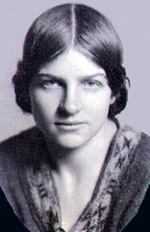
born in 1897 … grandparents wealthy landowners in Scotland, “with huge chilly castles, salmon brooks, deer-stalking … parents Liberal and progressive and brilliant … father John S. Haldane, distinguished medical biologist at Oxford, deeply concerned for working men and women … her older brother, J.B.S. Haldane, geneticist, biologist, a colossal personality; his transgressiveness, independent-mindedness, sheer cleverness set a bar for Naomi she was always longing to leap; Jack a free, wayward spirit, sacked from Cambridge for adultery with a colleague’s wife (whom he married), became a Communist, and later an Indian nationalist, renouncing his British citizenship … as children they experimented together on scientific questions … Jack went away to Eton, Naomi had to stay behind, even though she was the “rare girl” to attend the boy’s Dragon School in Oxford – her introduction to gender injustice. Her memoir Small Talk catches the stifling restrictions she suffered, never overcoming her ferocious jealousy of her brother – in her stories one finds stamped out “one spirited daredevil young woman after another – wild, strong-limbed and tousled, who break rules, act vigorously." Interjection: Haldane was one of three biologists in the 1920s who did the ground-breaking work resulting in the "modern synthesis" of Darwinian evolution and Mendelian genetics. What did science lose when Naomi was denied the right to pursue her first love, science?The Introduction/biographical sketch goes on and on, page after page dense with my underlining and asterisks, check marks, indications of how amazed and affected I was with the tale of this amazing Edwardian woman. A narrative, filled with fact, but also a magical tale about a writer seemingly almost mythical.
Naomi, the faery child, has intense dreams and kept open the connection to childlike wonder and terror. ”I met a brown hare”, she remembers, “and we went off and kept house (marriage as I saw it) inside a corn stook with six oat sheaves propped around us.” She did not know then, she continued, that the hare is closely connected with the moon and the goddess, as well as with witchcraft. ”As I remember it, I was married young to the hare.”
Also a bookworm, by sixteen she had worked her way through The Golden Bough - "relations between magic and society, regeneration rituals, tree cults, all running a live current of atavistic ecstasy” through her writing. Greek and Celtic myths (especially Scottish); brought up among Oxford classicists, spending her summers in the Highlands; drawn to neo-paganism, wrapped in the Celtic Twilight; the varieties of the supernatural blossoming into “contrasting uses of enchantment”: avant-garde demands for liberty (Nietzsche, The Rites of Spring, The Plumed Serpent); and traditionalist nostalgia for a “lost, enchanted pastoral” (Peter Pan, Wind in the Willows).
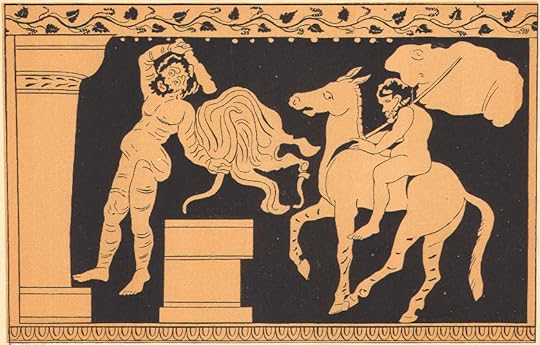
Oh maybe ‘tis my rockThe lilting rhyme seems to fly over the Highlands. Mairi’s disappointments not only fail to deter her, they are the source of her strength. The last stanza ends with her cry of equality:
And maybe ‘tis my reel,
And whiles it is the cradle
And whiles it is the creel.
I should be redding my house,
But oh, I’m stepping away
To hear high up in the fern
The tune that the faeries play.
Oh my bonny stone house
With the meal ark full to the brim!
But my fairy man’s in the fern
And I must go away to him.
And it’s Mairi, Mairi MacLean,
Ach, Mairi Maclean, come ben!
But I am stepping away
Adown to the hazelly glen.
Oh folks may look upon Jura,
And he may be rich who can,
But all the Isles of the Sea
Are for me and my fairy man!
Oh maybe ‘tis my rock
And maybe ‘tis my reel,
And whiles it is the cradle
And whiles it is the creel.
Oh maybe ‘tis the meal ark
That stands beside the wall,
And maybe ‘tis the weaving,
And I’ll being seeing to all.
And maybe ‘tis the pot,
And maybe ‘tis the pan.
But I can write songs as good
As the songs of the fairy man!
The same sensations overcame me as had done so upon the first occasion [the wheat], shrinking and hardness and darkness. And again the tension, becoming unbearable, broke into pale, thready growing-points, a pushing up towards light and warmth and down towards dampness and anchorage. And again I grew and spread green leaves and sucked through their pores the gases which dissolved through my warm chloroplasts. But this time I was a stronger growth, my stem thickened and became the bud-points of branchlets … And so, for me as a vine, seasons went by, and at last I was to be part of the vintage … minute green cell clusters swelled to berries … I was aware too of the men who came, aware of their pride in me … I endured the pain of the summer pruning … knowing that the great purpose was coming closer upon us … More and more the “I” that I was became concentrated upon the ripening grape-bunches, purpose and intention of my existence … later … enclosed in the smoothly fitting glass of a wine bottle … I knew that we all waited to be poured into the tingling throats, the hastening blood, of men and women, who through us would become braver and happier and more generous, makers of songs and stories, adventurers and lovers. This was our noble destiny; for this we had once been given the name of a God. Thus then the embottled wine sang in the darkness of its Dionysian fate.But the tale of the wine ends unhappily. Drunk by shallow and callous men, “it was my fate to set free not only the good in mankind but also the evil, not only the dreams of beauty but the nightmares of ugliness … I was dissolved and possessed by these men, and lost forever …”
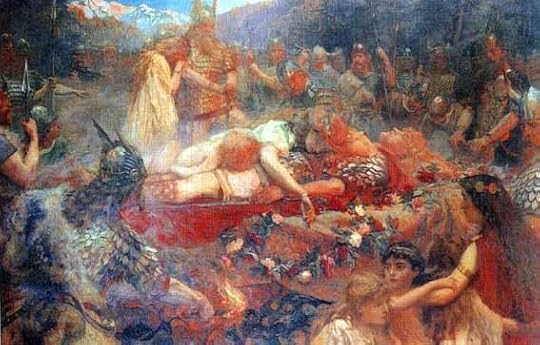
Grane, my horse, my horse… let him still be my hero, let him be remembered as he was … Let the pyre to burn the body that was once wise friend of wood-birds, once queller of flames, once Siegfried … Because Siegfried was young and still wise on the mountain top , let build the pyre to wipe out fear with fear and flame with flame until all shall be even as at the first even spinning of the Norns. Let me topple now from the precipice of dark and unbearable flames into the light flames which must for a moment be borne, and then nothing will again be nothing as in the no-time before All-Father wished me into being. Grane, my horse, my horse, because all was once well it makes no difference to the ending.
The wan water runs fast between us,
It runs between my love and me,
Since the fairy woman has made him a fairy
And sat her down upon his knee.
Eden Water flows cold between us
And west of Eden the Solway tide,
But the fairy woman she came from Ireland
And my love stayed on the further side;
My loves lies snug in Carlisle Castle
With the changeling woman for year-long bride.
Waters of Tweed are deep between us,
Fierce and steep the unridden fells;
But the fairy woman watches the swallows
And tastes the clover and hears the bells,
And my love watches and hears and follows.


