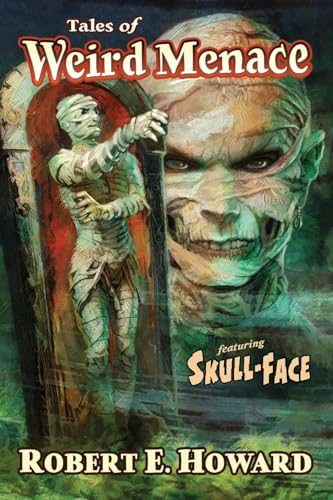
Tales of Weird Menace collects Howard’s Weird Menace and Yellow Peril yarns, many of which have never seen book publication in the U.S. It includes a hefty “Miscellanea” section featuring hard-to-find fragments and synopses. This volume is 473 pages, plus introductory material.
This volume will be printed in hardback with dust jacket, in a limited quantity of 150 copies, each individually numbered. Cover design and painting by Jim & Ruth Keegan; introduction by Don Herron; and edited by Rob Roehm. The book is expected to ship by the end of January.
Contents Tales of Weird Menace
Introduction: Lines of Succession by Don Herron
Skull-Face The Noseless Horror The Brazen Peacock Black John’s Vengeance Talons in the Dark The Hand of the Black Goddess Sons of Hate Moon of Zambebwei Black Hound of Death The Devils of Dark Lake Guests of the Hoodoo Room Black Wind Blowing Miscellanea The Red Stone Untitled (“The night was damp. . .”) The Ivory Camel Yellow Laughter The Story Thus Far . . . Taverel Manor The Jade God The Return of the Sorcerer Untitled Synopsis (“James Norris”) Spectres in the Dark The Spell of Damballah Partial Synopsis (Sons of Hate) Untitled Synopsis (The Devils of Dark Lake) The House of Om (Synopsis)
Robert Ervin Howard was an American pulp writer of fantasy, horror, historical adventure, boxing, western, and detective fiction. Howard wrote "over three-hundred stories and seven-hundred poems of raw power and unbridled emotion" and is especially noted for his memorable depictions of "a sombre universe of swashbuckling adventure and darkling horror."
He is well known for having created—in the pages of the legendary Depression-era pulp magazine Weird Tales—the character Conan the Cimmerian, a.k.a. Conan the Barbarian, a literary icon whose pop-culture imprint can only be compared to such icons as Tarzan of the Apes, Count Dracula, Sherlock Holmes, and James Bond.
—Wikipedia
Librarian Note: There is more than one author in the Goodreads database with this name.
An uneven mix of stories, from really great to merely entertaining - but all of them were good reads. I really like these books from the Robert E. Howard Foundation. It's heavy, bound well, and reads well. A lot of these stories have been unavailable or simply difficult to get. I like the inclusion of the unfinished stories and rough drafts. I do wish the book included information about the original appearances of the stories.
"Skull-Face" is, of course, the first story in the collection.
I was surprised that the protagonist, Steve Costigan, was portrayed as a drug addict. It's unusual for REH to portray his heroes as having a weakness like that. Yeah, Conan might start out in a desert, near death, but that is more his circumstance than a personal weakness. It's unusual for REH to give his characters PTSD, no matter how much war they have seen. I am thinking PTSD wasn't really much of a thing back then, considered to be "Shell Shock" at the time. Our hero in this story was at the Battle of Argonne, which places this story after WW1.
He is restored by Skull-Face and freed of his addiction, so Steve opts to work for him. This is unusual for REH as well. He uncovers a spy (John Gordon), but allows him to live. Steve also meets his dream girl, an oriental woman, who gives Steve a very vague warning, which is basically what Sax Rohmer would give his heroes: vague, useless warnings. Chapter 6 felt especially Sax Rohmerish.
REH mentions that Steve's sense of morality has been blunted or diminished. Again, this is at variance with most of REH's heroes. Steve was to impersonate someone, but that someone was found and reported as murdered before he could do so, so plans had to change. And then Steve becomes his own man, feeling his debt paid - and he feels more like an REH hero, acting as soon as thought of action enters his head, and revealing Skull-Face.
Skull-Face reveals that Steve is his slave, and without his aid cannot overcome his addiction. I've read criticism about REH's characters, that they are all cut from the same cloth, but this is VERY different from a standard REH character. This flaw sets up a fantastic amount of tension that wouldn't exist with Conan or Bran Mak Morn. It's also different from Sax Rohmer's set-up: REH isn't creating a Holmes/Watson team against a Moriarty arch-enemy, which is what Sax Rohmer did (Sir Denis Nayland Smith and Dr Petrie were very much a Holmes & Dr. Watson clone).
Oh, this is brilliant. The description of the need for Skull-Face's drug was top-notch. Never was Conan held in such bonds. Skull-Face wants Steve to murder someone.
It's interesting that REH uses the Steve Costigan character here, a character that has both been used as an REH stand-in (Post Oaks and Sand Roughs & Other Autobiographical Writings) and as a comical character (Sailor Steve Costigan, from Fists of Iron: Round 2), as well as other uses. I'm not entirely sure what to make of that.
Zuleika reveals her part in Steve's plight, but he is in love with her so it doesn't matter. In some ways, Zuleika is reminiscent of Rohmer's Kâramanèh, and her love of Dr. Petrie. She is Circassian, from a region bordering on the Black Sea. She reveals that Skull-Face is Kathulos of Egypt.
My pet philosophy on Skull-Face, my head-canon, if you will, is that Kathulos of Egypt is none other than Thulsa Doom of the Kull stories, who went by the nom-de-plume of Kuthulos. Later, we will see that Kathulos of Egypt is actually from Atlantis... which ties it even closer to the Kull stories. I honestly think Skull-Face is none other than Thulsa Doom. Sure, maybe REH just reused a concept from an unsold story, but I like to think they are one and the same. Like I said, head-canon; take it or leave it.
Anyway, Zuleika reveals that "He is the greatest sorcerer in all the world and knows all ancient magic and everything." Steve states that he is a mere husk of a man, only mighty of strength because of Skull-Face's elixir. This is not your standard REH character. Indeed, in some respects it is more like the much later character of Elric by M. Moorcock.
One of the things I love about REH is that he doesn't really prolong a fight. It's fast, furious, and brutal, and this fight scenes in this story are all of that.
I really love this story. Although inspired by Sax Rhomer, this story reads much differently. It's much more action-driven, and is more about ancient horrors than the "yellow-menace." It's very much REH at it's core and it reads like REH, not Sax Rhomer. There are no Holmes & Watson characters, and the only real thing one can compare is the love between Steve Costigan and Zuleika, and the love between Dr. Petrie and Kâramanèh. Kâramanèh finds an REH equivalent in Zuleika almost exactly.
There are some definite differences in style though. The Sax Rohmer characters are far more intellectual, and the REH characters far more physical. This isn't mere Rohmer pastiche. This is very much REH writing at his best. This is an EXCELLENT story.
"The Noseless Horror" has a John Gordon character, which is not the same character as in "Skull-Face." All in all, it is a fun story, but not a great story. Every beat of the story is telegraphed long in advance. The reader knows the mummy isn't ancient, that it's the fetish-mummy that was made of Von Honmann, and that the Sikh isn't the "noseless one" despite his lack of a nose. It's entirely too predictable. The only reason this story works at all is that REH is a master at story-telling. It's still an enjoyable read. I have no idea when REH wrote this (it wasn't published in his lifetime), but I wonder if it predated "Skull-Face." It has so many similar elements, it almost feels like a precursor.
"The Brazen Peacock" starts off with Erich Girtmann arriving at the unnamed narrator's house suddenly. He reminds the narrator that he owes him a life debt. Erich has stolen the brass idol (inlaid with gold) of Melek Taus.
I did a fair amount of reading and research about Melek Taus when I was writing Shem - Gateway to the South, and I owe a lot to this story for that. This is a pretty weak tale, in and of itself. I can see why it wasn't published during REH's lifetime. REH gets many facts about the religion correct, such as the Yezidees not speaking the name of Satan, the importance of the color blue, and the sacredness of fire. The ending felt kind of sudden, like REH had written the characters into a corner, and had a kind of ending where everyone was left as they had been if Erich had not entered into any of their lives. No one is better or worse off. There is no character development, and the adventure serves only to kill off Erich (the antagonist), and leave everyone else off exactly as they started.
It was fun read, though. REH knows how keep a reader interested and turning the pages, and that skill shows through here, despite the faults in the story.
"Black John's Vengeance" is also known as "The Black Bear Bites." It was rejected by Argosy, Adventure, and Far East. It was first published in 1974. The first paragraph is laden with mystery and atmosphere. Dang, REH could write. It also sets up the scene, and tells us the unnamed narrator is watching the house of Yotai Yun, a Chinese merchant prince. All in all, a pretty good story. I liked it better than the last two, but not on par with Skull-Face. It was atmospheric and tense. Not sure why it didn't sell. It is a pretty straight-forward plot, so maybe that's why. Until the end, there aren't really any plot twists or anything. Black John O'Connell is a pretty standard REH character. The bear motif was interesting (REH characters are often described with animal characteristics), but he was faster than expected for his size, was a large man, and very powerful. He has a single-minded focus on whatever goal he has in mind.
I think what really sets "Skull-Face" apart from the rest of REH's oeuvre, was that Skull-Face's Steve Costigan character was weak and drug-addicted. It really made him stand out. Black John O'Connell didn't really have anything that makes him stand out among REH's many strongman characters. I wonder if that is part of the reason this story didn't sell. No matter, I guess. I enjoyed this story a lot, and that's what matters.
"Talons in the Dark" was originally published under the title of "Black Talons" in Strange Detective Stories, December 1933. All in all, not a bad little story. It wasn't long, and it was packed with action. Howard wrote it well. I can see why this one sold, but the last couple hadn't. It had hints that something supernatural was happening, but it wasn't. Also, I've liked Leopard Men ever since I was young, and read Tarzan and the Leopard Men. I did a bit of research on the real-life Leopard Men for the Conan RPG also.
"The Hand of the Black Goddess" is a lively story. Never published in REH's lifetime, the final battle is a real crimson battle of descriptive furies at work. Butch Gorman is basically a red-headed Conan-like character. Brent Kirby is a contrast to him, slim and compact, with nervous energy.
"Sons of Hate" again have us with the private detectives Butch Gorman and Brent Kirby, the same characters as in "The Hand of the Black Goddess." Some twists in the story ensue. And... I really like the team of Gorman and Kirby. Kirby's mind and Gorman's brawn work well together. When Kirby reveals Juan's complicity, and he attacks, you really see this teamwork at the fore. The ending was a bit lack-luster, and too quickly wrapped up, with Stalbridge suddenly giving up his claim to the treasure in favor of Pembroke's niece. All neat and tidy, to be sure, but... kind of weak.
It was a good story, with a fairly weak ending after the combat ensued. If it didn't sell, I think it was that ending that killed it. Great story until the last few paragraphs, really. REH just wrapped it up too neatly.
"Moon of Zambebwei" was published in Weird Tales as "The Grisly Horror." All in all, a pretty good story. Very solid with a clear protagonist and a threat to a girl by foreigners. More of a horror story than a "weird menace" tale, since world domination by a foreign force really isn't the goal of the villain, but it works here, I guess. As a modern editor, I'd edit out all the n-words, but that was the time, and the point of these volumes is to print REH as he wrote. I liked the ape fight at the end, and thought the overall scene was pretty good. I liked that Bristol and Ballville (REH really liked names that began with the letter B) were childhood friends turned foes. I can see why it sold.
"The Black Hound of Death" was published in Weird Tales in 1936. Robert E. Howard spends about three paragraphs describing just how dark it is. That sounds like overkill, but it actually sets the tone of the story well. For purposes of this summary & review, let's just say it's pretty darn dark. No... let's go a bit further. Basically REH gave us his version of this line: "It's like, how much more black could this be? And the answer is none. None more black." I can see why this one sold. Absolutely solid story-telling. Good characters. Excellently written villains.
"The Devils of Dark Lake" was a great mix of adventure, horror, and yellow menace (although the bad guy was a white man who was merely born and raised in China... and also a Neanderthal man was his ally). The ending comes a bit abruptly, but it was an enjoyable tale. It definitely belongs in this collection. Absolutely had yellow menace in it, as well as straight out weird menace - all sorts of vile monsters live in Asia, apparently. This story was rejected by Standard Magazines, Inc. on October 14, 1935 and by Popular Publications on November 15, 1935. Standard Magazine thought it had too much horror in it, and Popular Publications thought it had too much adventure in it. I liked it.
"Guests of the Hoodoo Room" was not published during REH's life, but he did submit it to at least one magazine. The first page or so of dialogue was a little rough for me. Maybe I am just not used to 1930s slang, or it's just badly written dialogue (or both), but it was clunky for me, filled with words and phrases like 'bo, nabob, Dago red, flophouses, been to the bulls, giving someone the horse-snicker, jits, town-clowns, and so on. With one exception, I understood it all, but it read like someone was going hard-core to make the characters sound tough or "authentic," but it was so filled with slang it just... clanked for me. Very much a yellow-menace tale, it definitely belongs in this book. I thought the cannibalism angle was sufficiently weird, too. I thought it was a rollicking tale, with twists and turns from beginning to end. It may not have sold during his life, but it probably should have. I enjoyed it.
"Black Wind Blowing" was Howard’s second and final appearance in Thrilling Mystery in the June 1936 issue. He was paid $40 for it (which, when adjusted for inflation, would be $904.10 in 2024). This was a fun story. I really enjoyed it. I thought REH did a great job with his descriptions and with setting a chilling atmosphere of mystery, death, and devil-worship. The characters were good, and the menace from the east was palpable.
"The Red Stone" had a pretty strong start, with a character I would have loved to have seen developed further, basically a man driven by his habits and customs. This would have made for an interesting REH character. Unfinished past the first page.
"Untitled" Takes place in London, and a girl runs into a stranger's house. The stranger is named Gordon. He has a neighbor named Falcon. Falcon is some kind of mesmerist, who uses a dagger to make a mark on the girl. Story ends.
"The Ivory Camel," an unfinished story, stars Karnes McHenry. He's happily on the farm, milking a cow, when he noticed the hatchet in the hay. He comes up blazing, a .45 roaring flame and smoke and killed a hidden Arab-Indian mixed breed who had stolen a piece of jewelry from an Oriental cult - the titular ivory camel. Later, Mr. Ord tries to talk to McHenry about this ivory camel, but it doesn't go anywhere, but McHenry does send his sister, Alice, to her friend's house, Joan Grimes (yep, another Joan). The story ends here.
"Yellow Laughter" is a fragment, having lost both beginning and the end, with about a page extant, of a man fighting Orientals.
"Taverel Manor" always excites me. It was finished by Richard A. Lupoff in The Return of Skull Face (1977) and in Skull-Face (1978). It's generally advertised as a sequel to "Skull-Face," a story I love. It had the start of a rousing good tale. I was glad to see the return of John Gordon and Steve Costigan from "Skull-Face," and to see that they were now working together. It's a shame REH didn't finish the story. It was very much written as a "yellow-menace" tale, but in REH style.
"The Jade God" is an unfinished tale of Kirowan and Conrad. I assume it would have been a Mythos tale, as these two are often associated with them. Kirowan and Conrad hear a murder of their neighbor and run to the rescue. It's basically a locked room murder, as the only escape route seems impossible. The only clue is the man's dying words, "The Jade God." The Jade God is a statue the victim had given to Kirowan earlier that day for safekeeping.
"The Return of the Sorcerer" is an unfinished tale. This story was a little harder to get into because Abner and John are not likable characters. I also tend not to like the "captured and then forced into a quest by the bad guys" plot; it never feels believable to me.
"Spectres in the Dark" is an unfinished horror story. This one had the makings for a pretty good mystery.
"The Spell of Damballah" is an unfinished story. Mr. Kirby (Kirby is another name REH likes) and O'Brien (O'Brien is the narrator) is visited by a young man (John Ordley) worried about his fiancée, Joan Richards (another Joan). Mr. Kirby is an occult investigator. He is worried about one Ahmed Bey (at least it's not Ardeth Bey). They go to a party to meet Joan and Ahmed. Kirby recognizes Ahmed Bey as Loup, a mulatto from Haiti, and a voodooist. Funny, when I read Ahmed Bey/Loup's dialogue, I read it in the voice of Bela Lugosi. This was an EXCELLENT story so far, and I wish it had been finished.
The final story in the book is actually just a synopsis, "The House of Om." It's not fully fleshed out or written, just summarized. It starts out with too many characters having names that begin with B: Bill Blanton, Bixby, Bainbridge. It gets confusing when writers use too many names that start with the same sound. It's better to mix it up a bit. The story would have made a good novel, and is very much in the realm of Sax Rohmer's "yellow menace" stories, but with a decidedly REH twist. Oriental plots to conquer a city, create cults, debauch the youth, and more abound. Om is a Fu Manchu type, but only in terms of planning an Oriental takeover (he's actually a white guy who became twisted in Mongolia). The synopsis is entertaining reading, and I wish the story had been written.
I am re-reading a very enjoyable book. I recently re-read a classic Howard story, "Skull Face", an obviously inspired by Sax Rohmer's Fu Manchu stories and decided to finish the book. I've read some Fu Manchu and I like the Howard story better. His stories are always more visceral and the villain has supernatural powers. A sorcerer risen from the ocean out of fabled Atlantis.
Excellent selection of Robert E. Howard's Weird Menace short stories. You get everything from yellow peril to supernatural detective stories. The novella "Skull-Face" is one of Howard's best. Highly recommended
Unlike the Dell editions of Howard's work, this edition does not provide a publishing history of the stories it contains. This collection consists of the following stories, many of which showed up in Berkeley editions in the 1970s:
Skull-Face The Noseless Horror The Brazen Peacock Black John’s Vengeance Talons in the Dark The Hand of the Black Goddess Sons of Hate Moon of Zambebwei Black Hound of Death The Devils of Dark Lake Guests of the Hoodoo Room Black Wind Blowing
It also contains 119 pages of unfinished material. Several of the stories follow the adventures of detectives Gorman and Kirby. The stories have an Oriental tinge, taking place in the Far East or the Chinatowns of various cities. Tales of Fu Manchu anyone?
I’m a lifelong Robert E Howard fan, and after collecting the Ace paperback Conan series, spent the next 20 years looking for any Howard books I could find. I had grown to want the Howard-only writings, not the edited down, “posthumous pastiches,” and Frankenstein versions of stories that were part of the L Sprague de Camp legacy, but pure, unadulterated Howard. Even the Howard when he wasn’t at his best. In the 2000s my wish began to be granted with the Del Rey versions of Conan, Kull, Bran Mak Morn, Solomon Kane, El Borak and others. Then a couple of decades later I discovered Robert E Howard Foundation Press. Alas, by then the first editions of several of their volumes were out of print. I bought up what I could. Which was still several volumes, including “Ultimate Editions,” revised and updated versions of earlier first editions. This volume is one such. I will say this one started out slow for me. “Skull Face” was a nice read, but I just didn’t connect. But as the stories progressed, I felt they became better, tighter, more well-written. Be warned: there are racial stereotypes and language that were in the culture of his day, particularly the “menacing Asian” and “dark Africa” cultures. And most of the damsels are in distress and needing rescue. Nonetheless, this is pulp fiction of the weird action story at its overall best. Four stars as I don’t think all the stories land. But four hundred pages of fun, with another hundred of unfinished and draft stories, plus synopses of finished tales.