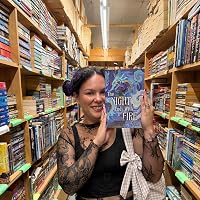
I am obsessed with what Liz Allan has done with In Bloom. This is one of those books where I finished reading and immediately wanted to talk about it because there is so much happening underneath what initially appears to be a scrappy coming-of-age story about four teenage girls, a grunge band, and their desperate desire to escape a shitty little Australian coastal town. I could not put this book down.
It is 1994 in Vincent, Australia, and four fourteen-year-old girls—Amy, Jade, Violet, and Lily—have formed a Nirvana-obsessed band called The Bastards. The name is a joke about their absent fathers, but it also becomes an identity. These girls have been written off by practically everyone around them. They are poor, unruly, overlooked, and considered the kind of girls who are destined to become exactly like their mothers: stuck, broke, pregnant, and surrounded by men who don't stay. Their great escape is music, specifically the Battle of the Bands, which they see as their ticket out.
And then Lily leaves.
Lily, the band's singer and once an inseparable part of the group, accuses their beloved music teacher, Mr. P, of sexual assault. The other three girls cannot accept this. Mr. P is the teacher who encouraged them, gave them somewhere to practice, and treated them as though they were worth something. So they decide Lily must be wrong. They begin investigating, convinced they can uncover evidence that will prove their teacher's innocence.
This is where Allan's novel becomes something much more complicated and much more brilliant.
For much of the book, Amy, Jade, and Violet speak as we. They are The Bastards. They move together, think together, remember together. It is an ingenious narrative choice because at first it feels like the ultimate expression of teenage friendship. These girls are inseparable. But gradually that collective voice begins to feel sinister. Who is speaking? Who remembers what? Who is protecting whom? And, most importantly, what are they refusing to say?
The girls skirt around the truth constantly.
They are unreliable not because they are deliberately lying to us, but because they are children trying desperately not to understand something they are not emotionally equipped to confront. Their version of events is shaped by loyalty, fear, shame, class, and their overwhelming need to believe that the adults they trust are actually safe. They cannot admit what may have happened because admitting it would destroy the little world they have constructed for themselves.
Amy feels like one of the clearest embodiments of the group's need for control. She is observant and fiercely loyal, but that loyalty becomes a kind of blindness. Her identity is wrapped up in The Bastards, in their music, and in the idea that the four girls together are stronger than anything Vincent can throw at them. The collective narration makes perfect sense for her because separating herself from the others would mean confronting things she would rather leave buried.
Jade has a different kind of toughness. There is an almost performative aggression to her, the kind of bravado that teenagers use when they have figured out that being frightening is sometimes safer than being vulnerable. She is angry at the world, but she is also desperate to belong in it. What I loved about her was the contradiction: she wants to be seen as someone nobody can hurt while simultaneously living in circumstances that make her incredibly vulnerable.
Violet is perhaps the girl I found most heartbreaking because of the space between how she sees herself and how other people see her. Like the others, she has absorbed the judgments of the adults around her. They see these girls as trouble, as stupid, as disposable. The girls, meanwhile, see themselves as clever, rebellious, destined for something bigger. That tension runs through the entire novel. They may be naïve, but they aren't insignificant, and Allan refuses to let the reader make that mistake.
And then there is Lily.
Lily is the girl who breaks the formation. She becomes the outsider, the traitor, the girl who has supposedly ruined everything. But the further we move into the story, the more complicated that judgment becomes. Lily's perspective is deliberately withheld for much of the novel, and that absence becomes incredibly powerful. We see her through the eyes of girls who desperately need her to be wrong. The question isn't simply whether Lily is telling the truth. The question is why these girls are so incapable of hearing her.
That is what makes In Bloom so devastating.
Allan is writing about sexual assault, but she is also writing about perception. About the difference between who you think you are and who everyone else has decided you are. These girls think they are rebellious outsiders, future rock stars, clever detectives, survivors. The adults see delinquent girls from broken homes. And somewhere between those two versions of them is the truth.
I also absolutely adored the 1990s atmosphere. Allan captures that particular era with such gorgeous nostalgia—the music, the clothes, the boredom, the sense that the world was simultaneously enormous and incredibly small. Nirvana isn't simply a soundtrack here; it becomes part of the girls' mythology. They look at Kurt Cobain and see proof that someone can escape. Music gives them a language for all the rage they don't know how to articulate.
And I loved that the nostalgia never makes the past feel safer than it was.
That is the trick of In Bloom. It allows us to remember the 1990s fondly while simultaneously reminding us how little girls were listened to, how easily young women could be dismissed, and how desperately teenagers could cling to the wrong people because those people made them feel seen.
The short chapters and relentless momentum made this an incredibly compulsive read, but it is the characters who stayed with me. These girls absolutely jump off the page. They are messy, funny, cruel, frightened, loyal, ridiculous, and heartbreaking.
In Bloom is about girlhood, friendship, class, trauma, music, and the terrifying process of becoming an individual when your entire identity has been built around belonging to a group. It is also about what happens when the story you have been telling yourself can no longer survive.
I was completely hooked. And by the end, I was looking back at everything these girls had said—and everything they hadn't—and realizing just how carefully Liz Allan had been manipulating my understanding of them all along.
Amazing. I absolutely loved this.