Jump to ratings and reviews
Rate this book

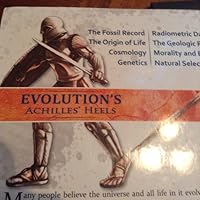
Evolution's Achilles' Heels

Rate this book
This powerful book (illustrated in full colour) exposes the fatal flaws of evolutionary thinking. Like no other work that we are aware of, it is authored by nine Ph.D. scientists to produce a coordinated, coherent, powerful argument. All of the authors received their doctorates from similar secular universities as their evolutionary counterparts. Each is a specialist in a field relevant to the subject written about: Natural selection, origin of life, geology, genetics, radiometric dating, the fossil record, cosmology, and ethics.

Evolution’s Achilles’ Heels directly demolishes the very pillars of the belief system that underpins our now-secular culture—evolutionary naturalism. It’s coupled with the Biblical command to reach the lost with the Bible’s Good News. In a nutshell, it’s a comprehensive outreach tool like no other.

The nine Ph.D. scientists are Donald Batten, Robert Carter, David Catchpoole, John Hartnett, Mark Harwood, Jim Mason, Jonathan Sarfati, Emil Silvestru and Tasman Walker. Foreword by Carl Wieland and edited by Robert Carter.

408 pages, Kindle Edition

First published July 1, 2014

51 people are currently reading
137 people want to read

About the author

Robert Carter

162 books11 followers

Ratings & Reviews

What do you think?
Rate this book

Friends & Following

Create a free account to discover what your friends think of this book!

Community Reviews

5 stars
79 (61%)
4 stars
32 (24%)
3 stars
11 (8%)
2 stars
2 (1%)
1 star
5 (3%)
Displaying 1 - 22 of 22 reviews
Profile Image for Frank Kool.
117 reviews17 followers
March 29, 2022
[WARNING: IT'S A LONG READ]

Two things to keep in mind when reading EAH: 1) It presents no positive evidence for creationism but only a critique of evolution, 2) "evolution" is here so broadly defined as to mean "naturalism".

Let's go through this chapter-by-chapter.

1) NATURAL SELECTION. The first attack on evolution is a bit confusing. The chapter starts by stating that natural selection can remove but not create information. One can only shrug at the truism of "natural selection only selects". The subject is then changed to genetics and it is argued that mutations cannot lead to speciation. Considering that genetics is the topic of the next chapter, the whole segment appears to be mere filler. It is further claimed that mutations cannot add new information, and that observed mutations are never reversible (i.e.: mutations are due to information loss and not gain). These assertions are at best contentious and at worst wrong. The arguments further hinge on attacking Darwin's moral character and the debunked idea of irreducible complexity.

2) GENETICS AND DNA. Here the metaphors start to break down. First, it is repeatedly stated that there are many Achilles' heels for evolution, rendering the metaphor useless. The point of the Achilles myth is the irony of an near-invincible warrior whose doom is the weakness of one small body part, but the book argues that everything about evolution is wrong. Second, the author first compares the human genome to a computer operation system (p. 58), then states that these comparisons are flawed, only to conclude that a natural explanation for the human genome is as absurd as a computer operation system without an intelligent designer.

Considering the large overlap with chapter 1, it is not surprising that the arguments again strongly lean on the idea of irreducible complexity. The author seems to be out to dazzle the reader with how complex genetics is. So he wonders why the earliest lifeforms would depend on such a fragile structure as DNA to carry their information, ignoring hypotheses like self-replicating RNA. As always, when considering the probability of something occuring by natural means, you need to take into account all the incremental steps and not look at the product of ca. 3.5 billion years of gradual change to conclude that this seems too complicated for natural explanations. And not knowing these basics is not necessarily the death blow for a scientific theory, it is at best an admonition that it is still an hypothesis, which is precisely what abiogenesis is. Again, refuting evolution requires positive evidence that it is impossible, not arguing that some aspects are yet uncertain.

The chapter concludes on several claims.
The first is that of genetics providing scientific evidence for Adam & Eve, this is immediately sabotaged by the author positing that God could have placed "multiple cell lines and human genomes" in their sexual organs, making any data about genetic diversity vulnerable to post hoc explanations.
Then there is the claim of dating mitochondrial Eve to around 4,000 BC, which is not only wrong but also pointless because mEve is the earliest known female common ancestor, not necessarily the first woman to ever live.
A baffling falsehood is presented when it is claimed that Genesis 6-11 predicts the global migration pattern of early humans according to the Out of Africa theory, despite the fact that Genesis only mentions a handful of cities in the Levant known to the authors.
The final claim is that of the supposedly problematic genetic similarities between humans and chimps, which is sabotaged by the segment concluding with a (awkwardly postmodern and relativistic) quote from Pääbo:
"I don't think there is any way to calculate the number... in the end, it's a political and social and cultural thing about how we see our differences."


3) THE ORIGIN OF LIFE. A pattern is starting to become clear: all authors focus a lot of energy on attacking Darwin's On the Origin of Species (1859), almost treating it like scripture written by a sacred figure. The fact is that there is no embarrassment in OoS containing doubts and errors: it was quite literally the first draft of the evolution theory and was build on 19th century scientific knowledge. In fact, evolutionary theory has only grown stronger by discovering what Darwin got right and what he got wrong.

So we have come to chemical evolution. The author denies the notion of "abiogenesis" (life from non-life) being separate from "evolution" (speciation, or biodiversity). However, there is a sleight of hand here: the author alternates between using the word "evolution" as referring to either a singular entity (the equivalent of naturalism) or as referring to one of many levels of evolution (gradual change in biology, genetics, chemistry...). Moreover, if we allow for these subdivisions, there is no reason to assume that disproving one level of evolution would disprove another.

The shiftiness of the author is further revealed when he quotes Dawkins "admitting" that the co-dependence of DNA and proteins is a Catch-22 for the origin of life (The Greatest Show on Earth: The Evidence for Evolution, p. 420). Taking a closer look at this book, there was no surprise discovering that the first thing Dawkins does after the quoted sentence is to explain how it could have happened. Interestingly, Dawkins coined the term Quote Mining Index in the very same book. The author later returns to the same book, again quoting Dawkins seemingly admitting that life from non-life is impossible. Yet this quotation is interrupted, a quick search reveals that it left out the words "biological chemistry is possible", and it becomes apparant that rather than admitting defeat, Dawkins was weighing the strengths and weaknesses of various hypotheses on abiogenesis.

An in-depth critique of the remaining pages by far exceeds the limits of this review (not to mention my knowledge on biochemistry), but considering the dishonesty displayed so far I'm not giving this the benefit of the doubt.

4) THE FOSSIL RECORD Again, attacks on the "numerous errors" of Darwin. At the risk of falling into repetition: arguing for creationism by attacking Origin of Species is like defending Flat Earth theory by correcting Copernicus' De revolutionibus. What is more obnoxious is the tendentious language that is used. The writing is more insolent than before, and here we see the pages filling up with exclamation marks (a cardinal sin of academic writing), insinuations about the feelings and motivations of "evolutionists", and sassy phrases like "but guess what?"

On to the factual matters. The author makes the questionable claim that paleontology is being framed to leave students "with the general impression that evolution has proceeded at a steady and consistent pace." Remarkably, the next segments criticize evolutionary ideas like punctuated equilibrium and the Cambrian explosion.

Next is Schweitzer's infamous finding of soft tissue in a T. rex fossil. Though presented as another nail in the coffin of evolution, it's really not and Schweitzer didn't claim so. In her own words:
"Whether [soft tissue] preservation is strictly morphological and the result of some kind of unknown geochemical replacement process or whether it extends to the subcellular and molecular levels is uncertain.", p. 6

Next up are transitional fossils. The author shows more bad faith by decrying that findings like Archeopteryx and Deinonychus led scientists to "blur the boundaries" between birds and dinosaurs, which is precisely what you'd expect transitional fossils to do. Then comes the Puujila darwini fossil, which author falsely claims is nearly identical to an otter skeleton (ignoring the shape of the skull and teeth marks that mark it out as a seal).

5) GEOLOGIC RECORD This chapter is somewhat of a breather because it's far more anecdotal then the others. It kicks off with some examples of fossils that were either quickly buried or that imply death by drowning, which curiously leads the author to conclude that a global flood is the only explanation. While it is shown that some geological features don't require millions of years to form under suitable or artificial circumstances, it is nowhere established that all geologic features were in fact formed rapidly, which is required if you want to argue that the Earth is less than 6,000 years old.

Next up are polystrate fossils, some more anecdotes on geology, and then we get to the final segment where all geologic data is reinterpreted into a Flood model. This requires some assumptions, the most problematic one being a 500 year Ice Age right after the Flood, which is funny considering that the author is a climate change skeptic. Considering that the chapter only deals with geology, conflicting evidence from history and archeology are avoided, such as multiple civilizations existing before, during, and after this supposed catastrophe. In fact, how is it possible that we found anything predating the Flood if this event was so catastrophic that it literally reshaped the continents? Last but not least, what about dendrochronology?

6) RADIOMETRIC DATING If all the quantum mechanics and equations won't give you a headache, the next paradox will: 1) radiometric dating is unreliable, 2) radiometric dating proves that the Earth is 6,000 years old.*

* if we assume that during the Flood, carbon was either buried underwater, released by volcanoes, or reabsorbed by rocks, depending on whether the desired conclusion requires more or less carbon in the sample.

7) COSMOLOGY I went into this chapter hoping for one thing: the author addressing the fact that we can see stars that are more than 6,000 light years away. To my consternation there was only this obscure paragraph:
"The cosmogony of [the whole Universe] must conform to [biblical history]. Coupled with earlier understanding of the ephemeral, model-dependent and philosophically underpinned nature of all cosmological statements, it should be plain that to disbelieve a straightforward reading of Genesis because of allegedly 'unanswerable' light-travel issues is untenable." p. 230

I read this three times to come to the conclusion that it means: "I believe in Genesis, so no."

The rest of the chapter is confusing. The author claims that the Big Bang model points to a transcendent cause but two pages later he dismisses people who interpret it religiously, saying the BB model epitomizes a fully materialistic system.
It is argued that cosmology is philosophy rather than a science proper, despite the author addressing the fact that the BB model predicted cosmic background radiation. Same with dark matter, which he claims is an post hoc solution to gaps in the model, rather than it being confirmed by observational evidence. It is also claimed that finding evidence for a cosmological model is the fallacy of affirming the consequent (since we only have one Universe), but considering that supporting evidence never has the final word in empirical science, this seems like merely casting suspicion.

8) ETHICS Considered to be "the most important chapter of the book", it is puzzling that the authors are educated in plant physiology and telecommunications. This only partly explains how two academics can repeat so many falsehoods and non sequitur, leading me to suspect that the entire thing was ghost-written by an overenthusiastic youth pastor.

It kicks off with the crux of the problem: accepting evolution would have societal implications, this is only true if evolutionary theory should translate into social practice, which is simply wrong.

The chapter goes on to decry the lack of moral and logical absolutes, without ever explaining how (inter-)subjective values and conventions are impossible, like saying that playing chess is impossible if naturalism is true because there are no absolutes. Check-mate, atheists!

Moreover, the chapter commits the double standard of claiming that atheism leads to moral nihilism while simultaneously showing that religion can justify literally anything. Case in point: Hitler is evil because he commits genocide whereas Yahweh commits genocide because he is "holy and just." One disingenuous oversight in the mantra of "evolutionism = atheism = Stalinism" is the fact that Stalin personally banned the teaching of evolution in the Soviet Union. Thousands of scientists were imprisoned or killed in order to make way for the marxist pseudoscience of Lysenkoism.

As the chapter goes on, the critique of secular values continuously conflates immorality with amorality, meaning it can't decide whether atheists have bad morals or no morals at all. More astounding is that even a philosophy freshman is expected to know Kant's categorical imperative, an ethical theory of moral absolutes with no appeal to the supernatural.

One last critique:
"How ironic that 'science' is now used as a weapon against the very Christianity which gave it birth."

It is ironic, and that it precisely what Nietzsche conveyed in his infamous and often misunderstood quote: "God is dead! And we have killed Him."
Profile Image for Mike.
Author 8 books46 followers
February 22, 2016
It's taken me a while to read this book because sometimes I got bogged down in the science; I could understand where they were going with their arguments, but not always the detail of how they got there.
It's a fascinating book: not only does it lay low evolution's arguments on every hand, but it provides good solid scientific reasons for doing so. Anyone who thinks that because this book comes out of Creation Book Publishers' stable, it will be faulty in its science, needs to read it and think again. If anything, it's the evolutionists whose science is found to be faulty, not just in one area but in many.
It shows again and again how a mindset will alter your thinking when it comes to science, how you will look for the answers that you want to find, rather than proving them by proper scientific methods. Yes, you could say that this is what the Creationist people are doing: starting out with a mindset and finding their answers, and in one or two of the chapters I felt that might be the case. But the science they present seems on so many levels to come up to the mark - and furthermore, it is often science produced not by scientists with a Creationist background but scientists on a broad spectrum of beliefs, from non-Creationist Christian through to atheists. One of the most encouraging things in the book is that there are scientists who are looking at the assumptions made by evolutionist scientists and are saying...This just doesn't add up.
I came to the chapter on the age of the world and struggled with this, because for many years I've assumed that people who told me the earth was billions of years old had good scientific reason to do so. It turns out that this isn't quite the case at all. There's no doubt that some of what's in this book will make your brain go into a bit of a tizzy; what the modern world assumes about science turns out to be in many instances based on faulty thinking and unproven 'facts'.
I suspect many people will just say (a) the discussions in the book are just too hard to understand, and/or (b) I don't want my worldview challenged, and/or (c) I just don't believe these guys know what they're talking about.
The good news is that these guys do know what they're talking about, which makes it all the more reasonable to carefully consider what they're saying.
145 reviews1 follower
October 12, 2016
"Evolution's Achilles' Heels" is an excellent, landmark book where '9 Ph.D scientists explain evolution's fatal flaws-in areas claimed to be its greatest strengths.'

The eight arenas of intellectual combat, each with their own chapter and their own scientist/author, are: 1) Natural Selection, 2) Genetics and DNA, 3) The Origin of Life, 4) The Fossil Record, 5) The Geologic Record, 6) Radiometric Dating, 7) Cosmology and the Big Bang, and 8) Ethics and Morality.

I found the book to be enormously interesting, but a few sections of both chapters 3: The Origin of Life and 6: Radiometric Dating went right over my head. That said, I understood the vast majority of the book and I've watched the accompanying movie (by the same title) several times.

I highly recommend "Evolution's Achilles' Heels" to everyone, from teenagers to adults. If you're not much of a reader or may find this book too difficult, the aforementioned movie presents the same arguments but in a less detailed format.

9/10
10/10 (if you're good with Chemistry and Biology-based academic language)
Profile Image for Jenna.
39 reviews
November 28, 2016
Excellent reminder that the Big Bang is a theory created by scientist. Just as no one was there to see God create the earth, no one witnessed the improbable fusing of particles to create a cognizant race of humans on a random planet.
Profile Image for Seth Sretep.
29 reviews
July 11, 2015
Great and informative book. Overwhelmingly logical arguments, as I have come to expect from the people at CMI. A must read for anyone who respects the truth.
Profile Image for Soteria Allen.
3 reviews15 followers
December 9, 2016
Evolution's Achilles' Heels by Robert Carter
I think Evolution's Achilles' Heels was great!! Wonderful!
Actually I watched the video instead of reading the book, but since I saw we could do a Review for an audio book, I didn't see any reason why we couldn't also do a review for a video, at least when there is also a book of the same title published also.
I have already been very blessed by the great scientific teachings by creationists, including by the main author of this book (& video) Robert Carter, on the website Creation.com for several years -- awesome teachings about our great universe, including every area of science pertaining to creation. And when watching their site, seeing their various teachings in geology, biology, zoology, astronomy, and more, I am ever awed as I see the care and precision with which all of nature, as well as animals, and all people, were made by our awesome creator God!!
When I am watching videos on their site, just as with the video (book) 'Evolution's Achilles' Heels', I already know the Bible is true, and that God, my best Friend, is the Creator. I didn't get 'Evolution's Achilles' Heels' to learn 'How did we get here?' or 'What is the truth about the origins of our universe -- Big bang, God, or something else?'
But I believe some people do get the book (video) and read it for that purpose, wanting to know more about 'what the truth is about our origins', and I believe the very interesting teachings on this site, and of course, in 'Evolution's Achilles' Heels', whether book or video, address that question VERY MUCH! And, from many angles, and with abundance of scientific evidence!
YES - I believe most people who are believers in Darwinian evolution would be very amazed at the abundance of carefully documented proof arrived at by many scientists who are often specialists in that particular area of science. I believe they would also be amazed at how caring these people obviously are to help others know the truth, and how the scientists even go into detailed explanation about 'the how' they arrived at the scientifically proven conclusions they did.
Very caring people who are also excellent in their field, eager to help people know the truth, and having much free material on their site, with much documentation, so people can come and read and check out things on their own. And, of course, check the material from other scientific sources, or even through Wikipedia, at least for leads into more sources.
I spotted a young fellow's review, Tyler, of the book 'Evolution's Achilles' Heels' on Amazon right where I was going to write a review for the video for Amazon. His review reminded me of the great amazement I had when I first learned of all the scientific proof there is that supports the Bible's account of creation, and how much Darwinian science, once thought by some to actually prove evolution of life over millions or billions of years, was true, has since been proven false. Much has been proven even by 'evolution believing' scientists as NOT TRUE, because of what has since been learned.
I believe you will get much enjoyment out of reading this book, or watching the video, 'Evolution's Achilles' Heels', seeing over and over the great precision, beauty and awesomeness of nature, especially us humans! Did you know our brains have an activity of 400 billion actions per second? And are far superior to the greatest computer? Learning things like that make we say "WOW" over and over while watching the exciting teachings on creation!
And if one believes our Maker is God, as I do, watching this video (book) does much to glorify God in your eyes! And I tell Him so -- how I marvel at His greatness!
Glad to review such a great video (book) and be passing on some important information at the same time. It really gives a person a sense of being much more than an animal, and also being here for a purpose, including to enjoy a loving and fun relationship with God, our Maker! And with people, to love and enjoy too!
1 review
June 7, 2015
I recently watched the DVD that is of the same name as the book that accompanies it.

It focusses on the same evidence we all see on the ground and the foundations that form our secular opinion and world view.
This dvd shows this same evidence through a view that the bible is a true record of the early history of the world.
It dismantles the faith we hold in the testing methods used to create the computer modelling which the modern teaching foundations are based on.
It gives hope that maybe there is a God and our lives have meaning.
I encourage you to read or watch it, I found it helpful.
Profile Image for Ariel Alejandro.
8 reviews4 followers
August 16, 2016
In short one of the best books I've read on the subject. A lot of it may seem weird if you lack experience, or at least intuition, in mathematics but it's an amazing refutation. I've seen "refutations" against this book but so far they all implied circular logic.
Profile Image for Jeremiah Gumm.
160 reviews4 followers
January 18, 2021
An excellent apologetical examination and response of 8 key "pillars" of evolution. This is not an easy read, but it is well-written and well-researched. Certainly worth a read.
Profile Image for Ed.
530 reviews3 followers
February 23, 2019
It is hard to read books such as this one and harder still to think about how to rate them and how to describe them. Evolution's Achilles' Heels is a Creationist attack on general evolutionary theory from lots of different angles, and in places it steps beyond criticising evolution and atheism and promotes creationism instead. There were eight main chapters each focusing on a different area of evolutionary theory or evidence for it, one of which was entirely focused on morality and ethics. Overall different chapters provoked very different responses in me:

1) some chapters made me angry. I do not have a problem with strong criticisms of popular belief, and actually I see no reason not to criticise evolution. I didn't think evolution was technically a scientific theory before reading this book, since though it might make predictive claims it cannot by definition be replicated in a lab - certainly not the purported billions of years of change. However, I often felt that the authors of the different chapters of this book overstepped themselves and opened themselves up to counter-arguments. Evolution is sometimes set up in this book as thought to be perfect, thought to be brilliantly scientific and already fully explained and coherent. I didn't think this was the case anyway. Then, having shown that evolution is not perfect, they make the leap that the only other possible scenario is a 6,000 year old world and specifically a Judeo-Christian God. I find this jump unconvincing generally and was not swayed this time around either.

2) some chapters just went over my head. That's not criticism and it's not complaint: it just means I can't judge them. I don't know enough about radiometric dating to have my own stance on it, and to be presented with circular arguments about it - or given a very detailed attack on its use to promote evolution and a very old universe - made me feel uncomfortable.

3) some chapters are convincing. The way they are presented is clear and what they are talking about really does seem to challenge evolution. That's great. I like that the origin of life is something they want to scrutinise, and I don't have an issue with their pointing out that to an extent believing in evolution is just that, belief, rather than some masterful objective stance the logical scientist naturally arrives to. I just think that, as said above, sometimes they overstate evolution precisely so they can then knock it back. Overall I think more points to them and the scientific community in general, assuming everyone involved in the debate respect each other and are arguing in good faith with one another

4) the chapter on morality and ethics was probably the weakest of them all in my opinion. By departing from clearer experimental claims against evolution I think they lose lots of impact. I don't think moral absolutism is right, in part because so many groups of people seem to insist at the top of their voices "I'm right! Not all those others saying they're right - they're wrong - I'm the one that's got it right!" This really irritates me. In addition, they make arguments that moral relativism and Darwinism were strong influences on famous leaders such as Stalin, Hitler and Mao, and that their evolutionary worldview and their atheism and their lack of adherence to Christian dogma was central to their evil and the millions of deaths they caused. Why? How do they know that? They make very strong claims on the role of Darwin's theories in, for instance, Nazi ideology, school shootings and increased youth suicide. I personally think it very arrogant and maybe ignorant to take circular logic and belief in your 'objective' superiority as your fundamental worldview, which is something that all monotheistic religions do by definition. Christianity was linked to a huge amount of, for instance, colonialism, and the authors make no attempt to address this. They make the argument that we all have an in-built moral compass because God made us in his image and he created our notion of righteousness and justice, but then say that now we have all turned away from any fixed notion of good and evil. You cannot have it both ways - but maybe I am simplifying their arguments. I appreciate morality and ethics are no doubt dealt with more subtly and more skilfully elsewhere - but I think this last chapter of the book should be taken with a pinch of salt, because there are lots of jumps and spurious claims in it, especially in comparison to the other chapters.

Overall I feel I was probably unfair to this book since I do not support the worldview on which it is based; however on the other hand I am prepared to have my own worldview challenged and have tried to be fair. As they suggest, we should all be able to make up our own minds on issues such as these.
2 reviews
December 25, 2016
Pseudoscientific, misleading book, that promotes scientific illiteracy, written for deluded people by deluded people. Ignored by the science community because it has nothing to contribute to the scientific endeavour. Not heavy enough to be a doorstop. Ultimately a sad book, because people who believe this nonsense keep themselves in wilful ignorance, which is very sad, but their business, so long as they do not try and indoctrinate children with the lies of creationism. Richard Feynman, physicist and Nobel Prize winner for his work on quantum electrodynamics, in his 1974 commencement speech at Caltech, warned graduates about "cargo cult science". Young earth creationism falls into the category that Feynman coined and described.

http://calteches.library.caltech.edu/...

https://en.m.wikipedia.org/wiki/Cargo...
Profile Image for Steven Below.
6 reviews
February 16, 2018
A good read! In a day and age where the hypothesis of evolution has been upheld by an increasingly degenerate society, the topics in this book are necessary to the Christian who holds to 2 Timothy 2:15. This book is a good way to see how evolution has not only sullied the concept of good science; but offers grounded explanations of data and how to challenge the opposition's position on matters that so many people just except. I found the sections on the "The Geologic Record" interesting because of some news about Christian groups being kept out of the Grand Canyon; and the section on "Radiometric Dating" because this understanding reveals the circular reasoning of evolutionists. "Genetics and DNA" is a good section to reveal the [evolution of the gaps] argument that one will encounter with the opposition.
20 reviews4 followers
January 26, 2016
Great book. I found some parts of it a bit difficult to understand, and perhaps they could have dumbed it down a bit for guys like me. The parts I did get were excellent, and a real encouragement.
95 reviews
June 26, 2022
Excellent series of studies on the states of evolution and creationism. The position of evolution is not as strong as many believe it is. This collection examines the evidence afresh - by qualified scientists, who also happen to be creationists.
Profile Image for Shane Hill.
374 reviews20 followers
March 5, 2019
Some good material exposing the flimsy 'science' known as Darwinism...and although I am not a young earther, there is much here that is valuable.....
2 reviews
July 29, 2023
Very logical and thorough.

I especially enjoyed the section on DNA and the workings of the cell. It's amazing how complicated the cell is and how interdependently the parts work synergistically to produce the whole, how the information in the DNA is maintained from generation to generation, and how God has kept the information intact despite mutations and mistakes of the DNA information. Chance could NEVER account for it all!
Profile Image for Jacob O'connor.
1,645 reviews26 followers
October 19, 2014
Are monkeys our ancestors? Is the world 6000 years old? Did Moses ride a pterodactyl to work? It's been a while since I've explored these questions, and I have an open mind. My first commitment is to the Bible, but I've seen good cases made for both sides of, say, the age-of-the-earth issue.

Evolution's Heels is a very conservative Christian take on the argument. That isn’t to say it isn’t scientific. Frankly, quite a bit of it was over my head. There are some things that felt wrong, but that could be because I've been steeped in the naturalistic, evolutionary paradigm from birth. There are things that I wish the naturalists would respond to, but that ain't going to happen.

A few years ago Ben Stein did the hilarious and frightening documentary "Expelled". It was about how universities have censored any whisper of Intelligent Design. Another example is the recent Ken Ham/ Bill Nie debate. I didn't see the debate, but I was embarrassed by the scientific world's response. Rather than engage Ham's ideas, they wagged their fingers at Nie for "legitimizing" creationism by even having the debate. Maybe creationism is so silly that the best thing to do is ridicule and ignore it, but is that how we practice science?

Again, I don’t have a dog in this fight. I'm against naturalism, but I'm open to the age of the universe, etc (see my thoughts on Plantiga's "Where the Conflict Really Lies"). I don't have the scientific merits to engage the topic. I'd like to see a better attitude from big science, though.
Profile Image for Alan.
206 reviews1 follower
February 20, 2016
The contributors to this book are able scientists with impressive knowledge of their specialist areas. Yet to me they seemed consistently to squeeze their scientific understanding into a particular manner of interpreting the early chapters of Genesis. Furthermore however ably one exposes evolution's Achilles heel it does not necessarily mean that the one alternative view is the correct one.
442 reviews1 follower
October 11, 2015
Our Wednesday night study. Not my favorite general reading but it did feel good to study again. I sometimes miss school. It is extremely erudite and complex and requires more concentration than usual. I am thankful for all the chemistry Angela has dragged me through!
Profile Image for Jimmy.
770 reviews22 followers
June 19, 2021
Excellent overview of the major holes in Darwinian evolutionary theory, including the supposed driving forces of evolution, natural selection and mutations. Evolutionists can't even explain how life arose in the first place.
Displaying 1 - 22 of 22 reviews

Can't find what you're looking for?

Get help and learn more about the design.