Jump to ratings and reviews
Rate this book

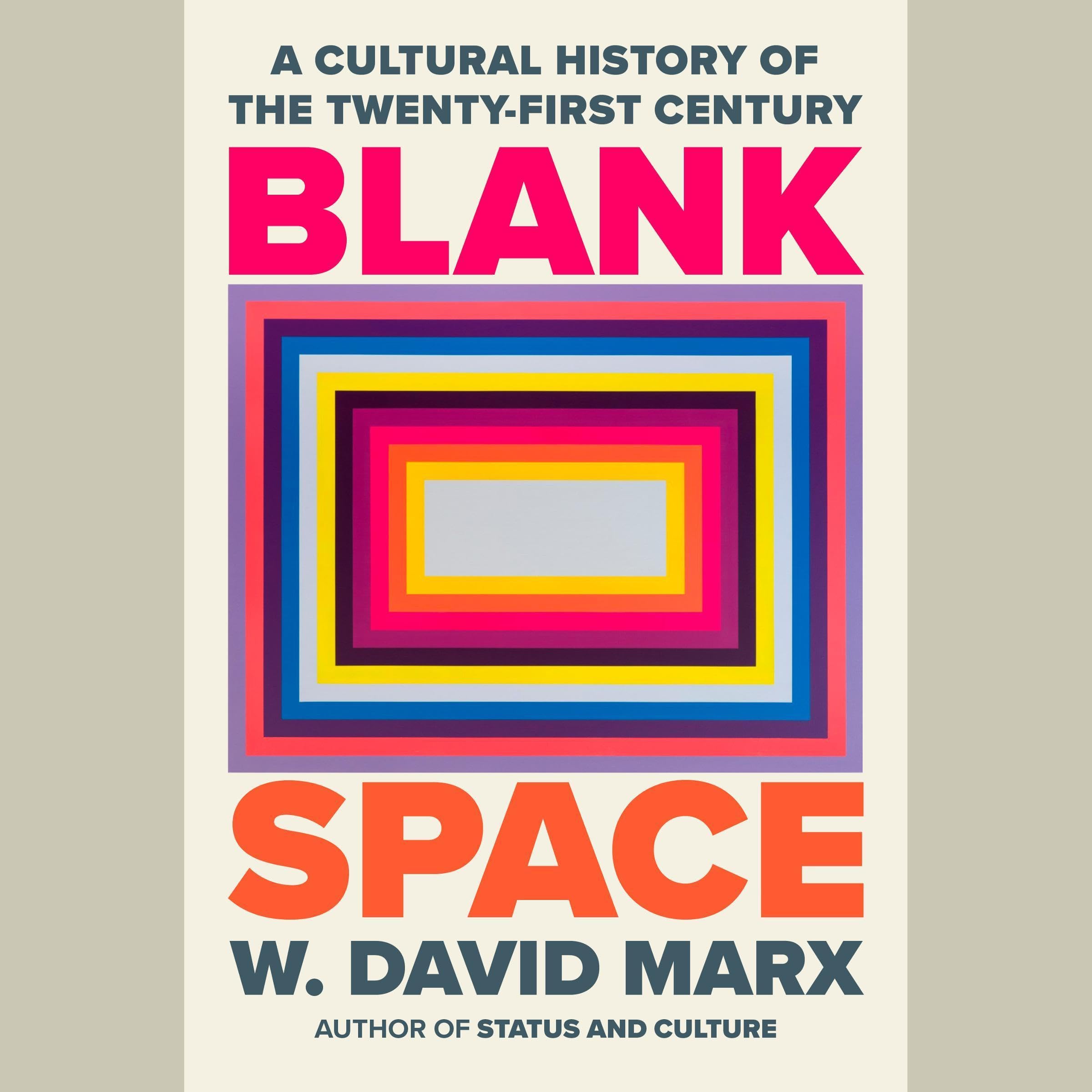
Blank Space: A Cultural History of the Twenty-First Century

Rate this book
A New York Times Book Review Editors’ Choice · A Washington Post Notable Nonfiction Book of 2025 · A People Best Book of November 2025 · An NPR Most Anticipated Book of Fall 2025

A revealing exploration of a quarter century of cultural stagnation, examining the commercial and technological forces that have come to dominate contemporary culture—from music and fashion to art, film, TV, and beyond


Over the past twenty-five years, pop culture has suffered from a perplexing lack of reinvention. We’ve entered a cultural “blank space”—an era when reboots, rehashes, and fads flourish, while bold artistic experimentation struggles to gain recognition. Why is risk no longer rewarded, and how did playing it safe become the formula for success? Acclaimed cultural historian W. David Marx sets out to uncover the answers.

In this ambitious cultural history, Marx guides us through the blur of the twenty-first century so far, from the Obama era to the rise of K-pop, from Paris Hilton to the Marvel cinematic universe, from Beyoncé and Taylor Swift to . . . Beyoncé and Taylor Swift, whose enduring influence highlights both their adaptability and the broader shifts in pop culture. Combining sociological, economic, and political insights with a deep dive into art, street culture, fashion, and technology, Blank Space dissects the rise of profit-driven, formulaic trends and the shifting cultural norms that often prioritize going viral over innovation. He reveals how backlash against indie snobbery and nineties counterculture gave rise to a “counter-counterculture”—one marked by antiliberal sentiment, the celebration of business heroes, and the increasing influence of industry plants and the elite class. In a world of crypto bros, nepo babies, and AI-driven art, Marx offers readers a much-needed dose of clarity and context.

Vibrantly narrated and sharply argued, Blank Space is an essential guide for anyone looking to understand the chaos of the twenty-first century, the trends, tastemakers, and icons who shaped it, and how we might push our culture forward over the next quarter century—through renewed emphasis on creativity, community, and the values that transcend mere profit.

Audible Audio

First published November 18, 2025

251 people are currently reading
6711 people want to read

About the author

W. David Marx

5 books158 followers
W. David Marx is a long-time writer on culture based in Tokyo. He is the author of "Ametora: How Japan Saved American Style" (2015) and "Status and Culture" (2022). Marx's newsletter can be found at culture.ghost.io.

Ratings & Reviews

What do you think?
Rate this book

Friends & Following

Create a free account to discover what your friends think of this book!

Community Reviews

5 stars
146 (17%)
4 stars
368 (44%)
3 stars
227 (27%)
2 stars
58 (7%)
1 star
27 (3%)
Displaying 1 - 30 of 189 reviews
Profile Image for bird.
453 reviews141 followers
January 16, 2026
i found this quite interesting for the first third or so, when it was shuttling through the post 9/11 culture-industry changes, because i was mostly oblivious to them at the time. once we arrived at the later obama years, it felt instead like a rapid-fire accounting of recent history i did not wish to be fired at me-- do you remember The Dress? yes, unfortunately i do!-- with little significant additional material in the form of assessment or connection.

the end analysis (which was also in the introduction) i also had some trouble with; his ultimate argument is that this century thus far has been a stagnant void of new culture, as indicated by the fact that any layperson could go "oh this is what the 60s looked like, and the 70s, and the 80s, and the 90s" but that the post-millennium all blurs together, with no great counter-cultural leaps of movement that then "seize control of the establishments" to push culture in a new direction.

his reasoning for this is that 1) music etc are no longer authentic/new but controlled by power's anticipation of audience demands e.g. everything is industry plants 2) music etc are no longer challenging/counter-cultural but written to be appealing/mainstream, which does not change culture 3) we now applaud selling-out, particularly as the valuation of diversity over innovation contributes to the celebration of marginalized entrepreneurship over art itself 4) society has become an omniculture which absorbs everything into one funnel without room for pushback, thus increasingly everything looks and sounds the same 5) the locus of power has not shifted 6) almost directly, "kurt cobain would have wept"

i found parts of this apt and parts inane and still more parts simply bizarrely out of touch and then furthermore unthinking about why/how things have happened. essentially, for those who hate the art of blogging, while i agree that art is broadly in a dismal place, particularly art that needs funding and access, art is not the same as culture. nevertheless, both of them have changed and will continue to change-- and moreover the forms and sites of them are changing, which makes them stranger to grasp. i'm going to go out of order.

6) he's dead and i don't care

2) i will address john lennon directly here: i will never understand why some people, mostly older guys who aren't fun to sit next to, think that things must be unpleasant to be counter-cultural, or that said unpleasantness provides automatic meaning. i don't believe anyone has ever listened to revolution no. 9 for any reason other than to piss off their parents or bewilder a girl, but do you know who did invent new and bizarre shifts in music technology and use them to make something compelling? george.

for this author, verbatim, the introduction of kpop and latin music into u.s. powerhouses do not represent revolutionary shifts because they are listenable or industry-backed or both-- literally, what are you talking about? how are these functional dichotomies, when what you are talking about is not only money but also culture?

1) sometimes this is true and it sucks; this has been to some extent true since people discovered you could make money off things (e.g. THE WALL OF SOUND etc). i don't know how much power in industries has shifted since their invention; i do agree that particularly in film people used to fund auteurs because they trusted their sensibility and skill, and now they only fund safe hits, and i'm not a fan of this. there have nevertheless been many interesting counter-cultural or novel artworks across music/film/etc since then-- and the entire form of tv has transformed not only through reality programming but through the sopranos and streaming and television as intimacy-- but

4) i agree that none of them has made as resounding a behavioral-cultural splash as like, sorry, sergeant pepper, and do you know when this dates back to? the emergence of the smartphone and the swift faucet of cultural progressions and fixations that become exhausted by the afternoon of their discovery. everyone is desperate for something to talk about at The Water Cooler and then when it's over it's forgotten. this is not the same thing as a blank space of culture; this is the process and locus of culture fundamentally shifting. i'll come back to this.

3) the book opens with a story about, i am genuinely trying to remember and i can't, let's say phish, and how when they accidentally got too popular and criticized for being mainstream they tried to write less appealing music and refused festival circuits and their album still sold better than they wanted it to. this is the stupidest story i've ever heard, and also i just went back and looked it up, and it was pearl jam. this is presented in diptych with the story of a finance ceo recently djing at the same festival, which i agree sucks, but that doesn't give gen x's valorization of attempting to appear niche for the illusion of counter-cultural cred when in fact you've become a trend any more legitimate. in fact, this is responsible for most of gen x's personality problems.

and yes, the parasocial identification with celebrities and wanting to support them by making them richer is ass, and championing success as its own metric of value is ass. but the real problem with the profitable industrialization of diversity is that

5) yes, the people selecting the diversity to market are the same people as always, and they have no taste when it comes to tastes and lives outside their own, but are hoping to continue doing profitable things more profitably than ever, and the people who enter into partnership with them are rarely people who are making interesting and challenging art. this is exploitation of shifting values and reflects the same focused position of power/money as everything else. nevertheless, the emergence of so much new art and artists even alongside bad or hollow or overly soothing art is not a void; it is just not what you expected.

also, no, modern culture is not "seizing the establishment" so much as making them irrelevant, which is arguably a greater cultural change than before, even if it's not one you like. rolling stone is now like, begging me to venmo them whenever i go to their website, and so is the new york times, and so is vogue.

4) to be honest, i'm sorry, saying "everything since 2000 has looked and sounded the same" is emo erasure. if culture starts with teens and specifically with laughing at teens for looking/acting goofy while listening to music that startles the ears, HELLO???? i have gerard way on the phone and he'd like a word!!!!!!!!!! literally speaking of post 9/11 cultural shifts, hello? sorry? what?

honestly to me this is in general a very straight man opinion, and i hate to bring #diversity into it like this, but the people who have looked the same since 2005 (advent of the normie social internet, decline of the bleached/gelled surfer hair) are straight guys, and that is because they are in their own vortex of defensive suffering that has only tightened with time. personally, if you show my wife any image of a woman from the last 20 years, i bet she locates her within two. we've had the anorexia years, the curvy-but-only-in-government-approved-places years, the return of the anorexia years, low-cut jeans, dark wash, plaid, mom-cut, high-waist, boot, skinny, wide, and that's just pants. these do not look the same and they don't feel the same. the crashing advent of normalized plastic surgery, high-maintenance skincare, specific faces in vogue specific years, water bottles, fjallraven backpacks, charms to put on your backpack, charms to put on your phone, going-out tops, chokers, layered necklaces, monochrome, bralettes, three-quarter sleeves, short-sleeves over long-sleeves, your grandmother saying get your hair out of your face, your grandmother saying why is your hair green, lana del rey girls.

what it is is that, as i said, the places that culture happens have changed since culture became something we could meticulously document ourselves, when we began appearing in others' phones as much as in their realities: impactful art and styles shuffle as quickly as they are, the culture becomes something different and dialectic: commentary, positionality, individual piecemeal alliances rather than big splash and aligned, reflective ripple. music has become quite literally background, music as confessional that reflects an individual rather than speaking for a generation. the image of the body has become foreground, an image which has to last on the grid more than six months without immediately turning embarrassing; words have become foreground.

and all of this of course becomes at least partially online, and this guy is not online at all, at least not past twitter. there's barely any investigation of culture-making on tumblr or reddit, which is frankly psycho. he mentions regarding tiktok and i think instagram only the influencer phenoms and that their algorithms serve "the most broadly appealing content reinforcing the shared parts of taste." there is absolutely more to the micro-level divisions, connections, and flag-plantings than this, particularly when it is so fervent and so many are doing it happily for free, without ambition of virality or celebrity, but because they are invested in performing their identity in society, or affecting society, which is to say making culture. (and these are also changing, rapidly, as culture-- changing and staying changed-- recently i rewatched an obama-era proposal flashmob and i felt like i was having a stroke.) i wish he was curious about any of this, particularly on the level of form rather than, dare i say, content!

there's only sporadic assessment of gender as a factor or divide in culture at all; there's nothing on gaming, to which he cites his own ignorance, but which produces an ultimate image of him looking out the window and going hey the kids aren't doing what they're supposed to be doing, because what they're actually doing are things he can't quite see, and also, it sucks out there, which again, i don't disagree with. but that's not the same thing.

the markers of culture he's talking about are all very recent. we've had basically affordable recorded music for what, 70 years? music we can transport for 40 years, the internet for 30, the internet transportable for 20. the sites of power and culture are changing and the forms of art that have become central to culture are changing. i'm not saying any of this is good. personally i would love it if the mega-rich boomers and gen-xers holding the reins of industry tight were to let go and let god, if spotify were to pay artists wages comparable to history even if it inconvenienced or charged me, if we all started wearing funky hats. i think these things would be good and fun. but what we have now is also something, and it is hardly stagnant. it is just new.
7 reviews2 followers
November 18, 2025
Enjoyed the author’s previous book “Status and Culture” 3 years ago, so got my hands on this one early thanks to a good friend who got first dibs.

Here is my honest take on it :

Blank Space is, in many ways, a testament to W. David Marx’s extraordinary ability to marshal vast bibliographies, track intellectual lineages across cultures, and stitch together patterns with impressive fluency. A decade ago, this method—an almost virtuosic accumulation of references, quotes, and cross-disciplinary comparisons—would have felt extraordinary. Pre-ChatGPT, the book’s sheer density of citations might have passed as a kind of cultural x-ray: here is someone who has read everything so you don’t have to!

But in 2025, the effect is strikingly different.

The very technique that once defined Marx’s authority now reads less like original insight and more like a beautifully organized database. The synthesis is thorough, yes—but depth of reading is no longer rare. Summaries, cross-cultural parallels, etymologies, even “patterns” across time can now be generated in seconds by any reasonably advanced model. This shifts the criteria for what counts as meaningful intellectual contribution. Simply having read a lot—simply connecting a lot—is no longer enough.

And that is where Blank Space falters. Beneath the avalanche of references lies surprisingly little that feels new. The central argument—that culture is stagnating—has merit, but Marx states it mostly in the register of lament (against suspiciously shallow framings of poptimism/omnivore culture/“inclusiveness”) rather than revelation. It’s a diagnosis without a prognosis, an extended moan about diminishing novelty rather than an attempt to offer alternatives, frameworks, or even provocations that push the conversation forward.

The book’s encyclopedic quality, once a strength, becomes a kind of camouflage: the breadth of sources creates the appearance of profundity, but the conclusions rarely rise above what culturally literate readers already suspect. In a world awash with AI-enabled synthesis, the question is no longer what one can compile from the global archive, but what one can argue, risk, or imagine. On that front, Blank Space feels curiously hollow—fitting, perhaps, given its title.

There is also an undercurrent in the book—subtle but noticeable—of resentment toward popular creators and commercially successful cultural producers. The critique of stagnation sometimes reads less like a structural analysis and more like an autobiographical grievance: a scholar frustrated that others profit from creating widely embraced work while he has devoted his career to niche areas that command reverence but not mass appeal (quick search reveals that Marx’s first book was “Ametora” , a book that appeals to a relatively small niche of Japanophiles) The book’s grand thesis occasionally feels like a gloss over a more personal tension: the suspicion that cultural stagnation is partly a story about his own position within the cultural economy.

This subtext doesn’t ruin the book, but it does color it. Rather than rising above the dynamics he critiques, Marx sometimes seems ensnared by them—using intellectual density as a shield, and cultural pessimism as a way of elevating his own choices.

Had Blank Space been published ten years ago, the mastery of material alone would have made it indispensable. Today, in an age or AI-enables synthesis, it reads more like a well-curated scrapbook of cultural melancholy: impressive in scope and structure, but lacking the spark of genuine intellectual novelty. I did, however enjoy the witty sarcasm in parts of the book.
Profile Image for Kaleigh.
269 reviews138 followers
November 18, 2025
Blank Space is THE pop culture history I've been waiting for.

In a sea of pop culture history books that tend to just rehash everything we lived through without really adding anything new, Blank Space offers a criticism and analysis of pop music, style, culture, and counterculture with actual theory and insight to sink your teeth into. You won't just feel like you're going down memory lane, you'll actually be learning and getting smarter. He discusses topics like indie sleaze, poptimism, generative AI, and the manosphere and explains their relationship to commerce and politics, how they came to be, the inner workings and dynamics of how they succeeded and/or failed, and the lasting impact they had on changing culture. The book is also funny and often even biting because it needs to be, but it's so well-researched and you can tell the author is obviously passionate and an expert about the subjects. (Marx's previous book, Status and Culture: How Our Desire for Social Rank Creates Taste, Identity, Art, Fashion, and Constant Change is just as delicious and vital btw!!!)

Blank Space is a MUST if you like pop culture, history, or want to better understand the connection between pop culture and politics.

Thank you to Viking and Netgalley for the ARC.
Profile Image for Emily Kessinger.
3 reviews1 follower
December 1, 2025
I read Blank Space as soon as it came out and recently read Marx’s Atlantic article, “Make Culture Weird Again.” — a piece that pushed me to finally write this review. The article implied that more esteem should be given to “weird” things without acknowledging that “weird” is subjective, elastic, culturally dependent — and, frankly, often just code for “things Marx personally thinks are brilliant.” The idea of “weirdness” he champions isn’t weird at all; it’s simply niche taste masquerading as a universal cultural metric. That blind spot played out across this entire book.

After reading Blank Space, it’s hard to shake the sense that Marx is less interested in understanding culture than in positioning himself close to it. The constant name-dropping — celebrities, indie musicians, designers, tech figures, creators — feels less like evidence and more like an attempt to borrow clout from people who actually shaped the culture he’s critiquing. The references pile up, but the insight never does.

The book starts with a promising premise about digital flattening and the disappearance of strong curatorial voices, but the argument stalls almost immediately. Each chapter follows the same rhythm: a broad observation, a cascade of citations, a detour into some 2000s microtrend, and then a resigned lament about how things used to be. Nothing builds. Nothing resolves. The middle chapters in particular feel like endlessly rearranged versions of the same idea (it is, however, impressive how much time Marx must have spent reading).

What becomes increasingly clear — and increasingly uncomfortable — is the tone of frustration that runs under the surface. Marx seems almost resentful of creators who turned visibility into success. Rather than interrogating the economic and technological structures that shape cultural production, he circles back to a familiar implication: if culture is “stagnant,” it’s partly because successful people don’t deserve the influence they have. It’s a critique bordering on bitterness. While it could be true, it is unclear what kind of “art” exactly Marx believes deserves higher esteem.

The irony is that Blank Space ends up exemplifying the very stagnation it claims to diagnose. It’s a remix of other people’s theories, filtered through nostalgia for a past cultural gatekeeping ecosystem that never really existed in the clean form he idealizes. There are brief moments where he almost breaks new ground on algorithms or attention economies, but they dissolve quickly under the weight of more references.

In the end, Blank Space is full of names but empty of synthesis — a cultural critique so obsessed with orbiting influence that it never develops gravity of its own.
Profile Image for Carla Remy.
1,091 reviews118 followers
January 1, 2026
A thorough overview of the last 25 years. They said the internet would make people more creative. It did not.
Profile Image for Aaron.
447 reviews15 followers
October 20, 2025
A fascinating look at a culture that hasn’t so much stagnated as frozen and become so ubiquitous, bland, and palatable as to be completely non-existent, as W. David Marx says, a “blank”.

I’ve long felt that pop culture has stagnated since the 90’s. I mean that was the last decade with a definable aesthetic and vibe to it, you know? The 70’s was disco and bell bottoms, the 80’s was hairspray and Reaganomics, the 90’s was grunge and irony laden detachment. Each of those decades recalls an evocative style, an ethos, almost a smell; they’re that distinct.

But the 2000’s and 2010’s? How were those decades culturally different from one another? Despite a few small things, what is really so different about 2010’s culture and 2020’s culture? What are the 2010 equivalent of bell bottom jeans? For years I was assured this suspicion was simply because I’m getting old, which, to be fair, is correct. However, there IS something afoot that can’t simply be chalked up to my new random joint pain and now having definite opinions about grocery store layouts.

The author does a better job laying it all out than I could. I learned a lot and also had some personal observations and feelings vindicated.

There’s a host of reasons for this bizarre null feeling around current popular culture. Hyper nostalgia that obsessively regurgitates the same handful of iconic media, the complete takeover of all artistic pursuits by entrepreneurial capitalism, the flattening effect of an internet largely made up of only a few monolithic social media sites.

Here are a couple key takeaways I found fascinating.

High finance has become ever more entwined with the production of film and television resulting in the rash of remakes, sequels and reboots, the absolute terror of anything original as a simple risk averse investment strategy. The lack of creativity is in some ways the point as art isn’t the desired goal anymore, a higher return on investment is. This is the main reason why there are almost no original movies coming out, everything has to be tied to an already existing property, something with a built in audience.

“Omnivore monoculture”, is a useful phrase the author coined encapsulating the ubiquitous sameness of all aspects of music, tv, film, etc. Genres are no longer distinct as much as they are different codes for saying the same thing. Nothing is niche anymore, everything is everywhere and you almost can’t help hearing about it. Styles and trends overlap and fuse together in a way that could theoretically be exciting, but ultimately ends up producing high quality, mediocre content.

This was an entertaining and informative read. I think it would be particularly impactful for readers, like me, who lived through the time covered here. But I could see it having something for almost any reader.

Profile Image for Stetson.
646 reviews379 followers
February 26, 2026
Blank Space: A Cultural History of the Twenty‑First Century by W. David Marx is in many ways a sequel to his Status and Culture: How Our Desire for Social Rank Creates Taste, Identity, Art, Fashion, and Constant Change. It extends his claims about the effects of market integration, media tech transformation, and democratization from that earlier work, leaning more deeply into its devitalizing, flattening, and debasing effects. The "blank space" Marx sees is the absence of new, coherent aesthetic paradigms. It, ultimately, calls for a return to smaller-scale cultural communities intentionally insulated from algorithmic pressures, greater knowledge of art of the past among aspiring creators, and increased risk tolerance from those in the business of art.

The book argues that the first quarter of the 21st century has been marked by stagnation, namely a type of perfunctory or "blank" repetition across music, film, fashion, art, and media. Marx, in a fashion reminiscent of another thinker whose surname he shares, asserts material forces are largely to blame, though he seems them as working through cultural vectors. Marx points to changes to economic and technological structures beginning in the mid-to-late 20th century and maturing at the turn of the century as ultimately responsible here. This includes the emergence of "platform capitalism" (sometimes called the attention economy or prioritizing engagement over creative vision), the financialization of arts production (the increasing value of existing IP and increasing risk management), the professionalization of creators (famous-for-being-famous, influencers, sockpuppets, and other astroturfed figures), and the stunting of subcultural incubation (the decrease in time-to-discovery-to-mainstream breakout due to increased discoverability). Although Marx sees these as the ultimate drivers of the phenomenon he describes, he invests most of the book in following the cultural shifts, especially in music, that came downstream of the incentives created by the techno-economic structures. This includes mapping the triumph of poptimism (i.e. rejection of the idea that commercial success undermines artistic value) or the decline of the anti-selling-out ethos, and the end of the counterculture.

There is little original about Marx's thesis, though his book perhaps offers a more comprehensive and detailed history of the various paradigms (rockism vs poptimism) or relevant cultural figures (Paris Hilton, Kim K, Kanye, and Donald Trump). In some ways, I see this book as a more comprehensive and systematic version of books like The Nineties or Kill All Normies: Online Culture Wars from 4chan and Tumblr to Trump and the Alt-Right, carrying forward concerns raised by David Foster Wallace in E Unibus Pluram and Infinite Jest in the form of cultural history rather cultural criticism or literary experimentation. The arguments about stagnation or anxieties about the death of artistic creation have been raised by many, especially with respect to debates central to or peripherally related to postmodernism. For instance, Jean Baudrillard was perhaps the first to systematically describe some of these observed trends, while Harold Bloom's theory of the anxiety of influence in some ways augured period of devolution in art, especially when knowledge of the past greats declined. Further, many popular recapitulations of this thesis exist in part or full. One that jumps to mind is The Decadent Society: How We Became the Victims of Our Own Success by Ross Douthat, which covers similar territory especially with respect to Franchise IP retreads but identifies a spiritual malaise rather than economics and technology as the problem. The idea that individual agency or shared cultural values may have a role in these trends doesn't figure into Marx's thesis.

Given that these ideas are all well-trod territory, it is difficult to strongly recommend this specific book. Marx is encyclopedic in his knowledge of various cultural phenomena so this is at least one area for which he deserve commendation; otherwise, I don't think this book is particularly trenchant or definitive as a work of cultural and historical analysis. It is stuck between an analytical and polemical work. It really should have leaned into the latter rather than the former, which is more dubious without really well defined methods and readouts. It is easy to spin alternative explanations up for much of what Marx observes and laments. For instance, the sheer amount of creation itself across an increasing number of media could serve as a barrier to a coherent mainstream culture and thus the necessary concentration of intellectual discourse or enough of a synced audience to even generated coherent paradigms. Further, the sheer amount of creation may itself preclude any digestible way of communicating about it. If Marx simply thinks there is a tradeoff between commercial incentives and artistic incentives then it is unclear why those who stand no chance to make anything on their creations but still do so tend not to produce anything interesting today either. He doesn't provide any rubric or basis on which we can actually judge and criticize the substance of art and without this I can't necessarily take his argument seriously.
Profile Image for Kate Goodman.
23 reviews3 followers
November 29, 2025
"The history of all hitherto existing society is the history of class struggles." - Karl Marx

W. David Marx somehow wrote an entire book without any materialist grounding. a real Chuck Klosterman for our times. /derogatory
84 reviews7 followers
March 11, 2026
3.5. Certainly thought provoking but more or less this book will just make you want to read the source material he got all his takes from (Jia Tolentino/Emily Nussbaum/Jia Lorenz/etc)
Profile Image for Alex Shinoda.
11 reviews
Read
March 30, 2026
Undoubtedly a well-researched book but the grandiosity and victim mentality in this book? Red flags

The entire book rests on a false premise that “not mainstream” = “not mattering”. moral sorting is disguised as “theory”.

First, the book 100% misreads contested public arenas and settled consensus by massively overgeneralising localised discourse into totalising cultural norm. Elite critical institutions—academic criticism, highbrow journalism, museums, and experimental art worlds—continue to draw sharp distinctions between market success and aesthetic value. The claim that “you can’t say anything negative” is simply untrue. The author refuses to distinguish between “being disagreed with” vs “being silenced”.

Second, the stance performs projection by attributing the critic’s own experience of friction to a structural silencing. What has changed is not the permissibility of critique, but the CONDITIONS of reception: critics now encounter immediate, visible, and often hostile disagreement thanks to the internet. The loss of asymmetrical authority is reframed as cultural repression, when it is more accurately described as the democratization of response. By framing mass audiences as “minions” and criticism as dangerous, the argument displaces anxiety about declining cultural authority onto fans themselves. What is actually threatened is not the ability to critique, but the privileged insulation critics once enjoyed from public response. Losing unilateral authority is recast as victimhood!

Third, this stance romanticizes an earlier critical order that never truly existed. Cultural criticism has always operated in tension with commerce and popularity. To claim that “if it makes money, it’s considered good” erases a long history of commercially successful art being dismissed by critics—and still is. The novelty is not pop’s dominance, but the democratization of reply.


Marx’s core mistake is not that money influences culture — it always has — but that he mistakes the visibility of mass taste for the dominance of mass taste.

Before social media:
• Most people liked basic, commercial things too.
• You just didn’t see them.
• Culture was filtered through critics, editors, curators, and tastemakers.

After social media:
• The same mass tastes exist…
• …but now they’re loud and measurable.

Taylor Swift didn’t become “the standard of good.”
What changed is that millions of people can now say “I like Taylor Swift” in public , all at once!

That feels like cultural flattening if and ONLY if you were accustomed to a world where:
• ordinary taste was invisible
• elite taste was overrepresented

Marx treats this as a new ideological regime (“poptimism,” “omnivorism,” etc.), but it’s really just the end of cultural gatekeeping by scarcity of platforms.


Culture didn’t get blander.
The hierarchy of who gets to speak collapsed.

And that feels, to people like Marx, who built their identity on being arbiters of taste, like an existential threat.

The issue Marx is concerned about is availability of platforms (unfortunately irreversible at this point) , NOT values. The people with taste will always have taste. His projections are irritatingly delusional, hence the 1 star despite the clear prose.
Profile Image for molly.
144 reviews2 followers
January 18, 2026
overly biased with no argument - i don’t see the point in this book other than feeding into the nostalgia cycle
Profile Image for CatReader.
1,091 reviews210 followers
January 11, 2026
W. David Marx is an American-born culture writer who's lived and worked in Japan for the past few decades. His 2025 book Blank Space is his argument on why the 21st century has, thus far, been lacking in forging own culture and innovation, and instead has been largely derivative of the 20th century. The main examples cited are from mainstream US music, though to a lesser extent, arenas like fashion are also discussed.

Unfortunately this book was a miss for me, as I generally disagree with Marx's argument (I don't think that the the 21st century has been culturally stagnant, and I think 26 years in is too soon to jump to that conclusion) and though Marx cites voluminous amounts of information (~75% of which I distinctly remember as I lived through these decades as well), it still doesn't prove his theory.

I think a stronger argument would have been of Marx were able to convincingly explain how and why music of, for example, the 1970s and 1980s was NOT, even in the slightest, derivative of music of the 1950s and 1960s, and show that rule applied right until the turn of the century when music became derivative and entirely unoriginal. He doesn't do this. He cites some defining trends and examples of late 20th century music but claims they're all original, then as soon as the year 2000 hits, innovation comes to a grinding halt. The 2000s were my formative music decade, and I conceptualized the decade as clustered in several distinct sonic landscapes (for instance, the teen/bubblegum pop of the early 2000s, the pop/rock of the early/mid 2000s, the pop/R&B of the mid 2000s, the dance/electronic-inspired pop and in parallel the pop punk of the late 2000s), and while none of those landscapes was made in a vacuum, each was innovative and took advantage of music recording and producing technology that would have been much harder or impossible to achieve in earlier eras -- aka, innovation. One of my favorite examples is the English Xenomania production team of Miranda Cooper and Brian Higgins whose primary creative muses/vehicles were English pop group Girls Aloud -- albums like What Will the Neighbours Say? (2004), Chemistry (2005), and Tangled Up (2007) were composed of the five group members singing random vocal tracks separately that were then spliced together with a pop/electronica beat that sounded very experimental and avant garde at the time and (in my opinion) have aged well. While Girls Aloud achieved a lot of commercial success in the UK in the 2000s (20 consecutive top 10 singles), they failed to break into other markets, and ironically, most members of the group didn't seem to have much appreciation or creative alignment with the music they released -- though as Marx himself cites when talking about the likes of Ashlee Simpson or Paris Hilton, not every musical artist is an auteur.

I digress. The point is, with areas like music, I think we're naturally primed to prefer what we listened to in our formative years (whether that was contemporary or not) and use that as a model for what defines 'good', 'original', 'innovative', etc. music for the rest of our lives. Having been primed on the music of the '00s, I don't really care for music of the '20s, but that doesn't mean it lacks originality and taste. With how differently we discover and listen to music these days (another innovation Marx skips over entirely), and how drastically that's shifted the music industry's profit model, change is really the only constant.

Further reading: 2000s pop culture
Hit Girls: Britney, Taylor, Beyoncé, and the Women Who Built Pop's Shiniest Decade by Nora Princiotti
Girl on Girl: How Pop Culture Turned a Generation of Women Against Themselves by Sophie Gilbert
Toxic: Women, Fame, and the Tabloid 2000s by Sarah Ditum

Further reading: music
The Song Machine: Inside the Hit Factory by John Seabrook
Pretend We're Dead: The Rise, Fall, and Resurrection of Women in Rock in the ’90s by Tanya Pearson
Mood Machine: The Rise of Spotify and the Costs of the Perfect Playlist by Liz Pelly
This Is What It Sounds Like: What the Music You Love Says About You by Susan Rogers and Ogi Ogas
How Music Works by David Byrne

My statistics:
Book 11 for 2026
Book 2317 cumulatively
Profile Image for Ben.
428 reviews14 followers
November 17, 2025
Thanks to NetGalley and Viking for the ARC of this title.

This is probably closer to a 3.5 than a 3 - I like this author working on THIS topic, but I was left a little underwhelmed by the abruptness of the way this ended. On the other hand, given that this is an extremely recent history, was there any other way this _could_ end?

This book asks a really good question - why does it feel like there's not any defining culture for the 2010s and 2020s in the same way we can easily classify "the 80s", "the 90s", y2k, etc.? It also goes an impressive way towards covering all of the trends and changes on the business side of things that's gotten us to where we are today. The way very recent history (and I do mean VERY recent: this applies the same talking-about-the-past language we associate with histories written about events 30 years ago to events that happened in 2024. It is late 2025 as I write this.) gets covered feels like it's all getting to a "here's how we got here" point that will be followed by some solid "and here's what we can do" chapters.

And yet: we only get one "conclusions" chapter. Which? fair. We're still in 2025 and it may be too early to really say what will get us out of our stagnated state of culture. And yet, I found myself not really buying Marx's sudden decision that what's really the bad guy here is "poptimism". After a ton of very solidly written chapters covering a ton of cultural spheres, this last-second "here's what the real problem is" felt incredibly underbaked and felt more like a personal bugbear for Marx than a solid argument for a source of the problem. The rest of his suggestions on what makes for more dynamic culture are great! The final arguments needed a better reasoning, and left me frustrated after what had been a fairly compelling history of recent culture.
12 reviews
January 7, 2026
This was a highly entertaining and thought-provoking American cultural history of the first quarter of the 21st century. I thoroughly enjoyed Marx’s tracing of pop culture (particularly music) from indie sleaze to the corporate pop tyranny of Taylor Swift. If you love cultural history and reliving forgotten pop and tv memories, you will have a good time reading this.

Marx argues that we have a developed a static cultural monoculture through a mix of neoliberalism and the rise of the internet. This culture hampers artistic innovation, and the few recent cases of important artistic breakthroughs have occurred through micro-cultural remnants of what we once had. This leaves a “blank space” in our culture where this innovative spirit once rested.

I’m inclined to generally agree with Marx’s assessment, although rather than a “monoculture” it seems that we have instead no distinct culture at all. Rather than norms and values, we simply have the dollar. Marx seems to conceptualise our culture as hollowed out; in existence but devoid of meaningful content. To me any semblance unified American culture has broken down entirely. I wish he dedicated more than 9 pages of conclusion to discussing his model of what we are left with and should do about it. I would have happily read 100 more pages of his diagnoses and solutions to this current moment.

In any case, I definitely recommend.
Profile Image for Chris M..
312 reviews6 followers
November 27, 2025
A great cultural analysis about the social, political and technological changes that took place from 2000 to 2025 and how they resulted in a cultural blank space, and overall, Marx is very accurate. One of the overarching themes in the book is that art, music, and culture became eclipsed by commercialization. He makes the case that when making money becomes the primary incentive, the quality of art and culture becomes watered-down and is less likely to challenge the status quo.

Other global events like the 2008 recession played a role too as executives became more risk averse and relied on established artists and franchises instead of investing in something new. This is evident in the growth of remakes, reboots and sequels in entertainment.

While the author is very knowledgeable about art and culture, he's not as knowledgeable in other areas. In chapter 13, he implied that all vitamins and supplements are placebos and scams. While there are bad actors, there are plenty of supplement companies that make products based on science and data and don't have a celebrity spokesperson. The examples he used were from celebrity endorsed products, which shows an availability bias.

His solution for addressing the cultural blank space is unclear and probably unrealistic. It also doesn't factor in the role that A.I. generated art and music will play. You can't put the toothpaste back in the tube. There would need to be a mass rejection of the status quo for that to happen, and as long as money is the primary incentive, I don't see people abandoning their source of income any time soon nor the convenience of quick access. There certainly does need to be a balance between making quality art and being able to make a living, but ultimately art scene cred doesn't pay bills.
Profile Image for lindsi.
169 reviews120 followers
December 23, 2025
It was fine but I didn’t feel like I learned anything. It was like a much less focused Filterworld with even less materialist analysis. Disappointing.
Profile Image for Leo.
105 reviews6 followers
Read
December 27, 2025
Imo, this book provokes a much-needed reckoning with our cultural cul-de-sac, pondering questions like: Why are there no heads anymore? (In the sixties, kids dismissed the previous paradigm, jazz, as hopelessly antiquated; today’s young adults enjoy Katri Helena.) How did conservatism become the hip counterculture and social progressives the squares? When did Silicon Valley regress from genuine innovation into little more than a hunt for new ethical lines to cross? And so on. Very interesting. Also not as negative as I thought, as Marx is quite funny with his words. Klosterman is the obvious comparison, but Marx is more systematic (historian), while Klosterman writes from an affective point of view (critic), I reckon… Anyhow, the hardest recommend.
Profile Image for Geof Sage.
535 reviews8 followers
February 17, 2026
"waaah! popular things must be bad! we must gatekeep art! waaaaaah!"

Also? Lots about Kanye and not nearly enough analysis or judgment about his descent into Nazism, just dry reporting. The author stared into the abyss too long.
Profile Image for Hannah.
182 reviews13 followers
Read
March 16, 2026
If I had to do it all over again, I’d read the intro and the conclusion and skip the evidence gathering of the main chapters of the book.

There’s nothing wrong with them exactly - it’s a well paced description with light analysis of the last 25 years of cultural production.

It’s just that, since so much of that production sucked, so tremendously much, that the urge to sleep - like, medicinally sleep, the kind of sleep you have no control over after you get a concussion - was so strong that I barely got through the body of the book. I’d start reading about, oh I dunno, when Kanye dissed Taylor Swift at the Grammys, or about the Fyre Festival, or what have you, and I just wanted to sleep to repair myself. No matter how hard I try, I’ll never get out of this world alive - cept when I sleep, I suppose.

Anyhow. His fixes are actually terrific and not reliant on an alternate universe where the Democratic Party isn’t trash, unlike most books with fixes at the end. I would be a lot more interested to learn about examples of successes there. Seriously, Paris Hilton springs to mind now several times a day, something I don’t think has ever happened to me, or if it did, hasn’t happened since 2002 or something.

In other news, I’m going to give up GoodReads. I haven’t been reading much lately, for better or worse, and it’s only by stepping away that I realized my book life is being shaped way too much by this site. I’ve really enjoyed a lot of the brief exchanges I’ve had with people on here, and it’s been a treat to write these reviews for the handful of people who read them. But I don’t love the idea that these are all being saved in a data center somewhere giving people asthma all so I can pick out books to read that make me seem a certain way online, while producing content for a Bezos-owned company, and providing the gubment a solid dossier of my reading interests and politics…there was a reason I delayed doing any social media until 2021 or so, but in the fog of the last few years I must have just forgot that I don’t want to be a part of it. Later!
44 reviews
March 4, 2026
Wow! A bit academic in parts but a real walk down memory lane of key fashion, music, and art cultural moments over the past 25 years; and how we went from where we were to where we are now… a blank space. A must read (or listen like me) for anyone working in or around the cultural space or who wants to understand the impact on the world of the cultural isms we have today. I learned a lot and it gave me pause as well.
Profile Image for jasper.
129 reviews
February 28, 2026
this reads almost like an encyclopedia of the 2000s through 2024. sort of an unusual format but marx packs in a lot and makes cogent arguments about trends in pop culture, digital culture, and politics aided by succinct readings of many tastemakers of recent criticism. no huge revelations therein, especially if you're already exposed to his milieu, but great overall
Profile Image for Marcus Hahn.
7 reviews
March 2, 2026
Had certain expectations for this book because of BJ Novak’s endorsement but turns out it’s probably just Novak doing his school pal a favor. Like another review said, the irony of this book using Taylor Swift lyrics to boost sales while adopting a distinctly dismissive tone toward her work!

The book reads less like cultural criticism than an extended exercise in narcissistic projection. Beneath the sociological language sits an unexamined assumption that the author’s taste is elevated, that obscurity signals value, and that culture is in decline largely because it no longer rewards people who see themselves as discerning outsiders.

Marx repeatedly conflates underground with better, confusing difficulty for depth and obscurity for seriousness. The book offers little empirical or aesthetic justification for why certain scenes, sounds or sensibilities should matter more than others beyond the fact that they sit outside the mainstream that Marx disdains. What’s most striking is how consistently cultural pluralism is reframed as pathology. Mass participation becomes “corruption,” popularity becomes evidence of decline, and fragmentation becomes “blankness.” Rather than interrogating his own positionality, Marx universalizes his frustration: if culture no longer centers HIS preferences, culture itself must be failing.

Compounding this is the book’s convenient avoidance of irreversible technological change. New platforms have fundamentally altered how culture is produced, circulated, and discovered. It’s 2026 — there is no return to broadcast-era consensus! Marx treats this reality less as a structural transformation than as a moral failure. Networked culture is judged by standards designed for a media ecology that no longer exists and will never exist again.

Running through all of this is the tone of a bitter Gen X lament, nostalgic for an era when subcultures conferred distinction and critics exercised real gatekeeping power. To sustain his narrative of stagnation, Marx conveniently ignores global cultural production outside the West, the vitality of micro-scenes, and the fact that innovation no longer announces itself through tidy movements or canonizable heroes.

Blank Space ultimately documents not the death of culture, but a critic mistaking the loss of status for the loss of standards.

In the end, Blank Space feels tailored to the self-styled tastemaker, often a nostalgic Gen X ironist or aesthetic Japanophile who needs to believe that simplicity is shallow, popularity is corruption, and cultural pluralism is decline, because without those premises, their distinction evaporates.
Marx mistakes minimal audience for maximal meaning … perhaps a comforting theory for anyone whose sense of distinction depends on not being widely understood!

Note: The writing is smooth and often clever. Still, this is a one-star read for me—not for lack of style, but because the argument is animated by a palpable narcissism: The book repeatedly mistakes the world’s refusal to orbit its author’s preferences for evidence that culture itself has failed.


Profile Image for Ritam Mehta.
27 reviews
Read
February 7, 2026
Enjoyed Status and Culture more. This filled the gaps I felt like I was missing in my recent pop culture knowledge, but I would have enjoyed a stronger theoretical foundation to tie everything together
Profile Image for Jordan Pittman.
35 reviews8 followers
January 26, 2026
Let's start with this -- the irony of some not well known man using Taylor Swift lyrics and writing about Taylor Swift so he can sell more books and make some money while accusing her of being more product than person. Oof. First of all, that particular jab felt incredibly personal. It feels as though Marx wrote this book just to take a few swipes at Taylor Swift. He could at least get some facts straight.

1) He totally misses the point of the entire masters controversy and re-recordings of her back catalog.
2) He neglects to mention the final leak / release of the phone call with Kim Kardashian and her ex-husband that proved Swift was telling the truth about the entire fiasco the whole time.
3) He actually says in the book that Swift never experiments with genres like other artists. I can't even! I would laugh if it didn't reek of misogyny.

There are some interesting points made in this book, but it's mostly about politics. However, as much as I hate the term, he seems to be virtue signaling to his audience that he's got liberal or progressive credentials all to hide from his takes that art (especially "good" or "artistic" music) is made mostly by white dudes. Go listen to the Strokes dude and let the rest of us enjoy what we enjoy!

He also totally misuses the term "poptimism" throughout the book. I seriously think he misunderstands its definition -- either that or he's purposefully using it as a pejorative slur the way right wingers use the term "woke" to describe anything for which they have disdain.

There are some truly elitist moments near the end of the book where he insists to be a good artist you have to have knowledge of the artists that come before you. Look, I understand studying art and being a student of art. It can absolutely make you better and I'm all for knowledge in general. But, it's quite ableist, classist, and elitist to claim someone making art can't do it well just because they don't know about an artist that made work before them.

His entire premise for the book is flawed, too. If there's no culture this century thus far, how does he have so much to drone on and on about?

This could have been a decent book. He could have written more about content creators and creating content for the sake of content. There might have been something interesting worth reading in that. But, instead, he just seems to be angry that there are no longer any gatekeepers when it comes to art.
Profile Image for Ashley (ashreadsitall).
255 reviews9 followers
July 6, 2025
4.5 ⭐️ “Over the past twenty-five years, culture has prospered as a vehicle for entertainment, politics, and profiteering—but at the expense of pure artistic innovation.”

“…we can feel what’s missing—there is a conspicuous blank space where art and creativity used to be.”

This was an incredibly insightful read that I finished in one day! The author takes a look at the “blank space” culturally speaking that we’ve seen in the past 25 years. If you’ve ever wondered how the 2000s and beyond will be remembered, it’s all referenced in this book and I gotta tell you. I’m embarrassed. It’s forgettable and a bit sad compared to previous generations.

Common themes include: Kanye, Kardashians and Trump. Not much to be proud of here. The author does an excellent job citing pop culture, music, movie and political references and gives five steps for rebuilding our cultural innovation at the ends. This is a worth the read!
Profile Image for Samantha.
2,701 reviews185 followers
November 28, 2025
First, I think it’s important to note that this book is not, as the subtitle suggests, discussing the culture of the 21st century. It is discussing the pop culture of the 21st century. There are no mentions here of fine art, literature, classical music, opera, and such.

I think it’s also important to note that we are about one quarter of the way into the 21st century at the moment, so this is, of course, a history of only the first 25 years of the century.

All of that is to preface the fact that Marx wants to tell you that the 21st century thus far essentially has no culture. Or pop culture. He’s conflating the two.

While I think there’s plenty to criticize about a lot of this century’s cultural tastes and patterns, I also don’t trust criticism that essentially wants to tell you nothing but that everything is awful. Marx does a better job than some of keeping a lot of his personal opinions out of the narrative except when they are necessary, but he’s pretty clear that his overall view of this century so far is basically that it sucks here.

Marx is about my age so the comparison trap here is tough to get on board with. We were in our late teens when the calendar turned over at Y2K, so this is the first set of decades in which we were actually old enough to have both the cultural sentience and personal taste required to even have informed opinions on culture. So it’s a tough sell to imply even slightly the idea of wanting to go back to a better, more cultured (again, he means pop cultured) time, aside froM some pangs of childhood nostalgia.

Marx makes some solid observations on some of the things that negatively shaped pop culture in the aughts (post 9/11 forced patriotism and American exceptionalism, etc), but later misses on things like OWS, which has perhaps lasting historical and political significance, but little to no (pop) cultural significance.

There’s also a lot of low hanging fruit taking up space here, leaning on things that trigger the “problematic!” sirens from the early 2000s. Are people really still blaming Paris Hilton for this much personal nonsense? Sigh.

If you’re just looking for a summary of pop cultural moments and events that have contributed to the American collective taste this century, I suppose this is an okay place to do that (though I would still caution that a lot of what was good or positively impactful was conveniently left out of the narrative or devalued here). If you want actual fair and balanced criticism of 21st century pop culture, look elsewhere.

*I received an ARC of this book in exchange for an honest review.*
Profile Image for Nicholas Sokić.
72 reviews1 follower
February 24, 2026
This history from the appropriately-named author manages to touch on, among other ephemera and detritus of the young century: Napster, Paris Hilton, World of Warcraft's microtransactions, Kanye West's whole deal, reality tv writ large, Antoine Dodson, the perhaps well-meaning but ultimately deleterious effects of poptimism, the increasing dadaism of meme culture, the hybridization of hip-hop, its throuple marriage with high fashion and streetwear, how omnivorous capitalist surrealism met the monoculture and relatedly: Silicon Valley's rise as a new class of global idols, mixing a push for automated creativity via AI slop with an embrace of fascism and greed the industrial age robber barons could only dream of. Also, a mention of the Rizzler.

Whew.

But its no mere recounting of events. I was actually quite moved by Marx's ending argument, tracing the patronizing logic of poptimism in a straight line from Ashlee Simpson's lip synching to Kim K, Jake Paul and the eventual deluge of AI slop. He forms this into an argument for taste and experimentation, rather than a base impulse to get the bag above all else. Remember when art was both an ecosystem and a public good?
Displaying 1 - 30 of 189 reviews