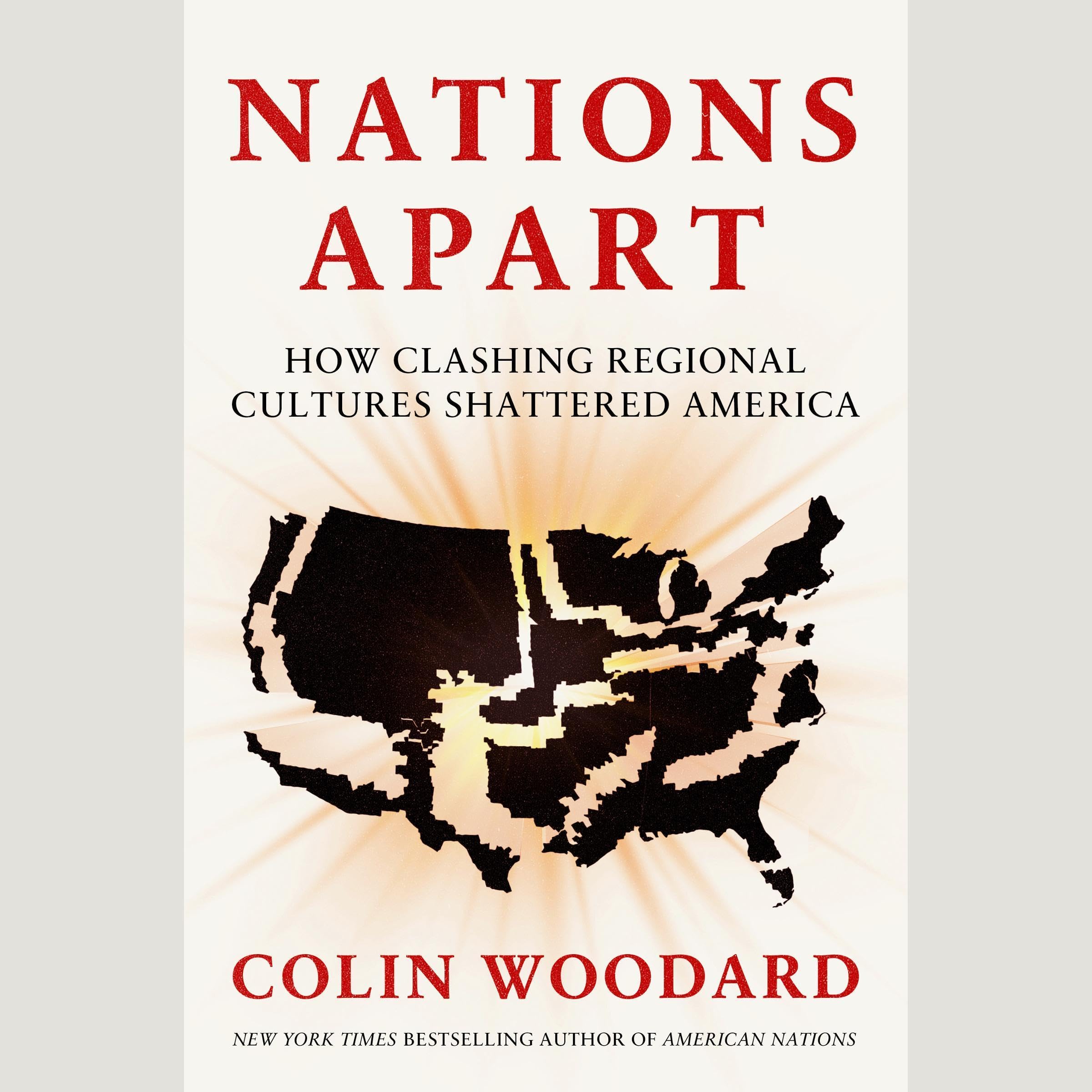
"A world-class intellectual. . . . [Colin Woodard’s] research can help Americans rediscover their common identity in spite of all the attempts to divide them." —Garry Kasparov
"A powerful paradigm for understanding the defining hot button issues of contemporary America and the action we can take to bridge our cultural divisions and save the republic." —The Next Big Idea Club
“A lucid exercise in political geography with tremendous—and disturbing—explanatory power.” —Kirkus Reviews
The bestselling author of American Nations reveals how centuries-old regional differences have brought American democracy to the brink of collapse and presents a powerful story that can bridge our cultural divisions and save the republic
Our democracy has been purposefully dismantled, first in the states and now at the federal level. With groundbreaking original data and historical insights, Nations Apart is an essential guide to understanding why Americans are so divided on many hot button issues, creating geographic fissures that have been exploited by authoritarians. Colin Woodard shows how colonial era settlement patterns and the cultural geography they left behind are at the root of our political polarization, economic inequality, public health crises, and democratic collapse.
Drawing on quantitative research from Woodard’s university-based think tank project, Nations Apart exposes the true ideological and cultural divides behind today’s struggles
* Gun control * Immigration * Health policy * Abortion * Climate Change * History * Authoritarianism and Democracy
But there is a road map to right the a carefully researched, vigorously tested common story for the country built on the mission set forth for us in the document that first bound our regions together, the Declaration of Independence. Combining compelling storytelling with scholarly vigor, Nations Apart offers a blueprint for bridging the rifts that divide us and ensuring the American dream of democratic self-government will reach its 300th birthday.
* This audiobook edition includes a downloadable PDF of maps and other images from the book.
I had already read “American Nations” so a lot of this was not new to me. I am less interested now in how the cultural divide got baked into this country. What I really want to know is how large swathes of the population can somehow be brought to evolve from their repressive, authoritarian, troglodyte views. Or, if that is not possible, how we can keep them from hurting the rest of us. This book doesn’t tell me that. I was bored by the more statistics-heavy chapters (like chapters 2 and 3). I received a free copy of this book from the publisher.
tl;dr: Woodard takes his already overfit "regional nations" (aka deep roots) model of American history and applies it to post-2010 American politics. It is a disaster that requires near deliberate misuse of already weak social science data along with rampant speculative theorizing. What's worse is that the purported analysis is performed in furtherance of a particular political worldview, one that is rooted in one of the regional cultures (what he calls Yankeedom but is largely a hangover of East Anglian Puritanism). Cheering for the victory of one set of regional cultures over the other conflicts with the fundamentals of the regional culture model. For there to be a union, there must be a compromise acceptable to all nations. If the model is correct and predicts our politics, then we are where we are because the compromise on offer was not acceptable. None of this is considered by Woodard. Instead, he offers up a polemic notable only for its arrogance and zealotry. --
Colin Woodard, like David Hackett Fischer before him, has argued that the United States is best understood as a federation of rival regional cultures or "nations" originated by their respective and distinct colonial settlements. This framing may seem banal, but the long tail of its predictive power is considered impressive, and it is a model that connects material factors (geography, biology, economy) to culture, which is often overlooked by traditional historical methods.
Woodard argues that these American “nations” (Yankeedom, New Netherland, the Midlands, Tidewater, Greater Appalachia, the Deep South, New France, El Norte, the Far West, the Left Coast, and the First Nation) are defined by enduring cultural values and practices that concern authority, liberty, faith, and order. These "nations" often persist across centuries even as the individuals comprising them undergo dramatic demographic transitions. After reviewing this model (old hat to readers of American Nations or Albion's Seed), Woodard presents how modern trends, tendencies, and interactions among these regional cultures explain American politics in the Trump era. In other words, it is a "deep roots" account of contemporary polarization, disunity, and discontent. Woodard specifically attributes blame to the extreme individualism, ethno-nationalism, social conservatism, and disregard for equality common to the Deep South, New France, and Greater Appalachia. He further argues that the concentration of these nations under the banner of the Republican party, which has made a play at national dominance using hardball tactics (gerrymandering, voter ID laws) and a demagogic leader (Trump), threaten liberal democracy. Woodard's only offered solution is that America must re-conceive the founding myth to shift toward the cultural values of Yankeedom, El Norte, and the Left Coast. This is equivalent to saying, "Give me what I want, accept your humiliation, AND you get nothing in return."
Woodard's "American Nations" analysis of modern politics is has merit but is deeply flawed. First, as mentioned before, his model of American nations is itself quite strained (he even concedes one of the nations has gone extinct - Tidewater). He has a strong tendency to reflexively uses it to explain too much. It is rare for him to rigorously exclude other independent variables, and, in instances where he makes the effort, many of the mistakes he is making are plain to readers (e.g. collider bias, confounds, etc). Plus, most of his commentary concerns just three of the 11 putative nations: Yankeedom, Greater Appalachia, and the Deep South. He tries to excuse this by arguing that the other regions react to these and are pulled in one direction or the other. This looks like hypothesizing after results known (HARK), which is a dubious epistemic practice and largely an exercise in indulging one's own biases rather than a way to evaluate one's model.
Another issue is that Woodard can't seem to find anything valuable about at least one of the regional cultures, the Deep South. He simply can't stomach anything about them despite it being an essential and growing part of America. He fails to reckon with the fact that Americans are beginning to voluntarily choose it as their preferred region to live in. The 2030 census is expected to find that 4 in 10 Americans live in the region Woodard defines as the Deep South, meaning that the Deep South is likely more than twice the size of Yankeedom. Nevertheless, Woodard seems to erroneously believe that Yankeedom has the numbers to dominate in our democracy. In reality, it would be the rump party, while the Deep South is closer to being representative of most Americans.
These strongly held priors lead to a recitation of repeatedly disproven narratives about Republican reliance on racial grievance or ethno-nationalism, gerrymandering and voter suppression to win national elections. That these talking points were trotted out despite their obvious and now storied obsolescence is inexcusable from someone publishing an alleged work of political science in 2025! The polling/data analyst David Shor has persuasively shown that in 2024 that Donald Trump benefitted immensely from the higher turnout of lower propensity voters, who were often younger and of minority backgrounds. Shor also demonstrated that if maximal voter turnout occurred Trump's victory would have been +5 rather than +1.5. This has been consistent with Democrats' increasingly becoming the party of affluent and educated white professionals and performing better in off-year, low-turnout elections. Perhaps all these electoral trends boil down to Trump alone, but their very existence refute Woodard's thesis. Maybe his explanation will be more true when Trump exits the political stage, but it sure doesn't explain Trump's 2024 success.
There are many other analytical errors and dubious claims. For instance, Woodard claims that America is exhibiting democratic backsliding; while this idea is a popular claim among a set of loud #Resistance academics, it has yet to be born out in rigorous datasets. Americans continue to participate in fair and open elections. The outcomes continue to be consistent with who assumes political office. The barriers to political expression and participation are at an all time low.
There are also enormous and bizarre whoppers littered throughout this book. For instance, Woodard repeatedly claims that SCOTUS gave the president absolute immunity for official acts. This is a partisan-brained misreading of the opinion in Trump v. United States and appears ignorant of the article 1, section 2 power that the Constitution gives to Congress. It is unclear why an academic, wanting his thesis to be taken seriously, would set his credibility and pet theoretical model on fire in order to echo partisan talking points. Is unity a goal he actually hopes for or does he just want Yankeedom domination? It seems clear he just wants the latter.
I am generally a fan of Colin Woodard's work, and am a proponent of using regional cultural patterns to understand history and current events (current events being, after all, just history as it happens) in the United States. I think American Nations is one of the most generally accessible books I've read on the topic, and recommend it--with a few caveats--to anyone interested. I've read American Character, too, but found it less memorable than its predecessor.
My feelings on Nations Apart are more ambiguous. It is, essentially and fundamentally, an attempt to apply the regional model described in American Nations to the national political landscape since 2016 (when American Character was published), applying this regional culture approach to public policy and opinion on various divisive political and social issues. It also updates these regions slightly from the earlier books, emphasizing the near-dissolution of the historical Tidewater region. It does a mixed job at its main project, and is occasionally enlightening but more often mainly restates the concepts behind the regional model presented through these issues as examples.
Woodard's writing on regionalism has always shown a preference for his own Yankeedom. That preference is even more marked here, and while it can be gratifying to a reader who shares this regional identification (New England across upstate New York and through the Great Lakes), I am not sure this approach would run well with a reader from a different cultural region even if they otherwise agree with his overall viewpoint. He frames a significant chunk of the tension in American civil society today as a conflict between the regional cultures of Yankeedom and the Deep South, and while he does cover his other regions in each section, the emphasis is much more on that one main divide.
Woodard's target audience here is implicitly people who already agree with him and come from a similar regional and demographic background, and the book really isn't structured to reach beyond that base and engage directly with readers outside this core (broadly, middle-aged left-leaning white people with decently-paid white collar jobs, residing in an area he defines as part of Yankeedom). This book could have been much better, I suspect, as a series of articles in a publication specifically targeted toward this kind of audience. As a book, it belongs so sharply to such a narrow span of time (sometimes he notes that he's writing in late 2024 or early 2025, but it's generally obvious even without the note) and is too short to deal satisfyingly with as broad a range of topics as it attempts to address. There are monographs to be written on, say, regional differences in what people respond to in the Tea Party movement--and this book doesn't have the scope to do more than tease it.
All that being said, it's an interesting companion piece to his previous books on related topics. It's thought-provoking. It wears its biases openly. It's trying to invite readers to communicate with the people around them and try to reach across divides for the better of all, sometimes quite explicitly, but does a rather uneven job of this (and again, it's aimed at someone approaching the conversation from something very close to Woodard's own perspective).
One more note: I see other reviews criticizing Woodard's "doomerism," but his conclusion really isn't one of doom and gloom. The last chapter is heavily about how a majority of Americans, across regions, share a majority of ideals even if they disagree on methods and details, and can and must still work together toward a better future. It strays from this point sometimes, but does get back to it in the end.
(3.75) I’m of two minds with this book: on one hand, the thesis (that America’s division stems from smaller regional cultures—which are generally born out of colonial era settlements) is political science at its most crucial. However, Nations Apart is dry, bludgeoning the reader with statistics. It’s tough, because the analysis here is outstanding, but it reads like an early draft of an academic dissertation. I also wish Woodard maintained a more objective tone since his fiery rhetoric—as valid as it is—is an easy way for bad-faith-thinkers to dismiss his argument. Overall, this is great information in a so-so book that will (likely) only attract readers who are already interested in political writing.
Colin Woodard hits again. This time around is especially engaging if you’re into a data heavy analysis of Americans on prominent modern day issues. It’s refreshing to hear the ways in which this shit today is not normal and to feel that slight pang of hope that we could get to something functional. I need this more frequently than every 5 years
4/5 — Anyone that has recently taken a good look at America has probably observed the stark cultural and political divides that follow regional patterns — primarily what this book is doing is expanding upon that observation with academic rigor, ultimately delivering a comprehensive framework for classifying and understanding these regions. The main objectives of this book:
1. Name each region, map its geography, and describe its key characteristics (this section may feel obvious/tedious to some — I wouldn’t say there are any big surprises here, but this is a necessary building block, and there were more regions than I might’ve guessed)
2. Explain how each region’s characteristics were shaped by its settlements patterns, looking back even before America was founded (this was the part that was newest and most interesting to me — thinking about questions like “How did concentrations of Puritans vs Quakers in the 1700s shape regional political ideology today? Have evangelical beliefs shaped political ideology in the Deep South, OR is it more likely that evangelical beliefs have evolved to meet the existing political climate of the Deep South?”)
3. Deep comparative review of regional differences on key current issues, such as immigration, abortion, and the environment. At times, this was tricky to keep up with, because you are jumping around a bit to compare statistics across all the different regions, often across multiple centuries, but I enjoyed overall and thought good topics were selected for comparison.
4. Reflection on current state of American democracy, “how did we get here, and where do we go from here?” I found the commentary on gerrymandering, ALEC, “tribe drive”, and “scaling trust among strangers” especially interesting.
I think knowing what I know now, I might’ve preferred to read a physical copy of this rather than listen on audio — the statistics could be a bit tricky to follow at times without having the numbers in front of me.
I found this really compelling and relevant — given its recent publishing, this takes us all the way through Trump’s re-election. If you feel lately like we’re hurdling toward civil war, this book provides nuanced context that tells the story of how we got here, recognizes the urgency of the current moment, and also delivers forward-looking insight on how we can address ideological gaps at the root in order to build a better democracy.
Really impressed by the expansiveness and depth of this research, and cool to learn the author is a Mainer and contributor to the Portland Press Herald!
The BlueSky Crowd Will Love This Goldmine. "Clashing regional cultures" didn't shatter America. America is strong and survived this for generations. What has shattered America in these past 20 ish years has been the hyper partisanship and doomerism that Nate Silver now calls "BlueSkyism" - which is why that crowd will love this book. Everyone else, don't waste your time.
With that TL;DR already dealt with, let's dive into the details. First, "goldmine", above. My personal worst possible rating for a book. It means you're shifting through a ton of shit to find something redeemable... but at least there *is* a fleck or two of something approaching redeemable here.
Second, backing up and briefly mentioning my own background, Woodard himself will probably just excuse this particular review knowing that I am a Son of the South who grew up at the border of what he calls "Greater Appalachia" and "Deep South" according to his own maps, directly along the path of that war criminal terrorist bastard William Tecumseh Sherman's Atlanta Campaign - and my home County literally still bears its physical scars to this day, in places readily seen even as their history isn't as readily known anymore.
Now let's truly discuss the book. To get to a one star rating means I had four major issues with the book, in this case and in no particular order:
-dearth of bibliography -shoddy "journalism" -elitism -doomerism
The bibliography here, calculated as the point when the "Acknowledgements" section begins, is just 14% of this text, which falls short of my expectation from reading many nonfiction books over my over seven years as a book blogger of between 20-30% documentation. Further, given the rather extreme nature of this book generally, the Sagan Rule - extraordinary claims require extraordinary evidence - applies, meaning even more documentation is actually needed... which this book failed to supply. So there goes one star.
Next, shoddy "journalism". For one, Woodard cites in at least one incidence that Donald Trump claimed the people at the "Unite The Right" rally in Charlottesville, VA were "very fine people". This has been resoundingly debunked... simply by showing the entire transcript of that very speech in question. Furthermore, Woodward speaks quite often of "voter suppression" and (accurately) proclaims that the right's fears of "voter fraud" are excessively rare so as to be near 0 actual incidents... except that the actual evidence of "voter suppression" turns out to be just as scant, despite Woodard openly proclaiming it happening quite often. In areas where his side is losing, of course. Note that even here, Woodward is blatantly and openly lying as he claims that Georgia does not allow people to be given water while waiting in line to vote. And these are only the things I have direct and personal knowledge of myself. So there goes another star.
Next, elitism. Simply put, Colin Woodard thinks he knows everything about every political issue... and even a lot of non-political ones. Colin Woodard needs to learn a bit of humility... and this is coming from someone often accused (at least earlier in life) of exactly what he is accusing Woodard of here. Let me be clear here: The general theory of the twelve nations is revolutionary and seems to have quite a bit of merit. It is why I was interested in this book to begin with. But when Woodard leaves this theory to comment on things such as climatology or virology, among many others, he inevitably winds up simply repeating extreme leftist talking points rather than actual history or science. And yet he makes these claims openly proclaiming them to be absolute fact and openly mocks those who disagree... even when he is blatantly wrong and, as a scholar, *should* be aware of just how wrong he actually is here. But again, blinded by his elitism. So there went another star.
Finally, doomerism. I mean, the subtitle of this book really does give that part away, I'll grant that. But particularly in light of the two attempted assassinations of now President Trump in 2024 (which happened as Woodward was still writing this book), followed by the assassination of former Minnesota Speaker of the House Melissa Hortman in June 2025 and then the assassination of conservative commentator Charlie Kirk in September 2025 (admittedly barely a week before I write this review), the doomerism in politics must end.
To do my part in helping end this scourge, I will do the one thing I can as a book reviewer, the one tool I actually have: I'll remove one star every time I see this in a nonfiction politically oriented book, beginning here.
There never was a place for such doom and gloom as "my opponents will end all elections!". It was wrong when the right did it, and I called it out back then. It is equally wrong when the left does it, and I call it out now. Elections for both Congress and President were held during the most trying times in US history - the US Civil War from 1861 - 1865 and World War II from 1941 - 1945. If we as a country can hold elections even in those circumstances, we're going to keep holding them in every peacetime circumstance, no matter what Woodard and other doomerists claim.
No, the only outcome of such doomerist proclamations is that more people will die both from suicide - as suicide is almost inevitably from a loss of hope for one reason or another - or from murder, as more and more people begin to believe that the only hope remaining is if their political opponents are dead. THIS. IS. WRONG. It is 100% unacceptable, and we as a society must verbally oppose this ideology with as much force as our words can possibly carry.
America can survive as a federation of twelve nations. We have for 250 years in just a few more months - and yes, we will absolutely make it to the 250th anniversary of the signing of the Declaration of Independence next summer. We'll also make it tot he 250th anniversary of our current Constitution first being ratified on June 21, 2038, when we will have at least one and possibly two Presidents post-Donald Trump.
We just have to have hope. We have to believe in the processes we have created, and that we can make the changes within them to continue to make ourselves a "more perfect union".
No matter the doomerism of Woodard and others.
Not recommended. (But you already knew that if you got here. ;) )
A long while ago I picked up the first book in the author's series about the various nations within North America, but I don't believe I finished it. It was ~8-10 years ago & my recollection was that it was too on the nose for the time. In returning to the American Nations series, I picked up the latest entry in the series as a way to better understand the current internal conflicts the USA is facing at this perilous time (2026). The first book described the history of each nation. This book, _Nations Apart_, dives into why each of the nations are unable to meet the moment and work together. I feel it truly describes the differences and how each region approaches ground truth, which then explains why some areas are fine with authoritarians and some areas are not.
I am finding a number of books that are companions to _End Times_ by Peter Turchin and _Goliath's Curse_ by Luke Kemp. Each describes history and regions based upon their own framework of history. _Nations Apart_ does the same, except breaks things down at the county level to illustrate which culture reigns over a region or state. It is here we can better understand why the Left Coast can work with Yankeedom, but neither region does well when confronted with the ways of the Deep South. Using the American Nations framework, the author dives into a number of national topics, using statistics at the county level to then describe why we see the data layout in the way it does. Enlightenment, it is.
Also, in my history reading from last year, it is quite clear the USA is still dealing with the issue of slavery after 250 years. From the writers of the constitution letting the southern states dictate the 3/5th rule & the agreement to not deal with the topic of slavery for 20 years, post-signing, to how the federal government handled Reconstruction after the Civil War, a lot of the problems we have stem from this issue. The Deep South is fine with authoritarian rule due to its segregation laws and society, even today. Many in the federal government like the thinking of the Deep South & Greater Appalachia as it has a certain appeal in rising up the few and pushing down the rest. Today the racism we see is a cancer that stems from the south and the east, owing to their initial settlers. While the Left Coast & El Norte do have some racism, it didn't start with slavery & they began as more multi-cultural due to the makeup of the regions.
It becomes clear that the USA is not simply a federal system of states, but a set of regional cultures that span states & countries. The current administration in 2026 is attempting to force the "blue" states to be more like the Deep South & Greater Appalachia in character and tone. Yankeedom in the north is more community driven, which is shocking from the hyper individualistic Deep South. They can't fathom that tens of thousands of people can organize without a charismatic leader or outside funding. It is quite foreign to them, as the Deep South & Greater Appalachia would only gather due to that mixture. The values of community is the driving difference between the regions. It defines how each nation sees a person and if they work together for the common good or not.
Due to the extreme differences in culture and thinking, without a bridge between the most extreme of American nations, they can never communicate properly. Each sees the other as something abhorrent. The data doesn't lie of why the south is failing, while the north and west thrive. I don't believe there is a path forward with the current federal system we have, as the mono-culture types will always try to poison what makes other regions great, which is their inclusiveness. The south has been working on their PR program for over 150 years that they are the moral center of the USA, which they really are not. If the states can not agree on the facts of the Civil War, then we can not start the healing. If the south continues to assert their right to dehumanize anyone that isn't a very narrowly defined group, then there will be continual conflict with the rest of the USA.
The book makes clear there are a lot of differences between the nations of the USA. My sense is many of the nations can work together for the common good. Except those that want to be hyper individualistic and keep the ideas of slavery of any kind alive. If more of Congress would actually read books such as this, we'd then have a common understanding of where the differences originate instead of each region standing on their favorite origin myths. Understanding each other goes a long way to deconflict any discussion. But if parts of the USA insist on denying science and pushing a history that is more myth than facts, there isn't much that can be done for them.
I am recommending this book along with the other two above to everyone I know, as part of my growing kit of understanding what is happening around us today. I find that by analyzing the polycrisis that is the world today, my sanity is helped. I may not be able to change history, but I can tell people about the through line of slavery, plus oligarchy, that is at the root of many problems in the USA today. In the past, the only way to fix the system this corrupt was to shatter it then reassemble it into something better. If following the Constitution is considered un-American or treason, then may require a reaffirmation across all of the USA that the Constitution is the law of the land, where everyone is treated equally and fairly.
Caveat Emptor: I am tolerant of all opinions except those of intolerance. Since the Cult of MAGA is built on intolerance, it is an evil that must be destroyed.
. . .A world where reporters, public officials. election workers, and anyone the Leader regards as "vermin" are physically threatened or attacked at his behest. A world where armed government agents permanently separate babies and toddlers from their parents with the aim of terrorizing people seeking sanctuary from murderous regimes abroad.. . . (Pg. 301).
Colin Woodard’s American Nations, plural emphasized, caught my attention a few years ago since it did a far better job of explaining the vastly simplified Red v. Blue maps that dominate political discussions, but yield no easy explanations. Instead of focusing on the artificial boundaries of state lines, Woodard explains the prevailing attitudes and mores of particular geographic regions based on who the first European settlers were in that specific region. Hence New England is “Yankeedom” and the New York metropolitan area is “New Netherlands.” The main flaw, in my opinion, was that Woodard paid scant attention the “Left Coast,” the area in which I resided at the time; he corrected that in his most recent book.
Nations Apart: How Clashing Regional Cultures Shattered America is an apt follow-up in the age of the vermin cult that is MAGA. And I do not use the Holocaust invoking term “vermin,” lightly, but because the Vermin In Chief, a despicable pedophile condoning liar and conman and his utter scumbag sycophants use that sort of language to describe darker skinned human beings and other Americans, many of whom are moderate and progressive, i.e. sane outstanding Americans. See a speech the fat repulsive treasonous sexual assaulter gave at a campaign rally in Durham, NH in fall of 2024. If the Vermin Cult had its way, these people, including me, would be in Alligator Auschwitz and other concentration camps that this criminal administration has erected to revel in its inhumanity and prove to the vermin, most of which reside in the “Deep South” and “Appalachia,” that brown skinned people and those friendly to their plight are “vermin.”
But back to my review: I’ve lived or spent substantial time in several of the regions that comprise the American Nations: I was born and raised in NYC, a.k.a. New Netherlands; spent summers of my youth in the “Deep South” and attended graduate school in Chapel Hill, NC for two years, an oasis surrounded by shitbags; I attended graduate school and lived in Tucson, AZ, a.k.a. “El Norte.” As a mariner, I spent ample time at training facilities in the “Tidewater” region, totaling well over two years considering my thirty years in maritime; the Tidewater region always confused me until I stumbled upon Woodward’s explanations. I lived for over a quarter century on the “Left Coast” in Seattle. Finally, I’ve spent the last eight years in the heart of “Yankeedom,” rural New Hampshire, right up the road from the author who lives in Portland, Maine. Thus, I can attest to the validity of Woodward’s synopsis of the differences between regions and the sordid corrosive soul that is destroying the nation, e.g. the Deep South and Appalachia.
I was born in 1965. Thus, I was a toddler as Jim Crow was ending. I experienced segregation firsthand, growing up in a segregated housing complex in Manhattan and attending a public grade school where blacks were bussed in from Harlem. Although I have a strong background in US history, it was edifying to read Woodard’s summary of Reconstruction, the backlash with the KKK, Jim Crow, and its repeal. This all culminated with a twice elected black (Mulatto) president and the backlash which led to our repulsive present predicament. As Melville wrote in Benito Cereno:
“You are saved,” cried Captain Delano, more and more astonished and pained; ‘You are saved: what has cast such a shadow upon you?” ‘The negro."
This sentiment not only applies to the USA in Melville’s time, a nation soon to be fractured by war, but also to the USA today where the shitbag MAGA cult is on a divine mission to erase history and emulate the Third Reich. And in so doing, they are rigging democracy.
While American Nations is a much stronger book than Nations Apart precisely because the former explains the history of the regional differences based on the mores of the early settlers and the societies they built, while the latter just summarizes it in order to explain differences in attitudes on social issues, e.g. gun control, abortion, and whitewashed historical narratives, all based on social science questionnaires. Despite this, in these dark times of the MAGA vermin cult, the sequel is welcome to better explain why certain areas of the country, the ones controlled by the vermin, are so anti-democratic and pro-authoritarian.
Required reading for Americans who can critically reason and have a sense of morality. Perhaps of interest for non-Americans to better understand the predicament the country is in. If for some reason you are in the US and this book offends you, stick your head in a fucking oven or load the gun you are so proud of owning to defend yourself from the "gubment," though you've never been in a militia, and blow your ignorant head to bits.
Most Americans came alive to the reality of polarization in our politics only recently. In the 1990s at the earliest, with the advent of Fox News and Newt Gingrich’s take-no-prisoners partisanship. But a remarkable book published in 2011 explained with faultless logic that the polarization began 400 years earlier.
In American Nations: A History of the Eleven Rival Regional Cultures of North America, historian Colin Woodward demonstrated that diverse patterns of settlement had laid the foundation for regional cultures that differed in fundamental ways. And those differences fostered values that were incompatible from one part of the country to another.
Now, in Nations Apart, he reveals how clashing regional values in America express themselves in dramatically different views on all the hot-button issues that roil our politics in the 21st century.
Distinctive regions with divergent political and social values
In American Nations, Woodard characterized the regional cultures that grew out of colonial settlement patterns as “nations.” He showed using the analytical tools of modern social science that each of these nations was dominated by a distinctive set of values. And that is the premise on which his argument rests in Nations Apart—that our political views are likely similar to those who live around us.
“Some of these ‘nations,'” Woodard writes, ”championed individualism, others utopian social reform. Some believed themselves guided by divine purpose, others espoused freedom of conscience and inquiry. [Others] embraced an Anglo-Protestant identity, others ethnic and religious pluralism. Some valued equality and democratic participation, others deference to a traditional aristocratic order modeled on the slave states of classical antiquity.” And these divergent values led to the Civil War, Reconstruction, the passionate differences over the New Deal, and, most recently, the polarization that divides us today.
Regional differences that don’t match state borders or national boundaries
Woodard demonstrates how geography and migration patterns have influenced the shape of the divergent “nations” we live in. The upshot is that the resulting cultural boundaries don’t often match established state borders or even our national boundaries with Mexico and Canada. And the consequences have been profound.
“There’s never been an America,” he writes, “but rather several Americas, wrestling with one another over the destiny of our shared federation. Today’s North America includes nine major regional cultures that are located primarily within the current borders of the United States plus four smaller ‘enclaves’ that are the U.S. portions of regional cultures that are primarily located in Canada, the Caribbean, Greenland, and Oceania.”
Conclusions firmly grounded in statistical analysis
Fair warning: if you’re among the many readers who shun charts, tables, and the extensive use of numbers, you won’t enjoy this book. I welcome their use. But even I grew weary of Woodard’s extensive use of the same polling and statistical analysis in chapter after chapter as he ticked off all the leading issues of the day. Guns, Abortion, Climate. Healthcare. And more abstract concerns such as democracy, authoritarianism, and how we interpret history. I got the point even before I’d read half the book.
Of course, if you’re most concerned about an issue spotlighted in one of the chapters, you may feel differently. And if you have an academic interest, or are engaged in electoral politics, you may well want to slog through all the numbers. But any general reader is more likely to bog down after just a few chapters.
About the author
Most of Colin Woodard‘s seven books to date, all nonfiction, elaborate his thesis that historic and cultural differences among the many distinctive regions of the United States account for the political differences that now divide us. Nations Apart is the third in a series that began in 2011 with American Nations: A History of the Eleven Rival Regional Cultures of North America.
Woodard is an award-winning journalist as well as an author. He holds a BA from Tufts University and an MA in international relations from the University of Chicago. Born in 1968 in Maine, he is the founder and director of Nationhood Lab at Salve Regina University in Newport, Rhode Island, where he is a senior fellow.
Pros - Data-rich analysis that defines different regions of the U.S. in ways that are both surprising and informative - Presents thoughtful theories about regional personalities, offering more depth than most conventional U.S. histories - Attempts to translate these insights into an actionable messaging strategy tailored to each region’s cultural traits
Cons - While the author acknowledges contradictions in his own analysis, he rarely offers explanations for why they exist. His frequent admission of “I don’t know,” though honest, feels unsatisfying and underdeveloped - Assumes the country could unite around progressive ideals if messaging were better tailored to each region, which feels naïve. Some regions fundamentally disagree on underlying values, not just the framing - Heavily researched but overly data-dense and dry, and it doesn’t meaningfully build on the author’s earlier work, 12 Rival Nations, which I would recommend instead
Summary This book offers a richly researched, data-driven exploration of regional differences in the United States and proposes a framework for understanding their distinct cultural personalities. While the analysis is often insightful, it stops short of explaining the deeper contradictions it identifies and places too much faith in messaging as a solution to structural and ideological divides. For readers already familiar with 12 Rival Nations, this book adds little that feels new, making it more of an extension than an evolution of the author’s earlier work.
Very interesting book explaining how the various regions (or nations as he calls them) are culturally connected, due to how each region began. For example, the Scots-Irish settled in the Appalachians, and they had come from a very feudal warrior-like area, fighting for their individual freedom. When they came to the States, they brought that independence with them. As you know, when people immigrate, they tend to follow other people from their own country, so you bring that culture with you.
Colin fills this book with data collected and sorted by these regions, NOT by state lines. His recommendation from the data to find a way to connect us Americans together is this statement.
We’re a nation defined not by shared bloodlines, religion, or history, but by a commitment to a set of ideals, the world-changing propositions about inherent rights of humans set forth in our opening statement as a people, the Declaration of Independence. That every one of us has a set of intrinsic rights given to them by the universe or God or, as the Declaration puts it, Nature’s God: - To survive - To live safely in their own person, free from domination; - To live the life they choose for themselves - And to take part in determining who represents us and hold them accountable
I have to agree that as divided as we appear, the above statement is what most people want and that we do have hope for the future because of it.
I usually read historical fiction with about 5% history and 95% fiction, so reading a non fiction book is a bit of a stretch for me. I loved American Nations and suggest reading that before Nations Apart, or maybe not.
The content of American Nations is probably for me the most accurate predictor of the past and near future I have come across. Even though the differences of who founded different colonies and why 300 to 416 years ago from Europe (or much much later) is way more important than it seems. The American Nations book is well summarized in the first chapter of Nations Apart. Mabe the summary is enough.
The essays on Guns, Health, History War, Belonging, Abortion, Climate, Democracy and Authoritarianism. The author and the "think tank" he founded are both in Yankeedom and he can fully seperate his corresponding world view, these chapters back his orginal thesis with more data and more recent events including the reactions to COVID.
So if you are Yankeedom born and raised do it for the common good type, or a Greater Appalachia independant spirit type or any of the other regional cultures of North America you will better understand your neighbors and maybe even yourself.
I rated this 4 stars only because there is a bunch of repeat information from the American Nations book, if you have not read that book and start here consider it 5 stars.
I read Woodard’s book American Nations a few years ago, and I desperately wanted to see an updated version that took more recent history into account. Well, this is that book. The first few chapters are a summary of the American Nations framework (more extensively explored in Woodard’s previous works), followed by a summary of how some of the most divisive issues in America – immigration, abortion, healthcare, climate change – show stark regional differences. I liked how Woodard doesn’t attempt to “both sides” the issues. He’s clear that the people are better off in the more communitarian regions of the country than the more individualist ones. I thought the book was strongest in chapters 8 and 9, where Woodard describes the rise of ethnonationalism and authoritarianism in the past 15 years or so, roughly beginning with the Great Recession and moving up to the election of Trump for a second term. (The book was written in late 2024.) I especially appreciated the analysis of how much of this rise was fueled by white evangelicals, particularly Christian Nationalists, and that Trump’s support was strongest where these groups dominated. All told, I quite appreciated this update to American Nations and hope that Woodard continues to put out periodic updates with explainers of current events through his regional framework.
I wish I could have given this book a higher rating. Woodard, who wrote an excellent book called American Nations, explained how settlement and cultural differences among various regions affected their social and political development. In Nations Apart, he builds upon his prior work, using data analysis to show how these cultural and social differences have lasted over time, and how they influence the current political and social issues that divide the country. That portion of the book is intelligent, analytic and worth reading. But as the book progresses, Woodard starts to become more overtly political and his biases become more evident. That becomes problematic in two respects; first, it makes you wonder about his objectivity, has he fudged or spun his data to make political points? Second, so much of his political points are obvious, overdone and have a weak connection to his more factual analyses. His fulminations about illiberal democracy and a drift toward authoritarianism are not wrong, but they're also not original and seem like padding. His book would have been much stronger without the last 75 pages.
There is little redeemable material in Woodard's project, which takes as its inspiration the fantastic work of David Hackett Fischer in Albion's Seed and then bastardizes it with intellectual slop combining the worst aspects of coastal elitist pretensions, Left-wing Doomerism, and an over-reliance on "vibe" storytelling. I will give it credit for having a plethora of maps - I am always fan of infographics - but the obviousness of how every iota of analysis is warped by Woodard's worldview makes it hard to stomach on the whole.
Especially telling are easily fact checkable lies (such as the oft-repeated "Good People on Both Sides" statement) and his habitual need to cast anyone who disagrees with him as authoritarian *and* libertarian. This book while certainly appeal to those who ideologically align with Woodard on the fringes of the Left but should be otherwise ignored, unless you need more proof that Yankeedom still produces culturally chauvinistic nitwits.
DNF I thoroughly enjoyed the original American Nations books. I knew that Woodard was a product of his nation (Yankeedom) and held it to the highest esteem. Well, in this one, he dials it up to 11. I couldn’t even get through the introduction. Reads like your hysterical liberal aunt on Facebook. He even quotes Heather Cox Richardson. Orange man bad and the evil evangelicals and Christians are destroying our republic etc. I could handle the turbo-lib worldview if he took his theory seriously, but he refuses to objectively look at his own nation and assumes his own cultural values are objectively the best. That immediately destroys the project. One question: why is everyone moving to the evil South if the states safeguarding democracy are doing so much better? It’s the end of Yankee ascendancy in America and they aren’t taking it well.
Enjoyed his American Nations book more but this book offered good insights.
The critique of how the American Legislative Exchange Council operates completely overlooked that the National Conference of State Legislatures and the Council of State Governments share several of the same financial donors, plus all three organizations create model legislation.
Regarding the reference to Japan’s petition for a post World War One resolution declaring “racial equality “ I encourage readers to read “Paris 1919” by Margaret MacMillan which described Japan’s petition during the Paris Peace Conference. A study of the petition is detailed here:
This is the most data-rich of Woodard’s books. From the first American Nations book until now, it has been attempting to apply this framework to current events and politics. This book follows through on that explicitly.
That said, it is a pretty wonky read, and it is not non-partisan. I wish the data were presented in a way that was more accessible to the average reader and less like a list of facts. I’m giving it four stars because the facts themselves are compelling and this is the first time I’ve seen them presented so clearly. I wish some aspiring 2028 presidential hopefuls would hire Woodard and his team.
An excellent continuation of previous work and good recommendations at the end. Mr.Woodard provides excellent analysis and explanations for many questions Americans might have about their fellow citizens and what drives our fractured politics. However, Mr. Woodard's virulent anti trump bias makes it very hard to get through the book, as President Trump is used as the the only example of totalitarian tendencies, ignoring the many aspects of these tendencies in Yankee, Communitarian, and Left Coast nations and their policies.This blatant hypocrisy should be examined more objectively, and exorcised from this book.
This building & greatly improves upon previous work by the same authors. In it, they first hypothesized about the multiple American "nations" determined by the source of original but not native settlement. I must admit, that I found this hypotheses very hard to swallow but I was impressed with its predictive power. This work provides much more satisfying philospophical justification for the hypothesis & depicts how each "nation" differs along various relevant socio-political axes. It further justifies the enormous differences between regions which we are now experiencing. There is good food for thought in this work.
35 years ago, I read Albion’s Seed, which explained how regional cultures in the US ARE THE RESULTS OF 5 REGIONAL immigration groups from the UK that first came to the colonies. This book greatly expands on that. For example, why is TX so different politically from Maine? The book offers a wealth of statistics and graphs. I agree to most of his analysis, but not all. He’s guilty of presentism in many cases. Some of his most interesting ideas are on the origins of American myths. He also ends with an analysis of the present state of our democracy. Again, I do not agree with all of his insight, but overall it is a more than a bit unsettling. A worthwhile read.
Large-scale studies of American disfunctions will always have some weaknesses, but this book does not deserve a 1 as some others have rated it. Woodard uses numerous valid studies to build his case on the regional cultures theory, and his conclusion is valid, as we must build a real myth to explain our existence based on new readings of the Declaration of Independence. We need to get back to Lincoln. My advice as a historian and teacher is to read this fully and see if we can help build this myth.
I loved Woodard’s “American Nations” and was excited to read “Nations Apart”. Unfortunately, the latter read like an enhanced edition of the former. Nations Apart had Little new material save for a political overlay that seemed pretty obvious. Further, as a north easterner with a solid if critical blue-state state of mind, the book set off my confirmation bias alarms. Finally, the writing from one chapter to the next felt formulaic. Lots of repeated phrases and structure.
Wonderful. Just as interesting as his first book, American Nations, and it gives insight into the American regions, cultures, and influences. Highly recommend to those who enjoyed his first book and those interested in cultural history.
Amazing. I loved it. Built on his previous book and really helped me understand the different regional cultures of America and why we are this way today. I loved his framework for a core national narrative at the end, it was powerful.
Some good analysis of the US system. My only real problem was that the "Far West" nation seemed more underdeveloped in his theories than most of the other nations. Felt like it was ignored a bit more.