Jump to ratings and reviews
Rate this book

ترانه های بیلیتیس

Rate this book
مجموعه ی اشعار سروده ی پیر لوئیس حول داستان زندگی عاطفی و جنسی زنی یونانی-فنیفی به نام بیلیتیس. پیر لوئیس در این اثر مدعی آن است که این اشعار در واقع اشعار خود بیلیتس هستند و وی آنها را از یونانی باستان ترجمه کرده است. اما در واقع این اشعار پرداخته ی خود اویند.

ترجمه این اثر کامل نیست اما بر خلاف دو چاپ اول و دوم، چاپ سوم اکثر قریب به اتفاق اشعار را دارا است.

176 pages, Unknown Binding

First published January 1, 1894

36 people are currently reading
1214 people want to read

About the author

Pierre Louÿs

327 books120 followers
Pierre Louÿs was a French poet and writer, most renowned for lesbian and classical themes in some of his writings. He is known as a writer who sought to "express pagan sensuality with stylistic perfection". He was made first a Chevalier and then an Officer of the Légion d'honneur for his contributions to French literature.

Born in Belgium, in 1870, but moved to France where he would spend the rest of his life. He was a friend of authors André Gide and Oscar Wilde, and of composer Claude Debussy.

Ratings & Reviews

What do you think?
Rate this book

Friends & Following

Create a free account to discover what your friends think of this book!

Community Reviews

5 stars
123 (27%)
4 stars
153 (34%)
3 stars
113 (25%)
2 stars
41 (9%)
1 star
10 (2%)
Displaying 1 - 30 of 52 reviews
Profile Image for هدى يحيى.
Author 12 books17.9k followers
June 22, 2018
هذه القصائد حارة
وقوية

فإن كنت ممن لا يهوون الأدب الإيروتيكي
فهذا الديوان لا يصلح لك

ولكن القصائد تحمل فيها جمالا من نوع خاص
يتعدى أفكارها العارية

فبنية القصيدة
وعواطفها المشبوبة
ودقة تعبيراتها
كلها جعلتني دون تردد أعطيها الخمس نجوم كاملة
Profile Image for Yann.
1,410 reviews399 followers
April 8, 2019
Et maintenant, sur les pâles prairies d'asphodèles, je me promène, ombre impalpable, et le souvenir de ma vie terrestre est la joie de ma vie souterraine.


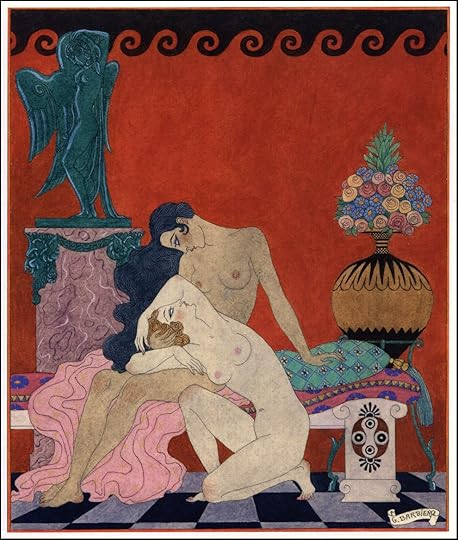
Quelques illustrations de George Barbier(1882-1932):


Les Chansons de Bilitis sont l’œuvre la plus célèbre de Pierre Louÿs(1870-1925), un romancier français, qui s'est ici amusé à monter une petite mystification, faisant croire qu'il s'agissait d'un véritable document historique retrouvé, les œuvres d'une contemporaine de Sappho, dont il ne nous reste que quelques bribes de Poèmes. Il n'a pas même négligé de citer de vrais ouvrages savants issus de l'industrieuse université allemande, d'inventer des découvertes archéologiques, et de multiplier les évidences pour donner du corps à son invention. Elle a eu le bonheur d'attraper quelques érudits enthousiastes, professeurs d'université offrant leurs services pour améliorer la traduction. Bilitis est même devenu un nom commun, comme Sapho.

Je voulais entendre
Le rire de Sappho
Et la voix de
Sa lyre

Ce qui me parvint fut
Le marmonnement moustachu
Des grammairiens

Des ptérodactyles grecs
Et des dodos victoriens.


Il s'agit en fait d'un pastiche, mélanges des bribes saphiques, des épigrammes de l'Anthologie Grecque Tome, et de tout ce que peuvent offrir Alciphron (Lettres de pêcheurs, de paysans, de parasites et d'hétaïres), La Pastorale de Daphnis et Chloé de Longus, Lucien et tous les romans grecs... Au final, on a plus d'une centaine de poèmes suggestifs et ingénieux, fruit de la malicieuse imagination et de l'art imitatif de l'auteur. Ce n'est pas mal du tout, mais quand même: c'était bien trop beau pour être vrai! L'introduction est excellente, et remplit parfaitement son office.

http://fr.wikisource.org/wiki/Les_Cha...
Profile Image for Teresa.
1,492 reviews
December 18, 2016
Cento e cinquenta e oito poemas em prosa que relatam a vida de uma mulher que se entregou inteira ao amor.
Bilitis nasceu no século VI numa aldeia perto da Panfília (região da Turquia). Aí cresceu, apaixonou-se pela primeira vez e foi mãe. Não era feliz e um dia foi embora para não mais voltar...
"Lembro-me de ter amado...Ó Paniquis, minha filha, em que mãos te deixei? Como é que, infeliz, te pude abandonar?"
Um barco leva-a para a ilha de Lesbos, o centro do mundo, onde vivia a poetisa Safo. Aí perde-se de amores por uma jovem meiga e inocente...
"Nada comerei esta manhã, nem mesmo à tarde;
não porei carmim nem pó nos lábios,
para que seu beijo permaneça."
O ciúme de Bilitis acaba por destruir esse amor...
"Não ouso entrar em casa e dar com o pavoroso vazio do quarto.
Não tenho ânimo para abrir a porta.
Não tenho sequer forças
para voltar a abrir os olhos.
"
Partiu para Chipre, onde se torna cortesã e vive os últimos anos da sua vida dedicados ao amor...
"O primeiro deu-me um colar. Um colar de pérolas
que por si só valia uma cidade.
(...)
O segundo fez-me versos onde dizia que os meus cabelos têm o negrume da noite.
(...)
O terceiro era belo. De tal modo que sua mãe sentia pudor em o beijar,
(...)
Tu. Tu nada me disseste. Tu nada me deste. És pobre e sem beleza.
Mas é a ti que dou o meu amor."
Alguém, por aqui, classificou este livro como "queer", mas não é nada disso. São sim lindos hinos que cantam o amor, o desejo, o prazer; a adoração pelos deuses e pela natureza.
____________________________
Diversos:
1.
O meu poema favorito. Uma das mais lindas declarações de amor que já li.

"Quando a água dos rios se elevar até aos cimos
cobertos de neve; quando se semear a cevada e o trigo
nos regos móveis do mar;

Quando os pinheiros nascerem dos lagos e os nenúfares
nas rochas, quando o sol se tornar negro, quando
a lua se despenhar na erva;

Então, mas apenas então, tomarei outra mulher,
e te esquecerei, Bilitis, alma da minha vida,
coração do meu coração.

Foi o que ele me disse. São palavras suas
e pesam muito mais do que o mundo. Estás-me a ouvir,
felicidade insensata? Como ousas comparar-te à minha?"


2.
Ilustração de George Barbier inspirada em Les Chandons de Bilitis

description
Profile Image for Julio  Diaz.
134 reviews
September 30, 2025
Qué intenso.

Puedo decir que son unos poemas bastante buenos, candentes, interesantes. Pero si hablamos del contexto en lo que está sucediendo, todo es algo fuerte y relativamente triste sobre Bilitis y su vida de cortesana.

En cada poema se expresan sus sentimientos, en cómo ve la vida y lo que siente a veces al dar sus servicios con las personas. Me deja pensando sobre la relativa inocencia en medio de ese mundo de lujuria.

Me gustó adentrarme en esta literatura, no soy muy de poemas, pero este me ha gustado en su mayoría.
Profile Image for Piotr.
93 reviews6 followers
April 2, 2025
travail immense de l'auteur, honnêtement fou comme ouvrage, alternant (en fonction des versions) entre l'érotisme et la douceur, franchement sublime bien que ça ne m'aie pas transcendé

Les femmes seules savent aimer ; reste avec nous, Bilitis, reste. et si tu as une âme ardente, tu verras ta beauté comme dans un miroir sur le corps de tes amoureuse.


(je tiens à noter que je me suis tapé le recueil sous grosse playlist de lyre, c'était un mood)
Profile Image for Eadweard.
604 reviews521 followers
August 4, 2015
I like how he presented them as genuine sapphic works.


"The River in the Woods

I bathed alone in the River in the woods. Without a doubt I must have frightened the naiads for I could scarcely see them far away, under the dark water.
I called to them. To resemble them as much as possible, I plaited irises black as my hair behind nape, with clusters of cheiranthus.
From a long floating grass, I made a green belt, and to see there I pressed my breasts by slightly tilting my head.
And I called out: “Naiads! naiads! play with me, be nice.” But the naiads are transparent, and maybe, unknowingly, I caressed their light arms."
----


"The Complacent Friend

The storm lasted all night. Beautiful-haired Selenis came to spin with me. She stayed for fear of the mud. We attended the prayers and tightly against one another, we filled my little bed.
When girls lie together, sleep remains at the door. “Bilitis, tell me, tell me who you love.” She was dragging her legs over mine to caress me softly.

And she spoke, into my mouth, “I know, Bilitis, who you love. Close your eyes, I am Lykas.” I answered with a touch, “Can I not see that you are just a girl? You joke in poor taste.”

But she continued: “In truth, I am Lykas, if you close your eyelids. Here are his arms, here his hands…” And tenderly, in silence, she enchanted my reverie with a singular illusion."
----


"The Tomb of the Naiads

Along the woods covered with frost, I marched; my hair before my mouth flourished with icicles, and my sandals were heavy with muddy and hard-packed snow.

He said to me: “What are you looking for? —I am following the track of a satyr. His little cloven hooves alternate like holes in a white mantle.” He told me: “The satyrs are dead.

“The satyrs and the nymphs also. For thirty years there has not been a winter so terrible. The track you see is that of a goat. But stay here, it is their tomb.”

And with his iron hoe he broke the ice of the spring where once laughed the naiads. He took large frozen chunks, and, lifting them to the pale sky, he looked through them."
----


"The Priestesses of Astarte

The priestesses of Astarte make love at the rising of the moon; then they rise and wash in a vast basin edged in silver.

With their bent fingers, they dye their tresses, and their hands tinted purple, mixed with their black curls, resemble branches of coral in a sombre and floating sea.

They never wax, so that the triangle of the goddess marks their bellies like a temple; but they tint themselves with a brush and perfume themselves profoundly.

The priestesses of Astarte make love at the setting of the moon; then in a carpeted hall where burns a high lamp of gold, they lay down at random."
----


" The Perfumes

I will perfume all my skin to attract lovers. On my beautiful legs, in a basin of silver, I pour some spikenard from Tarsus and some metopion of Egypt.

Under my arms, some spearmint; on my lashes and on my eyes, some marjoram of Kos. Slave, take down my hair and fill it with the smoke of incense.

Here the oenanthe of the mountains of Cyprus; I will let it drip twixt my breasts; rose liquor that comes from Phaselis perfumes my neck and cheeks.

And now, pour upon my loins the irresistible bakkaris. ‘Tis better, for a courtesan, to know the perfumes of Lydia rather than the mores of the Peloponnese."
Profile Image for Markus.
661 reviews105 followers
May 11, 2019
The Songs of Bilitis
By Pierre Louÿs (1870-1925)

This is Classic Lesbian Love Poetry written in prose, published in 1894.

The author fooled the experts of his time in pretending this poetry to be a new Archaeological discovery from a contemporary of Sappho 640AD as original ancient Greek.

Reading Sappho’s fragments of poems side by side in comparison, the modern authors work appears shallow, repetitive and of little originality, like a painting in pale watercolour.

Evaluation of whatever potential of erotic stimulation these words may have must be left to readers who would feel concerned.
Profile Image for Edragone.
174 reviews5 followers
November 5, 2022
5

Un incroyable recueil, monté sur une légende assez ingénieuse : l'auteur a fait croire que des fragments d'une poétesse grecque avaient été retrouvés. Il écrit donc à la manière d'une poétesse du VIè av. J.-C. d'un style qu'il qualifie "d'orientalisant". Les poèmes sont subtiles, doux, et mettent en avant essentiellement des amours lesbiens. On "suit" la vie de ladite poétesse (inventée de toutes pièces) de ses débuts avec un homme à ses désirs lesbiens avec des femmes.

Très belle découverte de ce poète néo-helléniste de la fin du XIXè début XXè.

Profile Image for Adriana Scarpin.
1,733 reviews
August 20, 2017
A ideia e os poemas são muito bons, mas também não há como negar que Louys viu a personagem sob uma óptica patriarcal não-sáfica, o que soa como brochante em geral.

Curiosidade: Certamente Chico Buarque leu a Bilitis antes de escrever Teresinha, o poema Canção do livro Bilitis de Pierre Louys já que foi aparentemente estruturada a partir dele.
Profile Image for Mariana Orantes.
Author 16 books120 followers
April 9, 2015
A un lado del lugar al que debo asistir cada día del año, hay una librería llamada Jorge Cuesta. En esta librería fueron a dar libros de la biblioteca personal de Sergio Fernández, académico de la UNAM: en cada libro, un ex libris de un sátiro que con una mano sostenía su enorme y alargado falo... "es un erotómano" sentenció por ahí un amigo. Compré de su biblioteca, dos libros: una antología de Vicente Gerbasi y éste de Las canciones de Bilitis, editorial Thor, bellísima. Lo tenían catalogado como "novela francesa", por dios. No, no es novela, es poesía, pura y bella poesía. Cuenta la historia de vida de la hermosa Bilitis y sus amantes; el erotismo que desborda no está sólo porque sí, sino porque habla del deseo, pasiones y fracasos de la mujer, de la niña, de la joven, de la vieja. Creo que es un libro imprescindible. Todos deberían leerlo y escribir versos de las canciones en las paredes de las plazas, las recámaras y los baños. En serio, la enorme paleta de sensaciones que tiene este libro es una maravilla; lleno de vitalidad no deja de tener momentos terribles y como todo gran libro, te cuestiona y hace que lo pienses una y otra vez.
Profile Image for C. B..
482 reviews81 followers
June 30, 2017
I first became interested in this book when I heard Claude Debussy’s magnificent musical setting of these poems. And the book – like the music – is a quintessential example of the beautiful ways that the ancient world was being romanticised at the end of the nineteenth-century. These works exude a deep longing for a time and aura that perhaps never existed. Pierre Louÿs was part of the Symbolist/Decadent movement in art, and his fascination with ancient Greece – like many of his contemporaries – was centred on the subversion of contemporary sexual mores that many writings of ancient Greece presented. This is an interesting series of poems that pastiche the style of the Greek lyric poets, but more specifically Sappho. Although it was a while ago that I read Sappho, I don't feel that these poems really capture the same feeling. They aren’t quite as recondite. Regardless, there are some beautiful gems in here. The poem “Tresses” is a gorgeously hazy snapshot of a strange erotic dream; the poem “Bilitis” is a very modern feeling declaration of self-pride; many poems, like “Desire,” are genuine and very grand depictions of love and lust. I also enjoyed the pieces towards the end which dealt with fading beauty. Split into three distinct eras of Bilitis's life, one actually becomes quite attached to her story.

I also find this work interesting in regards to a certain debate which surrounds it. This is an early example of what many would consider to be the fetishisation of female homosexuality. I’m quite torn about this. At times this criticism feels justified, but I don’t feel the writing to be gratuitous or exploitive to any severe degree. In the end, it simply has to be understood that this book was written by a man and for a small circle of male intellectuals. This depiction of sisterhood and love is unfortunately pure fantasy. But it’s a powerful one that even many lesbian thinkers were to take-up and appropriate (e.g. the Daughters of Bilitis organisation in the USA). So I would recommend this to those interested, and you can decide for yourself. It’s a real joy to lose oneself in this ancient fantasy.
Profile Image for Lucas Sierra.
Author 3 books602 followers
February 21, 2018
Me ha encantado Louÿs en este texto. En parte, porque ando viendo un curso de Teoría de la imaginación literaria, y tengo desde ayer el corazón heleno. En parte, porque leo este libro desde hace días, y ha sabido regalarme la elegancia de un universo sensual donde lo orgiástico es revelación. El erotismo, aquí, no es licor: es agua. Líquido vital. Movimiento.

Sumemos a eso la osadía de Louÿs al crear a la sacerdotisa, y tenemos full. Les debo una reseña de verdad para cuando el tiempo me sea más amable.
Profile Image for Dfordoom.
434 reviews124 followers
May 1, 2008
In 1894 the young decadent writer Pierre Louÿs published what was claimed to a translation of a series of prose poems by Bilitis, a hitherto unknown Greek woman poet of the 6th century BC, a woman who not only lived at the same time as the great Sappho, but was actually known to her. These poems tell Bilitis’s life story, including her lesbian love affairs and her career as a courtesan in Cyprus. In fact Bilitis never existed, and Louÿs wrote the poems himself. This in no way lessens their literary value, or their historical significance. Louÿs had both a genuine feel for, and a considerable knowledge of, ancient Greece. He was also an enthusiastic and sincere champion of lesbian love. Bilitis became something of a lesbian icon, and when in the 1950s the first major lesbian lobby group was formed in the US it was named the Daughters of Bilitis. The book itself, The Songs of Bilitis, was at various times banned in various countries. The poems are certainly erotic, and deal very unequivocally with lesbianism, although it’s difficult to see how anyone could ever have regarded them as obscene. Their principal shock value resides mostly in their very positive approach to their subject matter. And they’re very much worth reading as exceptional fine examples of decadent prose poetry.
Profile Image for Mohammad Ali Shamekhi.
1,096 reviews312 followers
January 17, 2015
سادگی و شفافیت اشعار در حدی ستایش انگیز کوبنده است. شرح تمایلات بدنی در این اثر در اوج سادگی مرا مجذوب خود ساخت. اشعار به سه دوره تقسیم شده اند: دوره ی نخست کودکی بیلیتس که حول طبیعت و عشق او به مردی می چرخد، دوره ی دوم که به اقامت او در لسبوس و شرح احوال هم جنس خواهانه ی او اختصاص یافته است، و دوره ی سوم که اقامتش در قبرس و بر دوش گرفت نقش خادم ونوس ( روسپی گری مقدس ) را به تصویر می کشد.در پایان نیز سه ترانه مرگ او را توصیف می کنند.

علاوه بر اشعار فراوانی که قابل توجه می دانمشان این چند شعر را برتر از همه یافتم: پیرمرد و پریان، دسته ی گل، انگشتری، ارمغان، نذر، قهر و آشتی، نی، مرگ پریان، تردید، یکبار دیگر، میهمانخانه، گلفروش، کبوتر، مرگ دل، و ترانه ی دوم از ترانه های سه گانه مربوط به مرگش.
Profile Image for Agris Fakingsons.
Author 5 books152 followers
February 12, 2019
..pirms miega gribēju vienu izlasīt, izlasīju visus. lai gan dažviet nesapratu apslēpto domu un erotisko pavedienu, man tomēr patika.
Profile Image for Maria Bodin.
77 reviews8 followers
August 8, 2019
Liksom fallet också är med Castaneda är skandalen roligare än själva läsningen. Men den hade sina fina snuskigheter, som dikten om att knulla Sapfo. Eller min favoritdikt, som presenteras här i slapphänt* översättning:

Hjärtat

Andfådd tog jag hennes hand och satte den hårt mot den fuktiga huden på mitt vänstra bröst. Och jag vred mitt huvud av och an, och rörde mina läppar utan att tala.

Mitt upprörda hjärta, så häftigt och hårt, bultade och bultade i mitt bröst, som en fängslad satyr krumbuktar sig, nedtryckt i en lädersäck. Hon sa mig: “Ditt hjärta gör dig illa.”

“O Mnasidika,” svarade jag, “kvinnohjärtat sitter inte där. Det här är en stackars fågel, en duva som slår med sina svaga vingar. En kvinnas hjärta är vedervärdigare.

Liknande ett litet myrtenbär brinner det med röd låga, och skummar över. Det är där jag k��nner mig biten av den rovlystna Afrodite.”

*Inte lika slapphänt som den engelska översättningen jag jämförde med, som översatt "baie de myrte" till "bunch of myrtle" och på så sätt suddat ut en ganska uppenbar klitorisliknelse :/
Profile Image for Matt.
186 reviews21 followers
March 10, 2022
If you’re going to create literary sapphic erotica in the 19th century you can get it past the censors by claiming it was written by the poet Sappho herself and that you discovered the original manuscript and translated it from archaic Greek. The author did this brilliantly. The presentation of erotic poetry in this volume is complimented by the brilliant illustrations of Willy Pogany in his iconic line work and minimalist style. This won’t be everyone’s cup of tea but if you appreciate faux lesbian erotic poetry, and have a sense of humor, you’ll like this book.
Profile Image for Molly.
305 reviews2 followers
June 8, 2024
Took it old school with this pride pick with some ancient sapphic poetry. Can I say it was erotic? I guess? Most poems weren’t and a lot had nothing to do with sex
Profile Image for Frankenstine.
9 reviews
December 13, 2022
نفس زنان دستش را گرفتم و بر روی دلم که سخت می‌تپید نهادم. لب گشودم تا سخنی بگویم اما هیچ نگفتم. دل دیوانه‌ام چنان سخت در تپش بود که گوئی میخواست همچون پرنده‌ای اسیر از زندان سینه بگریزد.
چون چنین دید به من گفت:«اوه! چقدر تپش دل آزارت می‌دهد...»
گفتم:«نه، مناسیدیکا ! دل ما زنان اینجا نیست. این که می‌بینی کبوتر اسیری است که بالهای ناتوانش را در پی آزادی بهم میساید. جایگاه واقعی دل ما جای دیگری از بدن ما است. آن معبد پنهانی الهه‌ٔ عشق است که در محرابش پیوسته شعلهٔ گلگون آتش هوس میدرخشد.»

دل- کتاب دوم (دیار سافو)
Profile Image for Matt.
434 reviews13 followers
April 25, 2016
This is a fun book of speculative verse. The author is a French symbolist poet, who assumes the voice of a fictional ancient Greek poet called Bilitis. The poems trace a narrative from her early youth to her death. There was a bit of a scandal when the book was published because Louÿs makes it seem as if he is translating a real poet, going so far as to list "untranslated" poems in the table of contents and including a fake "life of Bilitis" as a preface. The artifice is fun, but if you know a little about ancient Greece or ancient Greek poetry, the modern sensibility and occasional anachronism of the poems will be easy to spot. Despite this occasional mimetic looseness, many of the poems are interesting takes on ancient life. The story of Bilitis has many turns. It is erotic, pensive, hopeful, haughty, and despondent in turns. Some of the erotic poems are pretty sexy, but just as the attempt to create an ancient poet sometimes fails, so does the attempt to describe ancient sexuality. Bilitis is billed as one of the companions of Sappho (called "Psappha" here), but occasionally it seems like her erotic adventures are only being depicted for the delight of the male gaze. This is especially true in the last third of the poem when she becomes a hetaira (technical term for an ancient Greek prostitute). My favorite part of the book, and the part that was most interesting as a speculative take on an ancient woman's life, is the narration of her love affair with Mnasidika. After this ends (spoiler alert, I guess, but what good love poet ever had a happy ending?), the book loses a lot of its spark. At its best this collection is a fresh exploration of ancient life that briefly rivals classics like Mary Renault while also introducing elements of queer sexuality (that was much harder for Renault to depict in the 1960s for some reason. Thanks, Eisenhower!). I recommend it to lovers of the ancient world and lovers of poetry in general. There is something for everyone in here, even if you just are a creepy proponent of the male gaze.
Profile Image for Alex Sarll.
7,047 reviews365 followers
Read
October 19, 2012
A book seemingly designed to tick all the reading list boxes in Keith TotP's 'Pretentious Title TBC' - a dead French poet pretending to be an even deader ancient Greek lesbian(ish) poet. He even got away with it for a while, and when he was busted, nobody much minded. You can see why - he captures something of that same oblique, crystalline melancholy as Bilitis' supposed contemporary and acquaintance ('acquaintance'), Sappho. And while from our distance we can also taste the distinct tang of the French decadents...immersed in it, you wouldn't have noticed, would you?
Profile Image for Mariocarboni.
11 reviews
April 1, 2014
Straordinaria storia di un falso che rivelatosi rimane una raccolta di poesie d'amore che sembrano proprio scritte da Saffo. Chi non crede al ritorno o ai messaggi che travalicano i tempi e le generazioni si ricrederà . È indispensabile abbandonarsi sulla lettura senza pregiudizi . Certo i tempi nei quali questa opera è stata scritta si intravvedono tutti. Ma chi ha dimestichezza con l'amore saprà perdonare che solo oggi ha avuto l'occasione di leggere questo libro ingiustamente dimenticato.
Profile Image for K.A. Masters.
Author 33 books19 followers
August 16, 2020
This is a problematic work that romanticizes and fetishizes rape. The author's ignorance of the ancient Greek world and women in general is evidently clear on each page. It is the literary equivalent of turn-of-the-century erotic tobacco cards: it is clearly meant to titillate a male audience and little else.
Profile Image for Atticus.
104 reviews6 followers
September 12, 2020
I suppose I understand why he presented these forgeries as authentic (any writer could see that, I suppose), but even without the added gravitas of them being actual surviving pieces they're still very beautiful. You can see the subtle effort that he's put it in, and that effort is so, so sweet.
Profile Image for Sue Online.
119 reviews5 followers
June 23, 2025
If you think you know this work but have not read it, you do not know this work. I'm working with an author on a new translation and a new look at the poetry (and some new poems!), so I had a reason to really, *really* read the work.

Truth be told, I didn’t dive into The Songs of Bilitis expecting much beyond some dusty old poetry pretending to be ancient. I mean, it’s from the 1890s, written by Pierre Louÿs, who basically cooked up this whole story about Bilitis being this Greek gal whose poems were lost to time. Spoiler alert: he made the whole thing up. But, stay with me, because it actually gets interesting.

The poems follow Bilitis through three big chapters of her life — first as a young girl in Pamphylia (think not-actually-very-innocent countryside vibes), then her steamy, dreamy lesbian life on the island of Mytilene (hello, Sappho’s neighbourhood), and finally her more complicated years as a courtesan in Cyprus (cue the scandal). On the surface, it feels like the classic patriarchal bedtime story where an innocent girl tries out the ladies and ends up a prostitute. But it’s sneakier than that. There’s this quiet rebellion woven through the whole thing, where Bilitis owns her choices and her desires without needing some bro to define her.

The best part? That middle section, Elegies at Mytilene, is basically pure lesbian poetry bliss. It’s not written like some tragic, temporary detour before “real” heterosexual love shows up. Nope. Her relationship with Mnasidika? Full-on heart-eyes emoji. Bilitis talks about kissing her like it’s the most epic thing that’s ever happened. She and her friends compare their bodies — casually, playfully, and, yeah, erotically. It’s tender, sexy, and so rare for the time it makes you wanna high-five Louÿs, even though he was a man writing lesbian poetry for his own reasons (we can side-eye that later).

Sure, we could pick apart the whole appropriation-of-voice situation. But back then? This was one of the only places women-loving-women could see themselves reflected in something beautiful, not scandalous or pathological. And the natural metaphors like trees, rivers, all that earthy stuff. They frame desire as, well, natural. Not exotic. Not sinful. Just… life.

So, yeah, Pierre Louÿs might’ve been playing make-believe, but The Songs of Bilitis still hit different. It offered women a little glimpse of love, desire, and agency outside the usual rules — and honestly, isn’t that what good poetry is supposed to do?

Now, which version of you get will depend on if you read the original French, the modified French, or a translation. They've all got good and bad. Can I tell you a secret? I'm working with someone on a new version, so, full disclosure there.
Profile Image for Cpt Hawk.
72 reviews
June 11, 2023
Ah, Bilitis. I feel a great loss to learn in the notes that you are a fiction created by a French fool fond of Greek and the erotic. A friend of Wilde was Pierre Louÿs, did you know? And Claude Debussy wrote tunes for some of the songs Louÿs wrote as Bilitis? ... I really was genuinely moved to think that maybe this work was touching and eternal, but instead some limp-wristed dandy did the writing--

Whatever. What I found moving was the thought of Bilitis. Let's skip the bit where I bought it like a fool.

This is worth the read. If you take the tale sincerely, it's the collected poems of a young girl who leaves her home of Pamphylia at 16 for the Isle of Lesbos, not aware of what she steps into for here Sappho still reigns; and then, after the end of a 10 year relationship with a woman she had married, Bilitis briefly goes through a villain era before leaving for Cyprus, where she will eventually die before the age of 40--but not before she attempts an artistic, literary stint, becomes a popular courtesan, then a pimp, suffers more sexual assault and rape (ah yes, this was an issue for her also, briefly, while at home in Pamphylia), then declines in fame and usefulness as a courtesan as her body ages, and finally, she is wasted away by some disease. At the height of her grief following her break-up with her wife, Mnasidika, Bilitis writes a funeral chant for herself, wishing to die. Before the book's end, she writes three epitaphs for her grave. She got her wish.

Ignoring how I just realized I was swindled here 20 minutes ago ... I was moved by the ... slow progression of Bilitis as a person. I will give this to Louÿs, he does character work *very* well, and his initial set-up where he vouches himself as a translator effectively serves his narrative: there's not many segments where Louÿs goes silent in writing Bilitis' tale, but in the gaps he does leave, the way he works up to threads of plot or feeling, then drops it and picks it up later after some change has occurred and now Bilitis is nursing *that* variation on this wound instead ... very clever. Felt real and human.

The care and attention paid to the erotic interest of these fictional lesbians involved felt very natural to me, a real lesbian. I was wooed by the intensity of Bilitis' feeling and need. I was stressed when I watched Bilitis shift from someone carefree and freely loving to a person more jealous and paranoid about her relationship with her wife. The implication is that her wife cheated on her, and that's what brought this relationship down, and the tension in the poems that precede the final break-up had me balanced on a knife's edge. Bilitis' poems where she details how she'd do anything to keep her lover (before they break up), and her desperation for her lover to see her just one more time (after the break up), to the tune of, "I ask it of you, beg it of you, and think that the remainder of my life hangs on your answer." ... Alright queen, go off, hard same. And then she hooks up and toys with this girl that Bilitis knew had a crush on her and her wife while trying to cope? My god the writing for those poems that detail it ... now THAT is fire and emotion.

The thing that really got me about the writing of Bilitis is the complete sincerity, I think. There's the things you say, the things you can only reference in passing, and the things you mean to say--WOULD say--if only you were braver. Louÿs takes that last one and declares, "Fuck it! Bilitis is capable of 200% emotion now." And I appreciate that he writes Bilitis as a needy, desperate lover--unlike the rest of us, who presumably pretend we are not so while displaying all the symptoms privately. Bilitis by nature of being a supposed songwriter and poet is *not* private, which I suppose just adds another layer of intent and meaning to every poem put on paper and attributed to her pen and narrative. There is something painfully sad about watching her life go downhill as soon as she leaves Lesbos. The spit and fire is leeched out of her, and when it returns, it's with the grieving of a woman used, objectified, and reduced. Her grief then becomes some of the most potent parts about her character, as is her attempts to console herself about the aging of her body, the uses of her wisdom and cleverness in a sea of fellow courtesans where she becomes replaced by youth. There is also, of course, Bilitis' never-ending disgust and hatred leveled at perverts, pedophiles, and rapists, and her despair at witnessing or experiencing any of these things is likewise remarkably well-put coming from a male French writer who may or may not have been gay himself? Who knows. Bilitis seems to be trying to work out what confidence she can still find in her life in this last segment, despite clearly having said goodbye to her happiest days in Lesbos, and her swan dive into misery *after* she left Lesbos ... watching it left me quite troubled.

I may be giving Louÿs more credit than he deserves overall. I don't know the context with which his work was received or read. (Initially. Obviously American lesbians in the 1950s will pounce on it and name an organization after this text--the Daughters of Bilitis.) More likely than not he wrote all this woman-on-woman loving in The Songs of Bilitis and in his other works hoping to titillate his male peers. It is ironic that one of the most historically iconic lesbian writers is in fact a man, who as far as I know may not even have joined the lesbian crew by being trans. There is, however, the power of dead authors, which is to say fuck Louÿs, he's dead, I'm alive, and I will do as I please. Also, Louÿs DID write some banging lines, and he did it quite a lot, and I would be remiss to ignore all that.

When Bilitis said, "If one has suffered, I can scarcely feel it. If one has loved, I have loved more than she." When Bilitis said, "If life is a long dream, what use is there in resisting it?"

When Bilitis said, "The night is fading. The stars are far away. Now the very latest courtesans have all gone homewards with their paramours. And I, in the morning rain, write these verses in the sand. ... Those who will love when I am gone, will sing my songs together, in the dark."

When Bilitis said, "In gratitude to you who have paused here, I wish you this fate: May you be loved, but not love," and said, "I have sung of how I have loved. If I have lived well, Passer-by, tell your daughter."
This entire review has been hidden because of spoilers.
Profile Image for Pablo S. Martín.
387 reviews21 followers
March 16, 2022
Es increible cómo un engño bien fraguado, secundado por excelsa calidad, puede pasarse por alto.
La historia de la falsa traducción de las canciones de Bilitis es bien conocida, y no solo por ello ha pasado a la historia.
Las Canciones que Pierre Louÿs escribió son verdaderamente pequeñas obras de arte, de una calidad que pocas veces es igualable.
Es una cima sin duda de la poesía, mezclando el parnassanismo en caída con el simbolismo transigente, utilizando poemas en prosa de tanta y sentida belleza, que embriagan de solo ser leídos.
Y el legado que ha dejado enrededor del mundo es vasto y bello sin duda.

Gracias Pierre Louÿs por semajnte creatividad.
328 reviews
January 6, 2024
I found this book because I saw the most beautiful image by Willy Pogány and I was curious to see where it came from. His line art is simply gorgeous. The book itself started off relatively good, but unfortunately lost my interest the further I went along until I was just skimming the end. An interesting but very strange narrative, and some of the main character's life choices that had me raising my eyebrow.
Displaying 1 - 30 of 52 reviews

Can't find what you're looking for?

Get help and learn more about the design.