INSTANT NATIONAL BESTSELLER WINNER OF THE QUEBEC WRITERS’ FEDERATION AWARDS PARAGRAPHE HUGH MACLENNAN PRIZE FOR FICTION LONGLISTED FOR THE 2025 NATIONAL BOOK CRITICS CIRCLE AWARD FOR FICTION SHORTLISTED FOR THE 2026 CLIMATE FICTION PRIZE One of Barack Obama’s Favourite Books of the Summer TIME’s 100 Must-Read Books of 2025 Named a Best Book of 2025 by The Globe and Mail The New Yorker Vulture New York Public Library The Guardian Esquire The Boston Globe
An “incandescent” (The New York Times), “evocative and buoyant” (Toronto Star) page turner from the beloved author of Do Not Say We Have Nothing—this “rich and beautiful” (The Guardian) father–daughter saga leaps across centuries past and future, as if different eras were separated by only a door “Reading Thien is to admire how she brush-strokes language to create beauty. . . . Full of unexpected moments of beauty and pleasure.” (Los Angeles Times)
Why did people, who lived so briefly in this universe, contain so much time?
Lina and her ailing father have taken refuge at an enclave called the Sea, a staging post between migrations, with only a few possessions, among them three volumes from The Great Lives of Voyagers encyclopaedia series.
In this mysterious and shape-shifting building, pasts and futures collide. Lina befriends her unusual Bento, a Jewish scholar in seventeenth-century Amsterdam; Blucher, a philosopher in 1930s Germany fleeing Nazi persecution; and Jupiter, a poet of Tang Dynasty China, and through their stories, she comes to understand the role of fate in history and the way that ideas can shape the world, and to face up to the cost wrought on her family and others by her father's betrayals.
Exquisitely written with extraordinary subtlety of thought, The Book of Records leaps across centuries as if eras were separated by only a door. This is Madeleine Thien at her most exciting, sublime and engaging.
Madeleine Thien was born in Vancouver. She is the author of the story collection Simple Recipes (2001), and three novels, Certainty (2006); Dogs at the Perimeter (2011), shortlisted for Berlin’s International Literature Prize and winner of the Frankfurt Book Fair’s 2015 Liberaturpreis; and Do Not Say We Have Nothing (2016), about musicians studying Western classical music at the Shanghai Conservatory in the 1960s, and about the legacy of the 1989 Tiananmen demonstrations. Her books and stories are published in Canada, the U.S., the U.K. and Australia, and have been translated into 25 languages.
Do Not Say We Have Nothing won the 2016 Scotiabank Giller Prize, the 2016 Governor-General’s Literary Award for Fiction, and an Edward Stanford Prize; and was shortlisted for the 2016 Man Booker Prize, the 2017 Baileys Women’s Prize for Fiction, and The Folio Prize 2017. The novel was named a New York Times Critics’ Top Book of 2016 and longlisted for a Carnegie Medal.
At its core, this is a tale of a father and daughter–adrift in the shifting sands of time. As they recount how they arrived at The Sea, a nebulous crossroads where time folds in on itself, they strike up a friendship with three neighbors–notable figures from history–each offering up prudent tales from their own lives.
Thien deftly explores the power of stories and their telling, the transient nature of time and memory, and the permanence of love and connection. Her writing is elegant and measured, with the intimate father-daughter relationship being the most effective and affecting aspect of the novel. The lengthy interspersed stories relayed by the historical figures, while clearly well-researched, bog down the narrative momentum, slowing the pace more than necessary.
The deeper Thien wades into philosophical territory, the harder I found it to keep up, which I see as more of a personal shortcoming than a flaw in the book. She operates at a philosophical frequency beyond my level of understanding, making significant portions frustrating and difficult to parse. While I never quite grasped the full scope of what Thien was trying to convey, I suspect more erudite readers will have better luck.
My thanks to the publisher and Edelweiss for an advanced reader copy in exchange for an honest review.
A stunningly original blend of speculative fiction, history, biography, poetry, mathematics and physics, that is surely a strong contender for this year's Booker Prize.
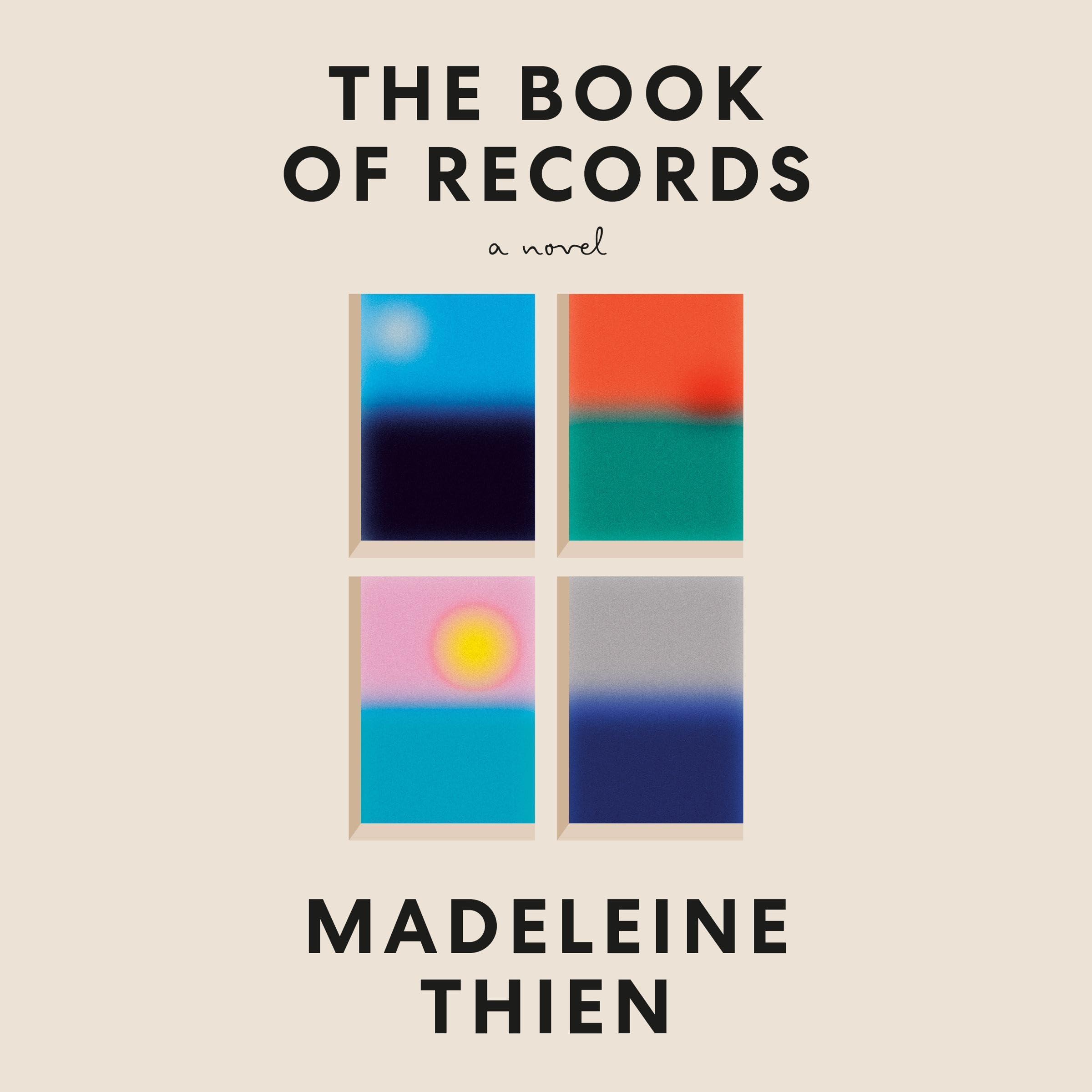
Lina and her father have fled the flooded Pearl River Delta at some point in the future, and find themselves in an enclave named the Sea. It is a place of refuge, where different oceans appear out of each window, a place where time folds and the refugees of the past, present and future collide. Lina carries with her three books from a series on great voyagers, detailing the lives of Du Fu, Baruch Spinoza and Hannah Arendt. But, as she gets to know her neighbours, she soon realises they know more about these people than any book could profess. For like Lina herself, they are all fleeing tyranny of different kinds and each is seeking new beginnings.
Deeply philosophical, intellectual, moving and profound, this inventive novel unfolds the story of humanity as it fragments across time. It is a high wire act performed with the skill and grace of a truly great writer. A masterpiece.
Cerebral and philosophical. Reflecting on grief, generations, collective human consciousness, remembrance versus living a life and how humanity deals with crisis, this is a novel that makes the head work hard, yet with a strong human heart. Time dissolves us as if we are nothing more than sugar in water
This was the second book this month that I read that features a daughter and a mathematician father, but I found The Book of Records much better executed than The Expert of Subtle Revisions. The Book of Records follows four lives, Lina and her father who are in an enclave called the Sea, where she encounters neighbours who embody historical figures: Jupiter (Hannah Arendt), Bento (Baruch Spinoza), and Blucher (Du Fu). These characters, drawn from her father’s cherished volumes of The Great Lives of Voyagers play a major role in the novel. The scenes set in the Sea have a dreamlike, almost Ghibli studio vibe to them, and talking about film vibes, it often made me think that the novel was set in a world akin to Pixar's Soul.
However the setting of much of the book is far from cozy, we have many worlds in crisis, be it failing Chinese empire, plague in Amsterdam or World War II engulfing France. Exile features heavily in all the narrative strands, be it geographical, societal or from expectations of one self. Breaking free from conventions, the Chinese emperor, being old (at 38) and financial success in the state exam for Du Fu, from the religious Jewish community in Amsterdam for Spinoza or with humanism and the nation state for Hannah Arendt, is also a common thread. At times I was reminded of The Three-Body Problem, in the focus on the life of great figures in history. Lina her story in my view was the weakest, least textured, but incapsulated the concept of liminality, also definitely present in the biographical uncertainties in the lives of world famous people and their undocumented slices of life as imagined by Madeleine Thien.
And then we have the middle section, featuring cyberspace in a rapidly changing China, where a Tsinghua trained system engineer needs to make important choices. This is a rich work that quotes Pessoa, Tacitus, Borges, Brecht, Calvino, Walter Benjamin, Van Gogh and off course the works of Hannah Arendt, Du Fu and Spinoza, while taking on a bold perspective on what it means to be human.
Concepts as system incoherence, the possibility of a collective human consciousness, remembrance versus life lived, are brought in a way that has human heart and which suggest a transcendental connection between lives in a way that is akin to the central concept of The Egg by Andy Weir
Quotes: The buildings of The Sea are made of time
You never be content if you separate what you want from what really is
Another story that has a daughter and a mathematician father
Hannah Arendt as a 18 year old being in a relationship with a 35 year old professor, Martin Heidegger
Pre-World War II as well
Death is routine
I think friendship is time itself
What we call now has no solidity, we are always falling through it
Survival required disobedience
They had no rights, not even the right to have rights
The only way to remember is to forget, to let time fill the story up and create it all over again.
Life is fated to be left behind
Mistaken beliefs are powerful
Was beauty a truth or a faith?
Was it possible that the ones we love are the ones we most powerfully imagine, the ones we create continuously in our mind?
5 "on the pinnacle of elegant erudition and melancholy wisdom" stars !!
Yearning, searching, struggling...
In a near future dystopian world on the China South Seas there is an enclave of humanity....
Lina (12) from FoShan has arrived with her father and they are befriended by 3 neighbors who are incarnations of Hannah Arendt, Baruch Spinoza and the Chinese poet Du Fu from Tang Dynasty China....
We are given morsels of physics, philosophy, poetry and struggle for safety and the deepest of intimacies....
Stories are misty, swirly, layered, provocative and immensely sad and beautiful....glimpses of joy and redemption
Exquisite prose...
A difficult tome to describe but an absolute masterpiece and one of the finest reading experiences that I have ever had...
Bravissima Ms. Thien... I am overcome with gratitude...
We have reached a place in history where I feel that we are all far too comfortable with the belief that there is something out there that’s coming that will permanently alter our reality. We consume media in the form of films, television, books and podcasts that all feature characters that ignored harbingers of doom and were left depleted by alien invasions, viral outbreaks, zombie hordes or just a straight up, all-consuming apocalypse. We’ve seen fictional presidents stand among citizens and military fighter jets to proclaim victory before the battle itself has ever been addressed or fought. We’ve read about the fall of empires because one character inspired a nation of millions to rise up. We’ve watched and rewatched the moment that a single perfect shot ended a tyrannical movement to cloak the universe in a specific tone of darkness.
But we are generally so focused on these heroic and triumphant figures and movements that dominate the story and provide all of the tension and all of the action that rarely do we ever address the maddening silence, the endless confusion, the unanswered questions that come with those that exist outside of the fray, those that are unaware of what’s going on and have no inkling of how to express or deal with the growing fever inside of them that even they don’t understand.
At the age of seven, Lina, the narrator of Madeleine Thien’s fourth novel The Book Of Records, finds herself stuck in a place that is clearly difficult to explain and yet somehow rings so vividly in my mind with each new revealing and delicious sentence. Lina and her father made a hasty escape from their home in Foshan in China that Lina has difficulty remembering the details of beyond the fact that her mother, her older brother and her aunt all stayed behind without them. The duo finds themselves at a location that one inhabitant refers to as sort of a confluence of multiple water paths in the ocean - a piece of land, rumoured to be a former military base that is affectionately referred to by it’s residents as The Sea.
But while Lina and her father end up taking residence in The Sea for many years while Lina grows up, the overwhelming majority of people that arrive at it’s West Gate entrance ultimately depart within days or even hours of their first arrival and travel to other regions of the world upon ships and boats that appear almost daily in the waters surrounding The Sea. But the more that Lina questions her father as to why they are unable to leave, his insistence that he will never leave deepens and Lina finds herself resigned to a fate where she won’t get the chance to see her remaining family ever again or have the opportunity to attend a real school before she becomes an adult.
Inside the surrounding walls of The Sea, buildings have morphed over time and bleed into each other and stack atop each other creating what appears to be something akin to a Kowloon Walled City on the water. Lina becomes convinced that she can see her home city of Foshan in the distance on the horizon and starts asking other inhabitants what body of water exists right outside the walls of the city. When she impossibly receives different answers from every single person that she questions, her father warns her that she will never find a way to be content if she cannot separate what she desires from what really is.
In their exile from Foshan, Lina’s father rescued three books from their family home for their journey - three volumes from of a set devoted to great figures throughout history. One volume dealt with the renowned Chinese poet, Du Fu. Another volume covered the life of famed Age Of Enlightenment philosopher, Baruch Spinoza. While the final volume spanned the life of the German writer, historian and philosopher, Hannah Arendt. Lina’s father reads to her from these artifacts until she is able to read them to herself, wearing out the bindings of the books from use.
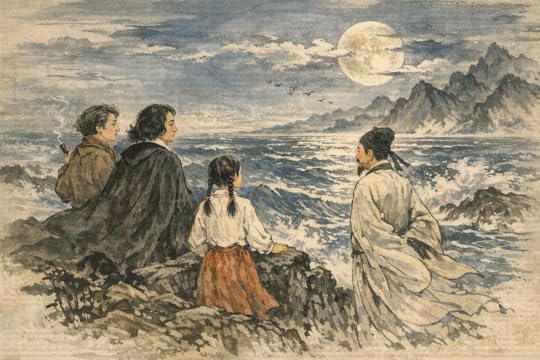
Some years after Lina and her father establish a more permanent residence in a high rise located deeper inside The Sea, Lina discovers a door in the building’s hallway that she is certain didn’t exist before that moment. Through this door, she meets three neighbours and finds that their residences all connect with each other and with the section of the building in which Lina and her father reside. These three new neighbours appear to have lived in the building for many years despite Lina only just having being made aware of them. As she begins to spend time with her new neighbours - Jupiter, Bento and Blucher - and makes them each aware of the stories told in the three volumes of books that she carries, they each regale her with tales of what they claim really occurred in the lives of the three historical figures presented in the books. As Lina listens to these tales and studies her new neighbours, she begins to see undeniable similarities between them and the figures they each seem to know so much about. What would feel like an impossibility of time and space in any other place begins to feel like a real possibility amidst the unanswerable question that is The Sea itself.
With The Book Of Records, Madeleine Thien has written a masterpiece of fiction that blends together a story about family, the different ways that history can be interpreted and remembered and a study on what our place is as humans in the larger fabric of time and space. I found myself taking small breaks at the end of each chapter just to gasp at both the sheer audacity and wonder of everything that I had just taken in. This book is reckless in it’s overall beauty and in it’s capacity to push your imagination and the boundaries of what you believe is possible.
Thank you to Knopf Canada and NetGalley for allowing me to read an advanced copy of this gorgeous story.
4.5, rounded up. This is not going to be for everyone, and reading it required greater focus and attention than anything else I've read this year. But the payoff was enormously satisfying.
I also realize that I'm one of the few people right at the middle of the Venn diagram for enjoying this novel: I'm a professional scholar in the history of philosophy, the Tang-dynasty poet Du Fu has been a lifelong inspiration to me, and I'm an absolute Hannah Arendt superfan. Since I already was familiar with most of the historical events and figures, and had a working knowledge of Thien's conceptual structures and theoretical framework, I could just sit back and let this wash over me.
But for many of you out there, this novel will probably sound like homework, or dramatized Wikipedia entries. And I'm not sure if a basic synopsis will convince anyone to pick this up.
Thien has piled up layer after layer of unwieldy elements, like a literary Jenga tower: near-future rising-seas cli-fi, extended philosophical ruminations and theoretical physics speculations on being and time, magic-realist speculations on past-life reincarnation, a tender broken family drama , richly-detailed immersive biographies of three great historical exiles, critiques of authoritarianism with Chinese characteristics, a purgatorial no-place where all spaces and times converge, the tensions between emotional truth and historical fact, optimal strategies in the game of Go, the problem of historical structures versus individual agency.
The novel is artfully structured, intercutting five different perspectives of one listener and four long-winded narrative voices. First, the adolescent Lina dutifully cares for her ill computer-scientist father, as they stop in a ramshackle floating city named The Sea to recover from their harrowing flight as climate refugees from mid-21st-century Foshan, China. This sprawling maze of retrofitted buildings are literally "made of time," welcoming travelers fleeing what appears to be a collapse of post-industrial societies amidst global warming, and appears to be a manifold connecting all times, spaces, and wanderers.
All that Lina owns are three books from a much larger set of "the lives of great voyagers," fictionalized children's narrative biographies of Du Fu, Baruch Spinoza, and Hannah Arendt. Her three next-door neighbors in The Sea-- Jupiter, Bento, and Blucher-- appear to be incarnations of these historical figures, who seem to have transcended time and space to recount their harrowing experiences of exile, freedom of conscience, and personal trauma. These three stories are thematically interconnected, and figures from one timelines pop into the others for cameo appearances.
In the novel's middle section, Thien narrates the biography of Lina's father Wui Shin, a brilliant cyberspace engineer, his impoverished and orphaned childhood, his meteoric educational success, his collaboration with the reigning techno-surveillance regime in China, his (un-?)principled betrayal of the woman he loves, and his ultimate quest for redemption. This seemed much closer to a David Mitchell novella, but the shift in tone makes it more affecting, and lends color and weight to the other narratives.
I hope this will give you an idea of the novel's too-muchness, and there's a lot of disbelief to be actively willed away. Not everything works or meshes, especially the rushed pacing of the final section, where Thien has left too much of Du Fu's biography to shoehorn in. Sometimes the cerebral ruminations crowd out the narrative's emotional impact, and there were moments when I wanted to be feeling more than thinking.
Many thanks to W.W. Norton and Netgalley for providing me with an ARC in exchange for an honest and unbiased review.
I struggled with this. The book is much smarter than I am. I appreciate the craftsmanship, the research, the writing, the imaginative structure of the novel - but it left me unmoved. Reading this often seemed like more chore than pleasure, although once I sussed out the characters and the infrastructure of the novel, it flowed more smoothly. I have no doubt this will be the recipient of many literary awards and I’m sure deservedly so. It just struck me as a novel to admire from afar, rather than hold next to my heart.
I’ll be interested to see what my Goodreads friends think of this.
tl;dr if i had a nickel for every time i’ve read a novel that starts with the phrase “The Book of” and is written by an Asian woman author, and has a magical realist bent, and is highly conceptual, as well as ambitious, but ultimately buckles neath the weight of its shotgun-approach to various topics including the pursuit of life, love, stability, oh and also features Walter Benjamin in its cast of characters, i’d have ten cents
Madeleine Thien’s The Book of Records spans space and time. In a cosmic search for the meaning of life, Thien introduces several philosophical minds across the ages, Du Fu, Baruch Spinoza, and Hannah Arendt, and sticks them in a magical building, The Sea, a temporal interlude-of-a-place for their wayfaring souls to consult each other.
At her best, Thien is able to construct a Mobius strip of feeling; the sense that joy and grief is a shared human experience across histories. Philosophy is a drop in the universe, but the search for answers, no matter how elusive, is the very essence of humanness itself. Also fun is the sense that the chapters we are reading are the books that Lina herself has been enamored with all her life. Are these embellishments, or are they true to the text? The novel thrums with life, and everything it has to say about books and connection is pretty much indisputable.
This is a lot. You can feel the polyphony of Thien’s narrators reach a crescendo towards the end, but the repetitive nature of their conversations quickly grows fatiguing. By the end, we’re being pummeled by philosophical observations that straddle platitudinous; the emotion of everything-going-on is sardinely crammed with the points Thien is trying to make. It gets suffocating.
This is also to say nothing of Thien’s overreliance on truly insipid, often baffling, and occasionally awful, figurative language. When I read something figurative, I want to feel as though something could not have been written or described in any other way. Thien’s metaphors and similes are distractingly bad. So bad in fact, I compiled a (lengthy) list of them for a friend. Here are just some that made me wince, cringe, or cackle:
“When he stood up, the world was soft as cake.” ???? also, so many mentions of cake. everyone’s eating cake.
“I turned the handle, but it was stuck and I had to jiggle it for a long time to get it open. Once it did, the click filled my ears like a bell.” the CLICK??? FILLED??? like a BELL???
“The horse’s eyes were universes in the twilight.” ???? is this how you describe stars reflected in the horse’s eyes????
”She busied herself by writing letters but words were flimsy, like hurling a carton of eggs at Hitler.” I CACKLED at this one
”Beethoven’s distant music was like the sun setting on the moon.” THE WHAT SETTING ON THE WHATNOW????
And these two, within a page of each other:
”As she typed, she experienced the freedom that only structure could create, as if she were the very tip of a bird’s wing.”
“Light stood on the cornices of facades, as if on the tip of a nose.”
It’s like the tip of a wing. It’s as if the tip of a nose. This is up to preference but when an author’s similes both call attention to the writing and are also this consistently bad, I’m fully taken out of reading or caring. If you’re a lover of figurative language, be warned that Thien’s constant attempts (the construction “as if” is used 233 times, “as a” 55) at simile/metaphor are frequently bad. It’s like, The Midnight Library bad.
So, if unlike me you can get past the writing, or if you somehow enjoy writing that describes birds “entangling like dozens of invisible wheels” (literally what the fuck does that even mean), maybe you’ll get more out of Thien’s philosophical dialogue through time and space. But these metaphors were like unmassageable knots in the shoulder of this novel. Like bumps in the worndown wooden roller coaster of life. A flat tire in the weary highway of existence. Or whatever.
The Book of Records is a story told by Lina as an older woman, fifty years after she and her father fled Foshan, China, and arrived at an enigmatic place called "The Sea," described as "a building made of time” where people from different eras can meet and get to know one another. In this time-melding way station, Lina interacts with three (real) people who also appear in three books she has managed to salvage from her previous life: a seventeenth-century Jewish-Portuguese scholar-philosopher from Amsterdam (Bento aka Baruch Spinoza), a female intellectual of World War II who fled Nazi persecution (Blucher aka Hannah Arendt), and a poet of Tang Dynasty in eight century China (Jupiter aka Du Fu).
Though they live (or lived) in different eras, they experienced many of the same issues, manifesting in different forms. Through their conversations within the space-time-warp, we learn the backstories of the five main characters: Lina, her father, and the three philosophers. Themes include memory, belonging, persecution, and displacement. It also explores the moral and emotional reckoning with the consequences of one’s decisions.
The author drops the reader into this unusual world right at the start. The occupants of this “time shelter” include many displaced people. It serves as a temporary refuge for these “time travelers” before they move on to their next “home.” Told in a non-linear style, it is an esoteric, philosophical novel, and not for anyone looking for a traditional plot. It is creative and thought-provoking, especially regarding “othering,” migration issues, and history repeating itself. I expect this book to be nominated for literary awards.
As overwhelmingly creative, thought provoking and impressive as this novel is, I did not have the mental stamina (or maybe just the basic intelligence) to stay with it. The best way I can describe it is to say that the layers and realities were interwoven and inverted into each other in a way that seemed almost mathematical. It was very beautiful, but very mirror-like and unreal. I have been, and very much remain, a huge fan of Madeleine Thien. This was just a little too much for me at this moment. (I’m not rating this because I don’t think I can do so properly.)
The Sea Within Us A Kindle ARC review of the Penguin Random House Canada hardcover/eBook/audiobook to be published May 6, 2025.
Heinrich said their problem was not that they over valued books but that they valued almost nothing else as highly.
The Book of Records is not an easy book to come to grips with on a first reading, especially as an eBook which I had *thanks* to a NetGalley ARC from the publisher. I think that I would enjoy a physical copy in order to more easily grasp its structure by being able to flip back and forth through its episodes. As it was it seemed as if it were 4 novellas which randomly shifted in and out of focus. And those novellas are told in maybe 10 or so episodes each which are not in a clear order.
You enter the book with the sense that it will be a sci-fi or cli-fi view into a flooded world of the future, a refugee crisis triggered by a climate crisis. By the end we learn that it is 100 years since the Three Gorges Dam (2006) project in China. A young girl Lina and her father are apparently stranded at a migrant waystation called The Sea. They are separated from the rest of their family for reasons that don't become clear until later. Lina reflects on their life and gradually she ages 50 years or so into the future and it becomes her life's memoir.
Among their few possessions are only 3 volumes of a set of 90 biographical books about famous personages. The 3 books are about writer Hannah Arendt (1906-1975), philosopher Baruch Spinoza (1632-1977) and Tang Dynasty poet Du Fu (712-770). The lives of the 3 historical figures are paralleled with people that Lina meets at The Sea. We learn about the historical lives in a seemingly random order while periodically returning to the future world. Each probably takes up about 1/4th of the book, but each is told in about 10 episodes spread throughout.
I previously only knew anything about Hannah Arendt and it sounded very true to the life story that I know, even if Thien is inventing the dialogues etc. It is basically Arendt's escape from Nazi Germany and then from Occupied France through Spain/Portugal and eventually to the USA. The Spinoza is his shunning by his Jewish community due to his atheism, so a different kind of running away. The Du Fu is about how the poet was not accepted for his poetry in his lifetime and was instead struggling to get a position at the Imperial Court to support his family.
So in a way it is 4 novellas making up a novel. The confusing element is that the stories drift in and out not necessarily in any order. It is Lina, Arendt, Spinoza, Du Fu, Lina, Du Fu, Spinoza, Arendt etc etc all randomly mixed up maybe 10 or so episodes for each. I guess each of the characters is escaping or migrating or being rejected by their societies in their own way. That is the connection as best as I can explain after a single reading.
While the order of the structure was confusing to me, each reading was immersive and I found myself quite engaged in each of the 4 story lines while I read them. I particularly enjoyed the passage about valuing books which I excerpted above. This is probably a 5-star for the writing and it is only my poor understanding and grasp which causes a reserved 4-star rating in this case.
My thanks to Madeleine Thien, Penguin Random House Canada and NetGalley for the opportunity to read this advance ARC copy for which I provide this honest review.
There is a podcast interview with Madeleine Thien about the process for the writing of The Book of Records at BBC Sounds, April 29, 2025.
There will likely be several reviews and interviews after publication that I'll add to this section. Initially there is an early summary at CBC Books from February 13, 2025.
"I suspect that our lives have run in parallel, that the two halves of our story can never end without the other...Love, he tells me, like devotion, leaves everything unfinished." 🌊💫📚 A radiant and deeply moving journey through time, memory, and human connection. By combining multiple histories and perspectives, this novel weaves a careful, tender tapestry of the best and worst parts of the human experience, the ways in which we search for belonging, and insightfully reveals how we as people connect to one another through eras, cultures, languages, because of the way that we feel so much universally: love, hope, grief, curiosity, fear. Intellectual, thought-provoking, but richly emotional and redemptive, The Book of Records is a powerful meditation on climate change, displacement, and how we draw and reform our own boundaries of time, self, of home. An ambitious novel that strikes straight to the heart.
Thank you so much to W.W. Norton for a copy of this incredible book!
“What we call now has no solidarity…We’re always falling through it.”
Oh, where to start. The Book of Records dazzles with its brilliance – intellectually rich, soberingly meditative, searingly provocative. It is, also in places, riveting, particularly when Thien zeros in on Hannah Arendt, Baruch Spinoza, and Tang Dynasty poet Du Fu.
But I’m getting ahead of myself. The book begins in the near future. A teenage girl, Lina, and her sickly father, Wui Shin, flee the flooded Pearl River Delta (and Lina’s mother and brother) and end up in a colossal migrant compound, overlooking “the Sea.” All they carry with them are three volumes of a series entitled The Great Lives of Voyagers. The volumes contain the histories of 20th century German-Jewish philosopher Arendt, 17th century Portuguese-Jewish scholar Spinoza, and 8th century Chinese poet Du Fu – each of whom struggled with authoritarianism and backlash in their own times. As soon as Lin and her father settle in, the doors slide open to their neighbors – Jupiter, Bento, and Blucher, who are the avatars for the three historical figures.
“The only way to really remember is to forget everything and let time fill the story up. To reach it through a different doorway.” So writes Thien. Indeed, the story gets filled up, as we readers begin to experience a more fleshed-out version of the three and what they had to endure – the collapse of their societies -- and ultimately, how taking responsibility for their lives leads to an open door for some sort of truth.
The author herself had this to say, “I always have the sense that Arendt, Spinoza, and Du Fu are thinking beside the reader. It’s as if there’s a hollow in their work and within this hollow there’s room for another person…with whom they are constantly, eternally in dialogue.” My reading experience is testimony to the author’s intention, and in many instances, I thrilled to it.
The Book of Records is chock full of philosophical ideas, but perhaps the most prominent is how to tell the story of the past to an eternally changing world; in short, memory and its altercations. One character says, “Maybe you and I should set sights on a world that emerges between each and every person. Maybe imagination is a way to find that place.” In another instance: “…when people like you and me have the training, expertise, and most of all the memory, should we leave governance to unprincipled fate? The most ethical way to predict the future is to invent it.”
Wow. Just wow. The book is brilliant, but it’s also quite challenging. There were times when I felt a little “lost at Sea”, slowing down, then speeding up, and trying to regain my moorings. I always admired, but didn’t always love, Book of Records. But one thing’s for sure: I’m very glad I read it. It has tendrils into the geo-political challenges we face today and I doubt I will soon forget it or ever read another book quite like it. I can’t thank W.W. Norton enough for providing me with an early copy in exchange for an honest review.
I didn't enjoy this at first, then got so into it that it became difficult to put it down and get some sleep, but then the ending fell quite flat for me. Seriously, the middle was SO good. But does that make the whole thing worth it? Novels like these irk me a bit - a story with some deep, hidden meaning that's never revealed, wrapped up in elaborately poetic writing in which you get the feel that even the author themselves doesn't know where to take the story.
This was a GoodReads 4.5 star (an EW 9) for me that was easy to round up. It has lots going on and is definitely the kind of book that will reward rereadings, which I quite value.
The Book of Records is a multi-strand exploration of of life in "interesting" times. Do we flee? If so, when? What compromises are acceptable? Which will haunt us? How many last minute surprises/tensions will we have to ride out?
Three of the strands the novel includes are based on the lives of historical figures: the Tang Dynasty poet Du Fu; Enlightenment philosopher Baruch Spinoza; and Hannah Arendt. The fourth stand, which takes place in an unidentified point in the future, follows Lina and her father who have moved from Foshan in China to "The Sea," a largely abandoned housing project along the coast of an unnamed ocean where refugees find themselves in a liminal sort of holding pattern: no longer in the land they've fled, but not yet in the new place where they will try to rebuild their lives.
The author moves among these four strands with minimal signaling, so reading demands a significant level of attentiveness, but the effort is more than repaid by the content of the novel. During the first shift from The Sea to Hannah Arendt, I had my doubts about whether this complex structure would work. I'm glad I continued reading. After a few more such shifts the structure became clearer, and I started to realize the sort of mindful riches that Thien is offering her readers.
If you like books that make you think and that offer interesting mixes of characters and time periods, you're in for a treat with The Book of Records.
I received a free electronic review copy of this title from the publisher via Edelweiss; the opinions are my own.
This may well be the best novel I have read this year, or for that matter, in any year. It contains multitudes, literally and figuratively, delving into major issues like war, migration, philosophy, history; how life and time intertwine.
I loved Madeleine Thien’s previous novel, Do Not Say We Have Nothing. I loved this one equally. She demands quite a lot of her readers which in turn means that she delivers hugely back to readers who are up to her demands. I felt more intelligent just because of reading both books.
This morning, I reread the first and last chapters. In times when most of the news is bad, from my viewpoint, I wonder if I should take a break from even listening to or reading the news. As I perused those first and last chapters, I realized that the news is a record of what is happening now that will become history. As depressing and discouraging as it can be, no matter which publication or outlet it comes from, it is the continuum between the past and the future. I was not there when the past happened and I will not be here when the future comes about, but I am part of that continuum.
I am not going to say more. There are numerous excellent reviews and interviews with the author which can add to your understanding of The Book of Records. But I will say, anyone who loves books, history, philosophical thought, or just stories, will find much to stimulate your involvement with the world. There are characters, both fictional and historical, that will grab you and not let go.
I will at some point read it again and I predict that I will find even more to understand and ponder when I do.
beautiful and philosophically & politically timely and forgiving and eminently quotable as always. as always the themes of historical repetition, desire for a better & more generous life, pain of loss & redemption, thinness of generational division are so compelling in thien's work. will update this w some of my favorite quotes when it's out, but this is such a gorgeous extension and expansion of ideas explored in do not say we have nothing which as you know if you know me is my favorite book until the end of time
On paper, this sounded like my kind of book — I loved the references to Spinoza and Arendt, and I was glad to learn about Du Fu. The intertwining of mathematics and philosophy into the storyline was right up my alley. But the writing… it was so inaccessible that the reading never quite flowed. Because of that finishing this book felt more like work than pleasure, and the closer I got to the end, the less motivated I was to keep going.
Intricate, and masterful in the craft, well-read, well-writ, but also oddly hollow. Abstract, abstracted, naval navel-gazing. A profound meditation on grief and displacement, but also three historical novels and one piece of cybernetic dystopian speculative fiction, and also autofiction, and also philosophy lecture notes, crammed together, pretty but failing to do justice, perhaps to either thought or feeling: reads as the author's commonplace book.
This gets the special "not rated, because the good in it I find undeserving, and the bad I find interesting."
This is an outstanding achievement of writing by Madeleine Thien, one that challenges the reader though attention is richly rewarded, a wonderful piece of story-telling. It’s an adventurous piece of work also, defying categorisation into genre.
In a haven for those displaced from their homelands called the Sea, a girl cares for her ailing father and is supported by fellow refugees from across the centuries. Time fluctuates. 17th century philosopher Baruch Spinoza, political philosopher Hannah Arendt on the run from Nazi occupied Germany, and Tang Dynasty poet Du Fu, are the protagonists of the three volumes in The Great Lives of Voyagers series Lina’s father managed to take as they fled from China. It is these stories that alternate and occupy the significant part of the book.
In the first half of the novel it is difficult to see what links Lina, her father, and these characters, and the narrative has a degree of the surreal about it. In the second part the link becomes clearer. Though this is an intellectual piece there are plenty of passages in it that contain riveting scenes of flight and terror, perhaps most of all, Arendt’s gruelling journey out of Germany which could well have made for a novel in itself.
This book is the highlight of Thien’s literary career to date, and surely a candidate for the Booker Longlist later this summer. I listened to the audio version, which takes a necessary 14 hours. I’m not sure I could have slowed my reading pace as much as that to get the equivalent from this exceptional book.
This isn't the type of book that I usually pick up, but despite that, I was very surprised that I ended up liking this.
This novel doesn't have a typical beginning, middle, and end. Instead, it focuses more on historical stories interwoven with each other alongside the main storyline. There's a cli-fi setting and an incident that elevate the stakes up a notch, so the main storyline with Lina and her father isn't just set dressing for the historical storylines.
I won't lie, the actual philosophy aspect is lost on me, but I definitely did enjoy the Hannah Arendt and Baruch Espinoza storylines. As someone who took a couple of critical theory courses during undergrad, it was really cool to see how these philosophers' personal lives shaped their thinking.
After reading about Hannah Arendt's extraordinary life (as reimagined in this novel), and with the rise of fascism in my own country, I have definitely elevated The Origins of Totalitarianism on my TBR. I never knew that a philosopher's life could be so interesting and so tragic. Kudos to this book for (re)introducing me to a very important and very topical read.
Thank you to W. W. Norton & Company and NetGalley for this arc.
July 2025, DNF at 20%. I really wanted to love this one, but it’s the writing this time. A strange mix of themes too obvious and close to the surface plus a considerably lavish application of metaphors and similes, perhaps to thinly veil the messaging — with which I seemingly agree, nonetheless.
reading The Book of Records felt less like following a conventional narrative and more like entering a carefully constructed intellectual and emotional space, one that invites patience, reflection and an openness to uncertainty. Madeleine Thien has written a novel that resists simplification and it is precisely this resistance that makes the book so rewarding. at its heart, the novel is concerned with how lives are recorded, remembered and interconnected across time and how personal histories are inseparable from broader cultural and political currents.
the story unfolds through a narrator whose quiet, observant voice becomes the reader’s guide through a layered world of relationships, memories and texts. rather than relying on dramatic plot twists, Madeleine Thien builds momentum through accumulation: fragments of stories, conversations and historical echoes gradually assemble into something resonant and profound. the characters encountered along the way feel thoughtfully rendered, not as symbolic stand-ins, but as individuals shaped by exile, loss, intellectual curiosity and an enduring need to understand where they belong. their interactions are understated yet emotionally charged, revealing how intimacy can grow through shared ideas as much as shared experiences.
what distinguishes The Book of Records is its ambitious engagement with history and philosophy without ever becoming didactic. the author weaves references to literature, political upheaval and collective memory into the fabric of the novel so seamlessly that they feel organic rather than ornamental. the past is never treated as a distant backdrop; instead, it presses insistently into the present, shaping identities and ethical choices. the novel asks difficult questions about what it means to bear witness, who gets to record history and how narratives (personal or national) are preserved or erased.
ultimately, The Book of Records earns its 5-star rating not through spectacle, but through depth, intelligence and emotional integrity. it is a novel that trusts its readers, offering complexity instead of easy answers and connection instead of closure. by the time the final pages are reached, the reader is left with a heightened awareness of how stories (both written and lived) shape our understanding of the world and of one another. it is a book that does not merely ask to be read, but to be contemplated and its quiet power lies in how fully it rewards that attention.
Wow, I found this novel purely phenomenal and powerfully resonant. Through the construction of a nightmarish yet utterly believable future, and tying this vision with flashbacks to similar episodes in history, it shows a common theme: of individuals trapped in the sweep of history of authoritarian, unaccountable governments, whose whims and decisions can lead to the uprooting of the lives of mere individuals, catastrophic displacement, and the suppression of individual thought.
Part I features the perspective of a young girl from the future, a displaced person seeking hapless refuge in a former military base in the South China Sea that's transformed into a hodgepodge, claptrap pile of temporary residences for similar refugees awaiting permits and places in boats transporting them to more permanent land. While waiting for her fate, the girl seeks solace in the company of two friends, and battered books about the lives of great persons of the past. Central to these volumes are three people in particular: the poet Du Fu, the philosophers Hannah Arendt, and Baruch Spinoza. Through flashbacks of their lives, a common theme that emerges seems to be that they are all individuals driven to expulsion or exile (or potential extermination, in Hannah's case) due to their beliefs or identities, which were incongruent with the orthodoxy of their ruling governments. All three struggle with questions arising from the isolation of their social positions as labeled outsiders. Is there a soul that survives and contains love and happiness? Is pursuit of truth via reason worth all costs, including forfeiture of belonging to safe religious doctrine? Is an individual path of honor and the calling of poetry worth the price, or is compromise through service to a fallible government acceptable, if it leads to belonging, public service and status?
Part II shows the flashback of the girl's father's life, and what led to their current tribulations. Spoiler Warning
The sentences in this book are incredibly beautiful and pensive, too, whether dispatched to describe the scenery or to set off a train of thought.
For instance, in description of the ruling government's ideology: ""A country cannot develop and transform this fast unless it leaves the souls of its people behind.""
""What the government is after, and what we loyal souls must achieve, is the happiness of the many. It is inevitable, a fact of society, that some people fall into the wayside.""
Of chess: ""This simple mutation (of moves) generates a different universe. With two moves, the player is faced with more freedom. Greater freedom equals greater incoherence. When the dimensions of the world are transformed, our trusted strategies are revealed for what they are: ridiculous. "Nothing is recognizable. "The player, too by necessity, becomes unrecognizable to herself." "They played until Hannah could stand it no more, and in a fit of rage, flipped the board, shocking them both. But a scorched earth policy changed nothing. After the massive destruction, the board was simply reset, according to the very same rules."" As in chess, so in history, and the repeat of the political cycles that governed us, and in doom may govern us yet again.
A novel that brings together stories of displacement and uprooting across time and space, finding beauty and sadness and affinities between Du Fu, Spinoza, Arendt and the fictional characters from near-future China. Profoundly moving, poignant and horribly timely, in a time of refugee crisis, government inhumanity in US and Europe, rise of fascism. Thien's story is intricately constructed and thought-out. I wanted there to be more at the end - but that's also quite fitting.
I am not sure how to review this book. I'm not even sure how I feel about it?
The shortest way for me to describe this book is that it's a very philosophical book, about philosophers philosophizing - but while on harrowing adventures.
And generally, I'm into that, although, I think it would have helped to know that going in. Instead, I was expecting something more like Thien's Do Not Say We Have Nothing, a book I loved and greatly admire.
When it became clear that I didn't totally get what was going on, I tried to let it wash over me and I found myself rapt in places and highlighting many passages in others. I think it might be better on re-read because there is so much depth to mine, but I'd have to be in the right mindset to dive in again.
In some ways, it reminded me of Cloud Cuckoo Land - with interwoven stories from different moments of history, but unlike Cloud Cuckoo Land, it was anchored in history and reality in a way that resonated much more with me. I definitely felt a much stronger emotional connection to the story and the characters.
On paper, I can see that this is quite the literary achievement but it's also a puzzle that I'm not sure I totally solved, which takes away from the experience for me a little bit, hence the four stars.
I received a digital Advance Reader Copy from NetGalley and Penguin Random House Canada in exchange for an honest review.
This was my first read by Madeleine Thien and The Book of Records is quite an inventive and multi-layered story! I really enjoyed the creativity in this writing as it blurs the boundaries of time and characters. The three historical figures are interwoven with care and rich thought. I especially liked the part about the Chinese poet Du Fu. The story within a story aspect was so interesting and I’m very curious to read this author’s other book Do Not Say We Have Nothing.
Thank you to the publisher via NetGalley for my ARC!
"The Book of Records" от Маделин Тиен е мащабен и многопластов роман, който отказва да бъде вместен в каквито и да било жанрови рамки. Подходих към книгата с очакването, че ще чета нещо в духа на дистопична проза, но скоро разбрах, че тук ме очаква нещо съвсем различно. Отне ми известно време, докато се ориентирам в преплетените сюжетни линии, но именно това структурно разгръщане, този отказ от опростеност, прави романа толкова въздействащ.
В центъра е Лина момиче, което бяга с болния си баща към място, наречено просто „Морето“ метафорична зона на бездържавност. Нейни спътници са не хора, а трите тома на енциклопедията Великите пътешественици Ду Фу, Спиноза и Хана Аренд , тези личности започват да се смесват с реалността на Лина, докато многократно препрочита томовете. Получава се разказ с размити граници, където история, философия и личен опит се отразяват едни в други.
Честно казано, най-силно ме ангажира историята на Лина, както и епизодите с живота на Хана Аренд въпреки че тя е добре позната фигура, Тиен вписва нейния път във Втората световна война по начин, който откроява връзките с други, далеч по-непознати времена. Комбинацията между познат и непознат исторически контекст обогатява четенето и дори ме подтикна да проуча дали в романа се появяват действителни личности. За мен беше особено ценно да чуя интервю с Тиен, в което тя споделя, че е загубила много хора, но че "The Book of Records" не е роман само за смъртта. Това насочване към темата за загубата помага на читателя да навлезе по-дълбоко в философската страна на книгата и да приеме нетрадиционната ѝ структура като според мен е умишлено избран път към размисъл и съпричастие.
Стилът на Тиен се движи между лек и неангажиращ текст и философска наситеност, като често изоставя линейния наратив в полза на нещо по-абстрактно. Романът е разглегда в дълбочина изгнанието и оцеляването, но не чрез драматични обрати, а чрез малки жестове на мисъл, памет и устойчивост. Историята на Лина и историческите епизоди подчертават цената на авторитаризма и необходимостта от човешко достойнство.
"The Book of Records" е взискателна книга. Философската ѝ дълбочина и нелинейната ѝ структура ще изпитат търпението на читатели, търсещи ясно дефинирани сюжети, но за онези, които ценят литературата като провокация и теми размисъл, този роман е истинско съкровище.
Много бих се радвала книгата да бъде номинирана за Букър, защото вярвам, че така ще получи нужното внимание.
I had to abandon ship at 20% as this was an excruciating slog for me. I'm sure this novel will find its readers, but I was not up for the very disjointed writing and the mix of historical figures and stories jumbled with an odd speculative sort of fantasy/science fiction setting. This is a very philosophical novel with DEEP THOUGHTS and I just did not have the patience or bandwidth to keep on with it. Thank you to NetGalley and W. W. Norton & Company for providing me with a digital review copy.