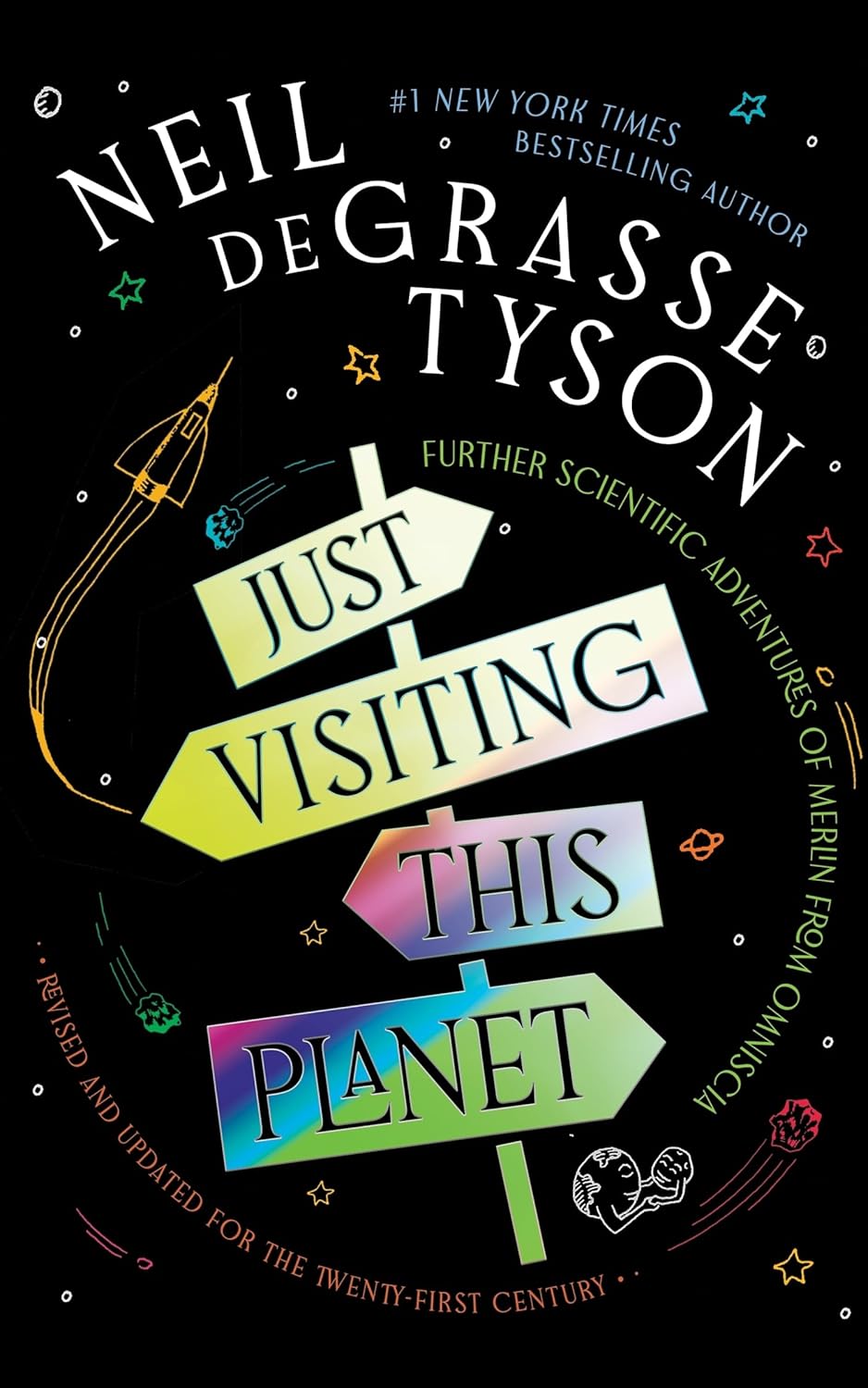
From Neil deGrasse Tyson, #1 New York Times bestselling author of Astrophysics for People in a Hurry, comes a spirited journey to the planets and stars, revealing the answers to many mysteries of our galaxy and beyond.
In this companion volume to Merlin's Tour of the Universe, we visit again with Merlin, a timeless space traveler from Planet Omniscia, who answers a collection of imaginative questions about the cosmos from curious stargazers. Whether waxing poetic about Earth and its environs, the Sun and its stellar siblings, the world of light, physical laws, or galaxies near and far, Merlin's remarks are engaging, humorous, and clear as a starry night sky.
Merlin tackles such conundrums as:
• If aliens exploded Earth's moon, what effect would it have on us? • Are black holes gathering matter in preparation for another Big Bang in another time and dimension? • Why does the Moon look bigger on the horizon?
Lively and entertaining, Just Visiting This Planet is an indispensable guidebook to the universe.
Neil deGrasse Tyson was born and raised in New York City where he was educated in the public schools clear through his graduation from the Bronx High School of Science. Tyson went on to earn his BA in Physics from Harvard and his PhD in Astrophysics from Columbia.
In 2001, Tyson was appointed by President Bush to serve on a twelve-member commission that studied the Future of the U.S. Aerospace Industry. The final report was published in 2002 and contained recommendations (for Congress and for the major agencies of the government) that would promote a thriving future of transportation, space exploration, and national security.
In 2004, Tyson was once again appointed by President Bush to serve on a nine-member commission on the Implementation of the United States Space Exploration Policy, dubbed the “Moon, Mars, and Beyond” commission. This group navigated a path by which the new space vision can become a successful part of the American agenda. And in 2006, the head of NASA appointed Tyson to serve on its prestigious Advisory Council, which guides NASA through its perennial need to fit ambitious visions into restricted budgets.
In addition to dozens of professional publications, Dr. Tyson has written, and continues to write for the public. From 1995 to 2005, Tyson was a monthly essayist for Natural History magazine under the title Universe. And among Tyson’s fifteen books is his memoir The Sky is Not the Limit: Adventures of an Urban Astrophysicist; and Origins: Fourteen Billion Years of Cosmic Evolution, co-written with Donald Goldsmith. Origins is the companion book to the PBS NOVA four-part mini-series Origins, in which Tyson served as on-camera host. The program premiered in September 2004.
Two of Tyson’s other books are the playful and informative Death By Black Hole and Other Cosmic Quandaries, which was a New York Times bestseller, and The Pluto Files: The Rise and Fall of America’s Favorite Planet, chronicling his experience at the center of the controversy over Pluto’s planetary status. The PBS NOVA documentary The Pluto Files, based on the book, premiered in March 2010.
In February 2012, Tyson released his tenth book, containing every thought he has ever had on the past, present, and future of space exploration: Space Chronicles: Facing the Ultimate Frontier.
For five seasons, beginning in the fall of 2006, Tyson appeared as the on-camera host of PBS NOVA’s spinoff program NOVA ScienceNOW, which is an accessible look at the frontier of all the science that shapes the understanding of our place in the universe.
During the summer of 2009 Tyson identified a cadre of professional standup comedians to assist his effort in bringing science to commercial radio with the NSF-funded pilot program StarTalk. Now also a popular Podcast, for three years it enjoyed a limited-run Television Series on the National Geographic Channel. StarTalk combines celebrity guests with informative yet playful banter. The target audience is all those people who never thought they would, or could, like science. In its first year on television and in three successive seasons, it was nominated for a Best Informational Programming Emmy.
Tyson is the recipient of twenty-one honorary doctorates and the NASA Distinguished Public Service Medal, the highest award given by NASA to a non-government citizen. His contributions to the public appreciation of the cosmos have been recognized by the International Astronomical Union in their official naming of asteroid “13123 Tyson.” And by zoologists, with the naming of Indirani Tysoni, a native species of leaping frog in India. On the lighter side, Tyson was voted “Sexiest Astrophysicist Alive” by People Magazine in 2000.
More recently, Tyson published Astrophysics for People In A Hurry in 2017, which was a domestic and international bestseller. This adorably readable book is an introduction to all that you’ve read and heard about that’s making news in the universe—consummated, in one plac
I enjoyed this book. That's right, it's a science book and I enjoyed reading it. I think anyone with a curious mind would enjoy reading Tyson's explanations of natural phenomena. I learned more than I thought possible about astrophysics. By the end of the book my understanding of gravity, speed of light, time, and energy were greatly expanded; but, at the same time, I experienced muddled thoughts and confusion. I didn't have a discouraged feeling, I was just reminded of how much I haven't learned, haven't asked, and would like to know.
The book is arranged into questions and answers. The questions are posited by a diverse population (as in differing backgrounds of understanding); and the answers to these questions are provided by Merlin, an extra-terrestrial from Omniscia in the Andromeda Galaxy. Some of the questions, I can relate (might have asked Merlin those same questions); but some of the questions were about phenomena of which I have no background understanding---so some of the answers I didn't really understand.
Merlin, as described in book, is as old as the earth and has come to the earth to observe and learn about the scientific understandings of earthlings. He is most intrigued by the questions humans ask and also by the scientific minds that have discovered so much about physics of earth.
Whether a reader has much science background or little, he or she will be intrigued by the concise way Merlin answers questions; and like me, the reader will likely be impressed with the speed at which they leap through the book.
I am duly surprised that I read a science book, written by an astrophysicist, within a span of two days. I'd have read the book in one sitting if I had not been interrupted. I have little scientific background, but it felt like this book was written with me in mind. It expanded my understanding of my planet in relation to the universe and spurred a lot of questions that this book didn't answer. After reading this book, I'm more curious about phenomena that make life possible, the Big Bang theory, recent scientific discoveries, and possibility of existence of life in other galaxies. Merlin explained very difficult concepts in a fun, and lighthearted way. I ended the book with this question: how in the world could such difficult science be explained with such clear, brief, and concise explanations?
Reading Just Visiting This Planet by Neil deGrasse Tyson felt like sitting around a cosmic campfire with the universe’s most charming astrophysicist except he’s wearing a wizard’s hat and answering fan mail from curious stargazers across the galaxy.
Presented as a follow-up to Merlin’s Tour of the Universe, this book lets us eavesdrop on conversations between Merlin, an immortal space traveler from Planet Omniscia, and the endlessly imaginative minds of humans wondering about, well, everything. From “what happens if aliens blow up the Moon?” to “are black holes saving up for another Big Bang?” Merlin’s answers are a delightful blend of hard science, humor, and wonder!
What I love most is how Tyson manages to make even the wildest cosmic thought experiments feel approachable. The science never gets so heavy it weighs you down it’s buoyed by Merlin’s wit and a genuine sense of awe. I found myself laughing at one page and then quietly marveling at how small and yet significant we are in the grand sweep of the cosmos on the next.
It’s the kind of book that makes you want to look up at the night sky and whisper, “Okay, Merlin, what else are you hiding up there?”
Some of the questions posed and the way they are answered made me laugh out loud. The author should know I live in Ohio and 3 of my sons attended Kent State University, so the question from Kent, Ohio, my personal favorite 🤗 I would have given this 5 stars but some of the questions and answers were so far out of my wheelhouse, that I was just confused.
I adored Neil deGrasse Tyson on Jeopardy, The Big Bang Theory, among other times I've seen him. I'd recommend this!!!
Thank you to the author, publishers and Goodreads for giving me the opportunity to read and review ☺️ Thank you for trusting me with your words!
Disclaimer - I received this in a Goodreads giveaway.
This book opened my eye to space and all of its wonders. Merlin is a great character to answers these questions that people with lingering questions. Merlin is a alien that knows much about space, time and everything in those lines. I recommend this book to anyone who wants to know more about the universe. (also Merlin talks in third person, so if you're not a big fan of third person maybe look for another space question book)
As a fan of Neil deGrasse Tyson, I was excited to read this book, however it is essentially a "Cosmic Queries" episode of his podcast in written form. He's also answering as an alien named Merlin. I was hoping for something more in-depth.
This was a really good book. Like the question and answer format. Lot of good easy to digest info. The sarcasm of Merlin was humourous if not scathing. Sometimes it was justified due to the question being asked, others I felt if maybe Merlin should have had his morning coffee before answering.
The title’s holographic sheen not only catches the sun’s ray perfectly, it also captured my imagination and prompted an impromptu visit to the science museum & planetarium.
I totally geeked out on 𝘑𝘶𝘴𝘵 𝘝𝘪𝘴𝘪𝘵𝘪𝘯𝘨 𝘛𝘩𝘪𝘴 𝘗𝘭𝘢𝘯𝘦𝘵 in one single sitting, which reads much like an advice column except with Dear Merlin for the inquiring minds about all things space-y. You can flip and start from anywhere inside this book. Expect to see elaborate lines of questioning (e.g. on p. 10) to simple inquiries like, “why can’t I feel Earth’s rotation?” Regardless of the questions being asked, Merlin from Planet Omnisca always has an answer.
I enjoyed the witty and quirky remarks even when the astrophysics went well above my head. It invoked a genuine curiosity that encouraged research and further doom scrolling on many different subject matters of the cosmos. This clever and accessible approach to learning more (than you want to know) about the universe is like a ravenous and unrelenting black hole - everything, including the simple yet playful illustrations, sucked me right in. Didn’t think I could possibly learn anything while being humored at the same time. Merlin proved me wrong. I’m still tickled over his answer on page 26.
Highly recommending this one.
Thank you Blackstone Publishing & BiblioLifesyle for my review copy.
Just Visiting This Planet raises my interest in science, and this I can honestly say that Neil DeGrasse Tyson motivates me do further research because of the subjects presented. I didn't know that the color of the moon can affected by air pollution. I want to learn more about what other objects or events could change the color of the moon. I didn't know that galaxies have different shapes. I want to learn about the visual difference between a spiral galaxy and an elliptical one. I learned that the atomic weight of a chemical element is determined by the number of protons in the nucleus. I never took chemistry, so I want to learn what a proton does. I learned about the Drake equation. The Drake equation analyzes different factors like stars and the technological capabilities of planets to determine if intelligent life is possible. I find intelligent life on other planets to be a fascinating subject, so I vow to learn more the Drake equation. I love learning new scientific insights from reading this book.
Thank you @bibliolifestyle @blackstonepublishing for the gifted copy of Just Visiting This Planet!
This is a companion to Merlin’s Tour of the Universe, which I loved. Both books use a fun Q&A structure, with Merlin, a fictional space traveler, answering imaginative questions about the universe and our place in it.
Tyson is always great at making big concepts feel accessible, but while the first book’s questions felt helpful and easy to follow, this volume was trickier for me. Many of the questions were denser than I expected or presupposed knowledge I just… didn’t have. And once I was lost on the question, the answer sounded like adults talking in a Charlie Brown movie. This only happened occasionally in Merlin’s Tour, but here it felt much more common. Because of that, I’m not sure I’d recommend this one unless you already have a pretty solid understanding of astrophysics.
🔹The book is a collection of questions and answers, which are grouped into chapters or categories. 🔹The information presented is fun to read, but it doesn’t have a structure, so it’s hard to remember; the information is scattered. 🔹The author’s style is always a pleasure to encounter because he mixes fun with information. 🔹Many of the pieces of information presented in the book can also be found in DeGrasse Tyson’s other books.
Cosmic question and answer sessions with a fictional character that explains science principals. This short form, easy to read book is the perfect distraction to everyday drama & petty divisions. To read about the moon, black holes, gravity, space, etc. is a grounding activity that helps me learn and makes me even more curious. There is so much hope in discovering new space knowledge. Thank you, Neil. Enjoy !