

What do you think?

The Chronicles of Thomas Covenant the Unbeliever #2
The Illearth War
After scant days in his "real" world, Thomas Covenant found himself again summoned to the Land. There forty bitter years had passed, while Lord Foul, immortal enemy of the Land, moved to fulfill his prophecy of doom.
The Council of Lords found their spells useless, now that Foul the Despiser held the Illearth Stone, ancient source of evil power, High Lord Elena turned in desperation to Covenant and the legendary white hold magic of his ring. And nobody knew how to use the white hold--least of all, Thomas Covenant.
Thus continues one of the most remarkable epic fantasies ever written...
The Council of Lords found their spells useless, now that Foul the Despiser held the Illearth Stone, ancient source of evil power, High Lord Elena turned in desperation to Covenant and the legendary white hold magic of his ring. And nobody knew how to use the white hold--least of all, Thomas Covenant.
Thus continues one of the most remarkable epic fantasies ever written...
527 pages, Mass Market Paperback
First published September 1, 1978
About the author
Stephen R. Donaldson
143 books2,789 followersStephen Reeder Donaldson is an American fantasy, science fiction, and mystery novelist; in the United Kingdom he is usually called "Stephen Donaldson" (without the "R"). He has also written non-fiction under the pen name Reed Stephens.
EARLY LIFE AND EDUCATION:
Stephen R. Donaldson was born May 13, 1947 in Cleveland, Ohio. His father, James, was a medical missionary and his mother, Ruth, a prosthetist (a person skilled in making or fitting prosthetic devices). Donaldson spent the years between the ages of 3 and 16 living in India, where his father was working as an orthopaedic surgeon. Donaldson earned his bachelor's degree from The College of Wooster and master's degree from Kent State University.
INSPIRATIONS:
Donaldson's work is heavily influenced by other fantasy authors such as J.R.R. Tolkien, Roger Zelazny, Joseph Conrad, Henry James, and William Faulkner. The writers he most admires are Patricia A. McKillip, Steven Erikson, and Tim Powers.
It is believed that a speech his father made on leprosy (whilst working with lepers in India) led to Donaldson's creation of Thomas Covenant, the anti-hero of his most famous work (Thomas Covenant). The first book in that series, Lord Foul's Bane, received 47 rejections before a publisher agreed to publish it.
PROMINENT WORK:
Stephen Donaldson came to prominence in 1977 with the The Chronicles of Thomas Covenant, which is centred around a leper shunned by society and his trials and tribulations as his destiny unfolds. These books established Donaldson as one of the most important figures in modern fantasy fiction.
PERSONAL LIFE:
He currently resides in New Mexico.
THE GRADUAL INTERVIEW
EARLY LIFE AND EDUCATION:
Stephen R. Donaldson was born May 13, 1947 in Cleveland, Ohio. His father, James, was a medical missionary and his mother, Ruth, a prosthetist (a person skilled in making or fitting prosthetic devices). Donaldson spent the years between the ages of 3 and 16 living in India, where his father was working as an orthopaedic surgeon. Donaldson earned his bachelor's degree from The College of Wooster and master's degree from Kent State University.
INSPIRATIONS:
Donaldson's work is heavily influenced by other fantasy authors such as J.R.R. Tolkien, Roger Zelazny, Joseph Conrad, Henry James, and William Faulkner. The writers he most admires are Patricia A. McKillip, Steven Erikson, and Tim Powers.
It is believed that a speech his father made on leprosy (whilst working with lepers in India) led to Donaldson's creation of Thomas Covenant, the anti-hero of his most famous work (Thomas Covenant). The first book in that series, Lord Foul's Bane, received 47 rejections before a publisher agreed to publish it.
PROMINENT WORK:
Stephen Donaldson came to prominence in 1977 with the The Chronicles of Thomas Covenant, which is centred around a leper shunned by society and his trials and tribulations as his destiny unfolds. These books established Donaldson as one of the most important figures in modern fantasy fiction.
PERSONAL LIFE:
He currently resides in New Mexico.
THE GRADUAL INTERVIEW
Ratings & Reviews
Friends & Following
Create a free account to discover what your friends think of this book!
Community Reviews
Displaying 1 - 30 of 560 reviews

July 30, 2011
Stephen R. Donaldson’s Lord Foul’s Bane was a hot mess of dark fantasy, most notably as having one of the least likeable protagonists in literature, inspiring me to make comparisons with Nabokov’s H. Humbert.
Thomas Covenant is a leper, no fault of his own, but what he is faulted with is his tragic crime against a sweet and trusting young character. Covenant, a man of our world, strangely transported to “The Land” – rich, vibrant, healthy and alive – as a victim of leprosy, is in stark contrast with the healthfulness of Donaldson’s world building. It was my theory that the author intentionally made Covenant uncharismatic to demonstrate a glaring distinction with the Land, making imperfect people from our world stand out in hyperbolic relief.
Another mystery from the first book was whether Covenant had dreamed – shades of Dorothy in Oz – his adventure in the Land. Donaldson explored this enigma by having Covenant be known as the Unbeliever and having him candidly discuss this idea with people from the Land.
This mystery is further investigated in Donaldson’s second book, The IllEarth War, as about half the book is told from the perspective of another transportee from our world, the blind Hile Troy.
Like Thomas Covenant, Troy, as unfortunate representative of our sad and diseased world, comes to the land with a severe disability. For Troy, he was born sightless, actually born without eyes at all, making him, like Covenant, a Eudora Welty-esque grotesque in the bright and beautiful sunshine of the Land. Ironically, Troy gains magical sight and becomes a leader in the land; and, unlike Covenant, not only believes in the vitality of the Land but he wants to defend with his life the giver of this great gift.
While only a few days goes by in Covenant’s time, more than forty years has passed in the Land, and Elena, daughter of Lena and Covenant is High Lord and we are faced with a sad tale of giants and ravers and Lord Foul’s nefarious attacks on the Land. Elena has been taught no ill will against her father and in fact has some curious designs for him, seeming to validate the idea that Donaldson wants to make his readers uncomfortable.
The world building and writing are excellent, but like Lord Foul’s Bane, our writer seems to have an ulterior motive in asking much from his readers. Exciting, thought provoking, but also frustrating and difficult to follow, this is still good reading in this genre and fans of Gene Wolfe may try this very dark story on for size.
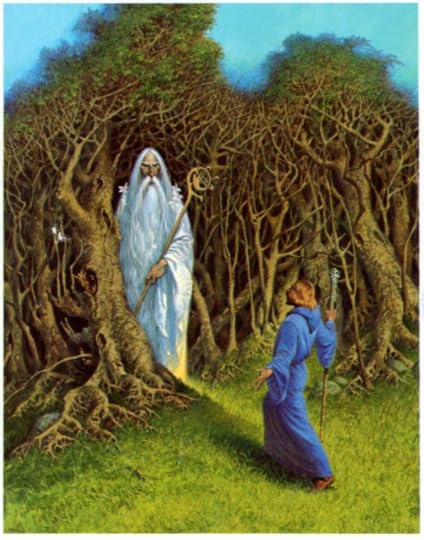
Thomas Covenant is a leper, no fault of his own, but what he is faulted with is his tragic crime against a sweet and trusting young character. Covenant, a man of our world, strangely transported to “The Land” – rich, vibrant, healthy and alive – as a victim of leprosy, is in stark contrast with the healthfulness of Donaldson’s world building. It was my theory that the author intentionally made Covenant uncharismatic to demonstrate a glaring distinction with the Land, making imperfect people from our world stand out in hyperbolic relief.
Another mystery from the first book was whether Covenant had dreamed – shades of Dorothy in Oz – his adventure in the Land. Donaldson explored this enigma by having Covenant be known as the Unbeliever and having him candidly discuss this idea with people from the Land.
This mystery is further investigated in Donaldson’s second book, The IllEarth War, as about half the book is told from the perspective of another transportee from our world, the blind Hile Troy.
Like Thomas Covenant, Troy, as unfortunate representative of our sad and diseased world, comes to the land with a severe disability. For Troy, he was born sightless, actually born without eyes at all, making him, like Covenant, a Eudora Welty-esque grotesque in the bright and beautiful sunshine of the Land. Ironically, Troy gains magical sight and becomes a leader in the land; and, unlike Covenant, not only believes in the vitality of the Land but he wants to defend with his life the giver of this great gift.
While only a few days goes by in Covenant’s time, more than forty years has passed in the Land, and Elena, daughter of Lena and Covenant is High Lord and we are faced with a sad tale of giants and ravers and Lord Foul’s nefarious attacks on the Land. Elena has been taught no ill will against her father and in fact has some curious designs for him, seeming to validate the idea that Donaldson wants to make his readers uncomfortable.
The world building and writing are excellent, but like Lord Foul’s Bane, our writer seems to have an ulterior motive in asking much from his readers. Exciting, thought provoking, but also frustrating and difficult to follow, this is still good reading in this genre and fans of Gene Wolfe may try this very dark story on for size.

January 22, 2016
I find myself in the unenviable position of rooting for Lord Foul Bane and his many loathsome minions. Maybe it's just the intentional feature of making all the good guys so perfectly good and forgiving and nonviolent and understanding, but Thomas Covenant DOES NOT DESERVE IT.
Therefore, I really want to see Lord Foul Bane corrupt every single one of those bastards solely for the purpose of rising up and smiting that worthless son of a bitch, the Ur-Lord Thomas Covenant.
If it wasn't crazy enough that the Rape-Child of TC loves her Rape-Father so much that she summons him from our world to save their cut-out-heaven, she thinks she's in love with him and throws herself at him.
Yes, she's his daughter.
Not only does every character in the Land have no more dimensionality than a piece of toilet paper, but their insane levels of acceptance, even when a rage-filled father goes after TC or when the only true hero of the tale attempts to smite TC across his head, no one gets his just deserts. The grand heroic general who deserves every accolade gets transformed into a tree, and this is despite the fact that he was summoned from the our world, just like TC. He was also the most interesting character of the bunch.
So what was actually good about this book?
Well, the battles and battles and endless battles and strategy wasn't as bad as I've read elsewhere, but it isn't my cup of tea. It reminded me of the bad old days of WoT books 7 and 8, or perhaps a bit worse, because I cared less for the Land or its characters.
Some of the fantasy elements were pretty good, though, and what's not to love about bone melding and turning a combatant's bones to ash, letting the meat sack tumble to the ground? I got into this book only late, and completely to spite TC. Good thing most of the novel didn't have TC in it, or I might have gotten through an entire season of a TV show I'm way far behind on instead of just half of it, all in a desperate attempt to alleviate the boredom I felt while reading this godforsaken novel.
I can understand why people might revere this, considering the amount and kinds of fantasy trash that might have been out and about at the time it was written. I understand why it changed the face of old fantasy, just as I understand the Mallorean books did the same.
But the fact is, they all lack the gritty realism and complexly developed characters that I have come to revere in modern fantasy, and I just can't get behind it.
Having far off pining and far off horrors and far off hopes and plans is just BORING as hell to me, and if it can't be shored up by characters that learn and develop and change when faced with singular events that OUGHT to change them, then all we've got is a spoiled asshole who's turned a veritable heaven into an ongoing hell and he actually BELONGS on the side of Lord Foul Bane and he always will. The fact that he was summoned by LFB's minion in the first place should be a dead giveaway, but what the hell do I know?
It's not like Lord Wonderful Kevin (Don't get me started with the silliness of that name, the wonderful ancient godlike hero and destroyer of the Land) had anything to do with TC's summoning, like everyone thought. It looks like everyone has been fooled, and fooled good. Maybe I'm right about TC's direction. I don't know. I'm going to have to summon superhuman stores of patience to pick up the third book to find out.
Therefore, I really want to see Lord Foul Bane corrupt every single one of those bastards solely for the purpose of rising up and smiting that worthless son of a bitch, the Ur-Lord Thomas Covenant.
If it wasn't crazy enough that the Rape-Child of TC loves her Rape-Father so much that she summons him from our world to save their cut-out-heaven, she thinks she's in love with him and throws herself at him.
Yes, she's his daughter.
Not only does every character in the Land have no more dimensionality than a piece of toilet paper, but their insane levels of acceptance, even when a rage-filled father goes after TC or when the only true hero of the tale attempts to smite TC across his head, no one gets his just deserts. The grand heroic general who deserves every accolade gets transformed into a tree, and this is despite the fact that he was summoned from the our world, just like TC. He was also the most interesting character of the bunch.
So what was actually good about this book?
Well, the battles and battles and endless battles and strategy wasn't as bad as I've read elsewhere, but it isn't my cup of tea. It reminded me of the bad old days of WoT books 7 and 8, or perhaps a bit worse, because I cared less for the Land or its characters.
Some of the fantasy elements were pretty good, though, and what's not to love about bone melding and turning a combatant's bones to ash, letting the meat sack tumble to the ground? I got into this book only late, and completely to spite TC. Good thing most of the novel didn't have TC in it, or I might have gotten through an entire season of a TV show I'm way far behind on instead of just half of it, all in a desperate attempt to alleviate the boredom I felt while reading this godforsaken novel.
I can understand why people might revere this, considering the amount and kinds of fantasy trash that might have been out and about at the time it was written. I understand why it changed the face of old fantasy, just as I understand the Mallorean books did the same.
But the fact is, they all lack the gritty realism and complexly developed characters that I have come to revere in modern fantasy, and I just can't get behind it.
Having far off pining and far off horrors and far off hopes and plans is just BORING as hell to me, and if it can't be shored up by characters that learn and develop and change when faced with singular events that OUGHT to change them, then all we've got is a spoiled asshole who's turned a veritable heaven into an ongoing hell and he actually BELONGS on the side of Lord Foul Bane and he always will. The fact that he was summoned by LFB's minion in the first place should be a dead giveaway, but what the hell do I know?
It's not like Lord Wonderful Kevin (Don't get me started with the silliness of that name, the wonderful ancient godlike hero and destroyer of the Land) had anything to do with TC's summoning, like everyone thought. It looks like everyone has been fooled, and fooled good. Maybe I'm right about TC's direction. I don't know. I'm going to have to summon superhuman stores of patience to pick up the third book to find out.
September 21, 2016
Evil Plan Scandal! Minions Too Stupid to Fail! "Well, (Shakes Head), I just don't know what to do next. I had my minions, Elena, Covenant, Hile, and the other lords just where I wanted them, and yet despite making colossally stupid decisions they still managed to snatch some sort of victory out of the ashes of defeat. Well, I'm sure I'll do better next time!" - Lord Foul - Evil God Gazette.
Themes established in the first book are expanded and further developed in this one. As follows,
[1] The normalisation of rape culture is expanded to include incest.
[1.1] At the magic pool, Glimmermere,
Covenant is confronted by the desires of his daughter and responds with ...
Violence
[1.2] At Trothgard.
Elena comes on to her father and Covenant is attracted by his rape daughter.
Covenant just manages to avoid having sex with his daughter, but this sudden shift to paternal tenderness doesn't wash. It's just too convenient for an Author where the needs of the narrative drive character choices [Ref 4 below].
The bottomline, the story engages in the normalisation of rape, violence against women, incest, and the idea that victims of abuse will come to love their abusers.
[2] Ubiquitous Stockholm Syndrome is everywhere*
*Except for fellow Earther, Hile Troy, and rape victim Lena's father Trell.
From Wikipedia "Stockholm Syndrome results from a rather specific set of circumstances, namely the power imbalances contained in hostage-taking, kidnapping, and abusive relationships."
Here's my take on Stockholm syndrome. Some people by default will align themselves with whomever they perceive as the most powerful person, despite how much abuse they may receive from that person.
Cases in point,
[2.1] Lena.
So, according to Elena, Lena forgot that Covenant raped her... and expects Covenant to 'return to her.' This is Stockholm Syndrome writ large. The implicit message is that rape victims will forget their agony and come to love/desire their abusers... All this is painted by Elena as a good thing.
[2.2] The Ramen Manethrall (leader),
The Manethrall Rue, leader of the Ramen is demonstrating that despite (pun intended) her people's professed and actualised lives of service to the fabulous Ranyhyn, she and her ilk are devoted to worshipping Covenant's power and by extension, Covenant himself. The intelligent, free-spirited, forces of nature - the Ranyhyn, who are terrified of Covenant - get thrown under the bus as soon as Covenant displayed his power over them... The Ramen are slaves to power wielded through terror - and this is held up as good and right? It would have been far more believable if the Ramen were implacably opposed to Covenant and filled with murderous intent directed at him.
But that would be actual characterisation, and Donaldson avoids characterisation like the plague, preferring his puppet props that he can twist this way and that...
[2.3] Elena.
See [1.2] above, where Elena declares her love for her father directly after he 'staggers her,' with a back hander.
[2.4] The Oath of Peace enables this process of alignment.
The Oath of Peace is the perfect victim framework for exploitation by psychopaths. A mass of people who will keep on forgiving, even in the face of atrocity, rather than instantiate justice. Mercy, without justice is weak. Justice without mercy is brittle. Together - they become tempered steel. A key subtext of this story is the denial of the value of justice.
Of course, Covenant remains unpunished.
[3] Covenant's False Dilemma.
If Covenant gives up his unbelief and believes in the vivid reality of the land, he will be forced to accept responsibility for the Land, which will kill him.
Simply put Covenant's 'false,' dilemma is that he must choose between unbelief and survival vs belief and death. This is a false dilemma. A fake construct provided by the author.
Covenant's real character-driven dilemma is between believing in the vivid reality of the Land and stepping up to the responsibility of saving the Land, and in the process put his life in service to the welfare of others, vs maintaining his narcisstic self-obsession with his leprosy, his powerlessness, and his futility, and above all else the avoidance of responsibility.
The character of Hile Troy, fellow Earther transported by magic to the Land, is precisely an externalization (REF 5 below] of the other side of Covenant's real dilemma. Hile Troy is who Covenant could be. In this book Hile Troy is the most well drawn character (has the most depth of any character in the first two books). He displays doubt and fear, and an unhealthy obsession with Elena, yet he also overcomes his doubts and fears with faith and courage, and despite his often poor generalship of the Lord's forces - he never gives up.
Having the main character driven by a false and easily avoidable dilemma is extraordinary to say the least.
[3.1] Covenant's Real Dilemma Sneaks Through
Covenant is obsessed with avoiding responsibility for the Land, this comes to the fore in the final act.
Covenant conceives of the idea of sacrificing his daughter rather than himself. All he had to do is manoeuvre her into taking full responsibility in fighting Lord Foul, and he can (Phew) stay in the calm shadows of total irresponsibility.
Here is the exact nature of Covenant's real dilemma. To believe in the Land and take responsibility for saving it or 'unbelieve' in the Land and avoid all responsibility for saving it.
How does Covenant answer his real dilemma. He remains the unbeliever and avoids responsibility. I'm beginning to think that Covenant is not just a violent rapist with a quiet hankering for his own rape-sired daughter, but that he just might be the stupidest main character in fantasy. The sort of stupidity that with exacting precision avoids the simple and obvious conclusions and choices, and instead clings to every indefensible belief with an absolute certainty born of his unshakeable conviction in his own rightness.
Covenant might be an unbeliever but he never doubts his own rightness for a second.
[4] Character driven Narratives vs Narrative driven Characters
If your wondering why Donaldson's characters are typically paper thin cardboard cut-outs that change their 'character,' on a dime leaving this reader perplexed and disappointed with their incoherence, look no further than the fact that Donaldson uses his narrative to drive his characters actions.
[4.1] Case in point, Covenant and the Blood Guards...
Covenant commits an act of rage and violence within the High Lord's sanctum and not a single Bloodguard comes running - not even after Covenant was explicitly warned against violence mere minutes earlier by the Bloodguard leader, Morin. High lord plus Covenant plus a newly activated super weapon and the loyal Bloodguard are invisible... then only minutes later, Covenant bemoans his powerlessness and futility after he activated a magic sword no one else could activate and thrust it into a rock.
Covenant's reactions to events make no sense, and the Bloodguard, magic ageless guardians of the Lords go missing every single time their vow would get in the way of the narrative.
[4.2] Case in point, Lord Callindrill.
Lord Callindrill does something stupid in the middle of a strategic and tactical retreat which puts everything at risk. Yes, he acted to save brave soldiers - but they were all dead a few moments later. His act changed nothing while putting the whole mission, and hence the Land he has sworn to protect, at risk.
Donaldson does this all the time. He does not build defined characters who then play out against each other - hence having the characters drive the narrative. For Donaldson, the process is reversed. The narrative drives the characters. If the narrative requires that a character behave 'out of character,' then they do. Callindrill, who is 'wizard smart,' is suddenly dumb, to enable another round of derring-do.
This blows out my reader engagement with the action due to a sudden attack of disbelief that Callindrill could be so stupid at a critical moment. If Donaldson had simply played his characters to the best of their ability, there'd be plenty of action, and the narrative would be much sharper and believable. Part of his problem is that his villains are also weakly defined, like nearly all his characters - mere cardboard cut-outs. The good guys and the bad guys are mirrors of each other. And like mirrors - any depth is an illusion.
On further reflection (no pun intended), this is aligned with Donaldson's stated view (paraphrased) that characters play out their internal struggles in the events and opposing characters. I.e. the external is the internal writ large ... mirrors indeed.
Perhaps it can be said, that for Donaldson, characters are ciphers for the drawing of specific internal/external conflicts. The force driving narrative focus becomes the conflict itself (and its eventual resolution) rather than the characters. Hence why the characters are so thinly drawn. They have to be transparent, or else they'll get in the way of Donaldson's method of externalising internal conflicts.
I.e. For Donaldson, paper-thin characters are a feature not a bug.
[5] Useful further reading from the Author on the nature of Epic Fantasy.
In Donaldson's own words he defines fantasy as
Further, Lord Foul is precisely defined as
This is writ large in a kinda opening of the 4th wall.
REF: The author's official web site at 'stephenrdonaldson.com' epic fantasy pdf.
Not Recommended: 1 'Rape and Incest are Normal,' star.
Themes established in the first book are expanded and further developed in this one. As follows,
[1] The normalisation of rape culture is expanded to include incest.
[1.1] At the magic pool, Glimmermere,
Covenant is confronted by the desires of his daughter and responds with ...
Violence
28%. "Treading water and sputtering, he looked around until he located Elena. “Fair warning!” He tried to sound angry despite Glimmermere’s fresh, exuberant chill. “I’ll teach you fair warning!” He reached her in a few swift strokes, and shoved her head down."Flirting
"He felt her tugging at his feet. Grabbing a deep breath, he upended himself and plunged after her. For the first time, he opened his eyes underwater, and found that he could see well. Elena swam near him, grinning. He reached her in a moment, and caught her by the waist. Instead of trying to pull away, she turned, put her arms around his neck, and kissed him on the mouth."Intimate gestures
"Clenching himself, he rolled over, and found that she sat close to him, regarding him softly. Unable to resist the sensation, he touched a strand of her wet hair, rubbed it between his fingers."And finally a smidgeon of awareness.
"but when he tried to relax and flow with it, his pulse throbbed uncomfortably in his chest. He was too conscious of Elena’s presence."Clearly attracted to his daughter and not perturbed by it. In this process, Elena is beginning to throw herself at her father. This reaches its apex at Trothgard.
[1.2] At Trothgard.
Elena comes on to her father and Covenant is attracted by his rape daughter.
78%, "Then the High Lord interrupted his reverie. She had left her robe and the Staff of Law on the grass by her graveling. Wrapped only in a blanket, and drying her hair with one corner of it, she came to join him. Though the blanket hung about her thickly, revealing even less of her supple figure than did her robe, her presence felt more urgent than ever. The simple movement of her limbs as she seated herself at his side exerted an unsettling influence over him. She demanded responses. He found that his chest hurt again, as it had at Glimmermere."Gets in some more violence against women, and once again the trusty Bloodguard are missing in action.
"She did not answer aloud. Instead she turned toward him. Tears streaked her cheeks. She was silhouetted against the darkening vista of Trothgard, as she stepped up to him, slipped her arms about his neck, and kissed him. He gasped, and her breath was snatched into his lungs. He was stunned. A black mist filled his sight as her lips caressed his. Then for a moment he lost control. He repulsed her as if her breath carried infection. Crying, “Bastard!” he swung, backhanded her face with all his force. The blow staggered her."Elena, Covenant's daughter by rape proposes to him.
"Her answer seemed to spring clean and clear out of the strange otherness of her gaze. “You cannot ravish me, Thomas Covenant. There is no crime here. I am willing. I have chosen you.”"Covenant shows out-of-character restraint...
"He stroked away the salt pain of her tears with his thumbs, and kissed her forehead tenderly."
Covenant just manages to avoid having sex with his daughter, but this sudden shift to paternal tenderness doesn't wash. It's just too convenient for an Author where the needs of the narrative drive character choices [Ref 4 below].
The bottomline, the story engages in the normalisation of rape, violence against women, incest, and the idea that victims of abuse will come to love their abusers.
[2] Ubiquitous Stockholm Syndrome is everywhere*
*Except for fellow Earther, Hile Troy, and rape victim Lena's father Trell.
From Wikipedia "Stockholm Syndrome results from a rather specific set of circumstances, namely the power imbalances contained in hostage-taking, kidnapping, and abusive relationships."
Here's my take on Stockholm syndrome. Some people by default will align themselves with whomever they perceive as the most powerful person, despite how much abuse they may receive from that person.
Cases in point,
[2.1] Lena.
17%. "My mother understood at once that this was a gift from you. And she shared it with me. It was so easy for her to forget that you had hurt her. Did I not tell you that I also am young? I am Elena daughter of Lena daughter of Atiaran Trell-mate. Lena my mother remains in Mithil Stonedown, for she insists that you will return to her." - Elena
So, according to Elena, Lena forgot that Covenant raped her... and expects Covenant to 'return to her.' This is Stockholm Syndrome writ large. The implicit message is that rape victims will forget their agony and come to love/desire their abusers... All this is painted by Elena as a good thing.
[2.2] The Ramen Manethrall (leader),
34%. “You are young and I am old. This journey has taken much from me. I have few summers left. There is nothing.” “My time has a different speed. Don’t covet my life.” “You are Covenant Ringthane. You have power. How should I not covet?” He ducked away from her gaze; and after a short pause she added, “The Ranyhyn still await your command. Nothing is ended. They served you at Mount Thunder, and will serve you again—until you release them.”
The Manethrall Rue, leader of the Ramen is demonstrating that despite (pun intended) her people's professed and actualised lives of service to the fabulous Ranyhyn, she and her ilk are devoted to worshipping Covenant's power and by extension, Covenant himself. The intelligent, free-spirited, forces of nature - the Ranyhyn, who are terrified of Covenant - get thrown under the bus as soon as Covenant displayed his power over them... The Ramen are slaves to power wielded through terror - and this is held up as good and right? It would have been far more believable if the Ramen were implacably opposed to Covenant and filled with murderous intent directed at him.
But that would be actual characterisation, and Donaldson avoids characterisation like the plague, preferring his puppet props that he can twist this way and that...
[2.3] Elena.
See [1.2] above, where Elena declares her love for her father directly after he 'staggers her,' with a back hander.
[2.4] The Oath of Peace enables this process of alignment.
37%. “You should have expected it. Or what did you think this Oath of Peace is about? It’s a commitment to the forgiving of lepers—of Kevin and Trell. As if forgiveness weren’t the one thing no leper or criminal either could ever have any use for.” - Covenant
The Oath of Peace is the perfect victim framework for exploitation by psychopaths. A mass of people who will keep on forgiving, even in the face of atrocity, rather than instantiate justice. Mercy, without justice is weak. Justice without mercy is brittle. Together - they become tempered steel. A key subtext of this story is the denial of the value of justice.
Of course, Covenant remains unpunished.
[3] Covenant's False Dilemma.
"If he did, he would soon come to resemble Hile Troy—a man so overwhelmed by the power, of sight that he could not perceive the blindness of his desire to assume responsibility for the Land. That would be suicide for a leper. If he failed, he would die."
If Covenant gives up his unbelief and believes in the vivid reality of the land, he will be forced to accept responsibility for the Land, which will kill him.
Simply put Covenant's 'false,' dilemma is that he must choose between unbelief and survival vs belief and death. This is a false dilemma. A fake construct provided by the author.
Covenant's real character-driven dilemma is between believing in the vivid reality of the Land and stepping up to the responsibility of saving the Land, and in the process put his life in service to the welfare of others, vs maintaining his narcisstic self-obsession with his leprosy, his powerlessness, and his futility, and above all else the avoidance of responsibility.
The character of Hile Troy, fellow Earther transported by magic to the Land, is precisely an externalization (REF 5 below] of the other side of Covenant's real dilemma. Hile Troy is who Covenant could be. In this book Hile Troy is the most well drawn character (has the most depth of any character in the first two books). He displays doubt and fear, and an unhealthy obsession with Elena, yet he also overcomes his doubts and fears with faith and courage, and despite his often poor generalship of the Lord's forces - he never gives up.
Having the main character driven by a false and easily avoidable dilemma is extraordinary to say the least.
[3.1] Covenant's Real Dilemma Sneaks Through
Covenant is obsessed with avoiding responsibility for the Land, this comes to the fore in the final act.
82%. "The next instant, he saw Elena’s gaze again, felt it sear his memory. He halted. A sudden idea threw back the chill. It sprang practically full-grown into view as if it had been maturing for days in the darkness of his mind, waiting until he was ready."
Covenant conceives of the idea of sacrificing his daughter rather than himself. All he had to do is manoeuvre her into taking full responsibility in fighting Lord Foul, and he can (Phew) stay in the calm shadows of total irresponsibility.
Here is the exact nature of Covenant's real dilemma. To believe in the Land and take responsibility for saving it or 'unbelieve' in the Land and avoid all responsibility for saving it.
How does Covenant answer his real dilemma. He remains the unbeliever and avoids responsibility. I'm beginning to think that Covenant is not just a violent rapist with a quiet hankering for his own rape-sired daughter, but that he just might be the stupidest main character in fantasy. The sort of stupidity that with exacting precision avoids the simple and obvious conclusions and choices, and instead clings to every indefensible belief with an absolute certainty born of his unshakeable conviction in his own rightness.
Covenant might be an unbeliever but he never doubts his own rightness for a second.
[4] Character driven Narratives vs Narrative driven Characters
If your wondering why Donaldson's characters are typically paper thin cardboard cut-outs that change their 'character,' on a dime leaving this reader perplexed and disappointed with their incoherence, look no further than the fact that Donaldson uses his narrative to drive his characters actions.
[4.1] Case in point, Covenant and the Blood Guards...
"16%. He grasped the krill in both fists, its blade pointing downward. With a convulsive movement, he stabbed the sword at the heart of the table, trying to break its blunt blade on the stone. ... “Unbeliever—you have brought the krill to life.” ... then at 19% ... That Covenant could not refuse; he was too ashamed of his essential impotence, too angry. Kicking himself vehemently into motion, he strode out of his suite."
Covenant commits an act of rage and violence within the High Lord's sanctum and not a single Bloodguard comes running - not even after Covenant was explicitly warned against violence mere minutes earlier by the Bloodguard leader, Morin. High lord plus Covenant plus a newly activated super weapon and the loyal Bloodguard are invisible... then only minutes later, Covenant bemoans his powerlessness and futility after he activated a magic sword no one else could activate and thrust it into a rock.
Covenant's reactions to events make no sense, and the Bloodguard, magic ageless guardians of the Lords go missing every single time their vow would get in the way of the narrative.
[4.2] Case in point, Lord Callindrill.
62%. "Callindrill was trying to help them. Rapidly he tore their clothing into strips, made tourniquets and bandages. He did not look up to see his danger."
Lord Callindrill does something stupid in the middle of a strategic and tactical retreat which puts everything at risk. Yes, he acted to save brave soldiers - but they were all dead a few moments later. His act changed nothing while putting the whole mission, and hence the Land he has sworn to protect, at risk.
Donaldson does this all the time. He does not build defined characters who then play out against each other - hence having the characters drive the narrative. For Donaldson, the process is reversed. The narrative drives the characters. If the narrative requires that a character behave 'out of character,' then they do. Callindrill, who is 'wizard smart,' is suddenly dumb, to enable another round of derring-do.
This blows out my reader engagement with the action due to a sudden attack of disbelief that Callindrill could be so stupid at a critical moment. If Donaldson had simply played his characters to the best of their ability, there'd be plenty of action, and the narrative would be much sharper and believable. Part of his problem is that his villains are also weakly defined, like nearly all his characters - mere cardboard cut-outs. The good guys and the bad guys are mirrors of each other. And like mirrors - any depth is an illusion.
On further reflection (no pun intended), this is aligned with Donaldson's stated view (paraphrased) that characters play out their internal struggles in the events and opposing characters. I.e. the external is the internal writ large ... mirrors indeed.
Perhaps it can be said, that for Donaldson, characters are ciphers for the drawing of specific internal/external conflicts. The force driving narrative focus becomes the conflict itself (and its eventual resolution) rather than the characters. Hence why the characters are so thinly drawn. They have to be transparent, or else they'll get in the way of Donaldson's method of externalising internal conflicts.
I.e. For Donaldson, paper-thin characters are a feature not a bug.
[5] Useful further reading from the Author on the nature of Epic Fantasy.
In Donaldson's own words he defines fantasy as
"Put simply, fantasy is a form of fiction in which the internal crises or conflicts or processes of the characters are dramatized as if they were external individuals or events. Crudely stated, this means that in fantasy the characters meet themselves - or parts of themselves, their own needs/problems/exigencies - as actors on the stage of the story, and so the internal struggle to deal with those needs/problems/exigencies is played out as an external struggle in the action of the story."
Further, Lord Foul is precisely defined as
"In fantasy, however,
the ultimate justification for all the external details arises from the characters themselves. The characters confer reality on their surroundings. This is obviously true in "The Chronicles of Thomas Covenant." The villain of the piece, Lord Foul, is a personified evil whose importance hinges explicitly on the fact that he is a part of Thomas Covenant. On some level, Covenant despises himself for his leprosy - so in the fantasy he meets that Despite from the outside; he meets Lord Foul and wrestles with him as an external enemy."
This is writ large in a kinda opening of the 4th wall.
"30%. “No,” Covenant said. “I recognized something in what you said—I’m starting to understand this. Listen. This whole crisis here is a struggle inside me. By hell, I’ve been a leper so long, I’m starting to think that the way people treat lepers is justified. So I’m becoming my own enemy, my own Despiser—working against myself when I try to stay alive by agreeing with the people who make it so hard. That’s why I’m dreaming this. Catharsis. Work out the dilemma subconsciously, so that when I wake up I’ll be able to cope.”
REF: The author's official web site at 'stephenrdonaldson.com' epic fantasy pdf.
Not Recommended: 1 'Rape and Incest are Normal,' star.

May 25, 2014
To all those who hated Lord Foul's Bane -- hark! and be redeemed. Thomas Covenant gets yanked back into the Land, where 40 years have passed for its people, but only days for him. In his absence, Foul has amassed an immense army and is preparing to march. The Lords have learned virtually nothing new to aid them in their own defense. And Covenant, who still believes he's dreaming, finds himself lusted after by the daughter of the woman he previously raped. That is, by his own daughter. Salvation is at hand. You need only pick up the book and start reading.
Huh? Where did I lose you?
No matter. The Illearth War is a terrific follow up to the first book in the trilogy, still with one of the great tragic heroes in the genre.
This book introduces something -- and someone -- new. Hile Troy, the new leader of the Lords' army, is a man who claims to be from Covenant's world. I say "claims to be" because Covenant believes he made him up, but the second part of the book is told from Troy's point of view, and tells of things of which Covenant has no knowledge. So we know what Covenant does not: the Land is real.
Troy accepts the Land, blesses it (for he was born without eyes, but now can see), and does everything he can to help the Lords defeat Foul. He is, I suppose, something of the sort of hero that many readers had hoped Covenant would be. And he shares their disdain: he neither understands Covenant's unbelief nor sympathizes with him in any way. But, again, we know something he does not: for all his military strategizing, he is not a rational man. He loves the Land because it loves him back. It's just the sort of alluring yet pathetic logic that Covenant fears as a pathway to despair and madness.
After the introductions of the first part, the book is split between Troy's war with Foul's army and the quest for one of the hidden wards of knowledge and power that the Lords believe can help turn the tide of battle in their favor. Covenant accompanies his daughter on the quest for the ward.
This line of the plot -- Covenant and his daughter -- was a stroke of macabre genius, wickedly encapsulating the central contradiction of Covenant's predicament, his desire to embrace the Land and his need to repudiate it. His solution, however, will appeal only to those who sympathize with his plight, for it leads him to do something that, if taken at face value, is even worse than rape.
No, this book isn't going to make converts of those who disliked the first. But for the rest of us, those of us who don't have it all figured out, it is another intimately compelling portrait of the tortuous struggle with the ideas and beliefs that define us, in a world that tells us every day in so many ways that we are wrong.
Post Script: In all the negative reviews of this book that I've read, the following quotation is probably the funniest and yet the most telling:
"He's still a leper, and it still isn't very important to this book." - Marianne
Huh? Where did I lose you?
No matter. The Illearth War is a terrific follow up to the first book in the trilogy, still with one of the great tragic heroes in the genre.
This book introduces something -- and someone -- new. Hile Troy, the new leader of the Lords' army, is a man who claims to be from Covenant's world. I say "claims to be" because Covenant believes he made him up, but the second part of the book is told from Troy's point of view, and tells of things of which Covenant has no knowledge. So we know what Covenant does not: the Land is real.
Troy accepts the Land, blesses it (for he was born without eyes, but now can see), and does everything he can to help the Lords defeat Foul. He is, I suppose, something of the sort of hero that many readers had hoped Covenant would be. And he shares their disdain: he neither understands Covenant's unbelief nor sympathizes with him in any way. But, again, we know something he does not: for all his military strategizing, he is not a rational man. He loves the Land because it loves him back. It's just the sort of alluring yet pathetic logic that Covenant fears as a pathway to despair and madness.
After the introductions of the first part, the book is split between Troy's war with Foul's army and the quest for one of the hidden wards of knowledge and power that the Lords believe can help turn the tide of battle in their favor. Covenant accompanies his daughter on the quest for the ward.
This line of the plot -- Covenant and his daughter -- was a stroke of macabre genius, wickedly encapsulating the central contradiction of Covenant's predicament, his desire to embrace the Land and his need to repudiate it. His solution, however, will appeal only to those who sympathize with his plight, for it leads him to do something that, if taken at face value, is even worse than rape.
No, this book isn't going to make converts of those who disliked the first. But for the rest of us, those of us who don't have it all figured out, it is another intimately compelling portrait of the tortuous struggle with the ideas and beliefs that define us, in a world that tells us every day in so many ways that we are wrong.
Post Script: In all the negative reviews of this book that I've read, the following quotation is probably the funniest and yet the most telling:
"He's still a leper, and it still isn't very important to this book." - Marianne

September 23, 2023
This series never lets up and never disappoints. A magnificent fantasy epic with an incredible storyline and exceptional characters.

May 4, 2012
"Thomas Covenant found himself once again summoned to the Land. The Council of Lords needed him to move against Foul the Despiser who held the Illearth Stone, ancient source of evil power. But although Thomas Covenant held the legendary ring, he didn't know how to use its strength, and risked losing everything...."
I’ll admit that book 2 is an improvement over book 1, but it’s a grudging admission. Having said that, Thomas Covenant is STILL an ass, but the improvement is that this installment isn’t all in Covenant’s POV. Mind you, Hile Troy as narrator is only a small step upwards. What is it with the Lords’ magic that they can only seem to snag “damaged” men from “our” world? At least Troy had some theoretical battle knowledge to contribute [but he would probably be much better at mission planning if he was less emotionally involved, à la Ender’s Game].
I hate that there are lots of female characters and all of them are cardboard cutouts (mind you, even the vast majority of the male characters are extremely under-developed, so I guess I shouldn’t bitch too much). High Lord Elena wastes time “massaging the brows” of upset men, instead of giving them a swift kick and telling them to get over themselves. Especially since Covenant and Troy both really need to get over themselves. Plus if a male High Lord spent time cooking and cleaning up along the journey, we’d wonder what the heck was wrong with him—where is his support staff? Elena’s willingness to just go haring off after the Seventh Ward right before battle just baffled me—once again, behaviour which wouldn’t be acceptable in a male character in her position and I didn’t find acceptable for her either.
Pacing was a big issue for me in this book. This tale just whips you onward, giving no respite, no hint that there is hope with which to buoy your spirit as the battle unfolds. I kept waiting for a switch, for a chapter to describe what Elena and Covenant were doing, for example. Instead, I was getting beaten down, as the army keeps on making heroic sacrifices and nothing is gained, they just face another retreat when they are already completely worn down and worn out. Even a glimpse behind enemy lines would have be an improvement, just to tear the gaze away from the grind of marching and making a series of “last stands.” Eventually, we get Covenant’s perspective, but I would have preferred some kind of alternation between the two, rather than just doggedly following one plot line to the end before starting in on the second plot line. And we never get a glimpse into the enemy camp, to know what the good guys are up against.
My biggest beef, I think, is that the people don’t act like any real people that I know. The people of The Land are sheep-like in accepting that Covenant’s ring accords him special treatment and in placing their faith in him and in Troy without any suspicion or any real discussion. There seems to be blind faith in their leadership by the council of Lords. The only emotions expressed by any characters are those of anger and unhappiness—if you don’t count unbelievable insta-love (which I don’t because it doesn’t exist). [And women falling in love with their fathers—like that’s going to happen except in Sigmund Freud’s wild imagination.]
2.5 stars, and that’s being generous.
I’ll admit that book 2 is an improvement over book 1, but it’s a grudging admission. Having said that, Thomas Covenant is STILL an ass, but the improvement is that this installment isn’t all in Covenant’s POV. Mind you, Hile Troy as narrator is only a small step upwards. What is it with the Lords’ magic that they can only seem to snag “damaged” men from “our” world? At least Troy had some theoretical battle knowledge to contribute [but he would probably be much better at mission planning if he was less emotionally involved, à la Ender’s Game].
I hate that there are lots of female characters and all of them are cardboard cutouts (mind you, even the vast majority of the male characters are extremely under-developed, so I guess I shouldn’t bitch too much). High Lord Elena wastes time “massaging the brows” of upset men, instead of giving them a swift kick and telling them to get over themselves. Especially since Covenant and Troy both really need to get over themselves. Plus if a male High Lord spent time cooking and cleaning up along the journey, we’d wonder what the heck was wrong with him—where is his support staff? Elena’s willingness to just go haring off after the Seventh Ward right before battle just baffled me—once again, behaviour which wouldn’t be acceptable in a male character in her position and I didn’t find acceptable for her either.
Pacing was a big issue for me in this book. This tale just whips you onward, giving no respite, no hint that there is hope with which to buoy your spirit as the battle unfolds. I kept waiting for a switch, for a chapter to describe what Elena and Covenant were doing, for example. Instead, I was getting beaten down, as the army keeps on making heroic sacrifices and nothing is gained, they just face another retreat when they are already completely worn down and worn out. Even a glimpse behind enemy lines would have be an improvement, just to tear the gaze away from the grind of marching and making a series of “last stands.” Eventually, we get Covenant’s perspective, but I would have preferred some kind of alternation between the two, rather than just doggedly following one plot line to the end before starting in on the second plot line. And we never get a glimpse into the enemy camp, to know what the good guys are up against.
My biggest beef, I think, is that the people don’t act like any real people that I know. The people of The Land are sheep-like in accepting that Covenant’s ring accords him special treatment and in placing their faith in him and in Troy without any suspicion or any real discussion. There seems to be blind faith in their leadership by the council of Lords. The only emotions expressed by any characters are those of anger and unhappiness—if you don’t count unbelievable insta-love (which I don’t because it doesn’t exist). [And women falling in love with their fathers—like that’s going to happen except in Sigmund Freud’s wild imagination.]
2.5 stars, and that’s being generous.

August 29, 2020
Malo po malo Stiven Donaldson se, kao sto sam se i nadao, okrece sebi i sve manje zavisi od Tolkinovih zamisli prilagodjenih sopstvenom delu. Ova knjiga je iz tog razloga mnogo bolja od prve. Takodje karakteri su vise razvijeni i sto je veoma vazno nije prestao da bude okrutan sto se tice njihove sudbine. Tako da ovde u naletima vidim i ono sto ce kasnije u mnogo vecoj meri doci nam od velikog G. R. R. Martina. Sve u svemu ovo je jedna dobra knjiga ciste Epske fantastike, opravdava u nekoj meri prvu, pisanje je podjednako dobro, dok ideja, autenticnost iste i njena realizacija idu ka boljem. Sve u svemu jedva cekam trecu knjigu :)
December 4, 2012
Another treasured edition to add to the extensive Thomas Covenant trilogy, that is an indisputable classic within the fantasy genre.
As a fan of Stephen Donaldson’s trilogy ‘the second chronicles of Thomas Covenant’ I was naturally keen to also read the first trilogy that started it all, being ‘the chronicles of Thomas Covenant: the unbeliever’ with this book (the illearth war) being the second volume following on from Lord Foul’s bane. I am constantly overwhelmed by how similarly to renowned author JRR Tolkien; Stephen Donaldson’s work is for it has stood the test of time by being as much loved today as it was in 1977. This has to be the most richly detailed and compelling work since ‘The Lord of the Rings’, with its complex plot and vast world-building that takes epic fantasy to ambitious heights.
Volume two: the illearth war continues the story of Thomas Covenant who has spent days in his ‘real’ world before then being summoned once more to the land. Forty bitter years has passed with Lord Foul, the immortal enemy pushing forwards to fulfill his prophecy of doom. With foul the despiser clutching upon his person the Illearth stone (an ancient source of evil & deadly power), the Counsel of the Lords have found their magic useless and no match for the opposition. As the high Lord Elena in desperation turns to Covenant and the legendary white Gold magic of his ring that he is in possession of, their task is simple; to find out how to use the power that is nestled within the ring before it is too late…
The Chronicles of Thomas Covenant are really special, memorable and such distinctive works that aficionados of high fantasy will love, and be enchanted by the dangers and magic that lies within each installment of this epic work. Comparable to Tolkien at his very best I cannot enthuse and praise Stephen Donaldson highly enough, for his work is truly sublime and inspirational which many authors of today can only dream to reach similar heights. His remarkable and noteworthy achievement has empowered many writers to discover the delights of this genre and to go beyond by pushing boundaries with your creativity and imagination, for after all nothing is impossible as he has here proved to readers. Highly acclaimed and cherished throughout the world, Thomas Covenant is a literary figure to remember and the world that surrounds him is one of excitement, discovery, and danger and is truly extraordinary. This is a trilogy of sheer remarkable scope, depth and sophistication and one that will blow you away by its great magnitude that is astonishing and mind blowing. Totally original, unique, clever and inspired this is a trilogy that is both most convincing and gripping; one in which you will loose yourself within.
An epic fantasy saga by an author whose books constantly amaze and delight, and which I recommend to all fantasy fictional lovers and avid readers of this genre!!! Just incredible…
As a fan of Stephen Donaldson’s trilogy ‘the second chronicles of Thomas Covenant’ I was naturally keen to also read the first trilogy that started it all, being ‘the chronicles of Thomas Covenant: the unbeliever’ with this book (the illearth war) being the second volume following on from Lord Foul’s bane. I am constantly overwhelmed by how similarly to renowned author JRR Tolkien; Stephen Donaldson’s work is for it has stood the test of time by being as much loved today as it was in 1977. This has to be the most richly detailed and compelling work since ‘The Lord of the Rings’, with its complex plot and vast world-building that takes epic fantasy to ambitious heights.
Volume two: the illearth war continues the story of Thomas Covenant who has spent days in his ‘real’ world before then being summoned once more to the land. Forty bitter years has passed with Lord Foul, the immortal enemy pushing forwards to fulfill his prophecy of doom. With foul the despiser clutching upon his person the Illearth stone (an ancient source of evil & deadly power), the Counsel of the Lords have found their magic useless and no match for the opposition. As the high Lord Elena in desperation turns to Covenant and the legendary white Gold magic of his ring that he is in possession of, their task is simple; to find out how to use the power that is nestled within the ring before it is too late…
The Chronicles of Thomas Covenant are really special, memorable and such distinctive works that aficionados of high fantasy will love, and be enchanted by the dangers and magic that lies within each installment of this epic work. Comparable to Tolkien at his very best I cannot enthuse and praise Stephen Donaldson highly enough, for his work is truly sublime and inspirational which many authors of today can only dream to reach similar heights. His remarkable and noteworthy achievement has empowered many writers to discover the delights of this genre and to go beyond by pushing boundaries with your creativity and imagination, for after all nothing is impossible as he has here proved to readers. Highly acclaimed and cherished throughout the world, Thomas Covenant is a literary figure to remember and the world that surrounds him is one of excitement, discovery, and danger and is truly extraordinary. This is a trilogy of sheer remarkable scope, depth and sophistication and one that will blow you away by its great magnitude that is astonishing and mind blowing. Totally original, unique, clever and inspired this is a trilogy that is both most convincing and gripping; one in which you will loose yourself within.
An epic fantasy saga by an author whose books constantly amaze and delight, and which I recommend to all fantasy fictional lovers and avid readers of this genre!!! Just incredible…
June 13, 2019
SO much better than the first book! I found the first book to be tedious, but this one I couldn't put down. It was a very rare type of book - a book which manages to be highly entertaining without sacrificing character depth/integrity, believability, or reducing the quality of the writing. An addictive read without relying on forced drama. In all the books I've read, only this and the Temeraire series have managed to achieve that.
January 18, 2023
**** 3.9 STARS ****
The Thomas Covenant Chronicles continues to astound, with it's wonderful world-building and the incredibly interesting and damaged characters that populate it.
Whilst not as good as the first book in the Thomas Covenant Chronicles, Lord Foul's Bane, The Illearth War was full of great pieces of lore and character development; and I loved the scenes between Thomas Covenant and Elena.
The Thomas Covenant Chronicles continues to astound, with it's wonderful world-building and the incredibly interesting and damaged characters that populate it.
Whilst not as good as the first book in the Thomas Covenant Chronicles, Lord Foul's Bane, The Illearth War was full of great pieces of lore and character development; and I loved the scenes between Thomas Covenant and Elena.

August 16, 2024
This second installment of The Chronicles of Thomas Covenant I found more engaging than the first. By the end of the story Thomas is having trouble maintaining the affirmation that it's all a dream and is also barely holding on to his sanity. Great story.

December 12, 2025
This return to the world of the first book was consistently engrossing. Probably my favorite aspects of the series are the descriptions of The Land. In countless lovely passages the author showcases his exquisite command of landscape painting with words.
The place is characterized by the profusion of natural splendor, and the way it is suffused by magic.
What Thomas Covenant does in the real world damages him physically. What he does in the Land damages him psychologically. He seems not cut out for either place. He is healed of his disease each time he comes to the fantasy world. And his delusion is dispelled whenever he returns to his miserable life.
The first section of the book, where he returns to his sad existence was moving. The treatment he receives and his self-destructive despair were compelling enough to justify their inclusion. the explanation for how he gets to the Land is typically flimsy. We are meant to surmise that it is a dream. But it is too profoundly real and complex for that. It makes him doubt the reality of his former life.
This mentality shifts when he meets Hile Troy, who appears to be from his world. Another sojourner in the Land. Similarly, this man has been cured of blindness and handed an important destiny on a platter. The Land has a way of bringing out one's true potential, no matter how buried it is. Thomas remains the gravest inhabitant, perpetually in doubt, and confronted continually by the troubling rape he committed in the first book. The consequences haunt him here in more ways than one. He must reconcile with his weakness, his worthlessness and step up. Readers will be as frustrated with him as they were in the first book. But that's the point.
His argument with Troy about accepting responsibility for his destiny and the way they debate whether the whole thing is a dream, showed that in both cases, action needed to be taken. The Land is dying under the sway of Lord Foul's armies. The good people under siege have failed for 40 years since Thomas' departure to secure a foothold. Again, he is their only hope, though now Troy will play a major part as the commander they sorely need. Shrugging it off as a dream is a cop out which will cost them everything.
Being in the Land, strengthens Troy's sight and empathy. It magnifies his powers. We have a responsibility to live meaningful lives. Everyone who came before has paved the way for Thomas. "The dreams of men belong to God," Troy says. Thomas has been chosen. Our main character persists in his naivety and Troy is forced to take control of the narrative.
Huge portions of the book are taken up by discussion of the strategies employed against the enemy. We then get to see these plans come to fruition or fail. The battles are immense, epic, fraught with luscious description. We can recognize this style as Donaldson's trademark. The whole purpose of the book seems to stage these grand operas of blood and carnage. The Land participates in the bloodshed. These characters are like microorganisms swarming upon a vast living thing.
Thomas' answer is: "He should leave living to those who were potent for it."
Till the end, Thomas again shirks his duty to his people. He wallows, he laments.
All the while the Land seduces. It persuades him to let go of his pathetic image of himself. It constantly reinforces and exerts its own reality.
The Lord's table is round. The Lords war with one another like knights.
Thomas holds the ring of power - an on-the-nose reference to Lord of the Rings.
The enemies of light want him to deny his involvement. Lord Foul's reaches go deep, infecting his resolve to rewire his destiny.
The dark one gasps at our humanity, squeezes the love and abundance from our hearts. We are left as husks, as cogs in a destructive machine.
The author's vision is at times mesmerizing. The world-building boggles the mind because it is presented haphazardly. We are meant to intuit the hierarchies of this military campaign without the help of interiority. The book demands attention, but it rewards with enjoyment.
The place is characterized by the profusion of natural splendor, and the way it is suffused by magic.
What Thomas Covenant does in the real world damages him physically. What he does in the Land damages him psychologically. He seems not cut out for either place. He is healed of his disease each time he comes to the fantasy world. And his delusion is dispelled whenever he returns to his miserable life.
The first section of the book, where he returns to his sad existence was moving. The treatment he receives and his self-destructive despair were compelling enough to justify their inclusion. the explanation for how he gets to the Land is typically flimsy. We are meant to surmise that it is a dream. But it is too profoundly real and complex for that. It makes him doubt the reality of his former life.
This mentality shifts when he meets Hile Troy, who appears to be from his world. Another sojourner in the Land. Similarly, this man has been cured of blindness and handed an important destiny on a platter. The Land has a way of bringing out one's true potential, no matter how buried it is. Thomas remains the gravest inhabitant, perpetually in doubt, and confronted continually by the troubling rape he committed in the first book. The consequences haunt him here in more ways than one. He must reconcile with his weakness, his worthlessness and step up. Readers will be as frustrated with him as they were in the first book. But that's the point.
His argument with Troy about accepting responsibility for his destiny and the way they debate whether the whole thing is a dream, showed that in both cases, action needed to be taken. The Land is dying under the sway of Lord Foul's armies. The good people under siege have failed for 40 years since Thomas' departure to secure a foothold. Again, he is their only hope, though now Troy will play a major part as the commander they sorely need. Shrugging it off as a dream is a cop out which will cost them everything.
Being in the Land, strengthens Troy's sight and empathy. It magnifies his powers. We have a responsibility to live meaningful lives. Everyone who came before has paved the way for Thomas. "The dreams of men belong to God," Troy says. Thomas has been chosen. Our main character persists in his naivety and Troy is forced to take control of the narrative.
Huge portions of the book are taken up by discussion of the strategies employed against the enemy. We then get to see these plans come to fruition or fail. The battles are immense, epic, fraught with luscious description. We can recognize this style as Donaldson's trademark. The whole purpose of the book seems to stage these grand operas of blood and carnage. The Land participates in the bloodshed. These characters are like microorganisms swarming upon a vast living thing.
Thomas' answer is: "He should leave living to those who were potent for it."
Till the end, Thomas again shirks his duty to his people. He wallows, he laments.
All the while the Land seduces. It persuades him to let go of his pathetic image of himself. It constantly reinforces and exerts its own reality.
The Lord's table is round. The Lords war with one another like knights.
Thomas holds the ring of power - an on-the-nose reference to Lord of the Rings.
The enemies of light want him to deny his involvement. Lord Foul's reaches go deep, infecting his resolve to rewire his destiny.
The dark one gasps at our humanity, squeezes the love and abundance from our hearts. We are left as husks, as cogs in a destructive machine.
The author's vision is at times mesmerizing. The world-building boggles the mind because it is presented haphazardly. We are meant to intuit the hierarchies of this military campaign without the help of interiority. The book demands attention, but it rewards with enjoyment.

January 20, 2023
This was both better and worse than the first book. I got a little more understanding of the enigma that is Thomas even though he remains a frustrating character. The book is split up into third parts, The first and best part sets up the story and introduces a new character, Troy, which I didn't like that much, part two was surprisingly engaging, especially since the main character is missing for the entire thing, and part three both my least favorite and most important part which both hit hard and underwhelmed.
4/5
4/5
April 22, 2025
Really gonna need Lord Foul to corrupt a bunch more Land people

February 27, 2013
I really had to force myself to read this book. And it is as bad as the first one. But to be fair I plugged on so that at least I can have a solid base for saying what needs to be said.
Not that I object to the three basic premises of the whole series:
1)the true anti-hero, the utterly unvilling and despicable character being the focal point of the story. Pretty good idead that.
2) The inanely stereotypical names (Lord Foul, T. Covenant, Rockbrother, Seareach) and plot devices (the quest) - That could actaully be part of the same deconstruction of the fantasy setting.
3) The overly constructed language. A constructed language and use of words is a powerful way to tell a part of the story without detailing everything.
BUT:
Donaldson does all these things so badly.
1) the anti-hero needs some internal logic. TC doesn't have any. The protagonist need to have some development, some change, some revelation. Either to the better or the worst. But TC - our protagonist is simply something the writer brings out to be inconsitently mean whenever another ten pages of incoherent dialouge is needed.
2) In a satirical or deconstrutivist way, using superbly obvious names on everything can add to the surrealism. But Donaldson doesn't to that. The names of places and persons seem like working titles put on them at an early stage and then never revised. If you want to deconstruct something, you need to have some substance to start with. You cant start with your own straw man of incoherency. And a quest, a journey is normally a simile for an internal jorney of the protagonist, and even when you want to kill off that concept, you cant just put in 200 pages of drivel to prove that being on a quest doesn't mean anything.
3) When constructing a language it is important to have internal logic to it. Not just look up a lot of words that sound unfamiliar to you and put them together. There has to be ethymology, cohesion, some connection between the words used, and the world, the history etc. When the big baddie of the universe is "Lord Foul", you can't go around letting one of his henchmen call himself "Satan's fist" without having an idea of where Satan comes into play in this universe. Sure - in our world Satan is a concept. But in the land - where they don't really believe in a creator at all - where did they get the concept of "Satan". How to people there see this as different from any other name like "Johnny" or "Treehugger Treeperson"
So since none of the contrary ideas of the books pan out to work. What you are left with is simply badly written, two dimensional, poorly thought out tripe.
Not that I object to the three basic premises of the whole series:
1)the true anti-hero, the utterly unvilling and despicable character being the focal point of the story. Pretty good idead that.
2) The inanely stereotypical names (Lord Foul, T. Covenant, Rockbrother, Seareach) and plot devices (the quest) - That could actaully be part of the same deconstruction of the fantasy setting.
3) The overly constructed language. A constructed language and use of words is a powerful way to tell a part of the story without detailing everything.
BUT:
Donaldson does all these things so badly.
1) the anti-hero needs some internal logic. TC doesn't have any. The protagonist need to have some development, some change, some revelation. Either to the better or the worst. But TC - our protagonist is simply something the writer brings out to be inconsitently mean whenever another ten pages of incoherent dialouge is needed.
2) In a satirical or deconstrutivist way, using superbly obvious names on everything can add to the surrealism. But Donaldson doesn't to that. The names of places and persons seem like working titles put on them at an early stage and then never revised. If you want to deconstruct something, you need to have some substance to start with. You cant start with your own straw man of incoherency. And a quest, a journey is normally a simile for an internal jorney of the protagonist, and even when you want to kill off that concept, you cant just put in 200 pages of drivel to prove that being on a quest doesn't mean anything.
3) When constructing a language it is important to have internal logic to it. Not just look up a lot of words that sound unfamiliar to you and put them together. There has to be ethymology, cohesion, some connection between the words used, and the world, the history etc. When the big baddie of the universe is "Lord Foul", you can't go around letting one of his henchmen call himself "Satan's fist" without having an idea of where Satan comes into play in this universe. Sure - in our world Satan is a concept. But in the land - where they don't really believe in a creator at all - where did they get the concept of "Satan". How to people there see this as different from any other name like "Johnny" or "Treehugger Treeperson"
So since none of the contrary ideas of the books pan out to work. What you are left with is simply badly written, two dimensional, poorly thought out tripe.
June 30, 2025
This series is looking like it's gonna be the kind I'll be conflicted about with every entry. The harrowing march to Doom's retreat reminds me of the Chain Of Dogs from Deadhouse Gate— a possible direct inspiration for the latter and peak in both cases. Reads smoothly too which is enough for me as the immersion merchant I am. 3.5 ⭐

October 29, 2023
The second part of the first trilogy about Thomas Covenant. The book itself also consists of three parts. In the first part, we meet TC again, just like in the first book, in his own world. After a decent opening, he once again finds himself in the world of The Land. In The Land, 40 years have passed during TC's absence. For me, the first part was a continuation of the first book, with a Thomas who is insufferable and full of self-pity. Some interesting characters are introduced, such as High Lord Elena and Troy, who also comes from TC's world.
In the second part, we take more distance from TC and see much from the point of view of Troy and Lord Mhoram. This greatly improves the story. The preparations for war, tactics, and the eventual battles are reasonably well done by Donaldson.
The climax in the third part seemed a bit messy, just like in the first book. TC and High Lord Elena have a separate mission that takes them away from the final battles. The ultimate resolution had a hint of a philosophical undertone, which, perhaps intended as a layer in the plot, felt rather cheap to me. Philosophy on the surface, if you will.
TC finally undergoes some slight character development. While the second book may be slightly better than the first book, it doesn't go higher than a maximum of 3.5 stars.
In the second part, we take more distance from TC and see much from the point of view of Troy and Lord Mhoram. This greatly improves the story. The preparations for war, tactics, and the eventual battles are reasonably well done by Donaldson.
The climax in the third part seemed a bit messy, just like in the first book. TC and High Lord Elena have a separate mission that takes them away from the final battles. The ultimate resolution had a hint of a philosophical undertone, which, perhaps intended as a layer in the plot, felt rather cheap to me. Philosophy on the surface, if you will.
TC finally undergoes some slight character development. While the second book may be slightly better than the first book, it doesn't go higher than a maximum of 3.5 stars.

July 9, 2008
This is is my favorite of the books in this series. When I first read it, about 35 years ago, I think I was pleased with Hile Troy's apparent competence, as opposed to Thomas Covenant's typical inability to achieve anything. This time, I'm not so sure. It was interesting to see how desperate Troy was to maintain his competence, as if his entire self image hinged on his results. Covenant, meanwhile, took comfort in his inability, since it protected him from accountability. Are they really in the same position--deathly afraid of failure--and dealing with it in different ways?


February 19, 2015
Wow, I think this is the first novel ever that I decided to leave unfinished. I had to create a new GR shelf for it anyway. Here's the (annotated) passage that broke the camel's back, on page 105. As you might have guessed, it's more whiny dithering over the "reality" of the Land:
Imagine yourself as someone who has lost literally everything, guaranteed one of the most horrible, torturous deaths imaginable. Now someone comes along and offers you unimaginable marvels of magic in an alternate dimension, and to play a heroic part in a quest greater than any ever conceived in your world. Real excitement and a chance to mean something to untold millions. The only catch is that after you do all that you have to kill yourself in your own drab world. You'd probably still even have time to document your exploits and become a (even more, in this case) famous author.
You'd do it, wouldn't you? I sure as hell would, in a heartbeat.
Seriously, I understand Donaldson's closeness with the disease of leprosy, given his upbringing, but he's really just shoving it on us relentlessly at this point. I just can't anymore. The only reason I'm posting this instead of just removing it from my books is that I read the synopses on wikipedia and the third book in the trilogy actually sounds appealing -- Foamfollower! Lena! -- so I'll go onto that one and just know to skip all this self-pitying BS. But man, what a disappointment this series has been so far. I was intrigued too! Good reveal on High Lord Elena! But yeah. . . no.
Not Bad Reviews
@pointblaek
He could not go on in this fashion. If he did, he would soon come to resemble Hile Troy -- a man so overwhelmed by the power of sight that he could not perceive the blindness of his desire to assume responsibility for the Land. That would be suicide for a leper.Ugh. Not this again, this crap that you're the only one who can't believe in the Land because it will doom you as a leper. I really hoped we had gotten that out of our system in the 1st book. It was by far the most tedious part.
If he failed, he would die. And if he succeeded, he would never again be able to bear the numbness of his real life, his leprosy.Okay, so couldn't you just kill yourself at that point, if it was truly so difficult to bear?
He knew lepers who had died that way, but for them the death was never quick, never clean. Their ends lay beyond a fetid ugliness so abominable that he felt nauseated whenever he remembered that such putrefaction existed.Okay, still not seeing why suicide wouldn't be an option here. . . maybe because of that promise you made to yourself to survive? Umm, I guess, but is there nothing to be said at all for being sole witness to one of the most amazing glimpses of alternative dimensions that any human has ever seen? That's surely gotta be worth something.
Imagine yourself as someone who has lost literally everything, guaranteed one of the most horrible, torturous deaths imaginable. Now someone comes along and offers you unimaginable marvels of magic in an alternate dimension, and to play a heroic part in a quest greater than any ever conceived in your world. Real excitement and a chance to mean something to untold millions. The only catch is that after you do all that you have to kill yourself in your own drab world. You'd probably still even have time to document your exploits and become a (even more, in this case) famous author.
You'd do it, wouldn't you? I sure as hell would, in a heartbeat.
Seriously, I understand Donaldson's closeness with the disease of leprosy, given his upbringing, but he's really just shoving it on us relentlessly at this point. I just can't anymore. The only reason I'm posting this instead of just removing it from my books is that I read the synopses on wikipedia and the third book in the trilogy actually sounds appealing -- Foamfollower! Lena! -- so I'll go onto that one and just know to skip all this self-pitying BS. But man, what a disappointment this series has been so far. I was intrigued too! Good reveal on High Lord Elena! But yeah. . . no.
Not Bad Reviews
@pointblaek
May 18, 2013
*For anyone reading my reviews, this is a cut-paste of my review of Lord Foul's Bane. I will write a separate review for the Second Chronicles, but for each of the first series, I will use the same review. Thanks*
Tolkien was not my introduction to fantasy fiction (neither was Donaldson); my first experience with SFF was RA Salvatore's The Crystal Shard. However, I immediately jumped into Tolkien, and afterward, Donaldson.
The Chronicles of Thomas Covenant are as different from Tolkien's world as almost any SFF (think Jordan, Martin, etc). The story is as epic (moreso, even), and much more emotionally involving. Not so much because Thomas Covenant is a "real" person from the "real" world, but because his reactions to his experiences, the way he responds with doubt and fury, and the way he manages to grow despite his dichotomous belief/unbelief, all ring true to me. Maybe not to everyone, but to me, yes.
Some of my best memories of middle/high school are of reading these books, ravenously. The sub- and side-stories, of the Bloodguard, the Giants, Hile Troy, even the background on the ur-Viles and other fantastical creatures, intrigued me as much as the main plot.
I have always thought this story had more depth than Tolkien (not to knock Tolkien - he's the Godfather of SFF, and I love his books), seemed more...adult? Maybe this was because of the vitriol of Covenant; Hobbits don't stomp around muttering "Hellfire and bloody damnation," no matter how fiery and dangerous Mordor became.
To sum up, The Chronicles of Thomas Covenant were not my first foray into fantasy fiction, nor were they my last; but they are one of the most influential series of novels to my evolution as a reader, and something I can always reread with as much wonder as the first time.
Tolkien was not my introduction to fantasy fiction (neither was Donaldson); my first experience with SFF was RA Salvatore's The Crystal Shard. However, I immediately jumped into Tolkien, and afterward, Donaldson.
The Chronicles of Thomas Covenant are as different from Tolkien's world as almost any SFF (think Jordan, Martin, etc). The story is as epic (moreso, even), and much more emotionally involving. Not so much because Thomas Covenant is a "real" person from the "real" world, but because his reactions to his experiences, the way he responds with doubt and fury, and the way he manages to grow despite his dichotomous belief/unbelief, all ring true to me. Maybe not to everyone, but to me, yes.
Some of my best memories of middle/high school are of reading these books, ravenously. The sub- and side-stories, of the Bloodguard, the Giants, Hile Troy, even the background on the ur-Viles and other fantastical creatures, intrigued me as much as the main plot.
I have always thought this story had more depth than Tolkien (not to knock Tolkien - he's the Godfather of SFF, and I love his books), seemed more...adult? Maybe this was because of the vitriol of Covenant; Hobbits don't stomp around muttering "Hellfire and bloody damnation," no matter how fiery and dangerous Mordor became.
To sum up, The Chronicles of Thomas Covenant were not my first foray into fantasy fiction, nor were they my last; but they are one of the most influential series of novels to my evolution as a reader, and something I can always reread with as much wonder as the first time.

April 11, 2013
More like 3.5*s, but I didn't like it enough to round up.
This book is a lot easier to read than Lord Foul's Bane, and there's a lot more going on. Without all the introductory stuff you're more straight into the story. And in terms of the former, there wasn't quite as much spent in the head of Thomas Covenant the Unbeliever/Idiot with some changes of POV in there too.
Though, to be fair to T.C., he didn't come across as as quite as much of an idiot in this book. Maybe also because we're not in his head quite so much and don't have to listen to him complaining so much of the time. Of course this means the times when he's the focus of Hile Troy - the central alternate POV in this book - his actions are unexplained and often made no sense to me.
In terms of the story itself, it's a lot more engaging and exciting in places, with stuff happening throughout rather than a slow build to the finale with odd other events scattered throughout. Plus there were some quite major developments at the end of the book and I'm really rather intrigued to see what happens next. I often find that the second book in a trilogy is the weakest as it serves as setting up for the big finale rather than being a story in its own right, but not so this time. Yes, there was plenty of set-up, but it didn't feel like the book had been sacrificed for the benefit of the third.
This book is a lot easier to read than Lord Foul's Bane, and there's a lot more going on. Without all the introductory stuff you're more straight into the story. And in terms of the former, there wasn't quite as much spent in the head of Thomas Covenant the Unbeliever/Idiot with some changes of POV in there too.
Though, to be fair to T.C., he didn't come across as as quite as much of an idiot in this book. Maybe also because we're not in his head quite so much and don't have to listen to him complaining so much of the time. Of course this means the times when he's the focus of Hile Troy - the central alternate POV in this book - his actions are unexplained and often made no sense to me.
In terms of the story itself, it's a lot more engaging and exciting in places, with stuff happening throughout rather than a slow build to the finale with odd other events scattered throughout. Plus there were some quite major developments at the end of the book and I'm really rather intrigued to see what happens next. I often find that the second book in a trilogy is the weakest as it serves as setting up for the big finale rather than being a story in its own right, but not so this time. Yes, there was plenty of set-up, but it didn't feel like the book had been sacrificed for the benefit of the third.

September 20, 2011
#31 THE ILLEARTH WAR by Stephen R. Donaldson: Durfee's top 50 novels countdown. This is Bk#two in the CHRONICLES OF THOMAS COVENANT (nine bks and counting) in the series. I actually equally liked Donaldson's sci-fi GAP series and his MIRROR OF HIS DREAMS Series. I chose ILLEARTH WAR for my list cuz I liked the blind-man character Hile Troy
November 28, 2022
A noticeable improvement over book one. Covenant is even more compelling a character than last time, more time is spent on character work over world building which worked for me a lot.
4.25/5 - excited to finish the trilogy!
4.25/5 - excited to finish the trilogy!

September 16, 2025
3.5
In this book I’ve grown used to SD’s writing style. But there are some strange choices that he makes with characters’ actions. I strongly dislike the dynamic between Covenant and Elena. I don’t like how she calls him by an endearment either. But there are other events which I did enjoy.
The story opens with Covenant’s wife who gives him a call. We don’t know why. So I’m intrigued by this and wonder if it’ll be addressed in the next book.
I also like the addition of Hile Troy’s voice to the narrative. It’s nice to have another perspective on things. I feel like he reflects the reader’s feelings and doubts about Covenant. Although Covenant clings to his belief that this is all a dream, he makes some good decisions in favor of the Land. So I’m glad to see he has some character growth.
“Hunger was like nerve-health - illusion, deception, dream.” He so closely associates this reality with his disease, that he can’t think it’s anything else but a strange dream.
We meet a true defender of the forest in Wildwood. Although he gives safe passage to our heroes, he exacts a promise and price. Troy says he’ll pay it. But he doesn’t know what he’s pledged himself to do. We lose so many people here. What becomes of Troy now? Are any Giants left after this? Who will lead them?
Amok is an enigma but also a creation of Kevin Landwaster. He never gives straight answers because they need to find the seventh Ward on their own in order to fight Foul. But he does guide them through the tunnels. However Covenant smells a trap and there’s some unexpected deaths.
So the last quarter of the book is very good. But I still don’t like some choices made by the author.
When Covenant returns to the Land, how much worse will things be there?
In this book I’ve grown used to SD’s writing style. But there are some strange choices that he makes with characters’ actions. I strongly dislike the dynamic between Covenant and Elena. I don’t like how she calls him by an endearment either. But there are other events which I did enjoy.
The story opens with Covenant’s wife who gives him a call. We don’t know why. So I’m intrigued by this and wonder if it’ll be addressed in the next book.
I also like the addition of Hile Troy’s voice to the narrative. It’s nice to have another perspective on things. I feel like he reflects the reader’s feelings and doubts about Covenant. Although Covenant clings to his belief that this is all a dream, he makes some good decisions in favor of the Land. So I’m glad to see he has some character growth.
“Hunger was like nerve-health - illusion, deception, dream.” He so closely associates this reality with his disease, that he can’t think it’s anything else but a strange dream.
We meet a true defender of the forest in Wildwood. Although he gives safe passage to our heroes, he exacts a promise and price. Troy says he’ll pay it. But he doesn’t know what he’s pledged himself to do. We lose so many people here. What becomes of Troy now? Are any Giants left after this? Who will lead them?
Amok is an enigma but also a creation of Kevin Landwaster. He never gives straight answers because they need to find the seventh Ward on their own in order to fight Foul. But he does guide them through the tunnels. However Covenant smells a trap and there’s some unexpected deaths.
So the last quarter of the book is very good. But I still don’t like some choices made by the author.
When Covenant returns to the Land, how much worse will things be there?

April 21, 2026
Really enjoyed this one and definitely better than the first.
August 8, 2020
Thomas Covanent trying to get his life together, gets a call from his ex-wife but before he gets a chance to talk he is dragged back to the Land. A place that he is still unsure of.
Mad that he is there and not home in the real world speaking to the woman who left him after his diagnosis of leprosy.
He finds out that though only a few weeks have past for him, 40 years have passed in the Land and he is not the only one in the Land from the real world, a blind man named Hile Troy is there, and he is in charge of the army for the Lord's, but even the truth of his arrival has been kept a secret from him.
High Lord Alena, Covenants summoner is drawn to Covenant, much to the disappointment of Troy, as she was who awoke Troy to the healing the Land gave him, the ability to see without having eyes.
Covenant finds that he again is healthy and was summoned because Lord Foul is again trying to destroy the Land.
As the war against Lord Foul begins and Troy's plans are started to fight hints tell of the fact that Troy's summoner is Lena's mother and also that Alena is her daughter, a product of the rape of Lena 40 years ago by Covenant.
After a meeting with Amok, who is the 7th ward, Alena desires to follow him to find the ward and picks Covenant to accompany her.
So the book splits, following Troy and and Lord Morhamn to fight Lord Fouls army, then goes back to follow Covenant and High Lord Alena on their quest.
Will the army of the Lord's winw out over Lord Fouls. Will Covenant and High Lord Alena find and be able to use the 7th ward. Read the book to find out.....
Mad that he is there and not home in the real world speaking to the woman who left him after his diagnosis of leprosy.
He finds out that though only a few weeks have past for him, 40 years have passed in the Land and he is not the only one in the Land from the real world, a blind man named Hile Troy is there, and he is in charge of the army for the Lord's, but even the truth of his arrival has been kept a secret from him.
High Lord Alena, Covenants summoner is drawn to Covenant, much to the disappointment of Troy, as she was who awoke Troy to the healing the Land gave him, the ability to see without having eyes.
Covenant finds that he again is healthy and was summoned because Lord Foul is again trying to destroy the Land.
As the war against Lord Foul begins and Troy's plans are started to fight hints tell of the fact that Troy's summoner is Lena's mother and also that Alena is her daughter, a product of the rape of Lena 40 years ago by Covenant.
After a meeting with Amok, who is the 7th ward, Alena desires to follow him to find the ward and picks Covenant to accompany her.
So the book splits, following Troy and and Lord Morhamn to fight Lord Fouls army, then goes back to follow Covenant and High Lord Alena on their quest.
Will the army of the Lord's winw out over Lord Fouls. Will Covenant and High Lord Alena find and be able to use the 7th ward. Read the book to find out.....
This entire review has been hidden because of spoilers.
December 10, 2013
"Not all crimes are committed by evil people. Sometimes a good man does ill because of the pain in his soul."
This is the second book in the Thomas Covenant series and takes place when Thomas is summoned once more to the Land. Even though it has only been a few months since he was last there, forty years have passed there. New Lords are in place yet the battle against the Despiser rages on. To aid them, Thomas must put aside his unbelieving nature and assist the High Lord Elena on a quest to find the Seventh Ward of Kevin's Lore.
This book was very different from the first one in the series and in my opinion vastly more enjoyable. The story takes place not only from Thomas' point of view but also from the point of view of Hile Troy, the Warmark of the Land and also someone from Thomas' world. Troy is a much more positive person, which seemed to balance the story out a bit rather than just hearing the whole thing from the doom and gloom of Thomas Covenant. :P Also, there were more mysteries and interesting characters introduced in the book which made it really hard to put down. I loved how a main theme of this book was in relation to Thomas dealing with the consequences of his transgressions the first time he was in the Land.
This book was great, a big improvement over the last one, and I look forward to starting the next one in the series.
This is the second book in the Thomas Covenant series and takes place when Thomas is summoned once more to the Land. Even though it has only been a few months since he was last there, forty years have passed there. New Lords are in place yet the battle against the Despiser rages on. To aid them, Thomas must put aside his unbelieving nature and assist the High Lord Elena on a quest to find the Seventh Ward of Kevin's Lore.
This book was very different from the first one in the series and in my opinion vastly more enjoyable. The story takes place not only from Thomas' point of view but also from the point of view of Hile Troy, the Warmark of the Land and also someone from Thomas' world. Troy is a much more positive person, which seemed to balance the story out a bit rather than just hearing the whole thing from the doom and gloom of Thomas Covenant. :P Also, there were more mysteries and interesting characters introduced in the book which made it really hard to put down. I loved how a main theme of this book was in relation to Thomas dealing with the consequences of his transgressions the first time he was in the Land.
This book was great, a big improvement over the last one, and I look forward to starting the next one in the series.

January 16, 2017
Real rating - 3.5 stars. [Spoilers ahead]
The Illearth War was a very inapplicable name for this book. In Donaldson fashion he took 5/6 of the book telling the story of how everyone got to where they are. The uncountable horde of Lord Foul was apparently killed by a bunch of grumpy trees....this I am OK with in concept (I mean come on, Tolkien did it too), but Donaldson did not elaborate on how that was done. Just like that the war was over....and before this, the Land's army was decimated piece by piece. We saw a few of the pieces, but not many.
Donaldson's strength is his ability to tell a story, of personal anguish, selfishness, and other very human emotions. His weakness is his inability to tell a story with any real action in it. His action sequences if you will get recycled to a predictable point. The only exception to this was the gruesome scene that took place with the Giants. But even this made little sense, that these powerful and wise beings would chose such an end.
BUT I can't stop myself from wanting to see how it ends. The concept and story have me hooked. Well done Donaldson, well done.....I am in for at lease another painful 500-600 pages.
The Illearth War was a very inapplicable name for this book. In Donaldson fashion he took 5/6 of the book telling the story of how everyone got to where they are. The uncountable horde of Lord Foul was apparently killed by a bunch of grumpy trees....this I am OK with in concept (I mean come on, Tolkien did it too), but Donaldson did not elaborate on how that was done. Just like that the war was over....and before this, the Land's army was decimated piece by piece. We saw a few of the pieces, but not many.
Donaldson's strength is his ability to tell a story, of personal anguish, selfishness, and other very human emotions. His weakness is his inability to tell a story with any real action in it. His action sequences if you will get recycled to a predictable point. The only exception to this was the gruesome scene that took place with the Giants. But even this made little sense, that these powerful and wise beings would chose such an end.
BUT I can't stop myself from wanting to see how it ends. The concept and story have me hooked. Well done Donaldson, well done.....I am in for at lease another painful 500-600 pages.
This entire review has been hidden because of spoilers.

October 9, 2009
Thomas is back in THE LAND, though he continues to refuse to believe it's real and continues to cry (or even wail) woe is me, life is awful. In so doing he drags his feet and causes consternation, confusion, and frustration all around.
You know if I'm in a dream, even if I'm sure I'm in a dream I usually participate and don't run around in the dream refusing to participate...oh well. Enjoy, if you can. Not horribly written, but not (in my opinion) great either, certainly not worth the cost of admission.
I was trapped in these books. I "felt" I had to finish them (I was reading them with 2 other people), but I don't think I can be said to have "enjoyed them". Actually, just the opposite. I've avoided everything by Mr. Donaldson since I read this trilogy.
You know if I'm in a dream, even if I'm sure I'm in a dream I usually participate and don't run around in the dream refusing to participate...oh well. Enjoy, if you can. Not horribly written, but not (in my opinion) great either, certainly not worth the cost of admission.
I was trapped in these books. I "felt" I had to finish them (I was reading them with 2 other people), but I don't think I can be said to have "enjoyed them". Actually, just the opposite. I've avoided everything by Mr. Donaldson since I read this trilogy.
Displaying 1 - 30 of 560 reviews