Jump to ratings and reviews
Rate this book

Ancient Lives

Марк Аврелій. Імператор-стоїк

Rate this book
Він залишав Рим як книжний філософ, а повернувся спустошеним важкими війнами полководцем. Під час його правління Рим досяг піку могутності, хоча йому довелося долати епідемії, наслідки страшних стихійних лих та загрози громадянської війни. Він не зміг стати прикладом наслідування для власного сина, однак був уособленням досконалості та гідності для сотень тисяч римлян.

У ваших руках захоплива історія шляху та випробувань імператора Марка Аврелія. З неї ви дізнаєтеся про роль стоїків та імператора Адріана у становленні майбутнього правителя, про моральні дилеми Марка Аврелія щодо рабства, про його стиль керування величезною імперією і рішучі кроки в умовах політичного тиску та економічних криз. У цій книжці Дональд Робертсон досліджує, що ж саме зробило Марка Аврелія визначним лідером і філософом, яким і сьогодні захоплюються мільйони людей.

208 pages, Hardcover

First published February 6, 2024

157 people are currently reading
5163 people want to read

About the author

Donald J. Robertson

11 books1,176 followers
Donald J. Robertson is the author of seven books including "How to Think Like a Roman Emperor"; the graphic novel "Verissimus", about the life and philosophy of Marcus Aurelius; a philosophical biography, "Marcus Aurelius: The Stoic Emperor"; and "How to Think Like Socrates", a guide to applying Socratic wisdom to modern life, based on the story of his life.

Donald is a cognitive-behavioural psychotherapist, writer, and trainer, specializing in the relationship between ancient philosophy and modern self-improvement psychology. Donald is known for his work on Stoicism and evidence-based psychotherapy. He was born in Ayr, Scotland, but now lives in Quebec and Greece.

Ratings & Reviews

What do you think?
Rate this book

Friends & Following

Create a free account to discover what your friends think of this book!

Community Reviews

5 stars
376 (40%)
4 stars
383 (41%)
3 stars
154 (16%)
2 stars
10 (1%)
1 star
2 (<1%)
Displaying 1 - 30 of 121 reviews
Profile Image for Alan (the Lone Librarian rides again) Teder.
2,711 reviews252 followers
April 23, 2024
The Man behind the Meditations
Review of the Yale University Press hardcover (February 6, 2024).

I had previously read author Donald J. Robertson's How to Think Like a Roman Emperor: The Stoic Philosophy of Marcus Aurelius (2019). That was during my intermittent reviewing days so although I rated it 5 stars I never got around to writing a review about it. I was definitely interested when I read that he was writing a further biography for Yale's Ancient Lives series.

There are already several biographies of Marcus Aurelius but I had been asked to write one that focused more on his character as an individual. It’s unusual that a non-academic would be asked to author one of these books. My background is in psychotherapy and philosophy rather than classics or history. I felt that previous attempts could have said a lot more about how Stoic philosophy guided his actions, and so I approached writing this book as if it were more like what I’d describe as a philosophical biography. - excerpt quoted from the author's substack.
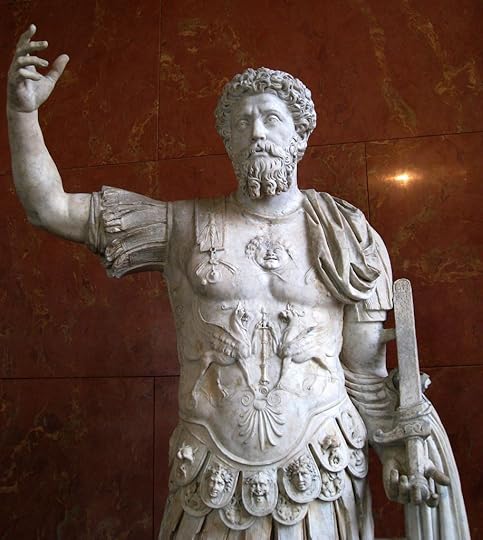


A statue of Marcus Aurelius. A cropped photo of the arm of this statue has been used for the cover of this book. Image sourced from Pinterest.

Robertson lives up to his planned goal by tracing the influence of various individuals on the life of the young Marcus Aurelius (121-180 AD/CE), especially from his mother and the various Roman emperors and Stoic philosophers who he encountered prior to becoming emperor at the age of 40 in 161 CE. He actually grew up thinking to become a philosopher rather than the ruler of Rome. Circumstances and the odd manner of Roman adoption led him to the imperial role, which was initially a co-emperor rule with adoptive brother Lucius Verus (130-169 CE).

The Meditations were written towards the end of his life during campaigns against the various warring Parthian and Germanic tribes. It is often the absence of comment in the Mediations about certain individuals, such as the emperor Hadrian (76-138 CE), that we understand those whom Marcus Aurelius didn't respect. From the description of Hadrian's rule and his pathological obsession with dead lover Antinous (111-130 CE), it is actually surprising that he is considered one of the 5 so-called "Good Emperors" of Rome.

There was a excellent amount of background to the life of Marcus Aurelius in this book and I learned various other interesting bits of trivia about Ancient Rome in the process. For instance I didn't understand previously that the title "Caesar" was actually given to the designated heir and not to the emperor themselves. "Imperator" was an honorary title granted upon the success of a military campaign. "Memento mori" meaning "Remember that you are mortal and will die" was an expression whispered by accompanying slaves into the ear of a victorious emperor or general as they rode chariots in a triumphal procession after a military victory, in an effort to undermine any thoughts of grandeur.

I enjoyed reading this further book in the Yale University Press' Ancient Lives series. I had previously read and reviewed Vergil: The Poet's Life, Cleopatra: Her History, Her Myth and Demetrius: Sacker of Cities.

Other Books
Donald J. Robertson is also the author of the forthcoming How to Think Like Socrates: Ancient Philosophy as a Way of Life in the Modern World (expected publication November 19, 2024).

Trivia and Links
Read an article by author Donald Roberson at Marcus Aurelius and How to Cope with Anxiety at Yale University Press.

There is also a Q&A about Marcus Aurelius with author Donald Robertson which can read at Who was Marcus Aurelius?.

Marcus Aurelius: The Stoic Emperor is part of Yale University Press's Ancient Lives series which also includes: Phocion: Good Citizen in a Divided Democracy (expected publication September 24, 2024), Vergil: The Poet's Life (2023), Ramesses the Great: Egypt's King of Kings (2023), Julian: Rome’s Last Pagan Emperor (2023), Crassus: The First Tycoon (2022), Cleopatra: Her History, Her Myth (2022) and Demetrius: Sacker of Cities (2022).
Profile Image for Henry Brand.
52 reviews2 followers
August 11, 2024
Interesting read. Engaging, and written well.

I think this book makes a very good backdrop for reading ‘meditations’, as it provides much historical context.
Profile Image for Safa Furkan.
189 reviews1 follower
December 5, 2025
Marcus Aurelius'un düşüncelerini seven biri olarak nasıl Düşünceler metnini yazan adam haline geldiğini anlamak için çok güzel bir kitap.
Profile Image for Nelson Zagalo.
Author 15 books466 followers
October 20, 2024
An interesting book, especially if you like Marcus Aurelius' Meditations (180). Robertson takes us through the years of the philosopher emperor's life, offering us a well-known perspective on him, that of the most positive emperor in the history of Rome. We get to know a little better the world in which he grew up, the reality in which he lived.

Despite everything, I don't feel that I've added much to what I already knew. Probably what impacted me the most was knowing that Marcus was educated by Hadrian, an emperor of whom I had a very positive image, thanks to Yourcenar, but who I discovered here was not the person she assessed to be, since, as Robertson says, he is almost absent from 'Meditations', although Marcus's mother is too.

3.5/5
Profile Image for Matthew Rodriguez.
53 reviews
March 13, 2024
An excellent and well-written biography of Marcus Aurelius. It read like a story while containing tons of historical details. I also enjoyed the more philosophical focus of the biography, which helps us better understand Marcus’ character and motivations.
Profile Image for Max ☭.
89 reviews
August 24, 2024
Amazing book. I was expecting a biography, but it was more history than biography. This might be my new favorite book from Donald J. Robertson, still unsure though. "How to think like a roman emperor" was also amazing.
Profile Image for Ahmed Rashwan.
Author 1 book33 followers
April 17, 2025
Sometimes, you stumble upon books that take forever to read (or listen to) and you start to wonder when the agony will finally cease. But, sometimes you pick up a book and finish it a month later because you wished you could go on reading (or listening to) it forever. In this case, I happily happened upon the latter.

They say it is always better when an author narrates his or her own book because they always narrate it in the exact way it was supposed to be read and after having heard Donald J. Robertson narration of this book (with an exquisite voice one must add) I am very much convinced that this is the case.

There is absolutely nothing I disliked about this book and that does not happen very often. For as long as I can remember (having watched Gladiator in 2000 and read Meditations in 2015), I have admired the man that is Marcus Aurelius. I would even go as far as saying that he was the catalyst for all of my interest in the Roman and Hellenistic periods. He is the reason I now know so much about those two periods and the reason I started researching Hannibal, Caesar, Alexander, Scipio, Augustus and the list goes on and the reason I got interested in Stoicism in particular and Greek Philosophy in general (and to even go so far as to name my firstborn Sophia) and why I can - proudly - spot the historical inaccuracies in both Gladiator movies.

So when I saw this book on Audible, I couldn't wait to try and find its physical counterpart; I immediately bought and started listening to it and I throughout the entire list, I was wishing it would never end. Donald's voice is soothing and eloquent, he is articulate and he speaks with such a passion about what I can only now assume is a topic that is as dear to him as it is to me.

What I loved about this book is that it delved into so many aspects of Marcus Aurelius' life; from his upbringing, the development of his philosophical views, his military campaigns to the people and events that surrounded him. I initially thought I would dislike the fact that Robertson sometimes deviated from the man himself, but when he did, it added so much historical value and helped me understand Marcus Aurelius even better that I found myself craving more.

I never thought I'd learn anything more about the man, and I never thought there was anything I could read or watch or listen to that made me admire him even more, but Robertson succeeded in all of the above. This book reignited my interest and admiration not only for Marcus Aurelius but also for the philosophy of Stoicism, that I had learned of and have been trying to implement for the majority of my adult life since I was introduced to it through Seneca's writing.

What this book majorly helped with was understanding that Stoicism was not just an unachievable ideal (because frankly in our day and time, I believed it had reached standards and values of almost mythical proportions), that was nearly impossible to uphold, but that it indeed can be practiced. I wondered how my puny self could compare myself to or fathom how much more difficult it would have been at the time of and in the positions held by men like Marcus Aurelius. So to read of how he nearly perfectly adhered to this philosophy, produced in me a renewed vigour in attempting to do so myself.

For lovers of history or Greek philosophy and especially for lovers of both. This is definitely a must read.
18 reviews
February 21, 2025
Great explanation of the experiences growing up and as emperor that shaped Aurelius' stoic philospohy. He witnessed the terror of Emperor Hadrian and the virtue of his adopted father, Emperor Antoninus Pius. Both had a great impact on his world view. Includes poignant quotes from Marcus' Meditations.
Profile Image for Espen Stølan Holten.
106 reviews2 followers
May 18, 2024
God bok OM Marcus Aurelius, enkelt å følge men forutsetter nok en kjennskap til Stoisimen for å få full uttelling.
Samtidig er det jeg savner at Robertson i større grad viser oss hvordan Stoisismen påvirket Marcus som beslutningstaker (vi ser noen eksempler, men f.eks. lite om spørsmålet om å gå til krig, som vel må være et komplekst spørsmål å anvende filosofi på (når man samtidig er keiser, lett for oss lenestol-keisere))
1 review2 followers
February 8, 2024
Of all Stoic authors, Marcus Aurelius is my favorite.

My second favorite Stoic author is Donald Robertson.

In his new book “Marcus Aurelius: The Stoic Emperor” I get to read both of my favorite authors at once on a subject I love.

Go grab your copies of “Marcus Aurelius: The Stoic Emperor” anywhere you buy books and follow Donald to learn more about his incredible work.

If you’re a fan or Stoicism, Marcus Aurelius or both I highly recommend this book.
Profile Image for Sebastián  Solórzano .
16 reviews
November 19, 2025
Great book!

I've been following Donald J. Robertson for a while now and he always delivers worth reading stuff!

This book is not an exception, It's by far the best biography of Marcus Aurelius. It offers a fresh perspective on Marcus' life, not just about the "Philosopher King" we all know and Plato wished he knew.

This book is about a human being trying it's best. We can read about the times when Marcus Aurelius felt he was falling short of his own standards, we can get a glimpse into the ideas that transformed him and made him who he was. The letters sent to Fronto, his teacher give us a more humane approach to an emperor that seems to be always good and reminds us that he as well had his own struggles.

Stoicism is about that, choosing virtue no matter what is happening and ultimately, being a good human being or as they call it "act according to nature".

What I love about Marcus Aurelius is that he is a reachable role model. He was after all, human as we all are. Not a God or a demigod, a simple human being trying his best. Which is even more remarkable considering all he went through. Burying almost all of his children, treason, endless death, multiple wars and a plague is unfortunate for someone who as Cassius Dio wrote "didn't meet the good fortune he deserved".

The fact that he not only endured this but he also tempered it with virtue, understanding and love is what makes Marcus Aurelius someone we should all read and learn from. This book makes it approachable to learn from the life of one of the greats.

To study the greats as Marcus did, puts us in his own category.

Can't miss this book.

1 review1 follower
January 30, 2024
Donald Robertson is one of the world’s leading experts on Marcus Aurelius and his extensive knowledge coupled with a profound passion for Stoicism is self-evident from every page of the book. Unlike other history books that often overwhelm the reader with an overabundance of minute details, “Marcus Aurelius: The Stoic Emperor” skilfully and almost inconspicuously weaves them into a broader narrative making the story so much more alive and memorable.

This is not a tunnel-vision biography of Marcus Aurelius; rather, it unfolds as a rich story that reveals how his wider socio-intellectual milieu moulded the mind of the future philosopher-emperor that we know so well from his “Meditations”. Donald Robertson, who is also a CBT psychotherapist, pays close attention to Marcus’s psychological vicissitudes, formative years, and oftentimes complicated interpersonal relationships.

In his new book, Donald Robertson shatters the saccharine image of Marcus Aurelius that often permeates the public perception of the emperor. What is revealed beneath this simplistic veneer is a flawed human – a flawed human who, with his Greek philostorgia, deeply cares about his loved ones, is determined to live humbly and virtuously and to bear the many sufferings thrusted upon him by fatum with Stoic equanimity.
1 review1 follower
January 31, 2024
This is a well written book: easy to read. The author uses text from Meditations to show how Marcus would have thought or responded while maintaining focus on the story. It seems well researched despite the dearth of contemporaneous sources. When the history is not clear, the author discusses the opinions of other scholars instead of just giving us what he thinks.
Profile Image for Me.
282 reviews1 follower
January 25, 2025
I've been reading and reflecting and practicing Stoic ideas for a few years now and I've come to regard Marcus as a sort of "father" to me, a wise guide to my life, an example of how to do the best one can and to really live by higher virtues. To the end, as written by Robertson, Marcus upheld his virtues with "ivory shoulders."

"Go to the rising sun; I am already setting" and "one man is born; another dies." It's the mid point in that journey that matters. It's also living by the example "we are born but once yet due every day " what are we doing with outlet lives? How do we conduct ourselves? What guides us through our lives but how do we face our own deaths, the natural conclusion?

I felt a moment of grief as the book came to a close. Robertson did Marcus good.
Profile Image for Guillermo.
17 reviews
November 10, 2024
This Is the second book I read from the author and he never disappoints me, amazing story telling.

Marcus's life is interesting, and it makes think that despite all philosophical knowledge, he was still a human with challenges to live a stoic life in a daily basis specially, someone as emperor of an empire that contributes to shape the world as we know it today.
Profile Image for Darin Barnes.
6 reviews
November 3, 2024
If you have read Meditations, and have a desire to learn about the man behind them, read this book. Great insight to what made Aurelius into a great leader and philosopher.
Profile Image for Luke.
10 reviews
December 5, 2024
An impressive man, despite the setbacks he faced during his life. Really interesting book that delves into the history of Marcus during his rule and his approach to governance. Interesting learning about the conflict between the virtues that he held himself to, conflicted with the normalities of Roman culture.

Donald frames the book in an easy to understand way from start to finish. From Marcus being under the roof of his mother Lucilla, until his final hours.
Profile Image for Josh Swinscoe.
42 reviews2 followers
June 8, 2024
I think this book is excellent.

Robertson starts the book of well with his introduction, and then the first few chapters of the book focus oh Marcus's childhood and the influence of various people, such as his mother, father, grandfather, his adoptive grandfather, Hadrian, his adoptive farther, Antoninus Pius, and his many tutors. This first bit gives a great overview of the world Marcus grew up in and the qualities he wanted to emulate and the ones he wanted to avoid.

Further on in the book, we see Marcus become emperor of Rome, while at the same time making the Senate make his adoptive brother, Lucius Verus, Co-emperor. We see their relationship grow and how they balanced eachother out in a way. We see the various different qualities that they both possessed, the world in which the both faced, and sometimes the conflict that arose between them.

Then we move onto the multiple Wars that Marcus had to face during his reign. Starting with the Parthians, and then Germaninc tribes, we see how Lucius Verus was during this time, up until his untimely death. Then we move on to all his other wars in Europe. Near the end though, it becomes focused on the civil war that Marcus faced due to Avidius Cassius in the East. We see how this ends and the results of it.

We end the book with Marcus' returning to the Danube frontier to fight another war. His death comes in around this time and we see him try and prepare for the sole reign of his son, Commodus.

The writing structure was straightforward and enjoyable to read, Robertson constantly made links to Marcus Aurelius Meditations, giving us a greater insight to Marcus himself and his views on the world and how he dealt with scenarios, like the constant loss of those close to him, or the constant wars he faced.

Overall, this is a well structured, enjoyable quick read that is full of knowledge and is a great book on the life of Marcus Aurelius. I can find no critique with it and would recommend anyone Intrested in such history read it.
Profile Image for Michael Bocanegra.
5 reviews
March 9, 2025
Marcus Aurelius faced insurmountable tragedies throughout his life. Preserving an empire through plague, invasions, and civil war is difficult to comprehend as being possible, but the far greater accomplishment was Marcus’s ability to stay true to stoicism throughout his life. Marcus always focused on living “in accord with nature.” By implementing justice in accord with his beliefs, he was often forgiving in his justice, which at the time, was likely controversial. My interpretation was that Marcus was “progressive” in the way he ruled and lived and ruled with intention and respect to his stoic values. This book is good to read before diving into his Meditations, which is what I plan to do. This book has also inspired me to learn more about Epictetus who had a profound impact on Marcus in his earlier life. I plan to explore Epictetus’s arguments around internal slavery (mentioned in this book). I think there is much to learn about our internal desires or vices that hinder or even enslave us. I find this extremely relative in today’s distracted world.
146 reviews
March 3, 2024
Very readable book...the author is clearly a skilled writer. I liked his notes on sources at the end, and throughout the book, I got the sense that the author was being careful to express his thoughts in such a way that the reader must choose for himself how to view and consider some of the gray areas about which not much can be stated with certainty. Roman history is all new territory for me and quite interesting to get a sniff of the politics, philosophies, and jealousies of the times. Not sure much has changed. Marcus and his adopted father present as very decent men, having a respect for people that was not always evident in predecessors or those who followed. People are so different; clearly, the apple fallen close to the tree may be rotting away before it even hits the ground.
Profile Image for Filip.
5 reviews
November 11, 2025
A clear and easily digestible overview of Marcus Aurelius’s life. However, it’s hard to escape the feeling that it remains somewhat superficial. The work lacks historical depth and shows little engagement with academic source criticism - it relies almost entirely on primary sources while making minimal use of the extensive scholarly literature that questions them. As a result, the author occasionally appears too trusting of those sources, or at least not critical enough in presenting them, which undermines its value as a serious biographical study.

At the same time, the book doesn’t delve deeply into Marcus’s personal philosophy or meaningfully connect his Stoicism to his role as ruler. The analysis stays on the surface, even though the author does identify some key moments where his philosophy clearly influenced his governance.

All in all, it’s an interesting and accessible read - useful for readers new to Marcus Aurelius and Stoicism - but little more than that.
Profile Image for Rich Bowers.
Author 2 books8 followers
June 7, 2024
Marcus Aurelius, The Stoic Emperor by Donald J. Robertson
 
Recommend: Yes
 
Read if Interested In: History, Ancient Rome, A bit of Philosophy
 
 
Summary: I initially passed on this book to preorder, thinking it may be more about philosophy than history and it turned out to not be the case.
 
Marcus Aurelius, The Stoic Emperor ended up being about the life of Marcus and what he went through during it. In a very digestible sub 200 pages, this book covered aspects of Marcus growing up around Hadrian, his education, time as emperor and of course references to Meditations. 
 
If you are curious about Aurelius' life, but may not have him in your list of favorite emperors, Robertson's book is perfect. He highlights major events (war, plague, family deaths) throughout while avoiding deeper details. Overall an enjoyable, quick read.
Profile Image for Andrew Whisney.
20 reviews
May 29, 2024
I've been on the hunt for an in-depth biography of Marcus Aurelius for a while now, and this has scratched that itch. Loved it—a fascinating book with incredible research. I'll likely re-read it multiple times.
Profile Image for Ty Cahill.
15 reviews
February 8, 2025
A glimpse into the life of the man behind the Meditations. Donald Robertson paints a great picture of Marcus’ life and the role stoic philosophy played in it. Highly recommend to anyone interested in learning about Marcus Aurelius, stoicism or the history of the Roman Empire. A great read.
296 reviews8 followers
February 24, 2024
well worth reading. a most amazing figure. It is a shame we dont have more information on his military acumen; and on his poor health.
31 reviews3 followers
March 6, 2024
An accessible, well-researched history of Marcus Aurelius’ life and rule as emperor. Highly-recommended.
33 reviews
July 19, 2024
Short book, good book. Seemed like smart and wise guy. Has gotten me into Roman history a bit and reckon I’ll do some more reading on that soon.
Profile Image for Alexander Olsson.
187 reviews6 followers
August 11, 2024
Marcus Aurelius Antoninus, världens kändaste Stoiker var Romarrikets kejsare under 100-talet e.Kr. Han är också känd som den sista "goda" kejsaren och den här biografin visar verkligen varför det är sant.

Boken lyfter viktiga handlingar före, under och efter hans liv. Exempelvis varför han fick rollen som kejsare när han inte hade någon koppling till tronen från födseln till hans eviga relation med döden som hemsöker honom genom hela hans liv.

Stark rekommendation om man har läst boken som Marcus själv skrev: Självbetraktelser eller vill läsa den men behöver lite förhandsinformation om hans liv.

5/5 stjärnor.
Displaying 1 - 30 of 121 reviews

Can't find what you're looking for?

Get help and learn more about the design.