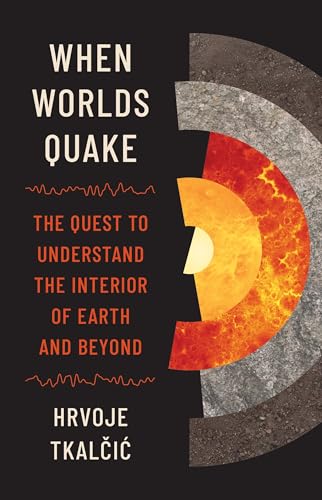
How earthquakes can reveal the subsurface secrets of our planet and other worlds
When Worlds Quake is a fascinating account of how scientists around the globe seek to use quakes to answer tantalizing questions about the structure and inner dynamics of our planet and to discover the deepest secrets of our nearest neighbors in the solar system.
Briefly traversing the history of seismology, Hrvoje Tkalčić describes the women and men who sought to understand major seismic events—from the catastrophic 1556 Shaanxi earthquake and the San Francisco earthquake and fire of 1906 to more recent events such as the 2020 earthquakes in Tkalčić’s native Croatia—and thus shaped the field. Modern global seismologists now not only study the behavior of earthquakes but also use seismic waves as tools to image Earth’s deep interior. To do this work, they need seismographs positioned around the globe, including in remote, challenging regions. Tkalčić takes the reader along on his own daring expeditions to install seismographs and collect seismic wave data from the wilds of the Australian Outback to the rough depths of the Southern Ocean, and even farther afield—to the Moon and Mars, where quakes can be used to image the interiors of these worlds.
A riveting and often personal narrative about the cutting-edge science of global and planetary seismology, When Worlds Quake reveals how quakes can help scientists to understand the mysterious inner architecture and ongoing evolution of our planet, as well as worlds beyond our own.
When Worlds Quake by Hrvoje Tkalčić transforms earthquakes from natural disasters into analytical tools, revealing how seismic waves serve as one of the most powerful methods for understanding the hidden architecture of Earth and other planetary bodies.
The book’s strength lies in its integration of narrative and science. By combining the historical evolution of seismology with firsthand field experiences and modern planetary research, it creates a layered perspective that is both intellectually rigorous and accessible.
At its core, this is a book about discovery. It reframes seismic activity not as chaos, but as data—positioning quakes as a gateway to understanding planetary formation, structure, and evolution across Earth, the Moon, and Mars.
Such an absolutely fascinating topic. I didn't know some of this about the interior structure of the Earth...
And I still don't feel like I really understand it. Come on, UC Press! The graphics in here make no sense and sometimes are repeated more than once. The translation, which I think the author did himself, is idiosyncratic, and sometimes engaging in an eccentric professor kind of way, but not a professional translation and not conducive to understanding the difficult material.