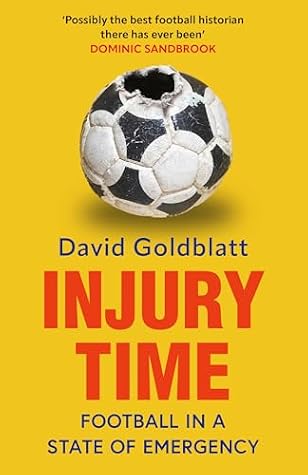
‘David Goldblatt is possibly the best football historian there has ever been’. Dominic Sandbrook
‘David Goldblatt is the greatest British sportswriter of the 21st century … Injury Time is an absolute classic.’ James Montague, author of The Billionaires Club and Engulfed
Football, history and the state of the nation – and why it matters.
Injury Time is a sharp and thought provoking look at contemporary British society through the lens of football; a society shaken by more than a decade of economic, political and social upheaval, whose causes and consequences have proved hard to grasp.
Set against the backdrop of Brexit, Covid and today’s ‘polycrisis’ – spanning economic decline, war in Europe, political unrest and climate change – this book argues that football provides an unmatched vantage point for understanding the nation’s state of affairs. From grassroots clubs battling for survival to the rise and fall of Russian oligarchs in the sport, the game’s tragedies and triumphs echo the larger shifts shaping Britain.
With striking examples such as Marcus Rashford’s anti-hunger campaign and the uproar surrounding Gary Lineker’s tweets, Injury Time underscores football’s central role in public conversation. Football, Goldblatt contends, is the ultimate societal bellwether – a reflection of Britain’s virtues and flaws alike.
Librarians note: There is more than one author in the Goodreads database with this name.
David Goldblatt is a highly experienced sports writer, broadcaster, and journalist. He is the author of The Ball is Round: A Global History of Football (Penguin, 2006), the definitive historical account of the world’s game. He has also written the World Football Yearbook (Dorling Kindersley, 2002), which was published in nine languages and ran to three editions.
As a journalist, he has written for most of the quality broadsheet newspapers including the Guardian, the Observer, the Financial Times, and The Independent on Sunday, as well as for magazines such as the New Statesman and the New Left Review. He is a regular reviewer of sports books for The Independent and The Times Literary Supplement and is currently the sports’ columnist for Prospect magazine.
As a freelance reporter he has worked for BBC Radio 4 and the BBC World Service, including producing documentaries on football in Jerusalem and the politics of football in Kenya. He has also appeared on other BBC radio programmes including The World Today, The World Tonight, The Sunday Morning Show, and Africa – Have Your Say.
In addition to his extensive writing and broadcasting career, he has also taught the sociology of sport at the University of Bristol and has run literacy programmes at both Bristol City and Bristol Rovers football clubs, as well as teaching sport, film, and media at the Watershed arts cinema, also in Bristol.
Injury Time: Football in a state of emergency is well worth reading, especially if you appreciate sharp, sociologically grounded commentary that treats football as a lens for broader political and cultural shifts.
David Goldblatt provides a tight focus on the game's recent history against the backdrop of Britain's broader recent social and political upheavals (Brexit, COVID-19, economic instability, climate change, and hyper-capitalism). This account excels at demonstrating how football reflects the health of wider society. He examines state-backed club ownership, the commercialisation of fan culture, the persistent battle with institutional racism, and the sport's rapid surrender to venture capital.
It’s as much a political and cultural dissection of modern Britain as it is a sports book, and all the better for it.
4.5 - super well researched, shines a light on how football, politics and society mirror each other. some great analysis linking wales' 2016 euro run and the surge for Welsh independence etc. wish it was longer and he went into more detail about other topics ruining the beautiful game
Just, no. Straight to the compost bin, this. I expected Galeano (extremely high expectations, admittedly), but I got well, absolutely nothing 'good' (or even informative/interesting) from this. The introduction was alright, but everything else after consistently disappoints. Could've added a bit of N'Golo Kanté and Son Heung Min (for no reason even) to spice up the writing and 'trick' one into believing that the rest is 'palatable', but not even that. How can one 'speak' of the Premier League of that era/generation without mentioning them two? Outrageous. What a shame (and personally, a waste of precious time), this. Could rant more, but rather not. In any case, let Hector Bellerin write (/cook) ! Go on and give that man a book deal already. And someone please translate Aitana Bonmati's into English, please? And anyway I recommend A New Formation: How Black Footballers Shaped the Modern Game instead of this, and also The Trading Game (while it doesn't have 'football' at its core, it's packed with tasty football analogies).
PAPERBACK EDITION! SHOVE YOUR DEVICE UP YOUR...(insert word of your choosing...)
“The system just continuously lets people down, and it always lets people down at the bottom of the system. It never lets down the people at the top.”
Although primarily focused on the EPL and the English game Goldblatt does occasionally stray beyond English borders and spends some quality time on Scotland, Wales and the Irish game and the politics and shenanigans involved in these places too. His approach is pleasingly similar to the likes of Simon Kuper. He covers a lot of ground and does it really, really well making so many great points along the way.
“The Premier League, composed of institutions nearly all created in late 19th Century working class Britain, was more than three-quarters owned by the global super rich.”
Russian-Israeli arms dealers, English pornographers, online gambling tycoons, US billionaire asset strippers. Russian gangsters, Middle Eastern tyrants, repressive, petro monarchs and many other Asian megalomaniacs the English Premiership, much like the city of London, is more than happy to bend over backwards to accommodate anyone’s money. And to think these are the guys who passed the so called “fit and proper” character test (cue: laughter). As long as they’ve got plenty of it and they get access to some of it then questions around morals, character and ethics are laughably waved away. And of course whenever you start to hear terms like venture capitalist, international consortiums, hedge funders and private equity firms - you know you better run for the hills my friend.
In reality the EPL has long since descended into a cesspit, a veritable swamp which promises riches and hides its many perils and pitfalls behind dazzling baubles. Also the shameless complicity of football clubs in recklessly promoting and profiting from the gambling industry. Too many of the players, most millionaires or multi-millionaires are more interested in squeezing as much money out of the system rather than being positive role models for younger kids and in too many cases they seem to exploit their status, whether selling crypto scams, promoting online gambling or generally avoiding tax. But thankfully we do get some voices of progress, reason and generosity, who risk abuse by speaking out or actually being proactive to try and help those a lot less fortunate than themselves - particularly the likes of Marcus Rashford and Gary Lineker who have stood out.
I found it extraordinary that, “It was only in 2001 that football required its physios to have the basic professional qualification, and only in 2004 that they should have the FA’s diploma in sports medicine.” Goldblatt points out many worrying truths like this, which reveal many a worrying gap or inconsistency.
We see how when the establishment and its many institutions – media, academia, government, the royal family, police forces etc all flourish and profit from racist and xenophobic agendas then it’s obviously going to be seen as a lot more acceptable in footballing circles. And of course footballing fans have always made for good punch bags and political pawns for any aspiring or cynical politician who wishes to profit from being seen to cherry pick the low hanging fruit, rather than resorting to the major time, effort and resources it would take to target it more meaningful at the highest level.
Even with the typos Goldblatt delivers yet another impressive, well-researched piece of work. Though would you really think it reasonable to include Scottish fans along with the notorious English as causing serious issues at away games on the continent?...And keep in mind that UEFA awarded the Scottish fans the Fair Play award for their friendly and sporting conduct during the 92 Euros?...So surely an unfair and inaccurate description, especially when he cites examples which were only English ones.
Well researched with examples ranging across all levels of football, this book relates the state of the beautiful game to the state of society today. Goldblatt looks at topics such as racism, Covid, the rise in foreign ownership of clubs, climate change and the increasing interest in women’s football. The background is the tumultuous period from Brexit to the present day, a time of increasing division in society and widespread economic changes.
The book is interesting and enjoyable, with plenty to think about within its pages. The author’s left wing political views are well to the fore, but that didn’t spoil my enjoyment as I found the football content more engaging than the political angles anyway. Occasionally opinions are presented as facts which was a bit jarring (and surprising for a journalist where I would have expected more balance) but overall the wealth of fascinating examples more than compensated for this.
Definitely worth reading for anyone with an interest in the current issues facing football and wider society.
Its a bit of a laundry list of things that happened in football recently (COVID, racism, FIFA corruption, etc.) and its all through the lens his own very lefty traditional Labour politics, but it is very enjoyable. It basically starts from the idea that football is corrupt and brutally capitalist, but it sill manages to bring people together. And even though we need something better, this might be the best that we have, and therefore its worth understanding and improving the game.
Really interesting to get you fully up to speed on the last decade of football. If you follow it closely, none of this will really be new information but I appreciate the inclusion of non league and lower league teams as I wouldn’t know such about them. I enjoyed it was broken down by a theme and how it played back into the theme each chapter (like climate change or art) some bits got heady but you kinda expect that from this type of book.
Great Report on the Ills of British Football and Society
David Goldblatt's newest, narrated by himself in a very engaging manner, is a chronicle of how British Football came to mirror all the ways in which Britain is broken. Linking the 2008 economic crash, Brexit and COVID pandemic, as well as the Russian invasion of Ukraine, he explores how these events (and the total failure of governance of both Britain and British football) have lead to the broken state of the game today.
The audiobook clocks in at around 13 hours and is very informative and entertaining. David Goldblatt's narration is captivating and I found myself listening with great interest to what he had to say. The book is very English centered, though it makes mention of the other nations of the British Isles. There is some very astute analysis of the other nations' football culture, especially that of Wales in the context of the Euros 2016 and the independence movement.
While he includes many an anecdote, he does not sugarcoat his analysis and is very frank about the multitude of issues British football and society are facing, and how one mirrors the other. But since he only briefly touches on things (and there are a lot of things to talk about), I found myself wishing for more depth and some more examples or outlines of potential solutions. The section about sustainability mentioned a handful of great initiatives, but the broader and legislative context usually is missing and that is a great shame in such an aspirational work.
Some things are not quite well researched (or well put, as it were), and there are factual errors, such as Cardiff City's change of ownership missing one crucial person between the two he mentions. Goldblatt meanders in his topics and while it all sort of makes sense, I felt that the real through line of the book wasn't there. I wish he had put more structure in place instead of writing, essentially, one long monologue where he jumps from one topic to the next without time to take a breath. Maybe a more academic framing might have helped?
Goldblatt also tries to tie together football and society in Injury Time, but fails (in my opinion) to make the final step and name the issues at the heart of the superficial symptoms. His analysis is clear and accurate but there is too much narrative and too little scientific rigour. Overall, the book is a truly insightful summary but lacks in depth. It is too short and could be so much longer and helpful in offering potential solutions or highlighting them where they are being attempted to be put in place already. There could also be more specificity, as I already mentioned, about the root causes of the problems, since they are pretty much all structural and of a governmental nature. He talks around them a lot but seems afraid to name names and blame the guilty. Where Goldblatt uses 1-2 sentences on an issue, he could easily make a chapter out of each of them.
I highly recommend this to any football fan who cares about the game at large and is interested in the societal connections football has, as a mirror of the people who interact with it in any sort of capacity.
Wonderful idea to look at modern British society through the mirror of football. In the introduction the importance of football is demonstrated by the fact that there was a time when television soap opera took precedence over showing matches, whereas now, the soap opera is cancelled to allow football to be shown.
This is a very accessible book that doesn't dwell on the technicalities of the game but on the culture of the sport and how it reflects current issues in Britain. Examples and topics are broad: the Covid-19 pandemic, racism, poverty, European war, women, Brexit, capitalism, climate and sustainability, alcohol, and ethical movements like Stonewall, wearing poppies and veganism to name a few. Fascinating to see how life and football - that simple game aimed at scoring goals in the opponents' net - have changed over time and yet remain irrevocably linked.
Goldblatt doesn't shy away from naming people and organisations to make his points and always references his sources as any good historian would. The book is highly researched and organised by topics that everyone can relate to. As a football fan, it is a little strange to see the developments in the game play out within the scope of British society while I was there all along, not really realising how life is reflected in sport.
It does drift a bit at the end with lots of figures and the scope is perhaps a little too broad to completely absorb all of the points made. Nevertheless, this is a provoking and fascinating read and should appeal to anyone interested in modern political culture, whether a fan of football or not. An analysis of recent history portrayed by the Beautiful Game.
Thought provoking and fascinating this is a forensic examination of all aspects of football in the UK over the past few decades and places the sport firmly within the context of its social and political milieu.
Goldblatt ranges far and wide, covering the impact of Brexit and COVID, the similarities between the strategies and policies employed by the top clubs and the political parties, the impact of BREXIT, racism, hooliganism, commercialism, the treatment of young embryonic players , the connection between art, music and sport, foreign ownership - amongst many others come under his microscope..
Very little escapes his gaze and his insights are challenging and original and show a deep insight into the innermost workings of the sport and of the country itself.
Thos is a deeply researched and highly original piece of work tat will be of interest to a wide audience and is well worth the effort to read - it will certainly make you think - even if you are not in full agreement with all of the author's parallels and assertions.
Thank you to HarperCollins UK Audio | Mudlark, the author and NetGalley for a LRC in return for an honest review.
David Goldblatt has long been known for his sweeping histories of football, but in Injury Time he does something both original and compelling: he uses the sport not simply as a pastime to analyse, but as a lens through which to understand the fractured state of modern Britain. Don’t let the title fool you – you do not need to know the offside rule, the names of players, or even have much interest in football itself to appreciate this book. The real subject here is society: Brexit, the 2008 financial crash, the Covid pandemic, the climate crisis, inequality, nationalism, and how the game both mirrors and magnifies those wider forces.
One reviewer compared the book to a university-level political science course, and that feels apt, though it is never dry or overly academic. Goldblatt presents his analysis in a way that is sharp, engaging, and always accessible. His anecdotes keep the narrative lively and while at times the scope means depth is sacrificed, the breadth of connections he makes is impressive and thought-provoking.
Special mention should be given to the audiobook format. Goldblatt narrates his own work and that always gives an edge. His delivery is clear, captivating and perfectly attuned to the weight and urgency of his argument – listening feels like being drawn into a wide-ranging but tightly argued lecture, alive with both passion and frustration.
Injury Time is recommended not just for football fans but for any reader (or listener) interested in the state of Britain today, its politics, and the way culture reflects deeper structural issues. Goldblatt avoids easy nostalgia or cheap shots; instead, he offers a vivid diagnosis of a society in crisis, using the national game as a mirror. It’s an original and powerful concept, executed with style.
If there is a shortcoming, it lies in the breadth sometimes outpacing the depth: certain issues could easily have filled whole chapters rather than a few sentences, and the structure can occasionally feel like one long monologue. Still, these are minor quibbles in what is otherwise an original, insightful and highly engaging work of nonfiction.
Є книги, які з'являються у потрібний момент, і не тому, що автор вдало вгадав тренд, а тому що реальність нарешті наздогнала їхню оптику. Injury Time Девіда Ґолдблатта — це не книга про футбол у звичному розумінні. Тут немає тактичних розкладок, немає рейтингів найкращих голів сезону. Натомість є холодний, детальний, місцями болісний діагноз: що сталося з Британією за останні п'ятнадцять років — і чому футбол виявився найточнішим інструментом, щоб це зрозуміти. Книга стартує з елегантної тези: у середині 1980-х телевізійні мильні опери витіснили трансляції матчів. Сорок років потому все перевернулося. Тепер футбол — головна мильна опера нації. Саме ця інверсія задає тон усьому, що далі розгортає Ґолдблатт. Injury Time визнана Telegraph Best Book of 2025 та увійшла до списку New Statesman Book of the Year 2025 — відзнаки, які засвідчують визнання книги далеко за межами спортивної літератури.
This is an extraordinarily detailed discussion of football in British society in current times. I’m a former passionate fan of one of the many clubs left behind by the rise and rise of the rich and powerful. Now I’m little more than an interested observer of the results on a Saturday afternoon. No TV games for my team. The author lays bare the ills of the current game, but it’s not all gloomy. He celebrates the growth of the women’s game in particular. Probably not a book for those with just a passing interest in the game, but well worth a read if you are or have been caught up in the excitement of watching your team’s victories and suffered their defeats.
Informative account of how football and the current state of the country are aligned. Greed, hubris, vanity and naked power grabs are all shown to be as prevalent in football as they are in the rest of society. Sometimes Goldblatt lets his politics get in the way of his reporting and starts to make assertions that others may take issue with or have valid criticisms against but he makes enough points to carry a bit of weight. Where he does let himself down however, is that he doesn’t really weigh in heavily enough at the true culprits for the state of the game and the country. Us. In a democracy the power should lie with the people and in football it should lie with the fans. That it doesn’t is because we allow those at the top to get away with it. You can’t complain about the state of things when you are quite happy to turn a blind eye to it when it’s all going your way. Sooner or later the situation will change and you can guess who will be picking up the bill for it. And I’m pretty sure it won’t be those at the top.
A good, if not groundbreaking, summary of the state of British football as of 2025. The author identifies virtually all problems as stemming from what he considers to be capitalism, but the relentless political commentary doesn't detract from some genuinely interesting chapters, especially on the women's game. There are few voices of footballers or fans heard, and most of the information won't be a revelation to anyone who follows the game.
An okay read. The author discusses a lot of what's wrong with football nowadays (be warned: this is mostly a book about British football). But it also reads more like a "where we are at," discussing the effect of the political climate (Brexit), Covid, ownership, human rights, social justice, drugs and even climate change on the sport. Goldblatt takes on a lot, but because of it, the book lacked a bit of focus for me. Still a worthwhile read.
A compelling , brilliantly researched and excellently written state of the English football nation that also works as a state of the English nation address and a good picture of how the world has turned and worked in the last ten years . It’s undeniably grim but also surprisingly hopeful and certainly offers a path forward if only football would take it . It’s a four star read but I have gone one higher to try , in some small way , to counteract the sheer stupidity of Emily’s review .
Goldblatt takes a long, hard look at the darker sides of football, from racism, sexual and drug abuse to sportswashing, gambling and corruption at the highest levels. While focussing largely on Britain, he also looks beyond its borders.
This was great. Little trip down memory lane through 2008-ish to today-ish through all the cultural events around the beatiful game in England and, to some extent, the UK. The financial crash, BLM, covid, the European Super League, poppymania, etc all covered with charming wit.
Depressing! Chapter after chapter detailing the many ways in which the modern game is spiralling out of control. All collected together and laid out in one handy volume of despair.
Some people are on the pitch.... they think it's all over.
Another thoroughly researched and excellently written analysis of modern football by the most intelligent and trustworthy voice in the game. If you have any interest at all in football beyond the pitch then this is essential.
The recent history of football culture in the UK told at an academic but really engaging level. Reveals a lot about contemporary British society as well as the sport itself.
Goldblatt is described as a football historian on the cover, and he had the slight detachment of a historian as he described various aspects of the modern game, putting them in the context of the past. It was well-executed in the main but there were just a few too many sections that were telling stories I'd already followed recently, and were therefore less interesting.
This was only the second book I'd read featuring Sandbrook's name and 'State of Emergency' on the cover, and like the podcast host Goldblatt is readable while still covering serious issues in depth, although a dictionary may be useful on occasions. In this book he covered a wide range of topics including some crossover with Game of our Lives such as the history of minute's silences and statues in stadiums, but this was essentially a book on the story of Premier League football since that book was published. Again, like Sandbrook, his approach was to be broadly rather than strictly chronological, as he grouped chapters by topic rather than just timelines, but I preferred the topics in historical context such as art on football rather than the merely contemporary, such as vaccines, where he also seemed to be a bit too forgiving towards footballers.
His willingness to have an opinion rather than just stating what happened did at least make it more interesting to read, although it helped I agreed with him generally. There were a couple of blindspots though: he missed that businessmen and venture capitalists buy football clubs because they think they can profit from their ultimate sale as asset values rise over time even if they make an annual loss, and in Goldblatt's eyes footballers are fully independent when doing good political things and easily influenced when doing bad things (see vaccines). Overall though his approach is to cover football as it is, not as he'd like it to be, and Goldblatt is good at it. It would probably be best though as a contemporary text in decades' time rather than a mixture of history and summary of recent broadsheet articles, though I accept I follow more of those than most.
I love that every couple of years, David Goldblatt emerges to show all us football writers exactly how it's done.
To say that the last decade in both British politics and British football has been 'eventful' is probably understatement of the century. While anybody interested in how the two mediums meet is likely aware of the ramifications of Brexit, the 2024 riots or climate change on football, the way Goldblatt weaves them together with such poetry, symmetry and discernment is second to none.
In Part One, 'Brexitball', he examines not just the xenophobia and outright racism that has haunted the England national team over the last decade. He explores how economics, the pretty disastrous culture fostered in the youth/grassroots game and growing calls for de-unification all become ugly pieces of the malaise that permeates our society.
His exploration of how football interacts with art, grime music and theatre in Part Three is exactly the kind of perceptive, beautifully transportive writing that I love to read. He saves perhaps the most alarming chapter for last, throwing football and its many personalities' approach to climate change under the microscope and coming up with a really bleak picture.
Goldblatt's writing, wide-screen vision and empathy is next level. I'm maybe slightly biased, because his political views largely align with my own, but it feels super refreshing to have a football commentator unabashed and unafraid to give wry socio-cultural opinions. Still far too few football writers do that for my liking.
I don't often agree with Dominic Sandbrook - one half of the irritatingly right-tilted The Rest is History podcast - but he's on to something when he says that Goldblatt is 'possibly the best football historian there has ever been'. This is easily the best football book I've read this year, and maybe Goldblatt's magnum opus.
Very insightful read. Some chapters are a bit sloppy, with some listing pages of examples and others getting very far from their original topic, but overall a very comprehensive exploration of modern football and how it represents an extreme version of basically every debate, issue, and crisis we face in modern Britain. Left me feeling incredibly depressed about the future