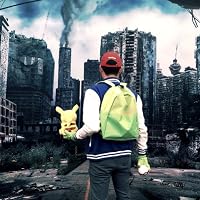
The latest novella by Nebula finalist Jordan Kurella is a moving allegorical tale and finalist for the Los Angeles Times Book Award. As mankind continues to hurt the planet, leaving us with scarred lands, stories like The Death of Mountains are more meaningful than ever.
When the Death of Mountains came for us, we had been aching for a long time. There is so much loss in being a mountain; it is a terribly long time to live. Yet something awoke within us when they arrived, their face a stone skull, their hands' obsidian bones that cracked and crackled like fracking. It made us hurt to hear their earthquake step across the ground as they arrived. Their breath was like coal dust, the stuff their cloak was made from. They left a trail of oil behind them as they walked.
When they spoke, their breath was hot, volcanic; it made us wither at first. We, however, are a middling hill of the Appalachians. And we have seen much worse.
Far worse than death.
The Death of Mountains says, “Plundered Mountain, it’s time to go.”
And we say, “We are not ready, Death. We have too much yet to see.”
Jordan Kurella has lived all over the world (including Moscow and Manhattan).
In his past lives, he was a photographer, radio DJ, and social worker. His work has been nominated for the Nebula Award and long-listed for the British Science Fantasy Award. He is the author of the fantasy novella, I NEVER LIKED YOU ANYWAY, the short story collection, WHEN I WAS LOST, and the climate fiction novella, THE DEATH OF MOUNTAINS. Jordan lives in limbo with his perfect dog and practical cat.
A gut-punch of a novella. A plundered mountain, almost utterly destroyed by humans with their machines, is visited by Death--but the mountain does not want to die. The back and forth flow of the tale is written with eloquent prose, with an ending both powerful and surprising.
I love a taut thriller or literary horror book: they are all I read, to be honest. However, we all need a palate cleanser sometimes, and Lethe Press was kind enough to place this gorgeous novelette into my hands at Stoker Con this weekend. The Death of Mountains by Jordan Kurella is not horror. It’s not sci fi or even fantasy, and yet, in a way, it’s speculative fiction at its best, an allegory of ecological and grief fiction with prose so beautiful, the number of pages I earmarked for their memorable, poetic passages is innumerable.
Buy this if you are a poet or lover of poetry, even though it is written in prose. Buy it if you like smart fiction. But most of all, buy it if you just need a breath of fresh air from all of the garbage on the news and ugliness on social media. It’s a poignant, dreamy, thought-provoking vacation from our technology-soaked, navel-gazing lives, and I’m grateful to have been able to read it.
This is a speculative fiction poetic novella, which was nominated for Nebula in 2026. I read it as a part of the monthly reading for April 2026 at SFF Hot from Printers: New Releases group. Before the story, there are accolades by writers I enjoy, including Karin Tidbeck and Premee Mohamed.
The very premise of the story is great: not only humans die. Mountains die too, and to them also comes a physical incarnation of death, specially for them, the Death of Mountains. Here, the Death comes to the Plundered Mountain, almost destroyed by men and their machines, cut in two by a road. However, the Plundered Mountain doesn’t want to die, so they decide to tell stories to each other to persuade what to do next.
The stories are interesting chiefly by their twist, for they often start with a tired trope and then change it. However, per se (assume you read these stories as standalones), they aren’t very strong, albeit poetic. So, the setting has an interesting premise with a great potential, there are interesting twists of the inserted stories but with some stuff I cannot agree with, like
If I could give this more than five stars, I would. This novella comes at a time when my life as a human is winding down. I’m 68 and see life as less permanent bows I am watching parts of the earth of my youth be destroyed by the powers that be and for their own gain. It is absolutely true that the “nature of all shoulders” is to “hold up the cares that weigh upon them” and I worry every day that less people care about that burden.
It’s still a hopeful read. It is hopeful without a sense of Pollyanna anywhere in sight.
This author thinks carefully about language. The tone of the book changes depending on whose voice you're reading. The Plundered Mountain is distinct from the Death of Mountains who is distinct from the Death of People. All of these avatars interact with each other in very human ways despite their lack of humanity.
Plundered Mountain does not want to die, even though they are in pain from all the things that people are doing to them. They offer a sort of Scheherazade-like bargain to the Death of Mountains. Why can't they tell each other stories, at least for a little while? Can't they wait at least another day? And Death of Mountains, despite knowing they are late, can't resist the offer. Maybe because they are a little too soft-hearted despite their profession.
Maybe a joke? Maybe bring Death of People into it for a story or two as well? These ancient beings are jaded but have maintained some compassion despite their best efforts to cover it up. Each short story or fable serves to illuminate the character of the one telling it. Turns out that maybe all of them are stuck in a cycle, but can anything be done about it? After all, Death is also a mercy, sometimes.
What happens if the protagonist is a mountain? This entire novel is the complete personification of the life of a mountain. The death of the mountain (mountain grim reaper) has come to collapse and end it due to the excessive mining by humans. What we have here is a book which asks the question, what if the mountain had a voice? What would its thoughts, aspirations and beliefs be? This is a short examination of life from a different pov which made this novella a fun one to read.
There's a lot of charm in the concept and the writing (see the description). But this kind of approach is not easy to sustain. The author's fans obviously don't agree with me.
This is one of six novellas nominated for this year's Nebula award. I found it by turns charming and upsetting. Much of the book is narrated by Plundered Mountain, who describes themself as a middling hill of the Appalachians. I loved Plundered Mountain. I can't recall ever reading a story told by a mountain before.
The plot is delivered in little bite-sized pieces, including question-and-answer segments and stories within the main story. Some of the stories-within-the-main-story are told by the eponymous Death of Mountains (another very likable character), some by the Death of People. I was initially anxious that the book would be unrelentingly downbeat, but that proved not to be the case. There's great sweetness in here too.
Four and a half out of five canary stars.
Update 6/4/2026: re-read this for my novella book club. I still like it very much.
About my reviews: I try to review every book I read, including those that I don't end up enjoying. The reviews are not scholarly, but just indicate my reaction as a reader, reading being my addiction. I am miserly with 5-star reviews; 4 stars means I liked a book very much; 3 stars means I liked it; 2 stars means I didn't like it (though often the 2-star books are very popular with other readers and/or are by authors whose other work I've loved).
I can’t decide how to describe this story. What if a mountain has a soul and doesn’t want to die? What if the psychopomp tasked with escorting her soul doesn’t like their job but also is afraid of being fired?
None of the characters here are people but every one of them has a wonderfully distinctive narrative voice. They seem like they shouldn’t coexist neatly and yet they do. Usually when people call a prose book poetic or lyrical they mean it has a lot of metaphors and detailed flowery descriptions. What I mean when I call this poetic is that every word was chosen with a very deliberate meaning and effect in mind.
I do, because I can’t help being myself, wish that someone who worked on this book knew that cottontail rabbits don’t dig warrens. They shelter in shallow nests, which is why it’s so easy to stumble across the babies in spring. I just think Plundered Mountain would know and care about these details of her inhabitants! And it mostly stood out because everything else is so careful.
perfect format, excellent execution, happy ending. what more could a kid ask for?
"'What if I could convince the Death of People to, you know, just get rid of people.' 'That is a little too harsh a solution, don't you think?' We have seen much joy from the lives of ants and stars and rivers, we have seen just as much from the lives of people themselves. We have seen just as much wonder and wondered just as much about their lives. The poet, the person driving the car, the man whose shoulders held back the morning, and others we have not mentioned. All of them have brought us so much joy over the time we remained here. Joy, and pain yes, but overwhelmingly joy. Ridding one entire set of beings to save others is never a solution. 'It's a bet worth making,' Death of Mountains says."
Put simply: my need for this book was realized in reading this book.
The grounded, lyrical prose of Jordan Kurella carries the tether of a Scheherazade banter, through an achingly beautiful and painfully wonderful existence. There is no more a distilling work of art as this bone-deep novella by Kurella. A true love letter to bittersweet and enduring hope (or ingenuity?)..
"We cannot stop ourselves from doing what it is we need to do."
"Yet in the abundance of joy we have experienced in our lifetime, we are still in pain."
"We suppose it comes back to what the poet had said: Is it not in the nature of all shoulders to hold up the cares that weigh upon them?"
I really enjoyed this short novel! The writing style is very unique, the storytelling is beautiful. It's a story I'll read again, I'll loan out to people or give to people. Such a meaningful story within these 114 pages. Highly recommend.
This is a short novella about a small mountain in the Appalachians talking to Death about the mountain's imminent death. It considers what it means for something as permanent and ostensibly undying as a mountain to die. And how it happens - cut through for a highway, excavated for coal, trees harvested for lumber, and waters poisoned by runoff. The environmental message is obvious.
But it's not just environmentalism. This mountain has a fierce love of life and of supporting the life on and in it. How life is full of sorrow and pain, but how it is small compared to the joys around us. The dew on the morning air, the tenderness of love, the wonder of a view, the happiness of a child running through a field of flowers.
And this is about that duality, of life and death. And about the impact we have on the environment around us. These are deep weighty subjects. Some I think about a lot, and I find myself unsatisfied here. There are some top-tier quotes for sure, but it feels like a gesture at something the author couldn't really define than a true exploration. But at the same time it feels foolish to expect a short novella about a mountain trying to cheat death to resolve an existential crisis that has been haunting humanity since the dawn of time.
That said, I did not like the ending. I thought it undercut the environmental message significantly.
I really enjoyed this book and I found it to be a thoroughly unique and engaging read. I think the world-building struck the perfect balance of just close enough to real life to hit while still feeling like a separate fictional world (at least, to me). I loved all of the little insights that the characters have and I think this book really makes readers think more deeply about its core themes of death, destruction, and (semi) immortality. I think the format and structure of the stories really helps to enhance the reading experience and made it all the more unique of a read. Despite being so short, this book really packs a punch and I think it benefits from taking breaks to think more deeply about the events and insights that are interwoven throughout.
I had the pleasure of meeting Jordan at a workshop in Utah some years ago, and I've followed their writing ever since. The Death of Mountains is at times poetic, thought-provoking, and funny. The POV shifts from character to character in a way that reminds me of Chaucer.
This is their strongest work to date (and was shortlisted for at least one award). Read it.
As a certified West Virginian, this story means a lot to me as someone who grew up watching the hills around me be desecrated by humans and their machines.
What a memorable, imaginative, and striking story. The prose is lyrical; the storytelling fable-esque. The story is so imaginative and beautiful. Mountains are the main characters--which, if it were up to me, mountains could be the main characters in every story.
"As a mountain, we feel and know all things that touch us: all roots, all hands, all embers. All things left behind. We have been burned and reborn. We have been cried upon and died upon. We have been cleaved in and gored out. Birthed upon and coupled upon. Time has told its tale upon us over and over and remade us"
The Death of Mountains comes to visit The Plundered Mountain- a mountain who has been stripped and mined by people and is near death. Death and the Mountain swap stories back and forth--about things they know and have seen and experienced. Death talks about other jobs--the Death of People and Machines and it's just so amazing, like this system of environmental checks and balances has always existed and Jordan Kurella just exposed it to readers-feels timeless and true. I love it
This is a perfect novella to take on any long ride through the American wilderness. Kurella portrays small moments of nature and decades-long industrial erosion with equal intimacy. For a story about the killing of a mountain there is a love of life in every page of this piece. The structure of this novella is a series of tales that Death and the Mountain tell each other as a way for both of them to procrastinate on the Death's job of reaping mountains. These stories-within-a-story then go on commentate on the setting and character motivations of the protagonists while also being punchy narrative gifts of their own. This reminded me greatly of prose like How Much Of These Hills Is Gold and The Tiger's Wife.
A lovely premise and some beautiful and funny moments in the prose. However, the tone for the various narrators seemed inconsistent at times (not what I’d expect for a mountain, nor the various eternal deaths). There is some clever world-building in the background I enjoyed, but that was not the point of the novella, so we didn’t get to see it more fully explored. I agree with much of the commentary, but it came across a little heavy handed.
I’m not sorry to have read this, and have been bouncing back and forth between three and four stars. The writing was mostly good, with a smattering of okay and excellent. I liked the world. I liked the characters. But it was uneven and didn’t execute on the premise in a way where I expect to recommend it more widely.