Jump to ratings and reviews
Rate this book

Flesh

Rate this book
Through chance, luck and choice, one man’s life takes him from a modest apartment in Hungary to the elite society of London – in this captivating new novel about the forces that make and break our lives

Fifteen-year-old István lives with his mother in a quiet apartment complex in Hungary. New to the town and shy, he is unfamiliar with the social rituals at school and soon becomes isolated, with his neighbour – a married woman close to his mother’s age – as his only companion. As these encounters shift into a clandestine relationship, István’s life spirals out of control.

Years later, rising through the ranks from the army to the elite circles of London's super-rich, he navigates the twenty-first century's tides of money and power. Torn between love, intimacy, status, and wealth, his newfound riches threaten to undo him completely.

368 pages, Hardcover

First published March 6, 2025

5161 people are currently reading
89607 people want to read

About the author

David Szalay

15 books824 followers
David Szalay (born 1974 in Montreal, Quebec) is an English writer.

He was born in Canada, moved to the UK the following year and has lived there ever since. He studied at Oxford University and has written a number of radio dramas for the BBC.

He won the Betty Trask Award for his first novel, London and the South-East, along with the Geoffrey Faber Memorial Prize. Since then he has written two other novels: Innocent (2009) and Spring (2011).

He has also recently been named one of The Telegraph's Top 20 British Writers Under 40 and has also made it onto Granta magazine's 2013 list of the Best of Young British Novelists.

A fourth novel All That Man Is was longlisted for The Man Booker Prize 2016.

He was runner-up of the Booker Prize for All That Man Is, and winner 2025 with Flesh.

Ratings & Reviews

What do you think?
Rate this book

Friends & Following

Create a free account to discover what your friends think of this book!

Community Reviews

5 stars
5,977 (26%)
4 stars
9,256 (40%)
3 stars
5,500 (24%)
2 stars
1,585 (6%)
1 star
463 (2%)
Displaying 1 - 30 of 3,533 reviews
Profile Image for Meike.
Author 1 book4,943 followers
November 11, 2025
Now Winner of the Booker Prize 2025
Oooohh, this is a tough one: I can see what others appreciate about the book, but if you make me plough through an intentionally non-immersive novel, I need more meat on that bone. Szalay tells the story of István, an alienated man feeling detached from his own life, starting from a point of trauma and then almost accidentally falling up the ladder of success. István is unable to effectively communicate his interior worlds, and the writing heightens the effect by also keeping the reader outside his consciousness. What István experiences though (or what is at least revealed) are physical sensations: The title-giving flesh he feels during sex and pain. How his emotions relate to the phsycical sensations remains unclear.

So yes, this is a book about masculinity, and one that undermines the trope of the hero's journey: István rises in the ranks, but he doesn't evolve, he moves, but he is never moved by anything. It's a sad story about loneliness and emptiness that can't be filled with anything outside the self, and a story about unprocessed trauma. István is groomed and raped by a much older woman as a teenager, then he's sentenced to youth detention after an altercation with the husband. Afterwards, István fights in the "war on terror", then relocates to London and moves upwards through the classes to work for the wealthy.

Throughout, our protagonist remains passive, his main untterance being "okay" - it's very hard to get through, because I, as a reader, am required to care more about a main character than this main character apparently cares about himself. It's a strange and admittedly very unusual literary trick that you rarely encounter to this degree and with such consequence. But, and here's my issue: To what end is this trick performed?

Don't get me wrong, literature is not supposed to answer all narrative questions or teach me a lesson or agree with me - but it should do something. And I don't really see how "male alienation, there you go" is particularly worthwhile. Sure, when István suffers the sexual trauma, he is a helpless child, he can't act, and that's probably the point here: To show how over the next decades, this quiet acceptance, this learnt helplessness keeps István from happiness. Maybe that's why it must be frustrating to read, because that's how content and aesthetics merge.

But it's still frustrating to read.
Profile Image for Emily May.
2,223 reviews321k followers
August 3, 2025
“As long as no one knows about it, it’s like it isn’t really happening. It’s like it exists in the same way that his fantasies exist, as something he’s just imagining.

That’s how it seems to him sometimes.”


How to describe this book? Maybe Stoner but written in a style more reminiscent of Sally Rooney.

I read Flesh because of the Booker and because I sampled it and the beginning seemed interesting. Actually, interesting is a good word to describe this whole book, along with frustrating and sometimes annoying.

It's essentially the life story of an exceptionally reticent man who goes through his life having things happen to him, passively allowing himself to be influenced by external factors and rarely seeming to hold the reins. It begins at fifteen, when István is groomed and sexually abused by an adult woman. This moment of powerlessness is a precursor to the rest of his life.

As a character study, it's both fascinating and infuriating. It shows without telling almost exclusively, to the point that I would have welcomed more direct information and more of István engaging with his own state of mind. Of course, that's not the point, and instead we observe the consequences of István's passivity with almost clinical neutrality. We get whole pages composed of dialogue like:

What’s funny?
I don’t know.
Yeah?
Yeah.
Okay.
Fine.
Nice, isn’t it?
Yeah, it’s nice.

If you read this book, it is inevitable that you will get to a point where you cannot stand the word "Okay". You may also, like me, feel that some of the narrative jumps were a bit too convenient. The story is episodic— we jump forward months or years between chapters with zero explanation for the in-between. Some of these jumps work fine, while others feel lazy, allowing the author to skip important explanations for how we got from A to B. Though, as much of István’s life seems to occur without rhyme or reason, perhaps that too was part of the point the author was making.

Because of the way it is written, with plenty of fragmented dialogue and minimalist prose, it's a super quick read. It's also a quietly painful one about alienation and moral inertia. István's passivity and his inability to communicate were annoying at times, but I felt sad for him. The ending is abrupt, unsentimental and also devastating.
Profile Image for Vit Babenco.
1,781 reviews5,776 followers
November 23, 2025
Is literature in such a bad decline? Or is the Booker Prize in such a bad decline? The story is shallow and one-dimensional and written poorly. The characters are robotic creatures.
The main character is fifteen… And in his adolescent head there is nothing but sexual fantasies…
‘Have you ever done it?’ his friend asks him.
‘No,’ István says.
‘Me neither,’ his friend says, making the admission seem easy somehow. He has a simple and natural way of talking about sex. He tells István which girls at school he fantasises about, and what he fantasises about doing to them.

Then he is seduced by an older woman… Their love affair ends tragically… No direction in life… From pillar to post… After a while he served for five years in the army… He is back home… Working in the winery… Next time we meet the hero in London…
Where’d you work?’
‘At the moment at this place in Soho,’ István says.
The man smiles. ‘What’s that like?’
‘It’s okay.’
‘What sort of place is it?’
‘It’s…you know.’ István is unsure how to describe it.
‘Nudie show?’ the man suggests.
‘Something like that. You know. Pole dancing. Whatever.’
‘Sure.’

Then he finds a much better job… Adulterous affairs… Accidental meetings… It’s just a way of flesh…
He has this feeling, with women, that it’s hard to have an experience that feels entirely new, that doesn’t feel like something that has already happened, and will probably happen again in some very similar way, so that it never feels like all that much is at stake.
Now it seems he is successful… Now it seems he is rich… But…
Stupidity finished a clueless asshole – this is a precise and complete summation of the novel.
Some people are like ships in the night sailing without any ports of destination.
Profile Image for Henk.
1,195 reviews302 followers
November 10, 2025
As I expected the winner of 2025’s Booker *sigh*
I found this exceptionally hard to get through and near the end I could murder someone when another "Yeah, Sure, OK, Not sure, alright, I don’t know" or a shrug or a repeat of a question raised appeared. It's like you’re watching something under a microscope, but without a reason to care about the specimen.
He thinks he is probably not as a nice person as he thought he was. He is probably not a nice person at all. - No shit Sherlock

Short hot take: Taylor Swift in less than 4 minutes of Fortnight has more vocabulary than main character István over 368 pages.

I had hoped that The Rest of Our Lives by Benjamin Markovits would be the worst book of this year's Booker Prize 2025, but then I hadn’t read vapid, uncomfortable and thematically monotonous Flesh. Main character István his circumstances changes 180 degrees during this novel yet he remains the same boring person who doesn’t seem to have any interiority and drive.
Dare I say this: the novel has as much interiority and reflection as an average porn story, with the first chapter feeling like a bad porn movie scenario, except for the neighbour not being hot according to István as a 15 year old. They go in rapid fire through all positions and things you can do sexually in a way that could be something on Nifty, except for the bleakness and uncomfortableness.
In the 10 chapters of Flesh everything just happens to the main character.
The dialogues are so simple as well, nothing is described of the young offender’s institution, drugs trafficking, deployment to Kuwait and Iraq directly and we get nothing but the faintest reflections of these events on István, who seems to have the interiority of a puddle and probably a good physique as he fucks nearly every woman who pops-up during the narrative.

Is this all about a man disappointed in women in every chapter? I thought halfway through, which morphed into What is this novel meant to convey, say?
Sometimes there is something that feels like the beginning of a reflection and realisation, like Don’t pretend to be a nice person or asking your mother if she has any coke (the not pepsi version).

Still, do I care about István? No. And I think it is due to the decision of the author to not grant us any glimpse into his interior. We just get his monosyllabic responses and descriptions of his (dumb or often at least misguided and shortsighted) actions.
Yeah, Sure, OK, Not sure, alright, I don’t know, shrugs, repeats question raised towards him
Is this supposed to be a depiction of post traumatic stress syndrome?
And why does he fuck everyone, is it because everyone projects things on his taciturn character plus that he seems to exude danger or something?

How are reviews calling this a dark comedy? The tone David Szalay strikes is also completely serious, the most hilarious thing I registered in this whole book is the excuses His room is quite small which someone says about the Munich Kempinski.
I feel deep unease, which may stem from being forced to stay with someone who doesn’t grow, or who embodies a kind of emotional vacancy that can feel suffocating.
The thematic monotony coupled to the level of repetition is exhausting in a sense.

Anyway, after 368 pages of unhappy heterosexual relationships we kind of end up at square one and I am pretty sure given the shortlist choices of this year's jury this might end up being the winner of the Booker 2025 sadly enough.
Profile Image for leah.
518 reviews3,374 followers
August 19, 2025
this book felt like if you asked chatgpt to write a bad sally rooney spoof about the male loneliness epidemic.

i’m taking a break from reading the booker longlist before it makes me hate reading forever.

Profile Image for Ken.
Author 3 books1,238 followers
Read
November 11, 2025
The good news: Loaded with minimalist talk, this novel reads bullet-train fast. But you have to get on board with it. The hero (simple man, simple dreams) taxes the popular misconception that protagonists are "good guys" (and I can hear Edgar, Allan, and Poe, shouting, "No, no, no!"). He's a bit of an oaf who seems to emit an irresistible sexual aura over a lot of women who apparently like guys who keep saying, "Okay," and "Sure," and "Yeah." As you can see (hear?) by the book's title, he's a willing man of action when it comes to matters of the flesh.

The bad news: Yes, it reads quickly but the protagonist doesn't change much. Maybe it's another popular misconception or my sentimentality, but I like protagonists who change as they age. You know. Inside as well as outside. Conflict doing its thing on weak humans, yet again. And he faces all kinds of challenges, but remains remarkably "scathed but unscathed" in any convincing fashion.

It's hard to knock a book you finish, so I won't go overboard either way. Let's just say, if people abandon it, I sympathize. And if people love its terseness and matter-of-fact slow motion train wreckiness, I sympathize as well.

As for the cover, it's further proof that the age-old prayer is always valid, saying, "And lead us not into temptation" is futile. Life is Adam & Eve to the core.

Nov. 2025 Post-Booker Update:

Wow. The Booker? It just goes to show how subjective everything in literature is. While I mostly enjoyed but was also somewhat amused by irritants in this book, I never once thought I had a prestigious award-winning tome in my hands while reading it. Not once.

That said, I enjoyed Szalny's collection of shorts, All That Man Is, so am glad he now has some recognition and more royalties in his pocket. You go, David. Write on writing on!
Profile Image for Jill.
Author 2 books2,056 followers
November 10, 2025
UPDATE: WINNER OF THE 2025 BOOKER

Anyone who has ever attended an introductory writing class has heard all the “rules”: active voice is far better than passive voice. Steer clear of banal dialogue. Keep the emphasis on the character’s thoughts. Make sure your characters are “relatable.”

David Szalay breaks all the rules and thank god for that! The result is a hypnotic and immersive novel that grabbed my attention from page one and kept it until the very last page.

From the start, Hungarian teenager Istvan doesn’t act but is acted upon. Our first encounter with him is when he begrudgingly agrees to help a very old (42) married neighbor with errands, and she purposefully seduces him -- stirring up confusing feelings. Soon afterward, a Big Bad Thing happens, with reverberations that echo through Istvan’s life.

We never are privy to what Istvan really thinks about the Big Bad Thing, or anything else, for that matter. Most of the time, his answers to any attempt to find out who he is are staccato-like. Here is a typical example: when a wealthy woman questions him about what it was like being in the army, he tries to figure out what she wants him to say. He ends up with a simple, “It was okay.”

She answers: “What do you mean okay? What does that actually mean? When you say it was okay, you’re not actually saying anything, are you?” She follows up by accusing Istvan of being evasive, and he does not convincingly deny it.

Despite himself, Istvan leads what some might consider a charmed life. Each chapter prods readers further into his future in London, as Istvan eventually comes to the attention of a very wealthy advocate. Soon, he is a driver for London’s billionaire class. Yet Istvan never truly aspires to what unfolds. He remains detached, accepting what is granted to him, never celebrating his good fortune but rather simply accepting it. He appears to want and expect nothing from life and, while frozen emotionally, his essential nature and his humanity peep out at certain intimate moments.

It spurred emotions in me, though, and I totally loved this book. I owe a deep thanks to Scribner and NetGalley for enabling me to be an early reader in exchange for an honest review.
Profile Image for Flo.
487 reviews527 followers
November 10, 2025
Update 2 : Now the winner of 2025 Booker Prize. So happy for it. I'm fascinated that Barry Lyndon is not mentioned at all when discussing this masterpiece.

Update : Now shorlisted for the Booker Prize 2025 - This is my favorite so far, but I have three more books to read until the winner is announced.

The minimalist prose and dialogue are actually perfect for the kind of character Istvan is. He is so passive that he almost doesn’t participate in the things that happen to him, and I really liked the unpredictability that this brings to the story. Unfortunately for me, but maybe not for you, about halfway through I realized that this is based on Barry Lyndon. That meant that in the second half I knew what was going to happen. I can still appreciate how David Szalay rewrote the story, but that’s the disadvantage of remakes : when you know the original, something gets lost.
Profile Image for Doug.
2,544 reviews912 followers
November 10, 2025
UPDATE: So, OF COURSE, my most detested of the Booker longlist takes the Prize once again - I swear, next year ... Ladbrokes! :-)

I am not quite sure how Szalay has wound up on the Booker list twice, and for what is essentially the same book. Sure, many authors tend to repeat themselves, but this seems almost comically just a slight variation on his previously Booker shortlisted All That Man Is. That one I didn't particularly like either, but this one just increasingly made me antsy to get it all over with.

I came away, not only not at all sure what the author was trying to convey, but even for whom his book is intended. In reading the two reviews linked below, I am now a bit clearer on that - but the reading experience of this book - much like the entirely passive MC and the sparse Hemingwayesque prose style, left me flat and uninvolved. (I can't stand OG Ernie and ersatz just makes my skin crawl!) Others have pointed out that it allegedly deals with lasting childhood trauma and/or toxic masculinity - but both are so subtly invoked they hardly register.

This is now the second Booker book in a row I've read (after The Rest of Our Lives) that examines in minute detail the daily lives of boring straight white male protagonists - both of which seemingly were championed by the same Booker judge, Chris Power. Let's just say our tastes are almost diametrically opposed.

Three things really made me cringe: first off, the word 'okay' occurs 342 times (thank you, Kindle search feature!) in 364 pages. Each time it popped up I wanted to scream. And this usually occurred because on seemingly every other page someone asks: 'How are you?' or "Are you okay?'. These are not particularly caring or empathetic characters, so WHY TF are they constantly asking each other that? Thirdly, Szalay has this odd tic in his dialogues, such that EVERY friggin' time someone asks a question, the person being asked has to REPEAT the question, thus:

'How are you?'
'How am I?'
'Yes, how are you?'
'I'm okay.'
'You're okay?'
'Yes, I'm okay.'

ARRRGGGGHHHHHHHH!!! It's as if everyone is HOH or something, as I don't think I have EVER repeated a question asked of me back to the questioner unless I didn't hear it properly the first time. Who DOES that? Of course, HAD he deleted those, this bloated book would have been a novella!

So once again a supremely disappointing Booker pick - they can't all be gems, but so many duds this year, so far.

https://www.nytimes.com/2025/04/02/bo...
https://www.theguardian.com/books/202...
Profile Image for None Ofyourbusiness Loves Israel.
872 reviews177 followers
November 10, 2025
November 10th 2025 update:
This book won an award??? HOW? WHY? Did the "profound" sex scenes sway the judges? Did Cheerios not submit the back of their cereal box this year? Dang!

Szalay's Flesh tracks István from the stairwells of a Hungarian estate to the suffocating steam of a sauna, and every page in between feels sticky with desire, shame, and secrecy.

The first chapter tumbles straight into sexual awkwardness, when a girl his age leaves him humiliated. Then his older neighbor begins an affair that pairs sex with dessert, declaring after a tryst punctuated by Somlói galuska, "You’re a man now." The relationship mixes chores with intimacy: she calls him to carry shopping bags, then draws him into her apartment, and their liaisons unfold beside fermenting cucumbers on her balcony.

Her husband's stairwell death after a scuffle stains every future encounter, leaving István trembling, “his legs shaking,” as he walks upstairs. Later, she pulls away mid-oral sex to rinse at the kitchen sink, leaving him with trousers damp and selfhood dismantled. Masturbation under the hot tap and furtive cigarettes smoked on the balcony keep shame alive.

From here the book shifts into barracks, where István learns that explosions batter the body with "It’s not just sound. It's pressure." Friendships with boys like Jacob, who trades war stories over milk, rub innocence against violence.

Adulthood does not dissolve the awkwardness; it multiplies it. Therapy sessions mimic interrogations, words spilling with the same oppressive rhythm as police questioning.

Helen enters his life, her domestic world echoing the secrecy of his youth, her presence entangled with the pressures of expectation. Her daughter Noémi contacts István through Facebook, a twenty-first-century intrusion that feels as destabilizing as any stairwell confrontation.

Class dynamics sharpen: Karl, Helen's ex, presents a Monet sketch, a gift that reeks of condescension and cultural gatekeeping. Corporate life grows absurd: Mervyn demands that István wear a suit every day to "look qualified," an instruction that reduces identity to fabric and thread. Finance escalates the grotesque scale of play: the £80 million loans hover in the background like a Monopoly game where the houses and hotels are real people's lives.

Every adult encounter carries residue from earlier chapters, whether in the rhythm of therapy, the act of smoking, or the unease of intimacy. The book layers encounters until István becomes a heap of shame, secrecy, and fleshly desire.

Szalay's preoccupation with appetite and desire as bodily forces rather than abstractions forces us to confront bodies directly, stripped of embellishment, and creates a reading experience where sex, death, food, and shame converge in the same register.

Intimacy and appetite function as metaphors for how European societies process secrecy, trauma, and the weight of history. Szalay had written a story of appetites that consume, of shame that endures, and of secrecy that shapes identity.

The book's vibe? Imagine Succession with minimal dialogue and more existential dread. It's Europe's identity crisis in a boardroom: who's the boss, who's the underling, and does anyone even care?

The book carries the somewhat misleadingly austere title Flesh, which might suggest either lurid carnality or metaphysical abstraction. David Szalay, however, cleaves to something slipperier: the lived murk where desire bleeds into routine, affection is pathological, and meaning is experienced bodily, not explained.

István's sauna scene, skin bare, secrets intact, is a punch to the gut. Is he a hero? A fraud? The book doesn't care. It just leaves you staring at the question. I'm still not sure if I should root for this guy or why did I bother spending time with him.
Profile Image for Darren.
183 reviews85 followers
September 20, 2025
Call me odd but what I look for in a novel tends to be; a good story, interesting characters and DIALOGUE

This had none. Which is bizarre as the book is 350 pages long and none of the characters stood out at all. Characters died and I didn't react at all. There's barely any characterisation

And dialogue? My God

"You okay?"
"Fine"
"Fine?"
"Yes"
"Really?"
"Yes"
"You sure?"
"Yes"
"Okay"
"Okay"

Every conversation is like that. Every character. It's so stilted and unnecessary. I'm just surprised I finished the book but it only took a few hours as most pages had the above dialogue.

I'm not saying it's a bad book but it really wasn't for me. It's unusual, which is an understatement, but there was no-one to root for at all
Profile Image for Stephen the Bookworm.
887 reviews117 followers
November 17, 2025
Flesh is a challenging read.- stark - direct - but pulls you in

Booker Winner 2025

Following the life of 15 year old István - a lonely boy living with his mother in a Hungarian town- the story follows his first troubled steps into adulthood. He finds himself in a relationship with am older married woman which confuses and troubles him until it leads to an action that alters the course of his future.

Life eventually takes him to the world of the rich in London during the noughties and into the 2010's and the pandemic.

Each chapter follows a significant next step in his life's trajectory: highlighting the excesses of living in a bubble of wealth- the turbulent and mixed relationships within this world - his employers; future wife; stepson and his own child.

After the first chapter, there was a feeling of being unsettled by the content and wondering how much despair and hardship could be endured but once István's journey arrives in London the story hooks as to how he will survive an unknown city that seems to offer itself to all

In some senses this feels like a morality tale - a fable about the desire to have more; improve your world and maintaining the facade and how it can all crumble in an instant. A story of a toxic masculinity and the need to succeed.l

David Szalay's writing is sparse, poignant , dark and in some senses brutal- the exploration of sexuality and the rawness of finding who you are is unsettling-..ultimately revealing the damage that early events can have on the older self. Empathy with István swings from event to event. What will become of him ? How will he survive the rollercoaster of the lifestyle he joins?

This novel reflects the world today - the ideal of money, success and prosperity equating to success and the fallacy of it all.

A powerful and provocative read.
Profile Image for switterbug (Betsey).
936 reviews1,494 followers
July 13, 2025
[4.5]

Flesh is a reminder that you don’t come to brilliant contemporary literature to find a role model or a friend. The novel’s protagonist, István, grew up meager in Hungary, living with his mother at a housing estate. He had jobs as a bouncer and in security, thoroughly uninteresting work. After a series of events—violence inflicted and violence endured, István surprisingly glommed onto a privileged life with a wealthy wife. He doesn’t have a lot to give emotionally, and he therefore doesn’t get much back. Benefits include his career as a property developer in London, fueled financially by his unobservant wife. Down to the marrow, István is blunt, reactive, and incurious, and somehow irresistible to certain women.

This big bad book is all about István, from childhood to old age. Vivid and dark, it’s one man’s inchoate and soulless life. Things happen to him; he doesn’t choose much. He relies on easy, convenient parts of his character to get ahead. Yet, he doesn’t seem to care or experience much joy. Szalay shrewdly underplays the peak moments of István’s life. By the writer’s design, certain liminal events happen offstage or between the lines. No explanation is provided for the lacunae—the text remotely clarifies (or unleashes quickly) as the days and years proceed.

Dialogue-heavy and terse, the narrative kicks ass with minimalist colloquies. Unpoised and tightly coiled, István doesn’t really grow; he just gets older. Catastrophes and transgressions happen and he just doesn’t learn. Instead, István lurches from one dubious event to another. He has a son that you know is sure to be just like him—apathetic and weak. István personifies the inner workings of a shallow man and a lack of self-awareness. It sounds dismal—and it is. But somehow Szalay makes an oppressive life vibrant.

István isn’t Pierce Brosnan sexy; he’s undeveloped, primeval, overall dark and gloomy to me, hiding weaknesses with a vicious mental dexterity. But I know the type of woman he attracts, the kind he can con without putting himself out. This isn’t a treatise on toxic masculinity; it centers on a cowardly, taciturn man, a life-lurker rather than a doer. He lacks imagination and passion, grows up quickly after an intense and defining moment--one that makes it to the page. Karma also plays a role and provides a theme in this tale. Ultimately, he meets his match by way of a moody stepson. Repeatedly, István doesn’t do well with conflict.

I withheld a half star due to the boggy middle section, which may owe to István’s inertia. I could not get myself to care one way or another what happened to István or the people he cared about—because he didn’t even care about the people he cared about! Despite all this, I was glued to the story. Szalay fleshes it out, with bones, blood, and balls.
Profile Image for Mary.
475 reviews945 followers
May 20, 2025
I think this could've been a short story if they removed the words "yeah" and "okay"

2.5 stars.
Profile Image for jocelyn •  coolgalreading.
818 reviews792 followers
June 3, 2025
there was something so incredibly compelling about this. beautifully written yet easily digestible. couldn't put it down
Profile Image for Maxwell.
1,441 reviews12.4k followers
October 16, 2025
Your mileage may vary with this one. I can see people absolutely loving it or hating it, and they could probably convince me either way. I found it readable and engaging, but ultimately a bit hollow. Not sure if as I sit with this one whether it will grow in estimation or continue to diminish.

Also John Green suing for plagiarism over the use of "Okay? Okay."
Profile Image for Blair.
2,038 reviews5,857 followers
May 15, 2025
The first chapter of Flesh sets the template. At 15 years old, our protagonist István is groomed into a sexual relationship with a female neighbour more than twice his age. This is something that happens to István; he goes along with it. He is powerless (obviously – he’s a child), but he’s also passive, ambivalent: he feels both disgust and desire towards the woman, and they cancel each other out into a flat, grudging acceptance, a shrug, an ‘okay’. And we understand that, from there, a pattern is established that repeats throughout his life. (Underlined when a piece of dialogue from the first chapter is repeated almost word for word towards the end (I love you/Stop saying that), except the speakers have switched roles, and now it’s István brushing off a younger partner.)

If good things happen, István accepts them. If bad things happen, István accepts them. As the story progresses through about 40 years of István’s life, this approach varies in its plausibility: maybe it’s a failure of my imagination, but I find it hard to swallow the notion of someone entering the upper echelons of the super-wealthy entirely by accident. (This particular jump between chapters reminded me of the mid-book break in Katie Kitamura’s Audition, actually, the way the reader is dropped into a radically different dynamic without any opportunity to consider its mechanics. A device you might consider clever or lazy. I wasn’t convinced by Szalay’s version, although of course they’re working towards different narrative goals.)

Much has been said about the sparse straightforwardness of Szalay’s prose here. The style is distinctive in other ways, too: short, broken-up paragraphs; often eschewing commas; occasionally informal when you expect it to be otherwise. It gives a greater sense of thought and/or speech than what one might usually expect from a novel written in third person, and this adds to the feeling of being inside István’s head yet remaining at an impassable distance, and the sense that he refuses to engage with himself, to assign any weight to any particular feeling.

While writing this up, I thought about Johanna Hedmann’s The Trio and how much it annoyed me because the characters acted like they had no agency over their own lives or even their thoughts, something I found unbelievable in that particular case. Szalay also depicts one such character, but he does so successfully. Even though we might find István’s inertia frustrating at points, we understand it, I think. The passivity is the whole point.

Flesh is a novel I find very interesting – and easy – to think about. It's precisely because it's so inscrutable that it’s so interesting. It's easy to project things onto István, both as a reader and as a character in the book, as many of those who meet him find.

In the end I found it excellent really – quietly affecting; the blurb describes it as ‘propulsive, hypnotic’, and it is. And we do get a sense of some greater emotion towards the end, even if it is literally (for István) too little, too late.
Profile Image for Rachel Louise Atkin.
1,358 reviews600 followers
April 19, 2025
God this book just absolutely broken me. It was exquisitely written, following a man from the age of 15 where he begins an act that changes the course of the rest of his life. Each chapter jumps ahead a few years in time and we follow up him until he is well into late adulthood.

Reading a book just about a man growing up seems boring but the things that happen in this are so distressing and sad, I was completely hooked and couldn’t tear myself away. It’s such a compelling read with characters that come to life and are very easy to her emotionally attached to.

I highly recommend this, it’s a perfect example of literary fiction that takes the ordinary and makes it fascinating and horrifying to read about. It left me so sad at the end but what a journey.
Profile Image for Trudie.
650 reviews753 followers
August 12, 2025
I was surprised by how much I enjoyed this novel. As a close follower of the Booker Prize, I should have read Szalay before; his All That Man Is was longlisted in 2016, but I dismissed it as too "blokey" at the time. I may need to reassess.

It's hard to explain why this book works, but easy to see why some readers will loathe it. It's a kind of masculine minimalism, if that's a thing. Many pages of dialogue which go something like -
" How are you feeling, István ? "
" Okay "
"Okay ? "
" Yeah "
" Yeah ? "
As the title suggests, there is a lot of sex, much of it so detached that István seems like an automaton. The genius is that Szalay, in creating a realistic portrait of an uncommunicative man, also gives you small glimpses into his soul. István does care about some things, and you must read carefully between the lines to note what they are ( a scene near the end really got to me ) .

Flesh is told in a pared-back, unemotional style, heavy on one-word dialogue ( usually “Okay” ), but it feels unexpected, propulsive, and honest. The author makes no grand statements or comes to any conclusions about whether István is a good man or a bad one; he just sort of is ... Life happens to him, some of it terrible, some of it amazing, and essentially the feeling I was left with was : “it is what it is”.
Flesh was an unputdownable read for me, and I am still thinking about why it got to me so much. Count this one as a Booker-25 success story ;)

Profile Image for Anita Pomerantz.
779 reviews201 followers
August 29, 2025
This novel might be the most realistic novel I've ever read. The question in my mind throughout though was "is that a good thing?"

I literally waffled between 5 stars and 3 stars as I was reading it. I really liked how the author used spartan dialogue and pauses to leave it to the reader to infer the interior thoughts. I mean what's more realistic that that. How many times per day are we thinking, "what did that person really mean?"

In addition, I think we all know people who let life happen to them. Istvan is really the quintessential example of a person who just floats down the river of life, being buffeted by the currents and the rocks, and barely lifting an oar. His self insight is so limited. There are hints that he is a good person, but also hints that he really isn't. Aren't we all both of those things?

The critical part of me didn't like that, like real life, sometimes the story gets dull. And the glimpses of joy were so fleeting.

However, if the goal of great literature is to expose the human condition for what it really is, then this book did that. No sugar coating. And that's why ultimately, I gave it 5 stars.
Profile Image for Dianne.
676 reviews1,226 followers
November 10, 2025
It won! It won! Booker Prize winner for 2025. Well deserved!

I can certainly see why this book (and its protagonist) wouldn’t be everyone’s cup of tea, but I loved it. The quietly profound physical sense of loneliness and loss at the end took my breath away. I guess you either “feel” this book or you don’t. I thought it masterfully done.
Profile Image for Nat K.
522 reviews232 followers
November 11, 2025
*** Winner! 2025 Booker Prize ***

The word ennui crept into my mind and stayed lodged there at around the halfway mark of this novel. I just couldn't shake off the feeling that the main character was a bit player in his own life. That events happened to him over which he had little or no control. Or which he didn’t seem to want to try to change, even as an adult.

Opening in a ubiquitous apartment block in Hungary, István is a horny fifteen year old who is unscrupulously seduced by his neighbour. An older woman. The same age as his mother. I cannot tell you how much eye rolling I did reading this chapter. It was juvenile. Appalling. Cringeworthy. Uncomfortable. With the end of the sordid “affair” occurring purely by chance where he accidentally becomes the cause of the death of her husband. Or was he wholly innocent? Stepping over a body on a stairwell and not calling for an ambulance might suggest otherwise…

Into juvenile detention. Into the army. Ending up in the UK. Working as a bouncer for a strip club. Ending up as security for the uber elite willing to pay top dollar for personal protection. Empty encounters. Meaningless. Usually with married women.

This is one of those strange novels that creep up on you. I nearly threw in the towel before I got started and persevered purely because I’d had this on reserve at the library for so many months, and I’m glad I did.

There are subtle shifts with the character of István. While he mainly retains his monosyllabic conversational style ”Yeah" and answering questions with a question, there is this brief window where it seemed he may just achieve the family life he himself did not have growing up. Until…Unimaginable, crushing grief.

What does it mean to be a man and how do you define masculinity? Does a lack of positive role models have such a deep impact on impressionable youth? Do the events that occur in childhood or early teenage years “set you up” for life? Are we truly slaves to our physical selves in that physical desires and sexual urges overtake all sense of decency? Is it all about Flesh?

This is quite stark and grim. And yet it seems to aptly set the tone for the detachment and alienation that so many feel today.

At the end of the book I was numb. And remember thinking “What is a life?”.

There’s a really interesting interview between ABC Radio National with the Author on the link below (commencing at 35:30). It's a worthwhile listen as David Szalay provides his thoughts on what prompted him to write this book and István’s character:
https://www.abc.net.au/listen/program...

3.5 ⭐️ surprised stars. Maybe even 4 at a pinch. I did a complete turnaround with how I felt about this book from beginning to end and now completely understand why it was shortlisted. I have to admit I wouldn’t even mind if it was to win the prize.

Book 8 of my Booker Prize longlist odyssey. I honestly didn’t think I’d be able to squeeze in one more as the winner is being announced next week. But there you go. Life.

Postscript! 11.Nov.2025

And the winner is..."Flesh" by David Szalay.

What a quiet buzz to be able to watch the ceremony from the other side of the world.

I'm actually pleased this won the Booker. It was not an easy read. And yet it was worthwhile. And I definitely felt a change in my reaction to the novel from start to finish.

I'm sure it wouldn't have been easy for the judges of @thebookerprizes to come to a unanimous decision. But I'm quietly satisfied, as it was a book that made me think (and it's just darn exciting to have the read the winner!).
Profile Image for Rebecca.
4,182 reviews3,447 followers
November 11, 2025
Hurrah! Jeez, now I wish I’d shouted my prediction to the skies instead of reviewing the book just an hour and a half before the Booker Prize announcement (though I’d only finished reading earlier that evening!). Original review: Although I’ve barely engaged with the Booker Prize race this year*, this would be my best guess for the winner. For the first third, I was getting Hemingway vibes. Next we move into more Fitzgerald and St. Aubyn ways-of-the-posh-and-wealthy territory. Then it’s on to Hardy and McEwan bleakness. In a way, it’s like Szalay returned to the format of All That Man Is (also Booker-shortlisted), except instead of each chapter focusing on a different character who represents a life stage, he follows the same one, Istvan, through the first half or more of his life. At first, I thought the linked-short-stories structure of that earlier novel plus Turbulence was recurring, as each chapter seemed to be a discrete story set at a different time of Istvan’s life and in a different place. But then we get 200 pages (4/7 of the book’s length) of the same extended story, wherein Istvan starts off as the driver for a rich couple, then becomes the wife’s lover, then ends up her second husband, working in property development and living in luxury - except it all comes with a deadline.

Istvan can be a frustrating character in that he is very out of touch with his emotions: his most common words are “Yeah” and “Okay” (“Stop being so f*cking evasive,” Helen says to him), and his taciturnity and noncommittal attitude seem to rub off on others as well. Because he’s involved in a tragic accident as a teenager and then joins the army in his early twenties and sees a comrade killed, there’s trauma that he has never truly processed, despite a couple of later spells in therapy. This plays out in his life as violence against himself and others, though he also saves a couple of lives through his actions. His stepson really skewers him when he says “you exemplify a primitive form of masculinity.” Or perhaps it’s more about arrested development in general. “It’s like he’s waiting for something else to find him. Or not even that. He isn’t really thinking about the future at all.”

The title could refer to many things: weakness, sexuality, mortality. The passage where Istvan is facing the fact that his son is approaching puberty and interested in bodies seems a key one. He reflects that it’s the age where you first realize that ‘you’ and your body are not one and the same and that the body’s desires may put it at odds with what you think of as you. To make the discussion less Freudian but still psychological in tenor, one could simply ask what the effect was on Istvan of not having a father in his life.

Does Istvan get what he deserves? I could hardly believe that Szalay would so cruelly strip everything from his protagonist, but from classical tragedy onward we know that this is what fiction often does: show us the individual in thrall to external forces that cannot be resisted. It may not be fair, but it seems realistic. This would be a good book club selection: lots to ponder; characters who are outwardly unlikable but with whom we have no choice but to sympathize. The flat affect and sparse style will turn some people off but mean that the novel is incredibly readable - it was never a struggle to surpass my page quota to finish before the due date. I thought of Hamlet and the “thousand natural shocks that flesh is heir to.” This is a book for our times and all times and for me that’s enough to make it a Booker winner.

*I half-heartedly skimmed two more (Choi and Miller) and swiftly DNFed another (Markovits); the Desai isn’t going to happen any time soon due to the length, and I haven’t enjoyed Kitamura enough in the past to try her again.
Profile Image for Claire.
1,219 reviews314 followers
August 8, 2025
Big yes from me. Szalay delivers a master class in storytelling here. His protagonist Istvan moves through a series of disturbing and upsetting experiences between the age of 15 and his middle age and we observe these through the lens of the physical responses and bodily experiences he has. It takes immense skill to occupy the interior of such an emotionally detached character and simultaneously to build tension so effectively. It was an edge of your seat reading experience for me. A clever, compelling, empathetic examination of masculinity and class. A strong start to my Booker prize 2025 reading.
Profile Image for Hannah.
2,257 reviews471 followers
May 14, 2025
From the first page, it was nothing but sex or about sex, and I got bored. Gave up on page 59.
Profile Image for Marialyce.
2,238 reviews679 followers
dnf
November 19, 2025
I thought we were trying to stop pedophilia and yet this book turned my stomach. I got to 11% and couldn't go any further. And this won the Booker award huh!!!
Profile Image for Sofia.
1,349 reviews293 followers
November 12, 2025
Okay.... Sure ..... Yeah

And this is how it is, now it’s the end,

Szalay creates a dissonance, a sort of detachment between what is happening and the very stilted conversations being had. This made Istvan seem very passive, very detached from his life, his story and I ended up questioning this reality. Then I just grew bored and wanted to get this over with. Unlike Istvan I do not have the aid of Xanax or Seroxat.

I keep imagining Charon offering Istvan a ride across the river and Istvan would light a cigarette and “Okay, yeah” he says.

At the same time I think of Stoner by John Williams and wonder why I was fully on board with that and why that was stoic and this was passive?

This was included in the Booker Longlist and Shortlist for 2025.

11th Nov 2025 - Booker Prize Winner for 2025
Profile Image for Alan (on December semi-hiatus) Teder.
2,705 reviews251 followers
November 11, 2025
November 10, 2025 Update Confounding the predictions and in a shocker, Flesh wins the 2025 Booker Prize. Outlier Island 🏝️ is floating away into the distance 🤣. Read the Booker Jury's decision here.

Brainless Banality 🍁
A review of the McClelland & Stewart hardcover (March 11, 2025)

This is a postcard from Outlier Island 🏝️📨📬
There is a real dividing line between the reactions to this book. Reading the first few chapters will likely tell you on which side of the line you will be. The laconic and often monosyllabic dialogue will either appeal in its minimalism or repel due to its juvenile character. It tells the life story of Istvan, at first a sullen Hungarian teenager during the final years of the Iron Curtain. It progresses through a prison term, a stint in the army, a job as bouncer/security guard, a boytoy to a rich woman, a marriage of comfort, the COVID lockdown era and a finale.

There is the occasional drama, but often the dramatic events occur off the page and are only referenced in hindsight e.g. prison life, the Iraq war, a drunken altercation, schoolyard bullying, a car crash, etc. There are several sex scenes but none with any passion. Based on the opening, I thought perhaps it might turn into an homage to a book by another Canadian writer of Hungarian heritage In Praise of Older Women (1965) by Stephen Vizinczey. The liaisons were often with older women, but were mechanical and without ardor.

Somehow this was not only longlisted but even shortlisted for the 2025 Booker Prize, and has a GR rating hovering about 4-stars. I couldn't see it myself. It is a mercifully quick read though if you want to check it off your Booker nomination list.


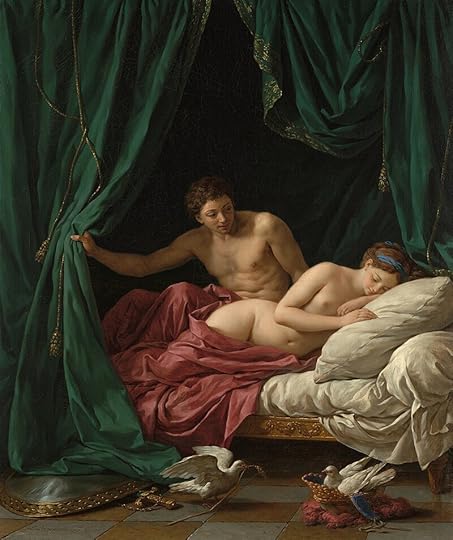
Venus and Mars: Allegory of Peace (1770) by Louis Jean François Lagrenée (1725-1805), a cropped portion of which is used for the cover of "Flesh." Image sourced from Wikipedia.

I mementoized* this book in addition to having to tag it with an Unsatisfactory Ending Alert. I am in the minority here but check some other 1 star reviews and I think you'll get a sense of what is lacking in this.

Footnote
* Mementoize is an invented word as follows:
mementoize
məˈmenˌtōˈīz/
verb / neologism
Definitions:
• 1. to tell a story in reverse order, as in the film Memento (2000) by director Christopher Nolan.
“Christopher Nolan didn’t invent reverse chronology story telling, but his film title Memento is the easiest to make into a verb: mementoize."
• 2. to read a book in reverse order to finish it, especially when reading it in forward order is not very interesting or compelling.
“The book was so dull I had to mementoize it in order to get through it."
• 3. a fictitious word invented for use in book reviews by The Lone Librarian™.


Profile Image for 〽️onicae.
72 reviews6 followers
December 8, 2025
Dire quale fosse la sua intenzione è difficile (D.S.)

Avete presente il gioco del domino? Esattamente così viene presentata la vita di István, il protagonista di questo breve romanzo. Una sequenza di eventi che non si sarebbero verificati e concatenati se la tesserina a monte non avesse perso l'equilibrio, fatalmente spinta da una forza superiore.

E' ungherese István. Ha quindici anni quando si trasferisce in un’altra città con la madre. E' introverso, inibito, solitario. Un adolescente come tanti se ne vedono nelle scuole e sugli autobus, quantomeno fino all'episodio deflagrante che, di fatto, costituirà un'ipoteca sul suo futuro.

Non ha ancora sviluppato la capacità di autodeterminarsi István e, di conseguenza, la capacità di sottrarsi, di dire no. Se si è molto giovani questa capacità va allenata, oltrechè supportata dagli adulti. Credo di poter dire che István non abbia avuto questo privilegio.
E quindi, in diverse occasioni della vita, si convincerà ad apprezzare proprio quanto non ha avuto la capacità di respingere. Del resto, come osserva Szalay, dire quale fosse la sua intenzione è difficile.

Saranno i dolori a modellare questa sua arrendevolezza, a trasformarla, a consentirgli di operare finalmente delle scelte, di determinare, nel bene e nel male, il suo futuro. E' un personaggio che evolve impercettibilmente quello di István e che raggiungerà la piena maturità solo quando la sofferenza lo avrà plasmato del tutto.

Protagonista assoluto di questo romanzo è il corpo che agisce e che reagisce ad ogni più lieve stimolo esterno. Szalay non si sofferma ad indagare i pensieri di Istaván: ad essere centrali nella narrazione sono le reazioni del corpo. Sono queste ultime a veicolare il sentire più profondo del protagonista.
Szalay rende la corporeità espressione dell'essere e fulcro del racconto.

Concludo con un doveroso cenno sulla struttura narrativa. Non ha nulla di particolarmente elaborato: è costituita da dialoghi brevi e fitti. Anche la scrittura è asciutta, del tutto priva di orpelli. E' un'operazione a sottrarre, simile a quella di Coco Chanel quando invitava a togliere l'ultimo tra gli accessori indossati.

La forma, così depurata, si riflette necessariamente sul contenuto. L'idea che mi sono fatta è che Szalay volutamente non elabori, non svisceri, non si soffermi su riflessioni particolari, non serva una spiegazione preconfezionata al lettore per consentirgli di appropriarsi del racconto, attraverso la propria lettura.

In altre parole, quelli che in un primo momento mi erano parsi irritanti vuoti narrativi, o meglio, vuoti esplicativi, si sono rivelati interessanti spazi interpretativi.
Displaying 1 - 30 of 3,533 reviews

Can't find what you're looking for?

Get help and learn more about the design.