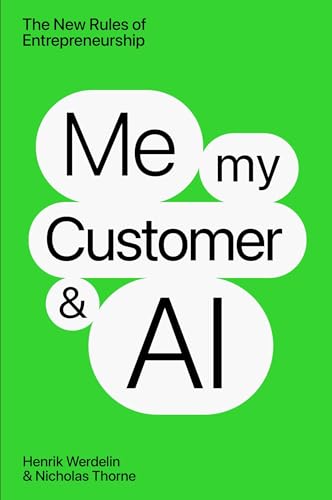
Unlock the future of entrepreneurship with Me, My Customer, and AI. This game-changing guide from startup veterans Henrik Werdelin and Nicholas Thorne shows you how to harness AI in order to break barriers, accelerate growth, and build a business that truly matters.
From entrepreneurs Henrik Werdelin and Nicholas Thorne—founding partners of Prehype, the global venture development firm behind some of today’s most innovative startups—comes Me, My Customer, and AI, the must-read guide for building successful businesses in the age of AI.
With artificial intelligence reshaping every business and industry today, who better to reimagine the rules of entrepreneurship than very the team who create groundbreaking companies, teach applied entrepreneurship at top universities, and empower founders with their Entrepreneur Residency program and Audos, the revolutionary AI cofounder for future entrepreneurs? Me, My Customer, and AI is both a roadmap and a rallying cry for the 60 percent of people in the US who have an idea for a new business.
Its message? There has never been a better or more critical time to start a business. AI removes barriers. It automates market research, accelerates prototyping, and streamlines customer engagement—freeing you to focus on what truly solving real problems and creating lasting value.
Drawing from their extensive experience launching and scaling companies like BARK, Ro, and AndCo, the authors bring wit, wisdom, and practicality to every page. And with innovative actionable exercises, they won’t just inspire, but they will equip and embolden you to— Identify your unique advantages and find your entrepreneurial focus Find problems worth solving for people worth serving Build meaningful, scalable customer relationships. Turn customer insights into sustainable competitive advantages
Me, My Customer, and AI is an indispensable and inspiring guide for anyone seeking to create lasting value in a world where technology is quickly commoditizing everything else. The future belongs to entrepreneurs who can cofound companies with AI while remaining radically human. Come along and join them.
"Me, My Customer, and AI" is a book that immediately positions itself at the intersection of human intuition, business evolution, and technological transformation, exploring how artificial intelligence is reshaping the very core of customer relationships. From the first pages, it becomes clear that this isn’t simply a discussion about technology - it is a reflection on the psychological, emotional, and strategic shifts happening as AI alters how businesses understand, predict, and serve their customers. The book acknowledges that while digital tools have revolutionized data-driven decisions, the heart of business has always been rooted in human connection. What makes "Me, My Customer, and AI" stand out is how it bridges these two forces - humanity and intelligence - rather than treating them as opposing powers.
The book explores the idea that we have entered an era where personalization is no longer a luxury but a non-negotiable expectation. Customers today do not want to be generalized; they expect brands to anticipate their needs before they even express them. Through real-world examples and research-backed storytelling, the author shows how AI allows companies to reach that level of emotional precision - not through cold automation, but through data that helps replicate the attentiveness of genuine one-to-one service. AI, when applied correctly, becomes an enhancer of empathy rather than a replacement for it. It isn’t framed as a threat to human roles, but rather as a partner that strengthens the business’s ability to respond with speed, relevance, and accuracy.
One of the book’s strongest points is its repetition of an important question: 'Who truly owns the customer relationship in the age of AI?' The author argues that companies that hand over their customer experience entirely to technology without anchoring it in values and emotional intelligence will eventually lose trust. What AI provides is power - but what customers desire is understanding. The companies that thrive will be the ones that treat AI not as the main act but as an amplifier of human intention. It emphasizes that strategy, not tools, determines whether AI becomes an advantage or a disconnect.
The book also dives into how AI is subtly rewriting the psychology of loyalty. Loyalty is no longer based on brand legacy or convenience - it is now earned through personalized anticipation and emotional assurance. Customers stay where they feel seen, and AI enables businesses to scale that feeling across millions. The book shares examples of companies using AI to eliminate friction before the customer even notices it exists - predicting churn, personalizing offers, and crafting journeys that feel tailor-made. But it also cautions that any over-automated, soulless execution of AI quickly leads to the opposite effect: disconnection. The message is clear - AI is a powerful instrument, but a dangerous one in unempathetic hands.
A significant portion of the book reflects on the role of the human professional in this new landscape. It directly addresses the fear of replacement and reframes it - stating that AI will not eliminate human relevance but will drastically punish those who refuse to evolve. The human role will shift from doing repetitive execution to mastering interpretation, creativity, and relationship-building. The book encourages professionals to develop an 'augmentation mindset,' where AI handles the data, and the human handles the narrative. It encourages leaders to integrate AI not as a separate department, but as a cultural mindset that flows through decision-making, customer listening systems, and brand identity.
The narrative also touches on the ethical dimension of AI without becoming overly philosophical. It emphasizes that customers may forgive errors, but they do not forgive manipulation. Trust, the book reminds us, is not a marketing metric - it is an emotional contract. If AI is used to exploit, customers will recoil. If AI is used to empower, customers will stay. The author insists that ethical AI is not just morally correct, but strategically superior. In an era where transparency is forced, not optional, the most customer-centric companies will not just use AI to know more, but to care more visibly.
As the book progresses, it becomes evident that it isn’t only speaking to marketers or technologists - it is speaking to founders, executives, strategists, and anyone involved in designing the future of customer relationships. It offers both strategic clarity and motivational urgency, conveying that AI is not coming - it has already arrived - and the only real question is whether we will build with it or be blindsided by it. It suggests that winning with AI is not about having the best tools, but about understanding the customer with radical precision and designing experiences that feel personal at scale.
What resonates deeply is its balance. It does not romanticize AI, nor does it demonize it. It presents it as a force - neither good nor bad - but one that reflects the integrity of those who wield it. It argues that businesses who use AI to reinforce human values will rise, while those who use it purely for exploitation will eventually be rejected. It consistently reinforces that the future of customer experience is not technology-driven or human-driven - it is partnership-driven.
In conclusion, "Me, My Customer, and AI" is a timely and insightful guide that reframes artificial intelligence not as a technological revolution but as a relational one. It reminds us that customers do not fall in love with algorithms - they fall in love with how a brand makes them feel seen, safe, and personally valued. By blending human intuition with intelligent systems, the book paints a future where AI is not the enemy of authenticity but the engine that powers it at scale. It succeeds in showing that the businesses that will dominate tomorrow are not those with the most data, but those who use AI to honor the customer as an individual - and in that sense, "Me, My Customer, and AI" is not just about technology, but about the future of trust itself.
A lot of fluff about knowing yourself, customers, building a community with the same “case studies” from Starbucks, Amazon, etc. And AI which would magically allows the founder to build “intimacy with the customers” and not to hire any employees. DNF.
BLUF (Bottom Line Up Front)A practical, if occasionally surface-level, exploration of how founders can use AI to deepen customer understanding and strengthen brand relationships. It reaffirmed my belief that technology’s greatest power lies not in automation but in amplifying empathy and alignment.
Executive Summary Henrik Werdelin’s Me, My Customer and AI examines how artificial intelligence can help founders and product teams build richer, more emotionally intelligent relationships with customers. Rather than positioning AI as a replacement for human creativity or intuition, Werdelin frames it as a relational amplifier — a tool for better listening, predicting, and serving.
Key ideas include:
1. Relationship Capital — Strengthen intimacy (anticipate needs before customers ask) and status (what being your customer communicates about them). 2. Entrepreneurial Energy Map — Chart your efforts across five “P”s: passions, positions, possessions, powers, and potentials, to clarify where AI can best extend your strengths. 3. Founder–Customer Fit — Use AI to role-play as customers, exploring emotional and motivational alignment between your mission and theirs. 4. Manual Before Mechanical — Don’t rush to automate; understand the human process first, then apply AI only to enhance or accelerate what already works. 5. Neighborizing vs. Personalizing — Avoid crossing privacy lines; instead, use AI to foster local, trust-based relationships that feel human rather than invasive.
Review As a learning designer, I found Werdelin’s focus on relationship capital refreshingly human. Too often, founders treat customer data as a control panel — something to be optimized rather than understood. His distinction between intimacy and status reminded me of motivation theory: people don’t just buy products; they buy identities, belonging, and acknowledgment.
Where the book shines is in its insistence that AI should serve human empathy, not efficiency for its own sake. The suggestion to focus on human listening and then use AI tools to analyze data and role-play as customers mirrors what we do in instructional design when building learner personas or testing experience maps. It’s a practical way to surface blind spots and check for alignment — something many teams neglect in the rush to scale.
That said, much of the advice felt intuitive, bordering on common sense for those already steeped in design thinking or customer experience. The five-dimensional map of entrepreneurial energy stood out as the most novel concept, offering a structured reflection on where founders derive momentum and where AI might extend it. I only wished the book had gone deeper into case studies or cognitive principles behind why these frameworks work.
Still, I appreciated its grounded tone: do things manually first, build understanding, then let AI extend your capacity. It’s a mindset that resonates deeply with how I approach emerging technologies in education — start human, stay human, scale thoughtfully.
TL;DR ⭐⭐⭐☆☆ A concise, practical guide that frames AI as a mirror for empathy rather than a machine for automation. Strong on mindset, light on depth. Worth reading for founders and creators who want to ground their AI use in authentic human connection.
Similar Reads
* Imagining AI by Genevieve Bell — Anthropological reflections on how AI reshapes our cultural narratives. * Human-Centered AI by Ben Shneiderman — A deeper, design-oriented take on keeping AI humane. * The Ministry of Common Sense by Martin Lindstrom — On empathy, observation, and the small human moments that scale trust.