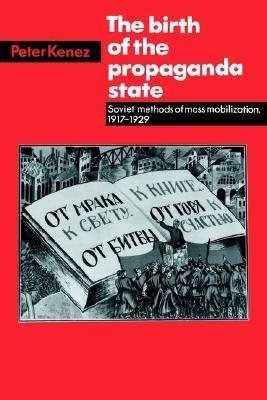
In this comprehensive study of the early development of the Soviet propaganda system, Peter Kenez describes how the Bolshevik Party went about reaching the Russian people. Throughout this book, Kenez is more concerned with the experience of the Soviet people than with high-level politics. The book is both a major contribution to our understanding of the genius of the Soviet state, and of the nature of propaganda in the modern world.
Peter Kenez, Ph.D., is a Professor Emeritus in the History Department at the University of California, Santa Cruz. A founding faculty member of UCSC's Stevenson College, Kenez received his Ph.D. from Harvard University. He has been teaching Russian and modern European history at UCSC since 1966.
Mr. Kenez' research interests include Russian history, Eastern Europe, 20th-century Europe and Soviet film. At UCSC, he has taught courses in each of those areas, as well as Modern European History, the Holocaust and Jewish social history. He is the recipient of an Excellence in Teaching award.
Kenez is a native of Hungary and a Holocaust survivor. He is the author of eight books, including A History of the Soviet Union from the Beginning to the End and the autobiographical Varieties of Fear: Growing Up Jewish Under Nazism and Communism. His most recent work is entitled From Antisemitism to Genocide; the Origins of the Holocaust.
This is one of many history books written by uninspired, yet diligent paper pushers. The title is incorrect, or incomplete. It should have been "The Birth of the Soviet Propaganda State". The text inside is like the title: it has most words and that is about it. A chronology of some sorts with no profound thought or conclusions. Take the opening chapter. Sure, the press developed in the last decades of the Empire, before the Bolshevik revolution. But why? Kenez has no idea. He just spits some numbers on how many newspapers there were that year and how many a few years later. Was it a profitable business? Kenez has no idea. He says something about one of Lenin's enterprises who was heavily fined by the authorities eight times. Heavily? What does that mean? Kenez has no idea. Is eight times unusual? Kenez has no idea. Why hasn't the newspaper changed title and address instead of taking eight fines? Kenez has no idea. He keeps going on with the junk he got from some other text. Like how Lenin was influencing the bla bla, peasants bla bla. Really? Is that the reason why decades later Stalin starved the peasants for refusing to collectivize?
It started strong and had a much more even-handed and interesting definition of propaganda and specifically Soviet propaganda than I expected. Lots of good information, quotes, statistics BUT I could barely establish what the author's argument actually was. He kind of returned to it in the conclusion asking whether or not Soviet propaganda efforts were successful, but the question of their novelty was left hanging.
A bird's eye view of an immense subject over a long (considering the number and importance of developmnets) period, so not always a lot of detail but useful as an introduction. However, little is based on archival sources so there's a heavy emphasis on capital-P Party. Curiously, Glavlit, the censorship agency, is not mentioned and its functions are described by the author as fulfilled by Gosizdat, the state publisher, which is an important error.