Jump to ratings and reviews
Rate this book

An Offering for the Dead (Eridanos Library) by Hans Erich Nossack (1-Oct-1992) Hardcover

Rate this book
Hans Erich Nossack's work is a link between the titans of early 20th-century German fiction - Mann, Musil and Broch - and the later generation of Boll and Grass. An Offering for the Dead is a small, hard gem set in the crown of that tradition. "It was raining again," the narrator of this haunting novel begins. He has survived some unmentionable, perhaps worldwide cataclysm - a biblical flood? nuclear war? - that has stripped him of his memory and most everything else. A woman's room, a notebook, a mirror, her comb - these artifacts in a void are all that remain: his first clues to the past, his own and the world's. His errant musings, reminiscent of the guilt-driven wanderings of Orestes, gradually piece together a history he must both remember and create in order to regain his identity, and, like Noah, repopulate a world in which he may be the only survivor. In a delicately allusive prose that resonates with overtones of man's ancient past and darkly apocalyptic warnings, Nossack, like Joyce and Proust before him, exposes the mythical undercurrents of contemporary life. Past, present and future blend into an eternal return of archetypal figures whose stories transform human history into a timeless parable of creative memory and immemorial destruction.

Hardcover

First published January 1, 1947

2 people are currently reading
127 people want to read

About the author

Hans Erich Nossack

47 books9 followers
Hans Erich Nossack war ein deutscher Schriftsteller, der zunächst als Lyriker und Dramatiker, später jedoch vor allem als Prosaautor in Erscheinung trat.

Ratings & Reviews

What do you think?
Rate this book

Friends & Following

Create a free account to discover what your friends think of this book!

Community Reviews

5 stars
8 (30%)
4 stars
7 (26%)
3 stars
7 (26%)
2 stars
4 (15%)
1 star
0 (0%)
Displaying 1 - 5 of 5 reviews
Profile Image for Vit Babenco.
1,777 reviews5,733 followers
November 12, 2024
Unknown time… Unknown place… No past… Just now…
It was raining again. Or still. I had no power over it.
So I stood up and went back. I told the people: “I will find a road.” Not that they asked me to do so. They were lying around like lumps of clay; a few rolled over, sighing. I only said it because at that moment it struck me as the right thing for them. But it was a lie; for I knew that the road could not possibly be where I was heading.

An ego and cosmos… An ego and the city… An ego in the void… Is everything just imagination?
Finally, I stepped into a home. It was a not very large one-family house, which stood in a garden. I entered the house because it happened to be in my way. Or because the garden gate and the front door were open. Or also only because I was fed up with running around and it was time to put an end to it.

No sounds… No odors… Not a single animate thing is around… He has no reflection in the mirror… And the protagonist starts wondering if he is alive or dead…
At that time, in front of the mirror, I did not doubt for an instant that I was alive. It was not I that was dead; it could only be that the mirror had died. I also examined it to find out. I wanted to push it away from the wall to check behind it, but I was unable to do so.
Then he falls asleep… And the world becomes filled with smells, voices and life… Is he the one whose reality and dreams are reversed? Or is there much more enigma in existence than may ever appear?
“Thou know’st how lame a cripple this world is.” John DonneAn Anatomy of the World
Profile Image for Jim Fonseca.
1,158 reviews8,457 followers
May 25, 2020
Revised and pictures added 5/25/2020

A translation from the German of a work from 1947. This was right after the war, and right after the atomic bombing of Japan. But it’s not directly about the horrors that occurred in Germany; instead it seems to be about a future nuclear Armageddon. We read of a blazing new star and that technology allows us to preserve life or to destroy it.

description

Perhaps the story also refers to the Allied firebombing of the author’s hometown of Hamburg. Wikipedia says one of the author’s most famous works is The End: Hamburg 1943, written 3 months after the bombing of Hamburg by the Allies during the Second World War.

This a short book (124 pages) without chapter breaks. In a dream-like, sleep-walking state, the narrator wanders through a city watching people in their ordinary lives. He has no interaction with them. Perhaps he is a ghost and they are real or perhaps he is the last person alive and they are ghosts.

As he wanders he reflects back on his upbringing and his relations with his father, mother, brother and other important people such as a favorite teacher. Even when he appears to be awake, he has amnesia for who people are.

There is much reflection on clocks, time, images in mirrors, names and mass hallucination. And of course, reflections on war and the trauma it inflicts on people (which we would now call post-traumatic stress).

Even for a fantasy it is a bit confusing and I thought it didn’t really contribute new insights compared to other such works. I note it’s very low-rated on GR (3.4).

description

The author (1901-1977) knows first-hand of what he writes about. He would have been 13 years old at the start of WW I and in his forties during WW II. And, as I mentioned above, it was his hometown, Hamburg, that was destroyed.

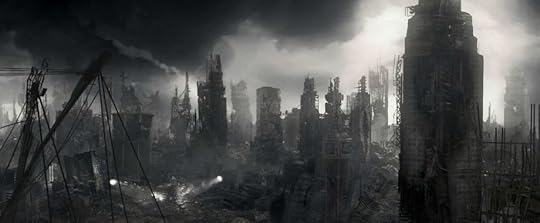
Top photo from dystopiainstudy.weebly.com
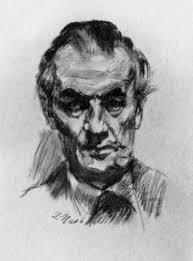
Sketch of the author from nimbusbooks.ch
Profile Image for Matthias.
397 reviews8 followers
January 13, 2021
Oh mother, make me nameless

Hans-Erich Nossack's little book appeared 1947, in the same year as Hermann Kasack's The city beyond the River. Both take place in a realm beyond the living, and both play with the inexplicable and symbolic.
The German title Nekya refers to an ancient Greek rite of necromancy, as described in book 11 of Homer's Odyssey. Many motives are taken from Aeschylus' Oresteia, but there is also the creation of a Golem. The book is far more experimental than Kasack's novel. The role of names and entities separate from our existence and that of memories as faded colors are examples. A hint of what Nossack tries to accomplish is given in the middle of the book:

Merkst du denn nicht daß ich von der Spanne Leben spreche, die sich vom Tode bis zur Geburt erstreckt? Eine Spanne, von der wir wissen, daß sie sich über sehr viel weitere Räume erstreckt, und von der wir wohl nur deshalb zu schweigen pflegen, weil sie sich nicht durch Zahlen begrenzen läßt.

(Don't you realize that I am talking about the life span between death and birth? A span of which we know that it stretches across far wider spaces, and about which we remain silent only because it cannot be measured by numbers)


This is less an allusion to a cyclic existence but rather an attempt to achieve the impossible, to make life possible again by remembering what happened before death.
18 reviews7 followers
May 27, 2025
“However, my character is such that I do not know how I would act if I suddenly found a lone rosebush in this muddy world. It is possible that the old song would come to my mind:

Oh, why do you still blossom, rose?
To whom shall I give you today?
The summer is gone forever, rose, I now must think of yesterday.

But it may be that I will tear it off, thereby injuring my fingers. And then I would hurl the rose on the ground and trample it.”

Profile Image for Jonathan yates.
240 reviews5 followers
January 30, 2021
Probably just a bad or archaic translation, everything was very fractured here and I couldn’t ever grasp the thread
Displaying 1 - 5 of 5 reviews

Can't find what you're looking for?

Get help and learn more about the design.