Jump to ratings and reviews
Rate this book

Kill City: Lower East Side Squatters 1992-2000

Rate this book
After being kicked out of her apartment in Brooklyn in 1992, and unable to afford rent anywhere near her school, young art student Ash Thayer found herself with few options. Luckily she was welcomed as a guest into See Skwat.

New York City in the '90s saw the streets of the Lower East Side overun with derelict buildings, junkies huddled in dark corners, and dealers packing guns. People in desperate need of housing, worn down from waiting for years in line on the low-income housing lists, had been moving in and fixing up city-abandoned buildings since the mid-80s in the LES.

Squatters took over entire buildings, but these structures were barely habitable. They were overrun with vermin, lacking plumbing, electricity, and even walls, floors, and a roof. Punks and outcasts joined the squatter movement and tackled an epic rebuilding project to create homes for themselves.

The squatters were forced to be secretive and exclusive as a result of their poor legal standing in the buildings. Few outsiders were welcome and fewer photographers or journalists. Thayer's camera accompanied her everywhere as she lived at the squats and worked alongside other residents. Ash observed them training each other in these necessary crafts and finding much of their materials in the overflowing bounty that is New York City's refuse and trash. The trust earned from her subjects was unique and her access intimate. Kill City is a true untold story of New York's legendary LES squatters.

176 pages, Hardcover

First published March 3, 2015

121 people want to read

About the author

Ash Thayer

1 book

Ratings & Reviews

What do you think?
Rate this book

Friends & Following

Create a free account to discover what your friends think of this book!

Community Reviews

5 stars
20 (62%)
4 stars
9 (28%)
3 stars
3 (9%)
2 stars
0 (0%)
1 star
0 (0%)
Displaying 1 - 7 of 7 reviews
Profile Image for Sarah Schantz.
Author 4 books108 followers
November 26, 2015
Clicking "read" for a book of photography seems a little strange, but aside from the fact that I did read the text within, I do believe that images which are represented artistically do require a "reading" just as one would "read" a Tarot card, or analyze the seemingly senseless splatter of a Jackson Pollock painting only to find the meticulous method to his madness. So to clarify and reiterate: I read the text in this book--the prologue by the artist herself, the introduction by Reverend Frank Morales, the various testimonies and stories of the featured squatters throughout the pages, the concluding conversation between Ash Thayer and Dana Hoey, but I ALSO read the photographs themselves. In some cases I was re-reading photographs of good friends I'd seen before, either in their travelling journals, their homes (both squatted and not), or on Facebook.

The first time I went to the LES, I think I was nineteen, and that time around I stayed at 5th Street where the photographer, Ash Thayer lived, and consequently one of the main squats featured in this book. I did not know Ash then nor do I know her now. Nonetheless, I believe I should be upfront with my particular bias as I review this art book. I spent my youth living on the streets, squatting, hopping trains, living under bridges, panhandling, dumpster-diving, and generally living on the fringes of society. Because many of us were runaways or outcasts or wanderers, we lacked and/or reveled in the lack of stable homes, but we almost all carried journals. These journals were filled with our thoughts, collages made from magazines we'd found in the trash, and oftentimes, the rare photographs we managed to take and get developed somehow. I guarded my journals more ferociously than I guarded my other few possessions--a sleeping bag, a back pack, a change of clothes, and maybe a book or two, because I knew too many people who'd had theirs stolen by the police; the general theory was the police were taking our journals to make a study of who we were. What makes the squatters in New York and in Philly (where I spent more time) unique, was the drive to make a home, a place to call our own. While I admired my friends who were squatting, and the politics of it, I was far too restless to stay put back then, and my journal was my only real home. Kill City is the ultimate journal, and in these pages, I found my old home--for me, I realized, my home was not within a building back then (a lesson I need to remember now as I struggle to pay rent), but within the community of my friends--friends I still hold dear, even if we are scattered far and wide by now, even if so many of us have died, these people will always be my one true family, my one true home.

I received Kill City in the mail yesterday. My own book debuts next week and I had a list of errands to run before the weekend rolled around. Ironically, I had to send a package of gifts to both my literary agent and my editorial team at Simon & Schuster who are all in New York, but I couldn't resist Kill City. I was literally all ready to go when the mail arrived, and when I saw the package, I knew what it was. I told myself I'd just take a peek and then get going, but I didn't leave until I'd finished reading every single word, and contemplating and admiring every single photograph. I barely managed to get my errands done. And then I came home, and I looked at the book again with my husband who was one of the original squatters at C-Squat, and where he and his ex conceived my stepdaughter. And then I took the book to bed and read the words again, and looked at the pictures one more time.

But Kill City is more than a walk down memory lane for those of us who were a part of this particular subculture. It is an important part of American history and a work of art. Along with being a writer, I also teach creative writing at the local community college. Again and again, I am astounded to find that not everyone understands the multiple layers of authentic art. Authentic art is art that doesn't just mean one thing, but sometimes several things all at once, and sometimes those things can appear to be contradictory. Kill City is a personal documentation of one young woman's life through photography while it also served as a politically-motivated evidence. As Thayer says, "This was before cell/camera phones," and "residents needed to have a visual record of the work that they did on the buildings" (174). Furthermore, each picture was carefully considered from before the shot was taken to the moment it was developed. This is especially clear when Thayer explains, "Most of the environments were dark, requiring good manual skills with the camera or the tripod" (174). This book is proof that the starving artist archetype is real. Considering when Thayer was taking these, she was somewhere between being an outsider artist and not. Obviously, she was in art school at the time, but she was able to capture a world that was purposely shrouded in darkness because all too often these squatters had to keep hidden so as not to be caught, and evicted. When I stayed at 5th Street I was surprised to learn that residents had to keep their windows heavily blanketed at night so as to conceal the pirated electricity from the cops. I'd been at 5005 in Philadelphia where we didn't have to do this, where the mail man actually delivered mail to our front door.

I mention this darkness and secrecy not to reminisce, but to evaluate Thayer's artistic choices and her impressive abilities: I've already addressed the difficulties she faced as a photographer with limited lighting and limited equipment, but I'd also like to address what Dana Hoey describes as "the celestial light" that makes the squatter subjects in Thayer's work "glow," thus "elevat[ing]" every person in every portrait (174-175). When I look at these pictures, and see the people "glowing," I see them illuminated by more than their "backlit . . . rooms," but from the love the artist felt for them, and they for her (Hoey 174). I mention this because we were a xenophobic group of kids, and for good reason. We had a lot of predators to fight off--the police, the government, but also drugs and those who dealt them. Hoey asks Thayer why she didn't take "sex and drug pictures" and that just shows the general misunderstanding outsiders had (175). We weren't pornographers or prostitutes (at least not generally), and for those of us who had problems with substance abuse, I direct you to look back at the sentence where I mention who our predators were. What Thayer has managed to capture is the true essence of this culture, the love and the respect we had for each other, the "do-it-your-fucking-self" mentality (Thayer 8), the independence, the exhilaration, and the freedom we felt as a community. When I look back at the terrible pictures I took from this time period, using either a cheap $20.00 camera or a disposable one, I didn't manage to capture this. My pictures are blurry, unfocused in more ways than one, and not a true representation of what I actually remember. I might have been using color film, but somehow my pictures all came out gray; they did not come out black and white--hell, even Thayer's black and white portraits are unbelievably radiant. After looking at Kill City, I fell asleep and I dreamed in color. I travelled back in time and I was with my family again. And we glowed to be together, to be reunited. I dream of my people often, but I never dream of them so vividly, and that is why I credit last night's dreams to Thayer's talent to not only accurarely represent her subjects, but to fuel her images in such a way they linger, and transcend. That my friends, is art.

As I tried to say before, this photography book is authentic art: it is personal and political in the way that the personal is always political; it is multicultural; it is punk; it is feminist; it is egalitarian; it is DIY; it is pure anarchy; it is historical; it is part of the literary and artistic canon called, "The American dream," a canon that has been forced to explore instead the disillusionment and destruction of this dream, a canon that should perhaps be renamed, "The American nightmare." KIll City is about so many issues because it is about so many different, unique, and amazing people, and because these people were portrayed by such an extraordinary artist. It is also a memorial to those gone--the ones taken by the predators I spoke of before; JP and Jaimie gone to one kind of predation, and then Bradley Will who filmed his own assassination down in Mexico years after he almost got himself killed in his heroic attempts to save 5th Street from a greedy city; and it is also a memorial just as much to the buildings that were lost--the homes that the American dream promises, stolen from their resident; it is a memorial to all the hard work that was destroyed by the government when they came in with their "destruction" dumpsters, their wrecking balls, their hired pyromaniacal thugs, and their endless court orders; it is a memorial, and proof, that a shrouded genocide was both attempted and committed against the people of the LES. That said, Kill City is also a celebration of survival, perseverance, and the bits and pieces of glory that were achieved. Part of that glory is the recognition of this artist, Ash Thayer, and the honesty and courage of her photography, the utmost beauty of her images, and the absolutely clear lens from which she saw this world.
Profile Image for Amar Pai.
960 reviews97 followers
October 21, 2015


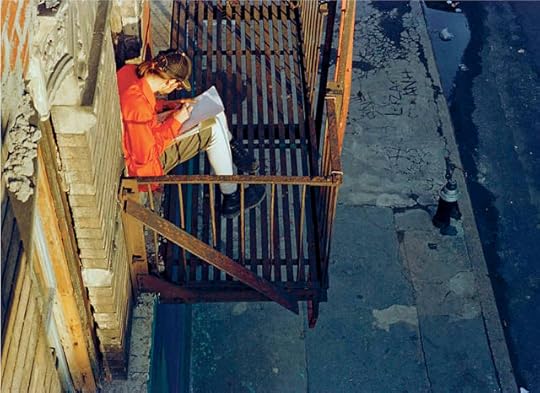
Kurt on Fire Escape, Fifth Street Squat, 1995
When I first showed up at Fifth Street, the center of the building was nothing more than a gaping hole where there were supposed to be stairs. A series of old, rusty fire escape ladders scavenged from somewhere leaned against the walls in the empty space from one landing to the next, all the way to the 6th floor. It was precarious, especially in the dim light, and even worse after drinking. I don’t know why I don’t remember anyone falling.

I’d never built a flight of stairs. None of us had. I think it was my dumb confidence that got the ball rolling. “We can do this, easy.” I wasn’t a building member yet. I needed to prove myself.

A few days later Scott and Patrick picked up some twenty-foot metal stringers and brought them back to the building, each weighing some hundred pounds. They were squared off, but needed to be cut at an angle to fit. We measured and measured, afraid to commit. No one wanted to be the one to make the wrong cut, and I
felt eyes on me. It was like a test that I knew I couldn’t fail—it had somehow been my idea. So I grabbed the circular saw with the metal grinder blade and made the cut.

When we hoisted it into place, it fit perfectly and I breathed a sigh of relief while acting like I knew it could only be perfect. I then quickly cut the second one to match, and we were on our way. Pretty soon we had a series of mosaic cement treads and cut-up police barricades to finish the flight of stairs to the 2nd floor. I earned my key, and an apartment on the second floor. The next flight of stairs was easier.
—Kurt, 537–539 East Fifth Street Squat
70 reviews4 followers
December 16, 2016
A photo-essay of the lives of New York squatters who were eventually ejected from buildings on 5th and 13th streets of the Lower East Side, by someone who lived with them who now is a working artist in Los Angeles. From the sheer perspective of what it was like to occupy one of these buildings, reconstruct it, and live in it, I felt that I learned more from meditating on these photos for a couple of days than I might have through any other method other than actually having done it myself. The photos itself are very intimate, inviting the reader into people’s lives moment by moment. The foreword by a pastor in the Bronx reminds us that, in some ways, elements of this life aren’t dead, as do the recent fires in Oakland. There will always be people who are trying to find to some extent to find a way to live off the grid, and when we consider what this “grid” has come to represent (the facelessness of the monoculture set in place by the large minority who has money; the ability of entire cultures and democratic processes to be altered by the simple act of hacking into machines that most of us have no real means of control over; the relentless expansion of inequality and endless wars in an age where the technology that’s been developed could be directed to something productive and also loving), contemplating the off-the-grid life and seeing some who made it work…for them…for a few years is immensely moving.
Profile Image for Harris.
1,099 reviews32 followers
June 19, 2015
“Kill City” contains a fascinating collection of images, shedding light upon a neglected and oft maligned subculture. These intimate, vivid photographs capture a specific and interesting period in the 1990s, as young squatters, following egalitarian and creative dreams, transformed the Lower East Side neighborhood of Manhattan. While I’ve yet to visit NYC and was in grade school for the majority of the period explored here, the influence of these experimental living space still resonate throughout the country and the world. Thayer’s masterful photography illustrates this important and inspiring community in a way not seen before.

In a city battling homelessness and skyrocketing rents, thousands of living space in the LES were abandoned and left to rot as the city still reeled from the crime waves and tension of the ‘80s; disaffected young people from across the nation and the world took advantage , banded together to make something out of the waste of the urban landscape. Photographer Thayer, a young art student, found herself in the midst of the secretive group, allowing her to record the work the young women and men put into making these abandoned buildings into homes. Melding punk and grunge ascetics with egalitarian pride and DIY-skills, they created an extremely interesting experiment in living during this period, lovingly reflected in Thayer’s expressive work.

As the squatters got to work breathing life into the area, making tottering ruins livable, planting gardens, creating a vibrant community in the neglected Lower East Side neighborhood, the city began to covet the now valuable real estate. By 2000, this resulted in the destruction and disbursement of the community to make way for other people able to pay for the privilege of living there. The photographs in this album provide a rare and effecting exploration of the people who made up the squatter subculture during this short but powerful period. As our culture continues to change, our economy and environment remaining fragile, the examples explored by “Kill City” remain an important look at how a society can function without hierarchies.
Profile Image for River.
147 reviews
July 6, 2015
I very much enjoyed this collection of photos. The book does an excellent job of capturing the squatting scene and brings compelling visuals to something I had only read about.
Displaying 1 - 7 of 7 reviews

Can't find what you're looking for?

Get help and learn more about the design.