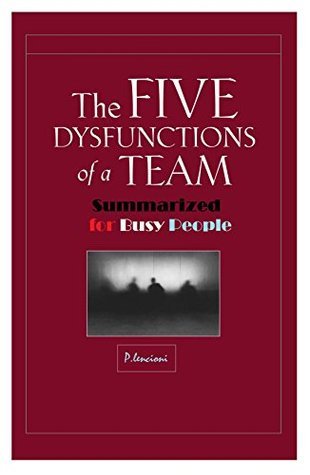
Don't have time to read the whole book? The Five Dysfunctions of a Team Summarized for Busy People is for you ! It briefly describes the many pitfalls that teams face as they seek to "row together". This summary explores the fundamental causes of organizational politics and team failure.
Patrick Lencioni is a New York Times best-selling author, speaker, consultant and founder and president of The Table Group, a firm dedicated to helping organizations become healthy. Lencioni’s ideas around leadership, teamwork and employee engagement have impacted organizations around the globe. His books have sold nearly three million copies worldwide.
When Lencioni is not writing, he consults to CEOs and their executive teams, helping them to become more cohesive within the context of their business strategy. The widespread appeal of Lencioni’s leadership models have yielded a diverse base of clients, including a mix of Fortune 500 companies, professional sports organizations, the military, non-profits, universities and churches. In addition, Lencioni speaks to thousands of leaders each year at world class organizations and national conferences. He was recently cited in the Wall Street Journal as one of the most sought-after business speakers in the nation.
Prior to founding his firm, he worked as a corporate executive for Sybase, Oracle and Bain & Company. He also served on the National Board of Directors for the Make-A-Wish Foundation of America.
In "The Five Dysfunctions of a Team," the central idea revolves around a simple but powerful truth: talent alone does not create success. Many organizations assume that assembling highly skilled and intelligent individuals will naturally lead to outstanding performance, yet this assumption often proves false. Teams frequently struggle not because of a lack of ability, but because of poor collaboration. The book explains that teamwork is not an abstract concept but a structured and predictable system. When teams fail, they tend to do so in consistent ways, following a pattern of dysfunction that begins with a lack of trust and cascades into deeper issues. Through a narrative centered on a struggling company and its leadership transformation, the book demonstrates how effective teamwork can be deliberately built. It presents a clear framework for overcoming common pitfalls and emphasizes that strong collaboration is one of the most valuable and rare advantages in any organization.
A key idea explored is that teamwork itself is a competitive edge that organizations often overlook. Many companies prioritize individual performance, credentials, and technical expertise, assuming these qualities will naturally translate into results. However, the story of a failing company illustrates how even the most promising organizations can collapse when internal dynamics are broken. Despite having excellent resources and talented individuals, the company deteriorates due to internal politics, competition, and lack of alignment. Instead of working toward shared goals, team members focus on personal agendas, leading to inefficiency and low morale. The introduction of a new leader shifts the focus toward building cohesion rather than chasing immediate outcomes. This highlights the notion that when a team functions effectively as a unified group, it becomes far more powerful than a collection of individuals working separately.
At the foundation of strong teamwork lies trust, but not just any kind of trust. The book emphasizes vulnerability-based trust, where individuals feel safe admitting mistakes, asking for help, and revealing weaknesses without fear of judgment or exploitation. In many workplaces, people hide their shortcomings to protect their image, which creates an environment of defensiveness and distance. When trust is absent, communication becomes guarded, and real issues remain unspoken. By contrast, when trust is present, individuals can speak openly and address problems directly. This kind of trust does not develop automatically; it requires deliberate effort, often initiated by leaders who model openness and honesty. When leaders admit their own limitations, they create space for others to do the same, gradually fostering a culture of authenticity and mutual respect.
Building on trust, the next essential element is healthy conflict. Contrary to common belief, the absence of conflict is not a sign of harmony but a warning signal. Teams that avoid disagreement often suppress important ideas and fail to challenge flawed thinking. The book distinguishes between destructive conflict driven by ego and constructive conflict focused on ideas. Productive disagreement allows team members to test assumptions, explore alternatives, and arrive at better decisions. Without it, meetings become superficial, with participants agreeing outwardly while disagreeing internally. This leads to poor decision-making and unresolved tension. When trust exists, however, conflict becomes a tool for improvement rather than a source of division, enabling teams to engage in meaningful discussions without taking criticism personally.
The ability to engage in open debate leads directly to the next step, which is commitment. Many teams struggle to make clear decisions because they seek unanimous agreement or avoid confrontation. This results in ambiguity, where team members leave discussions without a shared understanding of the direction forward. The book argues that commitment does not require consensus. Instead, it requires clarity and alignment, even if some individuals initially disagree with the chosen path. When people feel heard and understand the reasoning behind decisions, they are more likely to support them fully. Lack of commitment creates confusion and slows progress, while decisive action enables teams to move forward with confidence and purpose.
Once commitment is established, accountability becomes possible. This aspect of teamwork is often uncomfortable because it involves peers holding each other responsible for performance and behavior. In many organizations, accountability is left solely to leaders, which can create resentment and reduce effectiveness. The book highlights that strong teams rely on peer-to-peer accountability, where individuals openly address issues and uphold standards together. When team members avoid confronting one another, problems persist and performance declines. Transparency plays a crucial role in fostering accountability, as clear visibility of goals and progress encourages responsibility. When accountability is shared, it strengthens trust and reinforces a culture of excellence.
The final stage in the model focuses on collective results. Even when teams are talented and accountable, they can still fail if individuals prioritize personal success over group outcomes. The book stresses the importance of aligning everyone around shared, measurable goals that define success for the entire team. When individuals focus on their own achievements, collaboration weakens and overall performance suffers. In contrast, when the team’s success becomes the primary objective, members are more willing to support one another and contribute beyond their specific roles. Clear goals eliminate ambiguity and ensure that everyone is working toward the same purpose, creating unity and driving better results.
Another important insight is the value of spending time together as a team. While meetings are often viewed as inefficient, the book argues that regular interaction is essential for building trust, resolving conflicts, and maintaining alignment. Face-to-face discussions allow for deeper understanding and quicker problem-solving, reducing misunderstandings and duplicated efforts. Although investing time in meetings may seem costly initially, it ultimately saves time by preventing confusion and delays. Consistent interaction strengthens relationships and ensures that all members stay informed and connected, which enhances overall performance.
The transformation of the team in the story demonstrates that these principles require consistent effort and practice. Understanding the framework is not enough; teams must actively apply it in their daily interactions. Leaders play a critical role in shaping the environment, but lasting change depends on collective commitment. By encouraging vulnerability, promoting open dialogue, ensuring clear decisions, fostering accountability, and maintaining focus on shared goals, teams can overcome dysfunction and achieve high performance. The process may be challenging, as it involves uncomfortable conversations and changes in behavior, but the results are worth the effort.
In conclusion, "The Five Dysfunctions of a Team" presents a practical and insightful guide to building effective collaboration. It shows that teamwork is not a matter of chance but a deliberate process that requires trust, constructive conflict, clear commitment, shared accountability, and focus on collective outcomes. These elements form a structured pathway that any team can follow to improve performance. By addressing each layer of dysfunction and investing in strong relationships, organizations can unlock their full potential. Ultimately, the book reinforces the idea that great teams are created through intention, discipline, and a willingness to work together toward a common goal.
This book was recommended to me by one of our senior directors that I have a lot of time and respect for. Also, I find that I have worked in areas where seemingly good teams had blind spots, so this book was easy to pickup as the subject is relevant for me.
I found the book to be an easy read. The chapters are well organised and I thought that using a fictional scenario was a great vehicle to demonstrate some of the key points of the book.
I think that Patrick Lencioni has gotten it right when he says that the five major dysfunctions of a team are the Absence of Trust, Fear of Conflict, Lack of Commitment, Avoidance of Accountability, and Inattention to Results. I think that I would add one more just to make a point as he covers it in the back section of the book, which is inactivity due to fear of making a mistake.
My one critical point that kept me from giving five stars was that I found some of the narrative in the scenario a bit annoying as it seemed cliche. In particular, the parts at the end of the chapter, such as, "he certainly could not have known that he would be regetting the decision just a few weeks later." It didn't really add anything to the overall scenario, from my reading.
If you are a new manager and building a team from the ground up, or an experienced leader who is new to a position and trying to develop an existing team, I think that this would be a great tool in your leadership toolbox.
Overall, I agreed with much that was said because I have experienced it. I see value in the book and thought that it was well worth the time spent reading it.
You may not have time to go through the main book, but at only 19 pages it is hard to make excuses with this summation. A warning, though, that this is not the silver bullet solution as an end all be all, but certaintly it does address a lot of the issues facing teams today in a general sense and hopefully peovide an opportunity to talk about the concepts without pointing fingers within your team.
Very helpful across a broad range of teams. This model gives teams a common set of strategies and vocabulary to use when building an open and healthy work environment.
I thought I was buying the other one -- but this one was just right for today! I'll probably go ahead and order the larger edition now, but this summary helped me get started with a presentation to my small staff.
Great resource for anyone concerned with the time needed to devote to reading. This does a great job of summarizing and highlighting the key themes and concepts. Well worth the few bucks!
Very practical summary, and it also serves as reference notes to discuss the key principles presented by the book in a class setting or other places where analysis may be required.
I found the summary useful because I could get a quick overview and note where a team struggles, then resource the needs. I also find it a good size to work with busy them leaders.