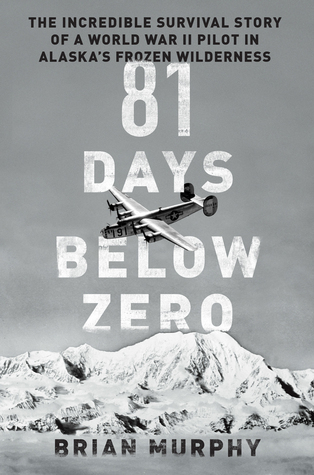
Shortly before Christmas in 1943, five Army aviators left Alaska's Ladd Field on a routine flight to test their hastily retrofitted B-24 Liberator in harsh winter conditions. The mission ended in a crash that claimed all but one—Leon Crane, a city kid from Philadelphia with no wilderness experience. With little more than a parachute for cover and an old Boy Scout knife in his pocket, Crane now found himself alone in subzero temperatures. Crane knew, as did the Ladd Field crews who searched unsuccessfully for the crash site, that his chance of survival dropped swiftly with each passing day.
But Crane did find a way to stay alive in the grip of the Yukon winter for nearly twelve weeks and, amazingly, walked out of the ordeal intact.
81 Days Below Zero recounts, for the first time, the full story of Crane's remarkable saga. In a drama of staggering resolve and moments of phenomenal luck, Crane learned to survive in the Yukon's unforgiving wilds. His is a tale of the capacity to endure extreme conditions, intense loneliness, and flashes of raw terror—and emerge stronger than before.
Brian Murphy is a Baby Boomer advocate and the founder and editor of BONZA (Baby Boomers of NZ and Australia) a Baby Boomer information website: www.bonza.com.au
He strongly believes that governments and industries are failing to adequately address the needs of the Boomer generation and the impact their impending retirement from the workforce will have on the economy and society by not having mature age policies. Since 1998 he has addressed these issues with thousands of Baby Boomers across New Zealand through his organisation, Grey Skills, and Australia through BONZA, by presenting well-balanced information sessions to the community on the pitfalls of an ageing population and advising how Boomers can plan for the future by acquiring the knowledge and skills to do so meaningfully.
Brian works to equip Boomers with the skills necessary to tackle the extension of their careers, re-entry into the workforce and to prepare financially and mentally for a longer than predicted retirement. He has had great success with thousands of Boomers, from general managers to drug addicts, assisting them to move forward with their lives no matter what their history is.
“It’s all about the future,” he states, “and never giving up!” He wants Baby Boomers to participate economically and socially if nothing else and have a BONZA life.
This survival story would make for an interesting magazine article, but there were simply not enough events or information to force a book out of the story. Instead, the author cobbled together numerous tangents which make up the majority of the material, and created this very fractured and disjointed story. Unfortunately, the result is that it feels long and drug out despite its very short length.
The reader does not even feel like they really get to know Leon Crane, whom the title misleads you into thinking the whole book will concern. There was never a feeling of suspense, in part because the survival story is constantly being paused to go off on yet another tangent. I simply wasn't concerned with what happened next. This book was easy to put down and was only ever picked back up to finish it for a book club discussion.
------------------------------------------- Favorite Quote: War is always a negative-sum outcome. It subtracts, removes, empties. No one who has witnessed combat can, with any honesty, describe it another way.
"81 Days Below Zero" felt like watching a Netflix or Hulu TV show without the paid subscription. It was like the free plan--the one with all the commercials. All you want to do is get through the commercials so you can finish your show.
I really wanted to go give this book a higher rating. But when three fourths of the book aren't even about the main survival story, it doesn't make it easy to recommend this read. A great story that's filled with too much filler.
This is the first time that I skipped entire sections of a book. Normally, if I don't like what I am reading, I'll just stop. But, I was interested in the main subject and wanted to know what happened to him, how he was able to survive. There was way too much extraneous, irrelevant information that was not needed and most of it was boring. If all of the worthless stuff was removed, it would have been a very slim book. It should have been just a magazine article on the WWII pilot who survived the crash.
I still can't decide if I liked the fact that the author took so many breaks from the main story to tell a whole bunch of other people's stories. It did add a nice dimension to the story in terms of seeing how Crane's story fit into other things going on during the war and within the history of the Yukon/Alaska, but at the same time I sometimes felt impatient to find out what was going to happen to Crane. All that said, I definitely was hooked and excited to see how the story turned out (but then I do like my polar survival stories...)
This book was just right... enough detail, without getting bogged down. It had a number of tangents to "pad" the story, but I found those tangents quite interesting, as I learned a lot about the battles in the Aleutian Islands against the Japanese during WWII and about the culture of rural Alaska at the time. The characters were interesting and well-drawn, and the survival story kept me engaged. You do sense how vulnerable Crane was, as a pilot from Philadelphia with all-too-little survival training. I was moved by the efforts of modern day researchers to recover any remains of those who didn't survive.
The survival story was interesting but the rest felt like filler. I agree with another reviewer on here that said it would have been better off as a magazine article.
This book is less about a WWII Arctic survival story and more about any number of other random topics.
✏️ Review ✏️
I really wanted to enjoy reading this book but — ugh! Although the main survival narrative in 81 Days Below Zero proved to be somewhat interesting to read, the overall delivery of this book is terribly executed. At any given time during Leon Crane's Alaskan survival narrative, the author would go off on any random tangent like discussing how Fairbanks, Alaska, got its name (long story) to recounting some man's trek across Antarctica (it was rumored but not conclusively proven that that man resorted to cannibalism during his Antarctic expedition after circumstances took a desperate turn — that's very random, I know 😏). It's random interruptions like that that are exactly what happens in 81 Days Below Zero. Except these deviations aren't just a few sentences; most of them take up more than two or three pages! So basically, coherency and continuity are thrown out the window in the book, which breaks the suspense of the main narrative and makes for a jarring and distracting experience.
The writing style didn't impress me that much either. It communicates the basics sights, sounds, and visuals of the survival story but in a rather simplistic, seemingly stifled manner.
My frustration with this book outweighs my enjoyment. 81 Days Below Zero could have been a ton better had the author not diverged from the main narrative an unforgivable amount of times to chase subjects superfluous to the overall narrative. Enough said.
📚📚📚📚📚📚📚📚📚📚📚📚📚📚📚📚📚📚
📊 A Quick Overview 📊
👍🏼 What I Liked: • The beginning of the narrative (before the author started to deviate to other topics).
👎🏼 What I Did Not Like: • The book's delivery — it's includes way too many distractioning and unneeded discussions of unrelated topics. • The main survival narrative — it's interrupted so many times and as a result is splintered and loses its suspense and flow. • The writing style — wasn't very descriptive or dynamic.
📚📚📚📚📚📚📚📚📚📚📚📚📚📚📚📚📚📚
❓ To Read or Not To Read? ❓
— Would I recommend this book? Perhaps. But only very rarely.*
— To whom? To those who enjoy WWII-era Arctic survival stories. And as long as you are aware that this book lacks continuity and coherence in telling its narrative.
*(Note: I leave it up to each individual to decide the maturity and discernment level required to read the books I recommend, based on my content warnings below [in my Book Breakdown]. My content warnings [if any] should always be considered alongside my recommendations when deciding who these books are best suited for.)
• One use of the s-word, five uses of "d*mn," eleven uses of "hell," one use of "bastards" as an insult, and six vain uses of God's name.
— ⚔️ Violence: 1/5
• A few brief scenes of mild peril; also briefly mentions circumstances involving death.
— ⚠️ Sexual: 1/5
• A very brief mention of an affair.
• A brief nondescript mention of a city's prostitution district.
📚📚📚📚📚📚📚📚📚📚📚📚📚📚📚📚📚📚
📣 Random Comments 📣
• Content note: There are a few discussions about Alaskan native spiritual beliefs, myths, and practices as well as a brief discussion about transcendental beliefs.
I really enjoyed this book! It was an interesting tale from a unique experience. The background info and relevant historical data were also fascinating. I am by no means an airplane or war buff, so I would have been bored had the book gone into too much detail. But it didn't - it was just enough to teach me what I needed to know to understand the crash and war as it related to Alaska. I especially enjoyed learning about survival skills and the Alaskan winters (which I have experienced and are no joke).
This was a fairly quick read. The audiobook narrator was not my absolute favorite, but he was decent enough that it didn't take away from the book.
My true rating is 4.5 stars - so give this book a try!
The book was enjoyable: however, I was disappointed in the execution.
This is a true story of how a WWII pilot (Crane) survived in the Alaskan wilderness after his plane crashed. He took each agonizing step to live. After 9 days of starvation, he finds an abandoned cabin with provisions that helped him in the rest of the journey to an air strip.
He tells his story of survival and assists in finding his lost comrade.
The book also included historical references to the WWII and history of Alaska. I found them to be very distracting when they were placed after each step of Crane's journey.
I bumped the book to 2.5 stars because the last 1/3th of the book was engaging till the end.
So epic. WW2 books and non-fiction stories of survival will never disappoint.
I’m tempted to critique the author like a snob - too many departures from the narrative, random sentences of casual tone, etc. - but who really cares. I was gripped the whole time I read it. Might’ve been five stars if Krakauer or Larsen wrote it but maybe not. I couldn’t put it down.
I enjoyed this book. It is the account of Leon Crane's survival in the Alaskan wilderness in winter after he bailed out of a B-24 that was about to crash. The author fills out the story with additional history and snippets of related characters. At first I found this annoying, but as the book progressed I appreciated it more. There was some bad language, but overall not bad. Again I reminded of the sacrifices that our service men and women and their families make to protect our country. I will be keeping this book.
Shortly before Christmas in 1943, five Army aviators left Alaska’s Ladd Field on a routine flight to test their hastily retrofitted B-24 Liberator in harsh winter conditions. The mission ended in a crash that claimed all but one—Leon Crane, a city kid from Philadelphia with no wilderness experience. With little more than a parachute for cover and an old Boy Scout knife in his pocket, Crane now found himself alone in subzero temperatures. Crane knew, as did the Ladd Field crews who searched unsuccessfully for the crash site, that his chance of survival dropped swiftly with each passing day.
But Crane did find a way to stay alive in the grip of the Yukon winter for nearly twelve weeks and, amazingly, walked out of the ordeal intact.
81 Days Below Zero recounts, for the first time, the full story of Crane’s remarkable saga. In a drama of staggering resolve and moments of phenomenal luck, Crane learned to survive in the Yukon’s unforgiving wilds. His is a tale of the capacity to endure extreme conditions, intense loneliness, and flashes of raw terror—and emerge stronger than before
my rating :5 out of 5 stars what did I think of it: OMG I just finished and I loved it, it was better than I that it was going to be, loved how there was so much history in it not only about the crew of the B-24 but also about their family, and the people who worked with them as will as the history of about the people and place that are mentioned, so much history that I didn't even know about, as I was reading all I could think was how the family and friends must had felt when they found out that the B-24 had went down, and what Mr. Crane must of felt trying to get back to Ladd Field, and the black and white phots , they just bring it to real life even more, this is a must read, I can't even put how I feel in words right now.
It's beyond me how anyone can fail to be taken into this story of Leon Crane's survival, alone in Alaska, given up for dead. I guess it's because we all read from our unique perspective. Because of quirks, luck, and Crane's ingenuity, creativity and fortitude, he survives 81 days in sub-zero temperature, and makes his way back to civilization. I'm so glad that Brian Murphy did the research and told this story, especially when Crane never wanted to talk about it. All this happened during WWII, but Murphy has through interviews and diaries of those involved reconstructed the story. Along the way, Murphy writes of related history of the war, and Alaska. It's what some called "filler." I call it fascinating. I never knew, for instance that the U.S. ferried planes to Alaska that were then flown by Soviet pilots to use in their efforts against Germany. This book was one of those I couldn't put down. My husband, a WWII buff is now enjoying it. I highly recommend it to anyone who likes history and a good survival story.
This is another amazing account of wartime survival, in this case, on a military base in Alaska during WWII. The author intersperses history with the arduous trek of Lt. Leon Crane from a crash site off the grid to safety. Lt. Crane is another superhero who used his brilliant mind and engineering expertise to solve survival challenges that made the difference between life and death in so many instances. The author covers the psychology of survival referencing the incredible survival of Douglas Mawson who authored his Antarctic experience in The Home Of the Blizzard. Unlike Mawson, Crane avoided discussing his miraculous survival for the rest of his life. This frustrated countless admirers and those close to the tragic incident from which Crane emerged as the sole survivor.
I would like to truly applaud Brian Murphy for taking his time and doing the research to write this book. It shows his hard work and dedication to writing this story as best as he can. While his research was impressive and extensive, I felt I read more about everything else besides Leon Crane. Every other page it seemed to go on another tangent about the back story of someone from Ladd Field, or the history of someone else’s brothers wife.
The story of Leon Crane is remarkable and a true testament to his willingness to get home. Unfortunately it felt that his story kept getting interrupted by interesting yet useless information. It’s too bad that Leon did not feel his own story was important and did not want to share many details about it throughout his life.
A well told story about an airman who bailed out of a B-24 bomber in the wilds of Alaska and managed to survive in freezing conditions until he hiked out to a town. It's a pretty remarkable story, and Murphy does a nice job telling it. For me, it was interesting to learn about Leon Crane (the man who survived the crash) and his role in the USAAF's testing of planes in extreme cold weather and the ferrying operations of aircraft to the Soviets via Alaska. Murphy also does a nice job weaving in the tale of recovery of remains from the crash site and a history of the region of Alaska where this took place.
A very interesting and well delivered book. The retelling of Leon Crane's story felt like a novel & survivalist show. I often forgot it was a story of someone's life experiences but the different sections of historical facts and references drew me back to reality. The authors did a really good job at flipping between the crash & Crane's survival, Crane's personal history, other WWII events, and the authors' own commentary. Douglas Beckstead's and the authors' research brought remembrance, honor, and respect to these men.
I really enjoyed this nonfiction account of Leon Crane, of the US Army Air Force, whose plane went down in the Alaskan wilderness. It's a story of perseverance, survival and luck. I learned a lot about the WWII effort in Alaska (I had no idea!) and the history of the gold rush and how Alaska was built up. While I read it for my school's biography unit, so I could recommend it to students, it's not written necessarily for middle schoolers.
An interesting story. I enjoy reading about all the various plane wrecks around the arctic and always wonder about the backstory, this one is well documented in this book. The downside is that Crane never spoke much about his ordeal so the story is a bit short, having to be backfilled with the history of Ladd field, the family members and other filler - interesting but not what I wanted to read about as much. Good short read though.
I haven't read many nonfiction books this year but the combination of mystery, suspense, and the fact that this was a true story it made this a very enjoyable read.
Like many others said the tangents the author goes on really take away from the survival story. It felt very disjointed. Would have been way better as a magazine article.
Interesting read. It provided enough detail to give you a sense of what the ordeal was like without bogging down the story. I learned something about Alaska ' s role in WWII and also about life for those brave enough to live there.
I commend Brian Murphy for all of his hard work and research that went into writing this book. That, and he is a good writer. However, due to there just not being enough source material to justify an entire 200+ page book, "81 Days..." fell short for me. Another reviewer wrote that this story would be better suited as an article. I definitely agree. I enjoy the occasional survival story, yet those very passages only made up about 50% of the book. A compelling chapter about our hero in the elements would end, followed by yet another droll chapter filled with WWII planes, irrelevant anecdotes, tangential historical context and finally another sigh/eye roll. Come ON! I wanna hear what happens!
If you're a WWII buff, perhaps you'd enjoy this book more than I did. It does a great job of covering the overlooked Alaskan war front. But that isn't really the kind of book I set out to read. The title/book description is misleading. Too little butter over too much bread.
"What Crane learned was gathered in increments, plucked like stray threads from crises and moments of doubt. His transformation bound him, in ways he probably couldn't yet imagine, to some of the greatest feats of resolve. In the words of one famous polar odds beater, it just comes down to putting one foot in front of the other."