Jump to ratings and reviews
Rate this book

Anatomy of a Song: The Oral History of 45 Iconic Hits That Changed Rock, R&B and Pop

Rate this book
Part artist confessional, part musical analysis, Anatomy of a Song ranges from the Isley Brothers' "Shout" to Janis Joplin's "Mercedes Benz" to R.E.M.'s "Losing My Religion".

After being discharged from the army in 1968, John Fogerty does a handstand and revises Beethoven's Fifth Symphony to come up with "Proud Mary". Joni Mitchell remembers living in a cave on Crete with the "mean old daddy" who inspired her 1971 hit "Carey". Elvis Costello talks about writing "(The Angels Wanna Wear My) Red Shoes" in 10 minutes on the train to Liverpool. Mick Jagger, Jimmy Cliff, Roger Waters, Jimmy Page, Stevie Wonder, Bonnie Raitt, and many other leading artists reveal for the first time the emotions, inspirations, and techniques behind their influential works. Covering the history of rock, R&B, country, disco, soul, reggae, and pop, Anatomy of a Song is a love letter to the songs that have defined generations of listeners.

Audible Audio

First published November 1, 2016

530 people are currently reading
2568 people want to read

About the author

Marc Myers

26 books36 followers
Marc Myers is a regular contributor to The Wall Street Journal, where he writes about rock, soul and jazz, as well as the arts.

Ratings & Reviews

What do you think?
Rate this book

Friends & Following

Create a free account to discover what your friends think of this book!

Community Reviews

5 stars
365 (20%)
4 stars
740 (41%)
3 stars
579 (32%)
2 stars
74 (4%)
1 star
10 (<1%)
Displaying 1 - 30 of 310 reviews
Profile Image for Scott.
2,255 reviews269 followers
April 7, 2023
"At its heart, this book is a love story - a five-decade oral history of rhythm & blues, rock and pop as told to me by the artists who wrote and and recorded the forty-five songs in these pages . . . learn about the discipline, poetry, musicianship, studio techniques, and accidents that helped turn these songs into meaningful generational hits that still endure today." -- from the author's introduction

Spurred on by my enjoyment of the sequel-ish Anatomy of 55 More Songs earlier this year I had to complete the melodic journey of sorts with author Myers' opening salvo Anatomy of a Song. Originally a series of articles in the Wall Street Journal from 2012 to 2016, when assembled they make a nice ride through forty years of American and/or British rock, R&B/soul and pop tunes beginning with Lloyd Price's raucous 'Lawdy Miss Clawdy' in 1952 and up to R.E.M.'s melancholic mid-tempo 'Losing My Religion' in 1991. To keep things a bit lively Myers also ventures out into country (represented by Loretta Lynn's ode to marital infidelity comeuppance 'Fist City' and Tammy Wynette's signature song 'Stand By Your Man'), gospel ('Oh Happy Day' by the Edwin Hawkins' Singers), and reggae (Jimmy Cliff's defiance ditty 'The Harder They Come') as well for his list. There were some great anecdotes (Tammy Wynette cautiously keeping her hairdressing license valid after chart success because "You never know") and some touching stories (Bonnie Raitt's familial bonds influencing her breakthrough 'Nick of Time,' a song I appreciate now more than ever since I hit my 40's) amidst the essay-interviews which shed some interesting light on the songs. The author's choices were mostly on point - the majority being known quantities or acknowledged classics, although he throws a few deep album cuts into the mix - and as a Rolling Stones fan I appreciated that they were afforded the honor of two spots with 'Street Fighting Man' and 'Moonlight Mile.'
Profile Image for H (trying to keep up with GR friends) Balikov.
2,125 reviews820 followers
June 29, 2022
Right before the mid-point of the twentieth century, pop music changed. There are a number of factors provided by Myers that contributed to the evolution of “Rock n’ Roll” “R&B” etc. from “Swing” “Pop” and “Jump Blues.”

Myers skillfully blends his historical research with interview material that balances nicely for those interested in the details of music creation and the evolution of popular music in the USA. Here are a few examples to help you determine whether it will work for you.

This is from the chapter on “Chapel of Love” by the Dixie Cups. Here we have combined comments from several of the singers and the song writer.
"In 1963, my sister, Rosa, Joan Marie Johnson, and I sang in a talent contest in New Orleans. Even though we didn’t win, Joe Jones told us he wanted to bring us to New York to see if we could get a record deal. We rehearsed a couple of songs for three months and then Joe drove us up—and seven other artists —in a station wagon…Right away, Wardell knew how he wanted the arrangement to sound…Wardell had a pad and pencil. As we sang, he knocked on his desk with his hand, creating the rhythm for the horns or bass drum….I wrote out a two-bar line that I felt would enhance the record. Then I handed out parts to the horn players. I also played celeste, starting with the second chorus. The keyboard’s bell-like tones helped build the song’s wedding-day drama and sweetened the arrangement a little."

This next quote is by Dion Dimucci about his song, “Runaround Sue” that was created at a teenage party.
"A lot of the people I knew growing up were there—Tony Gariano, Danny D., Jackie Serra, Joe Zinzi, Joe “B.B. Eyes,” Frankie “Yunk-Yunk,” as well as Linda, Carol, Susan, Marian, Judy, Ellen, and others. That night, I got everyone to lay down a beat on boxes and bottles and to clap hands rhythmically in time. I then came up with background vocal harmony parts and had everyone sing them over and over. It went like this [Dion sings]: “Hape-hape, bum-da hey-di hey-di hape-hape.” With this going on, I made up a melody and lyrics about Ellen. People were dancing, drinking beer, and having fun. When I left the party that night, I couldn’t let go of that riff and melody."

Here is Ray Davies of the Kinks discussing what he wanted to achieve on “You Really Got Me.”
"I wanted the song to sound like a repetitive Gregorian chant over a blues, so I pushed for a dirtied-up guitar sound. I also wanted a distorted bass sound with an echo effect, the way Ray Charles’s electric piano sounded on “What I’d Say” coming through the bad speaker of my parents’ record player. To try to emulate that sound, I punched a few holes in Pete’s preamp speaker with my mother’s knitting needle."

“The devil is in the details,” and Myers is spot on with a well-balanced, well-selected, and exquisitely detailed recounting of this era of popular music. 45 different stories that cover: how the artist was getting by at the time the song was written; the significance of the song; who did the writing and/or playing; and, those details of that particular place and time. This goes from Lloyd Price to R.E.M. and includes Elvis Costello, Steely Dan, and Janis Joplin. It’s all that I was hoping for except that there are only 45 songs.

I find that this now has a place on an easy-to-access shelf because it makes it convenient to take it down and quickly read one or two of these stories.
Profile Image for Julie .
4,249 reviews38k followers
January 8, 2017

Anatomy of a Song by Marc Myers is a 2016 Grove Press publication.

I love books about music and pop culture and so I was convinced this book would be up my alley.

Sure enough, I thoroughly enjoyed this look back at some of the most iconic songs that made up the pop music landscape from the fifties all the up to the early nineties.

I didn’t know every one of these songs, but I did know most of them. Many of them I had completely forgotten about over the years. But, what really sets this book apart from others with similar formats is the backstory of each song.

The forty-five songs that are listed tell a fascinating story about how the song was written, or the way it was produced, or how it almost didn’t get recorded and what impact it had on the music scene, who influenced the writer of the song, along with personal interviews and recollections.

There are classic R&B songs, pure pop songs, plenty of Motown, songs that changed the landscape of music, especially in the sixties, soul music, country music, anthems, folk music, soundtrack hits, dance tunes, new wave, punk, classic rock, MTV icons, and everything in between.

This is a delightful piece of nostalgia and pop culture, with carefully chosen songs, all them representing various trends and the climate of the era in which they were first recorded and became hits.

Be aware that Myers’ doesn’t always pick the most popular song by a band or performer. Instead, he goes for the most iconic or personal songs, the ones with longevity, and the ones with the best stories attached to them. I few times I scratched my head at his selections, but by and large his choices were very thoughtful, which kept the format from becoming stale.

The book is chock full of enthralling facts and stories and fun tidbits of trivia, but the interviews were my favorite part of each song featured. Some of the interviews were funny, but a few were poignant as well, revealing personal loss and various struggles along the way.

I told Alexa to play these songs for me and enjoyed listening with a new perspective, now that I know more about them.

The author did a great job of organizing the material, sticking to a chronological timeline, and there are pictures which helps puts names with faces if you are not familiar with the song or the performer.

I had a hard time hunting down a copy of this book, but thankfully found it on Hoopla. It was definitely worth the wait.

I found this book to be both an informative and entertaining list book, which can be enjoyed by anyone and everyone.

4 stars


Profile Image for Peter Boyle.
581 reviews741 followers
June 8, 2017
The concept behind this book is great - take 45 iconic singles and talk to the artists behind them about their inspiration, the recording and what happened after the songs were released. The idea was originally conceived as a column in the Wall Street Journal and the interviews are all assembled here. The genres explored are mostly pop, rock and R&B (old school Rhythm & Blues, not the contemporary racket that young folk listen to nowadays). However the song selection is downright bizarre. There is one song from the 90s (REM's Losing My Religion), which sticks out like a sore thumb in comparison to everything else featured. And a measly four from the 80s, my favorite music decade. Cyndi Lauper is a worthy inclusion but I doubt Merle Haggard's Big City springs to many minds when asked to recall an iconic 80s tune.

The book comes to life in the 60s and 70s songs that are examined. The discussion of You've Lost That Lovin' Feelin' in particular gave me chills. Now there's an iconic song, no doubt about it. I was delighted to learn that Brian Wilson phoned one of its songwriters in the middle of the night to tell him that it had basically restored his faith in music. The story behind Joni Mitchell's Carey is another highlight, a madcap tale of hippies and Greek caves. I also enjoyed Mick Jagger's thoughts on Moonlight Mile and discovered new meaning behind its lyrics (though Mick still maintains it's not about cocaine, I'm not so sure).

It's a real treat to hear from the likes of Smokey Robinson, Jimmy Page and Stevie Wonder about the songs that changed their lives. The oral history format works well and it's easy to devour the book in one big gulp (with the odd visit to Spotify/YouTube in between of course). I would love to have seen a better representation of the 80s (Bruce Springsteen, Madonna and Bono perhaps?) - maybe that's just me. But if you're a fan of 60s and 70s music you're sure to discover a treasure of fascinating details about some of your favourite songs.
Profile Image for Paul Bryant.
2,411 reviews12.6k followers
November 12, 2019

A delightful book full of great songwriters and musicians talking not about their glittering careers or their trips to rehab but specific songs, specific records, so this is right up my street. Loads of odd, brilliant details. Like - Berry Gordy plays the Four Tops their new record – they’d recorded it but they hadn’t heard the finished article – and “we begged him not to release it, to let us go down to the studio to record something else” says Abdul Fakir. It just sounded odd to them, weird, wrong. Well, it was “Reach Out I’ll be There” and after it was a huge number one Abdul went to see Berry and told him “Please don’t ever ask us again what we think of our records”.

We go from really early 60s – Please Mr Postman, Runaround Sue – up to Losing My Religion – early 90s, so not right up to date. We’re talking about very famous songs – Proud Mary, Suspicious Minds, White Rabbit, Maggie May, and others with three or even four words in the title, like The Harder they Come, Midnight Train to Georgia, real long titles.

I don’t know who Marc Myers is but somebody should get him to do another five volumes.
Profile Image for Perry.
634 reviews619 followers
December 13, 2016
ANATOMY OF A SONG
The Oral History of 45 Iconic Hits that Changed Rock, R&B and Pop
A solidly sapid salute (4.1) to the creative process that goes into writing a song, forty-five of them to be exact. I found it fascinatingly robust when it came to the rock songs, not quite as much so on the pop and R&B, but that's just a personal preference likely.

To give you a taste, in no particular order (the book covers them chronologically):


"Losing My Religion," R.E.M., Feb. 1991: According to Michael Stipe,
For the lyric, he knew he wanted to write an unrequited love song, like the Police’s 'Every Breath You Take.' In writing the lyric, he wanted it to be unclear whether the relationship in the song was real or a figment of the protagonist’s imagination. He created a character so shy and insecure that he questions every one of his moves and choices. He’s yearning for love and acceptance. He was never much of an autobiographic songwriter, but rather more of a storyteller. But he could draw from his own experiences and use details or observations from life to help bring resonance to the song’s character. Within the details of the story, he hit upon a universal feeling that everyone has experienced—one of terrifying uncertainty and an almost teenage desire for acceptance. “That’s me in the corner” is a wallflower, shy and frightened and not able to speak up. “That’s me in the spotlight” was initially “That’s me in the kitchen,” but “spotlight” had a harder consonant and worked better. It also flips the narrative. “Choosing my confessions” fit the atmosphere of uncertainty, in a near-religious, ecstatic context. The use of ecstatic or epiphanic moments is something I learned from his great friend and mentor Patti Smith. The song’s title came from an old Southern phrase—“I almost lost my religion”—that he heard growing up in the South. He changed it to “Losing My Religion,” which sounded better for the song. The phrase is a gentle way of saying that you’re at wit’s end over something stressful that’s out of your control.


"Maggie May," Rod Stewart, May 1971:
In July 1961, Stewart went with a few friends to the south of England to camp out at the Beaulieu Jazz Festival. ... He was sixteen and just coming out of his beatnik phase.... They snuck into the festival through a large runoff pipe and eventually made their way to a beer tent. There, he met an older woman who was something of a sexual predator. One thing led to the next, and they ended up nearby on a secluded patch of lawn. He was a virgin, and all he could think was, 'This is it, Rod Stewart, you’d better put on a good performance here or else your reputation will be ruined all over North London.' But it was all over in a few seconds. Her name wasn’t Maggie May, but the experience he had with her would influence the writing of the song ten years later."

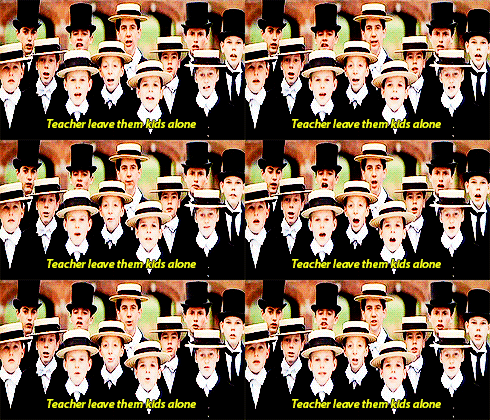


"Another Brick in The Wall (Brick 2)," Pink Floyd, Nov. 1979:
According to Roger Waters, the lyrics were a reaction to his time at the Cambridgeshire High School for Boys in 1955, when he was twelve. Some of the teachers there were locked into the idea that young boys needed to be controlled with sarcasm and the exercising of brute force to subjugate the boys to their will. That was the teachers' idea of education. When the band first recorded 'Brick 2' in the studio in early 1979, he thought of it as just a short thematic interlude in The Wall. After they finished it though, they realized the song was catchy and had bigger potential, but they weren’t quite sure how to build it out. They tried a guitar solo over the verse, but the song was still too brief. It wasn’t until The Wall was almost finished that he thought it might be good to get a bunch of English kids to sing the chorus, to animate the lyrics. They were in Los Angeles at the time, finishing the album at the studio.... So they sent the twenty-four track studio tape of “Brick 2” to the engineer back in Britain and asked him to find some kids to sing on it. He found the kids at the Islington Green School in North London, near the band's studio. He put together about 25 students between ages thirteen and fifteen and overdubbed them singing several times, so it would sound as if there were many more of them. He originally thought they’d use their voices as background for the lead vocals Dave and he had recorded, but the sound they heard on the tape when it came in was so emotionally powerful that they let them sing their part alone. To hear those kids from a not-so-affluent part of London singing the lyrics took his breath away. By adding those voices, the engineer had made the song visceral and deeply moving in a very serious way.
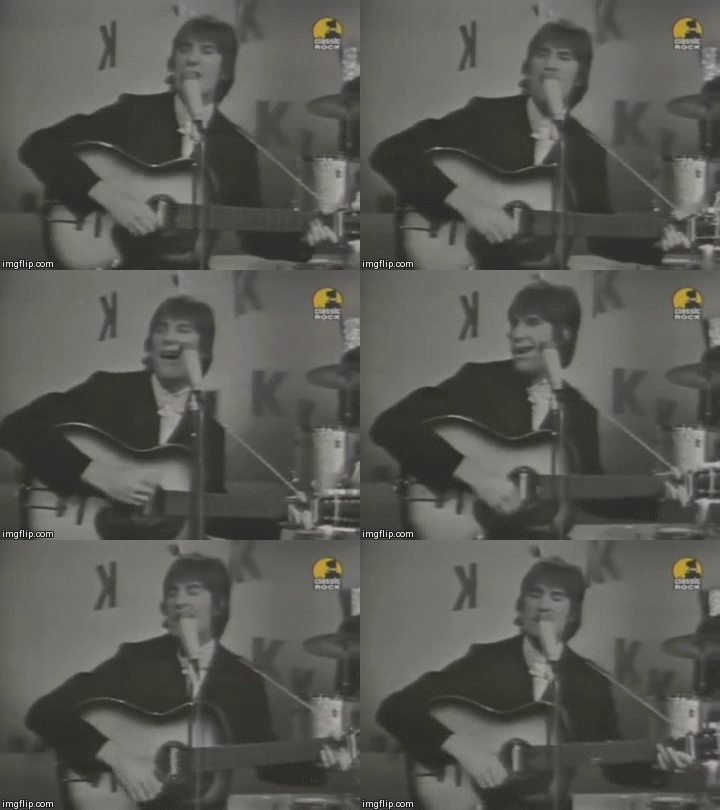

"You Really Got Me," The Kinks, August 1964:
According to Ray Davies, the inspiration for the lyrics and title came one night while playing at the Scene Club in Soho. During the set, he looked out in the darkness about 10 ft. from the stage and saw what appeared to be a 17-year-old girl moving better than anyone else on the dance floor. She had ash-colored hair set in a beehive style that was popular then. When they finished, he went off to find her, but she was gone and never returned to the club. She really got me going.

I wanted the song to sound like a repetitive Gregorian chant over a blues so I pushed for a dirtied-up guitar sound.
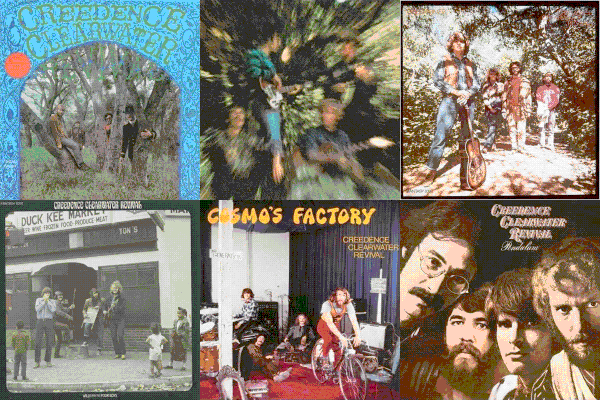

"Proud Mary," Creedence Clearwater Revival, Jan. 1969:
John Fogerty picked up his Rickenbacker guitar, and began playing a song intro he'd been working on, with a chord riff based on the opening to Beethoven’s Fifth that he'd first heard on TV growing up. He didn’t like how Beethoven had composed it, preferring to hit the first chord hard for emphasis, not the fourth. When he added rhythm to the chords, the song had the motion of a boat. He'd always loved Mark Twain’s writing and the music of Stephen Foster, so he wrote lyrics about a riverboat. The line “rollin’ on the river” was influenced by a movie he once saw about two riverboats racing. He finished most of the song in two hours. Then he opened his notebook [of song title ideas] for a song title and the first entry was “Proud Mary.”
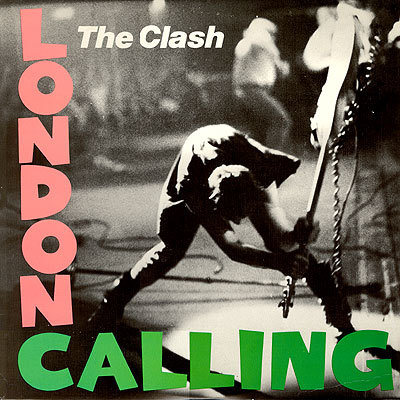

“London Calling,” The Clash, Dec. 1979, became one of the era’s most stirring and influential rock anthems.
With its martial beat, radio warning beeps, rocksteady funk bass line, and lashing lyrics, the song warned of a world facing dire ecological risks.

According to Mick Jones, who co-wrote the song with the late Joe Strummer, the initial inspiration for the song wasn’t British politics—it was their fear of drowning. In 1979 they saw a headline on the front of the London Evening Standard warning that the North Sea might rise and push up the Thames, flooding the city. They flipped. To them, the headline was just another example of how everything was coming undone.


Thank you, Grove Press and NetGalley, for an ARC in exchange for a fair and honest review.
Profile Image for BAM doesn’t answer to her real name.
2,040 reviews457 followers
July 8, 2023
I welcome any readers of this book to hold an active respectful discussion about it if that is something that interests anyone. I know I have a lot to say that really doesn't need to go in the review

7/8 in the famous words of the Pips- " wooh wooh"
I really battled with myself on the star rating and I have a feeling I might sleep on it and change it in the afternoon when I wake up. I just finished actually pressing off/on so that I read the last half of the book at the exact same time as the song was playing. I'm also on allergy meds so hopefully this all makes sense when I read this lol. But seriously 😒 I understand the rationale for the majority of these picks (I think) and of course one must say cut at some point or the book would become a monstrosity.


7/7 may I just say how cute is Janis Joplin I mean srsly! The pic the author chose to use to front her song section is just adorable! Talk about someone who was taken for granted. The chick always shoved into “ friend” section. Been there gf, been there

7/5 seriously! THIS IS ONE OF THE BEST PLAYLISTS IVE EVER LISTENED TO ! I’ve not stopped listening to it since I created it on my Spotify account. I cannot wait to read the second volume.

7/4 this book is fantastic! There were a few songs that I’d not heard, but the rest I was quite familiar with. Looking them up on Spotify really added to the experience. I still am not exactly sure how he picked these songs? There are some shared characteristics while still having originality. My problem is I’m a huge British pop fan, well I say pop but that extends to later musical eras of course. Regardless this really is a fantastic book

6/23 I decided to create a playlist on Spotify of the songs from both volumes of this series. I’m playing the song exclusively as I read each section of the songs. I didn’t read the synopsis, but the table of contents looks quite interesting and impressive. But actually listening to the song while I’m reading the chapter on that song really adds a special spice to the book.

Ok so I took my previous comment down because it appears at first glance that all of the artists in this book and its partner deal with American artists. EDIT: no The Rolling Stones make an appearance so it’s not American focused. Supposedly all of these songs in both volumes have had a mammoth influence in the genres of blues, soul, country, and rock; however, I’m still curious how the author, who wrote these articles for the Wall Street journal, picked these specific songs because I’m still about to slam the BAM down on this author. It’s not because it’s in the Grammy hall of fame. It’s not because they topped the charts. It just comes across as quite subjective. I know there is an introduction but that just fell flat to me. Look at me stirring the pot and searching for a conspiracy and crap.
Profile Image for Marilyn C..
290 reviews
January 1, 2017

I have always enjoyed knowing the background on songs, and Marc Myers in Anatomy of a Song delivers with just that. This is not a compilation on the greatest songs ever written, but songs Myers feels have been the most influential of their times. The book begins in 1952 and ends in the early 90’s, and goes into the mindset of the music industry at the time and how each song fit into its perspective era. I took the authors advice and listened to the song when I read each story. It definitely added to the enjoyment of this book. Here are just a few stand-out stories for me:

-Different Drum by the Stone Poneys: I haven’t heard this song in years but now have become hooked on it! Linda Ronstadt has such an incredible voice.

-Fist City by Loretta Lynn: You just have to read the background on this song, Lynn was one strong woman.

-Mercedes Benz by Janis Joplin: What a talented artist Joplin was, to write a song on a napkin one night in a bar then go on stage within a half hour and perform it is amazing.

-Carey by Joni Mitchell: I am not a huge fan of Mitchell’s but I admire her songwriting abilities and the background story on this song was very interesting.

-Another Brick in the Wall by Pink Floyd: Any background information on a Pink Floyd song is most helpful and the interview with Roger Waters does not disappoint.

-Time After Time by Cyndi Lauper: This story brought me right back to the 1980’s with Aqua Net hair spray and MTV! Lauper is the quintessential 80’s girl!

My list does not even touch on the stories of some of my all-time favorite bands such as The Rolling Stones, Blondie, Aerosmith and Led Zeppelin or great songs such as (Sittin’ On) The Dock of the Bay, Midnight Train to Georgia or Losing My Religion.

I recommend this book to all music lovers, and I hope Myers picks up in the nineties with a future book.
Profile Image for Jill H..
1,638 reviews100 followers
July 29, 2019
When you pick up this book, you need to realize that it is not about a list of the best songs ever recorded nor do the songs chosen claim to cover every major event in music history. Instead it is the author's goal to write about the evolution of music over five decades by capturing an oral history from those who were involved in each song and how it affected the music scene. So, if you, like me, were wondering why your favorites like Joe Cocker, Boz Scaggs, Van Morrison or David Bowie were not included (I have just dated myself!), it doesn't mean that they weren't important or popular. They just, in the author's opinion, were not the artists that initiated the standard for changes in the sound of music.

He begins his list of 45 songs with "Lawdy Miss Clawdy" by Lloyd Price, released in 1952 and ends with "Losing My Religion" by REM, released in 1991. The book was written in 2016 and the author felt that a song must meet the test of time of 25 years before it becomes iconic; thus, 1991 was chosen to end the list.

There are going to be some unfamiliar songs here and the book suggests that the reader may want to listen to them to get the full effect of what makes them important. The author interviewed singers, group/band members, producers, and songwriters of each song to reveal an insider's look at the music business and how a hit is born. It is simply fascinating for the popular music fan and highly recommended. I give it a 4.5 rating.
Profile Image for Scarlet Cameo.
667 reviews409 followers
July 18, 2016


This book was really, really fun to read. I love get informed about music, not all the time but some days i dedicated to that work, but i almost never do about music i don't like and i'm not exactly a big fan of R&B and Pop, but Rock, Heavy Metal and Blues, Geez! I love those things and the history of all these geners is united.

Well, all the interviews here shows all the work need to produce a song, even if you don't think that gonna be a hit, and how the music bussiness has changed. Probably the part i most enjoy and influence me was the percepction of a song, when i was young i always believe that a song must sound the most equal to the CD version but, when i grow up i learn that it's imposible because all the production need, but hell! here is so well explain, not exhaustive but detail enough to appreciate all the hard work that need.

The things that i learned here, and i'm grateful, are:

- You never can say wich song will be a hit (dah!), even if you created to be one more in the tracklist suddently can be a surprise

- Greatest lyrics are the result of a "hit of luck", must of the time aren't planned

-The most important part is the production, failure in that part can sink awesome songs

- All songs deserve a second chance to be a success

- "Losing my religion" is a romantic song (WTH!)


Playlist of all the songs mentioned in the book

A digital copy of this book was provided by NetGalley
Profile Image for Karyn.
294 reviews
December 1, 2022
Carey by Joni Mitchell has always been one of my favorite songs on one of my favorite albums of all time and the interview with her rated above the three stars that I have given this book. Googling photos and YouTube videos enhance the experience although no groundbreaking material was presented to me in this volume of hit songs. Enjoyable, because music is always essential.
Profile Image for Fred.
495 reviews10 followers
August 4, 2019
This is a wonderfully fun book, informative and well written. Marc Myers not only interviews the people responsible for the 45 songs that he has chosen for the book, but he intros every song by putting it into historical perspective. In this way the book itself is an anecdotal history of the way music and the production of music has changed in the last 60 years. I also appreciated that Myers includes songs from all kinds of genres and never seems snobby or judgmental. It is clear that he appreciates every artist even though they created in very different ways and produced songs of all kinds. The stories unearthed are precious and too numerous to mention. There is also a Spotify playlist that accompanies the book. I listened to eachsong before and after each chapter for a totally immersive experience.
Profile Image for Tracey.
1,115 reviews291 followers
August 9, 2022
I love this stuff. I love learning the background, the genesis for a work, be it a book or painting, tv episode or – obviously – a song. Websites like SongFacts are huge rabbit holes that I can and do fall into and lose ridiculous amounts of time. And this collection of 45 tales, originally articles in the Wall Street Journal, derived from the author's interviews with those who participated in the songs' creation and recording, are (more or less) fascinating.

There's a fairly common bit of trivia about the Beatles' "Lucy in the Sky with Diamonds", about how although everyone pretty much assumes it's about an acid trip (the capitals of the song title are LSD!), John Lennon always denied it, said it was based on a crayon drawing from one of his kids. Similarly, Steppenwolf's "Magic Carpet Ride" is not, as – oh, come on, as everyone who's ever heard it – thinks, about any mind–altering substances. It makes so much sense when you hear the story. ("Lucy" is not one of the 45 songs in this book, by the way – consider this a bonus.)

I do love this stuff. I love inside information, inspiration, in–jokes – I will never hear "Groovin'" the same again, now that I know about the Misheard–Lyric Joke the band used to make, which ranks up there with "There's a bathroom on the right" and "Hold me closer, Tony Danza".

I still find the selection of songs a little surprising. Despite never having heard of several, I have no argument with the songs and artists included (except for "Suspicious Minds" – I despise that song) – but I do wonder about so many artists who are not represented. Billy Joel, Simon and/or Garfunkel, Rush, Melissa Etheridge, Elton John, Styx, Bruce Springsteen. Bob Dylan. Michael Jackson – any of the Jacksons. Prince. David Bowie. Hell – the Beatles. I mean. There were two songs from the Rolling Stones, though. That doesn't work for me. But it's not my collection. I just wonder why. In a perfect world would these 45 songs be the 45 songs he would have chosen out of all the songs ever? Or did the songs choices depend on the interviews – whether people involved in the production were still alive, were willing, were otherwise available?

Why "Mercedes Benz" and not "Me and Bobby McGee?" I mean, it's a great story, but how do I know "Bobby McGee" doesn't have just as cool a background? (ETA: I have since learned that "Bobby McGee" was a cover by Pearl, so if it was going to be discussed here it would be under Roger Miller's name, most likely.)

The audio format took a bit of adjusting for me. Jonathan Yen did an excellent job of narrating, but still – knowing that the essays were based on taped interviews, it seemed off not to have the artists' own voices telling the stories. To sit with them, talk with them and extract the answers, edit everything down and write an article, and then give it to someone else to read – verbatim, with all of each person's idiosyncrasies – into a microphone – it just feels a little crazy. I mean, it does make sense, in that having to get the rights and permissions would have taken time and money from the book's budget, and the edited-down versions of the interviews were, I'm sure, pretty choppy. It just took a little time to adapt to the same voice reading Grace Slick and Loretta Lynn and Stevie Wonder and Michael Stipe. I absolutely commend the narrator and the producers for the decision not to try for impersonation of any sort – no accents, none of those characteristic speech tics, only a slightly lighter voice used for women's contributions. None of my problems with the book were due to the narrator – he was very good.

I think – apart from that – my only real complaint about this book is that it ended quite abruptly. The last song, "Losing My Religion", is featured, and then … that's it, no wrap up. Some kind of coda would have been nice. Other than that, it was a well–put–together compendium of articles.

But seriously, why two Stones songs?

1. Lloyd Price – Lawdy Miss Clawdy – https://www.youtube.com/watch?v=nYO26...
2. Little Willie Littlefield – K.C. Loving – https://www.youtube.com/watch?v=BEPt9...
3. The Isley Brothers – Shout – https://www.youtube.com/watch?v=qFCeP...
4. The Marvelettes – Please Mr. Postman – https://www.youtube.com/watch?v=pSlzh...
5. Dion – Runaround Sue – https://www.youtube.com/watch?v=ID–js...
6. The Dixie Cups – Chapel of Love – https://www.youtube.com/watch?v=rTq7w...
7. The Kinks – You Really Got Me – https://www.youtube.com/watch?v=fTTsY...
8. The Righteous Brothers – You've Lost That Lovin' Feeling – https://www.youtube.com/watch?v=NONMS...
9. The Temptations – My Girl – https://www.youtube.com/watch?v=6bsdG...
10. The Four Tops – Reach Out I'll Be There – https://www.youtube.com/watch?v=qd6Xk...
11. The Lovin' Spoonful – Darling Be Home Soon – https://www.youtube.com/watch?v=fXjzO...
12. The Doors – Light My Fire – (7 min) https://www.youtube.com/watch?v=deB_u...
13. The Young Rascals – Groovin' – https://www.youtube.com/watch?v=falI0...
14. Grace Slick (Jefferson Airplane) – White Rabbit – https://www.youtube.com/watch?v=XR8LF...
15. The Stone Poneys – Different Drum – https://www.youtube.com/watch?v=2FLN4...
16. Otis Redding – (Sittin' on) The Dock of the Bay – https://www.youtube.com/watch?v=wyPKR...
17. Loretta Lynn – Fist City – https://www.youtube.com/watch?v=YvPnY...
18. The Rolling Stones – Street Fighting Man – https://www.youtube.com/watch?v=A_ypZ...
19. Tammy Wynette – Stand by Your Man – https://www.youtube.com/watch?v=AM–b8...
20. Steppenwolf – Magic Carpet Ride – https://www.youtube.com/watch?v=2ccBi...
21. Creedence Clearwater Revival – Proud Mary – https://www.youtube.com/watch?v=XfyEp...
22. The Edwin Hawkins Singers – Oh Happy Day – https://www.youtube.com/watch?v=hzj3p...
23. Elvis Presley – Suspicious Minds – https://www.youtube.com/watch?v=RxOBO...
24. Led Zeppelin – Whole Lotta Love – https://www.youtube.com/watch?v=Q0utA...
25. Janis Joplin – Mercedes Benz – https://www.youtube.com/watch?v=Qev–i...
26. The Rolling Stones – Moonlight Mile – https://www.youtube.com/watch?v=stpRI...
27. Rod Stewart – Maggie May – https://www.youtube.com/watch?v=bxtCq...
28. Joni Mitchell – Carey – https://www.youtube.com/watch?v=Bulwl...
29. The Staple Singers – Respect Yourself – https://www.youtube.com/watch?v=–1pYK...
30. Jimmy Cliff – The Harder They Come – https://www.youtube.com/watch?v=j0Nm5...
31. Gladys Knight and the Pips – Midnight Train to Georgia – https://www.youtube.com/watch?v=A0F9l...
32. The Allman Brothers – Ramblin' Man – https://www.youtube.com/watch?v=1x28j...
33. The Hues Corporation – Rock the Boat – https://www.youtube.com/watch?v=fO1Z8...
34. Aerosmith – Walk This Way – https://www.youtube.com/watch?v=5UFFa...
35. Stevie Wonder – Love's in Need of Love Today – https://www.youtube.com/watch?v=nmcXI...
36. Steely Dan – Deacon Blues – https://www.youtube.com/watch?v=2A0wG...
37. Elvis Costello – (The Angels Wanna Wear My) Red Shoes – https://www.youtube.com/watch?v=N0aAG...
38. Blondie – Heart of Glass – https://www.youtube.com/watch?v=aa911...
39. Pink Floyd – Another Brick in the Wall – https://www.youtube.com/watch?v=YR5Ap...
40. The Clash – London Calling – https://www.youtube.com/watch?v=v7Ziw...
41. The Neville Brothers – Brother John/Iko Iko – https://www.youtube.com/watch?v=99NYJ...
42. Merle Haggard – Big City – https://www.youtube.com/watch?v=Th7tg...
43. Cyndi Lauper – Time After Time – https://www.youtube.com/watch?v=VdQY7...
44. Bonnie Raitt – Nick of Time – https://www.youtube.com/watch?v=Dy8gH...
45. R.E.M. – Losing My Religion – https://www.youtube.com/watch?v=xwtdh...
Profile Image for Art.
551 reviews18 followers
January 1, 2018
I joked for years that five hundred earworms live in my head. Funny because that seemed like such a preposterous number. And yet, that number may understate the reality.

A year or two ago, I began archiving and annotating my musical memories in iTunes. It began slowly. A tune here, a memory there. But late last summer, the project amped up into work-in-progress musical memoir.

We all remember many songs and tunes. My archive, however, includes only the tunes, songs and singers with a specific memory attached. For example, I will always remember the warm and sunny beautiful spring afternoon that the cool girls came into class singing “Going to the Chapel” by The Dixie Cups. There’s a concrete memory attached to a song. I saw Marcia Ball and B B King three times, Dylan twice and Leonard Cohen once. More memories. And on and on.

Hard to know for sure, but I may be halfway done after adding three hundred tunes running seventeen hours so far. People asked if I will publish this musical memoir. Don’t know. This began as a personal project. It’s a lot of work, fun work. But I’ve searched a little and cannot find a similar project or model. So this may finish as a one-off.

ANATOMY OF A SONG arrived, and its table of contents includes ten songs or artists already in my musical memoir playlists, which got this book off to a good start. Marc Myers writes about rock, jazz, soul and the arts for The Wall Street Journal. A version of each chapter here appeared in the paper since 2011.

But when I opened the book, the content appeared as interviews. Ugh, not my favorite format. Myers did a good job weaving the thoughts into forty-five interesting stories. “Think of this book as an oral-history jukebox,” he writes.

Favorite highlights:

— Dion di Mucci, a better blues guy than his big pop hits suggest, gave up his seat on the ill-fated flight almost sixty years ago to The Big Bopper as the tour rocked The Winter Dance Party, which began in Milwaukee and ended in Iowa when the plane crashed. Back in the studio, Dion said that he always enjoyed working with good session musicians, such as Milt Hinton, bass; Mickey “Guitar” Baker, guitar; and, Bucky Pizarelli, rhythm guitar.

— John Sebastian, founder of The Lovin’ Spoonful, came to his music as the son of an Italian immigrant man who played classical chromatic harmonica. John, most active in the sixties, was offered stronger pleasures along the way. But he was just a pot guy, refusing anything stronger.

— “Light My Fire,” by The Doors, released in sixty-seven as one of the first extended album tracks of a song, clocking in at seven minutes. The single for radio of the day cut out four minutes of solos. But where did the idea for a long track begin.

Ray Manzarek, the musical brains of the operation, drew on several influences, including “My Favorite Things,” stretched out to thirteen minutes by John Coltrane, and “The Girl from Ipanema,” a popular bossa nova. Manzarek, who played the melody with his right hand on one keyboard while playing the bass on another keyboard, said his bass line grew out of “Blueberry Hill” by Fats Domino, which he liked while growing up in Chicago. Manzarek also used a Bach motif that came from a piano book he played as a kid. Robbie Krueger, the guitarist who wrote the song, liked the ballad version released by Jose Feliciano the following year.

For the best ever conversation that breaks down a song and its influences, listen to Ray Manzarek on Fresh Air with Terry Gross. Although the song seems dated and overwrought, Ray’s talk and demonstration with Terry made the song new again for me. https://www.npr.org/2017/07/28/539989... Don’t just read the interview. You need to click the play button and enjoy these twelve minutes.

— Grace Slick of The Jefferson Airplane explains “White Rabbit,” released in sixty-seven. Talking to her generation of parents, Grace mentioned kid books we grew up on that influenced her song: “Alice’s Adventures in Wonderland,” describing what Alice drank and ate that made her small, tall and high. “The Wizard of Oz,” where our heroes cut through a poppy field, get stoned and fall asleep. Grace describes her song as built on a bolero, which builds in intensity.

— “The Dock of The Bay” by Otis Redding, released in sixty-eight. Otis liked to ad-lib at the end of songs. So, Steve Cropper, at Muscle Shoals, left ten measures of instrumental background at the end. Otis could not think of anything to say, so he whistled, which made the song. Three days after finishing it, Otis Redding and his band died in a plane crash in Madison. After that loss, producers went back to the track and added sounds of the sea and gulls. I served sixty-eight in Nam. This relaxing song played everywhere, reminding us of a time to come when we could stretch out after we returned home.

— “Proud Mary” by Creedence (Clearwater Revival), released in sixty-nine. John Fogerty, leader of the group, based the opening chord riff on the opening of Beethoven’s Fifth. Fogerty said that his voice and music channels Howlin’ Wolf and Wilson Pickett. Because he always liked the writings of Mark Twain and Stephen Foster, Fogerty wrote this song about a riverboat.

— “Oh, Happy Day” by the Edwin Hawkins Singers, released in sixty-nine. This gospel song that went mainstream quickly inspired others to write in that vein, including Paul Simon’s “Bridge Over Troubled Water,” George Harrison’s “My Sweet Lord,” and “Godspell,” as well as Melanie, who recorded with The Edwin Hawkins Singers.

Just a few of the many backstory stories that fill this interesting book. Even though many of these stories appeared elsewhere over the years, I enjoyed reading the first-person accounts. Well done.
Profile Image for Tony Parsons.
4,156 reviews102 followers
February 9, 2017
So many of my favorites musical legends growing up in the 60’s who succumbed drug overdoses.
I sure didn’t know Linda Ronstadt was in the Stone Poney’s group.
A must read for all rock country music lovers.

Edwin Hawkins singers, & the Neville Brothers.

& Cyndi Lauper still as goofy as ever.

I did not receive any type of compensation for reading & reviewing this book. While I receive free books from publishers & authors, I am under no obligation to write a positive review. Only an honest one.

A very awesome book cover, great font & writing style. A very well written past musical artists book. It was very easy for me to read/follow from start/finish & never a dull moment. There were no grammar/typo errors, nor any repetitive or out of line sequence sentences. Lots of exciting scenarios, with several twists/turns & a great set of unique characters to keep track of. This could also make another great musical educational movie, a college PP presentation, or even a documentary (A & E, History channel), or better yet a mini TV series. There is no doubt in my mind this is a very easy rating of 5 stars.

Thank you for the free Goodreads; MakingConnections; Grove Press; hardcover book
Tony Parsons MSW (Washburn)
Profile Image for Sarah.
Author 116 books953 followers
February 4, 2017
I think some of the song choices are odd, but there are some great stories in here (and some cool recording trivia).
Profile Image for Charlene.
875 reviews706 followers
January 17, 2021
This got lower ratings than I would have guessed, and I suspect that might be because readers wanted more popular songs, more of a story about what each song was about. I loved this book, specifically because it didn't really involve those things. Myers chose 45 songs, some popular and some less popular, but all of which had an interesting way of coming into the world. 

I didn't know about Loretta Lynn's Fist City or Merle Haggard's Big City. I had heard of these artists but didn't know anything about them or their songs. Myers made me love the story of how those songs came to be far more than I could ever love the songs themselves. 

The most shocking fact that came out of this book for me, was learning that Otis Redding Died only days after recording Sitting on the Dock of the Bay. That was a section I read right before bed. The next morning, it was the first thing I thought about when I woke up. So, I cuddled up with tea, blanket, and had Alexa play me Otis Redding songs, while I scoured the internet. After pulling up a list of Redding songs, I saw how popular the songs were and saw so much space where songs could have been, if he didn't die at 26 years old. It felt like such a profound loss and really filled me with a new appreciation for his talent and what he was able to bring to the world in the short time he was here. 

Myers did a great job of showing how bits and pieces of various songs came to exist in the minds of individuals and how those bits and pieces grew through collaboration. This aspect of the book turned out to be the very thing I had been missing when reading other biographies of song writers. I remember finishing bios about Stevie Nicks, Jewel, and other artists that felt so disappointing. After reading this, I realized I wished the authors had more of a construction focus (how the songs, themselves, were constructed), like Myers does. 

I highly recommend stopping to listen to each song before moving onto the next story. It really completes the experience. 
Profile Image for Heather Alderman.
1,121 reviews32 followers
April 21, 2024
What a fun read. I loved reading about the origins of the featured songs. Some of my favorites stories were You Really Got Me, White Rabbit, Whole Lotta Love, Mercedes Benz, Carey, Midnight Train to Georgia, Ramblin' Man, Walk This Way, Red Shoes, and London Calling. The technical information about the recording sessions weighed the stories down a bit, but overall, really enjoyed it.
Profile Image for Julie.
1,541 reviews
September 18, 2023
This was a five-star read for me about the music of my parents' generation that I grew up with and loved, told in the musicians' own words, and those of their producers, sound engineers, songwriters, and others in the music business. It was amazing to read about Keith Richards' songwriting process for "Street Fighting Man in his own words, or to hear how Janis Joplin put together "Mercedez Benz" in a fairly impromptu manner and only performed it a few times before her untimely death. One of my favorite anecdotes was about how Farrah Fawcett and Lee Majors were involved with the story of writing "Midnight Train to Georgia," recorded initially by Whitney Houston's mother, Cissy, but made much more famous by Gladys Knight and the Pips. The author does a wonderful job in the introductory paragraphs of delineating the cultural and social issues that surrounded the times and the songs that were created then. I read many bits of this aloud to my husband, they were so memorable, enjoyable, and even occasionally surprising or startling. I highly recommend this book to fans of music of this era and of pop culture in general, and I'm looking forward to reading the sequel: Anatomy of 55 More Songs.
Profile Image for Eric.
173 reviews77 followers
September 21, 2019
I've been recommending this book to many friends in the past weeks. It a great casual read with short chapter. But there's some great tales of creativity and blind luck on the writing and recording of 45 popular songs. Get it?? 45? The genres range from pop to r&b to rock to country. It's great to have Spotify on hand to hear the originals and some later covers. Strongly recommended for music fans.
Profile Image for Rick Elias.
30 reviews4 followers
January 15, 2017
A very interesting read...

Some of the song choices are questionable, but this book is well written and insightful. Not necessarily a "must read", but if you're a fan of songs and great records, you'll enjoy this book.
Profile Image for Erik Hanberg.
Author 14 books85 followers
August 15, 2020
I read the history of rock and roll volumes 1 and 2 which were good but very high level. This book is much more visceral because it’s all in the words of the musicians and songwriters themselves. It’s a really great way to read about the history of rock and roll.
Profile Image for Katie K.
84 reviews4 followers
December 1, 2016
Whither the index, Marc Myers?

(Nonetheless, a fun read, best read while listening to the songs.)
Profile Image for Andreea Ursu-Listeveanu.
538 reviews304 followers
February 25, 2020
OK, I'll be honest, I haven't read the entire book, but I read more than half of it, maybe even 2 thirds so I will cheat at marking it as read.

I didn't read all of it because I wasn't particularly interested in some of the songs. I didn't know them, I listened to them, they didn't appeal to me. The author says that he chose the songs based on their durability throughout the time and like all songs inducted in the Grammy Hall of Fame, they stand the test of time. Now I don't consider myself a walking musical encyclopedia, but I am quite up to date at least with the mainstream music. So I chose more recent stories and those songs wich for me stood the test of time, which I like and can sing along.

This is what I learned:

- most artists write the lyrics after they have the instrumental melody. but there are also some who do it the other way around, like Merle Haggard.

- my favorite stories were those behind the famous hits: Walk this Way, Losing my Religion, and Moonlight Mile. The main reason is that besides the instrumental explanations, the songwriters told how they wrote the lyrics. And that was of much interest to me. Steven Tyler, for example, being a drummer, chose his lyrics to follow the rhythm of a drum, he chose alliterations and he wanted to produce a musicality not only with instruments, but also with words. He also searched for words which had double meaning. Michael Stipe created a story and a character and Mick Jagger sang about his emotions and struggles with homesickness, and even if normally he's analyzing how he's writing, from the point of view of the grammar, not to jump from the 1st person to the 3rd etc, he didn't do that in Moonlight Mile. Then, Keith Richards describes the exact movements that he does with his hands when he's playing he guitars, and also how he and Jagger like to bounce the ideas from one another untile they sound good together. The Street Fighting Man story is fascinating from that pov.

Marc Myers has a blog on Wall Street Journal's website with the same name as this book so if you're interested, you can read some stories there.

46 reviews
May 21, 2022
An eclectic compilation of how songs come together. Rock, country, R&B, soul and pop are all represented, chosen from a span of 40 years starting in the early 1950s. The author is a journalist who uses interviews to dig into the details. It's a fast read and a good one for any lover of popular music.
Profile Image for Carter Murphy .
167 reviews8 followers
Read
March 12, 2023
Love. I’m a sucker for bts, so reading about the creation of these tracks was a real treat.
Profile Image for Vovka.
1,004 reviews48 followers
July 24, 2023
Great road trip book -- at the start of each of this book's chapters the song is mentioned, making it easy to pull up and listen to the song before continuing on to the discussion of how the song came to be. I learned a ton from this book and deeply enjoyed it. I wish it had been broader in focus -- very little here on genres outside of "rock and roll" and "country."
Profile Image for Robin Morgan.
Author 5 books287 followers
November 1, 2016
Being a child of the 1950’s I was born along with the real birth of the genre of music we fondly know as “Rock ‘n Roll”, and then for the genre known as “Pop”. By the time I was eight [1959] and could really begin to enjoy listening to the old style radios we had I enjoyed listening to this kind of music. While I might not have understood the meanings of the songs being sung, I still enjoyed the sound of these songs.

When I was ten I got my first transistor radio with those rectangle 9 volt batteries I could listen to my music any time I wanted to. The problem was back then I fell asleep with the radio on, and as you might have guessed by the time I woke up the battery had died. I had no music so I wound up, much to my chagrin, having to ask my parents for money to buy a new battery. Of course, wanting to teach me a lesson about responsibility [turning off the radio before going to sleep], they would deduct it from my allowance.

All my friends had record players which we listened to the 45 rpm records we used to buy with our allowances. Some of my friends had been lucky as their parents gave them money to buy their records any time a song became very popular. There was never a party where records weren’t played, sometimes over and over again. We used to stack as many records as we could so we wouldn’t have to change the records on our own. Diners had a small one at all of the booths they had, and if you were lucky your parents would pay for your song selections.

We all loved listening to the songs of the “Rock ‘n Roll” and “Pop”, etc. eras, we never became interested if there was a reason as to why the singer[s] decided to write their songs. Even though the eras of this music have died, we’ve never gotten the music out of our blood. Which is why we’re nostalgic about them still today, and why, even as adults, we’re always looking for an opportunity to see our favorite artists live. And along with this nostalgia comes an interest in knowing if there had been a reason for any of the songs a specific artist is noted for singing.

The only way to find out what had brought about the creation of the songs we had loved is to speak to those involved which is precisely what Marc Myers has done here. By interviewing these individuals [those still alive] the author takes us into their minds and the events surrounding the decades of songs the author has included in this marvelous compendium of the songs we all loved listening to as we grew up, songs we still love hearing today.

If there’s song which would epitomize all of the songs and artists in this book it would be Barry Manilow’s song I Write the Songs:

I've been alive forever
And I wrote the very first song
I put the words and the melodies together
I am music and I write the songs


[Chorus]
I write the songs that make the whole world sing
I write the songs of love and special things
I write the songs that make the young girls cry
I write the songs, I write the songs

My home lies deep within you
And I've got my own place in your soul
Now, when I look out through your eyes
I'm young again, even though I'm very old

[Chorus]

Oh my music makes you dance
And gives you spirit to take a chance
And I wrote some rock 'n' roll so you can move
Music fills your heart
Well, that's a real fine place to start
It's from me it's for you
It's from you, it's for me
It's a worldwide symphony

[Chorus]
[Chorus]

This is why I loved Marc Myers efforts in compiling this compendium of the origins of each of the songs he’s included here. Some of us might be familiar with the songs included in this book as they come from a column, of the same name, which the author wrote for the Wall Street Journal [2011 – 2016]. It must have been a monumental task for the author to select the 45 songs he’s included from all those he’s written about; perhaps if we’re lucky we might see a second book covering additional songs, songs we’ve listen to which we’d love to know the origins of.

For bringing back memories of our younger days and for enlightening us as to the origins of these songs, how can I not give Mr. Myers 5 STARS for his endeavor here
Profile Image for Alex Bledsoe.
Author 67 books794 followers
December 30, 2017
A compilation of columns from the Wall Street Journal, this runs from "Lawdy, Miss Clawdy" to "Losing My Religion." Most of the songs are well-known, and the stories behind them interesting, but it's like a "Rosencrantz and Guildenstern are Dead" tour through the music, with only occasional interludes from true classics. Judicious editing smooths out any quirks of accent, speaking patterns or gestures, giving each entry a sameness of tone. Still, moments occasionally shine through, like the image of Steven Tyler frantically writing the lyrics to "Walk the Way" on a wall because he didn't have any paper, or the tale behind "Carey" that involves Joni Mitchell, at one point, having fleas. A good read if you're interested in popular music as a whole, and the way some songs are crafted piece by piece, while others just sort of pop out all at once.
Displaying 1 - 30 of 310 reviews

Can't find what you're looking for?

Get help and learn more about the design.