

What do you think?
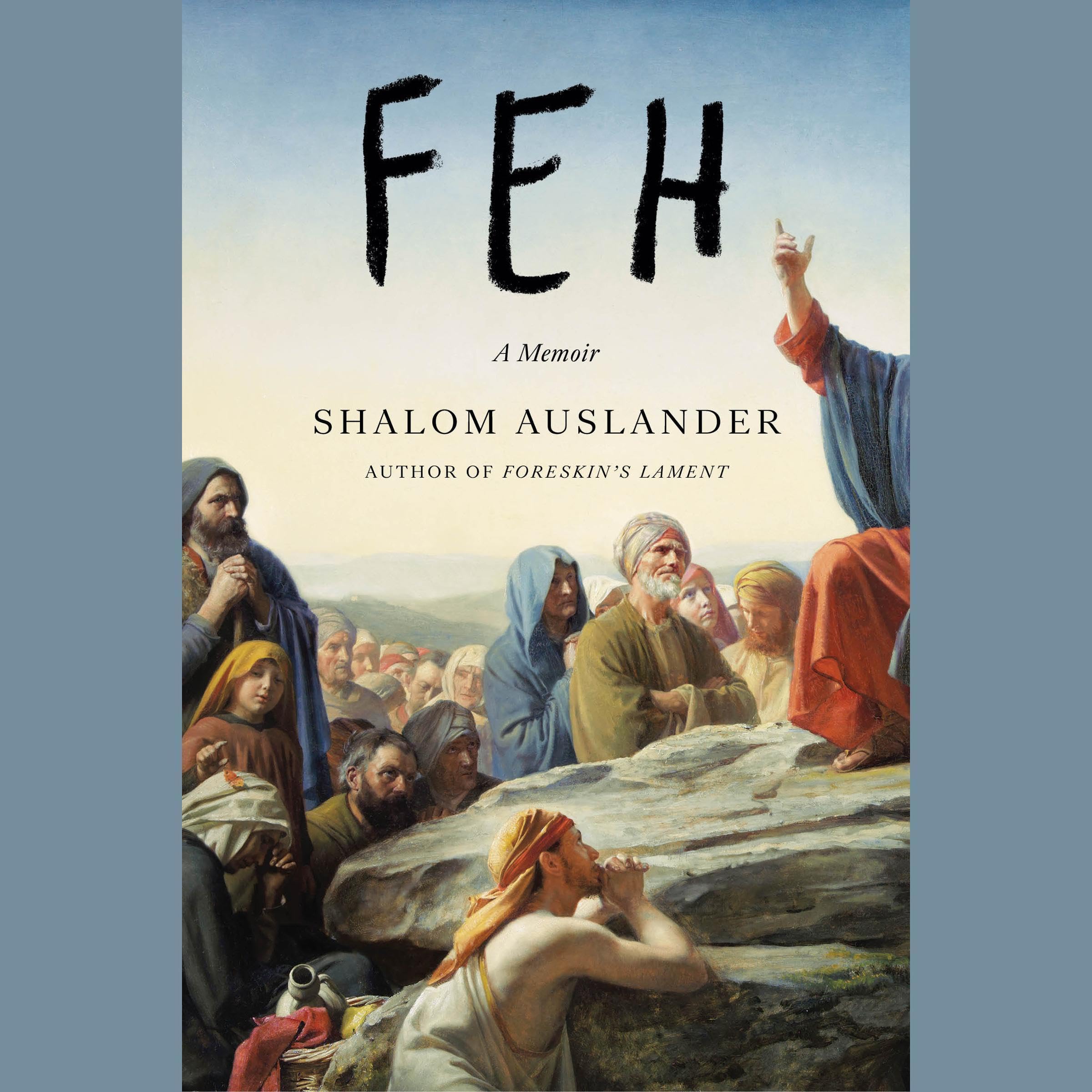
Feh
From the acclaimed author of
Foreskin’s Lament
, a memoir of the author’s attempt to escape the biblical story he’d been raised on and his struggle to construct a new story for himself and his family
Shalom Auslander was raised like a veal in a dysfunctional family in the Orthodox community of Monsey, New the son of an alcoholic father; a guilt-wielding mother; and a violent, overbearing God. Now, as he reaches middle age, Auslander begins to suspect that what plagues him is something worse, something he can't so easily a story. The story. One indelibly implanted in him at an early age, a story that told him he is fallen, broken, shameful, disgusting, a story we have all been told for thousands of years, and continue to be told by the religious and secular alike, a story called "Feh."
Yiddish for "Yuck."
Feh follows Auslander's midlife journey to rewrite that story, a journey that involves Phillip Seymour Hoffman, a Pulitzer-winning poet, Job, Arthur Schopenhauer, GHB, Wolf Blitzer, Yuval Noah Harari and a pastor named Steve in a now-defunct church in Los Angeles.
9 hrs. 38 mins.
Can he move from Feh to merely meh? Can he even dream of moving beyond that?
Auslander's recounting of his attempt to exorcize the story he was raised with—before he implants it onto his children and/or possibly poisons the relationship of the one woman who loves him—isn’t sacred. It is more-than-occasionally profane. And like all his work, it is also relentlessly funny, subversively heartfelt and fearlessly provocative.
Shalom Auslander was raised like a veal in a dysfunctional family in the Orthodox community of Monsey, New the son of an alcoholic father; a guilt-wielding mother; and a violent, overbearing God. Now, as he reaches middle age, Auslander begins to suspect that what plagues him is something worse, something he can't so easily a story. The story. One indelibly implanted in him at an early age, a story that told him he is fallen, broken, shameful, disgusting, a story we have all been told for thousands of years, and continue to be told by the religious and secular alike, a story called "Feh."
Yiddish for "Yuck."
Feh follows Auslander's midlife journey to rewrite that story, a journey that involves Phillip Seymour Hoffman, a Pulitzer-winning poet, Job, Arthur Schopenhauer, GHB, Wolf Blitzer, Yuval Noah Harari and a pastor named Steve in a now-defunct church in Los Angeles.
9 hrs. 38 mins.
Can he move from Feh to merely meh? Can he even dream of moving beyond that?
Auslander's recounting of his attempt to exorcize the story he was raised with—before he implants it onto his children and/or possibly poisons the relationship of the one woman who loves him—isn’t sacred. It is more-than-occasionally profane. And like all his work, it is also relentlessly funny, subversively heartfelt and fearlessly provocative.
10 pages, Audible Audio
First published July 23, 2024
About the author
Shalom Auslander
14 books384 followersShalom Auslander is an American author and essayist. He grew up in an Orthodox Jewish neighborhood in Monsey, New York where he describes himself as having been "raised like a veal".[1][2] His writing style is notable for its Jewish perspective and determinedly negative outlook.
Auslander has published a collection of short stories, Beware of God and a memoir, Foreskin's Lament: A Memoir. His work, often confronting his Orthodox Jewish background, has been featured on Public Radio International's This American Life and in The New Yorker. In January 2012, Auslander published his first novel, Hope: A Tragedy.
Auslander has published a collection of short stories, Beware of God and a memoir, Foreskin's Lament: A Memoir. His work, often confronting his Orthodox Jewish background, has been featured on Public Radio International's This American Life and in The New Yorker. In January 2012, Auslander published his first novel, Hope: A Tragedy.
Ratings & Reviews
Friends & Following
Create a free account to discover what your friends think of this book!
Community Reviews
Displaying 1 - 30 of 175 reviews

May 30, 2024
Not sure how to describe this book. Original, uncomfortable, a relentless chronicle of self-loathing. Very voice-driven. I loved it.

July 14, 2024
(4.7) what a rollercoaster of emotions... wow🔅🔆🔅
auslander should start making movies... we need more cynical jewish filmmakers that aren't woody allen
auslander should start making movies... we need more cynical jewish filmmakers that aren't woody allen

July 22, 2024
This book made me feel less alone in the world, I would 10/10 recommend it to anyone!!

September 6, 2024
Shalom Auslander's memoir Feh offers a brutally honest exploration of self-loathing and human nature. The Yiddish title, meaning disgust, sets the tone for a narrative shaped by religious fear and strict parenting. Auslander's raw style blends dark humor with touching moments, creating a striking contrast throughout the book.
As the memoir progresses, it shifts to a more contemplative examination of humanity's core. Auslander posits that storytelling and self-loathing are uniquely human traits, adding philosophical depth to his personal reflections. This perspective invites readers to scrutinize their own identities and self-narratives, challenging them to confront uncomfortable truths about themselves.
Feh may challenge readers with its unfiltered prose and dark themes, but it powerfully demonstrates the value of honest self-reflection. Auslander's memoir acts as both a mirror and window, offering a raw, darkly humorous exploration of human complexity. For those willing to engage, it provides a thought-provoking journey into the contradictions of human existence.
As the memoir progresses, it shifts to a more contemplative examination of humanity's core. Auslander posits that storytelling and self-loathing are uniquely human traits, adding philosophical depth to his personal reflections. This perspective invites readers to scrutinize their own identities and self-narratives, challenging them to confront uncomfortable truths about themselves.
Feh may challenge readers with its unfiltered prose and dark themes, but it powerfully demonstrates the value of honest self-reflection. Auslander's memoir acts as both a mirror and window, offering a raw, darkly humorous exploration of human complexity. For those willing to engage, it provides a thought-provoking journey into the contradictions of human existence.

Read
August 3, 2024a bit of an irl Good Omens that asks, what if god is the bad guy and humans are the good guys?
"Stories are a powerful thing."
"Stories are a powerful thing."

August 15, 2024
3.5 stars. I read Shalom Auslander’s previous memoir many years ago and this seems like more of the same. (What does it say about someone who writes two memoirs by the age of 50?) Auslander is an excellent writer but his subject matter is pretty repetitive and just so utterly “feh” and relentlessly depressing. I imagine it’s pretty hard to live in his head. Excellent audiobook read by the author.

July 3, 2026
4.7 I really liked this. Funny and emotional. Dry and wet. A very human read
October 9, 2024
I liked the Yiddish at first and the biographical tidbits and twists on biblical stories but then I found the cynicism and repetition boring. In fact, this book inspired me to create a new shelf, “skimmed toward the end”. I skimmed from about page 200 to the next to last chapter.

November 28, 2024
A pretty sad book about a man who relentlessly hates himself. I didn’t see any character development or growth. Author is a very talented writer but after 100 pages of self loathing I felt like I was reading the same thing over and over.
August 27, 2024
Definitely a certain type of audience but it’s good. A LOT of self loathing but I guess that’s the meaning behind Feh.

January 4, 2025
You know that one coworker who calls out and the whole office breathes a sigh of relief.... this guy is that coworker! Negative in every sense of the word. This was a tough one to get through.

May 31, 2026
David, Larry: “I do hate myself, but it has nothing to do with being Jewish!”
September 8, 2025
sometimes I don't understand how anybody but me specifically loves Shalom, but I love Shalom and this book gave me all the feels even if they are dark

October 19, 2024
Some books rekindle your belief in the power of literature. This is one of them. One of the best reads of the year for me, it was raw, merciless (mainly towards the author himself) and so much more candid than what is usually expected from a "candid" memoir to be.
Contrary to most memoirs, this one manages to transcend way beyond the narcissistic, and transform personal pain into original and, may I say, even helpful musings on life, culture, religion, capitalism and consumerism, parenting, couplehood and, most importantly, love of all kinds.
As a Jew and an Israeli, I identified with all of it, but you really don't have to be any of those to enjoy it thoroughly.
I've been following and reading all of Auslander's writing since his very first (excellent) novel came out. Like him, and like Depeche Mode, I, too arrived at the conclusion that "God's got a sick sense of humour." The only way to keep you going in the twisted world that we live in is by reading books like this one. I really need another fix like this from Auslander soon. Thanks so much for this, Shalom!
Contrary to most memoirs, this one manages to transcend way beyond the narcissistic, and transform personal pain into original and, may I say, even helpful musings on life, culture, religion, capitalism and consumerism, parenting, couplehood and, most importantly, love of all kinds.
As a Jew and an Israeli, I identified with all of it, but you really don't have to be any of those to enjoy it thoroughly.
I've been following and reading all of Auslander's writing since his very first (excellent) novel came out. Like him, and like Depeche Mode, I, too arrived at the conclusion that "God's got a sick sense of humour." The only way to keep you going in the twisted world that we live in is by reading books like this one. I really need another fix like this from Auslander soon. Thanks so much for this, Shalom!

February 22, 2026
I really enjoyed this one. Too long in the last quarter, and I didn't care for the parts about his therapist or Hoffman, and the entire LA arc with social media etc felt repetitive and overwrought. But! The existential crisis of body? A body designed to entrap humans in sin? The theological disgust? The horror-sadness of being told a story, that it's the only story, and to be punished for believing it all to begin with? Compelling and, for me, fun haha.
I enjoyed Auslander's total commitment to his suffering, learning, and misery. LOL. It is not depressing just unrelenting. He is mostly self-aware enough to not glamorize, but certainly he does seem to revel in how awful he feels at times haha. There's no solving what damage has been done to Auslander individually, but I am encouraged by his offering of this story. I want to understand this landscape of mind because it is different from what I know. The jokes mostly land and his references to a variety of authors and philosophers was appreciated. His family puts up with a lot from him haha.
Overall very good.
I enjoyed Auslander's total commitment to his suffering, learning, and misery. LOL. It is not depressing just unrelenting. He is mostly self-aware enough to not glamorize, but certainly he does seem to revel in how awful he feels at times haha. There's no solving what damage has been done to Auslander individually, but I am encouraged by his offering of this story. I want to understand this landscape of mind because it is different from what I know. The jokes mostly land and his references to a variety of authors and philosophers was appreciated. His family puts up with a lot from him haha.
Overall very good.

November 21, 2024
{3.5 stars}
Thanks to Riverhead Books for the gifted copy. All opinions below are my own.
Feh is the Yiddish word for yuck and the author uses this word to describe the uncomfortable parts of being human. He starts early with a Bible story about God creating Adam from dirt and that is the underlying theme that pervades his life. He struggles with mental health, pornography and drugs aiming for a momentary escape from the Feh-ness of life. Told through snippets of his life from childhood on through adulthood he gives us stories of religious expectations, gender roles and trying to help others find acceptence even though he seemingly has no ability to give that gift to himself. He continues to weave biblical stories throughout as he experiences the ickiness and heavyiness of humanity. As a writer he has several brushes with Hollywood and gives us the real stories behind his projects.
This one gave me David Sedaris vibes, it's entertaining but deals with some of the heavier topics of humanity with a new eye.
Thanks to Riverhead Books for the gifted copy. All opinions below are my own.
Feh is the Yiddish word for yuck and the author uses this word to describe the uncomfortable parts of being human. He starts early with a Bible story about God creating Adam from dirt and that is the underlying theme that pervades his life. He struggles with mental health, pornography and drugs aiming for a momentary escape from the Feh-ness of life. Told through snippets of his life from childhood on through adulthood he gives us stories of religious expectations, gender roles and trying to help others find acceptence even though he seemingly has no ability to give that gift to himself. He continues to weave biblical stories throughout as he experiences the ickiness and heavyiness of humanity. As a writer he has several brushes with Hollywood and gives us the real stories behind his projects.
This one gave me David Sedaris vibes, it's entertaining but deals with some of the heavier topics of humanity with a new eye.

July 28, 2026
"A volte, nei momenti più bui – quando mi si spezza il cuore o i miei sogni crollano o non riesco a trovare un lavoro per provvedere alla mia famiglia – ho il sospetto di essere la sit-com preferita di Dio.
«Mi ci vorrebbe proprio una bella risata», dice, accasciandosi sul divano e puntando il telecomando verso il televisore. «Guardiamo un po’ di Auslander.»" (p. 56)
"Trump senza soldi è solo un insopportabile coglione. Il repubblicano più accanito voterebbe forse per un Donald Trump povero? Qualcuno starebbe seduto di fronte a un Elon Musk indigente per più di dieci secondi senza tirargli un pugno in faccia? È già difficile non farlo adesso che è pieno di miliardi." (p. 79)
«Mi ci vorrebbe proprio una bella risata», dice, accasciandosi sul divano e puntando il telecomando verso il televisore. «Guardiamo un po’ di Auslander.»" (p. 56)
"Trump senza soldi è solo un insopportabile coglione. Il repubblicano più accanito voterebbe forse per un Donald Trump povero? Qualcuno starebbe seduto di fronte a un Elon Musk indigente per più di dieci secondi senza tirargli un pugno in faccia? È già difficile non farlo adesso che è pieno di miliardi." (p. 79)

April 1, 2026
I'm sad for Shalom! His humor is very indicative of the Gen-X comedy style: Self-loathing, judgmental, bitter, sarcastic, sniping at anyone who doesn't think exactly like him. Maybe this kind of thing was funnier in the early aughts.
Being raised ultra-Orthodox Jewish sounds like it did a number on him, spiritually and emotionally. I don't discount that. But I couldn't help but be fascinated by the fact that the only person who gives him any sense of hope is a pastor who spends every day feeding the homeless in LA. That man doesn't believe that God is feh, even if Auslander does.
Being raised ultra-Orthodox Jewish sounds like it did a number on him, spiritually and emotionally. I don't discount that. But I couldn't help but be fascinated by the fact that the only person who gives him any sense of hope is a pastor who spends every day feeding the homeless in LA. That man doesn't believe that God is feh, even if Auslander does.

September 12, 2024
Deeply resonant for a fellow “feh” who grew up evangelical. A moving, hilarious, depressing, wonderful piece about internalized shame, Philip Seymour Hoffman (may he rest in peace), and the stories we tell ourselves. I cannot recommend this book highly enough.
May 17, 2025
Audiobook, still counts.
Two stars may be on me—I assumed this would primarily be my favorite memoir genre, escape from religious extremism. Whoops.
The Philip Seymour Hoffman stuff was interesting.
I’m also done with reading about middle school aged boys’ sexual awakening. Enough.
Two stars may be on me—I assumed this would primarily be my favorite memoir genre, escape from religious extremism. Whoops.
The Philip Seymour Hoffman stuff was interesting.
I’m also done with reading about middle school aged boys’ sexual awakening. Enough.

September 9, 2025
Really touching tribute to Philip Seymour Hoffman at points. Overall, a really great piece connecting childhood trauma, experiences, and strict religious culture together to provide a unique worldview.

Read
April 5, 2025Dnf

November 11, 2024
Both bleak and funny, with fantastic literary references.

December 27, 2024
I really appreciated this book. Listening to him read it on audio was essential to the experience. With that said, I think I will also be purchasing a hard copy of this book to take these lessons, thoughts, reflections with me in a more tangible form.

January 8, 2025
Funny, quirky, repetitive, self-loathing overload.

January 6, 2025
He reminds me of David Sedaris, but like… way more depressing.

August 17, 2026
I think there’s a certain level of self-loathing a person must have to truly appreciate this book, and lucky for me, I’ve got it!

July 21, 2026
“Stories are powerful things,” writes Auslander in this well crafted memoir about how stories shape us. I loved this funny and irreverent but also serious and poignant book.
Read
September 1, 2025DNF
I do not think I am the intended audience.
I do not think I am the intended audience.
Displaying 1 - 30 of 175 reviews