

What do you think?

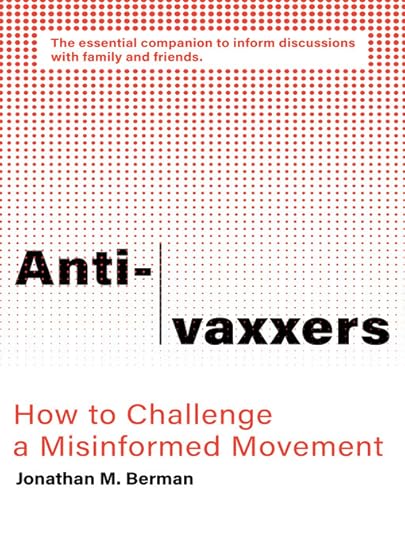
Anti-vaxxers: How to Challenge a Misinformed Movement
In Anti-Vaxxers, Jonathan Berman explores the phenomenon of the anti-vaccination movement, recounting its history from its 19th-century antecedents to today's activism, examining its claims, and suggesting a strategy for countering them.
After providing background information on vaccines and how they work, Berman describes resistance to Britain's Vaccination Act of 1853, showing that the arguments anticipate those made by today's anti-vaxxers. He discusses the development of new vaccines in the 20th century, including those protecting against polio and MMR (measles, mumps, rubella), and the debunked paper that linked the MMR vaccine to autism; the CDC conspiracy theory promoted in the documentary Vaxxed; recommendations for an alternative vaccination schedule; Kennedy's misinformed campaign against thimerosal; and the much-abused religious exemption to vaccination.
Anti-vaxxers have changed their minds, but rarely because someone has given them a list of facts. Berman argues that anti-vaccination activism is tied closely to how people see themselves as parents and community members. Effective pro-vaccination efforts should emphasize these cultural aspects rather than battling social media posts.
After providing background information on vaccines and how they work, Berman describes resistance to Britain's Vaccination Act of 1853, showing that the arguments anticipate those made by today's anti-vaxxers. He discusses the development of new vaccines in the 20th century, including those protecting against polio and MMR (measles, mumps, rubella), and the debunked paper that linked the MMR vaccine to autism; the CDC conspiracy theory promoted in the documentary Vaxxed; recommendations for an alternative vaccination schedule; Kennedy's misinformed campaign against thimerosal; and the much-abused religious exemption to vaccination.
Anti-vaxxers have changed their minds, but rarely because someone has given them a list of facts. Berman argues that anti-vaccination activism is tied closely to how people see themselves as parents and community members. Effective pro-vaccination efforts should emphasize these cultural aspects rather than battling social media posts.
Audible Audio
Published November 3, 2020
About the author
Jonathan M. Berman
2 books7 followersJonathan M. Berman is Assistant Professor in the Department of Basic Sciences at NYITCOM–Arkansas. An active science communicator, he served as national cochair of the 2017 March for Science.
Ratings & Reviews
Friends & Following
Create a free account to discover what your friends think of this book!
Community Reviews
Displaying 1 - 30 of 77 reviews
July 1, 2026
This book is written from the point of view of a pro-vaccine activist who is trying to counter the anti-vaccine movement. The author is solidly pro-vaccination who gives a detailed history of the anti-vax movement from the beginning when the classic arguments against vaccines first arose. The anti-vaccination movement's objections were mandatory vaccination were a threat to free choice, vaccines were foreign substances put in human bodies, and a mistrust of the motives of it's advocates. The last objection is understandable in this age of profit driven medicine in America when doctors pushed addictive pain medications like Oxycontin on patients produced by big Pharma. Jonathon M. Berman makes a strong case for vaccination with solid facts but faces an uphill battle against a well founded mistrust of the medical establishment and the huge amount of misinformation available on the Internet.

September 5, 2020
First, please let me make clear that I am very pro-vaccination. But, I have friends who have adopted this ideology, and I want to try to understand them instead of dismissing them as kooks and idiots.
The first few chapters talk about anti vaccine movements throughout history. The one common thread is that people allow superstition and fear to override evidence. And when forced to vaccinate, there is violence. I am sympathetic to the feelings of people wanting body autonomy. But, I also believe that people’s fears shouldn’t endanger public health. Another common thread is that anti vaxxers often falsely claim that unspeakable atrocities are being performed in the service of vaccination, like having vaccines tested on orphans.
The next section goes over some of the more prominent scandals surrounding anti-vaxxers. These are the stories that a lot of anti-vaxxers cling to like a branch as they're falling off a cliff. There's no convincing your anti-vaxxer friends or family about these incidents being false.
The book then transitions to an analysis of why anti-vaxxers believe what they do. This is where the book starts to shine. Berman's conclusions are cogent. He then synthesizes all of his findings into a case study and shows us how we can maybe, just maybe, convince the anti-vaxxers in our families and friend groups to examine reliable information. I won't go into specifics, because it's important for people to read this section of the book.
I strongly recommend this book. It's one of the first books I've read that combines an analysis of media theory, behavioral science, and morality to explain why people believe in disproven ideas about vaccines.
The first few chapters talk about anti vaccine movements throughout history. The one common thread is that people allow superstition and fear to override evidence. And when forced to vaccinate, there is violence. I am sympathetic to the feelings of people wanting body autonomy. But, I also believe that people’s fears shouldn’t endanger public health. Another common thread is that anti vaxxers often falsely claim that unspeakable atrocities are being performed in the service of vaccination, like having vaccines tested on orphans.
The next section goes over some of the more prominent scandals surrounding anti-vaxxers. These are the stories that a lot of anti-vaxxers cling to like a branch as they're falling off a cliff. There's no convincing your anti-vaxxer friends or family about these incidents being false.
The book then transitions to an analysis of why anti-vaxxers believe what they do. This is where the book starts to shine. Berman's conclusions are cogent. He then synthesizes all of his findings into a case study and shows us how we can maybe, just maybe, convince the anti-vaxxers in our families and friend groups to examine reliable information. I won't go into specifics, because it's important for people to read this section of the book.
I strongly recommend this book. It's one of the first books I've read that combines an analysis of media theory, behavioral science, and morality to explain why people believe in disproven ideas about vaccines.
October 6, 2020
Fell short in every possible way. This is such a critical topic and it deserves - no, requires - to be approached intelligently and executed effectively. It's also terribly edited. There were typos, missed punctuation, omitted words, and on more than one occasion, essentially the same sentence repeated twice. I regret this read.

November 6, 2020
Great, informative book on Anti-vaxxer beliefs, where they come from, and why they are usually faulty. Well researched and recommended.

March 12, 2021
Personally, I am sitting on the fence regarding whether to vaccinate for COVID 19; Plus or not; as I am in the midst of researching and studying the topic as well as the corruption. cronyism and criminality that is seemingly pervasive though-out Big Pharma, Medicine, and Government. The book does not really deal with these issues in any depth and instead builds arguments and facts that only support its conclusion or original hypotheses and position - that vaccines are good - no matter what harm they cause a few people. That harm may be death or a permanent cognitive or physical disability caused by a reaction. The demonic attitude is - who cares about a few human tragedies when the greater good is served remains, without doubt; ruthless, callous, and myopic.
A better approach to this hidden vaccination genocide would be to develop pre-tests that filter out people who are likely to have an adverse reaction. This way we can mitigate the human tragedies and deaths associated with vaccines or drugs and at the same time serve the greater good. (Plus crooks could make more MONEY- go figure) Moreover, the vaccinated populations need to be monitored for long-term physical or psychological side effects from cradle to grave. We do not for example want to create neurological disorders later in life. There are enough dumbed-down politicians, psycho-paths, and clowns being elected already.
Another key point is that we live in a free society and democracy; whereby it is an inalienable human right that we must have access to all the clinical studies and complete research regarding any drug or vaccine in order that we can personally adjudicate the information and the testing of populations, Experts have done a poor job and are generally biased in this regard. Doctors individually do not always look at this information because they are just too busy and don't have the time to read boring 800-page reports weekly, They in turn rely on colleagues' opinions or biased sources. Some clinical trials are for instance conducted on monkeys - I personally would have little faith in their clinical outcomes.
In conclusion, this book brings out a number of important issues on both sides of the debate, but it is not a balanced approach to discourse and fails to provide clinical solutions to critical therapeutic problems and hidden genocides such as the opioids crisis that has caused over 450,000 death over the past 20-years. (How many Viet-Nam wars does that equal?) In short, it was as if BIG pharma, medicine, and government were consulted about every sentence with little concern for our human and democratic rights. That's unacceptable.
IN GOVERNMENT WE TRUST???
LEST WE FORGET...
"whoopee, we are all going to die..."
https://www.youtube.com/watch?v=3W7-n...
But, it is just what the doctor ordered...
Recommended Readings:
Bad Pharma: How Drug Companies Mislead Doctors and Harm Patients
https://www.goodreads.com/book/show/5...
Lies My Doctor Told Me: Medical Myths That Can Harm Your Health
https://www.goodreads.com/book/show/5...
Further Readings
The Truth About the Drug Companies: How They Deceive Us and What to Do About It
https://www.goodreads.com/book/show/2...
Medical Industrial Complex (The Underground Knowledge Series, #3
)https://www.goodreads.com/book/show/2...
Deadly Medicines and Organised Crime: How Big Pharma Has Corrupted Healthcare
https://www.goodreads.com/book/show/1...
Virus Mania: How the Medical Industry Continually Invents Epidemics, Making Billion-Dollar Profits at Our Expense
https://www.goodreads.com/book/show/2...
Side Effects: Death. Confessions of a Pharma-Insider https://www.goodreads.com/book/show/8...
A better approach to this hidden vaccination genocide would be to develop pre-tests that filter out people who are likely to have an adverse reaction. This way we can mitigate the human tragedies and deaths associated with vaccines or drugs and at the same time serve the greater good. (Plus crooks could make more MONEY- go figure) Moreover, the vaccinated populations need to be monitored for long-term physical or psychological side effects from cradle to grave. We do not for example want to create neurological disorders later in life. There are enough dumbed-down politicians, psycho-paths, and clowns being elected already.
Another key point is that we live in a free society and democracy; whereby it is an inalienable human right that we must have access to all the clinical studies and complete research regarding any drug or vaccine in order that we can personally adjudicate the information and the testing of populations, Experts have done a poor job and are generally biased in this regard. Doctors individually do not always look at this information because they are just too busy and don't have the time to read boring 800-page reports weekly, They in turn rely on colleagues' opinions or biased sources. Some clinical trials are for instance conducted on monkeys - I personally would have little faith in their clinical outcomes.
In conclusion, this book brings out a number of important issues on both sides of the debate, but it is not a balanced approach to discourse and fails to provide clinical solutions to critical therapeutic problems and hidden genocides such as the opioids crisis that has caused over 450,000 death over the past 20-years. (How many Viet-Nam wars does that equal?) In short, it was as if BIG pharma, medicine, and government were consulted about every sentence with little concern for our human and democratic rights. That's unacceptable.
IN GOVERNMENT WE TRUST???
LEST WE FORGET...
"whoopee, we are all going to die..."
https://www.youtube.com/watch?v=3W7-n...
But, it is just what the doctor ordered...
Recommended Readings:
Bad Pharma: How Drug Companies Mislead Doctors and Harm Patients
https://www.goodreads.com/book/show/5...
Lies My Doctor Told Me: Medical Myths That Can Harm Your Health
https://www.goodreads.com/book/show/5...
Further Readings
The Truth About the Drug Companies: How They Deceive Us and What to Do About It
https://www.goodreads.com/book/show/2...
Medical Industrial Complex (The Underground Knowledge Series, #3
)https://www.goodreads.com/book/show/2...
Deadly Medicines and Organised Crime: How Big Pharma Has Corrupted Healthcare
https://www.goodreads.com/book/show/1...
Virus Mania: How the Medical Industry Continually Invents Epidemics, Making Billion-Dollar Profits at Our Expense
https://www.goodreads.com/book/show/2...
Side Effects: Death. Confessions of a Pharma-Insider https://www.goodreads.com/book/show/8...

December 16, 2020
I was pleasantly surprised by the tone of the book: straight-forward and absent of shaming. Starting with the premise that most people just want to be good parents, the book keeps one goal in focus: how to combat vaccine disinformation such that vaccine participation rises and the whole community benefits. (There are some regulation and law type things to advocate for as well but they’re mentioned briefly in one or two chapters - not at length or specifically.)
There’s some vaccine history, vaccine biology basics, and quite a bit of psychology and philosophy relate to the irrational nature of being human (and how we ALL experience these phenomena from time to time). There’s direct explanations of some of the more “well known” anti-vaccine headlines, which was helpful for me - since I’d literally only seen headlines in passing.
The later part of the book emphasizes differences between anti-vax conspiracy theorists, anti-vaccine parenting bubbles, vaccine hesitant, unvaccinated populations and undervaccinated populations. The privilege of being anti-vaccine is addressed only briefly, but is addressed - the book was released at the beginning of 2020 (with a preface added just as COVID was hitting).
I walked away with new information, new empathy, and understanding that I don’t have to have all the science memorized in order to help reassure the vaccine hesitant. The book sums up what actions we can take but ultimately it’s like COVID or climate change, we have to be part of our communities and when opportunities arise speak up - politely and kindly - with our positive vaccine experiences and some straight forward, no-snark, answers to questions and concerns about vaccines... and then let people change their minds on their own.
There’s some vaccine history, vaccine biology basics, and quite a bit of psychology and philosophy relate to the irrational nature of being human (and how we ALL experience these phenomena from time to time). There’s direct explanations of some of the more “well known” anti-vaccine headlines, which was helpful for me - since I’d literally only seen headlines in passing.
The later part of the book emphasizes differences between anti-vax conspiracy theorists, anti-vaccine parenting bubbles, vaccine hesitant, unvaccinated populations and undervaccinated populations. The privilege of being anti-vaccine is addressed only briefly, but is addressed - the book was released at the beginning of 2020 (with a preface added just as COVID was hitting).
I walked away with new information, new empathy, and understanding that I don’t have to have all the science memorized in order to help reassure the vaccine hesitant. The book sums up what actions we can take but ultimately it’s like COVID or climate change, we have to be part of our communities and when opportunities arise speak up - politely and kindly - with our positive vaccine experiences and some straight forward, no-snark, answers to questions and concerns about vaccines... and then let people change their minds on their own.

December 7, 2020
Accessible read covering the history of the anti-vaccination movement and the importance of vaccination and how it works. However, it is in need of some serious editing which really should have been caught prepublication (especially since the author thanks their editor...) as there are loads of typographical errors which is potentially not great for confidence building in skeptical readers.
Read because I am pro-vaccination and want to understand how anti-vaccinators (some of which float in both my familial and acquaintance circles) came to be so entrenched in their invalidated, unsubstantiated, and hyper-emotionally based beliefs.
Read because I am pro-vaccination and want to understand how anti-vaccinators (some of which float in both my familial and acquaintance circles) came to be so entrenched in their invalidated, unsubstantiated, and hyper-emotionally based beliefs.

May 17, 2021
(arc provided by netgalley!)
I would definitely recommend this book, especially as one to include in an overall collection of books about vaccine skepticism (read: don't just read this book! Read lots of them!). My preferred books about anti-vaxxers is critical yet compassionate, flexible in approach and yet steadfast in perspective. This isn't the book to hand over to the anti-vaxxer or medicine skeptic in your family, but it will help inform your perspective on how to approach them.
I would definitely recommend this book, especially as one to include in an overall collection of books about vaccine skepticism (read: don't just read this book! Read lots of them!). My preferred books about anti-vaxxers is critical yet compassionate, flexible in approach and yet steadfast in perspective. This isn't the book to hand over to the anti-vaxxer or medicine skeptic in your family, but it will help inform your perspective on how to approach them.

January 11, 2021
This book needed a title that better describes the content, like, The History of Vaccination.

August 10, 2025
Trying to dig deeper into the controversial vaccine discussion - i do lean towards the pro-vaccine side as I have seen some of the negative impacts of not vaccinating through my job. However, I found this book a bit more emotionally charged and a little less scientific/unbiased/objective than I was hoping. The first few chapters regarding the history of vaccines were the most interesting part.

December 15, 2020
More time spent giving the history of vaccinations than ways to challenge the beliefs of antivax people this book is still a very worthwhile read.

November 18, 2025
Balanced and informative. I'm really glad we have vaccines to protect us from nasty diseases that can result in death or lifelong impairment.

November 30, 2023
Very solid, informative and occasionally impressively written. Perfect for what it is as a primer for the issue.

October 15, 2020
More about the history of the movement; less on concrete ways to challenge the movement. Still a great book, and helped me understand a lot about my family history.

November 30, 2021
I was looking for an encompassing book about the anti-vaccination movement and this book is only passable with this regard. It’s much better as a thorough overview of how vaccines actually work and the history of vaccination. That’s where my three stars go. This takes the first half of the book.
But how to actually work with the vaccine hesitant and hopefully change their views feels rushed. Perhaps it’s just that there’s not a lot of evidence for how to do that well. As the author says, people have to change their own minds. Trying to convince someone who is emotionally invested usually just ends up in a fight. Online battles only sap energy. So, one is left feeling a bit bereft when one realizes that one can only patiently push kindness and good science, in public and private life, and hope for the best.
I will say that this book has many editing and proofreading problems. Missing words, missing punctuation, wrong words, entire sentences that are duplicated, awkward sentence construction that reads like a first draft, the list goes on. It seems to happen in bunches, as if the final draft got swapped out for an earlier version in some chapters. I have read many books from MIT Press and this is not the norm. Very unfortunate.
The book was about to go to print when COVID struck so the author got in a short introduction where he wondered how COVID anti-vaccination would turn out. I’m sorry to say, it’s not great. Too bad the book wasn’t held off to cover this important new turn. However, COVID denial writ large probably deserves its own tome to analyze the insanity.
But how to actually work with the vaccine hesitant and hopefully change their views feels rushed. Perhaps it’s just that there’s not a lot of evidence for how to do that well. As the author says, people have to change their own minds. Trying to convince someone who is emotionally invested usually just ends up in a fight. Online battles only sap energy. So, one is left feeling a bit bereft when one realizes that one can only patiently push kindness and good science, in public and private life, and hope for the best.
I will say that this book has many editing and proofreading problems. Missing words, missing punctuation, wrong words, entire sentences that are duplicated, awkward sentence construction that reads like a first draft, the list goes on. It seems to happen in bunches, as if the final draft got swapped out for an earlier version in some chapters. I have read many books from MIT Press and this is not the norm. Very unfortunate.
The book was about to go to print when COVID struck so the author got in a short introduction where he wondered how COVID anti-vaccination would turn out. I’m sorry to say, it’s not great. Too bad the book wasn’t held off to cover this important new turn. However, COVID denial writ large probably deserves its own tome to analyze the insanity.

Read
June 21, 2021Flash-read this today for work.
A pretty compact account of the anti-vaccine movement. It traces vaccine hesitancy from the its precursor in the use of cowpox to hold off smallpox infections in the 18th century, up to current times (2019 to be exact).
Throughout its history, vaccines has been seen as a transgression against liberty and bodily autonomy, a revolting product of bestial alchemy, faulty medical money-makers, and a sign that you are being a Hashtag Bad Parent. It's fascinating that basically most of the arguments against vaccines from its invention to this day are very similar. Though the book mostly focuses on vaccine history in the US and in Europe, the arguments that are highlighted must've been heard before by anyone remotely familiar with the topic anywhere. Fascinating, but kinda depressing too, no?
The most striking part of the book to me is on one of the oldest arguments spouted by anti-vaxxers, arguments based on liberty, which is still very prominent, something I'm sure to be very obvious as the Discourse on COVID-19 vaccines enter the fray. This argument seems to be rooted in people's discontent with their government and others that are portrayed as having something to gain from vaccines (namely industry and scientists). Gandhi used to see vaccine as part of the oppressive regime of the English (though he might have changed his mind later by a little bit). Mandatory vaccination was seen as part and parcel of the Poor Law in 1834, and were mostly opposed by laborers. Now, grifters use the language of the oppressed and claim Big Pharma conspiracy to peddle anti-vaccination. The book does well to handle the fact that those in power (i.e. the government, the science community, and the medical industry) did screw up a lot, and these justifiable grievances bleed into a more general distrust towards vaccines themselves.
A pretty compact account of the anti-vaccine movement. It traces vaccine hesitancy from the its precursor in the use of cowpox to hold off smallpox infections in the 18th century, up to current times (2019 to be exact).
Throughout its history, vaccines has been seen as a transgression against liberty and bodily autonomy, a revolting product of bestial alchemy, faulty medical money-makers, and a sign that you are being a Hashtag Bad Parent. It's fascinating that basically most of the arguments against vaccines from its invention to this day are very similar. Though the book mostly focuses on vaccine history in the US and in Europe, the arguments that are highlighted must've been heard before by anyone remotely familiar with the topic anywhere. Fascinating, but kinda depressing too, no?
The most striking part of the book to me is on one of the oldest arguments spouted by anti-vaxxers, arguments based on liberty, which is still very prominent, something I'm sure to be very obvious as the Discourse on COVID-19 vaccines enter the fray. This argument seems to be rooted in people's discontent with their government and others that are portrayed as having something to gain from vaccines (namely industry and scientists). Gandhi used to see vaccine as part of the oppressive regime of the English (though he might have changed his mind later by a little bit). Mandatory vaccination was seen as part and parcel of the Poor Law in 1834, and were mostly opposed by laborers. Now, grifters use the language of the oppressed and claim Big Pharma conspiracy to peddle anti-vaccination. The book does well to handle the fact that those in power (i.e. the government, the science community, and the medical industry) did screw up a lot, and these justifiable grievances bleed into a more general distrust towards vaccines themselves.

November 20, 2023
disappointing. The author seems to not know where their own book is going, making it a challenging and deeply disappointing. The author's presentation lacks information and coherence, making it a challenging read. Critical information seems disorganized. If this was a book about the AntiVaxx community and conspiracy, it world be good, hence the two stars. But the book barely even addresses the issue raised in the title, which is the whole reason i picked up this book in the first place.
this book fails to provide the necessary depth and authoritative tips needed to help us contribute meaningfully to the discourse on this critical issue. facts and statistics mean nothing to these people, there must be something deeper to address.
this book fails to provide the necessary depth and authoritative tips needed to help us contribute meaningfully to the discourse on this critical issue. facts and statistics mean nothing to these people, there must be something deeper to address.

November 23, 2021
Just finished Jonathan Berman’s (2020, MIT) book on the anti vaccine and vaccine hesitant movement. It doesn’t address Covid as it’s more about smallpox, diphtheria, polio, flu, MMR, etc.
Pretty interesting in terms of the sentiment of the movement, which was informed by some clearly erroneous control issues and outright disasters in the middle of the twentieth century. He doesn’t flinch from these as he contextualises the problems associated with polio infections and the (now ceased) reaction to the use of thimerosal. Really interesting stuff if you have the time.
However, it’s pretty clear Andrew Wakefield’s desire to make money and make spurious links to autism (when he was developing the “cure” ffs!) has really damaged a lot of the claims made in the past 2 and half decades. It also spurred on the Vaxxed film which is one of the worst bad faith documentaries I’ve ever seen.
Few typos noted in the edition I read
Pretty interesting in terms of the sentiment of the movement, which was informed by some clearly erroneous control issues and outright disasters in the middle of the twentieth century. He doesn’t flinch from these as he contextualises the problems associated with polio infections and the (now ceased) reaction to the use of thimerosal. Really interesting stuff if you have the time.
However, it’s pretty clear Andrew Wakefield’s desire to make money and make spurious links to autism (when he was developing the “cure” ffs!) has really damaged a lot of the claims made in the past 2 and half decades. It also spurred on the Vaxxed film which is one of the worst bad faith documentaries I’ve ever seen.
Few typos noted in the edition I read

June 25, 2021
I read here on Goodreads that the author had the working title of “Anti-vaxxers: Understanding a Misinformed Movement” but it was changed by the publisher. I like it better with his original title, because that is exactly what this book delivers. We are in need of as much understanding as possible these days with so much division in our county. I would consider myself pro-vaccine before reading this book, and still am. But I know that my interactions with vaccine hesitant and anti-vaccine friends will be better because of this book. I also appreciated the 54 pages of notes, it had me flipping back and forth often.

August 4, 2021
Brilliant!

November 19, 2020
I am very pro-vaccine. I am pro-science. I know many people who are “anti-vaxxers” and I wanted to better understand their viewpoint. The book goes over the history of vaccines and “anti-vaxxers”, it talks about major scandals related to vaccines and much more. It was a very interesting read especially with what’s going on in our world today with the COVID-19 pandemic.

March 25, 2021
This is one those books that is "good for you" to read in the same way that eating your vegetables is good for you. It is incredibly informative and educational on the history of vaccines, the history of the anti-vaccine movement, and best practices for countering the anti-vaccine movement and being a vaccine advocate. The problem is that this book was a slog to get through. It was so dry, threw so many facts at the reader, and didn't connect the information through an engaging narrative. Chapter 21, The Anti-Vaccine Parent was the best chapter in the book because it did just that in telling the story of Jim and Jenny and the factors that led them to be anti-vaccine. He used that to share the most effective ways to be a vaccine advocate. I recommend this book with the caveat that you will basically be reading a textbook - great information, but not the best read.

December 3, 2020
One reason is not mentioned though - some (if not most) of the anti-vaxxers are plain dumbasses that know nothing about how science works or the risk-reward equations, so, in most cases, to try to use science to refute their arguments is just plain wrong.
P.S. For me, personally, the major influence was The Illuminatus! Trilogy read pretty early in life, which ridiculed all the nonsense I'll encounter later, with the internet.
P.S. For me, personally, the major influence was The Illuminatus! Trilogy read pretty early in life, which ridiculed all the nonsense I'll encounter later, with the internet.
October 30, 2022
It has become popular among some supporters of vaccination to de-emphasize fact-checking and enabling access to good science as important to help debunk antivaccine advocacy. Unfortunately, Berman seems to fall into that camp.
First of all, there are two basic groups to consider. Hard-core antivaxers who subscribe to germ theory denial and conspiracies while demonizing physicians and public health advocates, are by definition unapproachable and cannot be swayed, unless (and even this is unlikely) they or their families are personally affected by vaccine-preventable diseases . The second group, the "vaccine-hesitant" _can_ be convinced to change their minds.
There is no one-size-fits-all approach to doing this, but efforts can and should be made on several fronts. They include discussions with trusted personal physicians, the sort of positive social media messages recommended by Berman, sharing of stories of tragic outcomes among unvaccinated children and adults, and crackdowns on licensed health care practitioners who spread harmful misinformation.
Above all, education has to start early in life. Critical thinking skills need to be taught and emphasized starting in grade school and extending through college years. Once kids learn how to recognize and avoid logical fallacies, they will be much less susceptible to the fearmongering, dismissal of expert opinion and reliance on false authorities that characterize the antivaccine movement.
Yes, by all means have those quiet, non-confrontational conversations among parents and physicians. But don't deride the efforts of immunization supporters and media fact-checkers who have tirelessly run down and debunked bogus antivax memes.
First of all, there are two basic groups to consider. Hard-core antivaxers who subscribe to germ theory denial and conspiracies while demonizing physicians and public health advocates, are by definition unapproachable and cannot be swayed, unless (and even this is unlikely) they or their families are personally affected by vaccine-preventable diseases . The second group, the "vaccine-hesitant" _can_ be convinced to change their minds.
There is no one-size-fits-all approach to doing this, but efforts can and should be made on several fronts. They include discussions with trusted personal physicians, the sort of positive social media messages recommended by Berman, sharing of stories of tragic outcomes among unvaccinated children and adults, and crackdowns on licensed health care practitioners who spread harmful misinformation.
Above all, education has to start early in life. Critical thinking skills need to be taught and emphasized starting in grade school and extending through college years. Once kids learn how to recognize and avoid logical fallacies, they will be much less susceptible to the fearmongering, dismissal of expert opinion and reliance on false authorities that characterize the antivaccine movement.
Yes, by all means have those quiet, non-confrontational conversations among parents and physicians. But don't deride the efforts of immunization supporters and media fact-checkers who have tirelessly run down and debunked bogus antivax memes.
November 13, 2022
Audiobook
This does not, like the title suggests, help you challenge a misinformed movement, at best it gives you a few talking points but even at that it is weak. First off, this was published just as the coronavirus was starting to turn into a pandemic in early 2020, as acknowledged in the preface, but instead of this giving the author pause and holding off publishing to learn more on the topic his book purports to help the reader with he ignores the current situation and publishes. The massive downfall of this of course is that the world, and certainly the Anti-vaxx movement and those in it, changed dramatically because of the pandemic. Yes, the roots of the movement and the history of vaccines as described in this book doesn’t change but the ideas of how to ‘challenge a misinformed movement’ have changed greatly, and so the author comes off as being naive, his arguments insufficient and in some cases just plain wrong. We all know more vividly now, as he states in the beginning of the book, that humans more often than not don’t base their decisions on logic but rather emotions. And the knowledge of this means the best way to challenge a misinformed movement is not by logic but of course that is what most of this book covers, and therefore falls way short of its goal. Yes, I feel I know more about vaccines but a lot of this was too boring to engage with and the intention I had going in was trying to better understand how to converse with anti-vaxxers as there are a lot more in my life (and these are people I respect and love) than I had any idea about before the pandemic. Unfortunately I feel like I have more logical arguments now but I also know these won’t help me.
This does not, like the title suggests, help you challenge a misinformed movement, at best it gives you a few talking points but even at that it is weak. First off, this was published just as the coronavirus was starting to turn into a pandemic in early 2020, as acknowledged in the preface, but instead of this giving the author pause and holding off publishing to learn more on the topic his book purports to help the reader with he ignores the current situation and publishes. The massive downfall of this of course is that the world, and certainly the Anti-vaxx movement and those in it, changed dramatically because of the pandemic. Yes, the roots of the movement and the history of vaccines as described in this book doesn’t change but the ideas of how to ‘challenge a misinformed movement’ have changed greatly, and so the author comes off as being naive, his arguments insufficient and in some cases just plain wrong. We all know more vividly now, as he states in the beginning of the book, that humans more often than not don’t base their decisions on logic but rather emotions. And the knowledge of this means the best way to challenge a misinformed movement is not by logic but of course that is what most of this book covers, and therefore falls way short of its goal. Yes, I feel I know more about vaccines but a lot of this was too boring to engage with and the intention I had going in was trying to better understand how to converse with anti-vaxxers as there are a lot more in my life (and these are people I respect and love) than I had any idea about before the pandemic. Unfortunately I feel like I have more logical arguments now but I also know these won’t help me.

June 8, 2021
I believe my expectations always end up a little unfulfilled because I buy those books looking for absolute answers that we are still struggling to find.
Anti-Vaxxers is a great book with a heavy baggage of facts, history and anecdotes on the anti-vaccination movement focused mostly in the US and UK (although the author cites sometimes the development of this movement happening in other countries, mostly driven by religion). It’s a lot of facts, of “why’s”, but only three chapters actually dedicated for “how to change it”, which at first may seem as disappointing, but extremely helpful compared to so many other non-fiction books that focus on misinformation at least at some point - and comprehensive, given that we know how the nature of humanity works and how extremely hard it is to find a magical formula to fight such an recent pandemic as misinformation spread through social media.
I swallowed the book in practically four afternoons. My copy is filled with highlights, post it notes and studies that I printed and attached to it. It’s an extremely easy book to read (although sometimes stressful given the facts of real life the author tells us) but it’s also an amazing study material. Almost 1/5 of the book is filled only with references to everything he says, most of them available for free so you can follow the “story” more in depth, if you’d like. I recommend it a thousand times for everyone. It was very enlightening in many many senses.
Anti-Vaxxers is a great book with a heavy baggage of facts, history and anecdotes on the anti-vaccination movement focused mostly in the US and UK (although the author cites sometimes the development of this movement happening in other countries, mostly driven by religion). It’s a lot of facts, of “why’s”, but only three chapters actually dedicated for “how to change it”, which at first may seem as disappointing, but extremely helpful compared to so many other non-fiction books that focus on misinformation at least at some point - and comprehensive, given that we know how the nature of humanity works and how extremely hard it is to find a magical formula to fight such an recent pandemic as misinformation spread through social media.
I swallowed the book in practically four afternoons. My copy is filled with highlights, post it notes and studies that I printed and attached to it. It’s an extremely easy book to read (although sometimes stressful given the facts of real life the author tells us) but it’s also an amazing study material. Almost 1/5 of the book is filled only with references to everything he says, most of them available for free so you can follow the “story” more in depth, if you’d like. I recommend it a thousand times for everyone. It was very enlightening in many many senses.

January 1, 2024
Anti-vaxxers is a lousy title, but the book itself is good. It provides a history of vaccine science and the many anti-vaccine movements that have arisen in response to it. Jonathan M. Berman published the book before COVID-19 vaccines were invented, so there is nothing touching on that very controversial topic. He does give compassionate insight into why so many people - especially white, upper class Americans - are choosing not to get vaccinated and choosing not to allow their children to be vaccinated. He debunks much of the misinformation out there while never shaming the many caring ordinary people who have been misled by it. Berman ends the book with useful suggestions for how to help convince people of the value and safety of vaccines.
You can watch an interview with the author here where he provides a more concise rundown of the material in the book.
Note: Many reviewers have commented on poor editing and grammar in Anti-vaxxers. I didn’t notice these problems in the 2020 eBook I read.
**
Citation:
Berman, J.M. (2020). Anti-vaxxers: How to challenge a misinformed movement. The MIT Press.
Title: Anti-vaxxers - How to Challenge a Misinformed Movement
Author: Jonathan M. Berman
Year: 2020
Genre: Nonfiction - Science, social studies
Page count: 280 pages
Date(s) read: 12/26/23 - 1/1/24
Reading journal entry #5 in 2024
**
You can watch an interview with the author here where he provides a more concise rundown of the material in the book.
Note: Many reviewers have commented on poor editing and grammar in Anti-vaxxers. I didn’t notice these problems in the 2020 eBook I read.
**
Citation:
Berman, J.M. (2020). Anti-vaxxers: How to challenge a misinformed movement. The MIT Press.
Title: Anti-vaxxers - How to Challenge a Misinformed Movement
Author: Jonathan M. Berman
Year: 2020
Genre: Nonfiction - Science, social studies
Page count: 280 pages
Date(s) read: 12/26/23 - 1/1/24
Reading journal entry #5 in 2024
**

October 25, 2024
This is not the book you are looking for if you are trying to find unbiased information about vaccines. Berman does a good job giving examples on how the scientific community is right, but in doing so he continues to refer to the anti-vax communities as unintelligent. Comments such as “I couldn’t believe what she was saying about vaccines because I thought she was intelligent” or “you can’t argue with anti vaxxers because you’ll wear off, what you need to do is behave as a good mom who vaccinates children” give a judgmental approach to his points, which for me makes the book less likable. Also, for Berman everything outside the scientific community is wrong. For example, he talks about natural supplements and how they don’t work. I agree with him that these supplements, just as medications, can come with fillers that are probably also not good for health. BUT, just as with medications, the right kind of supplement can go a long way. He is very black and white with his approach and I was just looking for something on the gray area. Two stars because of the information provided, although he didn’t actually cited any of those articles (unless he did it in the written version but in audiobook they were not mentioned).

August 25, 2021
Written by a science professor and published by MIT Press in 2020, this erudite yet easy-to-read volume looks into the anti-vaccination movement and how to counter its negative effects. Dating back to the nineteenth century, when vaccination first began in earnest, it tends to flare up whenever any new vaccine is introduced, but its arguments haven’t changed much in nearly 200 years. New additions in modern times include the debunked paper that linked the MMR vaccine to autism, conspiracy theories, and celebrities who misinform the public. Besides explaining how vaccines work and where they originated, the book covers everything I’d ever heard both for and against vaccines in the press and in social media. I feel more knowledgeable, and you can’t say better than that about any science book. As the coronavirus vaccines roll out around the world, it couldn’t be more timely as a better understanding of the details is essential to grasp the full situation. I highly recommend it to everybody.

March 12, 2023
Opposition to vaccination started around the same time the idea came to people. Vaccination is one of the most successful medical procedures the world has ever known. That is why the recent anti-vaxxing movements baffle me so much. People aren't ignorant about this; they are willfully ignorant about it. You have the internet. You can research what a vaccine is. The opposition can post their garbage and nonsense, but that shouldn't influence an intelligent person, right? I think I have too much faith in people sometimes.
The book is Anti-vaxxers, and Jonathan M. Berman wrote it. He examines the arguments and history involved in movements against vaccines. As with most books like this, it upset me. The book is wonderful despite this. It carefully deconstructs arguments against vaccination.
Thanks for reading my review, and see you next time.
The book is Anti-vaxxers, and Jonathan M. Berman wrote it. He examines the arguments and history involved in movements against vaccines. As with most books like this, it upset me. The book is wonderful despite this. It carefully deconstructs arguments against vaccination.
Thanks for reading my review, and see you next time.
Displaying 1 - 30 of 77 reviews