

What do you think?

Ahriman #3
Ahriman: Unchanged: Ahriman: Warhammer 40,000, Book 3
Book Three in the Ahriman Series.
After many years and untold sacrifices, Ahriman is ready to attempt the unthinkable. Join him in this quest through time and space.
Read it because....
It's the third book of the quadrilogy, but because it’s Ahriman, anything goes. When his grand plan is revealed, the scale of it will blow you away—and that's before the return to not one but both of the Thousand Sons' home worlds, and huge battles as the Legion turns on itself and a certain prominent figure comes home....
The
It has taken many long years and countless sacrifices, but finally Ahriman, former Chief Librarian of the Thousand Sons, now exile and sorcerer, is ready to attempt the most audacious and daring feat of his long life. His quest for knowledge and power has all been for one purpose, and he would now see that purpose fulfilled. His goal? Nothing less than undoing his greatest failure and reversing the Rubric that damned his Legion....
Written by John French. Narrated by Mark Elstob. Running time (approx.) 10 hours 35 minutes.
After many years and untold sacrifices, Ahriman is ready to attempt the unthinkable. Join him in this quest through time and space.
Read it because....
It's the third book of the quadrilogy, but because it’s Ahriman, anything goes. When his grand plan is revealed, the scale of it will blow you away—and that's before the return to not one but both of the Thousand Sons' home worlds, and huge battles as the Legion turns on itself and a certain prominent figure comes home....
The
It has taken many long years and countless sacrifices, but finally Ahriman, former Chief Librarian of the Thousand Sons, now exile and sorcerer, is ready to attempt the most audacious and daring feat of his long life. His quest for knowledge and power has all been for one purpose, and he would now see that purpose fulfilled. His goal? Nothing less than undoing his greatest failure and reversing the Rubric that damned his Legion....
Written by John French. Narrated by Mark Elstob. Running time (approx.) 10 hours 35 minutes.
Audible Audio
First published September 1, 2015
About the author
John French
154 books326 followersJohn French is a writer and freelance game designer from Nottingham, England. His novels include the Ahriman series from Black Library, and The Lord of Nightmares trilogy for Fantasy Flight. The rest of his work can be seen scattered through a number of other books, including the New York Times bestselling anthology Age of Darkness. When he is not thinking of ways that dark and corrupting beings could destroy reality and space, John enjoys talking about why it would be a good idea... that and drinking good wine.
Ratings & Reviews
Friends & Following
Create a free account to discover what your friends think of this book!
Community Reviews
Displaying 1 - 30 of 31 reviews

September 14, 2019

But why tell me?
He heard a chuckle, and felt an echo of cruelty in his head.
+Because someone should know that we return to our home, even if that witness is just you, Lensus Marr.+
He saw lights flare across the spines and prows of the closing ships as torpedoes and shells spat into the void.
+My name is Ahzek Ahriman, and we are the sons of Prospero.
We have come home.+
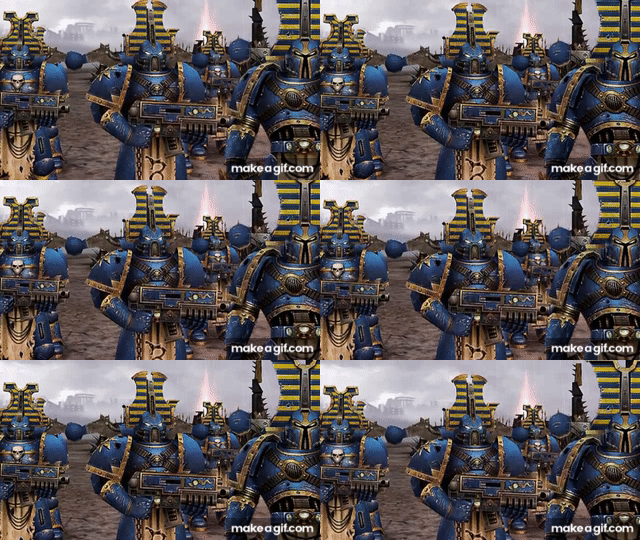
An excellent emotional and dramatic ending to an excellent series, filled with twists, thrills, well fleshed motivations/backstory driven characters, tzeentchian wiles and unexpected cameos: .
A bleak entertaining must read to all Thousand Sons' fans and a great bridge from the Horus Heresy saga to the 41th millennium grimdark setting, giving lots of insight about Azek Ahriman's motivations, his being at odds with Magnus the Red, his fall from grace and rise into being one of most iconic villains into Warhammer 40000 universe.
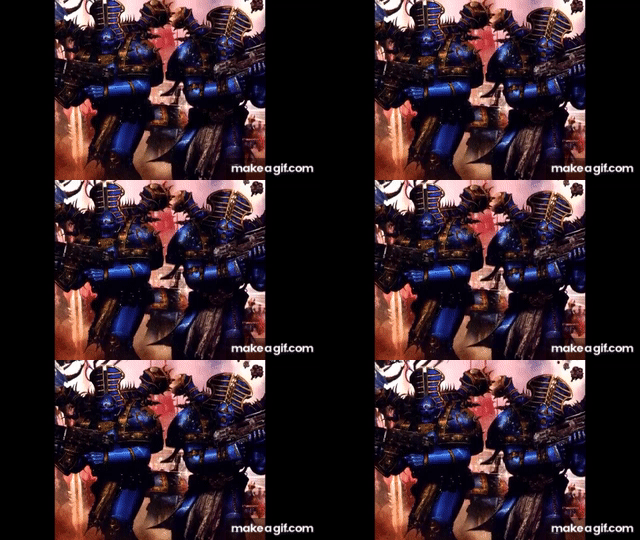
John French really made a great job here and I just can't wait to read more in the future about Azek Ahriman, Ctesias, Astraeos, Ignis and last but not least, Helio Isidorus: just one of the most amazing cast of characters ever assembled.
All is dust.

June 19, 2017
Out of all of the books in this trilogy, this one was the least enjoyable for me.
French is a good writer, and overall he did a fantastic job on this series of books, and the third one fits really well with the other two. Each of the characters from earlier in the series play a part in this novel, bringing together a number of different threads in a truly Tzeenchian manner. There's a lot in this novel that 40k fans will enjoy, and I admit, I enjoyed them as well, which is why this novel still got a three star rating.
Unfortunately, due to all the plots and their inevitable twists, some of the story gets lost. This wouldn't be a bad thing, except when compared to the previous two books, it seems as if French decided to amp things up significantly for this novel when he probably could have kept things simpler and lost none of the epic nature of events.
And this may be nit-picking, but I really wish the writers of the 40k universe would get Magnus the Red's appearance right. In the Horus Heresy, it's mentioned Magnus has one normal eye, and his other eye is just an empty socket. Yet in this book, as well as a couple others, he's mentioned as having a single eye in his forehead. (which makes less sense as he gave up his other eye for the knowledge to save his legion)
Still, French has created a good novel, as well as an excellent series, which brings together a number of excellent characters and plots to a single event that comes to fruition in this novel. I recommend this series, and I will most likely read this trilogy again. So if you enjoy the Thousand Sons, or Ahriman, this is the book and series for you. It definitely adds a lot more to Ahriman's character, and helps you to understand a lot of why he does what he does, and why he is at odds with Magnus.
French is a good writer, and overall he did a fantastic job on this series of books, and the third one fits really well with the other two. Each of the characters from earlier in the series play a part in this novel, bringing together a number of different threads in a truly Tzeenchian manner. There's a lot in this novel that 40k fans will enjoy, and I admit, I enjoyed them as well, which is why this novel still got a three star rating.
Unfortunately, due to all the plots and their inevitable twists, some of the story gets lost. This wouldn't be a bad thing, except when compared to the previous two books, it seems as if French decided to amp things up significantly for this novel when he probably could have kept things simpler and lost none of the epic nature of events.
And this may be nit-picking, but I really wish the writers of the 40k universe would get Magnus the Red's appearance right. In the Horus Heresy, it's mentioned Magnus has one normal eye, and his other eye is just an empty socket. Yet in this book, as well as a couple others, he's mentioned as having a single eye in his forehead. (which makes less sense as he gave up his other eye for the knowledge to save his legion)
Still, French has created a good novel, as well as an excellent series, which brings together a number of excellent characters and plots to a single event that comes to fruition in this novel. I recommend this series, and I will most likely read this trilogy again. So if you enjoy the Thousand Sons, or Ahriman, this is the book and series for you. It definitely adds a lot more to Ahriman's character, and helps you to understand a lot of why he does what he does, and why he is at odds with Magnus.
August 20, 2024
“The past is not ours to own. We think, because we can remember it, that it belongs to us. That we can go back to it. That we are the same person who lives those moments, breathed that air, and made those choices.
We are not the same. We are a stranger living with memories that belong to someone else. And the past belongs to itself.”
We are not the same. We are a stranger living with memories that belong to someone else. And the past belongs to itself.”

May 8, 2023
Everything Ahriman worked for is coming to an end in this novel. That the result is pretty much clear from the beginning is taking the thrill out of the story, but on the other hand I kept guessing why it has to be this way and how exactly it is going to fail. There are many factors working for and against Ahriman, and though I greatly enjoyed reading the story I can't help but associate a dullness to it all.
May 24, 2023
Epic, mind bending and boggling finale to this tale of everyone’s favourite sociopath.
May not be for everyone but I adore French’s language when coming to terms with stuff that is by definition indescribable.
I think I’ve appreciated this more on the re read than 5 years ago, it makes more sense when thinking of Crimson King and Fury of Magnus from the heresy/siege of terra.
May not be for everyone but I adore French’s language when coming to terms with stuff that is by definition indescribable.
I think I’ve appreciated this more on the re read than 5 years ago, it makes more sense when thinking of Crimson King and Fury of Magnus from the heresy/siege of terra.

November 22, 2015
The third and final novel in John French’s ambitious trilogy, Ahriman : Unchanged sees the Thousand Son sorcerer firmly back at the peak of his powers. Using knowledge gleaned from the Athenaeum (see Ahriman : Sorcerer) he prepares to enact a new Rubric, a grand undertaking that will correct the mistakes of his past. To do so he has to lead his forces back to Prospero and the scene of his legion’s darkest hour, and from there to face their father Magnus deep within the Eye of Terror. Standing in his way are foes both seen and unseen, from within the Imperium and without.
Read the rest of the review at https://trackofwords.wordpress.com/20...
Read the rest of the review at https://trackofwords.wordpress.com/20...

January 5, 2025
Tyrion Lannister: 2/5 stars
Tyrion sits by the fire in a dimly lit library, a goblet of wine in hand, as he flips the last page of "Ahriman: Unchanged". Setting the book aside, he leans back, rubbing his temple, the expression on his face caught between amusement and disappointment.
"Ah, Ahriman," Tyrion mutters, swirling his wine. "A tale of ambition, betrayal, and hubris—a story that should, by all accounts, resonate with me. And yet, here I sit, unimpressed."
He takes a sip, his sharp mind already dissecting the book’s flaws.
"The tragedy of Ahriman, a sorcerer seeking to undo the monumental failure of the Rubric, should have been riveting—a chess game of intellect and power. Instead, we are treated to an endless parade of grim-faced monologues and convoluted schemes that go nowhere. A pity, really. A character this fascinating deserved better."
Tyrion picks up the book, thumbing through its pages as if searching for something lost.
"The writing, while rich in detail, drowns itself in its own verbosity. Every description, every introspection, is stretched to the point where even my patience, vast as it is, begins to wear thin. The weight of the Warhammer universe is evident, yes, but it feels less like immersion and more like a heavy cloak suffocating the narrative."
He sets the book down again, a sardonic smile playing at his lips.
"And then there’s Ahriman himself—a character torn between brilliance and obsession, yet rendered static by his own repetitiveness. His quest for redemption, or perhaps vindication, lacks the nuance one might expect. Instead of growth, we’re given a character trapped in a cycle of failure, which, while thematically appropriate, grows tiresome after the first hundred pages."
Tyrion sighs, topping off his goblet.
"Still, I must give credit where it is due. The exploration of power and its consequences—how ambition can both drive and destroy—is a theme I can always appreciate. And there are moments of brilliance, fleeting as they may be, that hint at what this story could have been."
He raises his goblet in a mock toast.
"To missed opportunities, then. Ahriman may be unchanged, but I can only hope the next tale in this series finds its footing. For now, I shall seek out
Tyrion sits by the fire in a dimly lit library, a goblet of wine in hand, as he flips the last page of "Ahriman: Unchanged". Setting the book aside, he leans back, rubbing his temple, the expression on his face caught between amusement and disappointment.
"Ah, Ahriman," Tyrion mutters, swirling his wine. "A tale of ambition, betrayal, and hubris—a story that should, by all accounts, resonate with me. And yet, here I sit, unimpressed."
He takes a sip, his sharp mind already dissecting the book’s flaws.
"The tragedy of Ahriman, a sorcerer seeking to undo the monumental failure of the Rubric, should have been riveting—a chess game of intellect and power. Instead, we are treated to an endless parade of grim-faced monologues and convoluted schemes that go nowhere. A pity, really. A character this fascinating deserved better."
Tyrion picks up the book, thumbing through its pages as if searching for something lost.
"The writing, while rich in detail, drowns itself in its own verbosity. Every description, every introspection, is stretched to the point where even my patience, vast as it is, begins to wear thin. The weight of the Warhammer universe is evident, yes, but it feels less like immersion and more like a heavy cloak suffocating the narrative."
He sets the book down again, a sardonic smile playing at his lips.
"And then there’s Ahriman himself—a character torn between brilliance and obsession, yet rendered static by his own repetitiveness. His quest for redemption, or perhaps vindication, lacks the nuance one might expect. Instead of growth, we’re given a character trapped in a cycle of failure, which, while thematically appropriate, grows tiresome after the first hundred pages."
Tyrion sighs, topping off his goblet.
"Still, I must give credit where it is due. The exploration of power and its consequences—how ambition can both drive and destroy—is a theme I can always appreciate. And there are moments of brilliance, fleeting as they may be, that hint at what this story could have been."
He raises his goblet in a mock toast.
"To missed opportunities, then. Ahriman may be unchanged, but I can only hope the next tale in this series finds its footing. For now, I shall seek out

September 11, 2023
Three books in, and I feel like I should be enjoying John French's Ahriman series more than I actually am. This is 40k with fewer combat scenes, a morally ambiguous thinker of a lead character supported by a reasonably large and interesting cast of side characters, and the Imperium of Mankind barely features.
All these are massive plusses (to me anyway) that should help this work stand out from the crowd, but then for all the beautiful artwork (the cover of this book being no exception) Tzeentch has never quite been as clearly defined as the other Chaos gods and his followers have always struck me as high on style and low on substance. Even after three books I don't know that I've learned all that much more about Ahriman himself; he is highly driven to right wrongs of the past, has an ego the size of a planet, and regularly slips into self delusion. A good start but I find myself wanting to know more, and I'm not sure that development or growth is coming.
The time spent on abstract concepts and in dream-like sequences is another example of writing decisions that don't quite work for me. I understand why people love these books, but they're just not quite to my taste. After finding the first one new and refreshing the sequels have been just
...fine.
All these are massive plusses (to me anyway) that should help this work stand out from the crowd, but then for all the beautiful artwork (the cover of this book being no exception) Tzeentch has never quite been as clearly defined as the other Chaos gods and his followers have always struck me as high on style and low on substance. Even after three books I don't know that I've learned all that much more about Ahriman himself; he is highly driven to right wrongs of the past, has an ego the size of a planet, and regularly slips into self delusion. A good start but I find myself wanting to know more, and I'm not sure that development or growth is coming.
The time spent on abstract concepts and in dream-like sequences is another example of writing decisions that don't quite work for me. I understand why people love these books, but they're just not quite to my taste. After finding the first one new and refreshing the sequels have been just
...fine.
February 10, 2026
& that’s the end! or the beginning? maybe both. they’re all connected.
(i know there’s 2 more novels to go, but considering those aren’t a part of this omnibus. this definitely feels like a story ending. or beginning?)
overall, another great addition to ahrimans story! i have to be honest. the time paradox’s did hurt my smooth brain for a few chapters (a like all paradox’s. the more i thought about it, the worse it got). but eventually it clicks! i also don’t think this was aaaaaas good as the first two installments, but still a fantastic read.
also the ending, though kind of predicable, was stellar. the whole omnibus as a whole had its fair share of twists of turns but ever since the beginning, i had a feeling how this might end (or begin?)
it absolutely recommend reading this series to anyone interested. it helped being a big ahriman and thousands sons fan, but even if i wasn’t i would still highly enjoy this!! john french flushed out a lot of characters, make you deeply care about some new faces, and even brought in some old characters that it was nice to see again. having certain daemons appear as well was awesome! (changeling!?!). i think this also did a really good job on giving us more into tzeetch and his shenanigans.
two more to go!
(i know there’s 2 more novels to go, but considering those aren’t a part of this omnibus. this definitely feels like a story ending. or beginning?)
overall, another great addition to ahrimans story! i have to be honest. the time paradox’s did hurt my smooth brain for a few chapters (a like all paradox’s. the more i thought about it, the worse it got). but eventually it clicks! i also don’t think this was aaaaaas good as the first two installments, but still a fantastic read.
also the ending, though kind of predicable, was stellar. the whole omnibus as a whole had its fair share of twists of turns but ever since the beginning, i had a feeling how this might end (or begin?)
it absolutely recommend reading this series to anyone interested. it helped being a big ahriman and thousands sons fan, but even if i wasn’t i would still highly enjoy this!! john french flushed out a lot of characters, make you deeply care about some new faces, and even brought in some old characters that it was nice to see again. having certain daemons appear as well was awesome! (changeling!?!). i think this also did a really good job on giving us more into tzeetch and his shenanigans.
two more to go!
March 13, 2025
“Mortals in their ignorance called it a god, but it was no god. It was something beyond gods and prayers. Magic and fate coiled around it like fog winding around a tower. Countless mouths opened and closed across its skin. Tongues licked lips. Fangs glistened. Beaks snapped at the air. Far out, in the infinity of paradox which stretched from the Fortress, the silence of the Changer of Ways sent daemons scurrying in fear. The greater daemons and princes of the Court of Change waited. They could feel destinies rolling over and threads of existence snapping as the god of magic and lies – which was a god only by theft – contemplated the fate of a lone mortal.”
*
I was hesitant to read this because to be honest I got so sick of Ahriman (he’s a fantastic character, but I can only read so many books about him self-flagellating), and was actually convinced because I heard Khayon was in it. Let’s just say French did not disappoint, Khayon cameo included! He is definitely one of the more prosaically talented Black Library authors— every line of this book is a treat!
*
I was hesitant to read this because to be honest I got so sick of Ahriman (he’s a fantastic character, but I can only read so many books about him self-flagellating), and was actually convinced because I heard Khayon was in it. Let’s just say French did not disappoint, Khayon cameo included! He is definitely one of the more prosaically talented Black Library authors— every line of this book is a treat!
November 15, 2018
У книги странная проблема: отсутствие интриги и переизбыток интриг одновременно.
С одной стороны, читать историю, как Ариман пытается откатить рубрику и упокоиться с миром - примерно ... ну не знаю, как про Колумба, ищущего Индию. найдет или нет?
С другой - три слоя СПГС. Книга переполнена героями, каждыф из которых имеет свои очень хитрые планы и очень глубокие мотивы. При этом герои довольно картонные. В итоге их перестаешь отличать одного от другого.
Возможно, автор хотел компенсировать отсутствие глобально интриги сюжета кучей внутренних. Не вышло. Увы.
Из плюсов: читается довольно легко. Финальная тотальная колдунская битва описана довольно красочно. Ну и порадовала финальная вишенка, что старался гг не совсем зря.
С одной стороны, читать историю, как Ариман пытается откатить рубрику и упокоиться с миром - примерно ... ну не знаю, как про Колумба, ищущего Индию. найдет или нет?
С другой - три слоя СПГС. Книга переполнена героями, каждыф из которых имеет свои очень хитрые планы и очень глубокие мотивы. При этом герои довольно картонные. В итоге их перестаешь отличать одного от другого.
Возможно, автор хотел компенсировать отсутствие глобально интриги сюжета кучей внутренних. Не вышло. Увы.
Из плюсов: читается довольно легко. Финальная тотальная колдунская битва описана довольно красочно. Ну и порадовала финальная вишенка, что старался гг не совсем зря.
January 6, 2025
Everything was, is, and will be connected, like a serpent devouring its own tail.
As a massive fan of the Thousand Sons, I thought this book was fantastic. I loved how all the pieces of a grand puzzle fell into place as I read, and French’s depiction of Tzeentch and it’s Court of Change was exactly how I imagined it: unimaginable.
Changeling mentioned? Peak.
Iskander Khayon mentioned? Peak.
Magnus? Did nothing wrong. Peak
Ignis and Ctesias are my favourite characters. RIP MY BOY CREDENCE 🥲🥲🥲
As a massive fan of the Thousand Sons, I thought this book was fantastic. I loved how all the pieces of a grand puzzle fell into place as I read, and French’s depiction of Tzeentch and it’s Court of Change was exactly how I imagined it: unimaginable.
Changeling mentioned? Peak.
Iskander Khayon mentioned? Peak.
Magnus? Did nothing wrong. Peak
Ignis and Ctesias are my favourite characters. RIP MY BOY CREDENCE 🥲🥲🥲
This entire review has been hidden because of spoilers.

September 3, 2026
So many pages to go absolutely nowhere. Its like the joke about sitcoms where no matter what happens in an episode, it has to end with everything exactly the same as where it started. The whole books spends so much time trying to bring a dozen different stake holders together and half of them have zero consequence on anything. I wouldnt be as annoyed if we hadnt been forced to sit through some of the most boring ones for hundreds of pages just for it to be completely meaningless.

December 18, 2020
The final part of the Ahriman series might be the best part. It explains so much and still leaves me with questions.
My only disappointment is The Changeling. What was the point of them being in the book?
Everything else was amazing. Iobel and Ahriman's journeys have so much meaning and depth.
What is real?
What is true?
What is the point?
My only disappointment is The Changeling. What was the point of them being in the book?
Everything else was amazing. Iobel and Ahriman's journeys have so much meaning and depth.
What is real?
What is true?
What is the point?

May 25, 2023
Ahriman's final journey to redemption begins to fall short. Astreos' relationship with Ahriman is interesting but does not feel entirely satisfying at its climax. Ahriman's inner circle provide the antihero with relevant, nuanced counter points, which highlight just how truly terrible he is, albeit with admirable goals.
This entire review has been hidden because of spoilers.

September 2, 2023
Ahriman stories are overall really complicated, but epic, and this is no exception. It was pretty hard to read, but I'm glad I did it.
On the complicated part I had to look up some stuff of the warhammer lore wiki, and sometimes I did not know what was happening exactly, but the epic fights and the overall story saved it and made it worth it.
On the complicated part I had to look up some stuff of the warhammer lore wiki, and sometimes I did not know what was happening exactly, but the epic fights and the overall story saved it and made it worth it.

April 13, 2019
A interesting ending that wraps everything up. It drag on at times with all the little plots, overall I enjoyed the journey of Ahriman, I did love that Magnus had a part in it as well as Tzeentch makes a cameo.
This entire review has been hidden because of spoilers.
January 28, 2024
Excellent 3rd entry in one of the best 40K series
I’m biased because I LOVE Ahriman and the Thousand Sons. Regardless, this is an excellent entry in the series and it really ties up so many things while leaving the future wide open.
I’m biased because I LOVE Ahriman and the Thousand Sons. Regardless, this is an excellent entry in the series and it really ties up so many things while leaving the future wide open.

May 30, 2018
Betrayal comes to fruition. The Crimson King becomes more integrated and the Thousand Sons’ storyline as a fractured legion advances.

July 8, 2018
A truly Tzeentchian ending for this trilogy, with some interesting plot twists.


July 27, 2022
Ahriman makes me happy again.

October 16, 2025
Oh my god this was awesome.

December 30, 2025
good lord that was insufferable.
April 1, 2026
French es un buen escritor y el libro es bueno pero tiene tramas que se alargan a dolor. Fastidia que unos giros buenos estén entre tanta melaza.

October 29, 2023
John French never writes a dud but this got a bit big for its literary britches.

February 8, 2024
Started off pretty strong, French’s way of describing psykers continues to be my favorite part of his writing. The ending was enjoyable and did have a nice twist that I didn’t see coming. However, it, like the others in this series, was extremely slow far too often.

April 23, 2016
Overall, this marks a satisfying end to a gripping trilogy. If you're a fan of Ahriman, A Thousand Sons and Warhammer 40k in general, this trilogy needs to be read. There's lots of nice cameos in this final book, which I won't spoil, but needless to say when certain names and characters popped up, I had a big grin on my face. I certainly hope we'll get more Ahriman novels in the future, as he is a wonderfully complex character, who is actually very human at the core. It would be great to see French get licence to expand on canon and have Ahriman assault the Black Library or something similar, but who knows.
January 19, 2016
I'm not really fond of dream-like journeys of the mind, however I also have to admit that the tale of the Thousand Sons could not be told any other way. I also have to admit that I like how the Ahriman series connects 30K to 40K in a similar way to the Night Lords series.

November 20, 2022
Really good pay off to the trilogy and couldn't put this down once I got to the last third of the book
Displaying 1 - 30 of 31 reviews