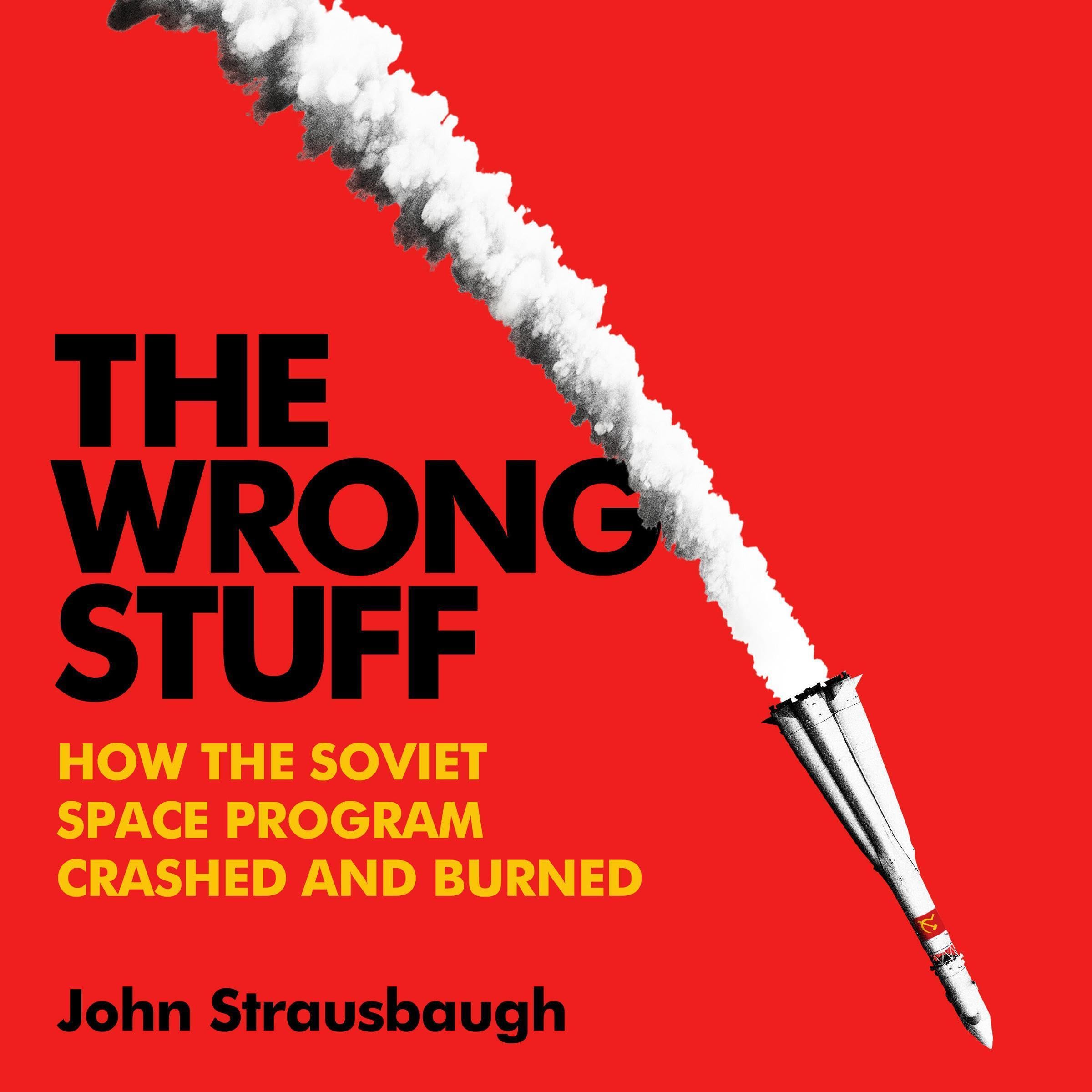
Despite the rather pugilistic title, this was a fair, and very humanizing, look at the Soviet Space Program. It's no secret that following the Second World War the Soviet Union was a wrecked, and ruined country. To rebuild their heavy industry, it being too expensive to retransport the industry east of the Urals back westwards, they dismantled most of the surviving heavy industry in eastern Germany and shipped it eastwards, taking with them the German engineers and specialists to teach the Soviets how to utilize it.
To become competitive with the Americans in the post war period, the Soviets did what any country desperate to rebuild from a calamity does: they stole everything not nailed down, either physically from Germany, and the rest of Eastern Europe, or intellectually through spies or outright bribery. Being technologically behind the West, especially the Germans, the Soviets also made a heavy play to grab as many Nazi scientists as they could before the Americans got their hands on them. They succeeded in grabbing the majority of the mid-level engineers and project managers. However the big names, men like Von Braun, managed to make their way to the Americans.
Even so the Soviets had their own native born rocket program dating to before the war. It didn't get very far off the ground, and so they had to rely on captured V2's to both test and tl experiment on, but they were incredibly lucky to have one native born son who could rival Von Braun in intellect. His name was Korolev, and without him, there would have been no Soviet Space Program, at least not one as early as they managed to field one.
Despite having run afoul of Stalin's paranoia and been tossed into a gulag before the Great Patriotic War (over trumped up charges, which was common, though he was tortured into a confession anyway...also common) he was released in order to begin the serious study of learning all he could of the Nazi rocket programs, and their own unfulfilled plans for dipping mankind's toes into space.
Korolev was a genuine genius, but he was forced to work within a perenially poor system. Poor in financial, and marerial resources, and always a step behind technologically. Hence the books title, The Wrong Stuff. Even so, what's really remarkable is just how many firsts the Soviets managed while in this state.
This book, writren in a breezy, almost conversational style, was meant to be an easy read and so is light on the science and the engineering (which I found disappointing, honestly), and only gives the bare bones on technical details (also disappointing) preferring instead to focus on the men, and women, and their stories. Through this approach the author greatly humanizes the Soviets, and their very Russian (and Ukrainian) senses of humor, hopes, dreams, and charisma really shined through.
The book spends quite a bit of time comparing and contrasting the Soviet program with that of the Americans, and to use one example the Americans preferred astronauts who were older, well into their 30's, already established military men or well known civilian test pilots, family men, husbands and fathers, and well vetted Christians.
The Russians preferred younger men, single, who were ideologically pure Soviets, though they shared the necessary skills as either pilots or navigators. (Or in the case of the first female Cosmonaut, a renowned civilian sky diver). And on the few occasions whenever Americans and Soviets got to meet, or late in the Cold War work side by side on joint missions, they got along remarkably well.
Likely the most entertaining, and ultimately tragic, tale in the book is that of Yuri Gagarin, who I had no idea was such a hell raising playboy! Celebrity really does change people, and often for the worse.
Another stream the book follows is the political leadership of the USSR, as the Soviet elites were very deeply intertwined with the inner workings of the space program. In this book it is three who are most discussed, and we meet one of them: Kruschev, Brezhnev, and Gorbachev. We spend quite a bit of time with Kruschev, and honestly, that pudgy little Ukrainian was a pure blast as a man. When he made a State visit to America in the 50's, he became kind of a celebrity, mostly because of his personality, and his utterly indefatigueable, and outrageous, sense of humor (which Americans found very endearing, Europeans found boorish, and fellow Soviets found embarrassing).
For all of their technological and material backwardness, the Soviets really did help pave the way for mankind's entry into space and built the first steps in our road to the stars. And like with the American program, these efforts often came with tremendous risks, and many Cosmonauts lost their lives in pursuit of political Soviet aims. And, in the end, that's why the Russians lost the Space Race despite sprinting well ahead in the 50's. For the Soviet leadership, it was all propaganda, all a stunt, all politics on display to the Third World, to awe them and to bring them on board with the Soviet global vision. They never had a set strategy in place, or even an ultimate end goal. Rather they had many competing programs, much of which were never completed due to lack of funding and or resources. The Americans, by contrast, were more cautious, more careful, and operated on a set, well defined strategy, with a clear end point in mind. And since the American effort was better funded, had access to greater technology (American computers had transistor technology in the late 50's, the Soviets were still using vacuum tubes well into the 60's), and was significantly better organized, despite it's slow start, the American program ultimately won the race.
A pretty good overview of the Soviet side of the Space Race, I just wish that there was at least a little more of the technology, science, design, and engineering that went into it all. Despite that, this was a pleasure to read, and a necessary humanizing effort for a now largely forgotten fragment of 20th century history.
Very highly recommended.