"With We Carry Their Bones, Erin Kimmerle continues to unearth the true story of the Dozier School, a tale more frightening than any fiction. In a corrupt world, her unflinching revelations are as close as we'll come to justice." –Colson Whitehead, Pulitzer-Prize Winning author of The Nickel Boys and The Underground Railroad
Forensic anthropologist Erin Kimmerle investigates of the notorious Dozier Boys School—the true story behind the Pulitzer Prize–winning novel The Nickel Boys—and the contentious process to exhume the graves of the boys buried there in order to reunite them with their families.
The Arthur G. Dozier Boys School was a well-guarded secret in Florida for over a century, until reports of cruelty, abuse, and “mysterious” deaths shut the institution down in 2011. Established in 1900, the juvenile reform school accepted children as young as six years of age for crimes as harmless as truancy or trespassing. The boys sent there, many of whom were Black, were subject to brutal abuse, routinely hired out to local farmers by the school’s management as indentured labor, and died either at the school or attempting to escape its brutal conditions.
In the wake of the school’s shutdown, Erin Kimmerle, a leading forensic anthropologist, stepped in to locate the school’s graveyard to determine the number of graves and who was buried there, thus beginning the process of reuniting the boys with their families through forensic and DNA testing. The school’s poorly kept accounting suggested some thirty-one boys were buried in unmarked graves in a remote field on the school’s property. The real number was at least twice that. Kimmerle’s work did not go unnoticed; residents and local law enforcement threatened and harassed her team in their eagerness to control the truth she was uncovering—one she continues to investigate to this day.
We Carry Their Bones is a detailed account of Jim Crow America and an indictment of the reform school system as we know it. It’s also a fascinating dive into the science of forensic anthropology and an important retelling of the extraordinary efforts taken to bring these lost children home to their families—an endeavor that created a political firestorm and a dramatic reckoning with racism and shame in the legacy of America.
Supplemental enhancement PDF accompanies the audiobook.
In a devoutly religious Ireland, babies and young girls were brutalized and discarded in the infamous Magdalene Laundries. In Canada and the United States, Indigenous children were brutalized and discarded by Indian Industrial Schools in the name of civilizing them: “kill the Indian, save the man.” The book “We Carry Their Bones” reveals how young boys in Florida were imprisoned, beaten and discarded– after all, “... they was throwaways.”
What does it tell us when atrocities are allowed to run rampant for decades, and people who sincerely believe themselves to be morally sound have no problem looking the other way. No one ever seems aware of what is going on and it is a total surprise and shock when one day the bones in the graves start talking.
The stories surfacing about the Arthur G. Dozier Boys School included reported whipping, torture, sexual assault, and vague explanations for death. For over a century the school served as a reform school under various names, had recently closed under the cloud of these accusations, and there was an urgency by the people of Marianna, Florida to sell off the property as quickly and quietly as possible.
A number of haunted men emerged with allegations which had tormented them since their stay at Dozier. These men called themselves the White House Boys, named for the building where beatings were doled out. They were traumatized by memories of classmates disappearing, taken away, never returning. One man told of having to bury his own brother in an unmarked grave and having to remain at that school.
The author, forensic anthropologist Eric Kimmerle, details her battles attempting to get justice for these men and the families of boys whose bodies were never located. Her mission seemed simple enough– identify and study the burial remains using sophisticated scientific techniques. She encountered threats and a tremendous amount of resistance from the community, people determined to keep the past sealed.
Particularly disturbing is the story about a fire in 1914 where seven boys were burned to death after being chained to their beds in isolation cells. Firefighters and spectators could only watch and listen to the screams as the building collapsed in flames. Later the remains were haphazardly mixed and buried in unmarked plots.
This utter disregard for human life is just flooring. Children were imprisoned as early as five years old for crimes such as smoking, skipping school, running away or merely being unwanted. Being poor was enough but being black was also a factor. Seventy percent of the boys buried were African American.
The question keeps looming– how could a society ever allow this to happen? This was not the dark ages, the Spanish Inquisition, or diabolical Nazi monsters. This did not happen in some distant third world dictatorship where genocide is something we shake our heads at in a casual disbelief. This was a cruel disposal of children butchered because they were easy to ignore. One of the town’s residents argued with the author “...they was throwaways…” Dehumanize a group and there is no empathy.
–In moments like this, I understood what William Faulkner meant when he wrote, “The past is never dead. It’s not even past.” – from author Erin Kimmerle.
Could something like this ever happen again? We have come so far and would never do something as callous as, say… warehousing children in over-crowded holding cells.
Passages of human cruelty are always difficult to read, especially in a true crime account such as this. Portions of the book get a little bogged down in the science and technique of excavating, demonstrating how painstaking the process is. An important, eye-opening book.
Thank you William Morrow and NetGalley for providing the advance reader copy in exchange for an honest review. #WeCarryTheirBones #NetGalley
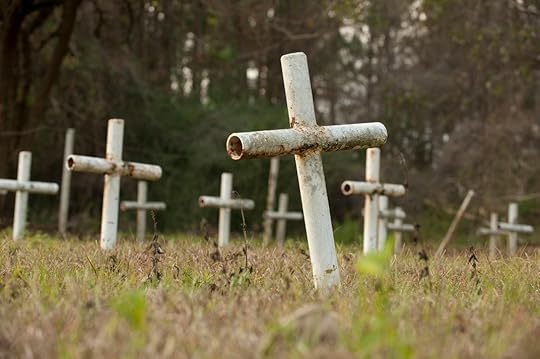
Image: Pipe crosses marking burials at the Dozier Boys School. MICHAEL SPOONEYBARGER/Reuters/Corbis (photo on Smithsonian magazine website)
For over a century, children as young as five were sent to the Arthur G. Dozier Boys School. Despite its name, this was not a school but a notorious prison of the worst kind.
Children were beaten, some to death, over the slightest infractions, chained to walls, kept in isolation chambers, and farmed out for labor. The "crimes" for which judges sentenced them to this institution of torture were often no more than incorrigibility, smoking, truancy, or trespassing.
Police could grab these children off the street and, without the benefit of a lawyer or their parents' knowledge, be taken before a judge for sentencing. Initially the judge would determine the length of the sentence, usually a year, but officials at the school soon asked for that to be changed.
William Milton, the superintendent in 1906, wrote to the governor asking that the children be sentenced to an indefinite period that would be determined by the school.
His reason? "Having so few inmates makes the crop come in slow." In other words, they needed to be sure to keep the place full in order to get the maximum profit off these children's forced labor.
The judge acquiesced.
Over 70% of the children were "colored" and the others were poor whites. The author points out how the Jim Crow laws and institutional racism allowed such a place as this "school" to flourish. These children were considered "throwaways".
Over the years, many children died or were murdered and were buried on the grounds. When the school finally closed in 2011, archaeologists began inspecting the site. Erin Kimmerle, author of this book and a forensic anthropologist, led a team in finding the number of actual burials at Dozier, which was more than official records claimed.
Using ground-penetrating radar, they were able to locate the burial plots. They then used forensic and DNA testing to determine who these children were and how they died.
Excruciating as it is, this is important history to know and as soon as I saw this book I wanted read it. Unfortunately, it's not very well written. It jumps all over the place, is repetitive, and has a lot more about the bureaucracy involved in getting permits to explore the land than it is about what the scientists learned.
This might be interesting and important information to some readers but was boring to me. I only wanted to know what they discovered and how they did.
There are a number of online magazine articles reporting on the findings that I found more interesting, not needing all the "filler" that a book requires.
Some readers will prefer learning all the minutiae and if you're one of them, I recommend this book. For those like me, an online article, such as this one at NPR should suffice.
Interesting topic, but poorly written. Timelines were confusing, information was either left out or repeated, and it felt like some topics were left with no closure.
I am so, SO fucking tired of trying to listen to true crime books, only to find out that the author put anti-Serbian propaganda into the book. If I had known who the author was, then I never would've started this. But since I did start it, and I heard what I did, I'm choosing to dnf.
And to think that I was anticipating a good read, one that even made me cry early on. But listen, I can't bring myself to read a book where it's clear the author doesn't care about my people, no matter how interesting the subject is.
She even mentioned that she thought about writing a book, about the Balkans. I am so glad she didn't, you have no idea.
As for the subject of We Carry Their Bones, it's indeed horrifying what happened there. I can't even imagine what those poor kids went through, and their stories deserve to be heard. So I'm sorry that I can't continue this, but I'll do my best to look the stories up myself and do some research.
I read a few reviews that say this is more a biography of the author than true crime, and since I didn't finish it I can't say for sure, but I can agree that so much of her background wasn't needed when all we really want to know is what happened to the kids.
2 stars because I didn't finish it, and for the attempt to tell this story.
3 stars because of its relevance but oh how very dull the rest of the book is.
This book deals with the horrendous things done to young boys, particularly to black boy whil the Dozier School was in business. Incorrigible boys they said were sent there but many were because of minor infractions or being an orphan. Easily disposable, these young boy were beaten and tortured and in a time where segregation ran rampant pretty much ignored by the state and community.
It was so sad that so many were thrown into unmarked graves and later the Erin Kimmerle and her team went through a multitude of batteles to see that these boys were identified and returned to their families.
Opened in 1900, Those who were confined there an survived had vivid memories of the atrocities present. Some eighty-one boys lost their lives there. The White House Boys as they were known through the efforts of Kimmerle and her staff have finally been allowed entrance to the grounds of this institution. The school closed in 2011.
Thanks you to NetGalley for a copy of this story. I only wish it had not been so detailed about the archeology and more focused on the families and the boys lost.
I found this author is just amazing at what she does for a living and how she fought to the end to get answers. She helped many family members who had lost their boys at this awful facility in northern Florida. The book has lots of background and history of the area and the school. The things that went on there were more than cringe-worthy. I liked learning about how they do a dig and later process what they find. Excellent read for the times. I received an advance review copy for free, and I am leaving this review voluntarily.
The first time I heard about the Dozier School, I was driving in my car listening to NPR. It was one of those segments where when I got home, I had to sit in my driveway to hear the ending.
Dozier School was a juvenile reform school school for boys in Florida. It was open for over 100 years, from 1900-2011, and its entire history is full of stories of abuse, deaths, and disappearances. This book details the history of the school and the fight to excavate the graveyard of unmarked graves on the school grounds, in the hopes of answering questions about the alleged abuse and reuniting families with the lost remains of their loved ones.
The story of Dozier School is horrifying, and it is covered well here. The author does a fantastic job of explaining how race, poverty, and historical events contributed to the creation and management of the school, and how long-held local prejudices interfered with attempts to investigate the school even after its closure. It's a terrible story, but it needs to be told.
I do think this book needed to clean up its timeline. It jumps around and is sometimes difficult to follow, and some threads disappear, leaving unanswered questions. Too much time was spent on the legal battle to excavate the graveyard--it's important to the story and needs to be included, but it should be more concise.
The weird thing about this book is that it was written by Erin Kimmerle, the forensic anthropologist who led the investigation and excavation....BUT it barely focused on the excavation, the results, what they found, or how the connected the physical remains with the historical information to make identifications. Basically, all the parts that I was really interested in reading about, and the topics that I expected from this particular author to cover in detail. She also jumps around frequently, making it hard to follow the story of any one boy, and she will often start talking about something in detail and then just STOP without finishing the story.
Here is one specific, frustrating example of an incomplete story: a dormitory fire caused multiple deaths in 1914. The school reported that the remains were too damaged to be identified, the bodies were buried in the graveyard, and families were notified. However, there were multiple inconsistencies in the reports of how many deaths had occurred and who they were. The book describes how during the excavation, they discovered 7 coffins containing charred remains from the fire, but the remains were only from 3 individuals mixed together and divided among 7 coffins. So then we get tons of detail about how the team returns the the site, finds the area where the dorm burned, excavates until they find debris from the fire, including bones, and then.....we jump to talking about something else entirely and never return to the fire victims. No info about if the new bones were consistent with the previous 3 individuals or not, no theories about what happened to the bodies of the other reported victims, nothing.
However, despite some of the narrative issues, Dozier School represents one of those uncomfortable parts of history that we still all need to know about, and the book is definitely worth a read.
*eARC provided by NetGalley in exchange for an honest review.
**As a note, I read this book as an eARC that did not include any photos, but I did notice there were photo references at the end of the book, so I may have missed out on images that may have provided additional information.
If you want to know what happened at Dozier School, find a different book. If you want to know the entire life story of the author and the trivial details of digging graves, including what hotels they considered staying at, this is the book for you.
I wanted to like this book, I really did. But when I’m constantly being pulled away from the story of the school (and the myriad abuses that took place there) to hear about the author’s father’s tube collection or how grateful everyone is to the author, I couldn’t do it. Even skipping whole chapters didn’t help.
Also, this book came out in 2022 and is heaped with praise for Pam Bondi, disgraced former Attorney General of Florida.
It wasn't all that long ago that I read Colson Whitehead's excellent The Nickel Boys, a novel inspired by the stories of abuse from men who as children were sent to the real-world Dozier School for Boys in Marianna, Florida. It is also a story of the long reach of trauma that lasts well after the horrific events at the fictional Nickel Academy, and how an investigation headed by a team from a Florida university that uncovers a "secret graveyard" sent one man back to finally confront the past and his pain. As Whitehead wrote in his book, "Plenty of boys had talked of the secret graveyard before, but ... no one believed them until someone else said it." By the time he'd written his book, Dr. Erin Kimmerle, a professor at the University of South Florida and a leading forensic anthropologist had already been working at the Dozier School. She explains in We Carry Their Bones that she had been introduced by a friend to a "local reporter" who had been working on "a series of stories" about "the dark history" of the real-life Dozier School, including "brutal beatings and sadistic guards and mysterious deaths."
As she notes,
"The stories raised questions about a purported cemetery on the school's property, and the reporter had hit a dead end. He had found the families of boys who died in custody and were buried at the school, families that had never found peace, for they'd never been given the opportunity to properly mourn. No one could point to the location of the graves where their brothers and uncles were buried. No state official had stepped up to find those burials."
While there was a small cemetery on the once-segregated black side of the grounds known in the records and among the locals as "Boot Hill," Dr. Kimmerle and her team were not "confident" that this was the only burial site. Permission to explore all of the grounds was denied by the Department of Juvenile Justice (which had claim to the side of the school where white boys had been confined and which did not close until 2011), and in 2012, the reason given was "pending sale of the property and other liability concerns." Kimmerle understood that with the sale of the "220 acres of the boys' school land," the new owners might very well "pave a parking lot on top of the graves of little boys," and that time was of the essence.
We Carry Their Bones details the work of Kimmerle and her team in investigating the area while trying to discover not only an actual number of burials, but also in trying to identify some of the remains so that they could be returned to their families.
There was a surprising amount of resistance to the work, but Kimmerle would not be deterred in her quest, and with the support of the media, of many of the boys' families and of politicians to whom she appealed, her team would go on to not only excavate remains, but also to examine them forensically and to take DNA samples from relatives in her effort to match those remains to names. In the end, she would eventually carry some of the bones of the identified boys to reunite them with their families.
Colson Whitehead's blurb on the front of this book notes that "In a corrupt world, Kimmerle's unflinching revelations are as close as we'll come to justice," and at every turn it is obvious that her objective was to offer any support and help she could to the families of the Dozier boys who never made it home. As she points out at the end, "the door was closed to us in the search for historic justice by many who had the power to open it," but Kimmerle's determination and that of all of the people involved made it so they would not and did not fail. It is a difficult book to read on several levels but on the other hand, it is a story that seriously needs telling, right now.
The story behind the real-life school that the Nickel Boys was based on. The author was part of the archeological team that helped excavate and bring justice to the boys that went to the Dozier Boys School in Marianna, Fl..
This book is important because not many people know this history. However, I wish it had been more clearly separated into a history of the school and then the archeological efforts. Right now, I feel like some of the importance of the history is lost with the current organization.
I received my copy from Netgalley in exchange for an honest review.
After having read Colson Whitehead's The Nickel Boys a few years ago, I have tried to read everything that has come across my path about the Dozier Boys School in Florida. It is hard to believe that that reformatory was allowed to hurt, maim and murder boys from 1900 to 2011, all in the misconception of rehabilitating them. A blurb from the synopsis really tells the story ~~
"Established in 1900, the juvenile reform school accepted children as young as six years of age for crimes as harmless as truancy or trespassing. The boys sent there, many of whom were Black, were subject to brutal abuse, routinely hired out to local farmers by the school's management as indentured labor, and died either at the school or attempting to escape its brutal conditions."
This book was written by Erin Kimmeris, a forensic anthropologist, who found the burying fields on the property of the Dozier school and exhumed the bones. Per the school there were 31 unmarked graves - of which they kept no information. No idea who was buried where or when - nothing but an unmarked pipe to show their placement. There ended up over 55 graves in two separate locations - some having more than one body.
This was the beginning of identifying and returning 46 boys to their relatives - some after 80 years. The investigation and identification goes on yet today.
I want to say this is connected to the Colson Whitehead book, Nickel Boys? Yes just pulled the synopsis! The synopsis of this particular book says all there is to say-find the bodies. There is not much of the history of the reformatory that I can remember. Focus was more on find these boys, identify them, let's reunite these children with family members and let's hope some are still alive. Some of these children were not even old enough to have started school. Such atrocities suffered by these children (largest population African American but abuse was dealt to all) its just shameful and disgusting. I'm not even quite sure who should take the blame since it was open for over 100 years and was closed just in 2011! 2011 people! I cannot believe there are still animals like this in the world. I want to vomit.
I know I keep talking about it ad nauseum, but Tananarive Due's THE REFORMATORY is going to come up again here. It is what it is.
WE CARRY THEIR BONES is a jarring piece of nonfiction that I'm glad I read, especially so soon after taking the fictional trip into that part of the world with Due's book. This is one of those subjects that, before reading either book, I knew existed...but my knowledge didn't go much deeper than that. It's absolutely staggering to think that forensic scientists like Erin Kimmerle were (are) needed to go in there and get justice for families so many years later.
I can see how this book might not be to everyone's taste, as Kimmerle's approach is -- understandably -- very science-based. She spends some time explaining how her job functions, and some readers might prefer that time be spent talking about the ramifications of the Dozier School's existence, or greater detail on what horrific things transpired there. (She does, in my opinion, give a good amount of space to these things, too.) My background interest in forensics and biology made it work for me. And, again, because I got so much unflinching detail about the torment those kids suffered at this place and others like it from THE REFORMATORY, maybe part of me was relieved to not have to see even more about it so soon. (Due's family pops up in this book, by the way, which was notable.)
There are moments where WE CARRY THEIR BONES gets a bit repetitive, which is what holds me from giving it full marks. But in terms of its significance in being told? That would be five stars, easily. I wonder how many people, like me, have spent months or years learning about the residential schools here in Canada and the plight of our Indigenous populations without ever realizing that Black children were being damned to the same fate south of the border, stolen from their families, tortured and left to die with vague causes and hand-waving explanations on their death certificates. This book is one I'd recommend if that's something you never knew about. Not an easy read, for obvious reasons, but an important one.
I picked this book up thinking it was about a historical event and was appalled to read that this “school” wasn’t shut down until 2011. As you read about the names of the elected officials who either helped, or more often hampered, the search for graves at the Dozier School site, there will be some you recognize as still being in power in the state of Florida. For readability, I would give this book 3 stars. At times the science seems repetitive. The true value of this book is in making known how juvenile reform was used as a cover for abuse and free labor. In the end there is closure for a few families, but no justice. Even the fact that the unidentified remains have been rebuffed without any historical marker as to why they are unknown is a continued injustice. It seems we need an encyclopedia of American history that has been shoved under the rug. They say in war, the winner writes the history. In America, it seems our national narrative has been written to flatter the people in power, mainly white males.
[...] "The past is never dead. It's not even past." We all live with our experiences. They are part of us. Not history. The idea that you can let sleeping dogs lie is sensless."
We Carry Their Bones: The Search for Justice at the Dozier School for Boys by Erin Kimmerle is easily the most impactful book I’ve read so far in my anthropology academic career. I picked it up for my forensic anthropology course, expecting a technical read about excavation and analysis—but it turned out to be so much more than that. This book carries incredible emotional weight. It’s about justice, memory, and the power of truth, but also about the deep humanity behind the science we study.
Kimmerle does an amazing job of explaining forensic anthropology in a way that’s accessible and engaging without watering anything down. She brings readers right into the process of uncovering evidence and identifying the boys buried at the Boot Hill cemetery, balancing the technical details with the emotional reality of what her team was doing. When I reached the section with the photos from the site, I actually cried—it’s impossible not to. Seeing the evidence of what these boys went through, and realizing how many of them were denied dignity even in death, broke me a little.
But what I appreciated most was how Kimmerle never loses sight of the people behind the project. She honors the boys’ lives, gives space to their families’ grief, and exposes the generational trauma that lingers in communities long after such atrocities are hidden away. She’s also honest about how personal and emotionally taxing this work became for her, how it differed from her previous cases, and the toll it takes to keep fighting for truth when faced with constant resistance—from the government, from the locals, from systems that would rather the past stay buried.
This book also captures how deeply interdisciplinary forensic work really is—how it depends on collaboration between scientists, lawyers, journalists, community members, and families. It reminded me why I fell in love with anthropology in the first place: because it connects science, humanity, and justice. We Carry Their Bones isn’t just a case study—it’s a call to remember and to act.
I’d recommend this to anyone, not just those studying anthropology or criminal justice. If you care about truth, history, and the fight for justice, this book will stay with you long after you close it.
Do not go into this book thinking you can blow right through this and then move on. It is absolutely not possible [unless you are a sociopath or psychopath, or someone who has not one drop of empathy, or are a racist, hideous individual, and lets be honest, if you are one of these, the chances of you actually reading this book are slim, so there is that] and you will need time to process much of this while you are reading it. There were days that I could only read 10% and then had to sit in either my tears or my anger and resolve it before moving on with my day.
I do not even know how to begin to write a review for this book [This is best going with little information because you WILL have thoughts and feelings when you read this. And that needs to come about naturally in my opinion]. There is just so much going on in my head and I have just stopped ugly crying over what I have read here on these pages. This is a book that will never, ever leave me and I will never be the same after reading it.
I lived in Florida for a time and it is not a fun place to live at times. Racism and hate and indifference are alive and well [and often celebrated] there. The parts of this book, where the author and her team butted up against the system and the politicians that hated what they were trying to do, while angering me to the point I felt like I had steam coming out of my head, did not surprise me at all. In a state where their prison system is for-profit and they care more about keeping bodies IN jail than actually helping and rehabilitating them [I know this first-hand. My ex-husband worked for a company that helped ex-convicts [I am pretty sure that he had young adults that came from the reform school - I remember him talking about a horrible school, but he never went into detail because it was just too much for him, get jobs in the community and helped them get counseling and care and the things we learned while he did that job irrevocably changed both of us], a reform school where they could control and "sell-out" the children that lived there would be a minor drop in the bucket, and their deaths, no matter how, would have mattered little. How horrifying this should be for all of us.
I think the author does an excellent job in breaking this all down for the lay person. I am sure there are things that she left out, simply because most of us would not get it. Her writing style is lovely and the way she tells the story in a non-sensationalized way is refreshing. There is no need for this here - the story alone is horrific enough. I love how she becomes friends with these families that are looking for truth and their brothers/cousins/uncles and how, from day one, respects them and the process and works tirelessly to bring them peace and comfort in any way she can. I admire her so much and would love to shake her hand and thank her for the work she did here [not even going to go into the work she did in the foreign field - wow].
What did surprise me [to a certain degree] was the indifference over finding who these poor boys were and getting them to the family that was left. So many people clearly have no heart and no compassion. WHO could know about boys being buried in the dark of the night, with no coffins, in secret and NOT want the truth? Apparently, a lot of people. Shame on them. That makes me sick to my stomach thinking about it.
I was raised to believe in hell. As an adult, I am not sure what I believe about it anymore, but I do hope there is a place of torment for the people that did these horrific acts, allowed it to happen, and knew it was happening and due to money, prestige, pride, and turned a blind eye to it all. That belief, and the fact that many of the people looking for their siblings/relatives for a lifetime were able to finally lay them to rest, are all that gives me peace over this.
Thank you to NetGalley, Erin Kimmerle, and William Morrow & Company for providing this ARC in exchange for an honest review.
The author of this book began this journey accidentally. As a forensic anthropologist she was called upon to verify 31 graves at an old reform school cemetery. What she discovered was a poorly kept burial spot for the children that died on the campus. As she dug deeper (figuratively speaking and, later, literally), she was approached by some of the survivors of the Arthur Dozier School. Buried in secrecy and shame, the school housed "juvenile delinquents" from ages 5 and up who were imprisoned for minor or no infractions and leased out as slave labor by day, and brutally abused and murdered by night. She uncovered horrific stories which are not clearly shared and attributed for privacy issues but enough is shared that the reader's stomach will turn.
Using fascinating technology, Kimmerle maps out part of the land and discovers anomolies that indicate 55 graves instead of 31 that were previously marked. The secrets are vast and not all told nor uncovered, but what Kimmerle found were the grown boys of the "White House," a building painted white where unspeakable brutality occurred; beatings with a leather strap, up to 135 lashes by "The One Armed Man," rapes, and murders. The boys were in their late 60's and older and deeply haunted by their time at the school, struggling with mental health issues for the rest of their lives. Additionally, many families never knew what became of their sons and brothers when they didn't come home. The semi-cemetery gave some of them answers.
What the author uncovered was a small town in Florida that did not want the secrets to be told. The school employed their fathers, grandfathers, and uncles who went home every night to their wives and children. They didn't want to know about the systemic racism or the cruel treatment meted out within the walls of the school and the fields in the surrounding areas.
The author brings some measure of closure to many of those impacted by the abuses at the school and shines a light on the historical (some are not in the distant history) mistreatment and inequality of the juvenile justice system in Florida. For the sake of brevity and readability, the detail on the lives of the boys is limited as is the story of abuse and death. Kimmerle is a scientist and carefully explains the way she went about identifying the unmarked graves, unearthing them, and identifying them where possible. It's heavier on the science side but the connections formed by her work are a clear by-product that impacted the author and the survivors lives for the better.
Thank you NetGalley for the opportunity to read the ARC copy of this novel, in return for an honest review.
I literally devoured this book! And that's even with the moments I had to stop, in order to come to terms with and remind myself that what I'm reading actually happened and then process the heaviness and totality of it.
The Bones We Carry was written by Erin Kimmerle, the anthropologist who spearheaded the exhumation of what was once believed to be a total of 31 boys; but later is determined to be several more buried on the property of a boys reformatory.
Erin relays the details of all the red tape she and her team had to cross, in order to bring justice to the family's of their lost brothers and uncles. Brothers and uncles who at very young ages suffered unimaginable horrors and abuse. Abuse that consisted of being confined to shackles on a wall if you were in isolation, lashes that left lasting scars, and other unspeakable abuse.
As Erin tells us about how she dug to unearth the possible buried bodies of boys from the reformatory, she also digs into the atrocities the juvenile justice system enacted on poor, black, and or disabled boys. And as she does, she unearths the schools history, reports of abuse, suspicious deaths, and the lengths the school and community went to defend, and then later, cover-up.
Kimmerle did a wonderful job of mixing the right amount of true crime with dashes of memoir, to help remind us, this was her experience, study, and research. However, sometimes Erin may of lost her timeline and voice amongst the amount of fact components she did include. While that did make only a couple of places harder to comprehend, the overall totality of the book was well written and gripping! I couldn't put it down, and hours later, it's the only thing I can think about.
This was an enlightening read about the process of archaeology to investigate and bring home the remains of dozens of boys who perished at a Florida reform school, many of them Black. This school is the stuff of nightmares, with boys being egregiously disciplined for things like truancy and running away. Kimmerle is unequivocal about the history of race at the school and in this part of Florida, but she does come across not as well-versed in the subject as she is not a historian or a journalist. If you are more interested in the science of archaeology, what it's like to work in teams, getting the funding to complete projects of this sort, and navigating the political landscape of such projects (in the press and in the small town), then I'd pick up this book. We get to know the history of a few of the families, but I didn't feel like it went as deep as I wanted it to regarding the backstories of the boys. Kimmerle is maybe a little dry or scholarly, but not enough to deter me from finishing this fascinating book.
This book is part history, part memoir, and part a detailed account of how they mapped the space, received political permissions, and conducted their dig.
I assumed I was getting mostly a history, so I wasn't prepared for how much of a character the author is - which felt weird and inappropriate in a book about boys dying and being mistreated? The mapping explanations were interesting, but the political approval process was less so for me.
Definitely learn about what happened at the Dozier school. Don't, like me, assume that this book centers the stories of the boys...this is more a story about forensic science and the experience of the author.
I wish this book had been laid out differently or written by someone else. A lot of time is given to the bureaucratic craziness of getting to actually search the cemetery for bodies and not enough on everything that was found and how certain findings were resolved. It didn't go as deep as I would have liked but was worth the listen.
3.5 stars. Another shameful issue that wasn't addressed: this was supposed to be a reform SCHOOL. I don't recall mention of classrooms, instruction in academic subjects, teachers. There were boys as young as five there. I don't believe they even learned to read.
This is nonfiction. It is all about how some politicians and people in Florida tried to stop the truth about the Dozier School for boys from coming to light. I did think there would be a bit more focus on the bones than there was since Erin Kimmerle is a forensic anthropologist. There was some, just not as much as I thought there would be. The bits that were included were enough to churn most people’s stomach and were quite depressing.
The impact fell short of being a 5 star book although it had the potential to be. I wish the author had worked with an investigative journalist on this book. Pieces of the book were lacking organization wise and there was a bit too much of the author’s personal life for my taste. In my humble opinion if you are a white author talking about how mainly Black boys were killed, sexually abused, and assaulted….your personal life story can be told in another book.
This book is definitely left leaning with multiple Republicans including Matt Gaetz being called out (for valid reasons—and if any Dems had voted the way Gaetz did I am sure would have received a similar berating tone). I thoroughly enjoy Republicans being called out. However, if you don’t enjoy reading about politics this is not the book for you. Murdered and abused Black boys receiving justice should not be a partisan issue. Both parties should agree on that, but this book showed a clear disagreement by some members of only one party.
“For others, the men who had been fighting for so long, there was reward in the simple acknowledgement that their suffering diminished their potential” has stuck with me for years.
We Carry Their Bones is a non-fiction book in which the author and forensic anthropologist, Erin Kimmerle, writes about her experience with the investigation of the Dozier Boys School. If that name sounds familiar, that’s because the school was the inspiration behind the 2020 Pulitzer winner, The Nickel Boys. For the boys who were sent to Dozier, they would leave the school haunted by the violence and abuse that they had suffered for the rest of their lives - if they even got out of it alive at all. Kimmerle’s objective was to exhume the bodies of the boys buried on the school’s property so that their families could claim the remains.Though it might seem difficult to believe that anyone would be against allowing people who spent decades searching for their relatives the opportunity to give them a proper burial, Kimmerle’s task wasn’t an easy one. She and her team had to fight tooth and nail to bring some sort of justice for the boys who were killed or died in mysterious circumstances and were hastily buried on school grounds. Back then, these boys were considered throwaways - they were sent to the reformatory for such ‘crimes’ as skipping school or being an orphan. Kimmerle in a very detailed way explains the way poverty, racism, and the lack of the civil rights we have today lead to the boys’ deaths, and how some members of the local community cared more about the town’s reputation than the truth. It’s a very powerful read, although I did find parts of it quite dense and the timeline a bit confusing.
TLDR: We Carry Their Bones is an emotional, difficult book about the history that isn’t known well enough, but that deserves our attention.
Leave it to Florida to once again give us something to talk about. Unfortunately, this story is not funny in the least.
We Carry Their Bones by Erin Kimmerle is an important book with some riveting information. The book tells the story of the Dozier School in Florida where numerous children were sent to be tortured and killed some mostly minor offenses. Kimmerle and her team are ultimately called upon to investigate the unmarked graves at the school to bring closure to numerous families over the 100 years the school was open.
The good parts are very good. I liked hearing about Kimmerle’s own experience before this episode in her life which gives a lot of context around who she is. I absolutely loved the science and the process of excavating the school. It showed an extreme measure of care and illuminates the parts shows TV shows cut out. The stories of the boys and what happened to them are heartbreaking.
Unfortunately, there are a few missteps in the narrative which I feel really hamper the book’s flow. It certainly seems Kimmerle intended to settle some scores. Specifically, a blogger is mentioned multiple times as a hindrance in her work. While he certainly seems like a pain and devoid of empathy, he also seems mostly tangential. The book doesn’t explain how much of a problem he really ended up being. If he was so easily swept aside, then it would have been prudent to just ignore him entirely. There are also strange asides which seem out of nowhere. A crack about a relative makes about Catholics makes it into the book without a clear link. There is also a section in the end of the book with a rant on mansplaining. Kimmerle and her team did righteous work in the face of some strong opposition. These examples seem beneath her.
Ultimately, I enjoyed the book for the most part and am happy people like Kimmerle and her team exist to bring the closure these families needed.
An infamous yet disturbing piece of Florida's history that I was interested in learning more about. However, I found this book to be poorly written, repetitive, and dry. The author spent more time talking about herself and her anthropologic technology than the actual history of this "reform school". I made it halfway through the book (after falling asleep a few times midsentence) before giving up on reading it. Knowing Kimmerle's resume didn't need to take up as much of the book as it did. I also didn't care to hear about her grants and ground penetrating radar a multitude of times. She focused on the difficulties she ran into trying to investigate the case, rather than the forensic investigation itself. I wanted details regarding the history and accounts from boys who survived the tumultuous experience and abuse. I feel like this was an afterthought when writing the book. I very rarely give up on reading, but even getting halfway through this felt like a chore.