Jump to ratings and reviews
Rate this book

Mayon

Rate this book
The Philippines, 1946

After being discharged from the Marines, John Buchanan is offered a position as overseer for plantation owner Ignacio Saenz. The offer is unexpected, considering he knows nothing about coconut farming, but the presence of Mount Mayon, an active volcano within sight of the property, tips the scales in Ignacio’s favor. Finally, John has a chance to put his lifelong passion for vulcanology into practice.

Gregorio Delgado, the current overseer, takes exception to this turn of events. He views John as an interloper and Ignacio’s offer as a thinly disguised excuse to marry off one of his six daughters. What neither of them expects is the powerful physical attraction that simmers between them. Could John be a kindred spirit, or is he just using Gregorio for his knowledge of farming to ingratiate himself with his potential father-in-law?

As John and Gregorio begin a tour of the haciendas, John discovers he has far more in common with his new acquaintance than he thought possible. Torn between honor and desire, John struggles to define who he is and what Gregorio could mean to him. Like the unpredictable volcano, equal parts beauty and danger, Gregorio becomes an obsession that could erupt at any minute and destroy them both.

256 pages, Kindle Edition

First published November 18, 2012

3 people are currently reading
220 people want to read

About the author

Mickie B. Ashling

51 books346 followers
MICKIE B. ASHLING is the pseudonym of a multi-published author who resides in a suburb outside Chicago. She is a product of her upbringing in various cultures, having lived in Japan, the Philippines, Spain, and the Middle East. Fluent in three languages, she’s a citizen of the world and an interesting mixture of East and West.

Since 2009, Mickie has written several dozen novels in the LGBTQ+ genre—which have been translated into French, Italian, Spanish, and German. A lot of her backlist is “Under Construction” as she slowly transitions from traditional publishing to representing herself. Her goal is to have most of her novels back in the universe by the end of 2023.

CONTACT INFO:
Email: mickie.ashling@gmail.com
Website: mickieashling.com
Blog: mickiebashling.blogspot.com
Facebook: www.facebook.com/mickie.ashling
Twitter: @MickieAshling
BookBub: https://www.bookbub.com/authors/micki...
Instagram: https://www.instagram.com/mickieashling/

Ratings & Reviews

What do you think?
Rate this book

Friends & Following

Create a free account to discover what your friends think of this book!

Community Reviews

5 stars
13 (38%)
4 stars
10 (29%)
3 stars
7 (20%)
2 stars
3 (8%)
1 star
1 (2%)
Displaying 1 - 21 of 21 reviews
Profile Image for Sheziss.
1,367 reviews489 followers
April 27, 2016
The love story is sweet. And the setting is interesting and different from everything else I’ve read. But there were several things that didn’t allow me to enjoy this fully.

Let’s begin with the obvious: how many books have I read that is set in Philippines? Zero. So, yes, this is the first one. No, I'm not an expert in this area, but I know a thing or two.


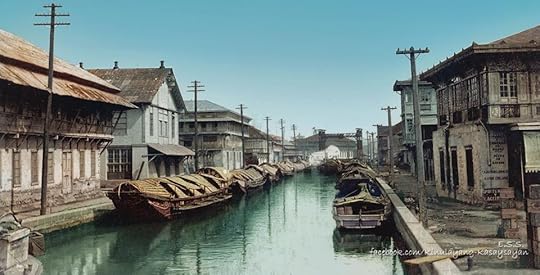
The Philippines has always bedazzled me. It’s the only hispanic country in Asia, which by itself is a rarity. When you look at the old photos you see hospitals, universities, churches, cathedrals, markets, streets and the like that are clearly not Chinese or Japanese or like any other country in the area. They have their own culture, their own fashion, their own cuisine. I had a Filipino English teacher and she said the lechón was a typical dish. Imagine my face when I knew they eat the food of Segovia.


(Metro station in Madrid)

The main part of the population is Catholic which by itself is shocking when we are speaking about Asia. My Philippine teacher herself was educated by nuns. She doesn’t speak Spanish but her grandpa was a Spaniard who married a Filipina. So I can kind of imagine that love story here.


I only know her but amongst my English-speaking teachers, she had the best accent, maybe only beaten by the Canadian one. Yes, I know I should not overgeneralize because I have only properly met one Filipina in my life but so far I can tell her accent is the easiest to understand in comparison to the Australian, American and English ones. By a long shot.

Here is what Spanish people know about Philippines, and that’s being generous. A while ago, an expedition paid by the Kingdom of Castile pushed Magallanes to achieve the first circumnavigation of the Earth. He died in the Philippines, so Elcano finished the task and reached the Iberian Peninsula (1522). Some decades later Legazpi came and founded Manila and Cebu. Then some centuries until the Spanish-American War and the Crisis of 1898.

That’s all.

Nothing about the Manila Galleon or the battles against the Japanese or the Dutch or the like.

So I try to know more and read everything I can find out there. Considering I read almost exclusively M/M, it wasn’t easy. But not impossible.

Unfortunately, I wasn’t wholly satisfied with the Spanish impression here. The problem I have with this book is not that there are inconsistent historical facts. I think the author did a hell of a job here. But I believe she’s “ignoring” the American presence in Philippines and outlining the Spanish details in a way I can’t consider entirely true and it's more negative than not. I don’t want to be skeptical, but when the Americans’ actions are so cool and the Spanish ones are so bad, it does not inspire trust. It’s like a bad guy versus a good buy and this dichotomy is not subtle.


I don’t want to give you a lecture but I don’t feel comfortable overlooking everything that rubbed me the wrong way. I’m giving you an out here.

Here there are some examples.

“He’d studied all the countries Spain had colonized for centuries, and the Philippines had invariably come up in their discussion.”

When Rome conquered Spain, Spain didn’t exist yet. It was a land full of Iberos and other tribes when the Celts invaded it. Then the Greek, Phoenician and Carthaginian came and established colonies in the coast. Then the Roman became powerful and coveted the land for her metals and people. The conquest lasted 2 centuries (219 BD -19AD, take that, Asterix and Obelix!) and they called that land “Hispania” (Spain+Portugal), and she became a province in the Roman Empire. This is what formed the “idea” of a nation when Hispania stopped being part of the Empire. Hispania stopped being part of Rome because in order to defend the Empire from the barbarians, they had to ask for help and give a part of it to the Centro European people. Meaning: Hispania was sold and invaded by the Sueves, Vandals and Alans. But then the Goths expelled them and ruled over it and it became a nation: Hispania. It didn’t last long as soon the Islam came.

Why is this so important? Philippines was named after King Phillip II. But before that? Using the same argument as with the Roman Empire: Spain ruled over lands that weren’t countries yet. Mexico didn’t exist and Phillippines didn’t exist. The same way USA began its existence after the Independence. The term “colony” is very popular in the English language: “the 13 American Colonies”. Spain never referred to the territories as the “colonies”, she was compounded by “viceroyalties” or “kingdoms”: Viceroyalty of New Spain, of Río de la Plata, of Perú, of New Granada… even Navarre and Naples and Portugal had viceroys. It means they had autonomy. Considering we are speaking about centuries ago. We can’t criticise past actions with the mentality we have nowadays. Civilization progresses at its own speed. Philippines, Puerto Rico and Cuba were captaincies general included in New Spain.


“The prevalent use of the Castilian language among the guest he’d met so far only confirmed the info he’d received when first landing on Philippine soil. The Spaniards still thought they were in charge. John figured that fantasy would have been obliterated by then, since they’d had given up the Philippines in 1898, but it seemed to be deeply rooted in Philippine culture.”
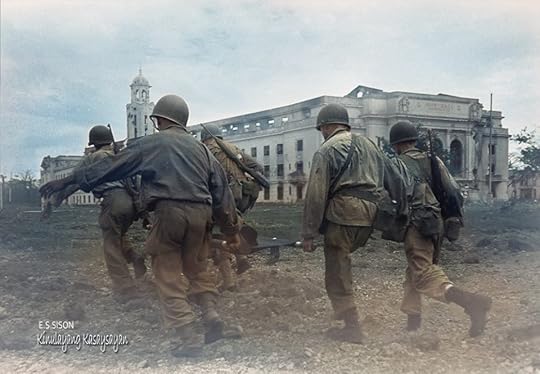

I’m going to avoid reading between lines: Spaniards are assholes.

Spain didn’t “give up” just like that. There was a war. The Spanish-American War. The old tired lion was no menace for a young eagle who would eventually become the first world power. The Conquest of the Wild West was done and the horizon was not definite yet. I won’t tell it here because this is not the place nor the time. I just want to say 1898 is a year most consider insignificant, but for Spain it was the “Disaster of ‘98” and it’s no coincidence we still use the popular saying “More was lost in Cuba”. It was indeed a turning point in Spain. There was an economic and social crisis and a literary movement called the “Generation of 98”. It was the year Spain become a third class power for good, the official year the Spanish Empire ended.

I wish Isaac Peral had been paid attention. A submarine or two would have come in handy then.

But what happened, happened.


Anyway, History is written by the victors and the Spanish Black Legend is still very alive.

“The Spaniards don’t consider me a part of their world, even though my father was pure Castilian”.


False, he was Basque, not Castilian. I honestly don’t understand this statement, it would be more logical to say he was Spanish, because Greg truly doesn’t know who his father was.

“And furthermore,” Greg blustered, “there are universities in Manila older than your famous Harvard. Did you know that?”

“No.”

“The University of Santo Tomás was founded in 1611. I believe Harvard wasn’t a thought until 1636.”
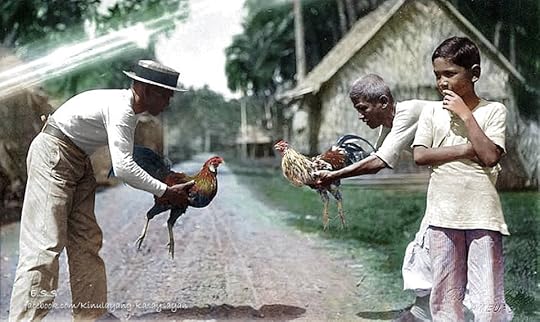

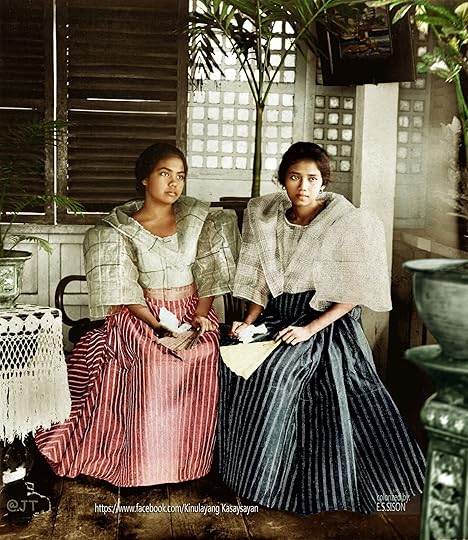
Why, universities? By the Spaniards? How do you dare?! Spaniards were fanatical people who were obsessed about enslaving and killing and getting all the gold they could! How can you say they had universities when Science and Arts were crushed under the Inquisition’s heel? And in Philippines, no less. Universities! You offend me! *snorts*

*ironic mode off*


There are lots of Spanish words included in the book. My Filipina teacher said they had lots of Spanish words in the Tagalog. Then we have the chavacano, which sounds like a very sweet Spanish and the written version is strange and familiar at the same time. But nowadays less than 3% of the population speaks chavacano (which is not small considering there are more than 100 million people in Philippines). Why is that?


Well, for starters, although the Spanish was the official language, it was never widespread throughout the Filipino population. It was of course spoken by the upper classes, mostly those who lived in the big cities, but also by the intellectuals and cultured people, those who had the means to pay for an education (this group didn’t necessarily include only those of European ancestry). It was by far less common in other classes and areas, which shouldn’t come as a surprise because there are more than 150 languages in the archipelago.

It’s also interesting to point out that many writers in Philippines wrote their works in Spanish, based on my research. The funny fact is that this “Golden Age” of Philippine literature was written in Spanish while and after she drifted apart from Spain, and even to talk about the independence and the nationalism. The first Philippine anthem was written in Spanish. Ironic, isn’t it?


Still, after the Philippine-American War, the Spanish language was forbidden in Philippines. Only English was allowed. The “Kill everyone over the age of ten” claimed many Spanish-speaking victims. Some of the works mentioned before were forbidden in Philippines and had to be published elsewhere. Lots of them were not even published but have been rotting in the oblivion ever since. Literally speaking, because in a country on which Mother Nature loves to download all her force, you can’t make light of it. Luckily, last time I checked, the Instituto Cervantes in Manila was beginning an operation to bring these works to the light.

But if language is not enough, we also have to take into consideration the WWII and the destruction of the cultural heritage and historical monuments of Manila, the place where the Spanish influence was stronger. Intramuros was demolished as a whole after the pattern bombing to kick the Japanese out, corpses included. Unfortunately, this massacre is even more unknown that that one in Leningrad/Saint Petersburg and Warsaw, but no less bloody and sad.


“Hordes of mosquitoes had also feasted on his tender flesh like cannibals. It was no wonder the Marines drummed in the importance of taking the tiny yellow pills to ward off malaria. The Atabrine tasted vile, but it actually kept the disease away, as did the mosquito nets when they had a chance to use them.”


This is a pity. This was a time when anti-malarial drugs were truly effective. In the 50s-60s there was an aggressive campaign run by the WHO whose objective was to erase the disease once and for all, the same way it was done with the smallpox, and the same way it’s being done with the polio. They were close to achieving it. But there were resistant strains that survived and the disease went out of hand again. The same with tuberculosis, one of the most widespread infectious diseases; it’s a real challenge figuring out how to control them.

References to nativity scenes, San Miguel beer, merienda, siesta… It could perfectly be Spain. Which makes me happy and nostalgic at the same time, with all those similarities.


“Greg was lucky his family had close ties to the Saenzes, and as such, he reaped some of the rewards of their wealth.”
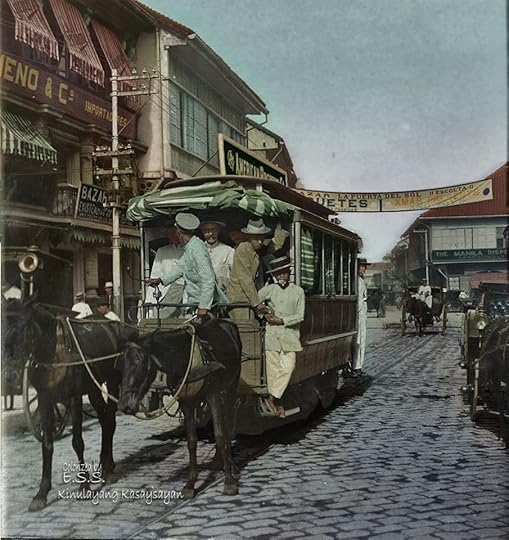

That “the Saenzes” sounds super weird. I know that in English it’s normal to use the plural that way, but in Spanish we would say “los Sáenz”, the article determining the plurality of the noun. I don’t know if in the Philippines it’s said like the Spanish version or the American one, though.

Sometimes, it felt an encyclopedia rather than a novel, with so many foods and customs and discussions now and then. I was interested in these details because it’s what makes this book different from the rest. But sometimes it dragged on.


Despite all of this, it was more or less bearable, because the love story is beautiful and lovely. With the added charm of it being forbidden in an exotic environment. So, as a whole, it was pleasant, if not truly poignant and captivating. I never had a rush to read the book but wasn’t repelled by it, either.

But then the shit hit the fan. And I was utterly upset.

There is a scene close to the end that seems taken from a soap opera. It’s like the Crowded Cabin scene from the Marx’ Brothers movie but with a drama queen-ish hint. Seriously.


It was a bit too much for my taste.

Then I put two and two together and realised something: the Spaniards were the bad guys. When you want to portray someone as nasty and despicable, you draw them as complete idiots or as ugly jerks. So I made my calculations:

Don Ignacio: an asshole.
Don Luis: an asshole.
Doña Carmen: a fat bitch.
Petunia: a fat bitch.

The only Spanish who deserved to be saved from being burnt alive was Daisy, who, by the way, was an airhead. And Lily, who was rather simple.

But the American? He’s perfect.

Americans win, Spaniards suck. Please, repeat. Americans win, Spaniards suck. Did you learnt it already or should I repeat it again?

Then the definite ending. It’s like... are you for real? Are you fooling me with this forced resolution of things? This too much, I can’t digest all this surreality. Perfect ending for John and Greg, it solves everything… Right?

I’m out.

So yes, I was a little annoyed by this and ended the book frustrated and a little offended, if you may.

It could have been marvelous, but it wasn’t. I guess I took it too personally, maybe I made a huge issue out of it. So please, don’t discard this book completely yet. But I can’t help my feelings in this.


*********


***Copy provided by the publisher in exchange for an honest review.***
Profile Image for Maya.
1,164 reviews34 followers
May 5, 2016
John Buchanan has just been discharged from the US Marines after serving his tour in 1940’s war-torn Philippines.  He has been approached by Don Ignacio Saenz, an extremely wealthy plantation owner, to become the manager of his vast plantation. Not certain that the job is for him, he agrees to work with the current overseer to decide if he will give it a try or if he will return to America. Had the war not interfered with his plans he would have graduated college with a degree in vulcanology and the opportunity to be so close to Mount Mayan is more than he can resist.

Don Ignacio Saenz sees more than a plantation manager when he looks at John, he sees a potential husband for any one of his six daughters. As an extremely wealthy man with no male heir, he is driven to get one of his daughter’s married as soon as possible so that she will produce a male heir for his vast fortune. Despite his wife’s disapproval, Ignacio makes sure that John is immediately immersed in his family life, surrounded by the daughters as much as possible.

Greg’s family has a long history with Ignacio, some of which is common knowledge and some of which is not. His grandfather was the Saenz family attorney and Greg has spent his entire life surrounded by the Saenz girls.  There are major class distinctions and so much racism and bigotry in the Philippine’s at this time. Greg has always felt like an outsider in his own country. His mother is native Filipino beauty and his father, who died before his birth, was a Spanish sea captain. Being of mixed race, Greg has not been fully accepted by either the Spanish or the Philipino’s.  Being replaced as plantation manager, a position he has held since the war broke out, is very upsetting to Greg but the fact the Don Ignacio hasn’t considered him a candidate to marry one of his daughters is extremely hurtful. He thinks of the girls as his sisters and doesn’t really want to marry any of them but he feels like the slight is because of his heritage. The fact that John is displacing Gregorio as plantation manager seems to be a callous decision but Ignacio believes he will now have the power to force Gregorio to go back to college and finish his law degree.  The family dynamics are complicated and full of deceit that has far reaching consequences.

John and Greg are absolutely stunning together. Their romance is fast and full of up’s and down’s. The fact that a same sex couple would be ostracized, or worse, is never far from their minds as they navigate their way to happiness.The attraction the men have for each other is palpable and they were absolutely smoking hot when they were together.  John has always wanted children and he vacillates between his desire for Greg and the possibility of having a child should he marry Don Ignacio's youngest daughter Daisy. His feelings for Greg are sincere and very strong but Daisy represents an easy way to have what he's always wanted. Love wins out and John and Greg do get their well deserved HEA, as unconventional as it may be.

This story is beautifully written. The historical setting was perfect. There is an entire cast of interesting and well drawn characters and there are a couple of plot lines outside of John and Greg’s romance that keep this book fresh and interesting. I am not a huge fan of historical novels and it is a testament to Ms. Ashling’s talent that I was unable to put this book down. My only niggle is that it felt like there was an information dump on a couple of subjects, particularly the food and coconut farming. It was a bit distracting for me at times and I found myself skimming some passages but it did not detract from my enjoyment of the story.

I found this to be a wonderfully written love story and easily recommend it to all.
Profile Image for John Inman.
Author 42 books442 followers
March 12, 2016
I really enjoyed this one. Mickie B. Ashling's MAYON, is a romantic, sweet, exciting love story that takes place in a world I was able to visit quite a bit when I was in the Navy. The Philippines. The story delivers a lot of the flavor of the Philippines and the author obviously knows the subject very well. Greg and John's love story is sexy and feels honest and true to life. The writing is excellent. Great cover art too. Perfect for the story.
Profile Image for multitaskingmomma.
1,359 reviews44 followers
February 24, 2016
Original Blog Post: Blog Tour, eARC Review, Excerpt, #Giveaway: Mayon by Mickie B. Ashling

Review by: multitaskingmomma
My Rating: 4.5 of 5 Stars

I read Mayon a few years back because the title lured me in. It's my country's most beautiful volcano with the almost perfect cone. It's on our stamps, on our tourism paraphernalia, it is a symbol of the country's people. That it's setting is a coconut plantation comes home to this reader.

Mickie B. Ashling wrote a story that is quite believable. Of John, an American, hired by the landowner to manage a huge hacienda and is faced with the difficult task of working with Filipino laborers and their unique psyche, as well as having to deal with an almost angry Gregorio, the overseer, who saw his opportunity for a better life threatened by the presence of the former Marine.

I didn't focus much on the romance that developed between the two men, my attention narrowing in on the authenticity of how the author portrayed the land and its peoples. I read was a beautiful, if not too realistic view of a country and how it used to be. The words spoken were not Googled and used in a way that clued me in, this author knew the language - well, at least the dialect of the region which is similar to mine.

Her portrayal of an American gringo hiding in the open with his Filipino lover is also quite realistic. John's decision in the end is the 'surprise' in quotation because I expected it to be. Take note, this is not a story that is fiction in nature and should be dismissed as fiction. These things happened and not imagined. They happened and continue to happen.

I loved reading Mayon. I truly did. For those who are curious of how it was and how it still can be, Ms Ashling succeeded in writing about a people, culture and country that I have not seem before coming from (sorry in advance to Mickie) a gringo.

Beautifully raw, sweet, real: Mayon.
Profile Image for Shannon.
2,163 reviews46 followers
June 9, 2016
Thinking this book is about a volcanic mountain expedition? It's so not! It's a romance that, yes, takes place in the 40's but reads a lot like a contemporary romance. It was wonderful. Really, really great. It's about an ex Marine and a Filipino/Spanish man trying to figure out love and being gay in a time when it was punishable by death but that's not giving it justice either. Basically, it is just a beautiful love story. (with great sex) Thanks for making me read it Jase!
Profile Image for Danielle  Gypsy Soul.
3,174 reviews81 followers
October 1, 2017
Although I enjoyed the setting there were just a few too many things that didn't work for me.

1) I didn't like the way John treated Gregorio (Greg) in a lot of the scenes - he seemed really dismissive towards him several times.

2) There were so many words that I didn't know the meaning of and had to keep going back to the beginning to look them up (which is a pain when reading an electronic book).

3) What was the deal with the author describing so many characters as fat (and then they all ended up being bad people)?

4) Towards the end it was a bit melodramatic. Lots of characters running back and forth between the homes either declaring their love or dropping some huge secret

5) The solution to the issue of them being together was a bit weird for me and a bit too convenient.
Profile Image for Daniel Mitton.
Author 3 books36 followers
February 23, 2016
(Originally reviewed for Love Bytes Reviews with a copy provided by the author / publisher for an honest review. Rated 4.5 out of 5.0 stars.)

I’m not a huge reader of historical fiction. But something about this blurb caught my eye when the book showed up on our available to read list at Love Bytes. So I grabbed it, and I’m glad I did.

The time is 1946. The place is the Philippines. The characters are one discharged American Marine, a pure-blood Spanish family, a mixed race young man, and his mother. The plot…a forbidden love between two men…amongst other storylines which I won’t mention.

John Buchanan has just been discharged from the United States Marines and has been offered a job…if he remains in the Philippines…as an overseer of a vast set of land holdings specializing in farming coconuts. The offer came from left field since John knows nothing about farming or coconuts. The offer has come from a man that John met while he was still in the military. That man, Ignacio Saenz, we meet in the prologue as a penniless young Spanish immigrant to the Philippines in 1921. In the story itself, it is now 25 years later and Ignacio is one of the wealthiest men in the country.

John has agreed to go to the property and view the various haciendas that make up the estate, but he doesn’t know until he gets there that he will be the replacement for the other young man who is currently doing the job! He also doesn’t realize that he is being set up to be a suitable “white” husband for one of Ignacio’s daughters! Mixed race marriages are not acceptable to the Spanish families in the Philippines at the time, and white men are scarce!

Gregorio Delgado is the same age as John, but of mixed racial background. His mother is a Filipino and his father was a Spaniard, who unfortunately died before Gregorio was born. Gregorio has been raised as almost a part of Saenz family, along with Ignacio’s six daughters. There is a background story as to why, which will blow the family apart when it is revealed. We, the readers, know the story for most of the book, and honestly, I kept expecting someone to guess it far before it was revealed, but sometimes you don’t notice something if you are too close to it I guess.

As you can imagine, Gregorio is less than happy about training his replacement, when he thought the job was his for life if he wanted it. There is some fairly heavy animosity between the two in the beginning, but things change when John and Gregorio leave on their extended visit to the outlying haciendas. Along the way they are forced to overnight in the wild and share their body heat like the men in the trenches did while John was in the military. Only difference, it turns out they both might be into other men…

What follows is a rich, sweeping story of two men finding themselves in a society and land where the thought of two men is forbidden. In 1946 homosexuality was forbidden everywhere. In the US sodomy was punishable by death or imprisonment. In the UK, imprisonment or chemical castration was the norm. Enlightened times for homosexuals were still decades away worldwide. Also remember, the Philippines was then, and is still now, a very strongly Catholic country. I liked how the author brought us these characters and showed us the difference between John’s fear of discovery and Greg’s much lower fear. John had witnessed a brutal attack on a homosexual man back in the States and was afraid of something similar if they were discovered. Greg was more naive.

This is the second edition of the book, the first having been published by Dreamspinner Press in 2012. I know that the prologue was added, giving background information on Ignacio, and I’m guessing there might have been some reworking on the Filipino language usage in the book as well, since I saw an older review that complained about having to flip back and forth to figure out what the words were. I didn’t have that issue. It seemed that for every Filipino word there was a translation. I was happy to see that. Honestly, I was really worried because there is a huge list of Filipino words at the beginning of the book and I thought I’d have to refer back.

I would definitely recommend this book for anyone looking for a historical type book, with an m/m theme that has enough sex to satisfy, without being on every other page. The landscapes and storylines were very well written, and I thoroughly enjoyed the book.
Profile Image for Jane Stewart.
2,462 reviews967 followers
August 28, 2015
2 ½ stars. This had so much potential. Parts were very good.

The relationship between two gay men was good. I’m relieved that the primary focus was not on hiding one’s gayness and being in the closet. That is so overdone in many gay male romances. Yes it was here, but it was secondary to other things. I liked the way the men desired each other. I liked the sex scenes. They were passionate, intense and not long.

I really liked the ending. It was a neat idea. I hadn’t read it before.

THE NEGATIVES:
I felt like the author was trying to teach me the Filipino language. Almost every page had a Filipino word. What was worse was that you had to flip to the beginning of the book to look up the word. It totally interrupted the flow of the story. If you have to use foreign words, put the meaning immediately after in parentheses. I was angry at all these words. When I read fiction, I’m not trying to learn a language. I want to escape and enjoy.

Too much of the story felt like a TOURIST GUIDE TO THE PHILIPPINES. Greg takes John on tours of the island describing the culture, the food, the dancing, the problems, the government, the coconut plantations and coconut products. Some of that was ok because it was done in story form: John vomiting after hearing what was in the food or his reaction to the cock fight. Most of the touristy stuff was ok, but some felt more educational than story-like. There was also John educating us on technical things about volcanoes. That got a little dry.

The main plot was Ignacio wanting to find husbands for his many daughters. Ignacio hires John to replace Greg who works for Ignacio. I would have liked more with those things and less of the tourist stuff.

I was skimming parts during the second half.

I received this book at the RT convention.

DATA:
Narrative mode: 3rd person. Story length: 254 pages. Swearing language: strong including religious swear words but not often used. Sexual language: moderate. Number of sex scenes: 15 mostly short. Setting: 1946 Philippines. Copyright: 2012. Genre: gay male romance.
Profile Image for Curtis.
988 reviews17 followers
February 27, 2016
It's the Philippines in 1946. John Buchanan, recently retired from the Marines, remains in the country to consider Ignacio Saenz's offer of a position overseeing his plantation. It's not something John would likely seek out under normal circumstances, but since the job would put him so close to Mount Mayon he can see it in the distance, he's willing to consider it. He's always had a fascination with volcanoes, so he's not sure he can pass up living so close to an active one. The current overseer, Gregorio Delgado, begrudgingly takes John out to see Mount Mayon. John quickly learns that Gregorio isn't leaving the plantation--Greg will be demoted if John steps into the role. John knows Ignacio is hoping to find a husband for one of his daughters, but he's not really bothered by Ignacio's ulterior motive. But when a spark of mutual attraction strikes on their campout near the volcano, Greg has a difficult time accepting any part of this new fate. And while John makes it clear to Greg the two of them can't have a future--society's just not ready for it--it turns out that there's no controlling an active volcano...when it erupts, it erupts.

Overall, this is an engaging and oddly romantic story. It's paced well, and I felt like the core relationships develop quite naturally. The cast of characters provide for some moments of comic relief against the backdrop of the broader drama. I was a bit bothered by the way John seemed to quickly dismiss Greg at times, though I felt there was some redemption as the story continued. Some situations seemed coincidentally a bit more convenient to furthering the plot than anything else, but nothing confused or derailed me during my reading. A nice historical romance.

[Disclaimer: I received a copy of this book from the publisher via NetGalley in exchange for an honest review.]
Profile Image for Rissa.
2,285 reviews3 followers
May 2, 2014
Oh my gosh! That was wonderful! I can't tell you how awesome that was to read a book about the Philippines! I freaking highlighted like crazy! The author KNEW what she was talking about. It was so on point, so perfect. It made me truly miss the country. This author showed the good and the bad of the country. And she did it right. This was a pleasure to read. I'm so glad I found this book! I hope this author will write about the Philippines again! ♥♥♥
My love for the book also includes the way the love story was portrayed. It wasn't all fantasy. I like how it was realistic and they knew what they were up against. It would be so great to see a glimpse of the future..... what happened next? I want to know what happens to their family! Kudos on a great story!
Profile Image for Shaz.
883 reviews130 followers
November 19, 2012
Not being a great fan of historicals I was slightly apprehensive about this book. Boy am I glad I read it though.

Mickie B. Ashling brings the post war setting in the Philippines to life. She immerses us in this world. You can hear the sounds, smell the coconuts and feel the breeze with her descriptions of this place and time.

Add to this the incredibly told story of love found in a time where a love like this is not only forbidden, but dangerous, and characters that grab hold of you and don't want to let go. Even the secondary characters add their threads to the oh, so rich tapestry that is this book.

Thank you Jason for encouraging me to read it!
516 reviews12 followers
November 23, 2012
Another excellent book from Mickie who again proves that she knows how to write.
I really enjoyed Mayon which is set in the Philippines at the end of WW2. The title of the book is taken from the volcano which dominates the landscape and, from the start, I was waiting for the explosion. There are explosions in Mayon but the book is so much more.
To me it is a book of discovery, of adventure and of love and I think that it is one which will appeal to a wide audience. I highly rrecommend it.
Profile Image for Gigi.
268 reviews
December 11, 2012
This was given to me by Goodreads First Reads. Thanks!

This was a light, enjoyable read that had a surprising amount of layers. Most 'pure' romance I've read is one dimensional in plot and only moves in one direction, whilst this book had lots going on and lots of stories to tell. The historical setting was nice, and the overall setting was well described, although sometimes I did have to remind myself that it was the 1940s, not the 21st century. The characters were strong enough to carry the story although I felt like John could've been fleshed out more especially in terms of his time in the army.

The romance was good but did lean towards instant love. All in all, the book covered 6 weeks and in the end the two men were fully committed to each other. It would've been nice to see the relationship on a broader sclae, as well as have more hardships (they never did stay angry at each other long). Then again, that steady romance was another thing that set this book apart from many of the other formulaic romances out there (meet, love, break up, get back together, get married). The romance was realistic until the end where, firstly, in the climax of the story, it felt like a soap opera with everyone going back and forth from rooms and houses and declaring love or telling huge secrets. It just felt a bit pantomine-ish. Then, we were given a very happy ending which seemed almost too idealistic for the times and for the issues brought up in the book previously. Some of the arcs were left unsolved and a few characters were dropped once they were deemed uneccessary but the book was about the romance between Greg and John and it followed through on that. The link between the volcano and the plot was also nice and I think the very last scene (not the epilouge) worked well.

One thing I did find very strange was the constant remarks about fat people and the over association of fat with evil/ bad/ immoral. If you want to write about it, go right ahead, but when you spend a large proportion of your story showing slim characters indulging in extreme-detailed described food (at least three times a chapter, I'd say) then condemning the fat characters eating in one scene, it just seems misplaced and hypocritical. It was just a bit of a random theme that the story kept going back to. At first I found it strange, by the fifth mention I was just laughing because it was such a weird thing to keep mentioning.

This book didn't wow me but I'll be the first to admit I'm not a big fan of pure romance. It was interesting, drew me in from the start and I had most of it finished in two days. All in all, a solid book with a good ending, a good plot and a good setting that will appeal to all fans of M/M romance.

Plot Rating: 7/10
Character Rating: 5/10
Style of Writing: 6/10

First 1/3: 7/10
Second 1/3: 7/10
Third 1/3: 6/10

MC Rating: 7/10
Scenery Rating: 8/10
Concept Rating: 6/10
Emotional Rating: 6/10

Overall Rating: 65/100

This entire review has been hidden because of spoilers.
Profile Image for Andrea.
979 reviews10 followers
December 20, 2012
4.25/5

I’ve described a lot of books as being well-written. Mayon is more than that, it’s great writing. The descriptions and imagery were fantastic. The natural beauty and generosity of the people was depicted so well that I was able to quickly connect and feel immersed in a foreign country and culture as they emerged from a devastating war.

John Buchanan is a newly discharged US Marine trying to figure out what to do with his life. He has been offered the position of plantation manager by a very wealthy man. He is also expected to marry one of the wealthy plantation owner’s daughters if he decides to take the job. John isn’t thrilled with the job or the daughters but the proximity to Mount Mayon may make it all worthwhile. He had been studying vulcanology before the war began and interrupted his studies, so for him this is the chance of a lifetime.

Gregorio Delgado (Greg) has grown up on the outskirts of the Saenz family. He has been a constant companion and friend to the Saenz girls all his life. Their father, Ignacio Saenz, took a special interest in Greg which has allowed him a lifestyle and education he would never have achieved otherwise. Greg has been managing the plantation on his own since the war broke out and is surprised by John’s sudden appearance. Greg is hurt and angry when he is told to give John, his replacement, a tour of the plantation and explain how the operation works.

What makes this book stand out is the development of every aspect of the story. It starts with the location and time. After that are all the different characters. There are complicated relationships within the Saenz family and some extend to Greg and his mother. The web of lies and mistrust amongst them runs just as deep as the love in some cases. John is thrown into the mess and given only a couple weeks to decide if these people are his future. I’m sure it sounds confusing but I promise you it all makes sense. The writing and character development are excellent!

As much as I enjoyed the family dynamics, they pale in comparison to the romance between Greg and John. They rightfully had a lot of fear and turmoil over loving another man in a time and place where that type of relationship would never be acceptable. It was the type of romance I love. They had to work, compromise, and sacrifice to get their dream. My only complaint is that all the pieces fell into place a little too perfectly and too predictably. I knew where everything was leading but I still enjoyed getting there. It’s a great book and I recommend it.
Profile Image for Jeannie Zelos.
2,852 reviews57 followers
February 24, 2016
Mayon,  Mickie B. Ashling

Review from Jeannie Zelos book reviews

Genre:  History

I was really looking forward to this read, with it being set back in the 1940’s where attitudes to Homosexuality were still very strong. I love books from a different time period, and those that involve other cultures.

 I didn’t really feel though that I got a proper sense of the country and its inhabitants, of the sisters, of John and Greg, and as it covers just a few weeks I was surprised at how John went from treating Greg as a quick fling to wanting to give up everything for him. It really was a complete swing in attitude and  I just can’t pinpoint where or why his attitude changed. I found him quite a selfish man, though I did understand his need for secrecy given the time period and what he’d seen happen to others. Greg was such a sweet guy, but threw his heart into John right from the start, but john never really seemed to consider Greg’s future, his feelings, the fact he was so open about wanting a life with John, yet he had other plans. Greg’s lived a pretty sheltered life, seems to just have his mum and the Saenz family, no other friends, and meeting john has thrown everything he knows upside down.

It was a kind of insta love on Greg’s side but I just felt John was hedging his bets, while still telling Greg he cared...The girls were a mix, from Ditzy Daisy to would be nun Prudence. We see lots of the countryside as Greg and  John go round visiting the estate, while he makes up his mind what to do, whether to take the job and with it the implied conditions of marrying one of the daughters but I didn't feel “there” the way I usually do with this sort of novel. I just felt like an onlooker, and in the same way I felt detached from John and Greg and their problems.

I did like the way the story wrapped up – cleverly done and I didn’t expect that :-) but overall it was a book I’m pleased I read, it had parts that I enjoyed but its not one I’d reread.

Stars: Three, an interesting read but a one off. .
 
ARC supplied by Netgalley and publishers for review purposes
Profile Image for Saarah Niña.
552 reviews23 followers
May 15, 2016
Love conquers all
A beautiful book zoning in on the message of 'love conquers all'. I never thought I'd enjoy it but it was a wonderful tale. Mayon follows the life of two young men: John, a volcano enthusiast and, Gregorio, an estate overseer. Their lives intertwine when Greg's boss, Ignacio, invites another man to 'take over his job'.

As you can imagine, the new arrival- John- is hated by Greg. But this doesn't last long....passion sets in. But homosexuality is stigmatized, there's no way that they could ever be....And Ignacio has other plans for John, involving his single daughters. Needless to say, they're all in quite a muddle. Greg can't grasp the seriousness of it, and his whole life is eventually thrown off course, why is Ignacio against the idea of him being his son in law? Why is Ignacio so willing to accept a strange foreigner into their family? Why is society so set in its ways against homosexuality? Why so backward? Who is he really?

I enjoyed the tale, I appreciated how it didn't focus on self acceptance, the men had that covered, rather it was about social acceptance. There was none of that denial, they both knew what they wanted. It was a strongly written novel, and there was no way anyone could be bogged down by the historical context of it.

What I didn't like so much was the constant love-making, I can tolerate it, sure, but......I much preferred their classic witty dialogue and the drama of the tale. But that's just me.

I received this through NetGalley.
Profile Image for Zenharley.
30 reviews2 followers
Read
December 30, 2012
12/29/12 update: never got back to this one, so will have to stay with the DNF.

Previously...

Only about 25 percent in, so the jury is still out on this one, but it's leaning toward a DNF for me. It's not a wall-banger by any means -- the unusual setting and timeframe is a nice change of pace, and the writing is mostly solid (aside from lots of head-hopping and some info-dumping) -- but neither the characters nor the storyline have caught my interest enough at this point to make me want to take the time to finish. YMMV -- This one just may not be my cup of tea..
Profile Image for Anya.
1,182 reviews61 followers
Want to read
November 12, 2012
I'm not into M|M books as in I haven't read a single one at all but I'm willing to give this book a try also with the story being set in the Philippines, this book got me curious..
Displaying 1 - 21 of 21 reviews

Can't find what you're looking for?

Get help and learn more about the design.