Penguin presents the audiobook edition of Pig by Roald Dahl, read by Stephanie Beacham.
In Pig, Roald Dahl tells a sinister story about the darker side of human nature. Here, a boy who grows into an accomplished cook goes in search of a final, elusive recipe . . .
Pig is taken from the short story collection Kiss Kiss, which includes ten other devious and shocking stories, featuring the wife who pawns the mink coat from her lover with unexpected results; the priceless piece of furniture that is the subject of a deceitful bargain; a wronged woman taking revenge on her dead husband, and others.
Roald Dahl was a beloved British author, poet, screenwriter, and wartime fighter pilot, best known for his enchanting and often darkly humorous children's books that have captivated generations of readers around the world. Born in Llandaff, Wales, to Norwegian parents, Dahl led a life marked by adventure, tragedy, creativity, and enduring literary success. His vivid imagination and distinctive storytelling style have made him one of the most celebrated children's authors in modern literature. Before becoming a writer, Dahl lived a life filled with excitement and hardship. He served as a Royal Air Force pilot during World War II, surviving a near-fatal crash in the Libyan desert. His wartime experiences and travels deeply influenced his storytelling, often infusing his works with a sense of danger, resilience, and the triumph of the underdog. After the war, he began writing for both adults and children, showing a rare versatility that spanned genres and age groups. Dahl's children's books are known for their playful use of language, unforgettable characters, and a deep sense of justice, often pitting clever children against cruel or foolish adults. Some of his most iconic titles include Charlie and the Chocolate Factory, Matilda, The BFG, James and the Giant Peach, Fantastic Mr Fox, and The Witches. These works are filled with fantastical elements and moral undertones, empowering young readers to challenge authority, think independently, and believe in the impossible. Equally acclaimed for his work for adults, Dahl wrote numerous short stories characterized by their macabre twists and dark humor. His stories were frequently published in magazines such as The New Yorker and later compiled into bestselling collections like Someone Like You and Kiss Kiss. He also wrote screenplays, including the James Bond film You Only Live Twice and the adaptation of Ian Fleming's Chitty Chitty Bang Bang. Despite his literary success, Dahl was a complex and sometimes controversial figure, known for his strong opinions and difficult personality. Nonetheless, his books continue to be treasured for their wit, originality, and the sense of wonder they inspire. Many of his stories have been adapted into successful films, stage plays, and television specials, further cementing his legacy. Dahl's impact on children's literature is immeasurable. His ability to connect with young readers through a mix of irreverence, heart, and imagination has made his stories timeless. Even after his death, his books remain in print and continue to be read by millions of children worldwide. His writing not only entertains but also encourages curiosity, courage, and compassion. Roald Dahl's work lives on as a testament to the power of storytelling and the magic of a truly original voice. He remains a towering figure in literature whose creations continue to spark joy, mischief, and inspiration across generations.
Oh damn. This was sad and sinister at the same time. That poor Lexington... I guess bad things sometimes happen to good people when they are naïve and let people take advantage of them.
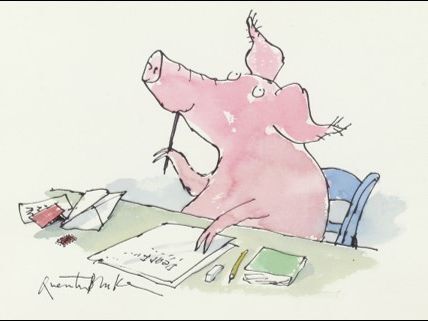
In England once there lived a big And wonderfully clever pig. To everybody it was plain That Piggy had a massive brain. He worked out sums inside his head, There was no book he hadn’t read, He knew what made an airplane fly, He knew how engines worked and why. He knew all this, but in the end One question drove him round the bend: He simply couldn’t puzzle out What LIFE was really all about. What was the reason for his birth? Why was he placed upon this earth? His giant brain went round and round. Alas, no answer could be found, Till suddenly one wondrous night, All in a flash, he saw the light. He jumped up like a ballet dancer And yelled, “By gum, I’ve got the answer!” “They want my bacon slice by slice “To sell at a tremendous price! “They want my tender juicy chops “To put in all the butchers’ shops! “They want my pork to make a roast “And that’s the part’ll cost the most! “They want my sausages in strings! “They even want my chitterlings! “The butcher’s shop! The carving knife! “That is the reason for my life!” Such thoughts as these are not designed To give a pig great peace of mind. Next morning, in comes Farmer Bland, A pail of pigswill in his hand, And Piggy with a mighty roar, Bashes the farmer to the floor . . . Now comes the rather grizzly bit So let’s not make too much of it, Except that you must understand That Piggy did eat Farmer Bland, He ate him up from head to toe, Chewing the pieces nice and slow. It took an hour to reach the feet, Because there was so much to eat, And when he’d finished, Pig, of course, Felt absolutely no remorse. Slowly he scratched his brainy head And with a little smile, he said, “I had a fairly powerful hunch “That he might have me for his lunch. “And so, because I feared the worst, “I thought I’d better eat him first.”
Pig is a short story about a child named Lexington whose parents die in an unfortunate police encounter while sneaking into their own house...for fun. Needless to say, Lexington has it bad and the Ending to this short story is twisted at best. I kept googling the fuckin' meaning of that ending for an hour after this ten minute read. Without revealing the plot and that ending I would like to pave my way into the text of this book and say that the main theme of this book is naivety and how it isn't good for anyone (Poor Lexington.) No matter how precious. .
Damn. I mean damn. What the hell. Here I was thinking that Mr.Dahl only wrote books for kids. I’ve been a vegan now for fives years but if I had read this as a kid then I am sure that duration would be far longer. A lot of the reviews on GR focus on the horrifying ending but little focus is put on how poor Lexington was also financially exploited by the greedy lawyer
Again a great story with a very sad end. I found the end very sinister and I really had to think about the end. Yeah, I got it finally. I give this story a 4.
Spoilers. Notes I’ve taken from this: -Hiding your children from too much can leave them naive and vulnerable. -People are greedy, gluttonous and will use and abuse the innocent -If the ending makes you uncomfortable, why is it okay for an innocent animal to endure same ending?
Loved it!
This entire review has been hidden because of spoilers.
I remember this being read aloud, in a Vegatarian dorm, by a group of impressionable youths who only knew Dahl from Charlie and the Chocolate Factory. This was my first experience with Dahl as an adult ( I wasn't quite an adult, but he was) and I will never forget it.
What a fist into the stomach! Dahl is not kind but he sure knows how to write. My kind of genius. Ok, my alternative interpretation for the moral message: If you don't eat the pig, you are the pig. You will be eaten. This world is cruel and unforgiving. Any minor stupidity or naiveness will be punished inevitably. The parents of Lexington fooled around and they were punished right on the scene. The aunt was sweet but she kept the child far too ignorant of the wild world outside. Naturally, the weak, stupid or naive will be hunted. Lexington was raised armless, he didnt know evil, he couldnt recognize it and he couldnt defend himself as a result. He was exploited first by the greedy lawyer, which happens to be Jew (free Palestine by the way) then the sullen waiter then after his money was looted, his flesh would be looted. The cold blooded irony with which this story was written tells me Roald Dahl was feeling sorry for the naive and it hurt him so much, in order to cope with the merciless order of the world, he turned to bitter irony and tries to pacifize anger and desperation by mocking the victim. You cannot fool us Mr Dahl, we know you have a tender heart and try to conceal it.
A short story about an unlucky child whose life was veiled in misfortune only 12 days into life, becoming an orphan and unwanted by everyone, an old aunt volunteered to take him in, and raised him under her own wishes and personal beliefs, isolation from the world instead of teaching him about life. Being his only guidance, once his aunt passed away, the boy found himself thrown into the outside world, a world where innocent and poorly informed people like him find themselves in perilous situations among human monsters who use them and even endanger them. The pig for me resembles a metaphor said by Prfs Severus Snape:" You have been rising like a pig for slaughter" The boy is the big, he was raised with no knowledge of life, relying on his aunt and seeing the world based on her own insights, without being given a chance to experience anything except things she allowed and suggested to him.
This entire review has been hidden because of spoilers.
I'm just emphasizing what everybody has said here, but the overall story was quite hideous, sinister, yet hilarious. Initially, I had to read this for my SAT class(which was dreadful), I quickly became fascinated with the story. I think the way Roald Dahl utilizes language and dialogue in this short story has successfully incorporated some humorous elements to emphasize the menacing aspect of society. I especially loved the ending since it showed how naivety and eagerness can harm you in some ways. Additionally, I loved the way Roald Dahl reflected the state of society at the time, and even though I disliked the image that Roald Dahl built for Lexington, which seems unrealistic for me at times, the execution was amazing and I would recommend it to everyone because it's a short yet meaningful piece of work.
Roald Dahl books bring back so many memories for me growing up. I was in the Infants (age 9 ish is it in U.K.?) and I remember my teacher, I can still see him in my minds eye. Oval sort of face, thinning ginger hair and a beard and moustache. His voices when enacting Roald Dahl books were mesmerising and to this day it’s a solid childhood delight.
This one I hadn’t heard of so saw it on Borrowbox on audio so I requested and listened.
It’s sinister, sad and quite different to stories I remember. Very good though.
Esse conto começa como um conto de fadas, literalmente com um "Era uma vez" para nos apresentar a Lexington, um órfão criado pela tia depois do trágico fim de seus pais. Mas, como acontece em contos de Roald Dahl, o esperado final feliz não vem. Num misto de conveniência e superproteção, Lexington é criado isolado do mundo por essa tia, o que faz dele uma pessoa inocente e que não só desconhece os trambiques do mundo -- caindo em vários no decorrer do conto, desde a herança que (não) recebe, até as informações sobre a comida no restaurante -- como acredita na boa vontade de todos com quem interage. O ápice dessa inocência é seu vegetarianismo. Para a tia Glosspan, não comer carne não é só dieta: é um ato político individual de ética e compaixão, um protesto contra a crueldade; em Lexington -- herdeiro do movimento sem a consciência crítica -- o vegetarianismo é apenas inocente e cego politicamente e se torna o estopim de seu fim. Na impossibilidade de conciliar dois entendimentos tão opostos -- a origem da comida com a opinião da tia -- Lexington vira vítima do sistema que não só ignora a inocência, a devora com gosto.
Affectively dramatic ending. "Pigs with white gloves." I am stuck with this reverberating metaphor in my head and I guess it won't go away as long as I keep eating meat, and even after.
This entire review has been hidden because of spoilers.
The story conveys the darker side of the human nature. It extracts a deep meaning that how innocent beings like pigs and Lexinton in this world are killed.