A True Story of Nazi Plunder and the Race to Recover the Crown Jewels of the Holy Roman Empire
Had Hitler succeeded in conquering Europe, he would have crowned himself Holy Roman Emperor. The Nazis had in their possession priceless artifacts that would give Hitler legitimacy in his subjects' the Crown Jewels of the Holy Roman Empire, including the Spear of Destiny, alleged to have pierced Christ's side at the Crucifixion. Looted from the royal treasury in Vienna, Austria, the Crown Jewels were hidden in a secret bunker deep beneath Nrnberg castle, known to few but Heinrich Himmler, his staff, and a captured German soldier whose family lived above it.
As luck would have it, the officer in charge of interrogating the soldier was First Lieutenant Walter Horn, art history professor. Following his report to General Patton, Horn would be assigned to recover this ancient treasure. Would he find it before covert Nazi agents could use it to revive the defeated regime?
>Based on recently discovered and previously unpublished documents and interviews with all remaining living participants, this is a tale that surpasses part thriller, part detective story, all true.
Books and book publishing have long been an important part of life in the Kirkpatrick family. My grandfather and namesake was a senior editor at McGraw-Hill for thirty-five years. My mother, Audrey Kirkpatrick, was a short story writer, and studied under Vladimir Nabokov at Cornell University. Katherine Kirkpatrick, my younger sister, is a former book editor at Macmillan and the author of five historical novels. My older sister, Jennifer Kirkpatrick was a writer and researcher for National Geographic.
I was born in Glen Cove, New York, on October 4, 1955, and grew up in Stony Brook, on the north shore of Long Island. While attending the Kent School, in Kent, Connecticut, I won writing awards for poetry and journalism. Throughout my high-school years, and during college, I wrote several hundred articles for Long Island newspapers and became a stringer for Associated Press.
At Hampshire College, in Amherst, Massachusetts, I majored in Chinese language and history. After graduation in 1978, I lived in Hong Kong, Taiwan, and Japan, where I taught ESL, directed and produced a short television documentary, and acted in two low-budget action films.
I completed my education in 1982 with an MFA from New York University’s Tisch School of the Arts, where I worked on several short films with classmates Spike Lee and Ang Lee, and optioned my first screenplay. While attending NYU, I wrote and directed "My Father The President" which won the 1982 American Film Festival and a CINE Golden Eagle. This film has since become a perennial favorite at over 1000 schools, libraries and museums across the country, and can be seen daily at the Theodore Roosevelt Birthplace at 28 East 20th Street, in New York City, and a the Sagamore Hill National Historical Site in Oyster Bay, New York.
The success of "My Father The President" caught the attention of film director Harrison Engle, who hired me to associate-produce a two hour television special, "The Indomitable Theodore Roosevelt," which starred George C. Scott. This film premiered on CBS in 1984, won a prestigious CINE Golden Eagle, and was nominated for an Emmy.
I moved to Los Angeles in 1982 and continued working with Harrison Engle, with whom I produced several short films for the Television Academy Hall of Fame, which included film biographies of Milton Berle, Norman Lear, Edward R. Murrow, and Lucille Ball.
The inspiration for my first book came in 1983, while I was collecting material at the Directors Guild of America for a film tribute to King Vidor, the legendary director of over seventy-six motion pictures. In the midst of organizing Vidor’s papers, I came across a locked strong-box containing the details of Vidor’s investigation of the 1922 murder of director William Desmond Taylor. Biographers A. Scott Berg and Edmund Morris were instrumental in helping me to obtain a publishing contract with E.P. Dutton. "A Cast of Killers," released in 1986, was on the best-sellers list for sixteen weeks, and was hailed as “mesmerizing” by author Anne Rice in a featured review for the New York Times Book Review.
After writing “A Cast of Killers,” I worked at Paramount Studios with screenwriter Robert Towne. Another screenwriter I worked with was Larry Ferguson, with whom I developed an action and adventure screenplay, “One Deadly Summer.” This film project, based on the true story of marine scientist Richard Novak’s one man war against Medellin drug lord Carlos Lehder, was optioned for actor Harrison Ford by Cinergi Films. Later retitled “Turning The Tide,” and co-written with author Peter Abrahams, it was published by Dutton in 1991 and excerpted by Readers Digest in 1992.
Research on my third book, "Lords of Sipán," was begun in 1991 in a small village on the north coast of Peru where I traced the contents of a looted pre-Inca tomb as it entered the black market in stolen antiquities. From Peru I traced the artifacts to London, New York, Beverly Hills, and
I'd recommend this book to anyone who is interested in Nazis and the Occult. Hitler's fascination with "The Spear of Destiny" has been exploited by various books and movies, but to my knowledge the story of the concealment of the Crown Jewels of the Holy Roman Empire--in what appears to have been an attempt to establish the foundations for a Fourth Reich--has never before been told. Perhaps this is because the two Americans directly responsible for their recovery were native German expatriates--Lieutenant Horn, an art historian and son of a Lutheran pastor, and Rosenthal, a Jewish intelligence officer whose family died in Dachau.
In the course of presenting the background for the solution of this mystery, Kirkpatrick gives an excellent overview of Hitler and Himmler's connections to the occult and demonstrates the crucial importance of Nurnberg in the creation of a thousand year empire. In addition, this book gives us a realistic look at the supremely difficult, haphazard and often corrupt bureaucracy of the American occupying forces in the first days after the end of the war.
Kirkpatrick takes a fascinating subject and turns it into thick boring paragraphs of information without almost any dialogue. 99% of speech in this book is told by narration. What is the point of making a novel out of this research if you have no events and no rhythm ? This is a long article trying to have plot, only trying in the laziest possible way. You can *feel* the documentation, and I do not mean that as a compliment. The book feels way too much like research itself, not research backing good story. You can't engage in a story when the book is organized by theme instead of events. At some point, we have 3 chapters in a row of the same person "talking" (more like a description of someone talking) with no interruption. Exemple: Troche takes Horn there, 20 pages description about how he explains this. New chapter. Troche takes Horn two doors further. 15 pages description about how he explains that, and so on...
The interrogations which usually provide the investigation thrill, are clumsy and unrealistic. This overuse of narration gives a definitive feel to any information we get, even from an unreliable character, stripping the statements, testimony changes and major revelations of their weight. In the end, we just don't care.
Backcover says: "It's like Da Vinci Code, except everything is true" And with even less skill. Dan Brown is far from being a great author, but he knows how to pull off an exciting chapter. This would have made a great History magazine. Instead, it is an awfully flawed novel. There is no emotion, no life. Horn is barely alive in this. When he enters the Nuremberg vault, he seriously describes the way the floor is made BEFORE the treasures lying on it. This should have been a powerful moment for the art lover and connoisseur he is, but nothing. Just facts and descriptions. Same thing when he finally finds the relics.
Worst of all are the moments when the author suddenly wakes up and attempts to describe how Horn feels. I don't want to sit through terrible prose of made up emotions running through a character who does not speak. It is not enough made up to feel real. The very rare moments where the author had to fill the blanks are way too obvious and awkward. It results in dialogs lacking credibility and characterization.
We do learn a lot and it is unquestionably a captivating subject. So this had to be really poorly executed to feel so much like work. Besides, such heavy research is occasionally stained with outrageous mistakes like:
"Zeus, the god of war"
Are you serious ?! Or:
" It was as if the Knights of the Round Table had returned to Avalon, and King Arthur, or his evil twin, accompanied by Merlin— which was how Himmler must have viewed himself- strode into Camelot wearing Excalibur"
The knights should return *from* Avalon *to* Camelot. Avalon is the island where Arthur is taken when he dies. The fact that the author places Camelot on it makes me wander about similar shortcuts I may have failed to pick up throughout the book and assimilated as truth.
An engrossing book about the post-war search for art treasure pilfered by the Nazis. I had already read The Monuments Men which was also excellent and covered somewhat the same topic. But this book concentrates on one particular treasure that the Nazi's considered sacred, the crown jewels of the Holy Roman Empire. Hitler saw himself as the rightful owner of these artifacts as he felt they represented the validity of the Third Reich as rulers of the world. They had been housed in a bunker in Nuremberg but disappeared shortly before the occupation by the Allies. One man, a scholar of ancient history, was given the responsibility of finding them with little to no clues as to where they were.
The author delves into the mystical side of the Nazi party and the relics of the past which were felt would protect the Reich for 1,000 years. There is much information here that will fascinate the reader and help make some sense out of the Aryan myth. A great read and highly recommended.
blurb from book depository: Had Hitler succeeded in conquering Europe, he would have crowned himself Holy Roman Emperor. The Nazis had in their possession priceless artefacts that would give Hitler legitimacy in his subjects' eyes: the Crown Jewels of the Holy Roman Empire including the Spear of Destiny, alleged to have pierced Christ's side at the Crucifixion. Looted from the royal treasury in Vienna, Austria, the Crown Jewels were hidden in a secret bunker deep beneath Nurnberg castle, known to few but Heinrich Himmler, his staff - and a captured German soldier whose family lived above it. As luck would have it, the officer in charge of interrogating the soldier was First Lieutenant Walter Horn, art history professor. Following his report to General Patton, Horn would be assigned to recover this ancient treasure. Would he find it before covert Nazi agents could use it to revive the defeated regime? Based on recently discovered and previously unpublished documents and interviews with all remaining living participants, this is a tale that surpasses fiction: part thriller, part detective story, all true.
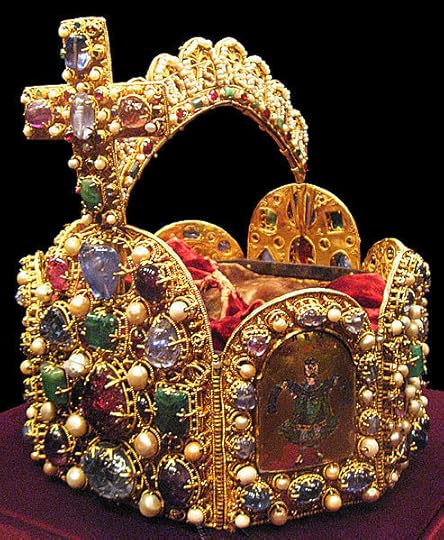
The Holy Roman Empire regalia were normally kept in Nuremberg, and a smaller part in Aachen. However, with the advance of the French in the French Revolutionary Wars, they were taken away in 1796 and brought to Vienna for safety. They have remained in the Schatzkammer ever since, even after the dissolution of the Holy Roman Empire in 1806. The cities of Aachen and Nuremberg tried many times, unsuccessfully, to reclaim the regalia. The regalia briefly left Vienna after the so-called "Anschluss", when Hitler had them sent to Nuremberg in 1938. After the war, in an adventurous story, they were found by American troops in a bunker and eventually returned in 1946.
The regalia are made up of many pieces, some of which are more than a thousand years old. It is one of the most important and complete collections of medieval royal regalia. Some of the most important items are listed below:
Who hasn't wondered why Hitler had such a strong yearning for these objects whilst patently being anti-established church (raping of nuns, destruction of churches). I won't spoil anything except to say Christ on the Cross was within 1st Reich and Hitler was squirreling away stuff for the formation of the 4th Reich where he would get to swan around in capes, crowns and highly dodgy fascist architecture, lording it over a beaten humanity. Proof is there that the Catholic Church was aware and helped in many ways, not least by facilitating the members of Odessa to escape. *shudder*
Still can't get my head around how one person would wish to destroy (and in some cases nearly succeeded) so much of the population of the only known inhabited planet in the whole universe just to play dress up to a ferociously diminished audience.
I’m at a bit of a loss as to what this book was trying to do. Kirkpatrick takes an interesting if uneventful event in the life of Walter Horn, a soldier known for his recovery of numerous important art and historical objects at the end of World War II, and somehow turns it into a rambling, dull narrative with pretentions of being an Indiana Jones adventure. Kirkpatrick begins by taking a single event in Walter Horn’s life, his recovery of the regalia of the Holy Roman Empire from Nurnberg. Under the city, there was a vault where the objects were supposed to be, but they had been moved. Horn does a lot of racing around and giving long lectures to people before finally leaning on the right person a little and that person tells him where the objects are. He then finds them. It is an interesting, if straightforward, tale that certainly deserves to be told, perhaps as a chapter in a larger book. Kirkpatrick tries to turn Horn into some dashing scholar-hero (which he was to some extent) but the way everything he does is shown to be upstanding and honorable becomes a farce. Presumably everything actually happened—but from divorcing his wife in a polite and civil way in the midst of this adventure to rescuing his German relatives by bribing some Soviets, driving them to safety, and not mentioning that they helped the Nazis even though he’s thinking it very, very hard during a family dinner, it all gets to be a bit much. Add to this that Kirkpatrick goes far beyond the expected level of recreating dialogue and such in this work, and you start wondering if you’re reading a novelization based on facts. However, what really makes this a tough read is that the author has decided a certain amount of historical, cultural and theological background is needed to understand the story (is it interesting, certainly in an academic sense, is it necessary to understand Horn’s search, not really) and delivers it not by including a few chapters of background material inserted at the appropriate points, but by having Horn give long lectures to every person he meets about topics they have no reason to learn about for the benefit to the reader. Kirkpatrick spends most of the second half flirting with conspiracy theory territory, seeing spears everywhere, and following Horn on a visit to a Nazi gathering place apparently to explain to us that 1. Concentration and Labor camps are wrong and 2. Nazis are creepy. I never would have figured this out without Kirkpatrick’s help.
As a chapter or two in a larger biography of Horn, or perhaps in a book about Nazi symbolism, this would have worked great. As a stand along book, I wasn’t impressed. There are certainly some interesting points to be made, but I’m sure there are other books that do this in a better manner.
I'm sure this book deserves four stars. I am. But since I listened to it while driving to visit the grandchildren I have gaps that make it hard for me to thoroughly sum up. I have long known that listening is not my primary learning style and every time I listen to a book on CD this sad fact is confirmed. If I'm listening to a book while riding as passenger in the car this is especially true. Allow me to ramble a bit.
When I was a little girl my grandmother lived over or, rather, along the river and through the woods next to the ocean. The roads were twisty and winding and we children were wedged in the back seat, plagued with motion sickness. I only remember actually heaving once but I remember many hours of feeling like I was going to blow chips as we slowly wound our way up (down?) the Columbia River to Grandma's house. I can also remember setting out from Grandma's to visit various points of interest and picnic spots, traveling, always wedged in the back seat, over yet even more twisty roads for what seemed like great distances, feeling queasy every minute of the way. I was completely astounded as an adult to discover these beauty spots were for the most part a mere 20 minutes from Grandma's driveway but back to my trip down memory's twisty lane. I clearly remember one particular trip, wedged in the back seat between my teenaged aunt and uncle. I must have looked green, utterly miserable and about to puke because my uncle told me that if I could close my eyes and fall asleep I wouldn't feel sick and when I woke up we would be there. This became my de facto survival tactic and though I haven't been car sick for 30 years (and really, that was morning sickness) it has never failed me yet.
So, I get in the car, get comfy and out of habit and for self defense purposes, my head starts to nod, my eyelids drift south at an amazing pace. Which makes it even harder than usual to follow a book on tape. If somehow I'm not actually sleeping my mind will grasp on some arcane point, say celtic runes, and begin a merry wander through J.R.R. Tolkien's works and onto that weird kid in high school who developed his own elvish tongue and set of runes and wrote in green ink whenever he could get away with it ... until I suddenly realize that the author has moved on a page or two or chapter ago.
What I'm saying here is, I missed bits. And it's not the author or the narrator's fault. It's me. Sad but true. I am sure this was a very engrossing tale of real life detective work and treasure hunting and filled readers and listeners in on lots and lots of interesting (and horrifying) bits of information regarding Hitler's fascination with the occult and building himself a nice justification for his actions based on myth, legend and history. I'm sure because the parts I heard, really, most of the book, were just that, interesting and fascinating. And because my husband said so and since it kept him awake for the whole drive, I'm gonna go with that.
This is a fascinating and very readable account of the survival of the crown jewels of the Holy Roman Empire. But the really interesting aspects of the story are barely touched - like General Patton's intention to them back to the USA as 'spoils of war' to decorate some monument - presumably to him; or how the return of the regalia to Austria was an early but significant transformation of Austria into Hitler's first victim rather then enthusiastic collaborator.
It is the emphasis, not the facts that are at fault and thus we here a great about the 'holy lance' which supposedly had pierced Christ's side an d Himmler was obsessed with - but then Himmler was obsessed with many stupid things and Hitler took no interest in them. We don't learn anything about some of the other more marvellous objects - nor the complicated history of the regalia - a brief examination actually makes their 'home' in Vienna very dubious. The Hapsburgs were Holy Roman Emperors but an awful lot of the Hapsburg lands were never within the Holy Roman Empire and a good argument exists that they belonged in Germany rather than Austria.
Nothing wrong with the book just remember that it is not even popular history - it journalism.
Kyle: All right, let’s see. Milk, eggs. Cookies. More cook- whoa, am I having a flashback?
[The supermarket is washed away by visual wavy lines, resettling into the remains of what appears to be a café in a war-ravaged city.]
Kyle: If this is happening because Neil Gaiman is attempting to capitalize on another obscure mythical being, so help me –
Sidney: Hello. Or should I say, guten tag?
Kyle: Oh! Sidney. What’s going on? Where are we?
[He sits and begins munching on leftover cookies on the table.]
Sidney: We are in Germany, but the when is important as well. It is, in fact, the summer of 1945.
Kyle: I am not a huge fan of the mixing of this place with that year, either in reality or in weird literary daydreams.
Sidney: Never fear, we are perfectly safe. You are just here as a byproduct of my uncanny ability to make factual surroundings seem intense and alive.
Kyle: Well, it’s not the war that I’m afraid of. It’s just that…well, how do I say this? Books about American heroes in this period seem to either read like textbooks or ridiculous propaganda. How in the world did you manage to find a middle ground, especially in a story about the theft of art and relics?
Sidney: I don’t know what you’re talking about. I simply wrote what was there.
Kyle: Yeah, but you wrote it so well! Over and over, I kept thinking, “I can’t believe I am so involved in the non-fiction story about recovering lost relics.” There were so many opportunities for this work to utterly derail into minutia about history or unrelenting apologizing for one of the worst atrocities known to mankind, but you really stuck to your target beautifully.
Sidney: As you may read about me on my page or even on the blog I created for this work, history is important to keep accurately. The story was just too important to let it be bogged down with anything else. I tried to keep things professional, as you might notice. If nothing else, my book jacket photo ought to have told you that.
Kyle: It did, and more. I felt like I was right in the middle of Lt. Horn’s investigation, picking up clues and trying to figure it out along with him. Really, the fascinating thing was knowing what I’ve learned in history and comparing it to what was going on – this really was a completely different take on what followed the war than I’ve seen before. Where I felt you really felt like you went the extra mile was in characterization. I know you had to pull it all from correspondence, interviews, and reports. It was a ton of work, I’m sure, but you built each person into incredibly complex people, with wants and problems – completely more interesting than any fictional soldier I’ve ever read. Many times, I’d think, “Wow, it’s weird that he’d include that,” about a revelation of a character, but then later, I’d be grateful for how well I could understand his motives.
Sidney: Peter Graves can eat his heart out. What you see in movies and TV isn’t always accurate. These were real people, and had more to them than just a 30-second backstory about a wife waiting at home and such and oh yes, perhaps they have a drinking problem, or maybe play the trombone or something.
Kyle: And their interactions were ridiculously interesting. It is pretty obvious that you know your way around a scene, and have worked with screenwriters in the past. I know you had to reconstruct a lot from reports, but even those notes brought so much life to the story I couldn’t believe it. In fact, my only gripe with the storytelling came at the few points where it seemed like the reports contained a really compelling narrative and you knew it, and I knew it, but there was just no way to really bring it together except for having been there.
Sidney: There were definitely points that could’ve been strengthened by being a little more creative with the story, but my duty here was to fact. There’s been enough speculation about these things already.
Kyle: I totally agree. I love that this story had such a great amount of intrigue and respect for the artifacts Horn was after, and even with the huge amount of conjecture and rather dark theory going around about the people involved, there was so much that can be backed up with documentation and actual observation. Mike Mignola isn’t entirely making it all up?
Sidney: Mike Mignola? Was he a part of the Axis?
Kyle: Er, nevermind. Either way, the story is really well told. It was a fantastic journey of an unsung hero of both the Allied and German cultures with all the mystery and adventure of the first and third Indiana Jones movies.
Sidney: Heh, Jones wishes his adventures were this interesting. Every bar story he has is just “Oh, I saved a long lost artifact with some implausible whip-cracking and ridiculous banter with a female and rescued my hat/female and –“
Kyle: Wait, you mean he’s real?
Sidney: Oh! Of course not. [under his breath] Not according to any reports you’ve read, anyway.
Kyle: …Right. So, my only other problem is this cover. Is there anything you could’ve done to keep people from staring at me in the library for holding a book covered in giant bold type reading “Hitler” and “Holy Relics,” separated by a swastika?
Sidney: Oh and look at the time, I must be off. Something…, uh, historic is happening in… Russia. Yes. Russia.
[Sidney makes his exit, and visual wavy lines again reveal the supermarket.]
Kyle: Hey! Come back here, Kirkpatrick! I’m not done with you! The least you could do is leave me some of those fictional cookies!
Just finished the book. As a cultural anthropologist I found this book full of information in one place . The author editorializes a bit much for my tastes, but it is his story. Good research gets tainted when you write for a specific audience. Reading through the Third Reich's last days in Germany, and the history of how the Crown Jewels were lost and found takes one through a maze of allied armies, SS officials, and friendships. The fact that Americans looted priceless relics is not new. They certainly did that in Baghdad.
The comments that the author makes in order to maintain a level of sympathy for the Jews and the families whose information helped in the research did not serve him well. I wrote a paper on Adolph Hitler for my Abnormal Psychology class in 1980, at Queens College, New York which received an A as I described the abuse that he endured as a child. Which surprised me, because Q.C. was 90% Jewish at that time and it meant that my instructor had to be very objective. Nowhere does this author mention this except to say he was an itinerant young man, sleeping in benches and at odds with his family. Therefore the portraiture painted is not clear. After years of reading everyone's history one realizes that the accounts will always be skewed in favor of the culture telling the story.
The story is very interesting. This site then helps to understand the anthropological search for the root of the "Aryan race" and I would like to add that if blond here is the determinant then should the Australian aborigines with their blond hair be included? or does the pigmented skin issue a different perspective?http://www.bradmeltzer.com/novels/boo...
I say read the book anyway. It will give you some background.
Here’s some considerable background before I even get to the review: Walter Horn was born and raised in Germany by Lutheran parents and studied art history (with an emphasis in pan-Germanic art) before fleeing to the United States to escape Nazism (something many of his family members would embrace). He landed a teaching job in art history at the University of California, Berkeley before enlisting in the U.S. military. In the immediate aftermath of World War II, when Europe is in near-chaos, Horn’s fluency in German and his academic specialty made him the perfect man to join a program created by the U.S. military to protect Europe’s cultural heritage. His first assignment, detailed in this book, is a race to recover the missing pieces of the crowned jewels of the Holy Roman Empire, believed by some to be coveted by fugitive Nazis in order to create a Fourth Reich. That’s a lot of detail for a short review, but those unique details make this nonfiction story and give it a wonderful depth. The adventure to recover the crown jewels would have been a good story on its own, but it wouldn’t have been as memorable or thought provoking. For all I’ve read about World War II, this is the first time I’ve come across such a detailed account of the chaos and compromises of post-war Germany and the religious and ideological foundations of Nazism. If possible, the latter makes Hitler and his minions even more frightening: There’s something about understanding the framework of how people justify hatred and violence that makes evil much more chilling than a black-and-white caricature. My one complaint is that for a book with such a phenomenal story, it’s somewhat dull and occasionally relies on explanatory tangents that break up the flow. However, I credit the somewhat monotonous tone of the book with a desire to stay close to the facts and avoid unnecessary embellishment, so I’m hesitant to be too critical of that shortcoming. Recommended.
What an amazing ride through the ending of World War II and the search for the missing Holy Roman Empires crown jewels. Horne, the man put in charge of the 3 week search, is made incredibly human and likable. The incidents revealed along the way to the recovery of the items are jaw-dropping and scary. I found myself re-reading the information because I could not bring myself to believe the intricacies of the plots behind the Nazi facade. Now I know that this empire was trying to be world rulers and I know that this was a cultish regime steeped in weird religion, but I never knew the depth of it all. In light of today's ongoing world stories, I can only realize we are so much like the people during the rise of Hitler, ignorant of the truth of the situation.
If you're interested in something besides the battles that took place and want to know more about some of the other stuff that took place then this book may be what you are looking for. A True Story, at the end of the War, about the Crown Jewels disappearing and needed to be found pronto - in a matter of weeks.
The fear of the Nazis having the hidden Crown Jewels of the Holy Roman Empire for their use in the possible Fourth Reich became a high priority for LT. Walter Horn to investigate and recover them quickly. He was given this task by the higher ups.
There is a good source of info in this Kirkpatrick book. His outstanding research made this book a very worth while book to read. Enjoyed the heck out of it.
I love this book. It entails the race to recover some of the stolen art and symbols of leadership stolen by the Nazis during World War II. The author even goes into why these symbols were important as they symbolized the power of the Holy Roman Emperors and their dynasty.
Only one chapter about Holy Roman Empire relics and Spear of Destiny. Epilogue relates to disappearance of the Spear. The book mainly details the Allied invasion of Nuremburg and the following occupation.
#54 - As Relíquias Sagradas de Hitler Nazismo, misticismo e a demanda secreta pelos tesouros sagrados da cristandade de Sidney D. Kirkpatrick
Nota: 8,1 (1-10)
Um livro simples e de leitura fácil, quase doce sobre um tema difícil. Um livro que nos mostra o lado oculto dos nazis e do sobrenatural que mtos acreditavam. Apesar dos crimes contra a humidade, muito se explica através de alguns mitos. Bem como os relatos de como alguns dos aliados se comportaram na Alemanha no pós guerra.
Sinopse
Durante a Segunda Guerra Mundial, de Paris a Estalinegrado, os nazis pilharam toda a espécie de peças de arte e antiguidades. Prevendo a invasão da Alemanha nazi pelos Aliados, Heinrich Himmler ordenara a construção, nas entranhas de um bunker do Castelo de Nuremberga, uma casa-forte especificamente destinada a receber os tesouros saqueados aos quais Hitler dava mais valor. Entre os objetos mais valiosos encontravam-se a Lança do Destino (que teria sido usada para trespassar o lado direito de Cristo na cruz) e as Joias da Coroa do Sacro Império Romano, artefactos antigos imbuídos de um misticismo medieval e cobiçados por governantes, de Carlos Magno a Napoleão.
Enquanto os bombardeiros aliados semeavam a devastação em Nuremberga e o Sétimo Exército dos EUA se preparava para invadir a cidade à qual Hitler chamara «a alma do Partido Nazi», cinco das relíquias mais preciosas, todas elas fulcrais para a cerimónia de coroação de um futuro Sacro Imperador Romano, desapareceram da casa-forte. Quem as tinha levado? E porquê? Terminada a guerra, o mistério continuou por esclarecer durante meses até que o comandante supremo aliado, o general Dwight D. Eisenhower, ordenou ao tenente Walter Horn, historiador de arte nascido na Alemanha que dava aulas em Berkeley, que procurasse os tesouros desaparecidos.
Baseando-se em interrogatórios e relatórios de informação inéditos, bem como em diários, cartas e entrevistas nos Estados Unidos e na Alemanha, Kirkpatrick conta esta história fascinante e perturbadora e revela - pela primeira vez - como um falhado estudante de arte vienense, obcecado pelo oculto e por sonhos de grandeza, quase conseguiu criar um Reich Sagrado com raízes numa reinvenção distorcida da História e da Igreja medievais.
I enjoyed the subject matter and would recommend this Occupation Era History book with reservations. The narrative is straightforward, a German-American Officer chases the missing Holy Roman Emperor's Regalia after it was hidden by the Nazi's; very interesting, and as the title intimates, the author provides background information on why Nazi Leadership was so interested in these jewels (connection to the glories of past German peoples, rallying point for the Third Reich). However, Hitler's Holy Relics is a first-person account, and it appears that the author takes a lot of liberties by inventing dialogue for the main character to espouse (longish exposition by the main character was my first clue that perhaps the backstory was made up, and for my benefit). The main character is made out to be a dashing Indiana Jones, scholar-adventurer type, but Lt Horne ditches his wife out of convenience, is smug to those that don't see the importance of his scholarship, bribes Russians, breaks the law and regulations in order to run a personal errand on Government time (also putting another Soldier's life in danger while doing it) and sympathizes with family members who were Nazi Party members (while constantly looking down his nose at former Nazi's working with the US Occupation Forces)... not sure what to make of it all... I did enjoy the underlying historical material, even if I found Lt Horne distasteful.
Fascinating story that is based on an unprinted oral history so much of this has likely not been told before (for us regular folks without access to previously classified files). The info on how Hitler and his henchmen took mystical beliefs and literally built them into their headquarters and cities, courtesy of architecture and layout, is some seriously Indiana Jones stuff. Various structures in Nuremberg, when marked on a map, form the shape of the Spear of Longinus? And it points at another important location?? Unbelievable but true. Also a lot of good information interspersed about the horrors of the war and the period just after, especially in Nuremberg as the city struggled with the aftermath. 3.5 stars (it would have been 4 stars, if not for the following issue). It felt like there was a lot of material that was not about the title topic. If the book had been titled more accurately, namely the story of Horn and his duties post-war in Nuremberg, then everything would have been completely on topic. But titles like that don’t move books the way something splashy does, like Hitler’s Holy Relics. So my markdown of stars has nothing to do with the author or the writing of the book, and everything to do with how its slight (and intentional) mis-marketing will likely lead many to complain it had filler. Now you know. I thought it was great and highly recommend.
The subtitle is “A True Story of Nazi Plunder and the Race to Recover the Crown Jewels of the Holy Roman Empire.” I much prefer the subtitle to the title as none of these items ever belonged to Hitler legally and especially not morally, and I can’t reconcile linking anything holy or sacred to such depravity.
Anyone interested in the Monuments Men will find this read fascinating as well as disturbing. Walter Horn was born in Germany, leaving at the onset of the Nazi regime. First studying art history in Italy, Horn then moved to the United States and became a naturalized citizen. Horn joins the U. S. Army and is assigned to interrogate war prisoners. Due to his background, he is assigned to the Monuments, Fine Arts and Archives Program. His first assignment is to hunt down the Crown Jewels of the Holy Roman Empire: the imperial crown, globe, scepter and two swords. Given just three weeks to complete this daunting task, Horn gets to work and completes his search with a few days to spare.
Along the way, we are given the history of the Crown Jewels and the Nazis’ obsession with ancient legends, mysticism and symbolism. Horn’s report was kept secret for decades, and it is chilling to think about the lengths they would go to for personal wealth and power, and world domination.
Absolutely fascinating, well-written and well-researched.
Um livro diferente para quem gosta do tema da Segunda Guerra Mundial. Neste livro, Kirkpatrick explora o fascínio que Hitler e os nazis tinham por todo o tipo de obras de arte. Esse fascínio levou a que, durante o avançar da guerra por toda a Europa, fossem reclamando como suas as mais variadas obras de arte e preciosidades. O livro foca-se especialmente nas relíquias do Sacro Império Romano que Hitler considerou como sendo os elementos essenciais a um Quarto Reich. Com a Ahnenerbe de Himmler, com académicos a trabalhar para o Reich, foram concentradas em Nuremberga as mais variadas obras de arte, onde se incluiam estas relíquias e a lança sagrada de Longino. Durante o livro, acompanhamos o processo de tentativa de localização destas relíquias na fase do pós-guerra em 1945. Regressarão elas a casa? Leiam o livro e descubram. Vale muito a pena este outro lado de um dos piores conflitos que a Europa viveu.
I think the author tries too hard to make this a story. It's okay if you're going to write most of it that way, but when he starts speculating entire chapters of conversations based on what certain people may or may not have said because they once said something similar to another person a couple decades later...that's not history. Plus some of the facts seem off. For example. I think it is page 79 the author says Jesus was killed the Friday before Passover? It was a Friday, but it was the actual day of Passover (Jewish days being counted what would to us be sundown Thursday to sundown Friday).
This book is all about the exploration & discovery of the rather strong relation between the Nazis & the Occult. The fascination that the Nazis had for the Crown Jewels of the Holy Roman Empire and the Spear of Destiny is very much demonstrated. They believed to be the heirs of that glorious past and aimed to create a likewise court in Nuremberg.
I recommend this book for all who are studyous of the area. Not to forget that this book gives a realistic look on the dirty, hidden, complex, tricky and corrupt bureaucratic system that the American occupation forces stablished in Germany after the V-E day.
Some of the most incredible, surprising and fascinating historical nonfiction about WW2 that I have read. I can’t believe I didn’t hear of this book sooner. Captured my imagination at every twist and turn. An amazing mystery and impeccably researched historical narrative all in one. Can’t wait to make my dad read it.
Don't be put off by the weirdness of the topic...the Nazis WERE weird. This is a tale of the man assigned to find some of the most historically precious objects stolen by the Nazis. The fact that they were also spiritually and occult in their nature makes for a slowly and truly strange unfolding detective tale. I enjoyed it thoroughly. Good reading and sound quality and not at all dry.
This book did not offer what I expected, which was something more in the line with Ravenscroft's Spear of Destiny (mentioned at the very end of the book). Instead, the book was more of a historical art caper mystery riddled with some excellent history. The author is gifted and the subject matter is interesting so it's worth a read.
This was a wonderful, fascinating read and a very different approach from many other books about WWII/Nazi history. It reads as a subplot of Monuments Men, with bits of occult history intertwined in this gripping story. It shed a whole new light on the personality of the Fourth Reich and is therefore a critical read for anyone interested in the Nazi movement, art history, or the occult.
Not bad, as it says in the title it is mainly about the crown jewels. It does cover Longinus and the search for his spear. It also explains that he was believed to be of Germanic origin like Arminius, so the first Christian was an Aryan.
While there are plenty of interesting and delicious maps, artifacts and truths to be found in this book, the author makes some poor decisions in injecting his politics, emotions and hate intonthe text. Its highly unprofessional and taints his reputation.