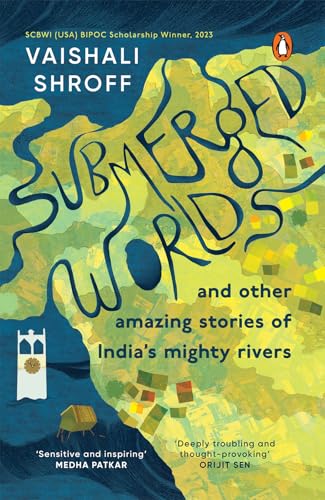
Submerged Worlds and Other Amazing Stories of India’s Mighty Rivers | Ganga, Yamuna, Narmada, Brahmaputra and more | Melting Glaciers, Urban Flooding, ... Destruction, Revival and more | Ages 13 +
The job of any river is to flow and as it flows, it nurtures everything around it, everything within it. But when human interference affects this natural flow, it brings floods and droughts, displacement and suffering in its wake.
From melting glaciers to urban flooding, sand mining to dammed rivers, river rights to river interlinking projects, dead rivers to river revival, this book is an attempt to understand India’s rivers through their stories and the narratives of those whose lives are interlaced with the life of rivers.
Deeply steeped in the historical, spiritual, cultural, political, ecological, and economic fabric of our society, these stories are highly relevant in today’s world where the climate crisis is a water crisis. Compelling readers to listen to the river’s gentle yet urgent voice, it’s a must read for all non-fiction lovers and students keen on understanding life in the subcontinent we call home.
Since childhood I’ve always been fascinated by rivers and water bodies like the way they flow, nurture, and shape everything around them. But when it came to Geography class, learning about all these rivers felt very dry and tedious. So when I came across Submerged Worlds, something clicked and I got very curious. A nonfiction book about rivers that tells real stories? I had to read it. Once I started reading I was completely immersed into the book and what I found inside was far more powerful than I expected.
This isn’t just a book filled with facts instead it’s a collection of stories that expose the heartbreaking reality of our rivers, that is told in a deceptively playful voice that hits you even harder because of its simplicity.
Why I loved it: • Complex river issues explained simply. • Real stories of people affected by floods, dams, and displacement. • A mix of history, culture, politics, and ecology.
Why you should read it: • It’ll change the way you look at rivers. • You’ll understand how climate change is a water crisis. • Perfect for nonfiction lovers and curious readers. • You’ll start listening to rivers and care deeply about them.
Don’t let the playful style, and the left handed illustrations by the author Vaishali fool you into a lull of a bedtime story with happy thoughts and good vibes. The innocent style is masking the harrowing experience of the lives lost, ecologies murdered, political apathy, and man made disasters with piling long terms costs in the name of development. The author does takes us through the abundant rivers in Kashmir frolicking with life, only to add that to his accelerating flow is because of global warming and faster melting glaciers , how some English Surfers were able to conquer the Hoogly tidal wave filled with untreated polluted water, how the dams have killed the migratory fish species, how whatever river flows through a major city is technically dead, be in Delhi, Mumbai or Chennai and the lives of people made to sign away their land rights to federal governments for permanent displacement and loss of livelihood.
A must read for anyone who wants to know anything about our blessed rivers in a blasphemous land.
Submerged Worlds is a book I'd recommend to a reader that's looking for a nice, easily digestible start to understanding more about India's rivers and water management systems. It covers a lot of ground and introduced me to a lot of new things about how we handle our rivers, new perspectives to think about, and plenty of interesting facts that I can now drop into conversations to sound smart. The book is not limited to technical information either: it makes space to discuss the human aspects, such as the gender disparity among those in charge of managing our rivers. Definitely consider this book if you're looking for some light reading on an interesting and important topic.
My issues with the book stem from the research aspects. Often, the book will lightly touch upon something but not expand on it fully - which isn't inherently an issue if the topic in question is outside the book's scope (it would just send me down fascinating research rabbit holes of my own after reading the book, like about a Chinese sea goddess), but occasionally, it left me wishing some topics were explored more fully. For instance, while talking about the under-representation of women in the management of river systems, the author relies on trite cultural shorthand to fill in the blanks. The book asks if things would be better if women were more involved and leaves it there, rather than talk about what gets ignored when women's perspectives aren't taken into account or give examples of different approaches taken when women were in charge.
Finally, some of the author's references did raise my eyebrows. The most egregious such instance was a source cited as simply 'a report on Medium'. That tells me nothing about the authenticity of the source and makes me question what standards the author had for ensuring the accuracy of the information (anyone can post on Medium, and as no other information about the article is given, there's no way to check if the Medium report is by a trustworthy source). Another properly cited reference led me to the blog of a shopping site. I'd hoped for more reliable and better-researched sources in a book like this.
I should note that nothing in the book fails the sniff test or feels made up at first glance, so it's entirely possible all the information contained is perfectly true. But when some of the references are suspect, it leaves me wondering if some embellished or outright incorrect facts may have crept into the book.
But those aspects don't take away from the fact that I did learn quite a lot from this book and will now go on to think about rivers in a new light, and it's still a book I'm glad I read.
🌊As someone who’s grown loving rivers, living a life wrapped around rivers since childhood, who has dipped her soul in most of the rivers mentioned in Submerged Worlds; whether it is Yamuna in Delhi or Ganga in Benaras, Brahmaputra in Assam or Bhagirathi in Uttarkashi, Lidder in Pahalgam or Zanskar in Ladakh, Godavari in Nasik or Narmada in Ujjain, when I came across Submerged Worlds, I thought to myself - wait, did Vaishali just write this for me?
🌊The title tugged at something personal, and the book felt like a mirror to my own riverine memories, my very own riverine love. Oh, this has been such a nostalgic ride!
🌊But what I expected to be just a breezy read on rivers turned out to be a delightful deep dive into the secrets they hide beneath. Lost cities, ancient bridges, ghost towns underwater and who knew rivers were keeping all this? Complex river issues like damming, displacement, floods, sand mining, and interlinking are explained so simply, it feels like a friend is narrating over chai.
🌊You meet real people affected by these issues, and suddenly, river politics isn’t just policy, it’s personal. There's a thoughtful correlation of history, culture, ecology, and even spirituality running through these pages, and it all felt just as overwhelming as urgent.
🌊To the rivers, to the people who live by them, and to the silent warning signs of climate change, which, as this book gently points out, is at its core a water crisis.
❓️Why should you read it?
🌊Because you’ll never look at a river the same way again. You’ll stop thinking of them as just pretty backdrops and start seeing them as living beings with stories, scars, and memories. For anyone who’s ever stood by a river and thought, what stories are you hiding under all that shimmer, this one’s your thoughtful, soulmate of a book, ready to submerge you in its undercurrents.
Rivers are not just water bodies; they are lifelines, storytellers, and witnesses to history. This book takes readers on an evocative journey through India's rivers, weaving together their ecological, cultural, political, and economic significance. It is both an ode to the life-giving force of rivers and a stark reminder of the dangers posed by human interference.
From the fragile glaciers that feed these rivers to the bustling cities that exploit them, the book unpacks critical issues such as urban flooding, sand mining, dam construction, and river interlinking. Each chapter brings forth stories of those whose lives are inextricably linked with these water bodies—farmers facing droughts, communities battling displacement, and environmentalists striving for river revival.
What makes this book stand out is its seamless blend of research and storytelling. It does not merely present data on climate change and water scarcity but humanizes these crises, making them deeply relatable. The narrative is both urgent and poetic, compelling readers to listen to the rivers’ gentle yet desperate calls for restoration.
It is important that we make the next generation aware of such serious consequences of human negligence and outright exploitation of natural resources. Vaishali's book Submerged Worlds is one such read which talks about rivers in India, their importance and the devastating effects of human exploitation.
Vaishal's books are as usual well researched and cover topics which need awarness amongst children and adults alike. I would tend to think of this is a kind of 'knowledge activism' because she isn't someone who would go on a rooftop to shout about this, but through her research and though provoking wirting makes a clarion call to us to be more 'aware' to be more 'knowledgeable' and then take 'action' to bring about a change and to look at the present state in a totally different way.
Vaishali talks about dissapearance of Saraswati, the dead Yauma, revival of Chambla, gold bearing subarnarekha. She has for the first time also illustrated the book and it is just fabulous. Book covers history, geography, mythology and a lot more.
Poingiant, passionate, urgent - one must read to be aware and take action today !
Submerged worlds is a very insightful read for readers of all age groups depicting the very alarming situation of India's major water bodies while also giving informative knowledge and facts about them. We are so busy in our daily lives that we do not realise the impact that the same advanced life is having on our natural assets. If not for such eye opening literature books no one would pay attention to it at all. How sad is the fact that our rivers are disappearing?
// One way or another, if we don't listen to our rivers and don't give them the freedom to flow, they are bound to disappear.//
Reading this book made me feel extremely sad and alarmed about the current situation of our water bodies.
Interesting read for young adults and for anyone curious to learn about the rivers in India. The writing is easy to read and well researched. I enjoyed reading the chapter: Guns and Roses, Submerged World, Rivers without border and European saga in Bengal.