Most of us have travelled by train and experienced true India. Shared food and stories with our co-travellers. Or reached the platform, gasping to find the train leaving with a merry whistle. And in a queue for tickets, dug through our wallets for exact change, complaining about the slow clerk.
Have you ever thought about what goes on in the minds of the deadpan faces that peek through the grilled counter, mechanically issuing tickets to faraway places while rooted to their seats?
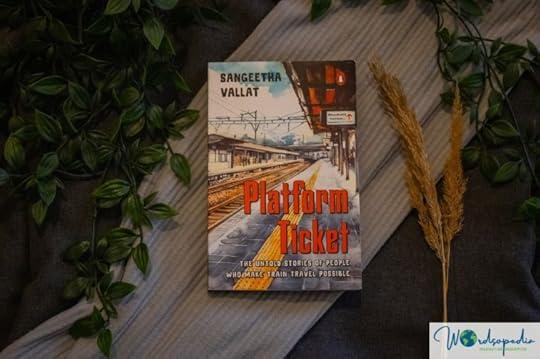
In Platform Ticket, Sangeetha chronicles her time as a ‘commercial clerk’ in the Indian Railways. Between sleepless graveyard shifts and heart-warming moments with travellers, Sangeetha’s life was far from dull. Her years of service, network of colleagues with varied experiences, and storytelling prowess guarantee an enjoyable behind-the-scenes look at this indispensable service in our country.
Booking counters not only build relationships with the passengers, but build strong point of friendship and love within the four walls, too.
I really loved this book, the funny/bitter-sweet anecdotes, and the short story type format where every chapter covers a different experience the author has had as an employee of the Indian Railways.
It is also a wonderful kind insight into how the Indian railways works, and especially how the booking office and nitty-gritty of a railway station functions.
Recommended if you are just starting out with nonfiction.
During college days, I found myself on a railway platform umpteen times. Though I am not too proud of the nuisance we created for the railways as clueless, foolhardy students, it made for some memorable times. The action-packed, spirited platforms always intrigued me. They were sometimes bustling with life, sometimes swamped in darkness, but never quiet.
I remember my attention flitting from the chatting passengers, hollering vendors, and to the coolies lugging baggage that seemed to be more than their own weight. But to be honest, I never gave much thought to the drab, grim-looking ticket counters or the people manning them.
This is why Platform Ticket is a rare revelation.
Sangeetha, a former Indian Railways employee, takes us backstage where we witness stories that are raw, hilarious, exhausting and deeply moving.
She opens the book with a cliffhanger, which instantly grabs you. With her, we journey deep into the underbelly of Indian train stations: right from bustling ones to far-flung, remote regions where the only companions of a railway employee are animals and sorghum fields.
The backdrop may seem mundane, but it is extraordinary if you look a little closer — a series of South Indian railway stations from the 1990s and early 2000s, depicted in varied colours. Sangeetha turns the setting into a stage brimming with drama: overnight shifts, ticketing chaos, homesick clerks, gambling assistants, public outbursts, power cuts, and sometimes, even death.
Her writing is rich and descriptive. You can almost see the characters come alive in graphic detail. You can smell the hot chai, relish the steam unfurling out of hot fritters, hear the clack of typewriters, and feel the fatigue of clerks hunched over counters at an ungodly hour.
You get to see the gradual transformation of Sangeetha as the plot advances. She morphs from a bright-eyed, bushy-tailed rookie to a gutsy, confident professional, juggling tough passengers, outdated systems, and leering eyes with practised ease.
The railway ecosystem is deeply intriguing, and wandering through it with an insider like Sangeetha to show you the twists and trails is both exciting and deeply satisfying. She brings back nostalgia and then some. The narrative feels authentic, often messy, but always full of empathy and honesty. Powerful stories and fascinating anecdotes, tucked carefully between the lines, go a long way to hook the reader.
Many times, the book felt like my very own ticket to a wooden bench at the far end of a platform. Scenes kept changing across years and seasons, trains kept coming and going, while I lounged around, tuned into the lively banter of an old friend.
A potent, deeply relatable memoir that deserves a slow, thoughtful read. Trust me, it offers sights you’ve never seen before.
And I promise, once you’ve read it, you’ll never look at a ticket counter—or the person behind it—the same way again.
Platform Ticket -Beyond the inside view , its an INSIDER’S VIEW
Sangeetha Vallat’s Platform Ticket is not just a memoir—it’s a warm, deeply felt tribute to the everyday heroes behind the railway counters. The writing is refreshingly simple and lucid, yet it carries remarkable depth. You don’t need to have worked in the railways to feel the connection—this book helps any common reader relate to the people, the pulse, and the profound human emotions hidden behind every issued ticket. More than a story of life, its a story with life.
Right from the first few pages, Vallat’s compelling narrative gently pulls you into her world. It’s not just her story—it’s also the story of the colleagues, porters, passengers, and friends she encounters. Her ability to weave their experiences into her own makes the book not just personal, but collective in spirit. Each character she introduces leaves an impression—some through humour, others through hardship or quiet strength—and all of them contribute to the book's soulful journey.
They say Rail Sneham in Tamil—a love for train travel. But Platform Ticket is more than that. It’s Railway Sneham—a rare and heartfelt love for the entire railway fraternity. From the dusty station floors to the clattering registers, the tension of last-minute bookings to quiet tea breaks on late shifts—Vallat gives us a tour of railway life that’s raw, respectful, and real.
The anecdotes are touching, the humorous moments well-placed, and every experience is rooted in a larger learning. You’ll find yourself slipping into her shoes—feeling the weight of her challenges, the laughter of her lighter days, and the silent strength she musters to keep going.
And perhaps what makes Platform Ticket truly stand apart is this: it reveals the life behind the counters in a way never told before. It honours the invisible stories—the work, the weariness, the courage, and above all, the humanity—of railway staff who keep the system moving while the world hurries past.
Final Thoughts
Platform Ticket chugs with life. It’s not only about trains—it’s about people. Their journeys. Their resilience. Their quiet, everyday triumphs.
A must-read for anyone who’s ever stood at a railway station and wondered what lies behind that ticket window. The answer, as Vallat shows us, is: a whole world full of our own stories someway or the other
One of the most delightful aspects of this book is how it transports the reader into a world rarely explored in literature: the Railways of India. Even in our movies primarily talking about Hindi movies a lot of action happens in trains but I can only think of maybe a Julie or The Burning Train which has stories centered around railways employees and on TV there was a series long time ago on DD with a plot about a station master in a mofussil town. Not much to go on and so this was the 1st time I read about how the railways really works.
The author’s evocative language brings to life the imagery of the railways and the unique working environment, creating a narrative that is both engaging and yet poignant.
The book is structured in an anecdotal style, introducing a variety of characters. It feels as if a group of old friends have reunited after a long time, sharing their stories with each other while the reader listens in. This approach creates a format that is engaging and immersive. Some of the pop culture references may not resonate with younger readers, but for those who grew up during the same period as the author, these details are instantly familiar and nostalgic. As the author’s first full-length book, it is quite an accomplished work. Although it is largely autobiographical, many personal incidents are only alluded to rather than fully explained. While this may be a deliberate choice, I found myself wishing for more details, purely out of curiosity and with respect for the author’s experiences.
● If the Indian Railways has been an important part of your childhood,
● If like me you thought that publishers like Penguin only pick up celebrities,
● If like me you love a captivating memoir,
If you tick even one of the boxes given above, all that you need is to pick up "Platform Ticket" and embark on an enchanting journey you are not likely to forget soon.
Just finished reading this truly wonderful memoir by this debut author — though calling her a "first-time author" feels almost unbelievable. Her writing is so refined and engaging that you’d think she’s been doing this for years. Publishers definitely missed out by not discovering her sooner. But now that she's here, I genuinely hope they encourage her to write more. Her talent deserves a broader platform, and we, as readers, deserve more of her words.
While I have so much to say about the story itself, it’s the author's writing style that left the deepest impression on me. Not once did I feel bored or tempted to skip a page. There's no unnecessary exaggeration or dragging; everything is crisp, clear, and compelling. She truly knows how to keep the reader hooked. I’ve now become a big fan of @platformticket.sangeethavallat!
That said, I must admit - Some words were unfamiliar might tempt us to Google and check disrupting the flow of reading, if you feel fine with the context you can keep going on. Too many abbreviations too disturbed the flow in an otherwise wonderful reading experience.
Now, about the story — I’m sure everyone who’s read this book would agree: trains have been a part of our lives in some way. Whether traveling for vacations or simply watching them as kids, trains have always brought a sense of wonder. For me, memories of my grandfather’s house in Villivakkam came flooding back. From his entrance, we could see the tracks, and I used to love watching goods trains go by. There was always an express train standing idle for no clear reason — it was fascinating!
But how many of us have ever really thought about the people behind the scenes? The ones issuing tickets, managing platforms, driving those trains — especially the women clerks and staff who work in such demanding environments?
I rarely visit local stations myself, and when I do, I often find myself complaining about how unhygienic or chaotic they are. But this book gave me a new perspective. It shines a light on the real struggles faced by railway staff — the emotional and physical hardships — yet also celebrates their strength, friendships, small joys, and the sense of purpose they find in their daily lives.
Even when the story touches on difficult topics, the author has a beautiful way of making you smile on every page. It’s not just a tale of struggle; it’s a heartwarming journey filled with humor, resilience, and humanity.
Platform Ticket is truly a joy ride. I wholeheartedly recommend everyone to hop on board and experience this unforgettable journey. 🚉❤️
I don't usually read too many memoirs. But this one was intriguing right from the premise to the rave reviews it's been getting. And I can say for sure, I wasn't disappointed. It tells us about the life of the people on the other side of the ticket counter. From the hardships they endure to the funny, intriguing, and heartwarming moments they experience. It says it all.
Sangeetha Vallat writes about her life in such a candid and witty way, and some lines have me laugh out loud. You never know when the punchline is going to come. I thoroughly enjoyed reading this book. Well done!
Powered by Sangeetha Vallat’s impeccable wit and humour, Platform Ticket captures the lives of Indian railway employees, the ones who kept the system running smoothly even before online reservations grew rampant. The book opens with an intrigue, an enquiry committee sitting down to question Sangeetha, and nosedives straightaway into how the journey began.
Platform Ticket introduces readers to the faces framed behind the glass panels of ticketing booths. Beyond the veil of dealing with long queues and often draining personalities of customers, the souls issuing the tickets are as human as the rest of us.
Sangeetha has laid down the intersectional tracks of personal and professional with a sure hand. The incidents enumerated might have a common theme but none of them are handled in the same way. As varied as her postings and duties were, the people she met and befriended along the way were as diverse and unique as well. Sangeetha focuses not only on the stories of her coworkers within the same station at each step, but also of her batchmates with whom she trained while coming up. She wields her expertise in both railways and writing to bring forth a memoir which is as informational as it is heartwarming, humane and hilarious, peppered with iconic pop culture references (DDLJ, anyone?).
I finished reading Platform Ticket last night, and to say it was underwhelming is an understatement. While the book started with some sort of linear timeline, interspersed with random incidents and anecdotes, it gradually devolved into more randomness. This left me unable to connect with the author via the book at all. While her behind-the-scenes, technical specifics of ticketing in the Indian Railways is mildly interesting, it does not quite resonate with my observations of the quintessential railway (or even government) employee from the other side of the glass. This is a book I would find difficult to recommend.
A unique memoir from an Indian railways booking clerk. I especially appreciated her unfiltered honesty, focus of the narrative on her work life without excessive forays into personal life, and inclusion of snippets from colleagues’ work lives.
3.5/5 for content most of the time, but the occasional forays into 4-4.5/5 territory felt like a pay off. Writing mostly 3/5. Took me 50+ pages to get into the narrative - till then, the book was rather uninteresting and I considered DNF-ing.
I will never look at a railway station again without “seeing” more.
This one made me yearn for a long train trip and I ended up finishing it it one sitting. The characters - each one quirkier than the next - kept the plot moving and I was so curious as to where life would take our young protagonist. Absolutely charming writing style that reminds me of Sudha Murthy, such a nostalgic story to sink your teeth into. Good job, Sangeetha!
If you are a generation spanning the seventies, eighties, and nineties, there is no way you have not taken a train journey. I can still recall with great nostalgia aloo ki sabzi, poori, and achar. The smell wafted through the entire coach when the dabba was opened, and it still makes my mouth water. Sangeetha's book is like that khane ka dabba, still lingering in some part of the heart. It beautifully captures the train journeys we had as kids, the bonds formed during such trips, and the effortless joy we experienced. It's a reminder of a time when journeys were more than just travelling from point A to point B, when we were not glued to our laptops or phones, but were fully present in the moment. Most of us have travelled by train and experienced the soul of India. Shared food, stories, and anecdotes with our co-travellers. Sometimes, forged a lasting relationship. We have missed trains, and we have fought with the reservation clerks for Tatkal tickets, feeling they were incompetent. We have dug through our wallets for exact change. Sangeetha's memoir is not only about us, but it also contains parts of all of us growing up together, only on the other side of the counter. I read a book that was so good after such a long time, and what worked for me was that it was humane; it connected, it was raw, and Man Sangeetha didn't sugarcoat anything, not even in the book. She is honest; she doesn't hide anything, whether it's an attraction with a colleague or a earning quick bucks with not-so-fair means. Her writing is not just lucid, it's empathetic. Sangeetha writes with heart, and it resonates with the readers. What is good writing anyway? It's when you start feeling the same emotions as written in the book. The challenges she and her colleagues faced were real, but you never see her feeling bitter about it. She writes about the responsibilities and difficulties of a commercial clerk not as a rant, but as an absolute matter of fact, evoking empathy in the readers. The moment a man exposed himself to the author made me shudder. The deaths that happen on the train tracks are something I never fully grasped, but then they became a harsh reality through this book. The lack of proper toilets, the difficulties of sharing the confined space, and dealing with some very challenging customers were all effectively highlighted. They say Rail Sneham in Tamil—a love for train travel. But Platform Ticket is more than that. It's Railway Sneham—a rare and heartfelt love for the entire railway fraternity. From the dusty station floors to the clattering registers, the tension of last-minute bookings to quiet tea breaks on late shifts—Vallat gives us a tour of railway life that's raw, respectful, and real. What truly sets Platform Ticket apart is its ability to reveal the life behind the counters in a way never told before. It's a tribute to the invisible stories—the work, the weariness, the courage, and above all, the humanity—of railway staff who keep the system moving while the world hurries past. It's a book that will enlighten you about the untold stories of the railway fraternity. I have had a few family members from my maternal side who served the railways. In fact, as a kid, I had my best memories with cousins in a two-room Sarojini Nagar Railway quarters in Delhi. Beyond that, I have never had such a profound discussion about the difficulties faced and other events that occurred with railway employees at that time. Sangeetha. I only have a regret that she talks less about her personal life, as a matter of fact. I wanted to know how she eloped. Though I wouldn't want to know about her kids. It's too painful in glimpses as well. It is a beautiful book, and it goes beyond the railway platform. It penetrates deep into the crevices. I recommend this book to everyone. PS. I understand you, Sangeetha, as a fellow Virgo.
Imagine a scenario in the early 1990s. You, your parents and siblings, cousins, uncles and aunts, and family friends occupied an entire railway coach, all with confirmed tickets to Trichy to attend a wedding!
The fun-filled chaos, guffaws, laughter, teasing, babies bawling, young kiddos fighting for window seats and wanting to sit with their favourite cousins, aunts, or uncles, and all the madness in between. Everyone is eagerly waiting for the train to start its journey. And don't forget the titillating smells of homemade foods emanated throughout the coach!
Now imagine yourself looking out of the window to see a young, pretty girl at the counter on the platform, her hands racing between issuing tickets, collecting money, returning change, listening to and telling stories, all simultaneously.
You see a couple of beggars talking to each other while a third one is sitting with them, but not engaged in the conversation. You see porters and cleaning ladies working on the platforms. You hear the TTEs exchange pleasantries with the young girl and her colleagues.
You see goods and cargo being wrapped and packed, waiting to board the trains. You see the station master wearing a worried look, his glances alternating between his watch, the railway tracks, the ticketing counters, and the hordes of people jostling on the platform. You've always wondered what their stories would be.
Like me, if you have known many stories of travellers and very few of those working to make your train travel as smooth as possible, then Sangeetha Vallat's Platform Ticket should be your go-to read.
Filled with heart-touching tales of beggars-turned-close-friends, gut-wrenching stories of discoveries of headless and mangled corpses on the railway tracks, sweet romances between likely and unlikely couples, the struggles of railway employees as they navigate their personal and professional lives, warm-huggy stories of lifelong friendships, the overwhelming grief when you hear the news of the deaths of such friends, and so much more.
Platform Ticket covers the entire gamut of humanity and some animals, all through the eyes of the author as she issues tickets and fills registers with passenger and train details in her office overlooking the platform while talking to everyone.
The book filled my heart and soul, leaving me wondering, “Why did the book end so fast?” By the way, I didn't finish the book in one go, which is why this review is delayed. I savoured it slowly, deliciously. I read a chapter a day, thought about it for a day or two (for some chapters, even more), and then read the next chapter.
Sometimes, it was not chapter-wise. It was incident-wise, personality-wise. There's a story of the friendship between three beggars living on the platform who bond inexplicably. How their lives intertwine and then separate left me in awe of human connection. What drives us to make connections with other people? What drives us away from each other?
As I read Platform Ticket, such and other deep philosophical questions arose in my mind. That's the power of Sangeetha's writing: simple yet undoubtedly profound. What I found most striking about the author and her writing is her ability to keep cynicism at bay despite the pains and losses. Her verve for life ensures that her book does not have an iota of preachiness.
One little thing I found lacking in this book is the narrative flow. It seemed to jump from one incident to another, which sometimes interfered with my reading.
Do I recommend this book? YES! YES! YES! Pick it up for nostalgia and that teeny-weeny bit of envy you feel for Sangeetha for her writing, relentless cheeriness, and joie de vivre
The platform ticket by Sangeetha Vallat, is a book that brings to you the various happenings in the life of a railway employee.
We have always travelled by train and grumbled when the person sitting behind the ticket counter took.a few extra minutes to give a ticket or when he or she fumbled with some changes. We were always in a hurry to board the train but Sangeetha Vallat 's book, The platform ticket, has taught us to see the world on a platform through the eyes of a person working for the railway and spending his or her time on the platform.
The initial struggles of how Sangeetha and some of her friends got into the railway job made an interesting read.
As the book proceeds with various episodes happening on the platform, behind the counter, outside the counter, the readers’ admiration for all those who made train travel possible increases by leaps and bounds.
When one reads about the night duty during eerie nights in some God forsaken place, double shifts when one of the employee is absent and so many other happenings in the life of a person sitting behind the ticket counter, we really squirm thinking about the few times we snappped at them. It was not very appreciable on our part.
The bond that the regular commuters have with those employed on the platform made a very heart touching read when Sangeetha sleeps in the train on her way back home and misses her station and alights at another place only to see that it is pitch dark and very late and then a regular commuter who has travelled in the same train and stays in that station takes her home in his bike and the family makes her feel very comfortable even with their meagre resources. Unknowingly a bond gets formed between two people belonging to two different worlds, one an employee of the railway and the other a normal commuter who buys a ticket everyday and travels in the train.
Sangeetha has beautifully described the wedding of a colleague and we feel like we are attending a Muslim wedding and having that food she has vividly described.
Then again the gory scenes of deaths happening in the railways; of a body with the severed head and how the railway employees go about with the formalities even when it is night and pitch dark they do not shun away from their duties, sends chill down your spine.
A crush on a married SM!!! That was a very emotional read, Sangeetha, lovely.
The urchins thronging the railway platforms, the beggars all become a vital part of the book. One of them goes missing and the railway employees feel sorry. The blind beggar couple smooching, oblivious of the fact that the world was watching them, was a beautiful read in this book.
Trains come and go, employees may retire and new ones will come, but after reading Sangeetha Vallat’s book, one can be rest assured that the scene continues to be the same on a railway platform.
Dear friends, do remember, next time when you put your hand across the small counter to get a ticket and if the person on the other side takes the few minutes to hand over the ticket and the change, please bear with him or her. After all railway employees are also human beings like us and not Robots, though they do multiple tasking unlike us.
Kudos to Sangeetha for penning such a beautiful book. It will stay in the heart of all the railway employees, all the commuters and everyone who reads the book.
For years, I believed railway stations existed primarily to test the limits of human patience.
You queue. You wait. You discover that the train is running three hours late. You buy tea. You buy another tea. You glare at the display board. You briefly contemplate moving into the waiting room permanently.
And much like Wi-Fi routers, booking clerks tend to become visible only when something stops working.
What never occurred to me was that the people behind those grilled windows might have stories worth hearing.
Sangeetha Vallat's Platform Ticket cured me of that oversight.
Drawing upon her years as a booking clerk in the Indian Railways, Vallat takes readers behind the scenes of one of India's most beloved institutions. What emerges is far more than a memoir. It is a bustling collection of stories populated by eccentric colleagues, station staff, regular commuters, platform dwellers, impossible customers, unexpected friendships and enough railway drama to keep several television serials supplied for years.
The book's greatest strength lies in its people.
Every few pages, someone walks onto the platform and into your memory. There are colleagues whose quirks are narrated with such affection that they feel like old acquaintances by the end. There are friendships forged over tea breaks and night shifts. There are stories of porters, clerks, passengers and platform regulars whose lives intersect in ways that are funny, moving and occasionally surprising. Vallat has the rare ability to make readers care deeply about people they would ordinarily pass without a second glance.
And then there is the humour.
Not the sort that arrives waving its arms and demanding attention. Vallat's humour emerges naturally from the peculiar ecosystem that is Indian Railways—a place where bureaucracy, humanity, exhaustion, resilience and absurdity coexist in equal measure. A misplaced assumption, an eccentric customer, a workplace anecdote: the book repeatedly finds comedy in situations that most of us would simply file under "another day at work."
What impressed me most was the generosity of Vallat's storytelling. Many memoirs spend their time staring into a mirror. This one spends its time looking out of the window. Again and again, the author steps aside to allow others to occupy centre stage. The result is a book that feels less like an autobiography and more like a lovingly curated gallery of human stories connected by railway tracks.
The writing is warm without becoming sentimental, observant without becoming cynical, and nostalgic without insisting that the past was somehow better. Vallat clearly loves her world, but she sees it clearly too. The affection never comes at the expense of honesty, which makes the stories all the more engaging.
Perhaps the book's greatest achievement is that it changes the way you look at railway stations. By the final page, "railway staff" no longer feels like a faceless category. It becomes a collection of individuals with lives, ambitions, friendships, disappointments and triumphs of their own.
After finishing Platform Ticket, I realised that for years I had been looking in the wrong direction. Like most passengers, I had been focused on the trains—the arrivals, departures and destinations.
Vallat gently redirects our attention to the people who make those journeys possible.
And suddenly the platform becomes far more interesting than the train.
Sangeetha Vallat’s Platform Ticket is a railway memoir like no other. In this book, the author chronicles her experiences as a booking clerk in the Indian railways. She narrates with panache the plethora of experiences, friendships, acquaintances, challenges, and victories over a fourteen-year career.
The author’s writing transports you to the busy platform of a train station, immersing you in the sights, sounds, and smells. She spotlights the people who are not prominent on an ordinary day, be it the beggars, the sweepers, the guards, or the hands that continually dispense tickets at the booking counters behind the grilled windows. Unlike other memoirs, the author includes stories from not just her life but also her friends and colleagues, making this collection all the richer.
The book combines elements of humour, adventure, nostalgia, and emotions while highlighting the challenges faced by railway employees. They have to deal with unruly, impatient customers, work long days accounting for the last rupee, and carry on with a smile despite dealing with personal issues because ‘the customer is always right’. The author also sheds light on how the railways have evolved over the years - from manual entry to printing tickets through automation, while also emphasizing the power of the human presence.
The book smashes stereotypes around ‘chatty’ or ‘leisurely’ ticketing jobs; booking clerks work late shifts, manage collections, and are held accountable during vigilance raids. They issue tickets at lightning speed during peak hours to ensure no customer misses out on a seat. At times, they don’t even have the luxury of fulfilling basic needs like visiting the toilet.
Platform Ticket is also the author’s journey; it’s the story of her growth – from a starry-eyed newbie to a veteran, from being the lone woman employed at distant stations to a champion of women's rights fighting for the establishment of gender-specific toilets.
As a reader, I could not relate to all of the experiences since I belong to a generation that is largely dependent on the internet for travel bookings. However, I found the book immensely enjoyable; a slice-of-life collection that leaves you grinning or reaching out for tissues occasionally. What stood out for me were the simple acts of kindness and courage - like when a Superintendent decides to reverse a train to rescue an injured boy who accidentally fell onto the tracks during a journey. Not all heroes wear capes; some work for the Railways!
Platform Ticket is a stunning debut; it is a memoir of resilience, courage, kindness, friendships, and unsung heroes, celebrating the Lifeline of the Nation: the Indian Railways.
When you think of heroes, who comes to your mind? Soldiers? Doctors? Astronauts? Scientists? Have you ever considered a railway clerk issuing tickets at the speed of light as a hero? At least, I wouldn’t have had I not read Platform Ticket. Platform Ticket is a true account of the author’s journey as a railway clerk. It is the journey of those unseen, unrecognized individuals who make train travel possible for us. The author, skillfully, takes us on a tour of behind the scenes action that happens on a railway platform. The anecdotes raised my brows and hair. Oh, really this also happens on an ordinary looking platform! There are stories that surprise you, shock you, but also leave a sweet after taste. These are stories about how the author has formed life-long friendships, while working with the Indian railways. This camaraderie was not limited with only her colleagues, but also her seniors, their families, and even with the customers. Platform Ticket is full of experiences-good, bad, ugly. Cases of how female employees face ridicule, and abuse make us wonder how safe we are as a nation. In the era in which the author worked with the railways, she highlights that their basic right to relieve themselves in peace was looked down upon. No ‘only women’ toilets. Peeping Toms in those toilets made their shifts horrendous. Yet, the employees, with their sheer determination to work and spread cheer overcame it all. That’s why I call them heroes. The author through her tiny ticketing window brings us world of possibilities. Be it strange relationships the beggars share or the weird ways in which people come to her rescue, the stories of Platform Ticket portray hope, but not without a glimpse of darkness. Like many memoirs, where the person in focus only talks about self, Sangeetha has consciously avoided the spotlight. She tells us stories of her friends and colleagues, what she learnt from them, how she grew up to be the person she is today because of them and why she will never be able to forget the madness of reservation and ticket issuing. If you read minutely, you do get a peek into the author’s personal life outside the railways. But only a peek. The focus remains on platforms. I have thoroughly enjoyed this ride, and I urge you to hop on. The Platform Ticket is a paisa vasool book.
Platform Ticket by Sangeetha Vallat Available in Kindle and paperback editions
The Indian Railways is one of the largest operating organisations in the world. Zillions of people travel through trains every day, including you and me. And yet how little we know about it!
In her debut novel Platform Ticket, author Sangeetha Vallat has shared candid narratives of her life as an employee of the Indian Railways.
From working at platforms in unheard-of stations, to earning the title of The Express Lady for her speedy work in booking tickets, Sangeetha has been there and done it all.
The book contains details of her tryst with the Indian Railways, a bond that began when she was just twenty years old. The experiences that she has had and the people she has met and befriended over the years – these form the crux of her narrative. The author has written in a manner that is casual, factual, witty and poignant all at once.
The book transports you into another world – that of the Railways where it is not just the trains or passengers that form the essence, but the beggars sulking in a corner of a platform, the sweepers, the police force ever ready to aid, the zillions of employees handling the tiniest of details that make for the smooth functioning of the organization, the clerks, the ticket-issuers, the ticket-checkers, Station Masters – it is a whole universe here! The author has successfully brought this universe to life through her detailed and exuberant narrative.
The narration is excellent, not only keeping the readers engrossed but also involving them deep into the scene. Candid glimpses of the author’s personal life show her struggles and her silent grief and add to the poignancy of the narrative. Snippets of the lives of her friends and the people she met during her working days add in a sense of the reality of life. You can feel her yearning for her friends and for good old days, and you can't help looking back at your own life and wanting to go back to a good old time as that mentioned in the book – a time when life thrived on personal connections and humane touch.
I know this book will stay with me for a long time. Can’t recommend it enough! Definitely a must-read for everyone.
Platform Ticket isn’t just a memoir—it’s a soulful tribute, a heartfelt tapestry (of Indian railways) of the unsung lives behind the railway window. Sangeetha Vallat takes us behind the grimy glass of the ticket counter, offering not just a peek into the machinery of our largest transport system, but into the lives and souls that keep it running. With warmth, wit, and striking clarity, she draws you into a world of quiet resilience, everyday travails, and deeply human stories. Each page pulses with nostalgia, humour, and heartache—capturing what it truly means to live and serve behind the glass. With unflinching honesty and a wry sense of humour, Sangeetha recounts her journey as a commercial clerk—bringing to life the chaos, charm, and contradictions of life at the railway station. Sangeetha recounts every story with authenticity, from irate passengers to curious beggars, from ant-covered corpses to office pranks, from chitranna tiffins to chai breaks (with dunked MilkBikis) standing on a dusty platform, under a pendulous fan, creaking its protests. You feel her fatigue, her triumphs, and the many moments of quiet learning. I haven’t enjoyed reading a memoir as much as I enjoyed reading this book. Sangeetha’s voice, rooted in reality and laced with memories, quietly yet stubbornly earns our respect. Rich with the knowledge of a life, lived well, aching with the loss of those gone, and rife with chuckles and laughter- this book warms the cockles of the heart. It is a ticket to cherished memories of bygone days wrapped in the scent of nostalgia. It is a reminder that sometimes the most profound stories come from the humblest of places. Life writes them. We only narrate them. So, pick this book up. Sit with it in the quieter moments and read it slowly. Don’t rush. This isn’t a racy novel. This is someone’s life on paper. Give it the respect it has earned by savouring the words on each page slowly. Let them seep in and percolate. Let them linger as they tickle your memories. Trust me, this book is a journey worth taking! It's one train you cannot afford to miss (with or without a ticket!)
Platform Ticket revolves around the experiences of Sangeetha Vallat, a commercial clerk in Indian Railways, as she sits behind the counter at various platforms throughout her eventful career, along with some interesting anecdotes of her colleagues.
The initial episodes of Ms. Vallat joining the railway course and undergoing training are interesting, and I especially loved her progressive and supportive family. I also enjoyed the humor interspersed throughout the narrative; it made me chuckle a few times.
Whenever the narrative focuses on Ms. Vallat and her experiences, especially the ones garnished with pop culture references, I found the book gripping. And the highlight of the book has to be the relationship of Ms. Vallat with her first Station Manager. It is developed beautifully, and the final scene between the two almost filled my eyes with tears. It was that powerful. I also felt for another character, Tippy. The last line of that chapter strummed my heartstrings. It was exceptionally written.
However, whenever the book strays to the anecdotes of her colleagues, especially the ones exploring the intricacies of railway equipment or ticketing, I found my interest waning. I also think there were too many characters in the book, and apart from the SM and perhaps Tippy, none were developed sufficiently or were interesting enough. And sometimes, the anecdotes were too short and thus difficult to understand.
The language is brilliant. Ms. Vallat possesses an enviable vocabulary and wields it with elan throughout the narrative. However, I did notice a few punctuation errors here and there.
Overall, I would say that for readers primarily interested in fiction, Platform Ticket would qualify as a decent read, but for those who don't mind reading fiction or non-fiction, this will be an excellent read. I would like to conclude by saying that after reading the book, I can now understand the challenges faced by ticketing clerks and empathize with them; that's why this book, despite not falling into my preferred genre, will always be memorable for me.
Trains have played a major role in my childhood travels. As a kid, every summer we would travel to Chennai from Delhi, the faithful ‘holdall’ carrying most of the belongings, befriending co-passengers, sharing meals, hopping out at stations to buy hot snacks. Platform Ticket by Sangeetha Vallat brought back all those memories. It was a fun-filled nostalgic ride.
As I read Platform Ticket, I was stuck with the realization that I had never actually thought about the person behind the ticket window. Train journeys were about the views from my window, co-passengers, reading novels, eating… but never the staff. In all my years of buying tickets, I just saw a hand passing a ticket through the grille. Sangeetha showed me the people behind our travels.
Sangeetha has a way with words (be it writing or talking!). Her narration isn’t fancy, rather she has a way of making the readers feel the words. She not only connects with the readers but also takes them on a journey with her.
I am glad I picked up this book. It made me understand what it’s like to work at the stations, deal with unruly passengers and the rush, the pressure of issuing tickets, the vigilance checks, and everything else that comes with the job.
Honestly, the chapter about bodies was disturbing. It made realise something I'd never thought of. Despite having read about so many suicides, I had never given a thought to the railway employees who had to deal with that. Kudos to these heroes!
The illustrations are delightful. And the Chapter names are clever. It made me curious about what’s coming next.
The next time I travel by train, I’ll remember that there are many people making my journey a success; each with their own story, their own struggles, their own reasons for being there. Platform Ticket is not just Sangeetha’s story, but the story of so many railway employees that nobody really thinks about; the ones who make train travel possible. Hats off to you, Sangeetha, for this remarkable book.
Wordsopedia Rating 4.5
This review reflects my honest and voluntary opinion.
It was a refreshing and yet deep read for, you must have guessed it, a long train journey. One can almost hear the chug, chug, chug of the tracks while living inside these pages. Kudos to Ms Vallat for creating that effect a memoir of railway officials should evoke.
The story of a railways clerical employee is something not many readers would have imagined, especially the era before digitalization. I was very suprised by the intricacy of the system and how each step had to be carried out in a precision that rippled across train timetables. I think of the railway timetable book that we used to see in the late 90s and early 00s while reading about the training on the field Sangeetha undergoes.
A simple girl from Chennai, dealing with a whole new language and demographic, was fun for the opening chapters. However, I was more enthused about her transfer to her hometown and the increased responsiblity of managing the comings and goings of the entire platform. I was pretty mind-blown by the handling of bribery, the vigilante of the suprise audits, the relationship with lost souls of the beggars that Sangeetha forms and the horrific responsilibity of the souls choosing or not choosing to end it all on the metal rails. It kept the story racing in the second half and me almost on the edge of my seat. It gripped me to finish the book overnight.
I applaud the narrative skill of Ms Vallat to keep the reader engaged even with small anecdotes that tied together in a neat time capsule by the end. It was a simple, lucid writing, and yet, I ended up feeling deeply for more than just the main character. It lost one star for some abbreviations I was not able to keep up with due to my reading speed and some interesting storylines to me that did not acquire the depth I desired.
Overall, great engaging read with deep insight into the magic of trains and the workforce behind them.
Train rides have always had a special place in my heart. There’s something so comforting about the sound of the train, the breeze from the window, the chai in small paper cups—and the long hours where you just sit, think, talk. I love train journeys with my daughter. It’s our time to be fully present with each other, talk about life, and watch the world go by.
That’s probably why this book connected with me so deeply.
This book is not about grand achievements or dramatic twists. It’s about the small, real moments that often go unnoticed. Sangeetha Vallat writes about her own life—how she waited for the brown envelope that would confirm her job in the Railways, and how proud her parents were when she got it. I could almost feel that joy. Her journey from a shy young woman to someone who worked at the ticket counter, facing hundreds of people every day, is shared so honestly—it doesn’t feel like you’re reading a book. It feels like someone you know is telling you their story.
What I loved most is how she describes all kinds of people she met—funny ones, difficult ones, kind ones—and the little lessons they brought with them. It reminded me of how every train ride is filled with strangers who carry their own stories. And how we often forget about the people behind the counter, doing their job with patience, empathy, and a smile.
The writing is simple but full of feeling. Some pages made me smile, others made me stop and think. I finished the book feeling grateful—for the everyday heroes who keep things running, and for the little moments that make up a life.
This felt like a train ride through someone’s memories—nostalgic, warm, and real. If you love people, stories, or just the magic of Indian train journeys, you’ll enjoy this one. I know I did.
Countless books feature train journeys across the variegated landscapes, towns and villages that stitch up our nation. Platform Ticket is different. It shines a rare light into a world that many travel writers fleetingly brush against: the cramped, grilled, sometimes smelly or cockroach-infested spaces from which a motley crew of indefatigable railway staff perform the numerous operations that keep our trains clacking and squealing across the world’s fourth largest network. The effervescent Sangeetha Vallat spent 14 years behind those counters, issuing tickets, collecting and giving change, filling book registers, computing fares while also conversing—yes, magically enough—with hundreds of impatient, beseeching or churlish customers.
Getting Hitched to a Railways Career
As a child, Vallat harbored a different dream: she wanted to read books. Not foreseeing a future where reading could earn a living, she opted to join the Railway Network. As the only one in her school to clear the Railway Recruitment Board (RRB) exam, she entered a two year vocational course along with her Plus 2, held inside a posh institution that seemed to signify a rosier future. Because of bureaucratic snags, she had to wait longer to receive the coveted brown envelope, confirming her Government job. To her youthful glee, the letter accompanied a free Railway pass printed on striking pink.