"Diana Cooper's name itself may mean little to many women here in America, although it is a famous name, intimately associated with great and stirring events. ...
Great beauty is a usual gift of the gods to the fortunate few among the young; but perpetual beauty is a mystery. The solution of the mystery lies, I suspect, somewhere in Diana Cooper's memoirs. The story of her girlhood, and of the young men who sent off to war, and of her love for Duff Cooper and marriage to him, is several different things at once. It is a threnody for that lost generation whose loss left England between wars to the Baldwins and the Chamberlains. It is a description of a way of life now vanished that seems from the vantage point of 1958 almost as remote and glittering as the life of the French court before the revolution.
But it is also a self-portrait of Diana Cooper, a curiously and fascinatingly honest self-portrait. And in this portrait you can trace the traits of character and gifts of life and feeling that have transformed the great beauty into perpetual beauty."
-- reprinted from Ladies Home Journal, September, 1958
This is the first volume in the biography of Lady Diana Manners, daughter of the Duke of Rutland, who later married Duff Cooper. This, the first volume of her autobiography, was first published in 1958 and deals with the time between her birth, in 1892 to the period just after WWI, when she married Duff Cooper.
In her youth, Diana Cooper was a socialite, member of the ‘Coterie,’ a group of young aristocrats, and was reputed to be the most beautiful woman in England. Although her fame was mainly due to her beauty, and social connections, she certainly knew everyone who was anyone in this period and this is an interesting social history as well as a fascinating portrait of an original ‘Bright Young Thing.’ She knew everyone from Winston Churchill, to Max Beaverbrook, to Rupert Brooke and was used to flattery and adoration.
Like many women of that period, and class, she had a rather haphazard education and her spelling remained imaginative throughout her life. She was, she admits in this book, indulged and spoilt, especially by her mother – who had a tendency for hysterics. The then, Lady Diana Manners, wryly looks back on a name already, ‘beginning to be overloaded with publicity.’
However, those early years of endless fun changed with WWI. Desperately in love with Duff Cooper by this point, the two exchanged endless letters, while Diana nursed at Guys, and in a private hospital set up by her mother. News of friends and acquaintances deaths are horribly endless, during that period. It is shocking to read, even now, at such a distance, the loss of so many young men during that time.
Luckily, for Diana, Duff Cooper survived the war and the two married. The end of this volume sees Diana setting out for a new career in silent films. I really enjoyed this and want to read on and discover more about the adventures of the Duff Coopers, as they embarked on their married life.
Read from February 25-26, 2017. Shelved Jan. 28, 2017.
I was led to this book under false pretenses!
In his fantastic book Old Money, Nelson W. Aldrich Jr. quoted Lady Diana Cooper getting depressed about William Paley's house Kiluna Farm, which during her stay featured luxurious place settings, pyramids of fruit in one's room, lotions and potions in the bathroom, all things "unattainable to us tradition-ridden tired Europeans." Aldrich's point was that Paley was very much trying to be more Old Money than he was, thinking his hostly accoutrements were simple and sparse. (One suspects there's maybe some false modesty on Cooper's part here.) In the endnotes, Aldrich ascribed Cooper's quote to her memoir The Rainbow Comes and Goes. But it wasn't there! The memoir finishes sometime in the 1920s, shortly after Diana's marriage to Duff Cooper, long before she has met Paley.
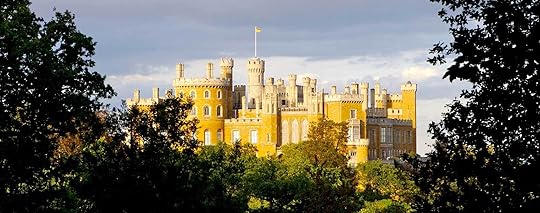
Diana Manners was born to the 8th Duke of Rutland(1) and Violet Lindsay Manners in 1892. Her grandfather, and upon his death her father, owned Belvoir -
in addition to their London house. The grounds and many rooms of Belvoir were open to the public three days a week. "In the summer my mother arranged for us children to picnic out and not to return until the hordes had departed for in truth the atmosphere - the smell - was asphyxiating." The Duchess of Rutland (mom) considered common not just the common people, but tomatoes and lemon as flavoring, dyed fur, holding hands, kissing on the mouth rather than the cheek, and Germany except for its music.
You would think the owners of Belvoir might feel secure in their wealth, but by 1906 the income tax had reached elevenpence per pound, and "every successive penny rise plunged us again into fear of the workhouse."
Diana was lightly homeschooled and for her entire life suffered an inability to do division. Nor was multiplication her strong suit, as she informed her fiance in a letter once that 8 pounds a week came out to more than 200 pounds a year. Life was gay, so gay, endless rounds of parties, siblings, friends, and young men. She was considered a great beauty and courted by many of them. Many of these aristocratic young men (although not her intended, Duff Cooper) were also killed in the Great War, which cast a semi-pall over the gaiety. Most of her memoir is gay, gay, gay, there's a long chapter consisting of the letters between them when he is at the front, and after they marry in 1919, she attempts to get into the film industry as an actress. Here the memoir abruptly ends.
Whether it's peacetime and things are going well or wartime and everyone around them is dying, the swells are unable to depart from their inane bubbly babble. Margarine may have replaced butter, but there are still endless amounts of champagne, unstoppable frivolity, and twentysomethings with the demeanor of toddlers. "The Coterie" was Diana's clique of swells (just as her mother had belonged to an earlier arty clique called "The Souls"). In August 1914 Diana wrote a letter to Edward Horner, who would soon be dead: "Edward darling, I think it's up to the Coterie to stop this war. What a justification! My scheme is simple enough to be carried out by you at once. It consists of getting a neutral country, either America or Spain or Italy or any other you can think of, to ask each fighting country to pledge their word...to cease hostilities, or rather suspend them totally until a treaty or conference is made....For God's sake, see to it...How splendid it would be.... Do see to it."
Against her mother's wishes, Diana became a volunteer war "nurse". These passages were among the book's dullest.
The war could be entertainment. "I had limped to Welbeck Street to have dinner with Alan Parsons on the night of the first Zeppelin raid. In a trice we were on the roof of his house to watch the fun and being hauled off it by an old char who thought us foolish." Later, more champagne, dancing, and songs of Debussy.
In a 1917 letter to Duff: "Later at Wimborne House arrived Jenny [Lady Randolph] Churchill and Maud Cunard, both a little tipsy, dancing and talking wildly. They had been walking and had got scared and had stopped for a drink. Maud had a set purpose to get to the opera, because it being a raid night the public required example. She really, I expect, wanted to die with Thomas Beecham if Covent Garden was to be hit. So we let her out at ten. I hope she was all right. The streets are opaque black with only the dear brave mauvais sujets about, thieving and vicing....I've ordered myself chemises embroidered in hand-grenades and a nightgown with fauns."
The most interesting passages, and there weren't many of them, entailed Diana and Duff telling each other about the books they were reading. Diana: "I slept all the afternoon while Mother drew me, and then woke and went out and bought What Maisie Knew because James is such a conspicuous gap in my reading, but I couldn't manage a single page without dropping off..."
Duff, writing from the front: "I have just finished The Brothers Karamazov and I don't think I need ever read another Dostoievski, need I? He is the great writer I like least. He heads my heresies. I am now enjoying Eminent Victorians. I love your markings. I don't think he is good on Manning but my criticism is rather too complicated to explain. You can't write well about a man unless you have some sympathy or affection for him, and he obviously has none either for Manning or for Newman. It is very easy and obvious to mock at people who worry about religion and especially about small points of doctrine. What is interesting is that the Victorians, Manning, Newman, Gladstone, Acton - all cleverer men than Strachey - really were worried to death about these things. Strachey seems to me to make no effort to understand them or to represent what they felt and what was their point of view, but simply to show how very funny their religious worries appear seen from a detached and irreligious standpoint, and he rather suggests that in so far as they had religious worries at all they were either mad or insincere. He doesn't write like an historian but like a pamphleteer. You don't feel reading him as you do when reading Gibbon that he is looking down from the heights of knowledge and wisdom upon "the crimes, follies, and misfortunes of mankind" and that he cannot occasionally refrain from sneering at them. You feel rather than he is out to sneer, that he is like an agile quick-witted guttersnipe watching a Jubilee procession."
(1) Not true; her biological father was apparently a man named Harry Cust. There is a photo of Harry in the memoir and he is described as a friend of the family whom she dearly loved....it's not clear if she knew Cust was her father in 1958 when she published the book.
Loved it especially the letters between her and Duff. They filled my heart with love for love. The last chapters were random and perhaps should have been saved for vol 2
I feel sure that this book was referred to in the creation of the TV series Downton Abbey. Many of the same names and houses are referenced. For me, the book was interesting to a point. It's an autobiography and the begins with the childhood of Lady Diana Manners who would marry Duff Cooper and become Lady Diana Cooper. Duff Cooper was her social inferior and financial inferior as well.
At some point the books becomes confusing because of all the names and people. If you read it, you might take some notes when someone knew enters the scene. I did enjoy how she captured the life of the aristocrats in Europe during Belle Epoque (her father was a duke). I also appreciated how she captured the devastation of World War I. I did not enjoy reading the letters between her and Duff Cooper.
The book ends when Diana gets an acting part and she will be going to New York for six months. She's newly married at this point and Duff Cooper is a civil servant who makes less money than she does. This may be the reason that he was a philanderer. At any rate, she stops the book before having mention the scandals.
The story of Lady Diana Manners' early years and marriage to Duff Cooper. Told , for the most part, from letters beteeen the two during WWI. Interesting history of the time with many references to leading literary figures of the day. Not a totally easy read, but worthwhile for history buffs.
Really 2 and a half stars. The first half of the book is better than the second, when it becomes more of an epistolary biography; the story is reduced to the reprinting of mawkish letters that were exchanged by the author and her fiancee at that time.
Lovely to venture into the world of the English nobility in an era lost in time. What a life they led! Slightly repetitive and marginally captivating, more often than not; thus not the best read but alas!
Interesting read and jolly, with an insight as to how the upper classes lived through WW1. I'm torn as to whether to read Part 2 or her biography by Phillip Ziegler.
The first part of the book, which documents the author's somewhat pre-Raphaelite upbringing in the household of a duke, is pretty solid and reasonably well-told. However, the second half suffers quite a lot when the author decides to quote at great length from the letters she wrote when a young woman. Cooper wasn't a very good writer at this stage of her life, and these letters are a real drag on the book. She spends much of her time writing to and rhapsodizing over her eventual husband, Duff Cooper, and her lovestruck prose is eye-rolling to read when you realize that Duff cheated on Diana the entire time they were dating and for the entirety of their marriage. Diana even knew about it and put up with it. Still, the first half of the book is quite readable. Of course, there are a few things that were left out. Duff's published diary reveals that when Diana was a nurse in World War I, she used to steal morphia from her patients, and she and her aristocratic friends would party with it later.
I would have given the book a higher rating if the drippy letters had been not been published.
What a wonderful memoir! Lady Diana Cooper reveals her life from her girlhood as Lady Diana Manners to her marriage to Duff Cooper, the love of her life. In between the reader is taken through the horrific days of the first World War, the loss of so many of the bright young men of the generation, many of whom were close friends or admirers of Lady Diana. Her struggle as a volunteer nurse working with the wounded soldiers, the long hours and the horrific sites are written of in a poignant and yet honest style. Her hopes and dreams for her future become more meaningful as we get to know the young woman; this propelled me to continue on to the next volume in her three-part autobiography.
As different from Testament of Youth as imaginable, yet with similar themes - a young woman breaking free of the Victorian parlour to become a VAD nurse, and the many beloved men in her life who were lost in the First World War. Aristocratic Lady Diana, considered the most beautiful young woman in England, writes with a lighter voice, as if her vibrant personality was never completely daunted by the hardships and sorrows.