

What do you think?

Dürer
Germany's greatest Renaissance artist Though he is most famous for his engravings, Albrecht D?rer (1471-1528) was also a master painter and draftsman whose work exemplifies the spirit of German art. D?rer's importance in the German High Renaissance was such that he can be considered to embody the movement entirely. His visits to Italy (where he studied most notably with Giovanni Bellini) had a profound effect on his artistic development and enabled him to combine both German and Italian influences in his work. In his later life, D?rer's passion for knowledge and progress led him to research and write on the subjects of art theory and mathematics, making him not only the greatest Northern European artist of his time, but also one of its leading thinkers. This overview of D?rer's entire oeuvre?covering his oil, tempera, and watercolor paintings, copper and wood engravings, and his drawings and sketches?is the perfect introduction to his work.
96 pages, Hardcover
First published January 1, 2006
About the author
Norbert Wolf
107 books10 followersNorbert Wolf is an art historian and author based in Munich. He has published several books with Prestel, including "Art Nouveau", "Art Deco", "Impressionism", "Spanish Painting", and "The Golden Age of Dutch and Flemish Painting", as well as monographs on Albrecht Dürer and Titian.
Ratings & Reviews
Friends & Following
Create a free account to discover what your friends think of this book!
Community Reviews
Displaying 1 - 17 of 17 reviews

November 23, 2025
I first encountered Durer on a Tuesday before lunch sat with 5 other girls in a small, dark room made darker by the blinds being pulled down and the hypnotic noise of the click of the slide carousel the only interruption in our teacher’s lecture. A’level History of Art rarely felt like study, sitting there looking at the most beautiful, influential works ever created and while the pure idealised Madonnas, the voluptuously sensual mythological scenes, the realistic Flemish portraits all left their mark on me, Durer was the artist I fell in love with.
It is hard to say why – perhaps it is his precociousness, his self-portrait at the age of 13 shows how astoundingly talented he was. Maybe his arrogance, a later self portrait has him as Christ, face on, long wavy hair framing his sombre face. I like to think it’s the variety of his work, from the detailed paintings of hares or a clod of earth (each hair, each blade of grass accurately recreated) to the woodcuts, his most famous being the Four Horsemen of the Apocalypse – a riot of movement, the oil paintings where he hides himself in the crowd looking out at us the viewer as if checking our reaction to his masterpiece, to his engravings which are the pinnacle of his art, if in any doubt look at St Jerome in his Study (also interesting for seeing what a lion looks like to someone who has only heard descriptions and never seen one in the flesh).
That was a long preamble to this book. This book is a great starting place for anyone unfamiliar with Durer. For its price the images are well reproduced and plentiful and there is a enough information detailing his travels and thereby his influences. I didn’t find out anything new (other than the now obligatory he was horrible to his wife, driven by money and most likely gay which seems to be the labels put on any historical figure of greatness who has been dead long enough that no-one close enough to care is left alive to challenge it) but that did not detract from the joy just looking at his work. Even if you don’t read a word of the text it is worth buying for the visual pleasure this book will give you.
It is hard to say why – perhaps it is his precociousness, his self-portrait at the age of 13 shows how astoundingly talented he was. Maybe his arrogance, a later self portrait has him as Christ, face on, long wavy hair framing his sombre face. I like to think it’s the variety of his work, from the detailed paintings of hares or a clod of earth (each hair, each blade of grass accurately recreated) to the woodcuts, his most famous being the Four Horsemen of the Apocalypse – a riot of movement, the oil paintings where he hides himself in the crowd looking out at us the viewer as if checking our reaction to his masterpiece, to his engravings which are the pinnacle of his art, if in any doubt look at St Jerome in his Study (also interesting for seeing what a lion looks like to someone who has only heard descriptions and never seen one in the flesh).
That was a long preamble to this book. This book is a great starting place for anyone unfamiliar with Durer. For its price the images are well reproduced and plentiful and there is a enough information detailing his travels and thereby his influences. I didn’t find out anything new (other than the now obligatory he was horrible to his wife, driven by money and most likely gay which seems to be the labels put on any historical figure of greatness who has been dead long enough that no-one close enough to care is left alive to challenge it) but that did not detract from the joy just looking at his work. Even if you don’t read a word of the text it is worth buying for the visual pleasure this book will give you.

July 7, 2014
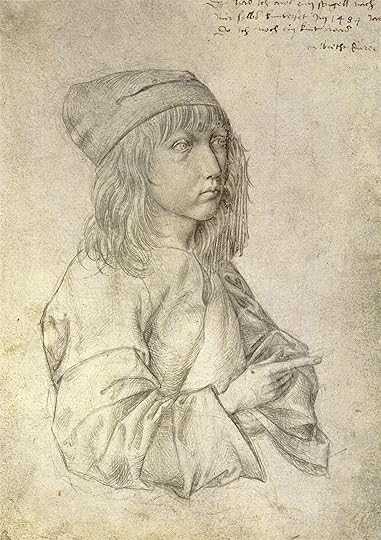
Self-portrait at 13
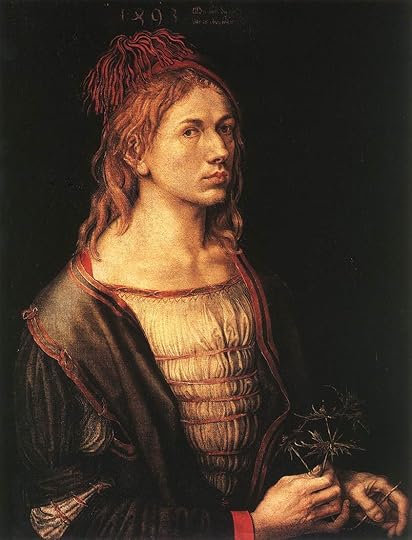
Self-portrait at 22
This being a Taschen book there are plentiful reproductions of the famous German painter, Albrecht Durer, who lived from 1471 to 1528.
Durer (I think) was the first German painter to become famous. His works are remarkable for their detail, expressiveness and versatility. His engravings (or etchings) are one-of-a-kind in the history of art.
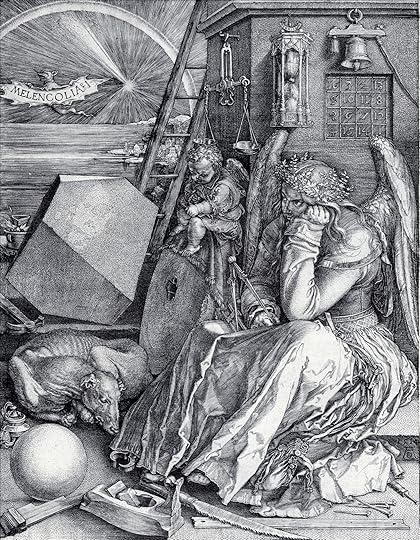
Melancolia I, 1514
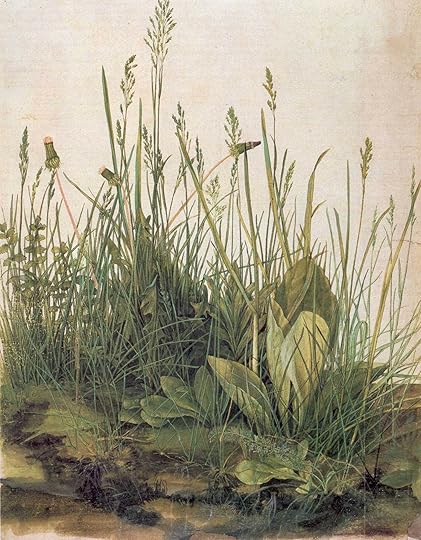
Large piece of Turf, 1503
During his lifetime he travelled to Italy where he was exposed to the great Italian paintings of the era. The author suggests that it was in Italy that Durer studied and improved his use of colour. To further market his art Durer also travelled to Belgium (Antwerp) and the Netherlands from his residence in Nuremburg. Given the time period I would imagine these journeys were long and arduous.
I wish the author would have discussed more Durer’s self-portraits which are most striking. We are provided with the context of Durer’s life which was when Martin Luther rebelled against the Catholic Church.
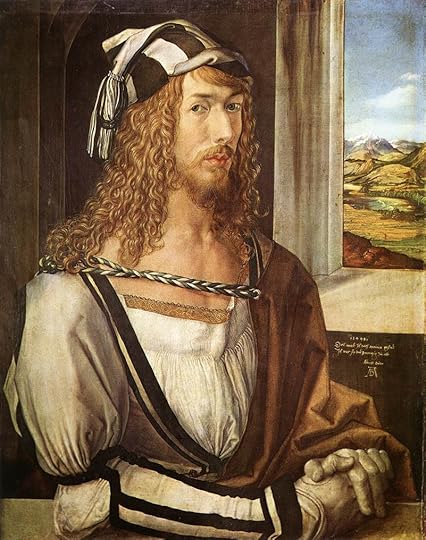
self-portrait age 26
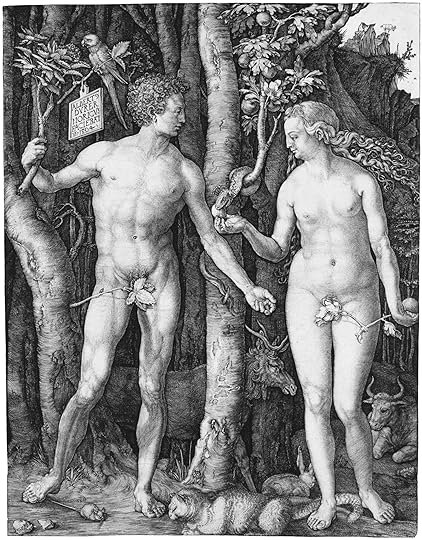
Adam and Eve, 1504
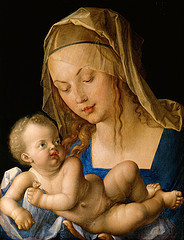
Virgin and Child, 1512
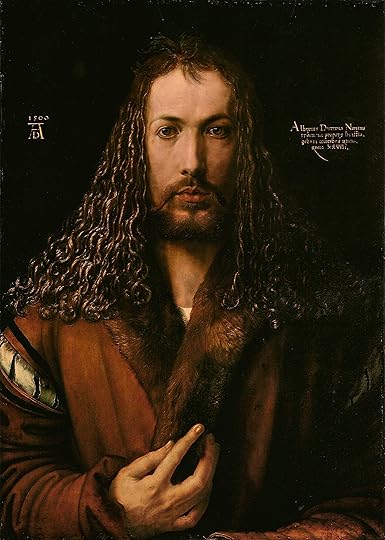
self-portrait age 28

May 9, 2020
This book boasts stunning full page illustrations and a massive amount of rich detail that familiarizes the reader with every aspect of Dürer’s legendary work. By the end, the reader has an excellent visual grasp on the body of his work. The book also has a long biography of Albrecht himself, but this is where it loses stars. For how blatantly religious Dürer was, the author fails to capture his faith’s influence on his work, the most quintessential aspect of his work. I felt it didn’t emphasize his influence from Luther and the reformation, even though it’s evident from his writings that he was strongly affected by it. Not only this, it goes on to impose painfully modern views, biases, and accusations in a paltry attempt at progressive historical revision. From multiculturalism to homosexuality, the author graps at straws attempting to make Dürer out to be an image of the modern secular world rather than a man of faith in a time of religious turmoil. Overall, the author’s handling of the nuances of Dürer’s life and person are weak at best and revisionist lies at worst, but it is still an excellent visual introduction to the artist.

Read
July 4, 2025William Blake has become my favorite visual artist over the past year or so. I love some of his poetry, but struggle with a lot of it. But the art is fantastic.
So when I found out that Dürer was one of his favorites I tracked this down.
The art is great, and the accompanying bio/context is decent.
Recommended!
So when I found out that Dürer was one of his favorites I tracked this down.
The art is great, and the accompanying bio/context is decent.
Recommended!

January 9, 2025
This homeschooling mom needed an overview of Dürer before our 6 weeks with his art began. What I gained in this book was: an interesting biography of his life events, highlights of his achievements, “firsts” and other notable moments (ex: first copyright infringement lawsuit!), and his place in the Renaissance movement unfolding around him. Art history was not my thing, so I needed it all. *Though, I have read some other reviews that question the author’s revisionist attempt to paint him as a symbol of modernity and progressivism rather than a man of committed faith. Bias noted.* Also, I don’t have loads of extra time for free-reading, so I was grateful I could gulp it down in an hour or two one night. It has enough detail to go a bit deeper, but not so much that it’s tedious - can be skimmed at need.
The other thing I was looking for in this biography was PICTURES. I’m grateful to say this book heaps a generous helping of detailed images on your plate. Each art piece is relevant to the text in the biography, and the main works are printed nice and big, so that when I set them in front of the kids for a picture study, we will be able to appreciate the vivid detail of the fabric and fur and glints of eye which characterize many of Dürer’s portraits. It is really helpful visual overview of Dürer’s style and body of work.
Through this book, I have grown to know and care about the artist. This helps so much when you are a mother-teacher and you’re about to present odd-looking works of art to the kids. I’m excited, for example, to show them the Rhinoceros while I pass along the fact that he created this likeness entirely from a 3rd party sketch and verbal description. (Amazing.) When your teacher is amazed instead of confused or judgmental, it’s inviting instead of distracting. They can just make relations with that artist and their work unhindered. I’m grateful this book was just the ticket for us with this.
Also, just a note to my future self: this book is not for freely handing to the children. There are speculations in the text about whether he was fascinated by homosexuality, discussions about a painting’s “libidinous” tones, and more than a little nudity throughout. Good for a flip-through with them, and for comparing his different works across the formats and through the years.
The other thing I was looking for in this biography was PICTURES. I’m grateful to say this book heaps a generous helping of detailed images on your plate. Each art piece is relevant to the text in the biography, and the main works are printed nice and big, so that when I set them in front of the kids for a picture study, we will be able to appreciate the vivid detail of the fabric and fur and glints of eye which characterize many of Dürer’s portraits. It is really helpful visual overview of Dürer’s style and body of work.
Through this book, I have grown to know and care about the artist. This helps so much when you are a mother-teacher and you’re about to present odd-looking works of art to the kids. I’m excited, for example, to show them the Rhinoceros while I pass along the fact that he created this likeness entirely from a 3rd party sketch and verbal description. (Amazing.) When your teacher is amazed instead of confused or judgmental, it’s inviting instead of distracting. They can just make relations with that artist and their work unhindered. I’m grateful this book was just the ticket for us with this.
Also, just a note to my future self: this book is not for freely handing to the children. There are speculations in the text about whether he was fascinated by homosexuality, discussions about a painting’s “libidinous” tones, and more than a little nudity throughout. Good for a flip-through with them, and for comparing his different works across the formats and through the years.

February 24, 2021
I like the basic art series by Taschen. The format and size are great and they do give you a nice introduction. I loved looking at the beautifully printed reproductions of Durer’s art. He really was a singular talent and I just love how he draws nature(such cute cows). Actually I really like how he paints people too. He really was a polymath who possibly was the first to the concept of the “selfie.” All jokes aside, his religious art, fueled by his own religious fervor and strong leanings towards the Lutheran reformation is impactful and beautiful. They really do evoke strong reactions in the viewer.
The text could be better, it was a bit dry in spots. There is lots of flipping around to see the works being referred to. But I suppose that can’t be helped. I shall be reading more of this series.
The text could be better, it was a bit dry in spots. There is lots of flipping around to see the works being referred to. But I suppose that can’t be helped. I shall be reading more of this series.

August 27, 2018
The book gives a fair introduction to Dürer’s life, successful, upward moving and prosperous, with a myriad of pictures featuring his major works. To a reader who just wants to learn a thing or two about this famous renaissance artist, this book does the job. But I was drawn to this artist for his erudition and scholarly aspirations, as demonstrated by his works, such as Saint Jerome in his Cell(1514), Melancholia I(1514), Knight, Death and the Devil(1513). Naturally, I would wish this introduction had devoted more attention to Dürer’s inner life and intellectual theorizing as how they informed his art and life, instead of having lavished pages and pages on what kinda worldly success he enjoyed both in Germany and Europe. Having said that, this Tachen book does give a comprehensive treatment of a wide range of Dürer’s artworks: altarpieces( He endorsed the Reformation at first, but later kept his distance from it), portraits for prominent noble families, personal studies on specific subjects. The third one interests me the most.
Out of the analysis of Dürer’s most talked-about work, a copper engraving, Melancholia I, one point struck a cord with me: “The putto, greyhound, tools and solid geometric figures represent firstly the creative possibilities of the human condition, and secondly the dangers that result when paralysis overtakes the power to act. ” As I am prone to fall victim to indolence, I should consider getting myself a copy of Melancholia I, lest I forget the dangers of being lazy.
Out of the analysis of Dürer’s most talked-about work, a copper engraving, Melancholia I, one point struck a cord with me: “The putto, greyhound, tools and solid geometric figures represent firstly the creative possibilities of the human condition, and secondly the dangers that result when paralysis overtakes the power to act. ” As I am prone to fall victim to indolence, I should consider getting myself a copy of Melancholia I, lest I forget the dangers of being lazy.

December 6, 2014
A great followup to yesterday's lecture at the Harvard Art Museums:
Albrecht Dürer’s Master Engravings—Melencolia, St. Jerome, and Knight, Death, and the Devil—500 Years Later | Harvard Art Museums (http://goo.gl/YMYy4d)
Friday, December 5, 2014
In 1513–14, Dürer produced his most celebrated prints, once presumed to be a grand scheme of unified meaning that together represents the medieval scholastic virtues of morality (Knight), intellectual inquiry (Melencolia), and theology (Jerome). Come hear Marjorie B. Cohn, the museums’ Carl A. Weyerhaeuser Curator of Prints, Emerita, discuss these works.
Presented in the Art Study Center, Up-Close Seminars provide unique opportunities to explore original works of art in an intimate setting. Led by a variety of speakers, these seminars address a wide range of objects in the collections of the Harvard Art Museums that are not currently on view in the galleries.
The book is certainly more expansive that the three "Master engravings" discussed.
Albrecht Dürer’s Master Engravings—Melencolia, St. Jerome, and Knight, Death, and the Devil—500 Years Later | Harvard Art Museums (http://goo.gl/YMYy4d)
Friday, December 5, 2014
In 1513–14, Dürer produced his most celebrated prints, once presumed to be a grand scheme of unified meaning that together represents the medieval scholastic virtues of morality (Knight), intellectual inquiry (Melencolia), and theology (Jerome). Come hear Marjorie B. Cohn, the museums’ Carl A. Weyerhaeuser Curator of Prints, Emerita, discuss these works.
Presented in the Art Study Center, Up-Close Seminars provide unique opportunities to explore original works of art in an intimate setting. Led by a variety of speakers, these seminars address a wide range of objects in the collections of the Harvard Art Museums that are not currently on view in the galleries.
The book is certainly more expansive that the three "Master engravings" discussed.

April 15, 2015
A beautiful book and fitting tribute to a brilliant artist.

December 15, 2025
Como libro para tener las principales obras de Durero en formato papel, a color y en buena calidad está muy bien pero el texto es horrible. De ahí las 3 estrellas.
El texto es demasiado biográfico, da detalles innecesarios, no explica las obras que contiene y en muchas ocasiones incluso introduce datos que son meras suposiciones no probadas como la supuesta homosexualidad o pederastia del pintor. Es absurdo pretender introducirse a la obra de un artista como Durero desde su biografía. Es como si en teoría literaria intentáramos explicar el Quijote desde la biografía de Cervantes en vez de como parodia de las novelas de caballería. Da muchísima pena porque Durero es un autor plagado de simbología, de elementos neoplatónicos en sus cuadros que lamentablemente quedan sin explicar o simplemente son tocados de manera tangencial porque al autor le parece más importante decir cuántas personas vivían en Núremberg en la época o si la mujer del pintor venía de una familia de orfebres. Totalmente lamentable y me da mucha pena porque la edición de Taschen es una maravilla a nivel visual.
El texto es demasiado biográfico, da detalles innecesarios, no explica las obras que contiene y en muchas ocasiones incluso introduce datos que son meras suposiciones no probadas como la supuesta homosexualidad o pederastia del pintor. Es absurdo pretender introducirse a la obra de un artista como Durero desde su biografía. Es como si en teoría literaria intentáramos explicar el Quijote desde la biografía de Cervantes en vez de como parodia de las novelas de caballería. Da muchísima pena porque Durero es un autor plagado de simbología, de elementos neoplatónicos en sus cuadros que lamentablemente quedan sin explicar o simplemente son tocados de manera tangencial porque al autor le parece más importante decir cuántas personas vivían en Núremberg en la época o si la mujer del pintor venía de una familia de orfebres. Totalmente lamentable y me da mucha pena porque la edición de Taschen es una maravilla a nivel visual.

July 25, 2018
I really like these Taschen basic art books. Norbert Wolf is a well known art historian and did a great job in conveying the basic facts and cultural background informing the work of Albrecht Durer. Illustrations and copious and good enough quality and this is probably the perfect introduction to the artist's life and work. I also loved the Taschen basic art book on Bruegel https://www.goodreads.com/review/show...

June 12, 2021
This is an excellent short overview of the life and career of Albrecht Dürer examined through his artwork. This volume has numerous colour plates of the different pieces of Dürer's including his landscape watercolours, religious engravings, portraits, pencil sketches and more, like others in the Taschen series. The volume is divided into seven sections, which included his work for the city and emperor, his religious pieces, a chronology of his life and more.
September 3, 2019
The text was small but I think there are later editions that rectify this. Other than this the content was very good. Good amount of illustrations and very detailed text. As for Durer; he was a brilliant artist. There is an arrogance to his paintings, particularly his self-portraits. It is not normally a likeable trait but Durer has backed himself up with his talent.
March 7, 2021
we are all going to hell

August 12, 2011
A brilliant representation of a man that inevitably fails to match his own self-portrait

September 20, 2011
Truly fascinating.

Displaying 1 - 17 of 17 reviews