Jump to ratings and reviews
Rate this book

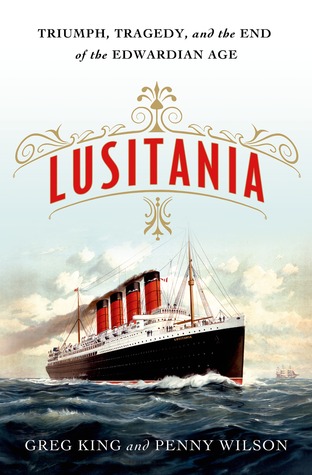
Lusitania: Triumph, Tragedy, and the End of the Edwardian Age

Rate this book
On the 100th Anniversary of its sinking, King and Wilson tell the story of the Lusitania's glamorous passengers and the torpedo that ended an era and prompted the US entry into World War I.
Lusitania: She was a ship of dreams, carrying millionaires and aristocrats, actresses and impresarios, writers and suffragettes – a microcosm of the last years of the waning Edwardian Era and the coming influences of the Twentieth Century. When she left New York on her final voyage, she sailed from the New World to the Old; yet an encounter with the machinery of the New World, in the form of a primitive German U-Boat, sent her – and her gilded passengers – to their tragic deaths and opened up a new era of indiscriminate warfare.

A hundred years after her sinking, Lusitania remains an evocative ship of mystery. Was she carrying munitions that exploded? Did Winston Churchill engineer a conspiracy that doomed the liner? Lost amid these tangled skeins is the romantic, vibrant, and finally heartrending tale of the passengers who sailed aboard her. Lives, relationships, and marriages ended in the icy waters off the Irish Sea; those who survived were left haunted and plagued with guilt. Now, authors Greg King and Penny Wilson resurrect this lost, glittering world to show the golden age of travel and illuminate the most prominent of Lusitania's passengers. Rarely was an era so glamorous; rarely was a ship so magnificent; and rarely was the human element of tragedy so quickly lost to diplomatic maneuvers and militaristic threats.

400 pages, Hardcover

First published February 18, 2015

101 people are currently reading
1418 people want to read

About the author

Greg King

35 books168 followers
Greg King (born 1964) is an American author, best known for his biographies of prominent historical figures.

He is the author of eleven internationally published works of royal and social history, specializing in late Imperial Russia and Edwardian-era royalty, including The Fate of the Romanovs, The Court of the Last Tsar, and the UK bestseller The Duchess of Windsor. A frequent onscreen expert and commentator for historical documentaries, his work has appeared in Majesty Magazine, Royalty Magazine, Royalty Digest, and Atlantis Magazine.

Source: wikipedia.com & us.macmillan.com

Ratings & Reviews

What do you think?
Rate this book

Friends & Following

Create a free account to discover what your friends think of this book!

Community Reviews

5 stars
131 (22%)
4 stars
236 (40%)
3 stars
162 (27%)
2 stars
42 (7%)
1 star
10 (1%)
Displaying 1 - 30 of 113 reviews
Profile Image for Matt.
1,054 reviews31.1k followers
April 26, 2016
This is the third book I’ve read in the run-up to the 100th anniversary of the sinking of the Lusitania. If you’re asking, it wouldn’t be the first book I’d recommend. Nor would it be the second. If you asked me for a third option, I would change the subject in my typical fashion, by pointing at something behind you, and then running away.

To clarify: The first book I’d recommend is Erik Larson’s Dead Wake. The second would be Diana Preston’s Lusitania: An Epic Tragedy. Both of them are highly readable, with Larson’s more tightly focused and briskly paced, and Preston’s more thorough and definitive as to all aspects of the disaster.

As for Greg King and Penny Wilson’s Lusitania: Triumph, Tragedy, and the End of the Edwardian Age? It’s for completists only. It’s for the person who can’t sleep at night for the nagging fear that there’s a Lusitania fact they’ve missed. This book doesn’t offer anything that isn’t presented more ably and entertainingly in those other two books. I read it out of an irrational suspicion that I might be missing something – and that what I missed might matter. It turns out I was not.

This is not to say I hated this book. I didn't feel any such strong emotion, good, bad, or otherwise. Taken in a vacuum, you might even find this a decidedly fine Lusitania entry. But we don’t live in a vacuum. We live in a snow globe perched precariously upon the shell of a giant turtle. There are other Lusitania books out there, so this one gets graded on a curve; and the curve is steep.

My first problem with King & Wilson’s book is its angle. Their subtitle – “the End of the Edwardian Age” – gives it away. This is a book about the Saloon Class passengers, a.k.a. the First Class passengers, a.k.a. the rich people. This isn’t necessarily a deal breaker. Faced with an unforgiving sea, both the rich and poor are quite the same. Besides, people are interested obsessed with wealth. We watch reality television shows about the rich and famous because those lives are so different from our own. Sometimes we watch aspirationally; other times, we watch with a bit of schadenfreude, hoping to see their foibles. Us Weekly has a section called “Stars – They’re Just like Us!” King & Wilson might have been going for a really dark version of that.

The way they go about it, however, is extremely tedious. King & Wilson open a chapter by briefly orienting you as to time and place, i.e., the day of the voyage, the location of the ship. Then they’ll introduce a First Class passenger and give an extended biography before segueing to the next person. Granted, some of these micro-biographies are fascinating. However, there is no real attempt to gracefully integrate these stories into the larger, more relevant narrative of the Lusitania’s final voyage. In Dead Wake, Erik Larson used his details to make certain passengers stand out during the sinking, making it easier to follow them during the chaotic events following the torpedoing. There is not attempt to do likewise here. Instead, each chapter feels like an information dump. Hey, we got all this research done, and it has to go somewhere!

(Lengthy side note: I am grudgingly willing to forgive the authors for completely neglecting steerage. The chief reason is that this is clearly not a comprehensive history. If you want to write about First Class, there’s room in the world for a book solely about First Class. It’s unimaginative, but to each his or her own.

Second, unlike the sinking of the Titanic, there has never been any controversy, at least that I’m aware of, regarding treatment of steerage passengers during the sinking. On Titanic, 62% of all First Class passengers survived, as compared to 25% of all Third Class passengers. The percentages are even more glaring when you look at gender. 97% of First Class women survived, while only 46% of Third Class women did. That’s some deviation. You do not have to accept the charge that Titanic officers deliberately locked people below. In my view, Captain Smith botched the evacuation so badly that it’s unlikely the thought ever occurred to him. Such an act of deviousness required organization badly lacking on Titanic that night. Still, even giving the officers and crew that benefit, there is no doubt that steerage passengers were neglected to death. Witnesses recalled a surge of Third Class passengers onto the Boat Deck as Titanic made her final plunge. They had been left below, and only in the final moments did they find their way up.

Aboard the Lusitania, on the other hand, the survival rate for First Class was 39%, as compared to 36% for Third Class. Lusitania sank in 18 minutes, as opposed to Titanic’s 2 hours, 40 minutes. There was not enough time aboard “the Lucy” to organize preferential treatment for any class. There was never any romantic notions of “women and children first.” All order broke down quickly. A moving, burning, sinking, tilting ship. Half the lifeboats unusable. The able seamen all gone to Naval vessels. It was every man for himself. The total breakdown of civilization in microcosm. This accounts for the shockingly high death toll of the very young on the Lusitania.

That said, it irritated me that the authors’ explain their focus on the one-percent as a lack of sources. This smacks to me of a half-shamed rationalization, as well as laziness. As a fellow Goodreader pointed out to me, a simple Google search for Lusitania survivors will take you to a wonderful web-based resource [http://www.rmslusitania.info/] that has linked bios on many Third Class passengers, and other links that take you to primary sources about those people. So, I don’t think a lack of sources compelled the negligence of steerage in this book. I think they used that as cover to do what they wanted to do all along: write about the rich people. Again, this is fine – just be honest about it. End lengthy side note).

Getting to the sinking is a chore, as you have to wade through a Who’s Who of 1915 high society. Once the torpedo strikes, I found the same old accounts of the sinking that are in other books, except that other books do a better job of arranging them. Again, I’m man enough to admit that I might be suffering a bit of Lusitania-lash. Maybe I’ve just read too much in a short period. Whatever the reason, King & Wilson’s sinking set piece did not make me forget all the book’s other nagging flaws.

Even when the authors hit upon something new or contra to conventional wisdom, they immediately drop the thread and move on. For instance, King & Wilson quote extensively from crewmember Leslie Morton’s extensive testimony and remembrances. Morton is often portrayed as a hero in Lusitania narratives. In his own story, he becomes a plucky adventurer with a fine eye for detail. He was also one of the lookouts to first spot the torpedo from Walter Schweiger’s U-20. King & Wilson, however, accuse Morton of abandoning his post.

At 2:10, [Morton] spotted “a thin streak of foam making for the ship at a rapid speed” some five hundred yards in the distance, followed by the wake of what he took to be a second torpedo. “Torpedoes coming on the starboard side!” he shouted through his megaphone. Morton was supposed to wait until his warning had been acknowledged; instead, he was racing across the deck to tell his brother John when he felt “a shock all over the ship…”

No one heard Morton’s warning: a critical thirty seconds passed before Thomas Quinn, high up in the crow’s nest, grabbed his voice tube and reported to the bridge…

Now you have my attention. This is something I haven’t heard before. An explanation as to why, on a clear fine day, the torpedo was spotted too late for the ship to take evasive action. This theory demands expounding. You have just accused a sailor of failing his duty in such a way as to put thousands of lives in jeopardy. But King & Wilson don’t expand. They just move on with the story. The endnotes don’t help at all. There is no amplification. There is no quoting of testimony (i.e., “I never heard Morton’s warning”). This turned my vague indifference into something more like frustration.

This was not the book for me. It might be for you. If you didn’t read any other Lusitania title this centennial year, you might find this one perfectly serviceable. But if you’re really only going to read one, choose another.
Profile Image for Jill H..
1,638 reviews100 followers
January 31, 2020
I think reading Erik Larson's masterpiece, Dead Wake: The Last Crossing of the Lusitania spoiled me for any other books on that horrible sea tragedy. But that is not the only basis for giving this book three stars. Some of my complaints follow:
* a plethora of characters, almost exclusively first class passengers which was very confusing
* overabundance of description of the interior of the ship. Down to every detail including the bathrooms.
* no pictures of the Lusitania except for a couple of old exterior shots. With no schematic of the interior or exterior, the reader has trouble trying to place where people were, where the lifeboats were, where the torpedo would have hit, etc.
* no map(s) of the position of the Lusitania or the U-20 (submarine)

There is, however, a good discussion of the Cruiser Rules, promulgated by the Hague Convention of 1907 which governed the sinking of a neutral or merchant ship.....a warning shot across the bow and time for the passengers to abandon ship. This rule had been broken by Britain earlier in the war, so it became meaningless.

The author also posits different reasons for why the Lusitania sailed into a war zone even though the German Embassy had posted a notice in the NY newspapers that stated that those traveling across the Atlantic did so at their own risk. Some of his reasoning is food for thought while others are stretching a point and slightly ridiculous.

Certainly not a bad book and one that might be a companion piece to Larson's if you are interested in the lives of the first class passengers.....otherwise, give it a pass.
Profile Image for Susan.
3,022 reviews570 followers
January 2, 2020
With the anniversary of the sinking of the Lusitania coming up in May 2015, there are a number of new books on the market; including “Dead Wake,” by Erik Larson (which I look forward to reading) and an excellent Kindle Single, “Act of War,” by Diana Preston and Michael Preston, which is a very good introduction to the subject. Previously, I had read, “Wilful Murder,” by Diana Preston and thought that also a very interesting read. However, I have to admit that I have long loved books by Greg King and Penny Wilson – both individually and together – so I was looking forward to reading this immensely and it did not disappoint.

Subtitled, “Triumph, Tragedy and the End of the Edwardian Age,” the authors attempt to concentrate on the human stories and follow several passengers – mostly from First Class and some from Second Class (their theory being they are better documented) as well as Officers and Crew. This is very much a depiction of the last voyage of Lusitania, rather than a book dwelling on conspiracy theories, although obviously reasons for the tragedy are discussed. The list of passengers included the immensely wealthy, the famous, businessmen and those travelling to visit relatives injured in the first world war, or looking to undertake relief work. Just a handful of passenger names include Josephine Brandell, an American opera singer, actress Rita Jollivet, Alfred Gwynne Vanderbilt, Charles Frohman, a central name in the theatrical world, hotelier Albert Clay Bilicke and automobile manufacturer Charles Jeffery.

The First World War started a year before Lusitania embarked on her last voyage, but America was unwilling to get embroiled in a European conflict and remained isolationist and neutral. Three years before leaving New York, the Carpathia had docked with the survivors of Titanic; now Lusitania was getting ready for her seven day voyage. As well as certain passengers being warned not to sail, there was an ominous announcement in the newspapers, by the German embassy, warning that ships were liable to destruction in the waters around the British Isles. Warnings were dismissed as propaganda and passengers reassured that the ship could outrun submarines and it was suggested that the Admiralty would provide protection once Lusitania reached dangerous waters. However, the expected escort did not materialise as Lusitania approached the Irish coast and, indeed, neither was the ship was not going at full speed. Still, ships had been torpedoed shortly before Lusitania sailed and, instances where ships had sailed under neutral flags and refused to heed warning shots, had led to the Germans seeing all ships as possible targets – including those carrying civilians.

It is obvious that, although most people thought it impossible that the ship would be attacked, there was a mood of nervousness and contemplation on board ship. Many passengers were urged to put their financial affairs in order before sailing, some slept in staterooms or on deck as they neared the danger zone and others mentioned the air of tension among passengers. Of course, much of this had to do with other matters – the war had already affected many of the passengers lives in other ways, even before the sinking. However, the authors paint a very detailed portrait of life on board and of many of the people sailing. It is also obvious that little was done to protect the ship, regardless of the danger and the warnings. Passengers who complained about the lack of information on what to do in an emergency – such as lifeboat drills or even showing passengers how to put on their lifejackets – were curtly informed it was not necessary, or fobbed off with assurances, or even warned to refrain from upsetting other passengers.

When disaster did strike and a U-boat torpedoed the ship, chaos ensued. Lusitania sank swiftly and the crew were unprepared and – often – unhelpful. Of course, Cunard had a crew of whoever they could find, as so many men were fighting in the war, so it is reasonable to say these were not of the standard the line would normally expect. Still, some of the stories of crew threatening passengers, taking life jackets for themselves, being unable to successfully launch the lifeboats due to lack of knowledge, and of the lack of direction from Captain Turner, are shocking. This book follows those passengers we have read about, after the sinking, and we discover what happened to them, the aftermath and the international condemnation that followed events. This is a very interesting read; the pages are populated with fascinating characters and it is dreadful to get nearer the point of the sinking and imagine what they went through. The authors attempt to debunk some myths and look at the events of that time, and that era, through the eyes of the people involved. An excellent book and highly recommended.
Profile Image for Teresa.
755 reviews213 followers
June 8, 2025
As well as always being fascinated with the Titanic, I've also had an interest in the Lusitania. This came about because I visited the Titanic museum in Cobh in Co. Cork which is the next county to my own. It was only then I realised the Lusitania had sunk off the coast there and the museum has part of it dedicated to this event.
The book was absorbing. I learned so much from it. The wealth on this ship equaled, if not surpassed, the wealth on Titanic. The passengers did really take their lives in their own hands by boarding and sailing on her. They had been warned that Germany would torpedo any English vessels sailing in the war zone off Ireland and England.
The captain had a lot to answer for. Reading this he was totally incompetent but he was a seasoned sailor and captain so this is hard to understand. The crew, a motley lot, who were scraped together becausea lot of sailors had joined the war, were useless in the extreme. Their actions beggars belief.
Yet just like the Titanic, the Enquiry into the sinking was a farce.
If you like this kind of history it's definitely a must read. There are about seventy five pages at the end that deal with notes, bibliography and index. A couple of websites are also included for further reading.
I dropped a star because there were so many people mentioned in it I found it hard to keep track of them all but that's just me.
Profile Image for Nigeyb.
1,478 reviews409 followers
November 14, 2021
The extent to which you are likely to enjoy Lusitania: Triumph, Tragedy, and the End of the Edwardian Age about the sinking of the Lusitania will largely depend upon your appetite for reading about the lives of the rich and privileged passengers who were aboard the vessel when she sank in May 1915. There were a lot of them, and authors Greg King and Penny Wilson spend the majority of the book providing details of their background, their lives and their intrigues, along with descriptions of the Lusitania's luxurious interiors. I am interested in the era and so found much to enjoy in this information. The knowledge of what is to befall all these people adds poignancy and an added grim fascination.

The drama of the actual sinking is truly gripping and it really helped me to imagine the experience and terror of being torpedoed and then sunk, on a vessel that was ill prepared for such an eventuality. The perfect storm of the Lusitania’s captain, Turner, making a succession of inexplicable errors of judgement, Britain waiving the "cruiser rules" (which made all liners liable to be torpedoed without warning by the enemy), and Germany’s new U-boats, all conspired to doom the Lusitania.

The story continues after the boat sinks and follows the survivors to Ireland and beyond, and also details how the lives of some of the survivors played out.

It’s an extraordinary tale and Greg King and Penny Wilson really do it justice in this engaging, thoroughly researched and well written account that personalises the tragedy whilst providing sufficient historical information to help the reader to view the tragedy within a broader historical context.

4/5

Profile Image for Jerome Otte.
1,916 reviews
August 20, 2025
A lively, readable and well-written work.

King and Wilson begin the book by describing the ship and some of its passengers. The description of the ship’s sinking is compelling, and the portraits of the people on board give the narrative an intimate feel. They explore the stories of the victims, survivors and their families after the sinking, and after the war. They also note how many of the ship’s upper-class passengers had, until their encounter with the U-20, been largely insulated from the horrors of war.

The book can be a bit repetitive or tedious at times, with lots of detail on things that don’t seem important. If you’ve read books on this subject before, you probably won’t find anything new. Some readers might find the ship and its interior hard to visualize. Also, the book focuses mostly on wealthier passengers, with a much hazier picture of lower-class ones (in the introduction the authors insist, somewhat amusingly, that this isn’t because of any kind of class prejudice) There’s also little on the German reaction.

A well-researched, accessible and comprehensive work.
Profile Image for Katherine.
745 reviews33 followers
January 1, 2015
Almost everyone in the world knows the story of the tragic collision of the Titanic and an iceberg in the North Atlantic. This is the story of an equally elegant ship populated by equally affluent and influential people sailing in unbelievable opulence in the opposite direction during a period when most of the Western world was at war. Here, then, is the Lusitania, the fastest ship on the seas, sailing under the guise of American neutrality from New York to Liverpool, through the Irish Sea and the war zone in which lurked German U-Boats.

On May 7, 1914 the commander of U-20 ordered the release of the torpedo that would send Lusitania to the bottom of the ocean within 15 minutes! That event, however, just a little over a hundred years ago, comes at the midpoint of this engrossing little book.

The authors begin the tale by setting the scene for us financially: a good motor car that would cost $1000 then, would in today's dollars cost $23 000. They provide a cast of characters, whose names and personalities are very familiar to the reader by the time the first explosion that rocked them and their late lunch, with portholes open to allow the lovely Spring breeze to enter the elegant rooms under an almost cloudless blue, sun drenched sky eleven miles off the shores of Ireland.

The writing's tone draws the reader into the early days of leisurely sailing with multiple changes of clothing, promenades and reading and lounging in deck chairs, writing letters, eating fabulous meals with strangers who become temporary friends, and following the social admonitions of Emily Post throughout. Yet, for some, there is some apprehension --the possibility of attack and the apparent lack of safety measures causing concern.

When the torpedo does come the reader, just as the passengers, experiences the shock, but disbelief that the ship will sink, through the fear, and panic and frantic reactions. We are carried overboard to be pulled down in the ship's suction only to bounce up. floating under an impossibly beautiful sky in freezing water. Eventually, some are saved and the authors take us ashore with them to the little town of Queensland and the beach where those who died wash up.

We are carried through the political manipulation of the story and then in an epilogue, we revisit the survivors to find what their lives became after the tragedy. It is such a well written book that the story seems as current as any in this morning's newspapers. The men and women and children--the passengers--the Captain and his officers on the Lusitania and even the Commander of the U-Boat are three-dimensional and real.

Anyone who enjoys the stories of the Edwardian Age and all its apparent splendor, who is fascinated by the social and technological changes of the early 20th century and who is interested in great human tragedies will find this book extremely rewarding and a fast read. It is, however, a book whose story lingers and brings home once more the fact that all the money in the world cannot protect mere mortals from overwhelming events and that some of the poorest of the poor can manage to survive them.

This was an Advance Uncorrected Proof that I received from BookBrowse to review
Profile Image for Jo.
186 reviews12 followers
April 20, 2015
Sorrowfully lacking in detail. Reads as if the authors hurriedly read it "there" and then put it "here", which would explain the bibliography and the sources, sans detailed notes. The passengers are all thrown into the mix much as they ended up in the water following the sinking; keeping them straight was a chore, which is beyond sad as this, after all, is their story.
Very few photographs. No maps. No schematic of the ship's layout, yet scads of detail about period decor, fabrics and what was on the menu.
WWI is going on, yet the reader is given next to nothing pertaining to the major players in the respective governments involved. Wilson, Churchill, Kaiser Wilhelm, their military brass and ambassadors flit in and out of the narrative like afterthoughts.
An unforgettable event condensed into a very forgettable book.
Profile Image for Zach Schwarz.
263 reviews31 followers
May 5, 2023
I have wanted to finally read this book for years now. The Lusitania has always been one of my favorite historical topics and I have done my own research into many of the passengers on its final, fatal voyage. I saved this book for the first week of May, to try and mirror its final crossing in 2015. It was refreshing to return to its decks and enjoy the well researched book by Greg King and Penny Wilson.

One of the strongest aspects of this book was the well researched background that the authors did on the passengers. They clearly enjoy the same little known details that I do and I loved reading about all the passengers that had become familiar to me during my own investigations years ago. It is always interesting to see how ship's passengers represent a microcosm of the world at the time. The usual scandals and trials and tribulations affected the Lusitania's passengers, much like society today. You had the usual millionaires like Alfred G. Vanderbilt and Charles Frohman but also many lesser known first class passengers of distinction. Josephine S. Eaton Burnside was a Canadian passenger and the daughter of Timothy Eaton, the founder of one of the biggest department stores in Canada. There was also a gay couple who lived, travelled and ultimately died together. You would not think something like this would be obvious in 1915 but it was clearly the case with Henry B. Sonneborn and Leo M. "Lee" Schwabacher. These are just a few of the examples featured in this book. While most of this was already known to me, it was a nice refresher and I enjoyed the book. It was a bit drawn out in the end but a solid 3.5 stars rounded up to 4.
Profile Image for MeriBeth.
106 reviews3 followers
April 2, 2015
Unlike the bulk of the King & Wilson collaborations I've read, Lusitania: Triumph, Tragedy, and the End of the Edwardian Age is extremely tedious. It's almost as if they did all this research into the people aboard, the event, and the ship then couldn't decide what parts to cut. Thus the book rambles a lot, giving us detailed biographies of what seems like every person in first class, called Saloon Class by Cunard, with occasional additions of second class passengers, before finally getting to the sinking. The extreme levels of detail about the people and the ship turns what should be an exciting book into a tedious slog. I actually ended up skimming much of the book until we reached the sinking of the Lusitania where things briefly picked up again. Soon, the book was bogged down again with detail yet didn't really expand much on things I'd learned in previously published books and a variety of documentaries. This book is primarily useful in learning about the passengers not the sinking or the aftermath thereof.
Profile Image for Cienna.
587 reviews8 followers
June 9, 2022
A fascinating story of this ship and its tragic end. I would highly suggest this to anyone interested in WW1 history or just looking for a detailed story of the Lusitania.
Profile Image for Leigh.
1,180 reviews
January 28, 2016
While I enjoyed reading this book, I can honestly say it's not my favourite book on Lusitania. It reads more like a social history with descriptions of many first class passengers and their daily lives on board in the days leading up to disaster. At times it felt like the book took a back seat to the descriptions of the life of rich and famous people in 1915. There was about a handful of second class passengers and no one from third class. I felt this left a bit of a void. You can't get a good look at life on board during the crossing if you leave out a big chunk of people who were on the ship. But all that being said, it was a readable account and for the most part a relaxing read. Along with the usual passengers including in Lusitania books, Lady Mackworth, Avis Dolphin, Rita Jolivet and Alfred Vanderbilt there were people mentioned that I hadn't heard much of or didn't realize were on the ship, like one of Timothy Eaton's daughters and Lady Allan from one of the most powerful families in Montreal who had the Prime Minister inquiring if she survived the sinking. It turns out Canada and Lusitania have a lot of connections. Maybe someday someone will write their story as they did with the Titanic, or maybe they have and I just haven't found that book yet. So overall a decent read, good if you want to hear more about the passengers, especially those in first and second class, but if you are looking for an in depth look into the disaster, and what led up to it, from the U-20, to the Admiralty and all the behind the scenes politics, then I suggest books like Wilful Murder, Seven Days to Disaster or Dead Wake instead.
Profile Image for Lita.
43 reviews4 followers
April 2, 2015
I won a copy of this book from Goodreads. The majority of this book is spent on detailed descriptions of the first class deck and personal lives of the rich passengers on the last voyage of the Lusitania. A couple chapters deal with the sinking of the ship and addressing the political causes/results of the sinking. Most of the writing is a mentioning lots of names and personal histories that are difficult to keep straight and follow through the timeline of the book. I previously did not know about the sinking of the Lusitania, so was interested in learning what information was given, but it was a slow slog, not a page turner.
Profile Image for Lori.
652 reviews
November 26, 2018
I listened to the Audio version of the book and am
Glad I did. Johnny Heller narrated the story and was FABULOUS! Of course the writing was so well done that the description made you feel you were on deck of the Lusitania or walking the hallways and enjoying the meals. And also there for what was a terrible terrible crime against innocent people.

Johnny Heller’s voice and art of speaking was great. Totally kept me interested in such a sad story.

Very well written. I enjoyed the epilogue which filled you in on most if not all of the survivors and what happened years later in their lives.
Profile Image for Sarah W..
2,490 reviews33 followers
December 30, 2021
This book chronicles the last voyage of the ill-fated Lusitania, a luxurious ocean liner that sailed into a war zone and was targeted by a German U-boat. A few years ago, I read Dead Wake by Erik Larson, which covers much of the same ground as this book. In the case of this book, I wish the author had done more to connect the sinking of the Lusitania to World War I, which felt like important context which was skimmed over in this history. Overall, a decent history of the Lusitania, although I would recommend Larson's Dead Wake over this book.
Profile Image for Zosi .
522 reviews2 followers
March 14, 2020
This book provides a good overview and primer of the Lusitania disaster, though it follows so many people that they blended together at times. I would have loved to also see the authors follow some third class passengers too, though I understand why they didn’t. Probably not the most thorough book out there, but it was still an enjoyable read.
Profile Image for Al Berry.
699 reviews7 followers
March 25, 2020
Decent book on the Infamous ship; not really a look at the manufacture or technicals but really starting from that fateful voyage, with a look at several of the passengers crew and what occurred throughout the voyage, close attention is also paid to the Uboat Captain, and there is a bit of a mystery of whether or not the submariner fired one or two torpedos.
Profile Image for Jill Crosby.
874 reviews64 followers
March 4, 2024
Very good at giving faces to the names of the passengers of Lusitania’s final voyage. Could’ve used more diagrams & maps, though, in order to make May 7, 1915 clearer. Not overly stuffed with details and political hot-potato-ing, focusing more on what we KNOW than what we’ve speculated.
519 reviews14 followers
August 30, 2024
It was a bit hard to follow. In order for each person's story to be told the torpedo hit the vessel multiple times in the telling.
Profile Image for Penelope.
178 reviews33 followers
March 23, 2019
Brought the ship and the disaster to life. Couldn't put it down.
Profile Image for Johannes.
175 reviews7 followers
June 5, 2025
Being this book not my first one by Greg King, I was actually much surprised by what I found. As some do, I have a penchant for aristocracy, royalty, and history in general, which means I bought many of his books, for they are good. Until this one...
In all honesty I do not undestand what both authors were trying to do here, we were deluged with a lot of unconnected information, especially up to the sinking, there is pretty much zero relationship between most passangers, or even the crew. Not to mention we are CONSTANTLY reminded it is going to sink, yes, I know, "tragedy" is on its cover, I don't expect otherwise but come on, let it slip a bit so we can get into the narration for a while. As for it... "the narration", there is pretty much none. The ship's history is barely acknowledged, we don't get many facts about its history, Cunard's, or the current context as for WW1.

To sum it up, as others already stated if you don't know anything about the RSM Lusitania, and want to know its history just buy Larson's book first, this one could be omitted altogether.
Profile Image for William DuFour.
128 reviews6 followers
June 2, 2019
An interesting book on this event and with the who, what, why, and when. With info I didn't know about.
Profile Image for Michael Poirier.
16 reviews
February 28, 2015
We are nearing the centenary of the sinking of the Lusitania and a plethora of new books are coming out. Two highly regarded historians, Greg King and Penny Wilson, have written an amazing true story of wealth and scandal set aboard the final voyage that ended in a huge loss of life.

Focusing on the first class passengers, the authors use many rare accounts not normally seen in books to move the story along. They zero in on the intimate backgrounds and what brought them to be aboard the ill-fated Lusitania. King and Wilson detail the unique personalities such as a fairly open gay couple, a bigamist, a Broadway and silent screen star, a philandering millionaire, nobility from the far corners of Canada, Italy, Wales and Ireland, automobile manufacturers, art dealer, sufferagettes, spiritualists, a female architect, doctors, nurses, soldiers... Think of it as Downton Abbey at sea. Society columns followed many of these people- Alfred Vanderbilt, Rita Jolivet, Lady Marguerite Allan, Albert and Gladys Bilicke, George Kessler, Josephine Eaton Burnside, etc.. The large cast of characters used to move the story along are well-chosen and are so well-drawn that it gives the book an intimate quality as if we are peeking in on them. An impressive array of photos of the people and the ship help us as we try to picture who and what the authors are describing. The fact that several Lusitania families helped with information for this book shows the hard work of the authors.

The glamorous backdrop is the ship itself and the readers are treated to vivid descriptions of the Lusitania's luxurious interiors. Life at sea is not what it is today. As there were no commercial planes it was really the only way to get to another land. We follow this group as they make friends, sip tea, read, play cards, and dance, while trying in vain not to worry about submarines and torpedoes. The suspense of what is about to happen carries readers to the fateful day. The authors show the agony of trying to abandon the ship in 18 minutes. Many heroic deeds are recorded and sad tales of overturned lifeboats, parents separated from children, and strangers helping strangers in moments of peril.

The story does not end as the waters close over the stern; King and Wilson use their impressive research to show what happened to the survivors and the families of victims in later life. Some fortunes change for the better, others for the worse. I can assuredly say that this book will be very useful as a research tool in the future and highly regarded by lovers of history. Having read the authors previous works, I knew to expect a well-written book and I was not disappointed. I eagerly await their next work.
Profile Image for Lorrie.
337 reviews21 followers
June 30, 2017
This book tells the story of the maritime disaster of the sinking of the Lusitania, a luxury ocean liner torpedoed by a German u-boat in 1915, a few years after the sinking of the Titanic.

Don't know why, but I am fascinated by tragedies. Perhaps it's in reading of the depravity of mankind in instigating a tragedy or the heroism of mankind in a tragedy's aftermath. Probably both. Though I've recently become somewhat desensitized to how awful humans can treat other humans (it now happens so frequently and the acts just seem to get more vicious and deplorable), the acts of heroism restore my faith in humanity. I'm also forced to take stock in my own life, seeing how life can so abruptly end. But enough of the philosophizing...

This lesser-known maritime disaster, though it hasn't garnered nearly the amount of publicity as the Titanic, is, nonetheless, an intriguing story in its own right with an equally interesting lineup of passengers and crew. The authors detail the lives of many of the occupants so that when the disaster actually occurs, the reader has a vested interest in what happens to them. After the Lusitania was torpedoed, it took only 18 minutes to sink. The stories of some of the survivors are eerily similar to those of the Titanic; the difference is the condensed amount of time between being struck and sinking, thus less time to think, strategize, ponder etc. I could feel the horror. There was a mention of one woman prematurely giving birth while in the ocean. It seems the captain and the crew were not at all prepared; the passengers took over the lifeboats because it was apparent the crew had not been trained in what to do in the event of an imminent sinking. There were stories of many of the lifeboats crashing into the sea, "spilling" its occupants.

The book tells of the aftermath and how each party wanted to place blame solely on another party. It also goes on to give the reader glimpses into the lives of the survivors and how and when they passed on later in life.

My only criticism would be that there are no pictures. Please note, however, that I did read an ARC, so perhaps the finished product will include pictures.
Profile Image for Michael Griswold.
233 reviews24 followers
January 31, 2015
The story of the Lusitania is very similar to the Titanic in that a luxury ship meets an ghastly human tragedy with the exception that the Titanic hit an iceberg, while the Lusitania was torpedoed by a German U-Boat during World War I. While this book delves into the various theories surrounding the mystery of the Lusitania's sinking, the real strength of this book comes from Greg King laying out the real clash of civilizations that the event itself brought into focus. On one hand, you have this luxury ship that contains people of money and affluence who are (with exceptions noted in the book) sheltered from the horrors of the brutal world war. Yet they are spiraling towards the most brutal war that humanity had to known at that point. The juxtaposition of the dying breaths of the Edwardian Age and World War One is truly breathtaking.

As a reader, Greg King paints this world of wealth and privilege so well that I became entranced by it. Yet somewhere down deep inside, I was waiting for the ship to be torpedoed. This kind of gives the book the quality of a horror movie that one has seen dozens of times. You know what's going to happen, but you have to wait for the big moment. I thought that this approach was really beneficial because it allows the reader to feel how passengers perceived the world and how the real world eventually impacted them permanently. A masterful work of non-fiction that could appeal to both the seasoned history reader for its' depth of description and the younger set for the methodical, hypnotic, movie-like storytelling.
Profile Image for Jean.
1,816 reviews803 followers
March 10, 2015
This is the 100th anniversary of the sinking of the Lusitania. It is the sinking of the Lusitania that brought the United States into World War I. The Lusitania was one of the beautiful luxury lines of the gilded age.

King and Wilson have done an excellent job fleshing out the history of the ship’s last voyage and the people who sailed on it
. Albert Vanderbilt was probably the most famous American on board to parish with the Lusitania.
King and Wilson tells in detail about the ship itself, from 200 miles of electric wiring that ran through it, to the three barrels of live turtles that the chefs brought on board. Part of the book feels like a series of short biographies of the wealthy passengers.

The authors describe in detail the attack by the German U-boat U-20 and the successful torpedoing of the ship. King and Wilson tell of lifebelts stolen from cabins, rickety lifeboats plunging into the ocean, passengers in the water getting sucked under by the sinking ship. It took 18 minutes for the ship to sink with 1198 dead and 128 of those were Americans. The authors point out that it was a lucky shot; it hit just the exact right spot which caused the ship to sink so fast. Lusitania was owned by the British company Cunard and the Captain and crew were British. She ship set sail from New York to Liverpool in June of 1915. I read this as an audiobook downloaded from Audible. Johnny Heller did an excellent job narrating the book.

Profile Image for Ann Woodbury Moore.
827 reviews6 followers
March 15, 2024
1915 is the 100th anniversary of the sinking of the Lusitania passenger ship during World War I. Erik Larson's book "Dead Wake: The Last Crossing of the Lusitania" has received the lion's share of attention, but this title also showed up on the New shelf. To compare the two:
--Larson's is better written.
--Larson has much more on the political and military background and ramifications. He selects just a few passengers and crew to highlight and focuses on them throughout. King and Wilson primarily concentrate on the passengers, but feature so many that it's easy to get lost and wonder, "Now, who exactly was that?"
--King and Wilson have more information on the shipwreck itself and what happened to the people directly involved.
--King and Wilson are far more negative about the Lusitania's captain, William Turner, than Larson is.
--King and Wilson include a few black and white photographs (Larson has none, "Dead Wake"'s major flaw).
I reserved an old book by Robert Ballard (of Titanic fame) from the only library in our entire system that owned it, "Exploring the Lusitania" (Warner/Madison Press 1995--long out of print), to look at in conjunction with these two titles. Its concise summary of the Lusitania's voyage nicely covers all the facts, and the numerous illustrations are absolutely fascinating. It's wonderful to be able to actually see what Larson and King/Wilson describe. In some cases, a picture truly is worth a thousand words!
Profile Image for Cindi (Utah Mom’s Life).
350 reviews77 followers
January 14, 2015
Germany and England are already embroiled in World War I and German U Boats are patrolling the sea. But on the luxury liner Lusitania a first class passenger can still enjoy the excess of the Edwardian Era.

The early chapters of Lusitania are fascinating. The reader becomes immersed in the era and the lifestyles of the rich and famous traveling on the boat. I was thoroughly intrigued by the information and history of the liner and the warnings from the Germans regarding travel through the war zone.

Unfortunately, the authors are heavy on research and information and nothing gets cut. Instead of focusing on a few interesting characters the book is packed with information about as many passengers as possible until it becomes drivel. Just too much.

Once Lusitania is hit by the torpedo, the book becomes exciting again. However, even the action becomes tedious. The same scene is described over and over by numerous witnesses.

Overall, what could be an interesting book is burdened by the excess of information.
Displaying 1 - 30 of 113 reviews

Can't find what you're looking for?

Get help and learn more about the design.